American State Bank (Aurora, NE)

Episode Information

Episode UID
76096071443
Episode Type
Suspension โ†’ Closure
Bank Type
state
Bank ID
7609607 routing
Routing Number
76-0960
Start Date
March 16, 1920
Location
Aurora, Nebraska (40.867, -98.004)

Metadata

Model
gpt-5-mini (chosen from majority vote of a three-model LLM ensemble)
Short Digest
eef0db5c70877e65

Response Measures

None

Description

Failure followed disappearance and fraudulent reporting by officer Charles W. Wentz; receiver appointed and bank remained in receivership.

Events (2)

1. March 16, 1920 Suspension
Cause
Bank Specific Adverse Info
Cause Details
Voluntary closing following disappearance of officer Charles W. Wentz, missing papers/securities and large overdraft irregularities uncovered
Newspaper Excerpt
This bank was caluntarily closed by the officers and directors on March 16
Source
newspapers
2. March 17, 1920 Receivership
Newspaper Excerpt
and taken over by the Bureau of Banking on March 17, and since has been held awaiting efforts ... to liquidate its affairs and make good its overdraft to the bank.
Source
newspapers

Newspaper Articles (11)

Article from Omaha Daily Bee, May 11, 1920

Click image to open full size in new tab

Article Text

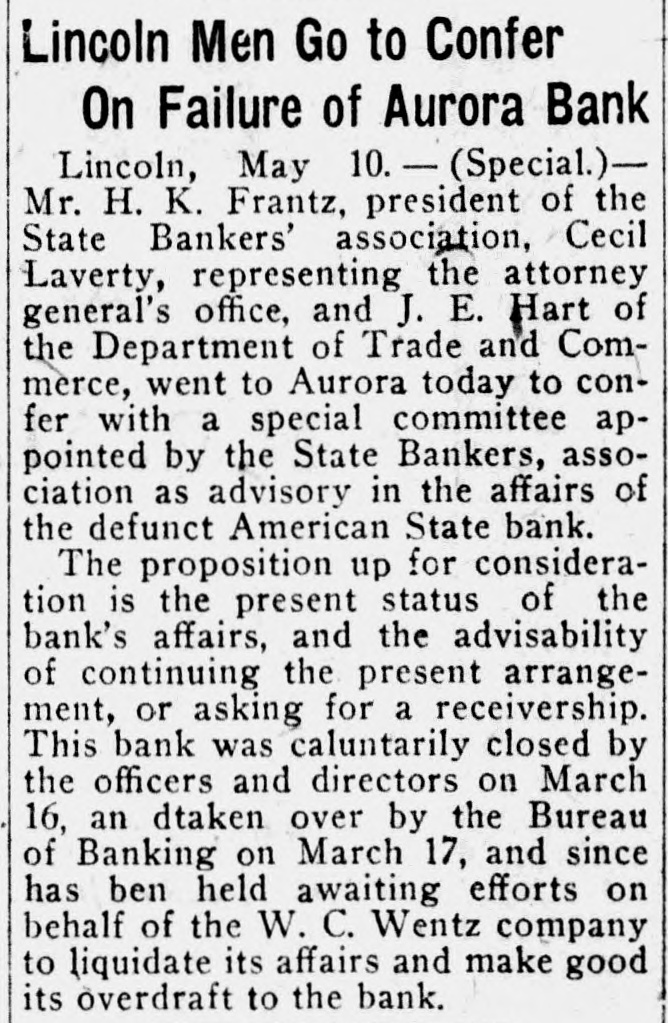
Lincoln Men Go to Confer On Failure of Aurora Bank Lincoln, May 10. - (Special.)Mr. H. K. Frantz, president of the State Bankers' association, Cecil Laverty, representing the attorney general's office, and J. E. Hart of the Department of Trade and Commerce, went to Aurora today to confer with a special committee appointed by the State Bankers, association as advisory in the affairs of the defunct American State bank. The proposition up for consideration is the present status of the bank's affairs, and the advisability of continuing the present arrangement, or asking for a receivership. This bank was caluntarily closed by the officers and directors on March 16, an dtaken over by the Bureau of Banking on March 17, and since has ben held awaiting efforts on behalf of the W. C. Wentz company to liquidate its affairs and make good its overdraft to the bank.


Article from Omaha Daily Bee, March 1, 1921

Click image to open full size in new tab

Article Text

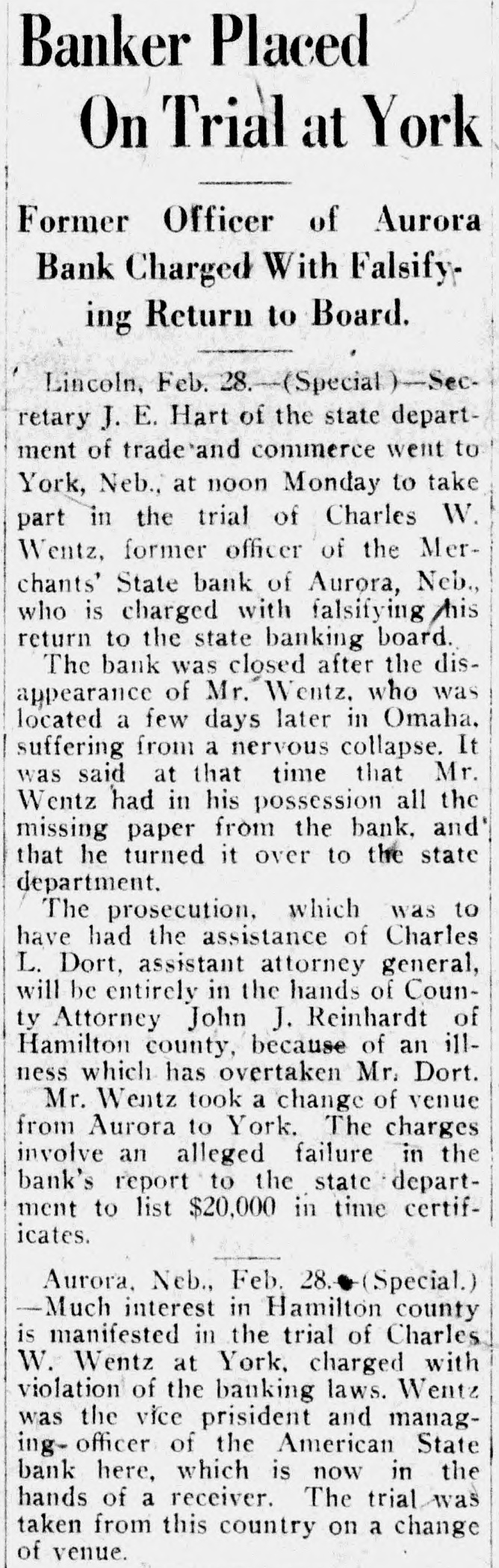
Banker Placed On Trial at York Former Officer of Aurora Bank Charged With Falsify ing Return to Board. Lincoln, Feb. 28. -(Special )-Secretary J. E. Hart of the state department of trade and commerce went to York, Neb., at noon Monday to take part in the trial of Charles W. Wentz, former officer of the Merchants' State bank of Aurora, Neb., who is charged with falsifying this return to the state banking board. The bank was closed after the disappearance of Mr. Wentz, who was located a few days later in Omaha, suffering from a nervous collapse. It was said at that time that Mr. Wentz had in his possession all the missing paper from the bank, and that he turned it over to the state department. The prosecution, which was to have had the assistance of Charles L. Dort, assistant attorney general, will be entirely in the hands of County Attorney John J. Reinhardt of Hamilton county, because of an illness which has overtaken Mr. Dort. Mr. Wentz took a change of venue from Aurora to York. The charges involve an alleged failure in the bank's report to the state department to list $20,000 in time certificates. Aurora, Neb., Feb. 28. (Special.) -Much interest in Hamilton county is manifested in the trial of Charles W. Wentz at York, charged with violation of the banking laws. Wentz was the vice prisident and managing- officer of the American State bank here, which is now in the hands of a receiver. The trial_was taken from this country on a change of venue.


Article from Omaha Daily Bee, March 3, 1921

Click image to open full size in new tab

Article Text

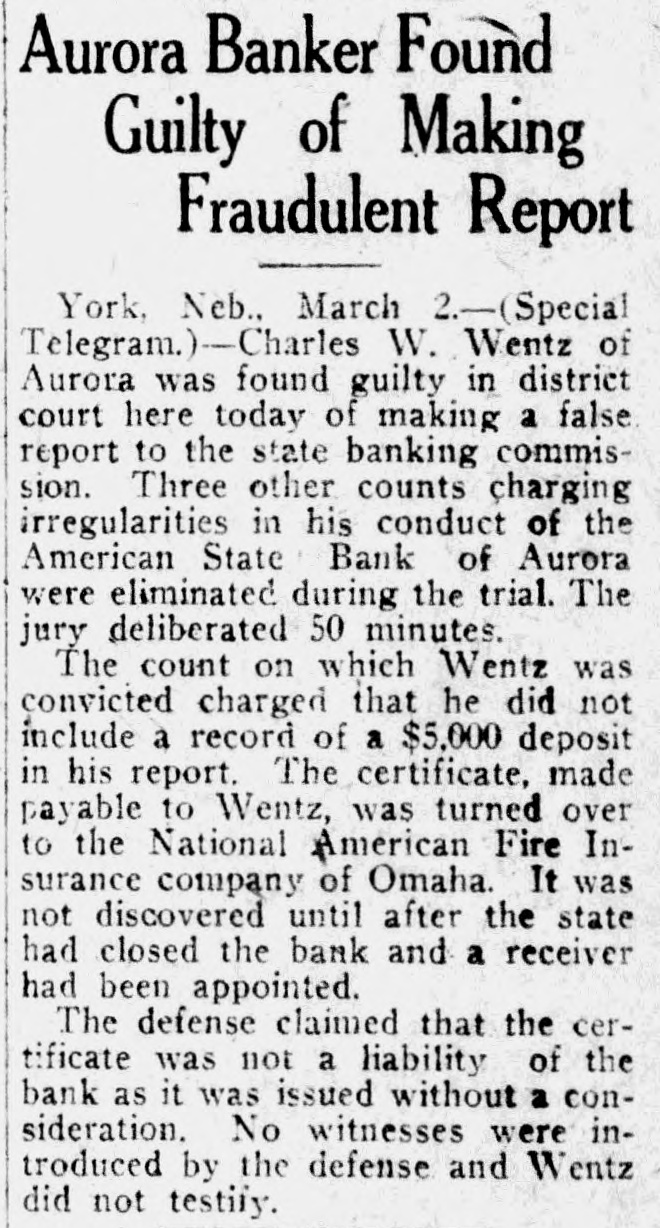
Aurora Banker Found Guilty of Making Fraudulent Report York, Neb., March 2.-(Special Telegram.)-Charles W. Wentz of Aurora was found guilty in district court here today of making a false report to the state banking commission. Three other counts charging irregularities in his conduct of the American State Bank of Aurora were eliminated during the trial. The jury deliberated 50 minutes. The count on which Wentz was convicted charged that he did not include a record of a $5,000 deposit in his report. The certificate, made payable to Wentz, was turned over to the National American Fire Insurance company of Omaha. It was not discovered until after the state had closed the bank and a receiver had been appointed. The defense claimed that the certificate was not a liability of the bank as it was issued without a consideration. No witnesses were introduced by the defense and Wentz did not testify.


Article from Omaha Daily Bee, April 9, 1921

Click image to open full size in new tab

Article Text

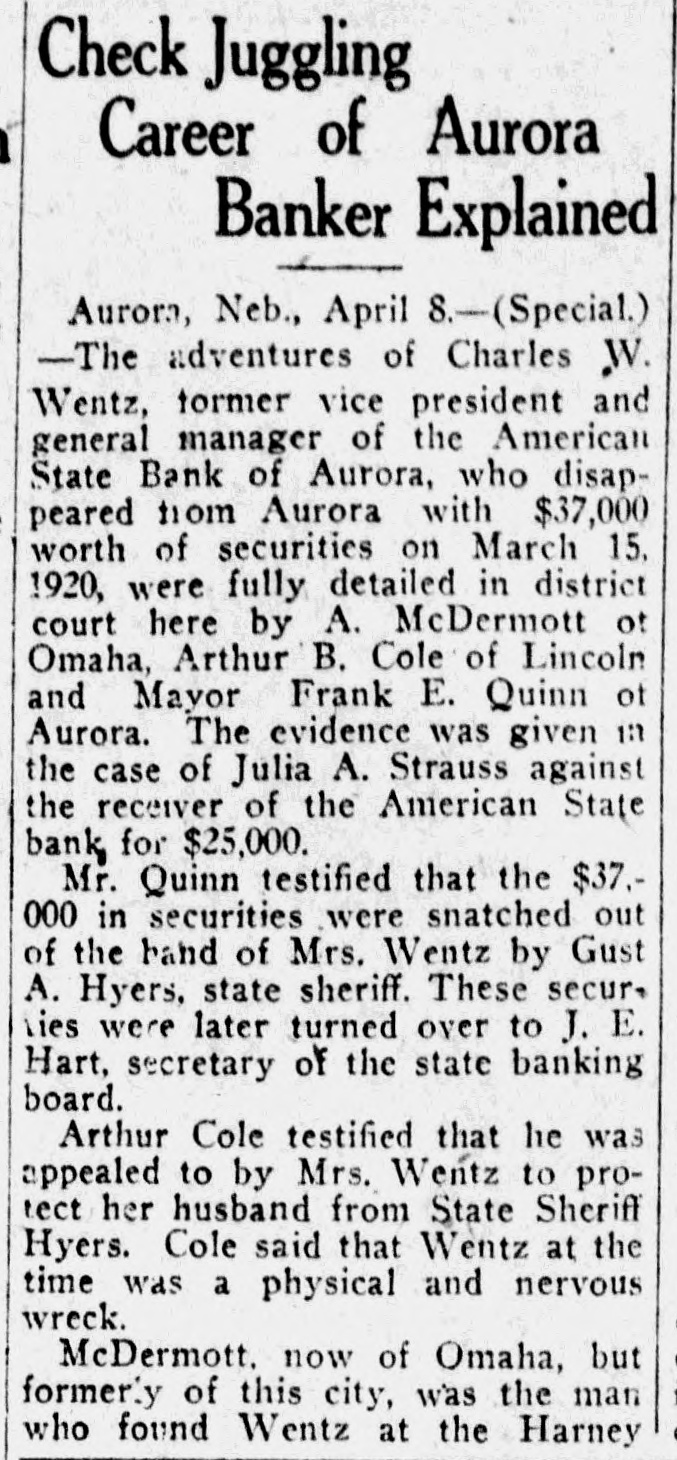
Check Juggling Career of Aurora Banker Explained Aurora, Neb., April 8.-(Special.) -The adventures of Charles W. Wentz, tormer vice president and general manager of the American State Bank of Aurora, who disappeared nom Aurora with $37,000 worth of securities on March 15. 1920, were fully detailed in district court here by A. McDermott ot Omaha, Arthur B. Cole of Lincoln and Mayor Frank E. Quinn ot Aurora. The evidence was given 1:7 the case of Julia A. Strauss against the receiver of the American State bank for $25,000. Mr. Quinn testified that the $37.000 in securities were snatched out of the band of Mrs. Wentz by Gust A. Hyers, state sheriff. These secur, vies were later turned over to J. E. Hart, secretary of the state banking board. Arthur Cole testified that he was appealed to by Mrs. Wentz to protect her husband from State Sheriff Hyers. Cole said that Wentz at the time was a physical and nervous wreck. McDermott. now of Omaha, but formerly of this city, was the man who found Wentz at the Harney


Article from Omaha Daily Bee, April 11, 1922

Click image to open full size in new tab

Article Text

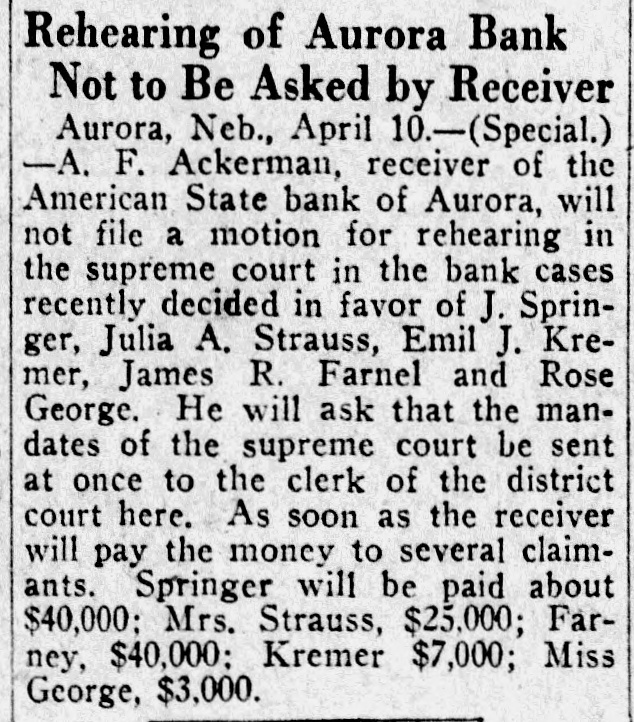
Rehearing of Aurora Bank Not to Be Asked by Receiver Aurora, Neb., April 10.-(Special.) -A. F. Ackerman, receiver of the American State bank of Aurora, will not file a motion for rehearing in the supreme court in the bank cases recently decided in favor of J. Springer, Julia A. Strauss, Emil J. Kremer, James R. Farnel and Rose George. He will ask that the mandates of the supreme court be sent at once to the clerk of the district court here. As soon as the receiver will pay the money to several claimants. Springer will be paid about $40,000; Mrs. Strauss, $25,000; Farney, $40,000; Kremer $7,000; Miss George, $3,000.


Article from Omaha Daily Bee, April 15, 1922

Click image to open full size in new tab

Article Text

Bank Receiver Pays Out $125,000 to 5 Claimants Aurora, Neb., April 14.-(Special.) -A. F. Ackerman, receiver of the American State Bank of Aurora, turned over money and securities aggregating $125,000 to Benjamin W. Springer, James R. Farney, Julia A. Strauss, E. J. Kremer and Rose George, claimants from the Amer-


Article from The Grand Island Independent, April 20, 1923

Click image to open full size in new tab

Article Text

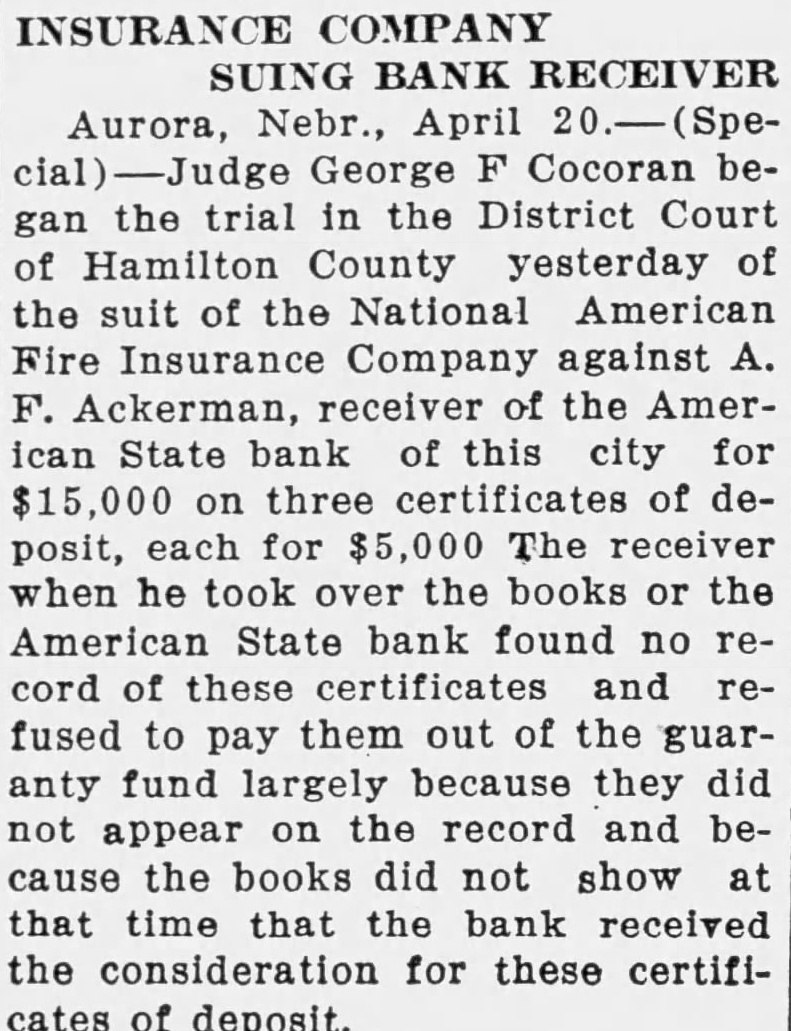
INSURANCE COMPANY SUING BANK RECEIVER Aurora, Nebr., April 20.โ€”(Special)โ€”Judge George F Cocoran began the trial in the District Court of Hamilton County yesterday of the suit of the National American Fire Insurance Company against A. F. Ackerman, receiver of the American State bank of this city for $15,000 on three certificates of deposit, each for $5,000. The receiver when he took over the books of the American State bank found no record of these certificates and refused to pay them out of the guaranty fund largely because they did not appear on the record and because the books did not show at that time that the bank received the consideration for these certificates of deposit.


Article from Norfolk Daily News, April 26, 1923

Click image to open full size in new tab

Article Text

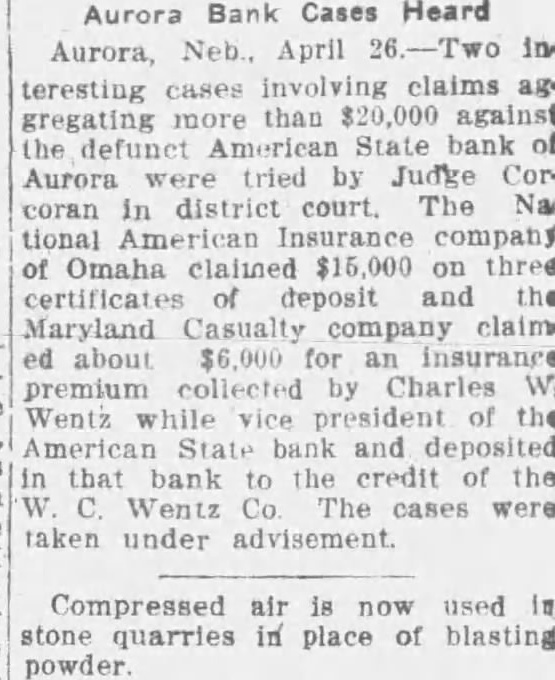
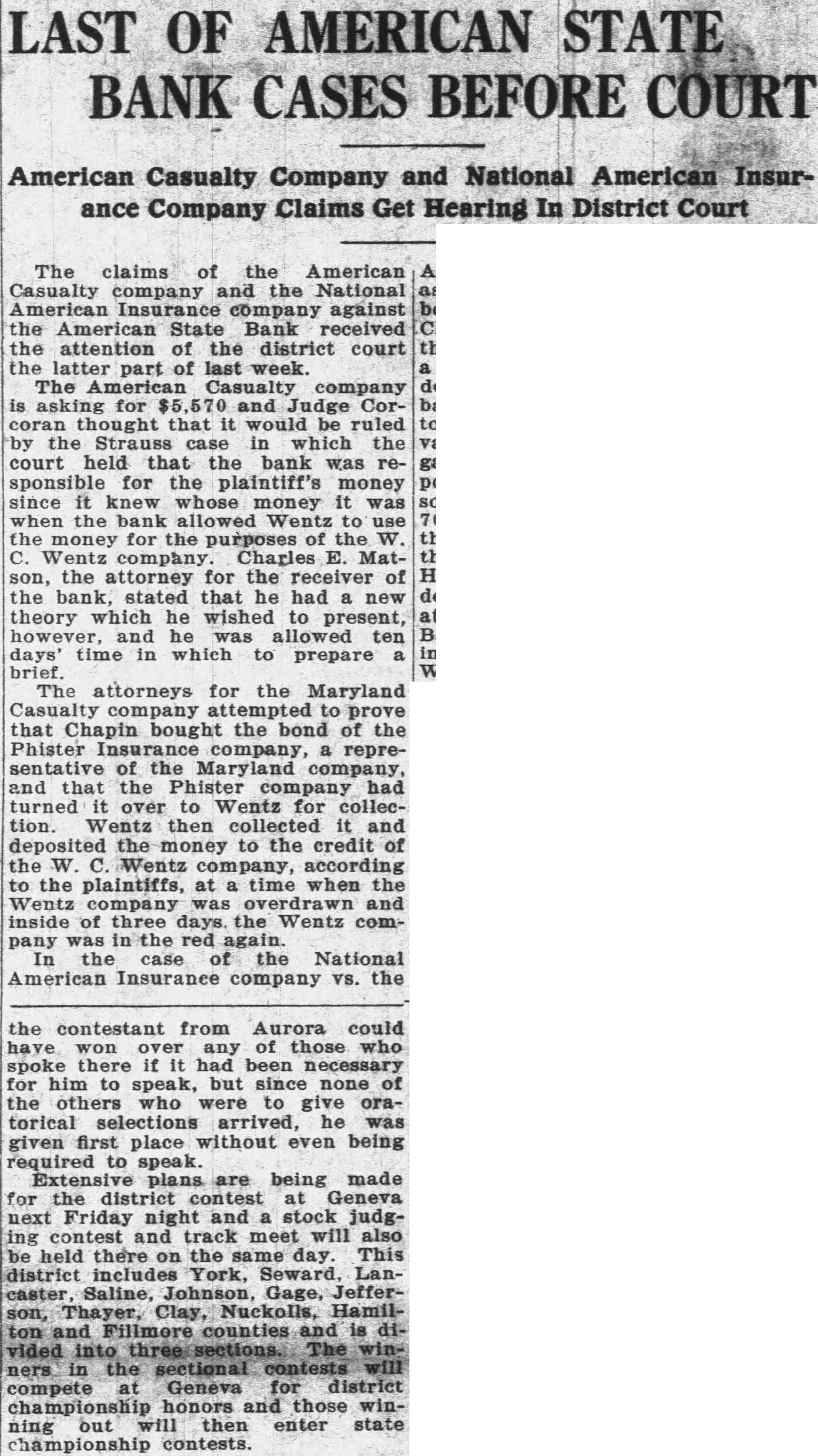
Aurora Bank Cases Heard Aurora, Neb., April 26.โ€”Two interesting cases involving claims aggregating more than $20,000 against the defunct American State bank of Aurora were tried by Judge Corcoran in district court. The National American Insurance company of Omaha claimed $15,000 on three certificates of deposit and the Maryland Casualty company claimed about $6,000 for an insurance premium collected by Charles W. Wentz while vice president of the American State bank and deposited in that bank to the credit of the W. C. Wentz Co. The cases were taken under advisement. Compressed air is now used in stone quarries in place of blasting powder.


Article from The Grand Island Independent, April 30, 1923

Click image to open full size in new tab

Article Text

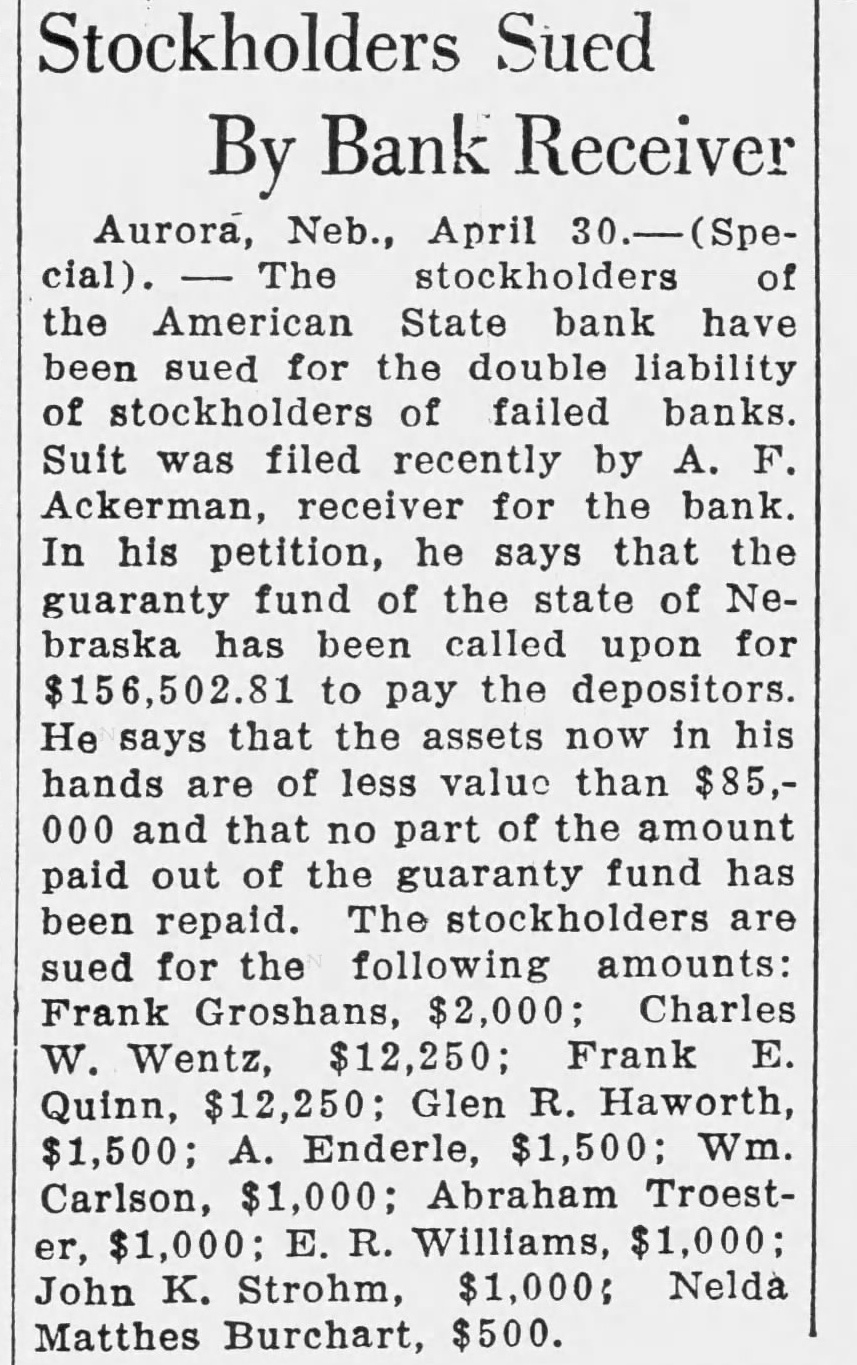
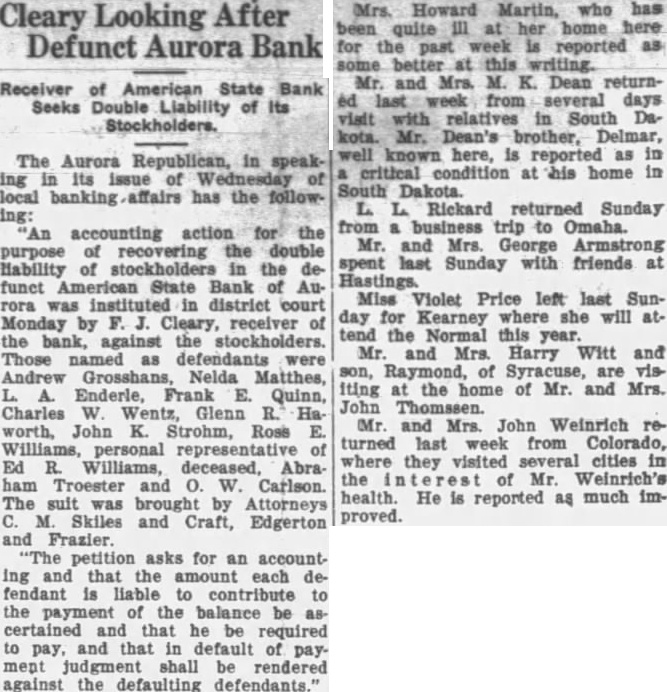
Stockholders Sued By Bank Receiver Aurora, Neb., April 30.โ€”(Special). โ€” The stockholders of the American State bank have been sued for the double liability of stockholders of failed banks. Suit was filed recently by A. F. Ackerman, receiver for the bank. In his petition, he says that the guaranty fund of the state of Nebraska has been called upon for $156,502.81 to pay the depositors. He says that the assets now in his hands are of less value than $85,000 and that no part of the amount paid out of the guaranty fund has been repaid. The stockholders are sued for the following amounts: Frank Groshans, $2,000; Charles W. Wentz, $12,250; Frank E. Quinn, $12,250; Glen R. Haworth, $1,500; A. Enderle, $1,500; Wm. Carlson, $1,000; Abraham Troester, $1,000; E. R. Williams, $1,000; John K. Strohm, $1,000; Nelda Matthes Burchart, $500.


Article Text

BANK RECEIVER NAMES AURORA MEN IN A SUIT AURORA. Suit has been filed in district court by Cleary of Grand Island, receiver of the American State bank, against Frank E. Quinn, Harold R. Quinn, John F. Quinn of Aurora, and Robert J. Quinn of Macomb, III., askIng that mortgage and warranty given by Frank Quinn on his bakery property at Aurora be set aside. The petition alleges the receiver obtained a judgment for $12,250 against Frank E. Quinn as his double liability on bank stock held in the old American State bank, which failed in 1920. It alleged that in 1922 and 1924, pending the settlement of the affairs of the bank, Quinn mortgaged the business property to his brother without consideration and then deeded it to his sons without consideration thereby making the judgment of the receiver ible.


Article Text

BANK RECEIVER NAMES AURORA MEN IN A SUIT AURORA has been filed in district court by Cleary of Grand Island. receiver of the American State bank, against Frank E. Quinn, Harold R. Quinn, John F. Quinn of Aurora, and Robert Quinn of Macomb, III., asking that mortgage and warranty deeds given by Frank E. Quinn on his bakery property at Aurora be set aside. The petition alleges the receiver obtained judgment for $12,250 against Frank E. Quinn as his double liability on bank stock held in the American State bank, which failed in 1920. It is alleged that in 1922 and 1924, pending the settlement of the affairs the bank, Quinn mortgaged the business property to brother without consideration and then deeded it to his sons without consideration, thereby making judgment of the receiver uncollectible.