State Bank (Gering, NE)

Episode Information

Episode UID
76104371465
Episode Type
Suspension β†’ Closure
Bank Type
state
Bank ID
7610437 routing
Routing Number
76-1043
Start Date
January 1, 1922*
Location
Gering, Nebraska (41.826, -103.660)

Metadata

Model
gpt-5-mini (chosen from majority vote of a three-model LLM ensemble)
Short Digest
ca112c3f729d55fa

Response Measures

None

Description

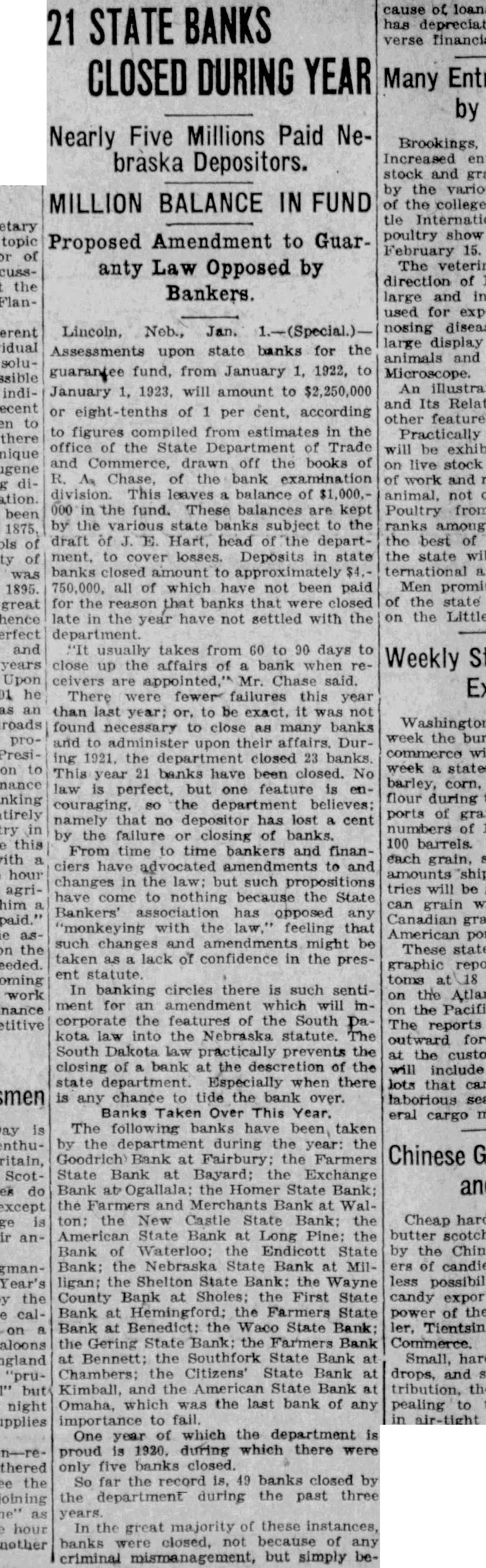
Bank listed among state banks taken by the state department in 1922; receivership and litigation appear in later articles.

Events (4)

1. January 1, 1922* Suspension
Cause
Government Action
Cause Details
Taken over/closed by the Nebraska State Department of Trade and Commerce (state-appointed receivership).
Newspaper Excerpt
the Gering State Bank; ... Banks Taken Over This Year.
Source
newspapers
2. May 14, 1927 Other
Newspaper Excerpt
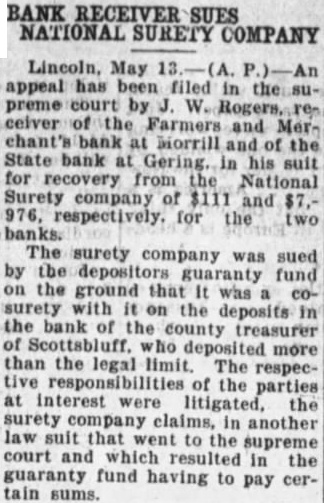
BANK RECEIVER SUES NATIONAL SURETY COMPANY ... receiver ... in his suit for recovery ... for the State bank at Gering.
Source
newspapers
3. May 14, 1927 Receivership
Newspaper Excerpt
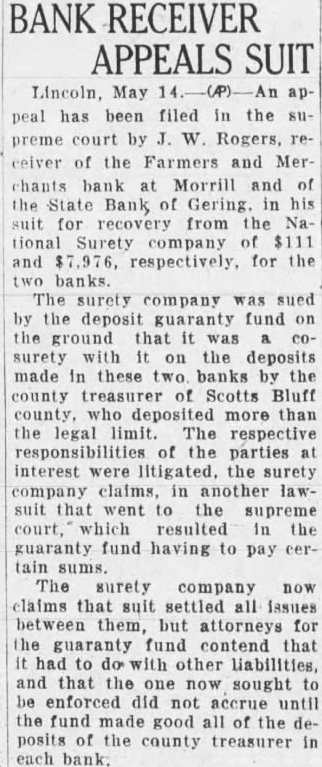
appeal has been filed ... by J. W. Rogers, receiver of ... the State Bank at Gering in his suit for recovery ... from the National Surety company of $7,976, respectively, for the two banks.
Source
newspapers
4. September 23, 1931 Receivership
Newspaper Excerpt
Inasmuch as affairs of the ... Gering State banks are nearly wound up, Mr. Peterson is expected to close the receiverships within a short time.
Source
newspapers

Newspaper Articles (4)

Article from Daily Drovers Journal-Stockman, January 1, 1923

Click image to open full size in new tab

Article Text

21 STATE BANKS CLOSED DURING YEAR Nearly Five Millions Paid Nebraska Depositors. MILLION BALANCE IN FUND Proposed Amendment to Guaranty Law Opposed by Bankers. Lincoln, Neb., Jan. 1.β€”(Special.)β€”Assessments upon state banks for the guarantee fund, from January 1, 1922, to January 1, 1923, will amount to $2,250,000 or eight-tenths of 1 per cent, according to figures compiled from estimates in the office of the State Department of Trade and Commerce, drawn off the books of R. A. Chase, of the bank examination division. This leaves a balance of $1,000,000 in the fund. These balances are kept by the various state banks subject to the draft of J. E. Hart, head of the department, to cover losses. Deposits in state banks closed amount to approximately $4,750,000, all of which have not been paid for the reason that banks that were closed late in the year have not settled with the department. "It usually takes from 60 to 90 days to close up the affairs of a bank when receivers are appointed," Mr. Chase said. There were fewer failures this year than last year; or, to be exact, it was not found necessary to close as many banks and to administer upon their affairs. During 1921, the department closed 23 banks. This year 21 banks have been closed. No law is perfect, but one feature is encouraging, so the department believes; namely that no depositor has lost a cent by the failure or closing of banks. From time to time bankers and financiers have advocated amendments to and changes in the law; but such propositions have come to nothing because the State Bankers' association has opposed any "monkeying with the law," feeling that such changes and amendments might be taken as a lack of confidence in the present statute. In banking circles there is such sentiment for an amendment which will incorporate the features of the South Dakota law into the Nebraska statute. The South Dakota law practically prevents the closing of a bank at the discretion of the state department. Especially when there is any chance to tide the bank over. Banks Taken Over This Year. The following banks have been taken by the department during the year: the Goodrich Bank at Fairbury; the Farmers State Bank at Bayard; the Exchange Bank at Ogallala; the Homer State Bank; the Farmers and Merchants Bank at Walton; the New Castle State Bank; the American State Bank at Long Pine; the Bank of Waterloo; the Endicott State Bank; the Nebraska State Bank at Milligan; the Shelton State Bank; the Wayne County Bank at Sholes; the First State Bank at Hemingford; the Farmers State Bank at Benedict; the Waco State Bank; the Gering State Bank; the Farmers Bank at Bennett; the Southfork State Bank at Chambers; the Citizens' State Bank at Kimball, and the American State Bank at Omaha, which was the last bank of any importance to fail. One year of which the department is proud is 1920, during which there were only five banks closed. So far the record is, 49 banks closed by the department during the past three years. In the great majority of these instances, banks were closed, not because of any criminal mismanagement, but simply be-
Article from Beatrice Daily Sun, May 14, 1927

Click image to open full size in new tab

Article Text

BANK RECEIVER SUES NATIONAL SURETY COMPANY Lincoln, May appeal has been filed in the supreme court by J. W. Rogers, receiver of the Farmers and Merchant's bank at Morrill and of the State bank at Gering. in his suit for recovery from the National Surety company of $111 and $7.976, respectively. for the two banks. The surety company was sued by the depositors guaranty fund on the ground that It was a cosurety with it on the deposits in the bank of the county treasurer of Scottsbluff. who deposited more than the legal limit. The respective responsibilities of the parties at interest were litigated, the surety company claims, in another law suit that went to the supreme court and which resulted in the guaranty fund having to pay certain sums.


Article from The Omaha Morning Bee, The Omaha Daily News, May 14, 1927

Click image to open full size in new tab

Article Text

BANK RECEIVER APPEALS SUIT Lincoln, May appeal has been filed in the supreme court by J. W. Rogers, receiver of the Farmers and Merchants bank at Morrill and of the State Bank, of Gering in his suit for recovery from the National Surety company of $111 and $7,976, respectively, for the two banks. The surety company was sued by the deposit guaranty fund on the ground that it was cosurety with it on the deposits made in these two banks by the county treasurer of Scotts Bluff county, who deposited more than the legal limit. The respective responsibilities of the parties at interest were litigated. the surety company claims, in another lawsuit that went to the supreme court, which resulted in the guaranty fund having to pay certain sums. The surety company now claims that suit settled all issues between them, but attorneys for the guaranty fund contend that it had to do with other liabilities, and that the one now sought to be enforced did not accrue until the fund made good all of the deposits of the county treasurer in each bank


Article Text

Bank Receiverships Are Denied Luikhart Denying application of E. H. Luikhart, secretary of the state department of trade and commerce, District Judge Carter Thursday assigned a number of independent bank receiverships in western Nebraska to A. E. Torgeson of Scottsbluff. Judge Carter recently announced in other receivership actions that he would not appoint Luikhart in place of Clarence G. Bliss, former secretary, or other receivers, until he had assurance that Governor Bryan would not interfere. The independent receivership transfers were made after H. C. Peterson of Lodgepole, resigned. The Bridgeport, Angora and Broadwater banks were then placed under Torgeson's jurisdiction. Peterson will file final reports at once on the American State bank of Scottsbluff and the Security State bank of McGrew, and will resign from their receiverships it was stated. Togerson is expected to also be assigned these banks. Inasmuch as affairs of the Oshkosh State, Minatare and Gering State banks are nearly wound up, Mr. Peterson is expected to close the receiverships within a short time. SIDNEY.β€”H. C. Peterson of Lodgepole, receiver of a number of failed banks in western Nebraska, has resigned as receiver of the Bridgeport, Angora State and Broadwater State banks. District Judge Carter appointed A. E. Torgeson to succeed Peterson. Applications for the appointment of E. H. Luikhart, secretary of the state commerce department, as receiver were on file with Judge Carter but he said he would not make the appointment until Luikhart had agreed to work under the direction of the court.