Waco State Bank (Waco, NE)

Episode Information

Episode UID
76105771473
Episode Type
Suspension β†’ Closure
Bank Type
state
Bank ID
7610577 routing
Routing Number
76-1057
Start Date
September 16, 1922
Location
Waco, Nebraska (40.897, -97.463)

Metadata

Model
gpt-5-mini (chosen from majority vote of a three-model LLM ensemble)
Short Digest
402224f1dd719b92

Response Measures

None

Description

Closure followed discovery/admision of forgery by the cashier; bank taken by state department.

Events (2)

1. September 16, 1922 Suspension
Cause
Government Action
Cause Details
State banking board closed the bank after cashier L. E. Cooper admitted forging notes and criminal charges were filed.
Newspaper Excerpt
The bank was closed Saturday by the state banking board.
Source
newspapers
2. September 21, 1922 Receivership
Newspaper Excerpt
The Waco State Bank ... was taken by the department during the year.
Source
newspapers

Newspaper Articles (2)

Article from The Madison Daily Leader, September 21, 1922

Click image to open full size in new tab

Article Text

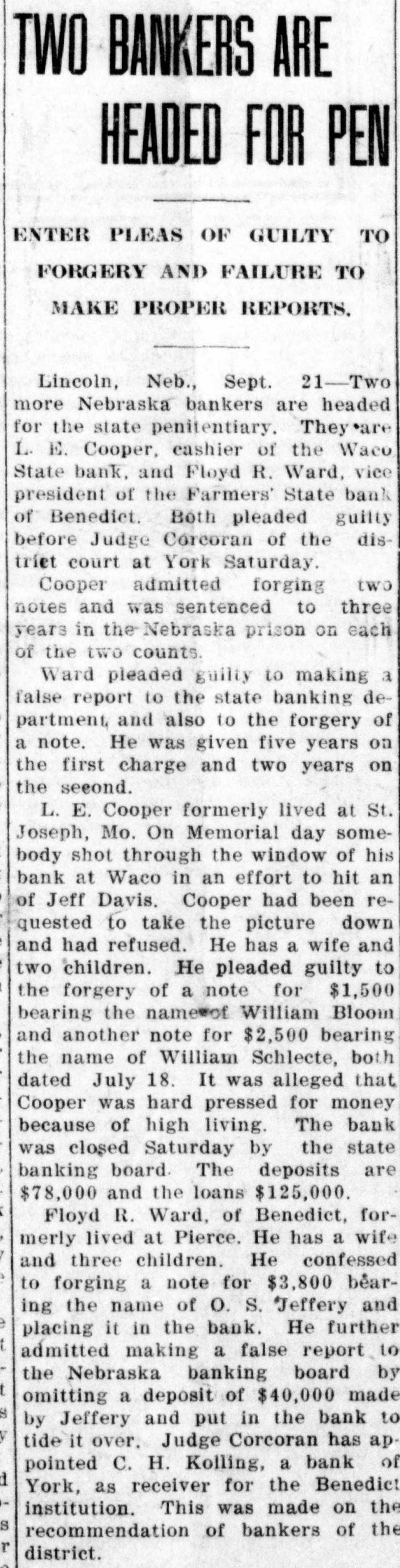
TWO BANKERS ARE HEADED FOR PEN ENTER PLEAS OF GUILTY TO FORGERY AND FAILURE TO MAKE PROPER REPORTS. Lincoln, Neb., Sept. 21-Two more Nebraska bankers are headed for the state penitentiary. They'are L. E. Cooper, cashier of the Waco State bank, and Floyd R. Ward, vice president of the Farmers' State bank of Benedict. Both pleaded guilty before Judge Corcoran of the distriet court at York Saturday. Cooper admitted forging two notes and was sentenced to three years in the Nebraska prison on each of the two counts. Ward pleaded guilty to making a false report to the state banking department and also to the forgery of a note. He was given five years on the first charge and two years on the second. L. E. Cooper formerly lived at St. Joseph, Mo. On Memorial day somebody shot through the window of his bank at Waco in an effort to hit an of Jeff Davis. Cooper had been requested to take the picture down and had refused. He has a wife and two children. He pleaded guilty to the forgery of a note for $1,500 bearing the namewof William Bloom and another note for $2,500 bearing the name of William Schlecte, both dated July 18. It was alleged that Cooper was hard pressed for money because of high living. The bank was closed Saturday by the state n banking board. The deposits are : $78,000 and the loans $125,000. : Floyd R. Ward, of Benedict, for, merly lived at Pierce. He has a wife / and three children. He confessed n to forging a note for $3,800 bΓ©aring the name of O. S. Jeffery and e placing it in the bank. He further t admitted making a false report to the Nebraska banking board by t omitting a deposit of $40,000 made 8 by Jeffery and put in the bank to y tide it over. Judge Corcoran has ap. pointed C. H. Kolling, a bank of d York, as receiver for the Benedict institution. This was made on the S recommendation of bankers of the r district.

Article from Daily Drovers Journal-Stockman, January 1, 1923

Click image to open full size in new tab

Article Text

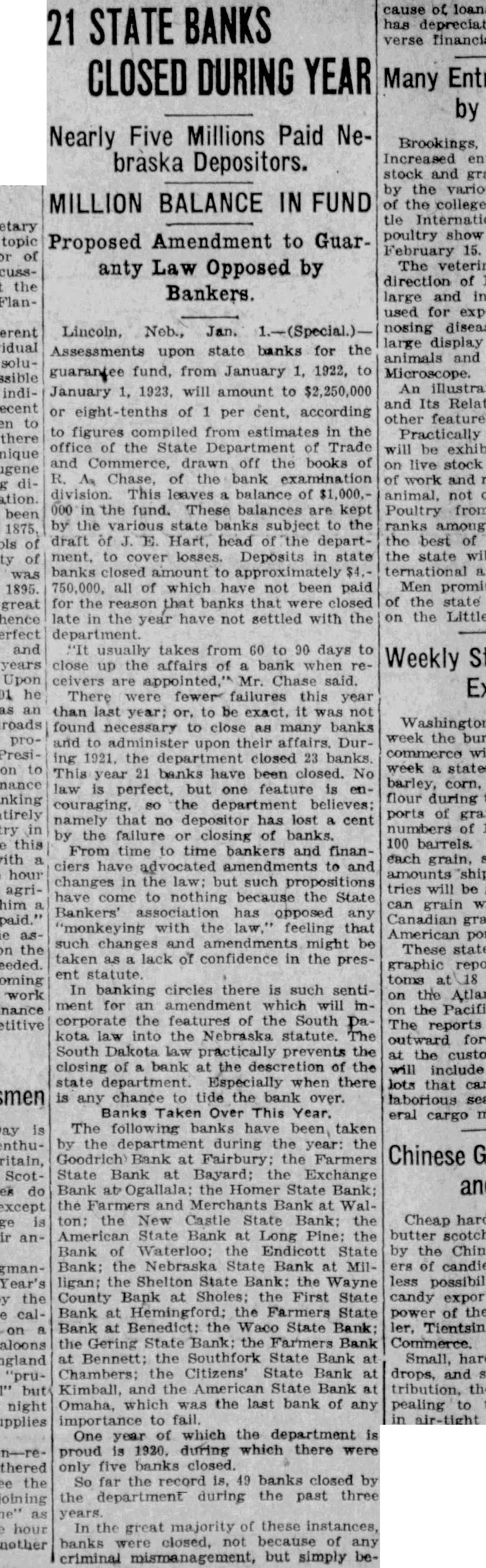
21 STATE BANKS CLOSED DURING YEAR Nearly Five Millions Paid Nebraska Depositors. MILLION BALANCE IN FUND Proposed Amendment to Guaranty Law Opposed by Bankers. Lincoln, Neb., Jan. 1.β€”(Special.)β€”Assessments upon state banks for the guarantee fund, from January 1, 1922, to January 1, 1923, will amount to $2,250,000 or eight-tenths of 1 per cent, according to figures compiled from estimates in the office of the State Department of Trade and Commerce, drawn off the books of R. A. Chase, of the bank examination division. This leaves a balance of $1,000,000 in the fund. These balances are kept by the various state banks subject to the draft of J. E. Hart, head of the department, to cover losses. Deposits in state banks closed amount to approximately $4,750,000, all of which have not been paid for the reason that banks that were closed late in the year have not settled with the department. "It usually takes from 60 to 90 days to close up the affairs of a bank when receivers are appointed," Mr. Chase said. There were fewer failures this year than last year; or, to be exact, it was not found necessary to close as many banks and to administer upon their affairs. During 1921, the department closed 23 banks. This year 21 banks have been closed. No law is perfect, but one feature is encouraging, so the department believes; namely that no depositor has lost a cent by the failure or closing of banks. From time to time bankers and financiers have advocated amendments to and changes in the law; but such propositions have come to nothing because the State Bankers' association has opposed any "monkeying with the law," feeling that such changes and amendments might be taken as a lack of confidence in the present statute. In banking circles there is such sentiment for an amendment which will incorporate the features of the South Dakota law into the Nebraska statute. The South Dakota law practically prevents the closing of a bank at the discretion of the state department. Especially when there is any chance to tide the bank over. Banks Taken Over This Year. The following banks have been taken by the department during the year: the Goodrich Bank at Fairbury; the Farmers State Bank at Bayard; the Exchange Bank at Ogallala; the Homer State Bank; the Farmers and Merchants Bank at Walton; the New Castle State Bank; the American State Bank at Long Pine; the Bank of Waterloo; the Endicott State Bank; the Nebraska State Bank at Milligan; the Shelton State Bank; the Wayne County Bank at Sholes; the First State Bank at Hemingford; the Farmers State Bank at Benedict; the Waco State Bank; the Gering State Bank; the Farmers Bank at Bennett; the Southfork State Bank at Chambers; the Citizens' State Bank at Kimball, and the American State Bank at Omaha, which was the last bank of any importance to fail. One year of which the department is proud is 1920, during which there were only five banks closed. So far the record is, 49 banks closed by the department during the past three years. In the great majority of these instances, banks were closed, not because of any criminal mismanagement, but simply be-