Nebraska State Bank (Milligan, NE)

Episode Information

Episode UID
76110071471
Episode Type
Suspension β†’ Closure
Bank Type
state
Bank ID
7611007 routing
Routing Number
76-1100
Start Date
July 1, 1922*
Location
Milligan, Nebraska (40.500, -97.388)

Metadata

Model
gpt-5-mini (chosen from majority vote of a three-model LLM ensemble)
Short Digest
b9316afa08b2bc38

Response Measures

None

Description

Bank was taken over by state department and placed in receivership; later assets sold and depositors paid from guaranty fund.

Events (4)

1. July 1, 1922* Receivership
Newspaper Excerpt
After B. A. Lynn of Geneva was named receiver, Jay M. Riley of Lincoln, state bank examiner, and E.C. Sharp who has had charge of the bank since June 19, made a report of the condition of the failed bank.
Source
newspapers
2. July 5, 1922 Suspension
Cause
Government Action
Cause Details
Closed/taken over by state bank officials/Department of Trade and Commerce due to a large shortage, alleged frauds and insolvency
Newspaper Excerpt
The shortage of the Nebraska State bank of Milligan, which was closed by state bank officials Wednesday, totals $50,000
Source
newspapers
3. April 13, 1923 Other
Newspaper Excerpt
I, Bert A. Lynn, being the duly appointed, qualified, and acting Receiver for the Nebraska State Bank of Milligan, Nebraska, by virtue of an order of the Honorable Ralph D. Brown, Judge ... made on the 13th day of April, 1923, will sell ... the following described property, to-wit.
Source
newspapers
4. February 16, 1924 Other
Newspaper Excerpt
Nebraska State bank, Milligan, full payment to depositors, $80,184.
Source
newspapers

Newspaper Articles (11)

Article from The Omaha Morning Bee, July 10, 1922

Click image to open full size in new tab

Article Text

Milligan Bank Shortage Will Reach $50,000 Grain Company With Offices of Bank as Shareholders Appears to Owe Bank $15,000 to $18,000. Geneva, Neb., July 9.--(Special Telegram.)-The shortage of the Nebraska State bank of Milligan, which was closed by state bank officials Wednesday, totals $50,000, it was estimated at a meeting of creditors Friday nights After B. A. Lynn of Geneva was named receiver, Jay M. Riley of Lincoln, state bank examiner, and E.C. Sharp who has had charge of the bank since June 19. made a report of the condition of the failed bank. The examiner was still in doubt as to the amount of the bogus certificates of deposit issued. Many of them were torn from the back of the book, he said. Discrepencies in the deposits total $10,000, of which $7.500 is said to be admitted by the men under arrest. Seek Missing Record. Riley stated that four months ago he examined the Milligan bank and found that there was no record of its standing with its correspondent. the Merchants National bank of Omaha. Riley then wrote the Omaha bank for figures and left town. The letter from the Omaha bank was sent to Riley in care of the Milligan bank. One of the figures in this statement had been changed, when he opened the letter a few days later, he said. Other alleged frauds included the misappropriation of $7,000 and a draft with an endorsement, believed to have been forged. Sight drafts on commission firms, for which it is believed no grain was shipped, were also disclosed. Liberty bonds are said to have disappeared from the deposit vaults of the bank and taxes paid to be forwarded to the county treasurer were never remitted. according to bank records. Grain Company Involved. The Milligan Graini, company appears to be indebted to the bank from $15.000 to $18,000. Besides Emil J. Kotas, former head of the Milligan bank, the other owners of the elevator are Herman Statsny, twice arrested for selling intoxicating . liquors, and James Keedjl, Adolph Kotas, cashier and brother of Emil J. Kotas, A committee of three was appointed to advise with the receiver and act in the interest of the community. This is made up of Len J. Davis, cashier of the Citizens State Bank of Geneva, S. F. Funemaker of Tobias and W. J. Matske of Shickley. The Nebraska State Bankers association interests will be represented by a committee composed of C. H. Brinkman of Ohiowa. L. P. Sorenson of Sutton and C. E. Bowdev of Friend. Fifty bankers were in attendance from this and adjacent counties. Frank M. Sloan of Geneva was chosen chairman and Leroy Stines of Fairmont, secretary.

Article from Daily Drovers Journal-Stockman, January 1, 1923

Click image to open full size in new tab

Article Text

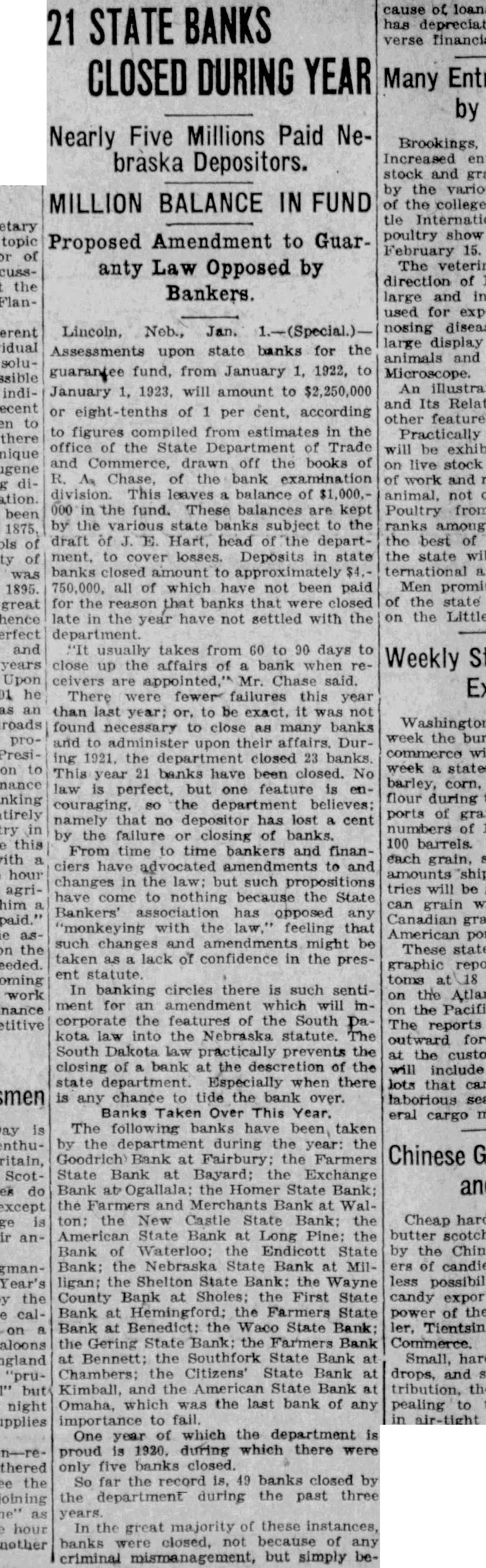
21 STATE BANKS CLOSED DURING YEAR Nearly Five Millions Paid Nebraska Depositors. MILLION BALANCE IN FUND Proposed Amendment to Guaranty Law Opposed by Bankers. Lincoln, Neb., Jan. 1.β€”(Special.)β€”Assessments upon state banks for the guarantee fund, from January 1, 1922, to January 1, 1923, will amount to $2,250,000 or eight-tenths of 1 per cent, according to figures compiled from estimates in the office of the State Department of Trade and Commerce, drawn off the books of R. A. Chase, of the bank examination division. This leaves a balance of $1,000,000 in the fund. These balances are kept by the various state banks subject to the draft of J. E. Hart, head of the department, to cover losses. Deposits in state banks closed amount to approximately $4,750,000, all of which have not been paid for the reason that banks that were closed late in the year have not settled with the department. "It usually takes from 60 to 90 days to close up the affairs of a bank when receivers are appointed," Mr. Chase said. There were fewer failures this year than last year; or, to be exact, it was not found necessary to close as many banks and to administer upon their affairs. During 1921, the department closed 23 banks. This year 21 banks have been closed. No law is perfect, but one feature is encouraging, so the department believes; namely that no depositor has lost a cent by the failure or closing of banks. From time to time bankers and financiers have advocated amendments to and changes in the law; but such propositions have come to nothing because the State Bankers' association has opposed any "monkeying with the law," feeling that such changes and amendments might be taken as a lack of confidence in the present statute. In banking circles there is such sentiment for an amendment which will incorporate the features of the South Dakota law into the Nebraska statute. The South Dakota law practically prevents the closing of a bank at the discretion of the state department. Especially when there is any chance to tide the bank over. Banks Taken Over This Year. The following banks have been taken by the department during the year: the Goodrich Bank at Fairbury; the Farmers State Bank at Bayard; the Exchange Bank at Ogallala; the Homer State Bank; the Farmers and Merchants Bank at Walton; the New Castle State Bank; the American State Bank at Long Pine; the Bank of Waterloo; the Endicott State Bank; the Nebraska State Bank at Milligan; the Shelton State Bank; the Wayne County Bank at Sholes; the First State Bank at Hemingford; the Farmers State Bank at Benedict; the Waco State Bank; the Gering State Bank; the Farmers Bank at Bennett; the Southfork State Bank at Chambers; the Citizens' State Bank at Kimball, and the American State Bank at Omaha, which was the last bank of any importance to fail. One year of which the department is proud is 1920, during which there were only five banks closed. So far the record is, 49 banks closed by the department during the past three years. In the great majority of these instances, banks were closed, not because of any criminal mismanagement, but simply be-


Article from Omaha World-Herald, January 25, 1923

Click image to open full size in new tab

Article Text

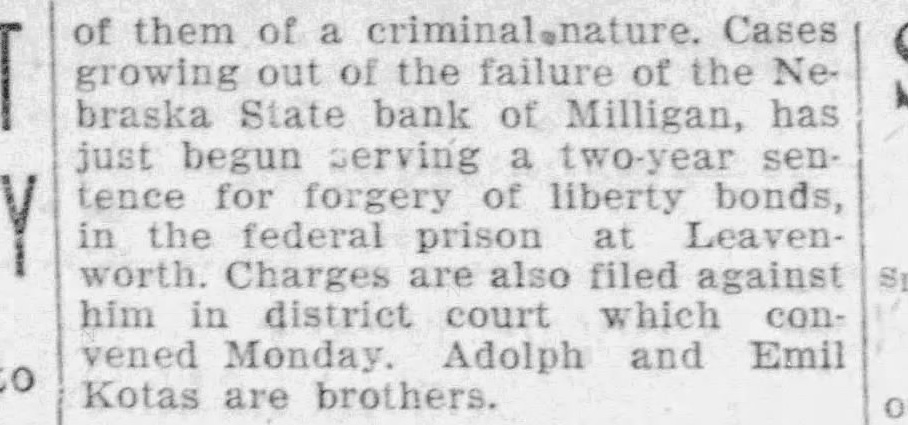
of them of a criminal nature. Cases growing out of the failure of the Nebraska State bank of Milligan, has just begun serving a two-year sentence for forgery of liberty bonds, in the federal prison at Leavenworth. Charges are also filed against him in district court which convened Monday. Adolph and Emil Kotas are brothers.


Article from Nebraska Signal, February 22, 1923

Click image to open full size in new tab

Article Text

DISTRICT COURT. Term Lasting Four Weeks Ended Saturday Noon With Many Cases Still on the Docket. Judge Brown adjourned district court Saturday forenoon after a four weeks' session. Three weeks of the time were taken up with jury cases. A good many cases were disposed of but a large number still remain on the docket. All of the grain cases from the Milligan vicinity are yet to be heard and a number of the cases brought by the receiver of the failed Nebraska State bank of Milligan are yet to come to trial. The suit of Adolph Uldrich of Milligan on his claim for $6,500 against the failed Nebraska State bank of Milligan, which was being tried when The Signal went to press last Thursday morning, was finished at 10:50 a. m. At 3:45 p. m. the jury asked permission to come back to the courtroom to make inquiries regarding the evidence. The court gave permission. The jury desired to know particularly about the deposition of Adolph Kotas in which Mr. Kotas stated that he told Mr. Uldrich that the state guaranty fund would be liable for his $6,500, which he had given the bank, in case the bank failed. The jury returned to the jury room at 4:25 and immediately returned with a verdict allowing Mr. Uldrich's claim in full. The bank's receiver claimed that the $6,500 had been turned over to Adolph and E. J. Kotas and had not been deposited by them in the bank. The following composed the jury in this case: R. F. Dwyer, James Bumgarner, Wilmer Brown, Fred H. Camp, Clark Yates, Henry Eppler, Fred Matthies Sr., A. C. Fogle, R. H. Lovegrove, Henry Helderstadt, C. M. Hourigan and Henry Fisher. Counsel for the receiver of the Nebraska State bank of Milligan filed a motion for a new trial in the case of the bank against James Bors on a $3,000 note. The motion was argued and was taken under advisement by the court until the next term. Mr. Bors claimed that he had signed an accommodation note and the case was decided in his favor. The foreclosure case of B. A. Lynn, receiver, against Fred and Lucile Hodek was heard by the court last Thursday afternoon. The defendants alleged that the mortgage securing a $4,000 note had not been acknowledged by them. The court found that Fred Hodek had executed and delivered to E. J. Kotas the $4,000 note set forth in the petition and that the note with $758.30 interest was due. The court further decided that the mortgage had been executed by Mr. Hodek but that the said mortgage was fraudulently dated prior to defendant's marriage and that the defendant was married on the date of execution of the mortgage and the real estate described therein was at that time the homestead of the defendant and his wife. The mortgage was therefore declared void. The note and the mortgage had been assigned to E. J. Kotas so that the bank was not an innocent holder. Judgment was given the bank on the note but the mortgage was held void. In the foreclosure suit of B. A. Lynn, receiver, against Emma C. Hodek, et al, the defendants offered no testimony. Judgment was given the plaintiff for $3,000 on note and mortgage and the sheriff was ordered to sell the real estate unless the judgment is paid within twenty days. In the foreclosure suit of B. A. Lynn, receiver, against Tena Hodek, et al, the plaintiff was given a judgment on a note and mortgage for $3,000 and a sheriff's sale was ordered unless the judgment is paid within twenty days.


Article from Nebraska Signal, April 19, 1923

Click image to open full size in new tab

Article Text

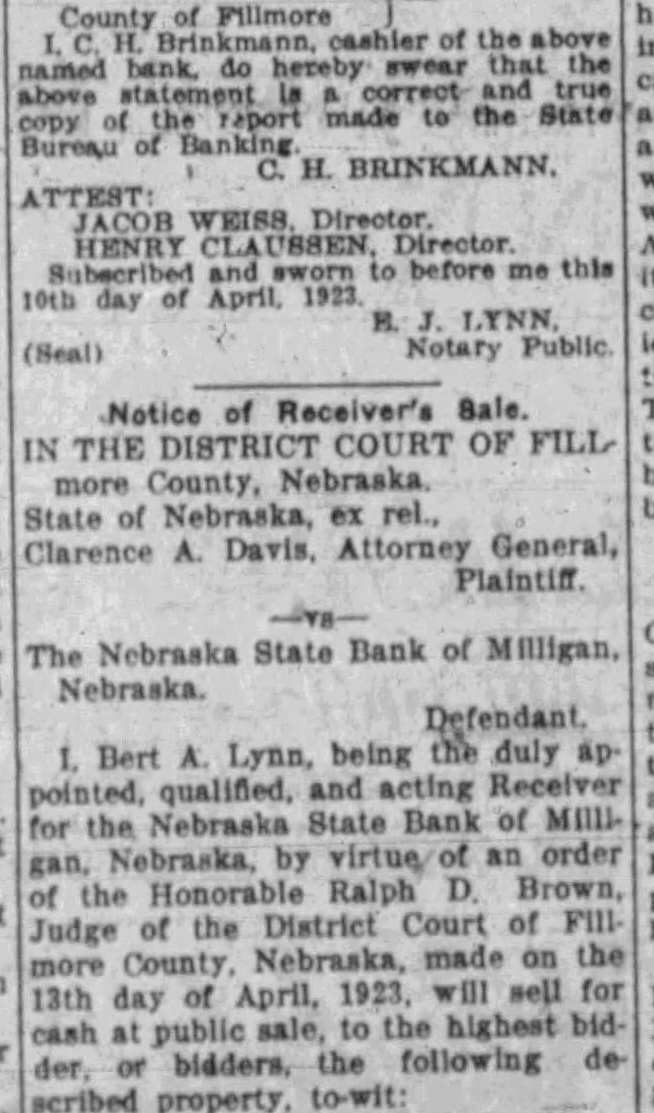
County of Fillmore I, C. H. Brinkmann, cashier of the above named bank, do hereby swear that the above statement is a correct and true copy of the report made to the State Bureau of Banking. C. H. BRINKMANN. ATTEST: JACOB WEISS, Director. HENRY CLAUSSEN, Director. Subscribed and sworn to before me this 10th day of April, 1923. H. J. LYNN, Notary Public. (Seal) Notice of Receiver's Sale. IN THE DISTRICT COURT OF Fillmore County, Nebraska. State of Nebraska, ex rel., Clarence A. Davis, Attorney General, Plaintiff. β€”vsβ€” The Nebraska State Bank of Milligan, Nebraska. Defendant. I, Bert A. Lynn, being the duly appointed, qualified, and acting Receiver for the Nebraska State Bank of Milligan, Nebraska, by virtue of an order of the Honorable Ralph D. Brown, Judge of the District Court of Fillmore County, Nebraska, made on the 13th day of April, 1923, will sell for cash at public sale, to the highest bidder, or bidders, the following described property, to-wit:


Article from Lincoln Journal Star, November 9, 1923

Click image to open full size in new tab

Article Text

NO INTEREST ON DEPOSITS BANK RECEIVER RAISES NEW ISSUE IN HIGH COURT. Claims That Guaranty Fund Cannot Be Drawn on to Protect Investment Where Time Deposit Is Held. An entirely new question of law was argued and submitted to the supreme court Friday by C. H. Sloan, attorney for the receiver for the failed Nebraska State bank of Milligan. It is whether the deposit guaranty fund maintained by assessment upon the sound banks is liable for interest on time certificates of deposit. Mr. Sloan said that the statute is silent upon the proposition, while the decisions of other courts, being upon laws differently worded, are of no direct application. On the 16th of June, 1922, Katie Vavra deposited $3,200 in the Milligan bank and received a certificate of deposit for six months bearing 5 per cent interest. Three weeks later the bank was taken over by the department of trade and commerce. The lower court held that the fund was liable for all unpaid interest. The case is regarded by the bankers as important, as it adds materially to the liability of the guaranty fund, since a considerable proportion of the failed banks are small ones, which carry the largest percentage of time deposits. The defense is that the deposit guaranty fund is organized on the mutual dollar basis insofar as the repayment of deposits is concerned. It does not promise to repay other than the dollar that was deposited, and it is not obligated to protect the profit of the investing depositor. To so hold, it was argued, would be to favor the time depositor as against the one with an open checking account, and is no more of an obligation of the fund than the payment of back salaries for the bank officers. It is admitted that it would be a proper charge against the general assets of the bank. Mr. Sloan said the object of the law is good, however weak and unsound it may be economically, and to make the banks pay this interest would be inserting lead in the millstone that hangs about the necks of the sound banks under this system. It would be equivalent to a fire insurance company charging a higher rate on fireproof buildings than on tinder-roofed dwellings, or a life insurance making a sound 21-year-old man pay more than an octogenarian or a consumptive.


Article from Lincoln Journal Star, November 9, 1923

Click image to open full size in new tab

Article Text

NO INTEREST ON DEPOSITS BANK RECEIVER RAISES NEW ISSUE IN HIGH COURT. Claims That Guaranty Fund Cannot Be Drawn on to Protect Investment Where Time Deposit Is Held. An entirely new question of law was argued and submitted to the supreme court Friday by C. H. Sloan, attorney for the receiver for the failed Nebraska State bank of Milligan. It is whether the deposit guaranty fund maintained by assessment upon the sound banks is liable for interest on time certificates of deposit. Mr. Sloan said that the statute is silent upon the proposition, while the decisions of other courts, being upon laws differently worded, are of no direct application. On the 16th of June, 1922, Katie Vavra deposited $3,200 in the Milligan bank and received a certificate of deposit for six months bearing 5 per cent interest. Three weeks later the bank was taken over by the department of trade and commerce. The lower court held that the fund was liable for all unpaid interest. The case is regarded by the bankers as important, as it adds materially to the liability of the guaranty fund, since a considerable proportion of the failed banks are small ones, which carry the largest percentage of time deposits. The defense is that the deposit guaranty fund is organized on the mutual dollar basis insofar as the repayment of deposits is concerned. It does not promise to repay other than the dollar that was deposited, and it is not obligated to protect the profit of the investing depositor. To so hold, it was argued, would be to favor the time depositor as against the one with an open checking account, and is no more of an obligation of the fund than the payment of back salaries for the bank officers. It is admitted that it would be a proper charge against the general assets of the bank. Mr Sloan said the object of the law is good, however weak and unsound it may be economically, and to make the banks pay this interest would be inserting lead in the millstone that hangs about the necks of the sound banks under this system. It would be equivalent to a fire insurance company charging a higher rate on fireproof buildings than on tinder-roofed dwellings, or a life insurance making a sound 21-year-old man pay more than an octogenarian or a consumptive. On the other side it was argued that the state authorizes the banks to pay interest on time deposits, and cannot now be heard to challenge the right to recover it; that the interest is an integral part of the debt; that the right to the interest is conferred by statute, and that the law says that any person from whom money is withheld is entitled to interest at 7 per cent, save in banks, under this law.


Article from The Lincoln Star, February 16, 1924

Click image to open full size in new tab

Article Text

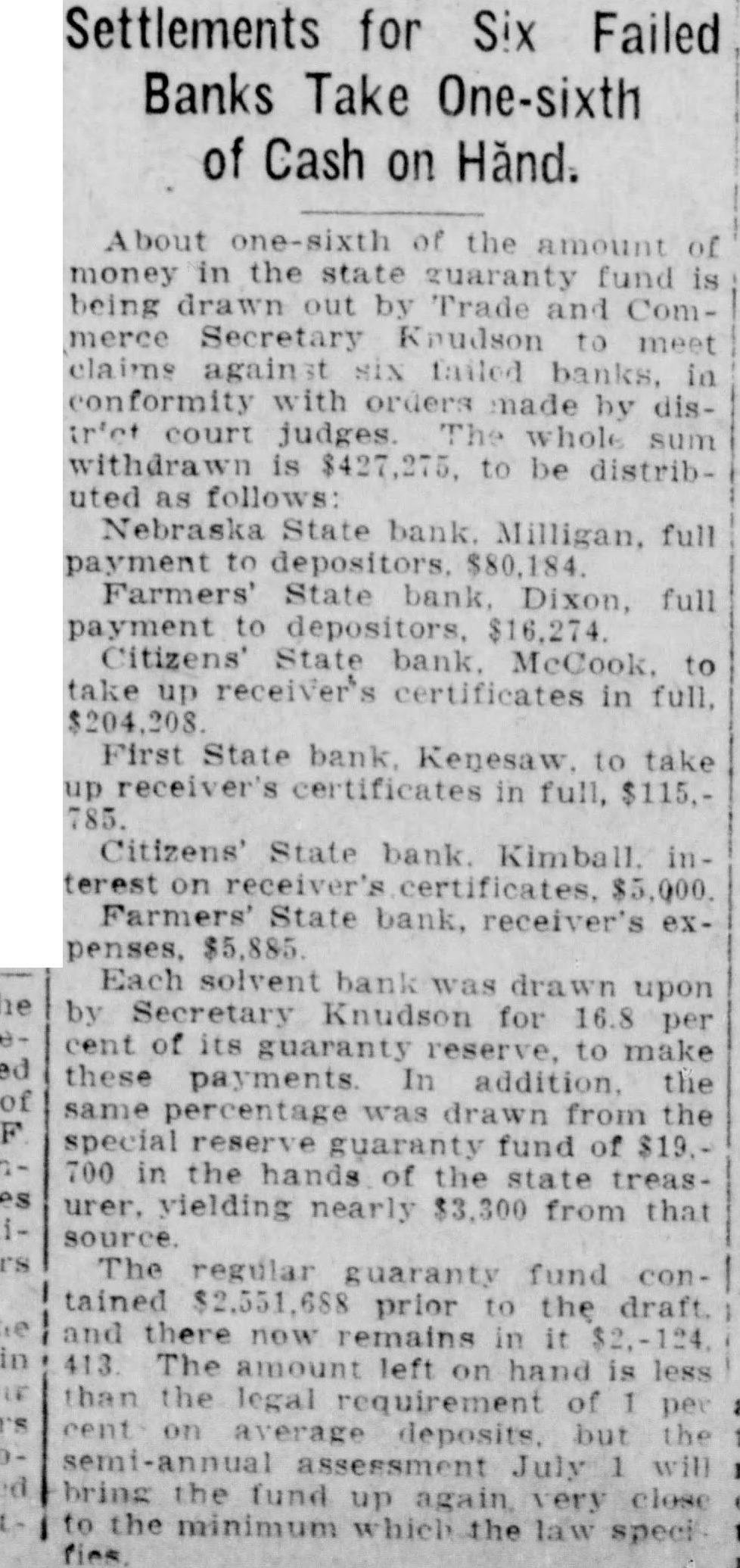
Settlements for Six Failed Banks Take One-sixth of Cash on Hand. About one-sixth of the amount of money in the state guaranty fund is being drawn out by Trade and Commerce Secretary Knudson to meet claims against six failed banks, in conformity with orders made by district court judges. The whole sum withdrawn is $427,275, to be distributed as follows: Nebraska State bank, Milligan, full payment to depositors, $80,184. Farmers' State bank, Dixon, full payment to depositors, $16,274. Citizens' State bank, McCook, to take up receiver's certificates in full, $204,208. First State bank, Kenesaw, to take up receiver's certificates in full, $115,785. Citizens' State bank, Kimball, interest on receiver's certificates, $5,000. Farmers' State bank, receiver's expenses, $5,885. Each solvent bank was drawn upon by Secretary Knudson for 16.8 per cent of its guaranty reserve, to make these payments. In addition, the same percentage was drawn from the special reserve guaranty fund of $19,700 in the hands of the state treasurer, yielding nearly $3,300 from that source. The regular guaranty fund contained $2,551,688 prior to the draft, and there now remains in it $2,124,413. The amount left on hand is less than the legal requirement of 1 per cent on average deposits, but the semi-annual assessment July 1 will bring the fund up again very close to the minimum which the law specifies.


Article from The Fillmore Chronicle, August 22, 1924

Click image to open full size in new tab

Article Text

DISTRICT COURT Judge Ralph D. Brown finished the June term of district court Saturday afternoon. The term, which was first set for June 23, did not begin until July 21 and there were other adjournments between sessions. Judge Brown will hold a special term beginning September 10 for the purpose of hearing the Milligan grain cases. These cases, in which sixteen Milligan farmers sued the Updike Grain company and other companies for losses sustained when the Milligan Grain company failed, were in court a week in January. A good deal of evidence was taken at that time and it is hoped to finish the evidence at this special term. Judge Brown issued an order last Thursday permitting E. J. Dempster receiver of the Nebraska State bank of Milligan, to sell the remaining assets of the bank. The date of the sale is September 24. C. M. Skiles of Lincoln represented the department of trade and commerce at the hearing. In the case of the Nebraska State Bank of Milligan vs James Bors, the plaintiff's motion for a new trial was overruled. The plaintiff then filed a motion for a judgment notwithstanding the verdict. This was overruled also and the court ordered the defendant to have and take nothing on his cause of action. Bors got a verdict in a jury trial when the bank receiver sued on a note some time ago. The suit of Sarah Wellman vs. Franklin W. Stephenson, to quiet title was heard Friday and the petition of the plaintiff was granted. There was no contest in the case. The suit of the Farmers & Merchants bank of Milligan vs. Frank Svoboda, Rose Svoboda and Albert Kassik was tried Friday. The court rendered a judgment against each of the defendants for $2,488.88 and interest In the foreclosure suit of George R. Bates vs. Peter Detweiler, et al, a judgment was given the plaintiff for $8,221.33 and the sheriff was ordered to sell the mortgaged property unless the judgment was paid within twenty days. The foreclosure suit of the Home Bank of Ohiowa vs. Edward K. Petracek, et al, was heard Saturday. W. J. Maier and wife, two of the defendants, entered their default. The court gave the plaintiff a judgment against the Maiers on their note for $4,223.71. The sheriff was instructed to sell the property in twenty days. Anntoer foreclosure suit was that of Emma Stutzman vs. Fred S. Manning, et al. A judgment of $2,466.12 was given the plaintiff with orders to sell the mortgaged real estate in twenty days at sheriff's sale. The Grafton State bank's foreclosure suit against Samuel Kauffman and wife was heard Saturday and the plaintiff received a judgment of $6,632.44 on three notes. In the partition case of Laura Kappmeyer vs. Henry Buckmeyer, J. D. Hamilton, trustee, filed his final report which was accepted by the court. The trustee was discharged from further duty in the case. When the case of Frances Bermaster vs. Thomas Bermaster, came up for hearing on the petition of the plaintiff for separate maintenance, attorneys announced that the parties had become reconciled and the petition of the plaintiff and the cross-petition of the defendant were dismissed and withdrawn from the files. Court adjourned at 5:10 p. m. until September 10.β€”Geneva Signal.


Article from The Fillmore Chronicle, June 18, 1925

Click image to open full size in new tab

Article Text

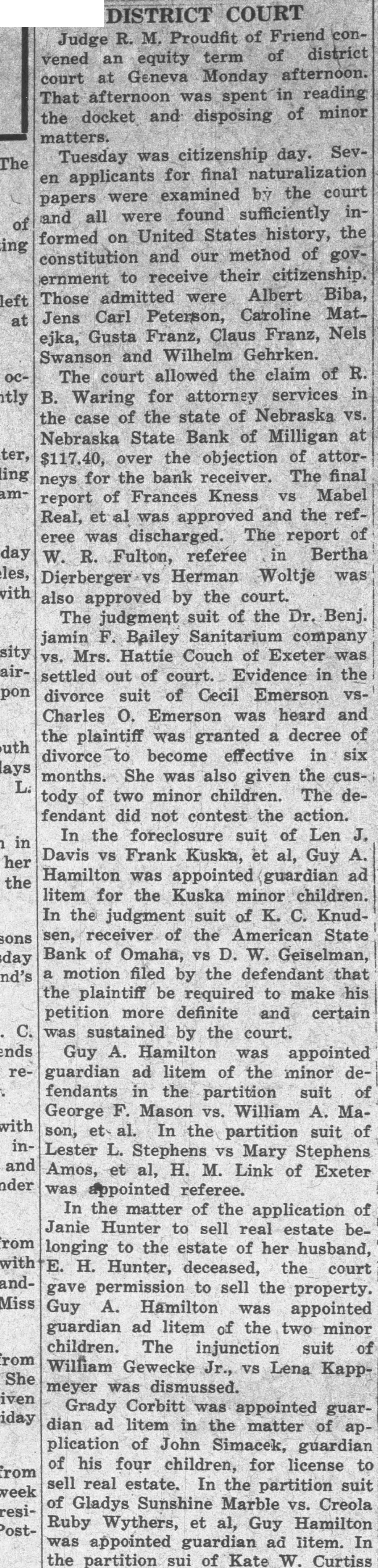
DISTRICT COURT Judge R. M. Proudfit of Friend convened an equity term of district court at Geneva Monday afternoon. That afternoon was spent in reading the docket and disposing of minor matters. Tuesday was citizenship day. Seven applicants for final naturalization papers were examined by the court and all were found sufficiently informed on United States history, the constitution and our method of government to receive their citizenship. Those admitted were Albert Biba, Jens Carl Peterson, Caroline Matejka, Gusta Franz, Claus Franz, Nels Swanson and Wilhelm Gehrken. The court allowed the claim of R. B. Waring for attorney services in the case of the state of Nebraska vs. Nebraska State Bank of Milligan at $117.40, over the objection of attorneys for the bank receiver. The final report of Frances Kness vs Mabel Real, et al was approved and the referee was discharged. The report of W. R. Fulton, referee in Bertha Dierberger vs Herman Woltje was also approved by the court. The judgment suit of the Dr. Benjamin F. Bailey Sanitarium company vs. Mrs. Hattie Couch of Exeter was settled out of court. Evidence in the divorce suit of Cecil Emerson vs Charles O. Emerson was heard and the plaintiff was granted a decree of divorce to become effective in six months. She was also given the custody of two minor children. The defendant did not contest the action. In the foreclosure suit of Len J. Davis vs Frank Kuska, et al, Guy A. Hamilton was appointed guardian ad litem for the Kuska minor children. In the judgment suit of K. C. Knudsen, receiver of the American State Bank of Omaha, vs D. W. Geiselman, a motion filed by the defendant that the plaintiff be required to make his petition more definite and certain was sustained by the court. Guy A. Hamilton was appointed guardian ad litem of the minor defendants in the partition suit of George F. Mason vs. William A. Mason, et al. In the partition suit of Lester L. Stephens vs Mary Stephens Amos, et al, H. M. Link of Exeter was appointed referee. In the matter of the application of Janie Hunter to sell real estate belonging to the estate of her husband, E. H. Hunter, deceased, the court gave permission to sell the property. Guy A. Hamilton was appointed guardian ad litem of the two minor children. The injunction suit of William Gewecke Jr., vs Lena Kappmeyer was dismissed. Grady Corbitt was appointed guardian ad litem in the matter of application of John Simacek, guardian of his four children, for license to sell real estate. In the partition suit of Gladys Sunshine Marble vs. Creola Ruby Wythers, et al, Guy Hamilton was appointed guardian ad litem. In the partition sui of Kate W. Curtiss


Article from Fillmore County News, June 18, 1925

Click image to open full size in new tab

Article Text

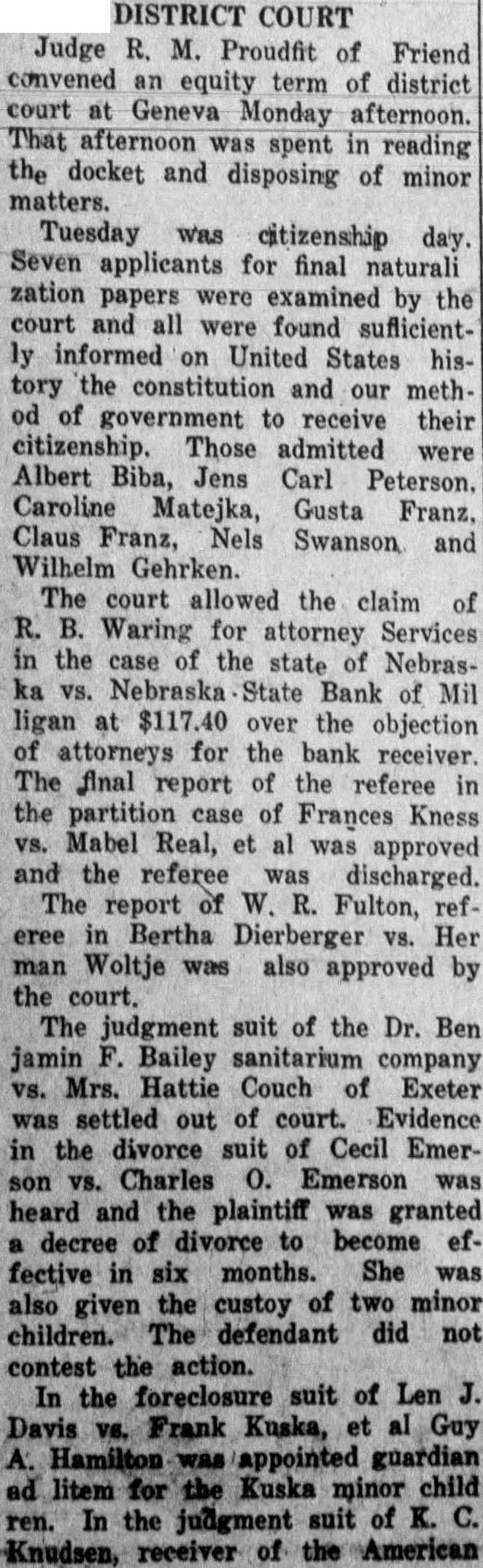
DISTRICT COURT Judge R. M. Proudfit of Friend convened an equity term of district court at Geneva Monday afternoon. That afternoon was spent in reading the docket and disposing of minor matters. Tuesday was citizenship day Seven applicants for final naturali zation papers were examined by the court and all were found sufficiently informed on United States history the constitution and our method of government to receive their citizenship. Those admitted were Albert Biba, Jens Carl Peterson. Caroline Matejka, Gusta Franz. Claus Franz, Nels Swanson and Wilhelm Gehrken. The court allowed the claim of R. B. Waring for attorney Services in the case of the state of Nebraska vs. Nebraska State Bank of Mil ligan at $117.40 over the objection of attorneys for the bank receiver The final report of the referee in the partition case of Frances Kness vs. Mabel Real, et al was approved and the referee was discharged. The report of W. R. Fulton, ref eree in Bertha Dierberger vs. Her man Woltje was also approved by the court. The judgment suit of the Dr. Ben jamin F. Bailey sanitarium company vs. Mrs. Hattie Couch of Exeter was settled out of court. Evidence in the divorce suit of Cecil Emerson vs. Charles O. Emerson was heard and the plaintiff was granted a decree of divorce to become effective in six months. She was also given the custoy of two minor children. The defendant did not contest the action. In the foreclosure suit of Len J. Davis vs. Frank Kuska, et al Guy A. Hamilton was appointed guardian ad litem for the Kuska minor child ren. In the judgment suit of K. C.