Citizens State Bank (Holdrege, NE)

Episode Information

Episode UID
76120771478
Episode Type
Run → Suspension → Closure
Bank Type
state
Bank ID
7612077 routing
Routing Number
76-1207
Start Date
February 1, 1923
Location
Holdrege, Nebraska (40.440, -99.370)

Metadata

Model
gpt-5-mini (chosen from majority vote of a three-model LLM ensemble)
Short Digest
5ed37f478b1d5840

Response Measures

None

Description

Bank voluntarily closed Feb 8 and was turned over to state department; later receivership expected.

Events (3)

1. February 1, 1923 Run
Cause
Rumor Or Misinformation
Cause Details
Publicity and announcements by Governor Bryan and investigation news prompted withdrawals and loss of confidence.
Measures
Bank officers sought refinancing and proposed paying new capital; notices posted; attempted to secure guaranty fund payment.
Newspaper Excerpt
Straightway followed a run on the Davis bank at Holdrege.
Source
newspapers
2. February 8, 1923 Suspension
Cause
Government Action
Cause Details
Bank closed after heavy withdrawals precipitated by publicity and refusal/withholding of a draft on the state guaranty fund; bank turned over to state banking department.
Newspaper Excerpt
The Citizens' State bank ... voluntarily closed its doors this morning and was turned over to the state department of trade and commerce
Source
newspapers
3. * Receivership
Newspaper Excerpt
It is expected, however, that a receiver will be appointed and the depositors will then be paid.
Source
newspapers

Newspaper Articles (18)

Article from Daily Drovers Journal-Stockman, January 27, 1923

Click image to open full size in new tab

Article Text

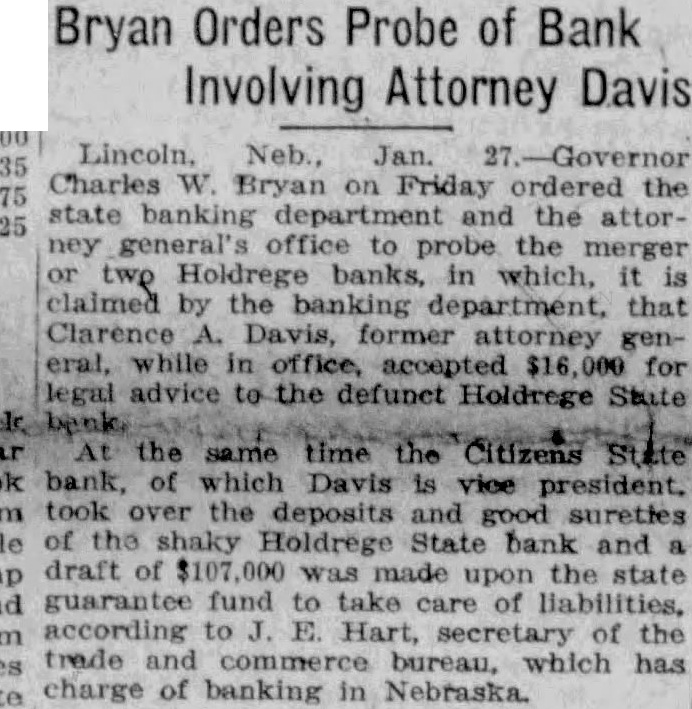
Bryan Orders Probe of Bank Involving Attorney Davis Lincoln, Neb., Jan. 27.—Governor Charles W. Bryan on Friday ordered the state banking department and the attorney general's office to probe the merger of two Holdrege banks, in which, it is claimed by the banking department, that Clarence A. Davis, former attorney general, while in office, accepted $16,000 for legal advice to the defunct Holdrege State bank. At the same time the Citizens State bank, of which Davis is vice president, took over the deposits and good sureties of the shaky Holdrege State bank and a draft of $107,000 was made upon the state guarantee fund to take care of liabilities, according to J. E. Hart, secretary of the trade and commerce bureau, which has charge of banking in Nebraska.


Article from Omaha Daily Bee, February 9, 1923

Click image to open full size in new tab

Article Text

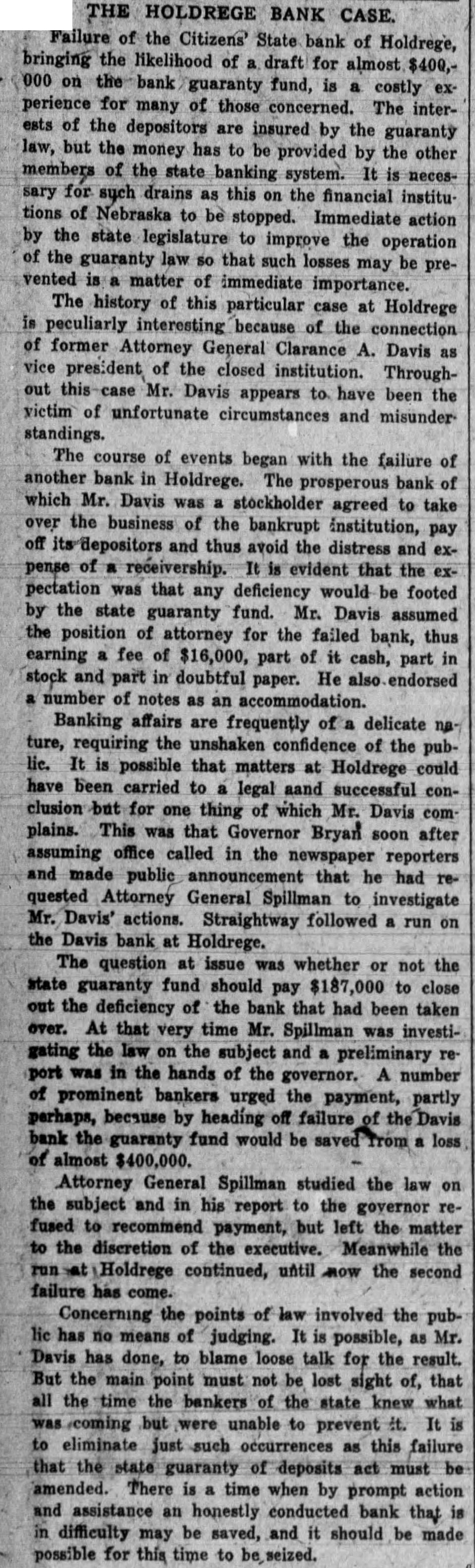
THE HOLDREGE BANK CASE. Failure of the Citizens' State bank of Holdrege, bringing the likelihood of a draft for almost $400,000 on the bank guaranty fund, is a costly experience for many of those concerned. The interests of the depositors are insured by the guaranty law, but the money has to be provided by the other members of the state banking system. It is necessary for such drains as this on the financial institutions of Nebraska to be stopped. Immediate action by the state legislature to improve the operation of the guaranty law so that such losses may be prevented is a matter of immediate importance. The history of this particular case at Holdrege is peculiarly interesting because of the connection of former Attorney General Clarance A. Davis as vice president of the closed institution. Through-out this case Mr. Davis appears to have been the victim of unfortunate circumstances and misunderstandings. The course of events began with the failure of another bank in Holdrege. The prosperous bank of which Mr. Davis was a stockholder agreed to take over the business of the bankrupt institution, pay off its depositors and thus avoid the distress and expense of a receivership. It is evident that the expectation was that any deficiency would be footed by the state guaranty fund. Mr. Davis assumed the position of attorney for the failed bank, thus earning a fee of $16,000, part of it cash, part in stock and part in doubtful paper. He also endorsed a number of notes as an accommodation. Banking affairs are frequently of a delicate nature, requiring the unshaken confidence of the public. It is possible that matters at Holdrege could have been carried to a legal and successful conclusion but for one thing of which Mr. Davis complains. This was that Governor Bryan soon after assuming office called in the newspaper reporters and made public announcement that he had requested Attorney General Spillman to investigate Mr. Davis' actions. Straightway followed a run on the Davis bank at Holdrege. The question at issue was whether or not the state guaranty fund should pay $187,000 to close out the deficiency of the bank that had been taken over. At that very time Mr. Spillman was investigating the law on the subject and a preliminary report was in the hands of the governor. A number of prominent bankers urged the payment, partly perhaps, because by heading off failure of the Davis bank the guaranty fund would be saved from a loss of almost $400,000. Attorney General Spillman studied the law on the subject and in his report to the governor refused to recommend payment, but left the matter to the discretion of the executive. Meanwhile the run at Holdrege continued, until now the second failure has come. Concerning the points of law involved the public has no means of judging. It is possible, as Mr. Davis has done, to blame loose talk for the result. But the main point must not be lost sight of, that all the time the bankers of the state knew what was coming but were unable to prevent it. It is to eliminate just such occurrences as this failure that the state guaranty of deposits act must be amended. There is a time when by prompt action and assistance an honestly conducted bank that is in difficulty may be saved, and it should be made possible for this time to be seized.


Article from Omaha World-Herald, February 9, 1923

Click image to open full size in new tab

Article Text

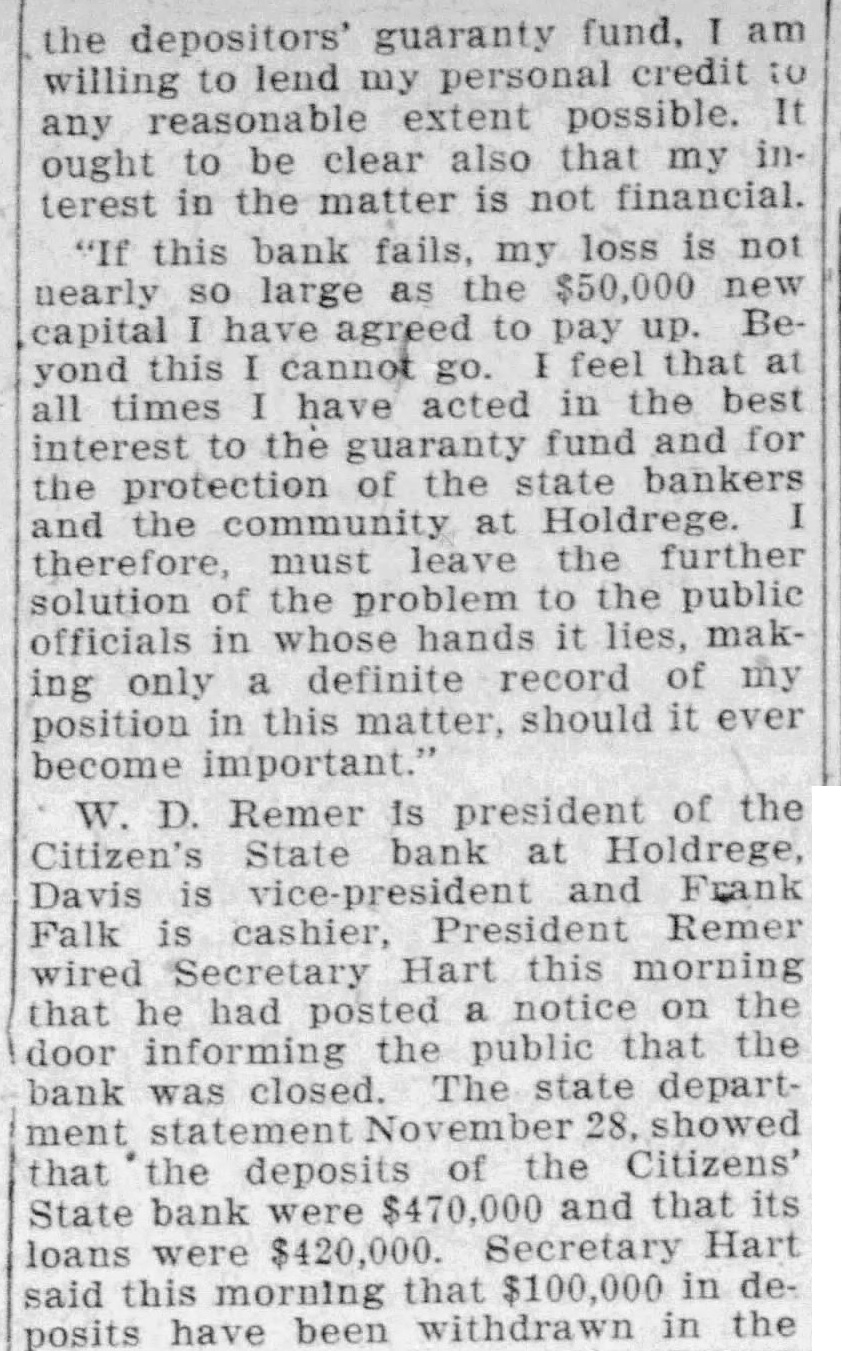
the depositors' guaranty fund, I am willing to lend my personal credit to any reasonable extent possible. It ought to be clear also that my interest in the matter is not financial. "If this bank fails, my loss is not nearly so large as the $50,000 new capital I have agreed to pay up. Beyond this I cannot go. I feel that at all times I have acted in the best interest to the guaranty fund and for the protection of the state bankers and the community at Holdrege. I therefore, must leave the further solution of the problem to the public officials in whose hands it lies, making only a definite record of my position in this matter, should it ever become important." W. D. Remer is president of the Citizen's State bank at Holdrege, Davis is vice-president and Frank Falk is cashier. President Remer wired Secretary Hart this morning that he had posted a notice on the door informing the public that the bank was closed. The state department statement November 28, showed that the deposits of the Citizens' State bank were $470,000 and that its loans were $420,000. Secretary Hart said this morning that $100,000 in deposits have been withdrawn in the


Article from Omaha World-Herald, February 9, 1923

Click image to open full size in new tab

Article Text

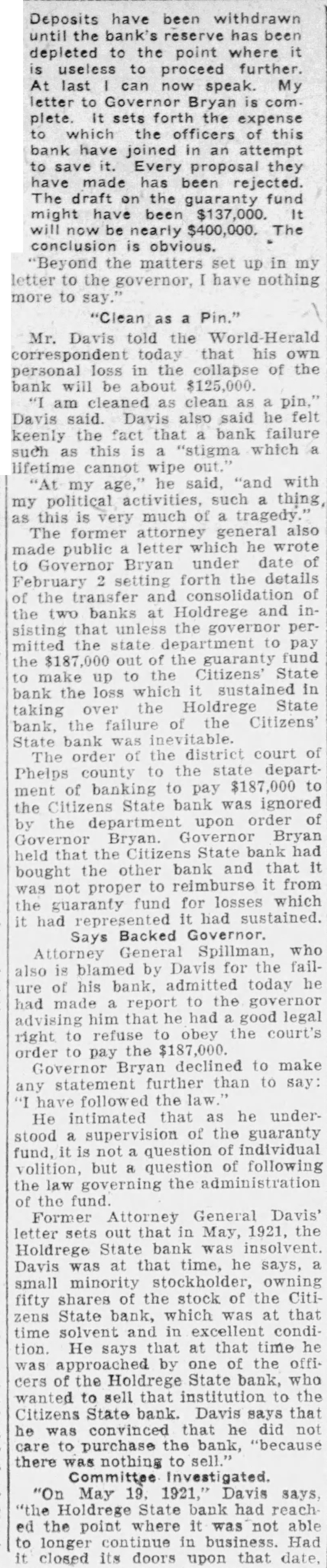
Deposits have been withdrawn until the bank's reserve has been depleted to the point where it is useless to proceed further. At last I can now speak. My letter to Governor Bryan is complete. It sets forth the expense to which the officers of this bank have joined in an attempt to save it. Every proposal they have made has been rejected. The draft on the guaranty fund might have been $137,000. It will now be nearly $400,000. The conclusion is obvious. "Beyond the matters set up in my letter to the governor, I have nothing more to say." "Clean as a Pin." Mr. Davis told the World-Herald correspondent today that his own personal loss in the collapse of the bank will be about $125,000. "I am cleaned as clean as a pin," Davis said. Davis also said he felt keenly the fact that a bank failure such as this is a "stigma which a lifetime cannot wipe out." "At my age," he said, "and with my political activities, such a thing as this is very much of a tragedy." The former attorney general also made public a letter which he wrote to Governor Bryan under date of February 2 setting forth the details of the transfer and consolidation of the two banks at Holdrege and insisting that unless the governor permitted the state department to pay the $187,000 out of the guaranty fund to make up to the Citizens' State bank the loss which it sustained in taking over the Holdrege State bank, the failure of the Citizens' State bank was inevitable. The order of the district court of Phelps county to the state department of banking to pay $187,000 to the Citizens State bank was ignored by the department upon order of Governor Bryan. Governor Bryan held that the Citizens State bank had bought the other bank and that it was not proper to reimburse it from the guaranty fund for losses which it had represented it had sustained. Says Backed Governor. Attorney General Spillman, who also is blamed by Davis for the failure of his bank, admitted today he had made a report to the governor advising him that he had a good legal right to refuse to obey the court's order to pay the $187,000. Governor Bryan declined to make any statement further than to say: "I have followed the law." He intimated that as he understood a supervision of the guaranty fund, it is not a question of individual volition, but a question of following the law governing the administration of the fund. Former Attorney General Davis' letter sets out that in May, 1921, the Holdrege State bank was insolvent. Davis was at that time, he says, a small minority stockholder, owning fifty shares of the stock of the Citizens State bank, which was at that time solvent and in excellent condition. He says that at that time he was approached by one of the officers of the Holdrege State bank, who wanted to sell that institution to the Citizens State bank. Davis says that he was convinced that he did not care to purchase the bank, "because there was nothing to sell." Committee Investigated. "On May 19, 1921," Davis says, "the Holdrege State bank had reached the point where it was not able to longer continue in business. Had it closed its doors upon that date,


Article from Omaha World-Herald, February 9, 1923

Click image to open full size in new tab

Article Text

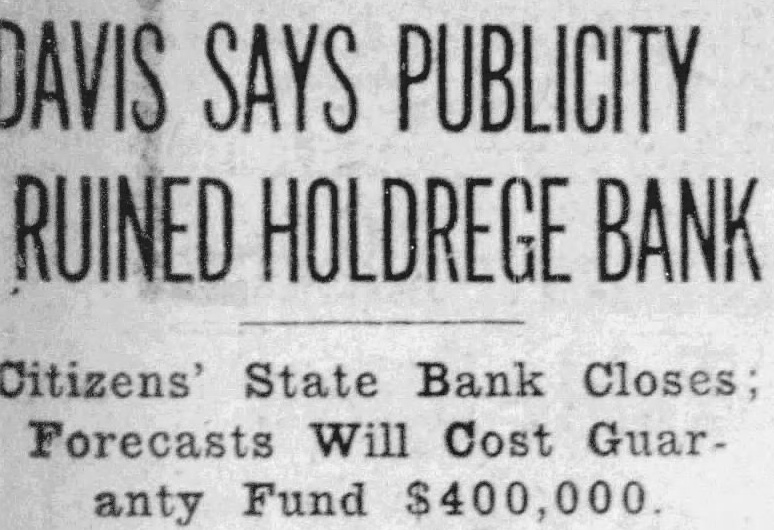
DAVIS SAYS PUBLICITY RUINED HOLDREGE BANK Citizens' State Bank Closes; Forecasts Will Cost Guaranty Fund $400,000.


Article from Omaha World-Herald, February 9, 1923

Click image to open full size in new tab

Article Text

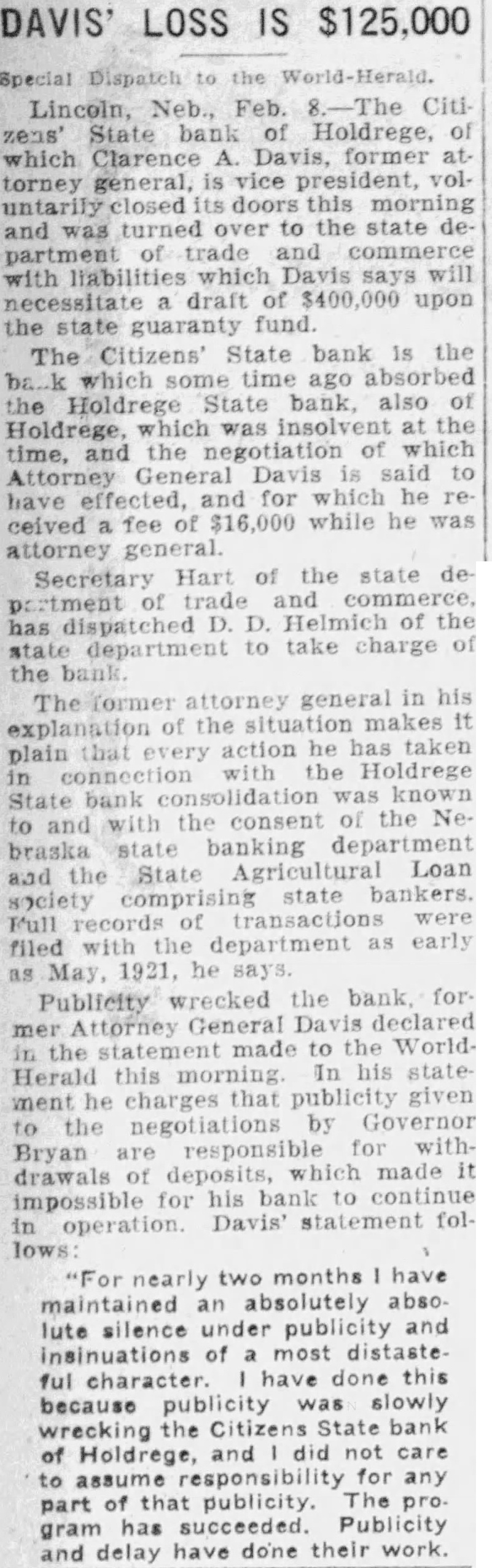
DAVIS' LOSS IS $125,000 Special Dispatch to the World-Herald. Lincoln, Neb., Feb. 8.—The Citizens' State bank of Holdrege, of which Clarence A. Davis, former attorney general, is vice president, voluntarily closed its doors this morning and was turned over to the state department of trade and commerce with liabilities which Davis says will necessitate a draft of $400,000 upon the state guaranty fund. The Citizens' State bank is the bank which some time ago absorbed the Holdrege State bank, also of Holdrege, which was insolvent at the time, and the negotiation of which Attorney General Davis is said to have effected, and for which he received a fee of $16,000 while he was attorney general. Secretary Hart of the state department of trade and commerce, has dispatched D. D. Helmich of the state department to take charge of the bank. The former attorney general in his explanation of the situation makes it plain that every action he has taken in connection with the Holdrege State bank consolidation was known to and with the consent of the Nebraska state banking department and the State Agricultural Loan society comprising state bankers. Full records of transactions were filed with the department as early as May, 1921, he says. Publicity wrecked the bank, former Attorney General Davis declared in the statement made to the World-Herald this morning. In his statement he charges that publicity given to the negotiations by Governor Bryan are responsible for withdrawals of deposits, which made it impossible for his bank to continue in operation. Davis' statement follows: "For nearly two months I have maintained an absolutely absolute silence under publicity and insinuations of a most distasteful character. I have done this because publicity was slowly wrecking the Citizens State bank of Holdrege, and I did not care to assume responsibility for any part of that publicity. The program has succeeded. Publicity and delay have done their work.


Article from The Hastings Daily Tribune, February 10, 1923

Click image to open full size in new tab

Article Text

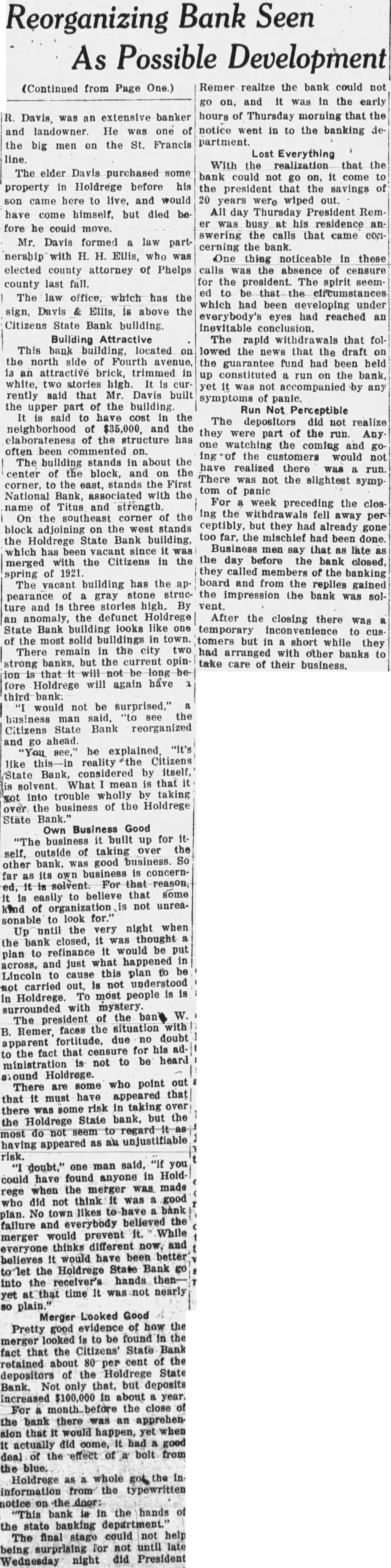
Reorganizing Bank Seen As Possible Development (Continued from Page One.) R. Davis, was an extensive banker and landowner. He was one of the big men on the St. Francis line. The elder Davis purchased some property in Holdrege before his son came here to live, and would have come himself, but died before he could move. Mr. Davis formed a law partnership with H. H. Ellis, who was elected county attorney of Phelps county last fall. The law office, which has the sign, Davis & Ellis, is above the Citizens State Bank building. Building Attractive This bank building, located on the north side of Fourth avenue, is an attractive brick, trimmed in white, two stories high. It is currently said that Mr. Davis built the upper part of the building. It is said to have cost in the neighborhood of $35,000, and the elaborateness of the structure has often been commented on. The building stands in about the center of the block, and on the corner, to the east, stands the First National Bank, associated with the name of Titus and strength. On the southeast corner of the block adjoining on the west stands the Holdrege State Bank building, which has been vacant since it was merged with the Citizens in the spring of 1921. The vacant building has the appearance of a gray stone structure and is three stories high. By an anomaly, the defunct Holdrege State Bank building looks like one of the most solid buildings in town. There remain in the city two strong banks, but the current opinion is that it will not be long before Holdrege will again have a third bank. "I would not be surprised," a business man said, "to see the Citizens State Bank reorganized and go ahead. "You see," he explained, "it's like this—in reality the Citizens State Bank, considered by itself, is solvent. What I mean is that it got into trouble wholly by taking over the business of the Holdrege State Bank." Own Business Good "The business it built up for itself, outside of taking over the other bank, was good business. So far as its own business is concerned, it is solvent. For that reason, it is easily to believe that some kind of organization is not unreasonable to look for." Up until the very night when the bank closed, it was thought a plan to refinance it would be put across, and just what happened in Lincoln to cause this plan to be not carried out, is not understood in Holdrege. To most people is is surrounded with mystery. The president of the bank, W. B. Remer, faces the situation with apparent fortitude, due no doubt to the fact that censure for his administration is not to be heard around Holdrege. There are some who point out that it must have appeared that there was some risk in taking over the Holdrege State bank, but the most do not seem to regard it as having appeared as an unjustifiable risk. "I doubt," one man said, "if you could have found anyone in Holdrege when the merger was made who did not think it was a good plan. No town likes to have a bank failure and everybody believed the merger would prevent it. While everyone thinks different now, and believes it would have been better to let the Holdrege State Bank go into the receiver's hands then—yet at that time it was not nearly so plain." Merger Looked Good Pretty good evidence of how the merger looked is to be found in the fact that the Citizens' State Bank retained about 80 per cent of the depositors of the Holdrege State Bank. Not only that, but deposits increased $100,000 in about a year. For a month before the close of the bank there was an apprehension that it would happen, yet when it actually did come, it had a good deal of the effect of a bolt from the blue. Holdrege as a whole got the information from the typewritten notice on the door: "This bank is in the hands of the state banking department." The final stage could not help being surprising for not until late Wednesday night did President Remer realize the bank could not go on, and it was in the early hours of Thursday morning that the notice went in to the banking department. Lost Everything With the realization that the bank could not go on, it come to the president that the savings of 20 years were wiped out. All day Thursday President Remer was busy at his residence answering the calls that came concerning the bank. One thing noticeable in these calls was the absence of censure for the president. The spirit seemed to be that the circumstances which had been developing under everybody's eyes had reached an inevitable conclusion. The rapid withdrawals that followed the news that the draft on the guarantee fund had been held up constituted a run on the bank, yet it was not accompanied by any symptoms of panic. Run Not Perceptible The depositors did not realize they were part of the run. Anyone watching the coming and going of the customers would not have realized there was a run. There was not the slightest symptom of panic. For a week preceding the closing the withdrawals fell away perceptibly, but they had already gone too far, the mischief had been done. Business men say that as late as the day before the bank closed, they called members of the banking board and from the replies gained the impression the bank was solvent. After the closing there was a temporary inconvenience to customers but in a short while they had arranged with other banks to take care of their business.


Article from The Hastings Daily Tribune, February 12, 1923

Click image to open full size in new tab

Article Text

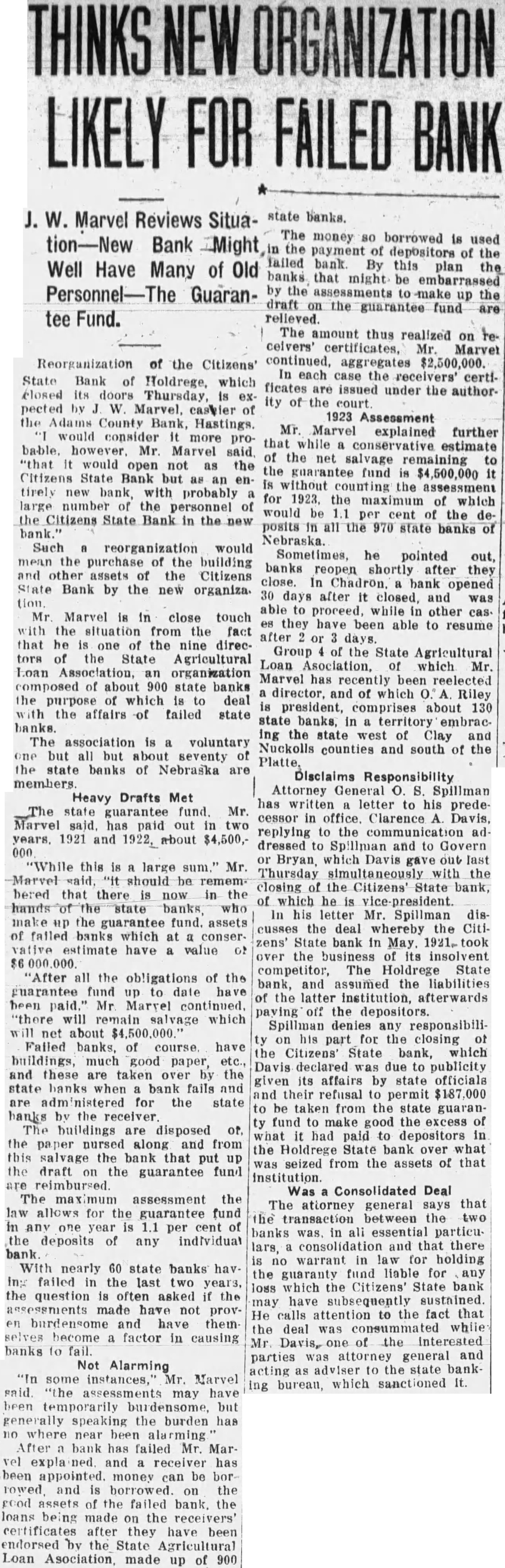
THINKS NEW ORGANIZATION LIKELY FOR FAILED BANK J. W. Marvel Reviews Situation—New Bank Might Well Have Many of Old Personnel—The Guarantee Fund. Reorganization of the Citizens' State Bank of Holdrege, which closed its doors Thursday, is expected by J. W. Marvel, cashier of the Adams County Bank, Hastings. "I would consider it more probable, however, Mr. Marvel said, "that it would open not as the Citizens State Bank but as an entirely new bank, with probably a large number of the personnel of the Citizens State Bank in the new bank." Such a reorganization would mean the purchase of the building and other assets of the Citizens State Bank by the new organization. Mr. Marvel is in close touch with the situation from the fact that he is one of the nine directors of the State Agricultural Loan Association, an organization composed of about 900 state banks the purpose of which is to deal with the affairs of failed state banks. The association is a voluntary one but all but about seventy of the state banks of Nebraska are members. Heavy Drafts Met The state guarantee fund, Mr. Marvel said, has paid out in two years, 1921 and 1922, about $4,500,000. "While this is a large sum," Mr. Marvel said, "it should be remembered that there is now in the hands of the state banks, who make up the guarantee fund, assets of failed banks which at a conservative estimate have a value of $6,000,000. "After all the obligations of the guarantee fund up to date have been paid," Mr. Marvel continued, "there will remain salvage which will net about $4,500,000." Failed banks, of course, have buildings, much good paper, etc., and these are taken over by the state banks when a bank fails and are administered for the state banks by the receiver. The buildings are disposed of, the paper nursed along and from this salvage the bank that put up the draft on the guarantee fund are reimbursed. The maximum assessment the law allows for the guarantee fund in any one year is 1.1 per cent of the deposits of any individual bank. With nearly 60 state banks having failed in the last two years, the question is often asked if the assessments made have not proven burdensome and have themselves become a factor in causing banks to fail. Not Alarming "In some instances," Mr. Marvel said, "the assessments may have been temporarily burdensome, but generally speaking the burden has no where near been alarming." After a bank has failed Mr. Marvel explained, and a receiver has been appointed, money can be borrowed, and is borrowed, on the good assets of the failed bank, the loans being made on the receivers' certificates after they have been endorsed by the State Agricultural Loan Association, made up of 900 state banks. The money so borrowed is used in the payment of depositors of the failed bank. By this plan the banks that might be embarrassed by the assessments to make up the draft on the guarantee fund are relieved. The amount thus realized on receivers' certificates, Mr. Marvel continued, aggregates $2,500,000. In each case the receivers' certificates are issued under the authority of the court. 1923 Assessment Mr. Marvel explained further that while a conservative estimate of the net salvage remaining to the guarantee fund is $4,500,000 it is without counting the assessment for 1923, the maximum of which would be 1.1 per cent of the deposits in all the 970 state banks of Nebraska. Sometimes, he pointed out, banks reopen shortly after they close. In Chadron, a bank opened 30 days after it closed, and was able to proceed, while in other cases they have been able to resume after 2 or 3 days. Group 4 of the State Agricultural Loan Association, of which Mr. Marvel has recently been reelected a director, and of which O. A. Riley is president, comprises about 130 state banks, in a territory embracing the state west of Clay and Nuckolls counties and south of the Platte. Disclaims Responsibility Attorney General O. S. Spillman has written a letter to his predecessor in office, Clarence A. Davis, replying to the communication addressed to Spillman and to Governor Bryan, which Davis gave out last Thursday simultaneously with the closing of the Citizens' State bank, of which he is vice-president. In his letter Mr. Spillman discusses the deal whereby the Citizens' State bank in May, 1921, took over the business of its insolvent competitor, The Holdrege State bank, and assumed the liabilities of the latter institution, afterwards paying off the depositors. Spillman denies any responsibility on his part for the closing of the Citizens' State bank, which Davis declared was due to publicity given its affairs by state officials and their refusal to permit $187,000 to be taken from the state guaranty fund to make good the excess of what it had paid to depositors in the Holdrege State bank over what was seized from the assets of that institution. Was a Consolidated Deal The attorney general says that the transaction between the two banks was, in all essential particulars, a consolidation and that there is no warrant in law for holding the guaranty fund liable for any loss which the Citizens' State bank may have subsequently sustained. He calls attention to the fact that the deal was consummated while Mr. Davis, one of the interested parties was attorney general and acting as adviser to the state banking bureau, which sanctioned it.
Article from Lincoln Journal Star, February 13, 1923

Click image to open full size in new tab

Article Text

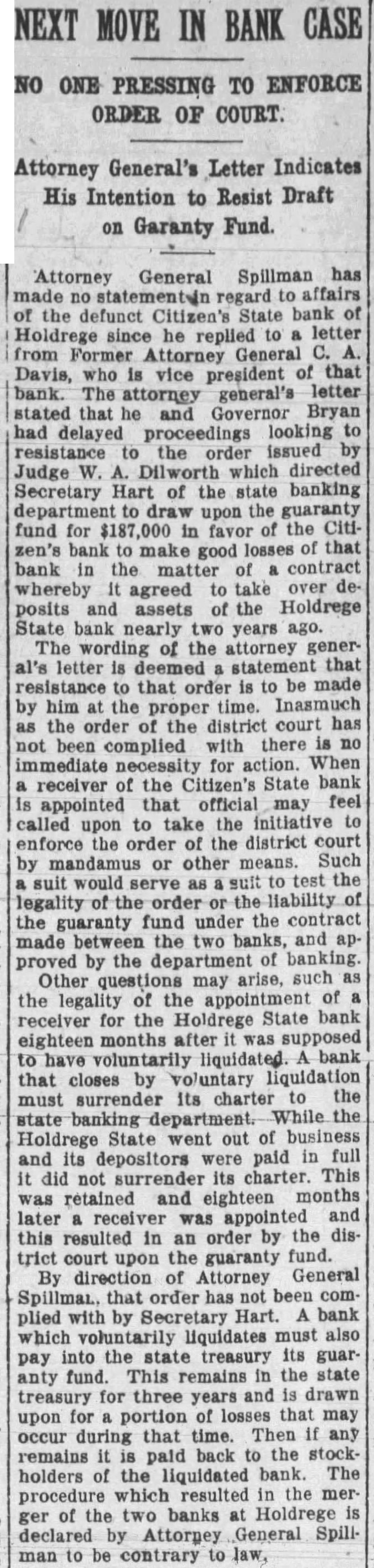
NEXT MOVE IN BANK CASE NO ONE PRESSING TO ENFORCE ORDER OF COURT. Attorney General's Letter Indicates His Intention to Resist Draft on Guaranty Fund. Attorney General Spillman has made no statement in regard to affairs of the defunct Citizen's State bank of Holdrege since he replied to a letter from Former Attorney General C. A. Davis, who is vice president of that bank. The attorney general's letter stated that he and Governor Bryan had delayed proceedings looking to resistance to the order issued by Judge W. A. Dilworth which directed Secretary Hart of the state banking department to draw upon the guaranty fund for $187,000 in favor of the Citizen's bank to make good losses of that bank in the matter of a contract whereby it agreed to take over deposits and assets of the Holdrege State bank nearly two years ago. The wording of the attorney general's letter is deemed a statement that resistance to that order is to be made by him at the proper time. Inasmuch as the order of the district court has not been complied with there is no immediate necessity for action. When a receiver of the Citizen's State bank is appointed that official may feel called upon to take the initiative to enforce the order of the district court by mandamus or other means. Such a suit would serve as a suit to test the legality of the order or the liability of the guaranty fund under the contract made between the two banks, and approved by the department of banking. Other questions may arise, such as the legality of the appointment of a receiver for the Holdrege State bank eighteen months after it was supposed to have voluntarily liquidated. A bank that closes by voluntary liquidation must surrender its charter to the state banking department. While the Holdrege State went out of business and its depositors were paid in full it did not surrender its charter. This was retained and eighteen months later a receiver was appointed and this resulted in an order by the district court upon the guaranty fund. By direction of Attorney General Spillman, that order has not been complied with by Secretary Hart. A bank which voluntarily liquidates must also pay into the state treasury its guaranty fund. This remains in the state treasury for three years and is drawn upon for a portion of losses that may occur during that time. Then if any remains it is paid back to the stockholders of the liquidated bank. The procedure which resulted in the merger of the two banks at Holdrege is declared by Attorney General Spillman to be contrary to law.


Article from The Hamilton County Register, February 13, 1923

Click image to open full size in new tab

Article Text

Explains Retaining Fee Regarding the retaining fee, reported to be $16,000, which he received, Mr. Davis states that he received 100 shares of stock and $2,000 in certificate of deposit, in consideration of which he has, as a Holdrege lawyer, tried and has pending during the last year and a half, suits involving more than $165,000, and has personally guaranteed the credit of the Citizens' State to more than $100,000 at one time. He also states that $4,000 in non-collectable notes were assigned to him, and that the officers of both Holdrege banks, correspondent banks and the banking department were fully advised as to the this arrangement. Mr. Davis points out that the fee is 6 per cent of the $200,000 involved in litigation less than the cost of the average receivership. He notes that as he has to pay others who assisted him, $4,500 is left in his hands for his personal services in trying the suits and guaranteeing $100,000 worth of notes. He adds: "I am still guarantor of more than $75,000 of loans negotiated by this transaction." In his letter of February 2 to the governor. Mr. Davis says the "regretted" publicity given the matter through Mr. Bryan, the banking secretary and attorney general, has caused the Citizens State bank a loss of more than 75,000 in deposits in one week; that it is on the verge of failure, and that the only way to save it is the payment of the claim ordered by the court on the guaranty fund. He makes the definite proposition that the Citizens State bank bear $50,000, the amount of its capital stocks of the loss, making the draft $137,000. Any legal proceedings instituted he says, will result in the immediate closing of the bank. The compromise settlement whereby the Citizens bank was to bear $50,000 of the loss was approved by the directors of the State Agricultural Loan association, at a meeting in Omaha, December 27. State bankers of group four of the Nebraska Bankers association adopted a resolution stating that no consolidation had been effected, and that the plan be adopted. This meeting was called by O. A. Riley, group president, on December 22. The letter of Mr. Davis to the governor concludes. "Upon the commencement of any legal proceedings, or upon a communication from either the governor or the attorney general, that they desire to set aside the order directing the payment of this claim, I will, myself, personally go before the court and move to set aside this order and I will, at that time, close the doors of the Citizens State bank. In that event, the draft upon the depositors' guaranty fund instead of being $187,000 will be more than $400,000. That matter is beyond my control. I occupied public office long enough to know that the private financial institution lies at the mercy of the state departments. To show my sincere desire to help this community, to save this bank, to save the depositors' guaranty fund, I am willing to lend my personal credit to any reasonable extent possible. If the attack which is directed at this transaction is directed at me as a personal matter, I am willing to dispose of all of my interests in this bank to someone who will be free from the attack which is apparently being made. It ought to be clear also, that my interests in the matter are not financial. If the bank fails my loss is not nearly so large as the $50,000 of new capital I have agreed to pay up. Beyond this I can not go. I feel that at all times I have acted in the best interests of the guaranty fund and for the protection of the state bankers and the community at Holdrege. I therefore must leave the further solution of the problem to the public officials in whose hands it lies, making only a definite record of my position in this matter should it ever become important." On receiving notice of the failure to open of the Citizens State bank Thursday morning, Secretary Hart immediately wired B. B. Heimich of Indianola, bank examiner, to go to Holdrege and take charge. The department's records show that the bank is capitalized at $50,000, and on November 28 had loans of $420,000 and deposits of $477,000. W. B. Remer is president and Frank Fall, cashier.


Article from The Omaha Morning Bee, February 14, 1923

Click image to open full size in new tab

Article Text

Spillman Defied Law Is Charge of Fremont Banker Dan V. Stephens Asserts At. torney General "Usurped Court Authority" in Holdrege Bank Failure. , Dan V. Stephens, Fremont banker and a member of the state bankers' legislative committee, charged in a statement issued Monday night that Attorney General Spillman has "usurped the authority of the court" in his stand on the Citizens State Bank of Holdrege affair. "He (the attorney general) defled the court in his advice to the bank. ing department not to pay the draft on the guaranty fund which would have saved the Citizens bank," the statement says. "He acted as judge, jury and prosecuting attorney in defiance of law and order and is now in contempt of the court issuing the order." State Machine Competent. Mr. Stephens declares the controversy over the failure and on the merits of the Citizens bank's claim on the guaranty \ fund, has been waged by Attorney General Spillman and Clarence A. Davis, former attor. ney general and a vice president of the failed bank, "proves conclusively the incompetency of the state political machine to administer a highly technical and sensitive business such as the banking business." "This is proven by the fact that 54 banks have failed right under the department's nose, and that last week the Citizens State Bank of Holdrege was broken, notwithstanding numerous warnings that fussing about questions of the law on which all kinds of legal opinions were available would do that very thing," continues Mr, Stephens. Banks Exploited. Interviewed by The Omaha Bee yes terday, Mr. Stephens said he was not "taking sides" in the matter. He continued: "Mr. Spillman avers he is not concerned in a practical solution of the Holdrege case, but only in its legality. He merely proves the bankers' con. tention that the banks are being exploited while politicians and lawyera fuss over the law. The fact that the guaranty fund is now compelled to pay $400,000 or more to the depositors of the Citizens bank. when, if the court's order had been obeyed. $187. 000 would have settled the bill, may not interest Mr. Spillman as a practical proposition, but it would if he had to pay this unnecessary loss him self." In an argument for an amendment of the banking laws "so that banks will be in a position to help the state department to enforce the law and handle the institutions in need of help," Mr. Stephens declares that at the state has a present "life and death power over bankers." He de clares "no political machine can suc cessfully exercise such a power," and as a solution urges the plan which would create a "commission composed of heads of by practical banks chosen banks themselves as an advisory body to the state banking department." He declares such a commission would prevent exploitation of banks and the wasting of banks' property through expensive receiverships.


Article from The Holdrege Progress, February 15, 1923

Click image to open full size in new tab

Article Text

INTEREST STATEWIDE IN BANK CASE (Continued from page 1, Sec. 2) has ordered upon the guaranty fund. The reports on file in the banking department will show that the Citizens State bank, itself is clean and free from bad paper except such as it took over from the Holdrege State bank. "The situation is most critical. To avert the impending failure of this bank I have made to the bankers' association and I now make definitely to you the same proposition outlined in the bankers' letter, the substance of which is that the bank bear $50,000 of this loss. This is its entire capital and this sum the bank is willing and ready to pay up. "I want to make it clear to you that this plan will save more than $150,000 more for the guaranty fund than will the wrecking of the Citizens' State bank. If this plan is accepted the draft on the guaranty fund will be for $187,000 less the $50,000 of new capital paid in. The Citizens' State Bank will be solvent and we will have saved a bank. "On the other hand, the statements that have been given to the press and the interviews of the public officials seriously question the integrity of myself and my associates in this transaction as well as the legality of the court's order. I desire to place myself on record in this letter that if, in the judgment of either the governor or the attorney general, there is any impropriety in any of the things which I have done, that it is not necessary to bring any legal proceedings to set them aside. With the comment that has been made in the press, resulting already in large withdrawals from the bank, the mere commencement of any legal proceeding whatsoever will precipitate a run on the bank and necessitate its closing. It is, therefore, utterly futile to bring any legal proceeding. Even if this bank was able ultimately to establish its rights, it is entirely at the mercy of the public officials and the newspapers and lies helpless before them, awaiting their pleasure." "Upon the commencement of any legal proceedings, or upon a communication from either the governor or the attorney general, that they desire to set aside the order directing the payment of this claim, I will, myself, personally go before the court and move to set aside this order and I will, at that time, close the doors of the Citizens State bank. In that event, the draft upon the depositors' guaranty fund instead of being $187,000 will be more than $400,000. The matter is beyond my control. I occupied public office long enough to know that the private financial institution lies at the mercy of the state department. To show my sincere desire to help this community, to save this bank, to save the depositors' guaranty fund, I am willing to lend my personal credit to any reasonable extent possible. If the attack which is directed at this transaction is directed at me as a personal matter, I am willing to dispose of all of my interests in this bank to someone who will be free from the attack which is apparently being made. It ought to be clear also, that my interests in the matter are not financial. If this bank fails my loss is not nearly so large as the $50,000 of new capital I have agreed to pay up. Beyond this I can not go. I feel that at all times I have acted in the best interests of the guaranty fund and for the protection of the state bankers and the community at Holdrege. I therefore must leave the further solution of the problem to the public officials in whose hands it lies, making only a definite record of my position in this matter should it ever become important." SACRAMENTO AND RAGAN Word has been received of the birth of a 6 pound son on February 8th to Mr. and Mrs. Lewis Carpenter at a hospital in Sterling, Colo. Keith Boyd is the little one's name. There was a wolf hunt February 13th south west of Ragan. M. E. Ladies Aid served luncheon at noon at the home of John Stark


Article from The Hastings Daily Tribune, February 23, 1923

Click image to open full size in new tab

Article Text

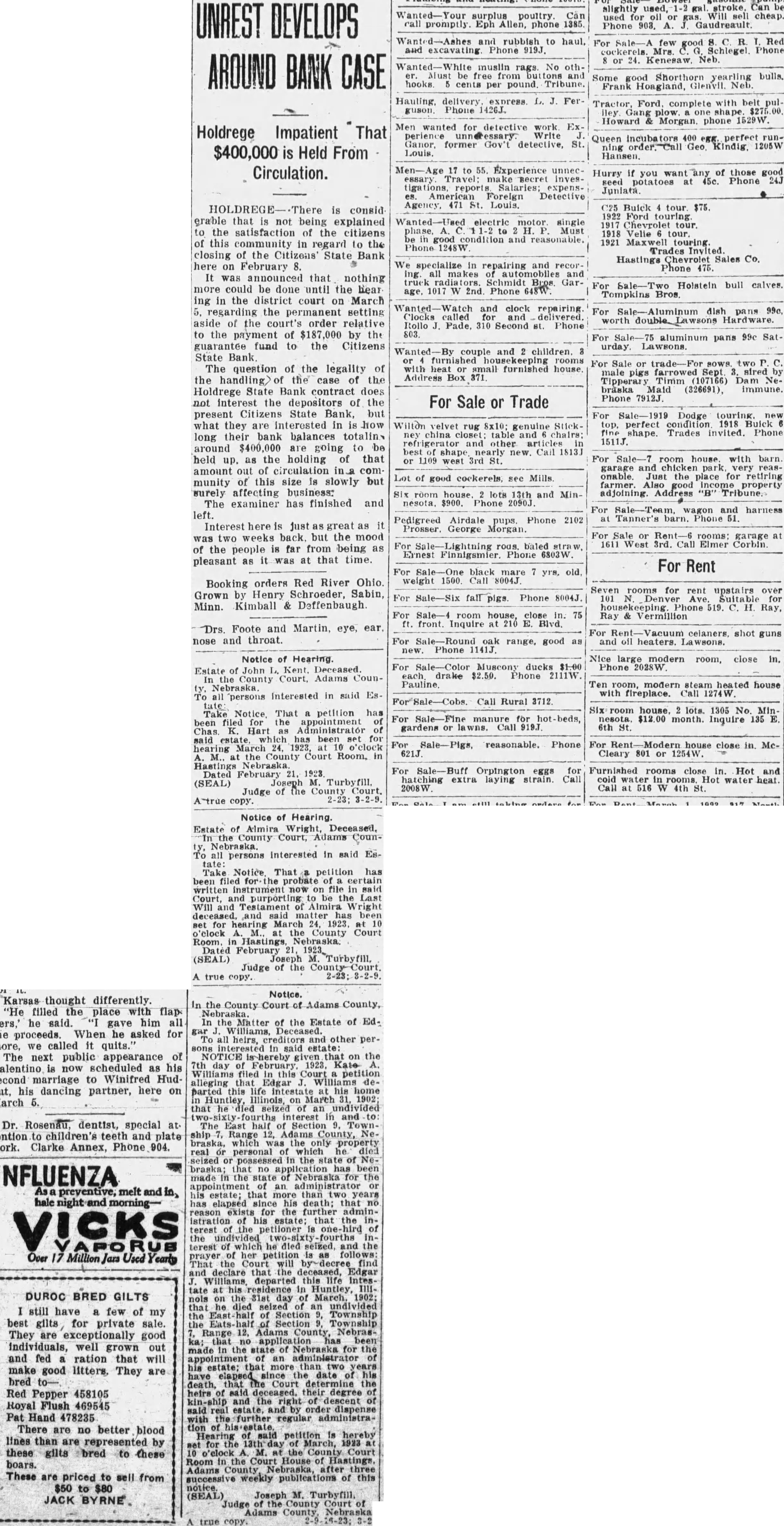
UNREST DEVELOPS AROUND BANK CASE Holdrege Impatient That $400,000 is Held From Circulation. HOLDREGE—There is considerable that is not being explained to the satisfaction of the citizens of this community in regard to the closing of the Citizens' State Bank here on February 8. It was announced that nothing more could be done until the hearing in the district court on March 5, regarding the permanent setting aside of the court's order relative to the payment of $187,000 by the guarantee fund to the Citizens State Bank. The question of the legality of the handling of the case of the Holdrege State Bank contract does not interest the depositors of the present Citizens State Bank, but what they are interested in is how long their bank balances totaling around $400,000 are going to be held up, as the holding of that amount out of circulation in a community of this size is slowly but surely affecting business. The examiner has finished and left. Interest here is just as great as it was two weeks back, but the mood of the people is far from being as pleasant as it was at that time.


Article from Evening World-Herald, March 17, 1923

Click image to open full size in new tab

Article Text

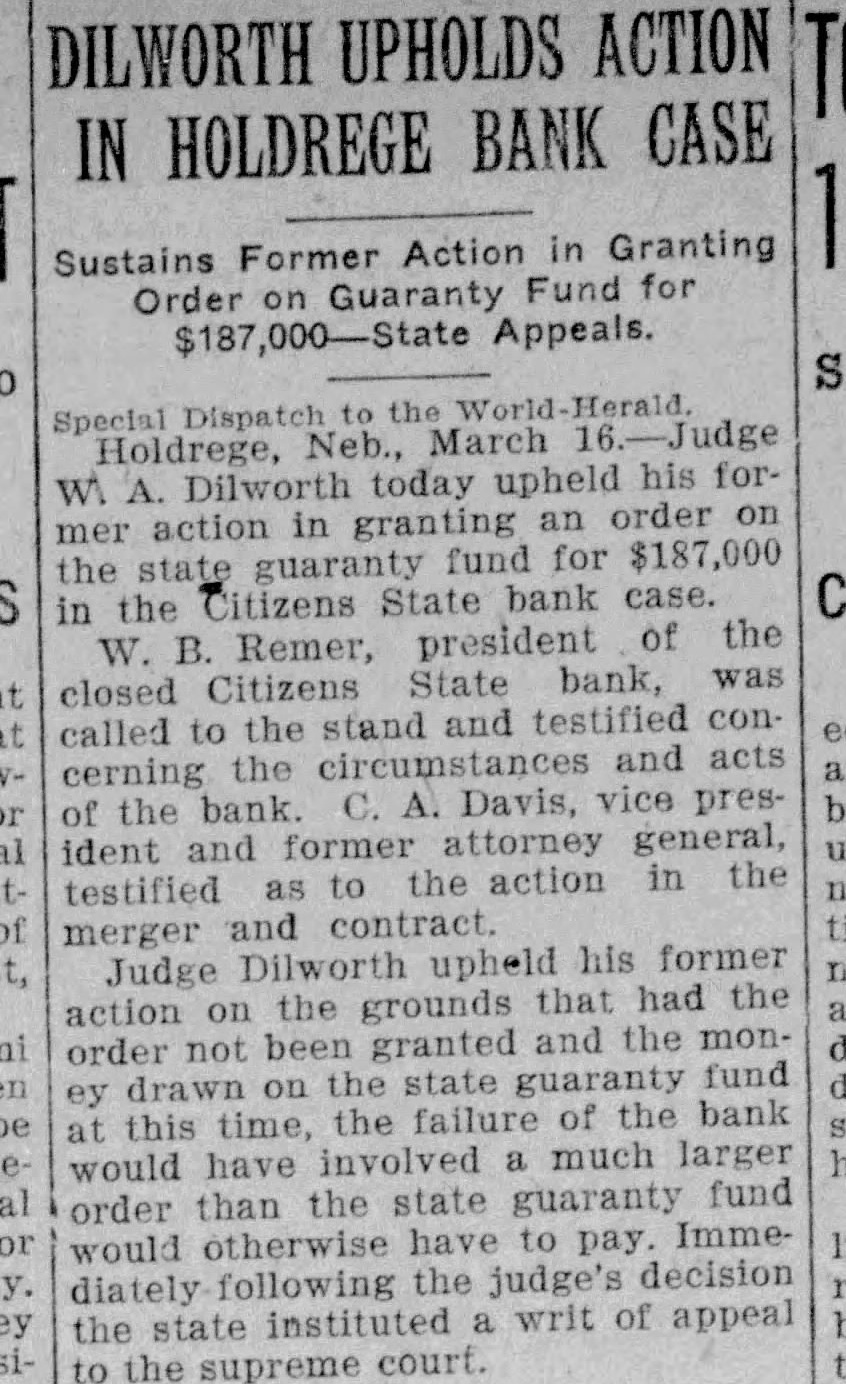
DILWORTH UPHOLDS ACTION IN HOLDREGE BANK CASE Sustains Former Action in Granting Order on Guaranty Fund for $187,000—State Appeals. Special Dispatch to the World-Herald. Holdrege, Neb., March 16.—Judge W. A. Dilworth today upheld his former action in granting an order on the state guaranty fund for $187,000 in the Citizens State bank case. W. B. Remer, president of the closed Citizens State bank, was called to the stand and testified concerning the circumstances and acts of the bank. C. A. Davis, vice president and former attorney general, testified as to the action in the merger and contract. Judge Dilworth upheld his former action on the grounds that had the order not been granted and the money drawn on the state guaranty fund at this time, the failure of the bank would have involved a much larger order than the state guaranty fund would otherwise have to pay. Immediately following the judge's decision the state instituted a writ of appeal to the supreme court.


Article from The Lincoln Star, October 4, 1923

Click image to open full size in new tab

Article Text

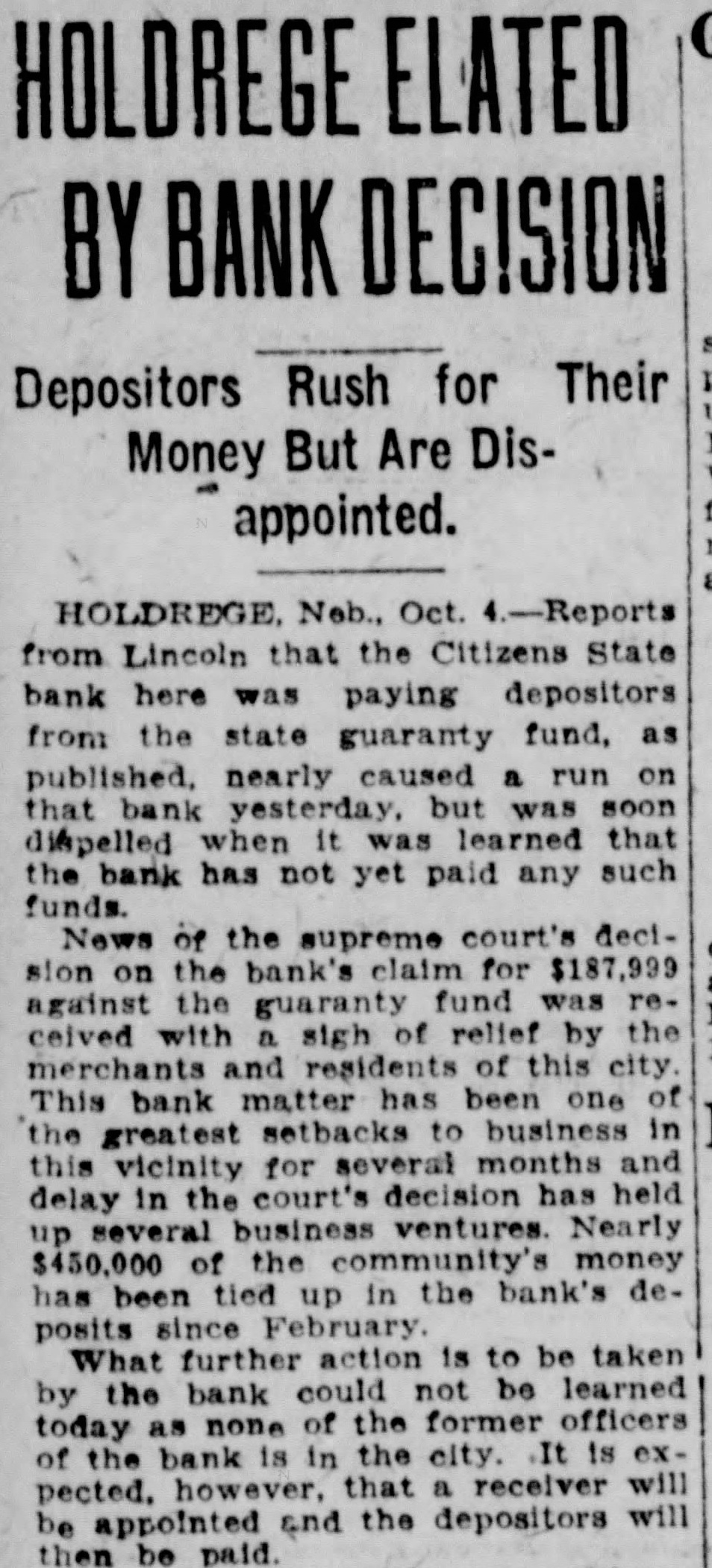
HOLDREGE ELATED BY BANK DECISION Depositors Rush for Their Money But Are Disappointed. HOLDREGE, Neb., Oct. 4.—Reports from Lincoln that the Citizens State bank here was paying depositors from the state guaranty fund, as published, nearly caused a run on that bank yesterday, but was soon dispelled when it was learned that the bank has not yet paid any such funds. News of the supreme court's decision on the bank's claim for $187,999 against the guaranty fund was received with a sigh of relief by the merchants and residents of this city. This bank matter has been one of the greatest setbacks to business in this vicinity for several months and delay in the court's decision has held up several business ventures. Nearly $450,000 of the community's money has been tied up in the bank's deposits since February. What further action is to be taken by the bank could not be learned today as none of the former officers of the bank is in the city. It is expected, however, that a receiver will be appointed and the depositors will then be paid.


Article from Omaha World-Herald, October 4, 1923

Click image to open full size in new tab

Article Text

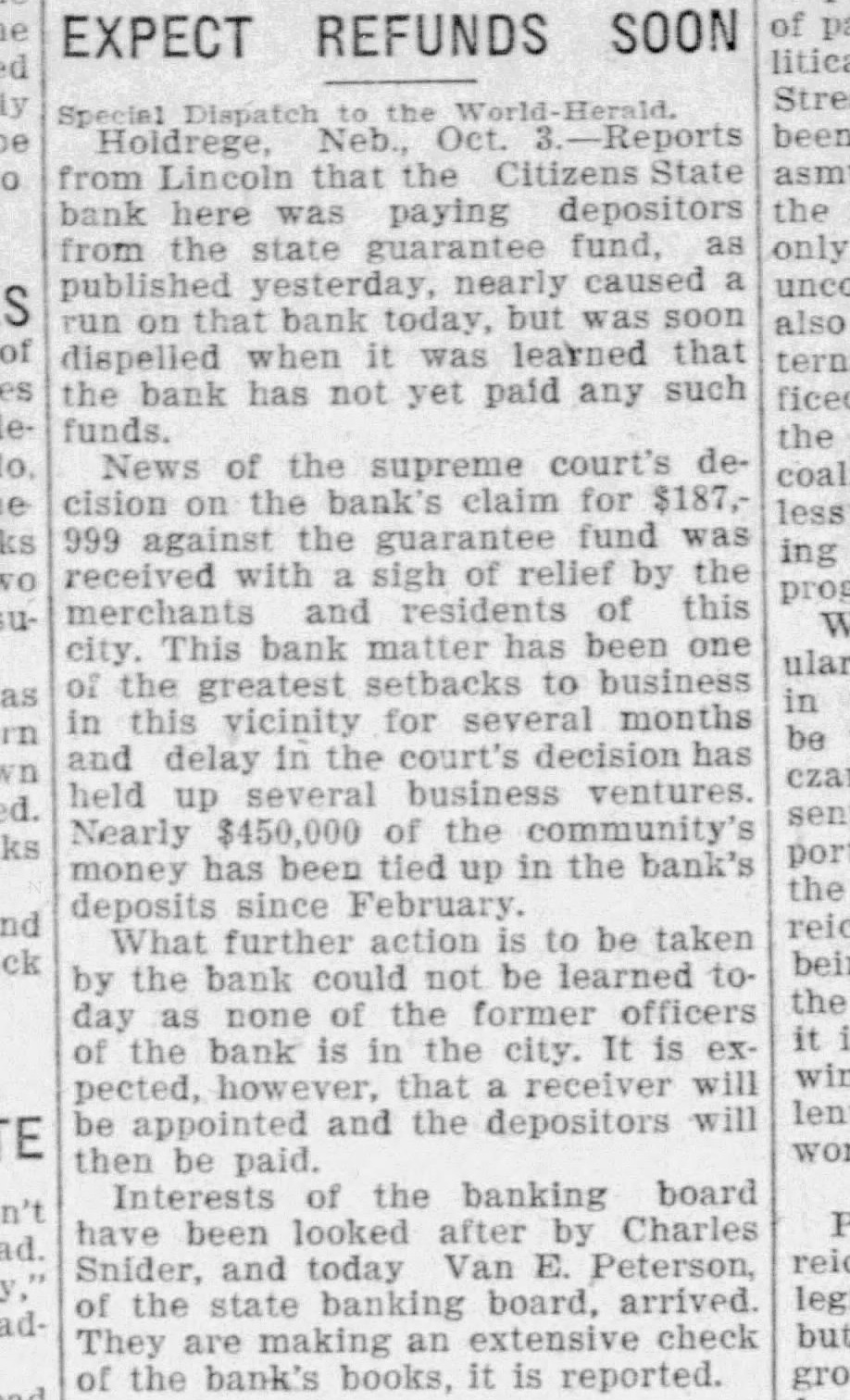
EXPECT REFUNDS SOON Special Dispatch to the World-Herald. Holdrege, Neb., Oct. 3.—Reports from Lincoln that the Citizens State bank here was paying depositors from the state guarantee fund, as published yesterday, nearly caused a run on that bank today, but was soon dispelled when it was learned that the bank has not yet paid any such funds. News of the supreme court's decision on the bank's claim for $187,999 against the guarantee fund was received with a sigh of relief by the merchants and residents of this city. This bank matter has been one of the greatest setbacks to business in this vicinity for several months and delay in the court's decision has held up several business ventures. Nearly $450,000 of the community's money has been tied up in the bank's deposits since February. What further action is to be taken by the bank could not be learned today as none of the former officers of the bank is in the city. It is expected, however, that a receiver will be appointed and the depositors will then be paid. Interests of the banking board have been looked after by Charles Snider, and today Van E. Peterson, of the state banking board, arrived. They are making an extensive check of the bank's books, it is reported.


Article from Evening World-Herald, October 4, 1923

Click image to open full size in new tab

Article Text

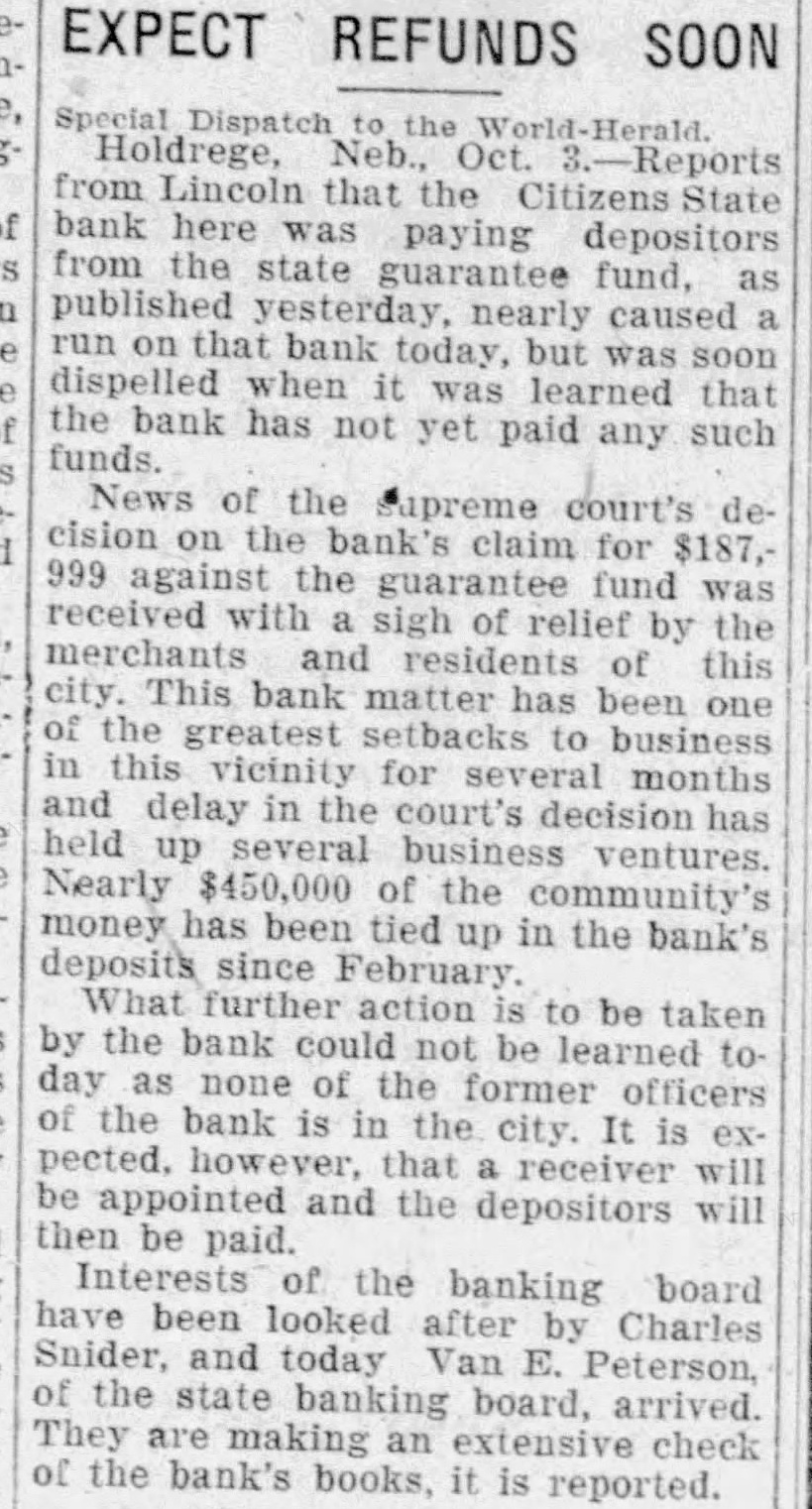
EXPECT REFUNDS SOON Special Dispatch to the World-Herald. Holdrege, Neb., Oct. 3.—Reports from Lincoln that the Citizens State bank here was paying depositors from the state guarantee fund, as published yesterday, nearly caused a run on that bank today, but was soon dispelled when it was learned that the bank has not yet paid any such funds. News of the supreme court's decision on the bank's claim for $187,999 against the guarantee fund was received with a sigh of relief by the merchants and residents of this city. This bank matter has been one of the greatest setbacks to business in this vicinity for several months and delay in the court's decision has held up several business ventures. Nearly $450,000 of the community's money has been tied up in the bank's deposits since February. What further action is to be taken by the bank could not be learned today as none of the former officers of the bank is in the city. It is expected, however, that a receiver will be appointed and the depositors will then be paid. Interests of the banking board have been looked after by Charles Snider, and today Van E. Peterson, of the state banking board, arrived. They are making an extensive check of the bank's books, it is reported.


Article from The Independent Herald, October 5, 1923

Click image to open full size in new tab

Article Text

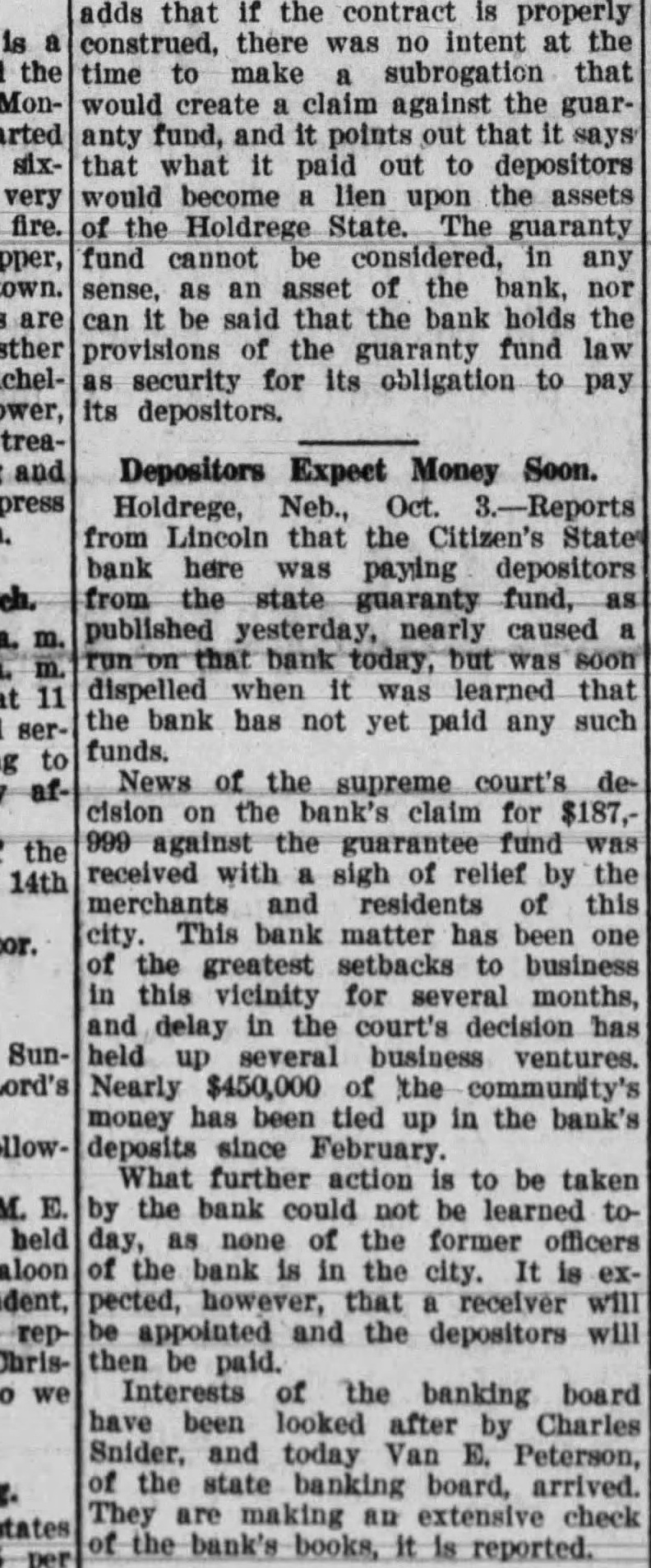
adds that if the contract is properly construed, there was no intent at the time to make a subrogation that would create a claim against the guaranty fund, and it points out that it says that what it paid out to depositors would become a lien upon the assets of the Holdrege State. The guaranty fund cannot be considered, in any sense, as an asset of the bank, nor can it be said that the bank holds the provisions of the guaranty fund law as security for its obligation to pay its depositors. Depositors Expect Money Soon. Holdrege, Neb., Oct. 3.—Reports from Lincoln that the Citizen's State bank here was paying depositors from the state guaranty fund, as published yesterday, nearly caused a run on that bank today, but was soon dispelled when it was learned that the bank has not yet paid any such funds. News of the supreme court's decision on the bank's claim for $187,999 against the guarantee fund was received with a sigh of relief by the merchants and residents of this city. This bank matter has been one of the greatest setbacks to business in this vicinity for several months, and delay in the court's decision has held up several business ventures. Nearly $450,000 of the community's money has been tied up in the bank's deposits since February. What further action is to be taken by the bank could not be learned today, as none of the former officers of the bank is in the city. It is expected, however, that a receiver will be appointed and the depositors will then be paid. Interests of the banking board have been looked after by Charles Snider, and today Van E. Peterson, of the state banking board, arrived. They are making an extensive check of the bank's books, it is reported.