Lyman State Bank (Lyman, NE)

Episode Information

Episode UID
76127871543
Episode Type
Suspension β†’ Closure
Bank Type
state
Bank ID
7612787 routing
Routing Number
76-1278
Start Date
July 1, 1928*
Location
Lyman, Nebraska (41.917, -104.039)

Metadata

Model
gpt-5-mini (chosen from majority vote of a three-model LLM ensemble)
Short Digest
e90a9c30fcb74b48

Response Measures

None

Events (3)

1. July 1, 1928* Suspension
Cause
Bank Specific Adverse Info
Cause Details
Bank is described as having failed/being insolvent (no specific trigger given)
Newspaper Excerpt
the Lyman State bank which failed about year ago
Source
newspapers
2. July 23, 1929 Receivership
Newspaper Excerpt
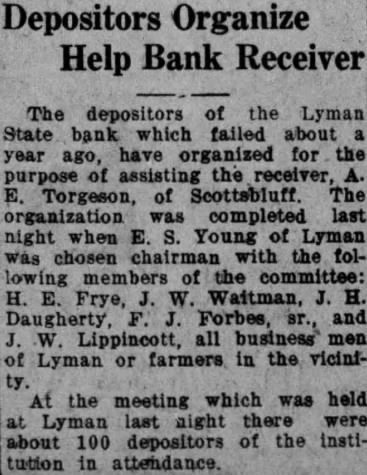
Depositors Organize Help Bank Receiver The depositors of the Lyman State bank which failed about year ago, have organized for the purpose of assisting the receiver, Torgeson, ... At the meeting which was held at Lyman last night there were about 100 depositors of the institution in attendance.
Source
newspapers
3. April 16, 1932 Receivership
Newspaper Excerpt
The Nebraska supreme court today affirmed the action of District Judge E. F. Carter in appointing A. E. Torgeson as receiver of seven failed banks ... The seven banks concerned in the decision today are: ... Lyman State bank ...
Source
newspapers

Newspaper Articles (10)

Article from Scottsbluff Republican, July 23, 1929

Click image to open full size in new tab

Article Text

Depositors Organize Help Bank Receiver The depositors of the Lyman State bank which failed about year ago, have organized for the purpose of assisting the receiver, Torgeson, of The organization was completed last night when E. S. Young of Lyman was chosen chairman with the following members of the committee: Frye, W. Waitman, H. Daugherty, Forbes, and Lippincott, all business of Lyman or farmers in the vicinity. At the meeting which was held at Lyman last night there were about 100 depositors of the institution in attendance.


Article from The Poultney Journal, August 29, 1930

Click image to open full size in new tab

Article Text

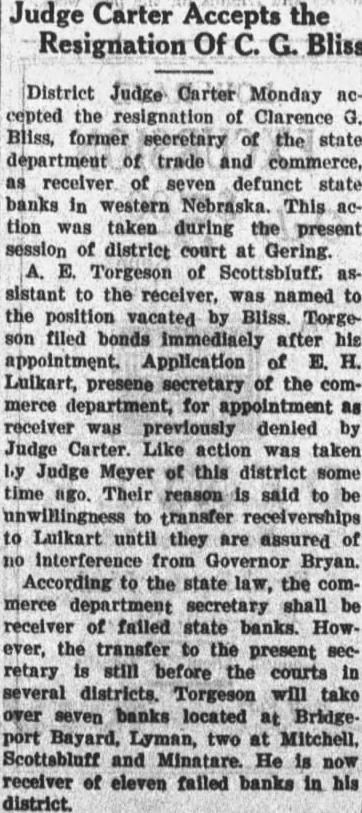
Judge Carter Accepts the Resignation Of C. G. Bliss District Judge Carter Monday accepted the resignation of Clarence G. Bliss, former secretary of the state department of trade and commerce, as receiver of seven defunct state banks in western Nebraska. This action was taken during the present session of district court at Gering. A. E. Torgeson of Scottsbluff, assistant to the receiver, was named to the position vacated by Bliss. Torge son filed bonds immediaely after his appointment. Application of E. H. Luikart, presene secretary of the commerce department, for appointment as receiver was previously denied by Judge Carter. Like action was taken by Judge Meyer of this district some time ago. Their reason is said to be unwillingness to transfer receiverships to Luikart until they are assured of no interference from Governor Bryan. According to the state law, the commerce department secretary shall be receiver of failed state banks. However, the transfer to the present Becretary is still before the courts in several districts. Torgeson will take over seven banks located at Bridgeport Bayard, Lyman, two at Mitchell. Scottsbluff and Minatare. He is now receiver of eleven failed banks in his district.


Article Text

ART TORGESON SUCCEEDS BLISS AS BANK RECEIVER Arthur Torgeson, brother of Atty. Torgeson of this city and forbank employe here, will succeed H. Bliss as bank receiver in this district. special from Gering says: Bliss, former secretary of trade and commerce, presented his final report and resignation as receiver for seven defunct state banks in the Seventeenth judicial district to Judge Carter here Tuesday. Torgeson of Scottsbluff appointed to succeed Bliss as The defunct banks involved in Tuesday's reports are Irrigators', Scottsbluff; American bank and Mitchell State, Mitchell; Lyman State, Lyman: State bank, Bank of Bayard at Bayard; Nebraska State at Bridgeport.


Article Text

POWER TO SELECT BANKS' RECEIVERS Legislature Held to Have Overstepped Powers in Enacting Law. Declaring that the imperative duty the judicial department of government to protect its jurisdiction. at the boundaries power fixed by the constitution and that the naming of state bank judicial function which exercised or trolled the governor or legislature, supreme Saturday upheld the action of District Judge Carter Morrill in refusname H. Luikart, secretary trade commerce, receiver for Mitchell State bank, Irrigators bank Bridgeort, Lyman State bank, State bank of Scottsbluff, State bank Bridgeport, State Bank of Minatare, and Bank of Bayard. Justices Paine and Day dissented. The court, an opinion written Justice Rose, that legislative act providing that the secretary trade commerce shall be the receiver of all insolvent state banks amounts no more than judicial proceedproperly pending court equity liquidation of bank, than legislative recommendation to the judiciary to point him, otherwise the enactment an encroachment on judicial power. Judge Carter Named Torgeson. Judge Carter was the only district judge who refused name Luikart, when the latter succeeded Bliss. He appointed Torgeson, who been assistant ceiver under Bliss, the ground that having had actual charge liquidation of these seven banks better position serve all interests than Luikart, name one to handle their The court points out in its sion that the statutes nowhere provide for the liquidation of state banks invoking the judicial power the state, the has granted any officer, administrative board, or tribunal (Continued on Page 8.)


Article Text

"In a pending cause, the chief executive and the legislature cannot change or modify judicial orders or lawfully require the court to do so. A judicial order in pending litigation does not change with political fortunes or legislative acts or executive appointments." Outlining the separation of powers in both the federal and state governments, Judge Rose wrote that it is imperative that the judicial department of the government protect its jurisdiction at the boundaries of power fixed by the constitution. Quasi Public Business. Judge Paine, however, in his dissenting opinion argued that banking is a quasi public business which the state may control as it sees fit and that the legislature had authority to provide any means of liquidating insolvent state banks. The plan adopted by the 1929 legislature of liquidating failed banks with a state official as receiver brought order out of chaos, reduced the expense of liquidation, and need be considered no limitation on judicial power, Judge Paine held. "The old plan of individual receiverships under individual district judges having been tried and found wanting, the new plan promises a great improvement," he wrote, "and should not in these times of distress, be hampered by any undue jealousy on the part of the judiciary for fear its right may be infringed upon." He urged that the judiciary should co-operate with the will of the legislature "to the great end that the depositors may receive the largest possible sum from a prompt, vigorous and efficient liquidation of banks by one responsible person, to-wit, the secretary of the department of trade and commerce." The seven banks for which Torgeson had been named receiver and in which the appointment was upheld Saturday were the State bank of Minatare, Mitchell State bank, Irrigators' State bank, Scottsbluff; Lyman State bank, American bank, Mitchell; Nebraska State bank, Bridgeport and the Bank of Bayard.


Article Text

COURTS ONLY HAVE POWER TO SELECT BANKS' RECEIVERS Legislature Held to Have Overstepped Powers in Enacting a Law. Declaring that it is the imperative duty of the judicial department of government to protect its jurisdiction at the boundaries of power fixed by the constitution and that the naming of state bank receivers is a judicial function which cannot be exercised or controlled by the governor or legislature, the supreme court Saturday upheld the action of District Judge Carter at Morrill in refusing to name E. H. Luikart, secretary of trade and commerce, as receiver for the Mitchell State bank, Irrigators State bank of Bridgeport, Lyman State bank, American State bank of Scottsbluff, Nebraska State bank of Bridgeport, State Bank of Minatare, and Bank of Bayard. Justices Paine and Day dissented. The court, in an opinion written by Justice Rose, says that a legislative act providing that the secretary of trade and commerce shall be the sole receiver of all insolvent state banks amounts to no more than a judicial proceeding, properly pending in a court of equity for the liquidation of a bank, than a legislative recommendation to the judiciary to appoint him, as otherwise the enactment would be an unconstitutional encroachment on judicial power. Judge Carter Named Torgeson. Judge Carter was the only district judge who refused to name Luikart, when the latter succeeded Bliss. He appointed A. E. Torgeson, who had been assistant receiver under Bliss, on the ground that having had actual charge of the liquidation of these seven banks he was in a better position to serve all interests than Luikart, who must necessarily name some one to handle their liquidation. The court points out in its decision that the statutes nowhere provide for the liquidation of state banks without invoking the judicial power of the state, and the legislature has never granted to any executive officer, administrative board, department or tribunal (Continued on Page 8.)


Article Text

Judge Announced He Would Not Consider Substitution of Luikart for Bliss Unless Assured Bryan Would Not Interfere. Lincoln, Apr. 16. (AP)β€”The Nebraska supreme court today sustained the action of District Judge E. F. Carter of Gering in appointing A. E. Torgeson of Scottsbluff as receiver of seven failed state banks in the seventeenth judicial district. Judge Carter had refused the application of E. H. Luikart, secretary of the state department of trade and commerce, to be made receiver succeeding Clarence Bliss, his predecessor in office. The supreme court held that where the liquidation of a state bank is conducted in a court of equity the procedure is judicial and not executive. The court also ruled that the appointment of a receiver should not be made or controlled by the governor or legislature. It is the imperative duty of the judicial department to protect its jurisdiction at the boundaries of power fixed by the constitution, the court declared. A legislative act providing for the appointment of the secretary of the department of trade and commerce as receiver for all insolvent state banks must be regarded as merely a legislative recommendation to the court, the opinion stated. Otherwise this act would be unconstitutional, the court finds. The decision of the court terminates a controversy between state banking department officials, Gov. Bryan and Judge Carter. Torgeson was appointed receiver of the banks when Clarence G. Bliss, former secretary of the department of trade and commerce, resigned. F. C. Radke, counsel for the receivership division, applied for the appointment of Luikart, but this was refused by Judge Carter. Seven Banks Affected Judge Carter announced he would not consider the substitution of Luikart for Bliss until he was assured Gov. Bryan would not interfere with Luikart as receiver. Torgeson subsequently was named. The seven banks concerned in the decision today are the State Bank of Minatare, the Mitchell State Bank, Irrigator's Bank of Scottsbluff, the Lyman State Bank, the American Bank of Mitchell, the Nebraska State Bank of Bridgeport, and the Bank of Bayard. The eighth bank in the 17th district turned over to Torgeson was the Bridgeport bank. "In a cause properly before a court of equity for determination," the court added the appointment of a necessary receiver is a judicial function which cannot be exercised or controlled by the governor or the legislature." In another place the court said: "It is an imperative duty of the judicial department of government to protect its jurisdiction at the boundaries of power fixed by the constitution."
Article Text

Courts Only Have Power To Select Banks' Receivers Declaring that the imperative duty of the judicial department government protect its jurisdiction the boundaries of power fixed and that the naming state bank receivers judicial function which cannot be exercised controlled the governor the supreme court urday upheld the action of District Judge Carter Morrill in refusing name secretary trade and commerce, receiver the State bank, Irrigators bank Bridgeport, Lyman State American State bank Nebraska State bank State Bank of Minatare and Bank Bayard The in an opinion written Rose, that providing that secretary trade and commerce shall be the of all insolvent more than pending equity for the liquidat bank, than legislative the judiciary point the enact ment would be an judicial power. Judge the only district judge refused name when latter succeeded He appointed Torgeson, who had been under Bliss, on the ground that having had charge the liquidation of these seven banks he a better sition all interests than Luikart who must necessarily to handle their liquidation. The court points out in its decision that the statutes nowhere provide the liquidation of state banks without invoking the judicial power the and the legislature has never granted to any executive administrative board, department tribunal authority wind of banks without invoking the of the court. The law that the secretary of trade and commerce shall report bank's insolvency to the attorney general, shall ask the courts name receiver, and then proceeds to tell the court shall name the secretary as receivUse of the courts for purposes liquidation has been the universal practice both before and after the under discussion was passed. law makers themselves judicial sale barn the Teeter Stock Co., which has done business during the fall and and which has attracted large crowds to Beaver City every Friday afternoon, closed last Friday for the summer. Sales are limited during weather and would be warm profitable conduct the sale until early fall. when will re-opened and conducted as hereto-


Article Text

TORGESON WINS IN SUPREME COURT SUPREME COURT UPHOLDS DECISION OF JUDGE CARTER IN BANK RECEIVER CASE Linceln. April 16-The Nebraska supreme court today affirmed the action of District Judge E. F. Carter in appointing A. E. Torgeson as receiver of seven failed banks in the seventeenth judicial district. The deeision terminates a controversy between state banking department officials, Governor Bryan and Judge Carter Torgeson was appointed receiver for the banks when Clarence G. Bliss, former secretary of department of trade and commerce, resigned. F. C. Radke, counsel for receivership division. applied for appointment of E. H. Luikart, Bliss' successor, but this was refused by Carter. Carter announced he would not consider substitution of Luikart for Bliss until assured Governor Bryan would not interfere with Luikart as receiver. Torgeson subsequenty was named. The seven banks concerned in the decision today are: State bank of Minatare Mitchell State bank, Irrigators bank of Scottsbluff, Lyman State bank, American Bank of Mitchell, Nebraska State bank of Bridgeport, and the Bank of Bayard. The eighth bank in the district turned over to Torgeson was the Bridgeport Affirming Judge Carter's action, the court held where liquidation of an insolvent state bank is conducted in court of equity pursuant to law, the proceedings is a judicial and not executive order, from which an appeal is allowed by statute. "In a cause properly before court of equity", the court added, "for determination, appointment of a necessary receiver is a judicial function which cannot be exercised or controlled by the governor or the legislature." The court also said: "It is an imperative duty of the judicial department of the government to protect its jurisdiction at the boundaries of prower fixed by the constitution.' Answering the contention of Governor Bryan, Luikhart and Radke, that the law clearly specifies the trade and commerce department secretary shall be sole and only receiver, the court said: "A legislative act providing the secretary shall be the sole receiver of all insolvent state banks, amounts to no more in a judicial proceeding, properly pending in a court of equity for the liquidation of a bank, than legislative recommendation to the judiclary to appoint him. as otherwise the enactment would be an unconstitutional encroachment on judicial power." The affirming decision, written by Justice W. B. Rose and concurred in by majority of the court, was dissented to by Justice Bayard A. Paine Justice L B. Day also dissented to the majority decision, but did not concur in Justice Paine's prepared opinion of dissent.


Article Text

CARTER DECISIOIN BANK RECEIVERSHIPS SAYS POWER NOT VESTED IN GOVERNOR TO APPOINT RECEIVERS OF FAILED BANKS Act Unconstitutional Declaring that is the imperative duty of the judicial of to protect its jurisdiction the boundaries of power fixed the constitution and the naming state bank receivers judicial function which cannot be exercised controlled by the governor or legislature, supreme court Saturday upheld the action of District Judge Carter of this judicial district, in fusing to name Luikart, tary trade and commerce, ceiver for American Bank of Mitchell, Irrigators bank of Scottsbluff, Lyman State bank, American State bank Scottsbluff, Nebraska State bank Bridgeport, State Bank of Bank of Bayard. tices Paine and Day dissented. The court, in an opinion written Justice Rose, says that legislative providing that the secretary trade and shall be sole receiver of all insolvent state banks amounts to no more than judicial proceeding, properly pending in court of equity for the liquidation bank, than legislative recommendation the judiciary to appoint him, as the would be an croachment on judicial power. Judge Carter Named Torgeson Judge Carter was the only district judge who refused to name Luikart, when the latter succeeded Bliss. appointed Torgeson, who had been assistant receiver under Bliss, on the ground that had actual of the these sevbanks he was in better position serve interests than Luikart, must necessarily name some one handle their liquidation. The court points out in decision that the statutes nowhere provide for liquidation state banks withinvoking the judicial power state, and the legislature has granted to any executive board, tribunal authority wind up affairs banks the The law is that the tary of trade and shall port bank's insolvency to the attorney general, who shall ask the courts name receiver, and then ceeds tell the court that name the secretary as receiver. Use the courts for purposes of liquidation has been the universal practice both before and after the law under discussion was passed. The lawmakthemselves provided for judicial The court says that as the governnames the secretary and may tire him and name another, the fect of the law to make mandatory on the courts to name whoever he names, and to modify the ment of the court. Neither the nor the legislative department pending cause, can change modify judicial orders or lawfully quire the court to do judicial order pending does change political fortunes or acts executive ments. Can't Surrender Power. The framers of the constitutions, state and federal, have adopted the plan executive, legislative and dicial departments independent other. has been regarded by statesmen and standing advancement in the science government. Throughout the history of the present the courts have spected the of the other and extended them the due to divisions equal rank, but courtesy to the surrendering judicial power. Justice Paine, in his dissent, said that to back to the custom district judge appointing pendent receivers each county for banks will defeat the whole worked out the legislature. thought that the supreme court should the fact that disjudges in all other districts named He the plan has brought order out of chaos tends for speedy and While an officer the court justice thinks that the case presents just overlapping power in the twilight zone between departments. suggests that the judiciary cheerfully co-operate the end prompt, vigorous efficient by responsible person be effected in the interest of depositors. Franz Radke, counsel for the banksaid the cision given Saturday that effect sought for in be secured another change the statutes. believes not be necessary change constitution in have control of receiverships placed the hands of the Radke believes inconsistent for the state to set up an elaborate machine for the handling of receiveronly have the court say ship, ably would not effect changes any districts where judges have given their permission for him to act ceiver. doesn't make any difference personally,' the secretary plained, do this work without pay. handled in this office simplified manner."