The bank was closed by the state banking board in Oct 1919, reopened by supreme court, then suffered renewed trouble and closed again (with a receiver) in early 1921.
Events (5)
1.October 1, 1919*Suspension
Cause
Government Action
Cause Details
Closed by the state banking board following examiner reports and appointment of a receiver by the board.
Newspaper Excerpt
closed by the state banking board recently
Source
newspapers
+24 days
2.October 25, 1919Reopening
Newspaper Excerpt
The Scandinavian-American bank ... was reopened for business today. State Bank Examiner Lofthus surrendered receivership following a decision of the supreme court that the bank was solvent.
Source
newspapers
+16 months
3.February 14, 1921Run
Cause
Bank Specific Adverse Info
Cause Details
Reported shortages/controversial examination practices and capital/reserve concerns triggered depositor agitation and withdrawals.
Measures
Deputy bank examiners conducted an examination of the books; later a receiver conducted collections.
Newspaper Excerpt
it ceases to be a wonder that a run developed again on the Fargo institution and it was forced to close its doors recently.
Source
newspapers
same day
4.February 14, 1921Suspension
Cause
Bank Specific Adverse Info
Cause Details
Bank closed after renewed run/insolvency concerns and examination findings.
Newspaper Excerpt
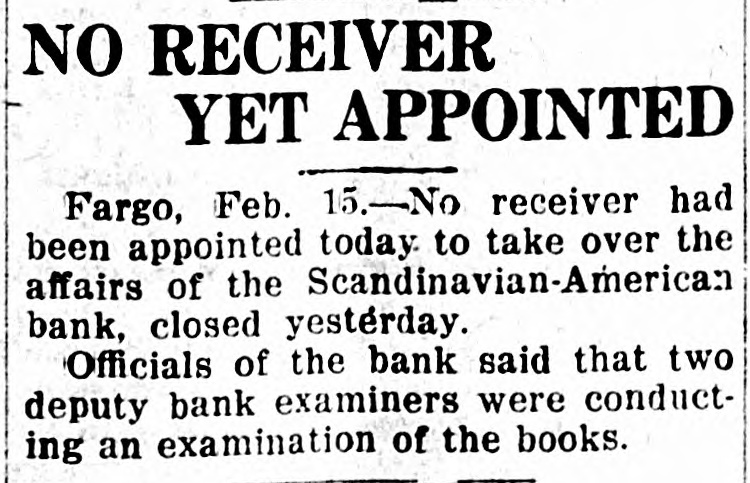
No receiver had been appointed today to take over the affairs of the Scandinavian-American bank, closed yesterday.
Source
newspapers
+15 days
5.March 1, 1921*Receivership
Newspaper Excerpt
representative of the receiver of the defunct Scandinavian-American bank of Fargo ... is trying to collect approximately $17,000 on a note ... held by the Fargo bank receiver, and the collector is making every effort to collect ... .
Source
newspapers
Newspaper Articles (25)
1.October 9, 1919The Bismarck TribuneBismarck, Mandan, ND
Click image to open full size in new tab
Article Text
LOFTHUS AGREES TO PUNISH N
D. BANKING BOARD Townley Bank Examiner Declares Action of Commission Will Be "Reviewed" LANGER RECEIVES NOTICE The Fargo Townley organ carries the following statement of the rescue of the Scandinavian-American bank: O.E. Lofthus, state bank examiner, yesterday morning took charge of the affairs of the Scandinavian-American bank of Fargo, which was closed by Attorney General William Langer and Secretary of State Thomas Hall last Thursday. P. E. Halldorson, appointed by Langer as temporary receiver, was ousted by Mr. Lofthus, under an order issued by the state supreme court Wednesday afternoon. Collections Received Collections were received by Mr. Lofthus yesterday, some of which at least, had been refused by the "receiver the day before according to statements made. Steps were taken to check up the affairs of the institution. Mr. Lofthus is in charge as bank examiner, not as a receiver. Last evening Mr. Lofthus issued a statement to the public pledging that the action of Langer and Hall in closis to ing the the courts, bank and he be impresses fully reviewed by upon the no lutely public possibility the fact that of the there depositors is absolosing a single dollar. The bank examiner's statement follows: Lofthus' Statement "To the depositors of the Scandinavian-American bank of Fargo, North Dakota: "The temporary receiver appointed for the above bank by the state banking board has been ousted by the supreme court of the state of North Dakota. action of the board in closing "The this bank is going banking to be fully reviewed and investigated by the courts of this state; and pending said investigation the supreme court has placed the undersigned, state bank examiner, in charge of the property of the bank. "I desire to impress upon the depositors of this bank, the fact that there is absolutely no possibility of their losing a single dollar; and all reasonable diligence and dispatch will be used by the undersigned in completing my duties with a view to the early payment of your account. "Respectfully, "O. E. LOFTHUS, "State Bank Examiner." Yesterday morning, in taking charge of the bank, Mr. Lofthus served the following notice on Halldorson and Albert Sheets: "To William Langer, Albert E. Sheets, Jr., Thomas Hall, and P. E. Halldorson: "I,O.E. Lofthus, state bank exand complete aminer, having control assumed of the manage- full can order ment of bank of the the of Scandinavian-Ameri- Fargo, court, N. D., do by hereby you, that notify I will supreme you, hold and each responsible of for or or any any property documents that you may papers, have disduring appeared, the taken if time any, unlawful from that you this bank have held and possession, and for this reason, "I suggest that one, or all of you, remain in this bank while I make a complete check so that you may yourselves be advised in the premises as to your responsibility. "Dated this eight day of October, A. D. 1919, at Fargo, N.D. "Signed, "0. E. LOFTHUS, "State Bank Examiner."
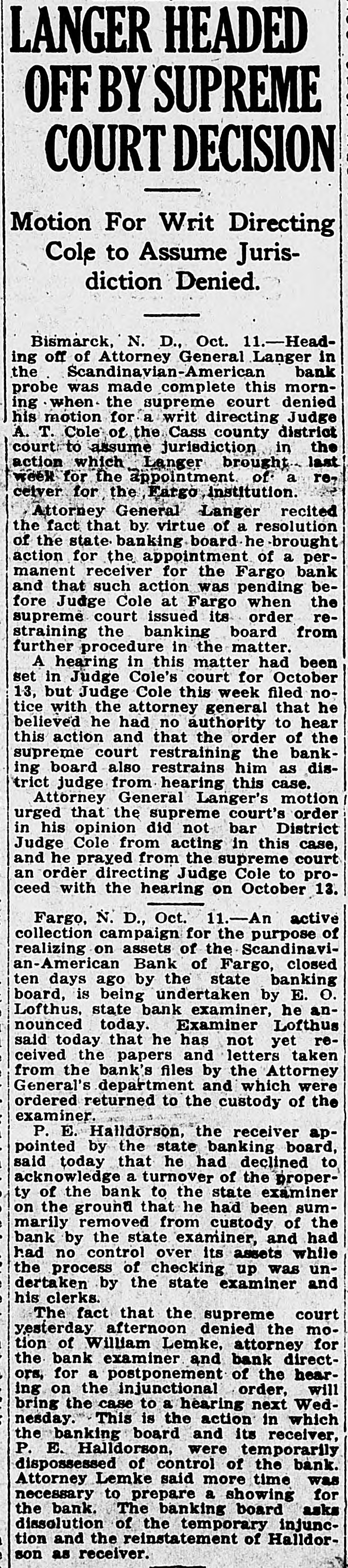
LANGER HEADED OFF BY SUPREME COURT DECISION Motion For Writ Directing Cole to Assume Jurisdiction Denied. Bismarck, N. D., Oct. 11.-Heading off of Attorney General Langer in the Scandinavian-American bank probe was made complete this morning when the supreme court denied his motion for a writ directing Judge A. T. Cole of the Cass county district court to assume jurisdiction in the action which Langer brought last week for the appointment. of a re? celver for the Fargo institution. Attorney General Langer recited the fact that by virtue of a resolution state. banking he-brought appointment a for the action of manent the for receiver the Fargo of bank perand that such action was pending before Judge Cole at Fargo when the supreme court issued its order restraining the banking board from further procedure in the matter. A hearing in this matter had been set in Judge Cole's court for October 13, but Judge Cole this week filed notice with the attorney general that he believed he had no authority to hear this action and that the order of the supreme court restraining the banking board also restrains him as district judge from hearing this case. Attorney General Langer's motion urged that the supreme court's order in his opinion did not bar District Judge Cole from acting in this case, and he prayed from the supreme court an order directing Judge Cole to proceed with the hearing on October 13. Fargo, N. D., Oct. 11.-An active for the purpose on assets of the collection realizing campaign Scandinavi- of an-American Bank of Fargo, closed ten days ago by the state banking board, is being undertaken by E. O. Lofthus, state bank examiner, he announced today. Examiner Lofthus said today that he has not yet received the papers and letters taken from the bank's files by the Attorney General's department and which were ordered returned to the custody of the examiner. P. E. Halldorson, the receiver appointed by the state banking board, said today that he had declined to acknowledge a turnover of the property of the bank to the state examiner on the ground that he had been summarily removed from custody of the bank by the state examiner, and had had no control over its assets while the process of checking up was undertaken by the state examiner and his clerks. The fact that the supreme court yesterday afternoon denied the motion of William Lemke, attorney for the bank examiner and bank directors, for a postponement of the hearing on the injunctional order, will bring the case to a hearing next Wednesday. This is the action in which the banking board and its receiver, P. E. Halldorson, were temporarily dispossessed of control of the bank. Attorney Lemke said more time was necessary to prepare a showing for the bank. The banking board asks dissolution of the temporary injunction and the reinstatement of Halldorson as receiver.
3.October 24, 1919The Pioneer ExpressPembina, ND
Click image to open full size in new tab
Article Text
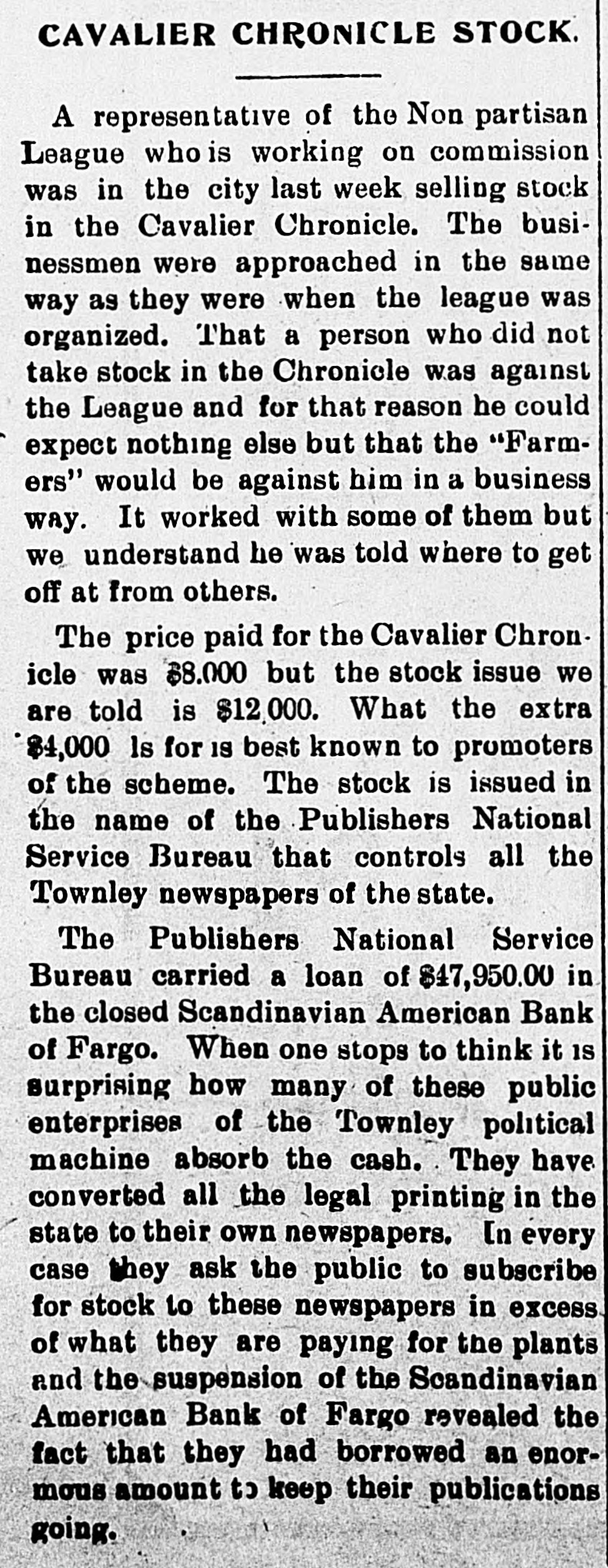
CAVALIER CHRONICLE STOCK
A representative of the Non partisan League who is working on commission was in the city last week selling stock in the Cavalier Chronicle. The businessmen were approached in the same way as they were when the league was organized. That a person who did not take stock in the Chronicle was against the League and for that reason he could expect nothing else but that the "Farmers" would be against him in a business way. It worked with some of them but we understand he was told where to get off at from others. The price paid for the Cavalier Chronicle was $8.000 but the stock issue we are told is $12,000. What the extra $4,000 Is for IS best known to promoters of the scheme. The stock is issued in the name of the Publishers National Service Bureau that controls all the Townley newspapers of the state. The Publishers National Service Bureau carried a loan of $47,950.00 in the closed Scandinavian American Bank of Fargo. When one stops to think it IS surprising how many of these public enterprises of the Townley political machine absorb the cash. They have converted all the legal printing in the state to their own newspapers. In every case they ask the public to subscribe for stock to these newspapers in excess of what they are paying for the plants and the suspension of the Scandinavian American Bank of Fargo revealed the fact that they had borrowed an enormous amount to keep their publications going.
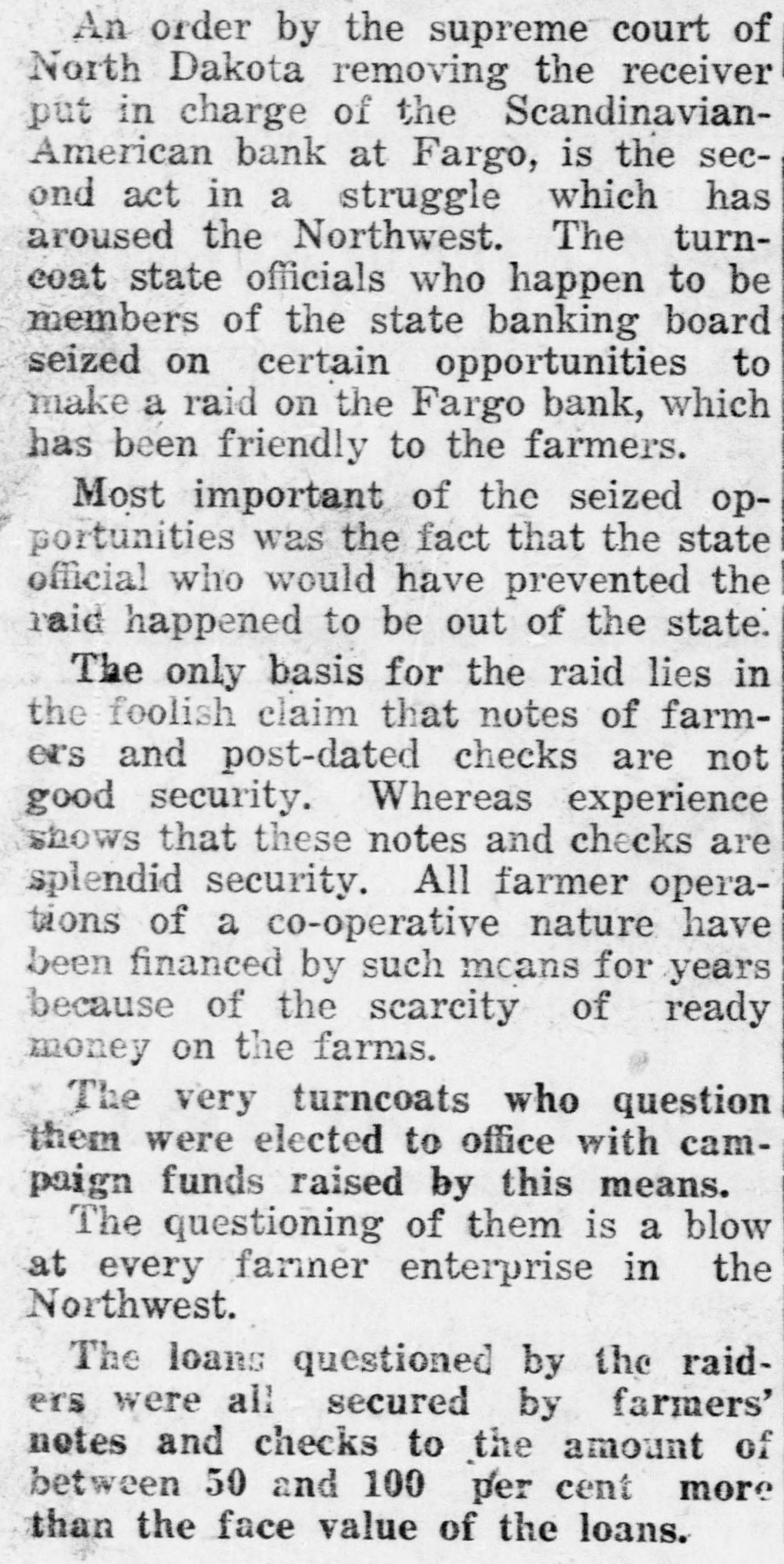
An order by the supreme court of North Dakota removing the receiver put in charge of the Scandinavian-American bank at Fargo, is the second act in a struggle which has aroused the Northwest. The turncoat state officials who happen to be members of the state banking board seized on certain opportunities to make a raid on the Fargo bank, which has been friendly to the farmers.
Most important of the seized opportunities was the fact that the state official who would have prevented the raid happened to be out of the state.
The only basis for the raid lies in the foolish claim that notes of farmers and post-dated checks are not good security. Whereas experience shows that these notes and checks are splendid security. All farmer operations of a co-operative nature have been financed by such means for years because of the scarcity of ready money on the farms.
The very turncoats who question them were elected to office with campaign funds raised by this means. The questioning of them is a blow at every farmer enterprise in the Northwest.
The loans questioned by the raiders were all secured by farmers' notes and checks to the amount of between 50 and 100 per cent more than the face value of the loans.
5.October 25, 1919The Daily Gate City and Constitution-DemocratKeokuk, IA
Click image to open full size in new tab
Article Text
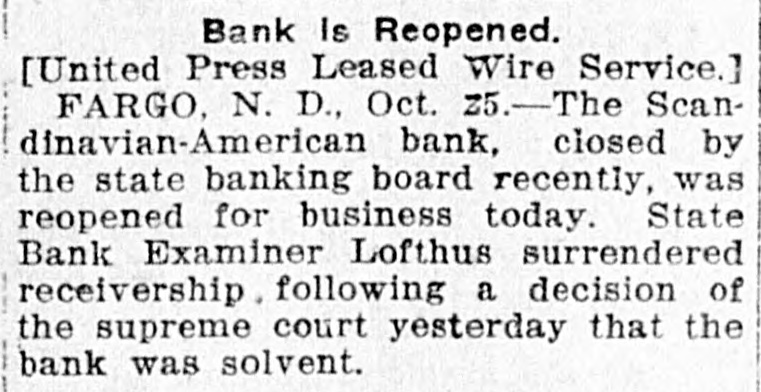
Bank Is Reopened
[United Press Leased Wire Service. ] FARGO, N. D., Oct. Z5.-The Scandinavian-American bank, closed by the state banking board recently, was reopened for business today. State Bank Examiner Lofthus surrendered receivership following a decision of the supreme court yesterday that the bank was solvent.
6.October 25, 1919The Topeka State JournalTopeka, KS
Click image to open full size in new tab
Article Text
Fargo, N. D., Oct. 25.-The Scandinavian-American bank closed by the state banking board recently, was re+ opened for business today. State Banking Examiner Lofthus surrendered receivership following a decision of the supreme court yesterday that the bank was solvent.
7.October 28, 1919Omaha Daily BeeOmaha, NE
Click image to open full size in new tab
Article Text
The Scandinavian-American bank of Fargo has been reopened, the supreme court of North Dakota having removed the receiver and declared the bank solvent. The acid test will come when the depositors try to get their money.
8.October 29, 1919Willmar TribuneWillmar, MN
Click image to open full size in new tab
Article Text
GREAT FARMER RALLY BOOSTS FARGO BANK Vote to Raise Capital and Surplus From $60,000 to $600,000. By E. B. Fussell. Fargo, N. D.-as an answer to the attempts to wreck the Scandinavian-American bank at Fargo, 7,000 League farmers gathered here on Tuesday, October 21, and decided to increase the capital and surplus of the bank, now $60,000, to $600,000, making it the largest bank in North Dakota. It was the greatest meeting in the history of the League. The Fargo Auditorium, seating 3,500, was crowded a half-hour before the meeting started and after all avallable standing space had been filled it was necessary to hold afternoon and evening overflow meetings out of doors. Farmers from the northern part of the state were on hand with two bands boosting for Grand Forks for the location of the big $1,500,000 mill and elevator. "There are no bank wreckers in Grand Forks," was their chief argument, and though the meeting was held in Fargo, the chief rival of the Forks for the mill and elevator, the Auditorium resounded with cheers for the northern town.' Governor Speaks. Governor Lynn J. Frazier was accorded a tremendous ovation when he addressed the night meeting. Minnesota and North Dakota "Frazier-for-President" clubs were on hand urging his choice by the Republican national convention for first place on the presidential ticket in 1920. President A. C. Townley of the League addressed both afternoon and evening sessions and held the big crowd spellbound as he told of the founding of the League, the fights that it had met and won and of the final effort made now to down it through financial influences. M. W. Thatcher, president of the Equitable Audit company of Minneapolis, told the farmers the true condition of the Scandinavian-American bank. Despite the attempts to break it by starting a run the bank has cash resources of nearly $400,000, he pointed out, and had nearly twice the legal reserve required. Run to Deposit. Following the meeting a sure-enough "run" on the bank was started. It was not a run to withdraw deposits, however, but to put up more money. A dozen tellers and volunteer clerks were kept busy until after midnight, receipting for subscriptions to additional stock and for deposits to be placed in the bank as soon as it re-opened. Individual deposits ranged from $50 up to $5,000, while telegrams were received at the meeting offering deposits from banks and individuals. Other speakers at the meeting included President J. M. Anderson of the Equity exchange, former Congressman James Manahan of Minneapolis, Speaker L. L. Stair of the North Dakota house of representatives, Senator J. I. Cahill, William Lemke, A. E. Bowen, George D. Brewer and N. S. Randall. A big night parade was a spectacular feature of the day's events. Resolutions adopted by the meeting pledge the League members' united support to the management of the League and the state officers who are working to carry out the industrial program authorized by the people and the last legislature.
9.October 30, 1919Emmons County RecordLinton, Williamsport, ND
Click image to open full size in new tab
Article Text
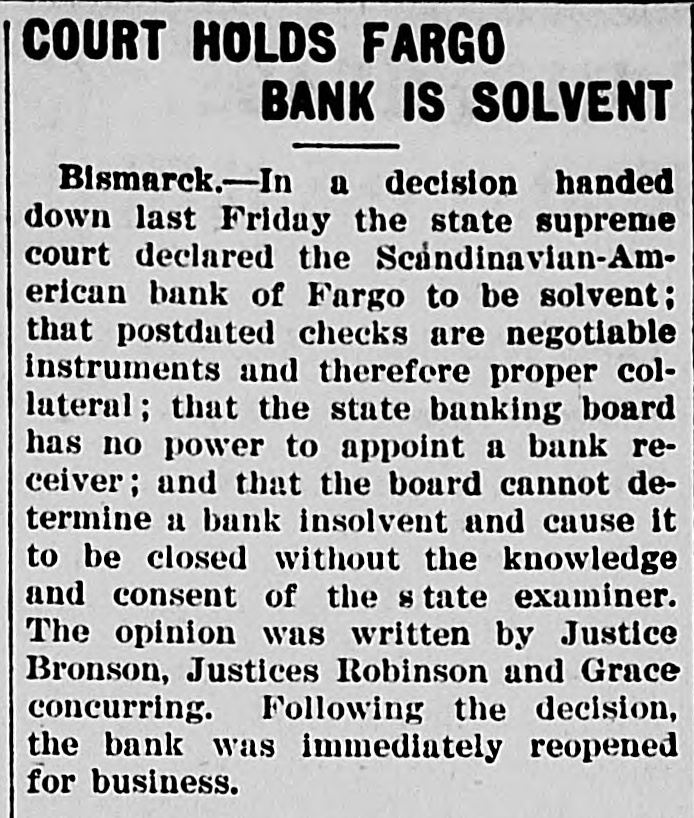
COURT HOLDS FARGO BANK IS SOLVENT Bismarck.-In a decision handed down last Friday the state supreme court declared the Scandinavian-American bank of Fargo to be solvent; that postdated checks are negotiable instruments and therefore proper colInteral; that the state banking board has no power to appoint a bank receiver; and that the board cannot determine a bank insolvent and cause it to be closed without the knowledge and consent of the S tate examiner. The opinion was written by Justice Bronson, Justices Robinson and Grace concurring. Following the decision, the bank was immediately reopened for. business.
GREAT FARMER RALLY BOOSTS FARGO BANK Fargo, N. D.-As an answer to the e attempts to wreck the Scandinaviane American bank at Fargo, 7,000 League farmers gathered here on Tuesday, October 21, and decided to increase the capital and surplus of the bank, now $60,000 to $600,000 making it the largest bank in North Dakota. It was the greatest meeting in the history of the League. The Fargo Auditorium, seating 3,500, was crowd ed a half-hour before the meeting started and after all available standing space has been filled it was necessary to hold afternoon and evening overflow meetings out of doors. Farmers from the northern part of the state were on hand with two hands, boosting for Grand Forks for the location of the big $1,500,000 mill and elevator. "There are no bank wreckers in Grand Forks" was their chief argument, and though the meeting was held in Fargo, the chief rival of the Forks for the mill and elevator the Auditorium resounded with cheers for the northern town. Governor Lynn J. Frazier was accorded a tremendous ovation when he addressed the night meeting. Minnesota and North Dakota "Frazier-for President" clubs were on hand urging his choice by the Republican national convention for first place on the presidential ticket in 1920. President A. C. Townley of the League addressed both afternoon and evening sessions and held the big crowd spellbound as he told of the founding of the League, the fights that it had met and won and of the final effort being made now to down it through financial influences. M. W. Thatcher, president of the Equitable Audit company of Minneapolis, told the farmers the true condition of the Scandinavian-American bank. Despite the attempts to break it by starting a run the bank has cash resources of nearly $400,000, he pointed out, and has nearly twice the legal reserve required. Following the meeting a sureenough "run" on the bank was started. It was not a run to withdraw deposits, however, but to put up more money. A dozen tellers and volunteer clerks were kept busy until after midnight, receipting for subscriptions to additional stock and for deposits to be placed in the bank as soon as it is reopened. Individual deposits ranged from $50 up to $5,000, while telegrams were received at the meeting offering deposits from banks and individuals from $15,000 to $25,000. At midnight the clerks were unable to give an estimate of the total amount of money received. Other speakers at the meeting included President J. M. Anderson of the Equity exchange, former Congress man James Manahan of Minneapolis, Speaker L. L. Stair of the North Dakota house of representatives, Senator J. I. Cahill, William Lemke, A E. Bowen, George D. Brewer and N. S. Randall A big night parade was a spectacular feature of the day's events. Resolutions adopted by the meeting pledge the League members united support to the management of the League and the state offiers who are working to carry out the industrial program authorized by the people and the last legislature. County Club Leader Resigns Mr. Tracy who has been doing ex-
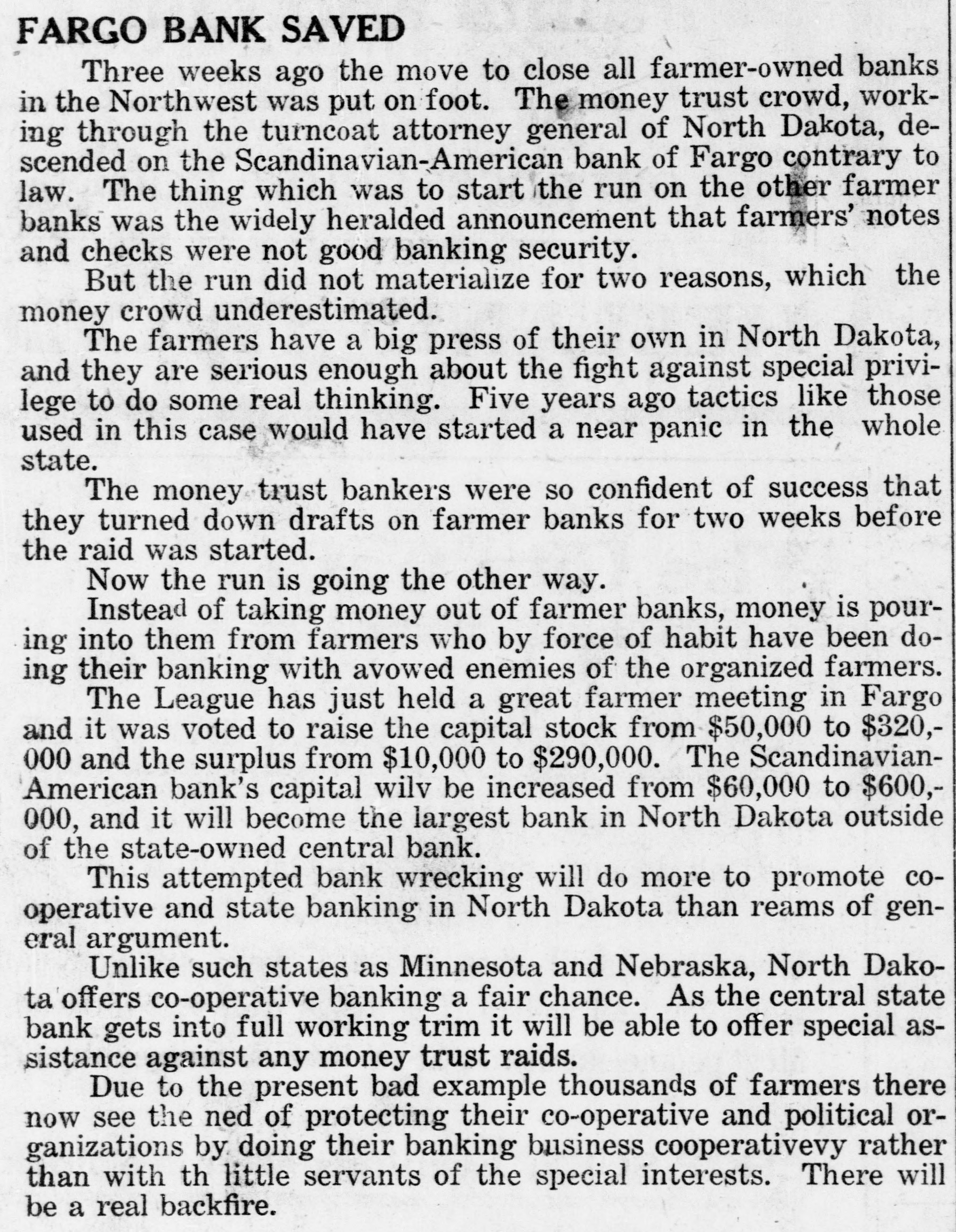
FARGO BANK SAVED Three weeks ago the move to close all farmer-owned banks in the Northwest was put on foot. The money trust crowd, working through the turncoat attorney general of North Dakota, descended on the Scandinavian-American bank of Fargo contrary to law. The thing which was to start the run on the other farmer banks was the widely heralded announcement that farmers' notes and checks were not good banking security. But the run did not materialize for two reasons, which the money crowd underestimated. The farmers have a big press of their own in North Dakota, and they are serious enough about the fight against special privilege to do some real thinking. Five years ago tactics like those used in this case would have started a near panic in the whole state. The money trust bankers were SO confident of success that they turned down drafts on farmer banks for two weeks before the raid was started. Now the run is going the other way. Instead of taking money out of farmer banks, money is pouring into them from farmers who by force of habit have been doing their banking with avowed enemies of the organized farmers. The League has just held a great farmer meeting in Fargo and it was voted to raise the capital stock from $50,000 to $320,000 and the surplus from $10,000 to $290,000. The ScandinavianAmerican bank's capital wilv be increased from $60,000 to $600,000, and it will become the largest bank in North Dakota outside of the state-owned central bank. This attempted bank wrecking will do more to promote cooperative and state banking in North Dakota than reams of general argument. Unlike such states as Minnesota and Nebraska, North Dakota offers co-operative banking a fair chance. As the central state bank gets into full working trim it will be able to offer special assistance against any money trust raids. Due to the present bad example thousands of farmers there now see the ned of protecting their co-operative and political organizations by doing their banking business cooperativevy rather than with th little servants of the special interests. There will be a real backfire.
12.November 6, 1919Sioux County PioneerFort Yates, ND
Click image to open full size in new tab
Article Text
COURT HOLDS FARGO BANK IS SOLVENT Bismarck.-In a decision handed down last Friday the state supreme court declared the Scándinavian-American bank of Fargo to be solvent; that postdated checks are negotiable instruments and therefore proper collateral; that the state banking board has no power to appoint a bank receiver; and that the board cannot determine a bank insolvent and cause it to be closed without the knowledge and consent of the state examiner. The opinion was written by Justice Bronson, Justices Robinson and Grace concurring. Following the decision, the bank was immediately reopened for business.
13.November 7, 1919The Bismarck TribuneBismarck, Mandan, ND
Click image to open full size in new tab
Article Text
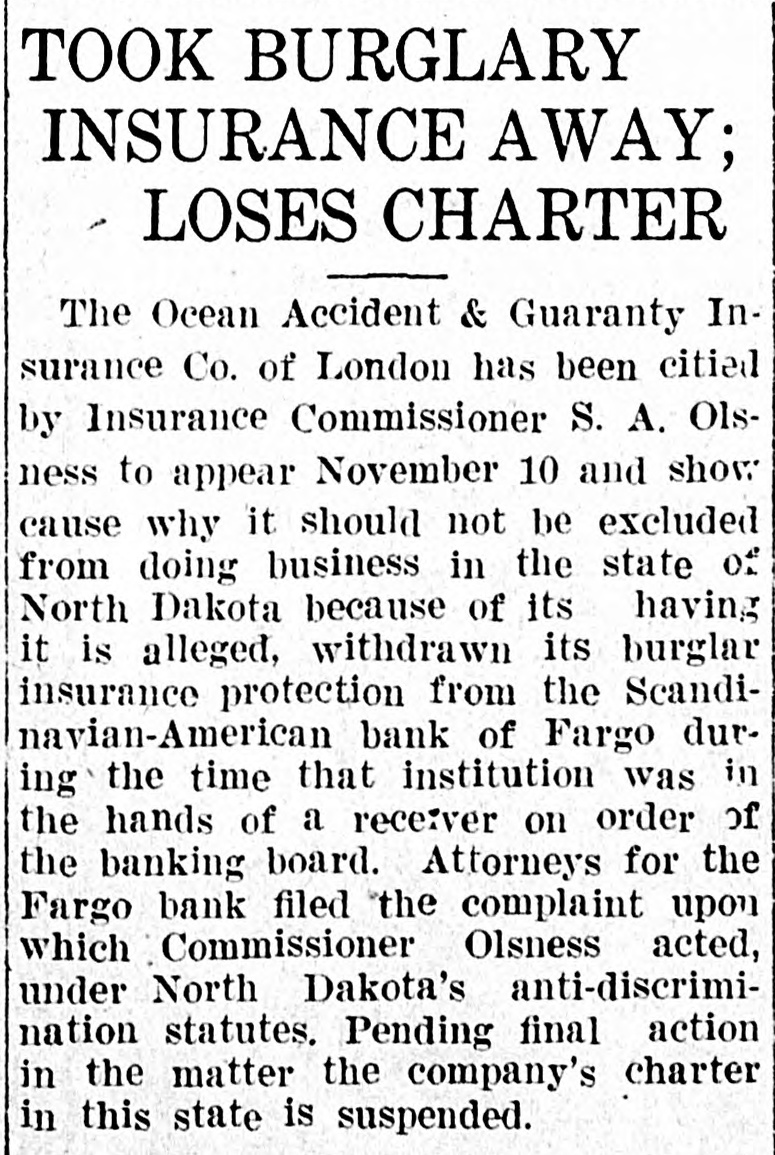
TOOK BURGLARY INSURANCE AWAY; LOSES CHARTER The Ocean Accident & Guaranty Insurance Co. of London has been citied by Insurance Commissioner S. A. Olsness to appear November 10 and show cause why it should not be excluded from doing business in the state of North Dakota because of its having it is alleged, withdrawn its burglar insurance protection from the Scandinavian-American bank of Fargo during the time that institution was in the hands of a receiver on order of the banking board. Attorneys for the Fargo bank filed the complaint upon which Commissioner Olsness acted, under North Dakota's anti-discrimination statutes. Pending final action in the matter the company's charter in this state is suspended.
14.November 24, 1919The Bismarck TribuneBismarck, Mandan, ND
Click image to open full size in new tab
Article Text
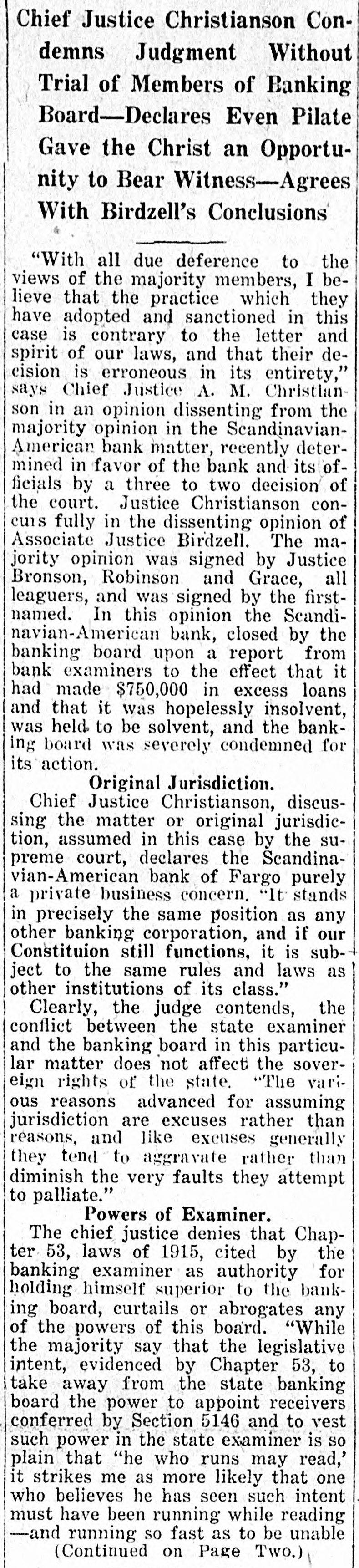
Chief Justice Christianson Condemns Judgment Without Trial of Members of Banking Board-Declares Even Pilate Gave the Christ an Opportunity to Bear Witness-Agrees With Birdzell's Conclusions "With all due deference to the views of the majority members, I believe that the practice which they have adopted and sanctioned in this case is contrary to the letter and spirit of our laws, and that their decision is erroneous in its entirety," says Chief Justice A. M. Christian son in an opinion dissenting from the majority opinion in the ScandinavianAmerican bank matter, recently determined in favor of the bank and its officials by a three to two decision of the court. Justice Christianson concuis fully in the dissenting opinion of Associate Justice Birdzell. The majority opinion was signed by Justice Bronson, Robinson and Grace, all leaguers, and was signed by the firstnamed. In this opinion the Scandinavian-American bank, closed by the banking board upon a report from bank examiners to the effect that it had made $750,000 in excess loans and that it was hopelessly insolvent, was held to be solvent, and the banking board was severely condemned for its action. Original Jurisdiction. Chief Justice Christianson, discussing the matter or original jurisdiction, assumed in this case by the supreme court, declares the Scandinavian-American bank of Fargo purely a private business concern. "It stands in precisely the same position as any other banking corporation, and if our Constituion still functions, it is subject to the same rules and laws as other institutions of its class." Clearly, the judge contends, the conflict between the state examiner and the banking board in this particular matter does not affect the sovereign rights of the state. "The various reasons advanced for assuming jurisdiction are excuses rather than reasons, and like excuses generally they tend to aggravate rather than diminish the very faults they attempt to palliate." Powers of Examiner. The chief justice denies that Chapter 53, laws of 1915, cited by the banking examiner as authority for holding himself superior to the banking board, curtails or abrogates any of the powers of this board. "While the majority say that the legislative intent, evidenced by Chapter 53, to take away from the state banking board the power to appoint receivers conferred by Section 5146 and to vest such power in the state examiner is SO plain that "he who runs may read,' it strikes me as more likely that one who believes he has seen such intent must have been running while reading -and running SO fast as to be unable (Continued on Page Two.)
15.February 15, 1921The Bismarck TribuneBismarck, Mandan, ND
Click image to open full size in new tab
Article Text
NO RECEIVER YET APPOINTED Fargo, Feb. 15.-No receiver had been appointed today. to take over the affairs of the Scandinavian-American bank, closed yesterday. Officials of the bank said that two deputy bank examiners were conducting an examination of the books.
Fargo bank in September, 1919, the joker was applied. It had never been the custom to do so in examinations of any other banks. The examiner himself, in reports on other institutions, had written: "Sums due to banks are classed as demand deposits." One widely known judge, who was attorney for the North Dakota Bankers' association even prior to that time, had pointed out the absurdity of the law. It made it practically impossible to operate a privately owned state bank as a reserve bank. The supreme court, in ousting the attorney general and his agents from the Fargo institution upheld the custom, and not the joker. In fact, the supreme court decision made what has been custom, the law. The law itself has been amended since. Nevertheless, the political opponents of the administration have attempted to apply this ancient joker to the Bank of North Dakota and the ScandinavianAmerican bank. It ceases to be a wonder that a run developed again on the Fargo institution and it was forced to close its doors recently. Testimony proving that many banks were far below legal reserve was introduced in the senate committee from reports on file in the office of the state bank examiner.
17.March 3, 1921Cavalier County Farmers PressLangdon, ND
Click image to open full size in new tab
Article Text
Fargo bank in September, 1919, the joker was applied. It had never been the custom to do so in examinations of any other banks. The examiner himself, in reports on other institutions, had written: "Sums due to banks are classed as demand deposits." One widely known judge, who was attorney for the North Dakota Bankers' association even prior to that time, had pointed out the absurdity of the law. It made it practically impossible to operate a privately owned state bank as a reserve bank. The supreme court, in ousting the attorney general and his agents from the Fargo institution upheld the custom, and not the joker. In fact, the supreme court decision made what has been custom, the law. The law itself has been amended since. Nevertheless, the political opponents of the administration have attempted to apply this ancient joker to the Bank of North Dakota and the ScandinavianAmerican bank. It ceases to be a wonder that a run developed again on the Fargo institution and it was forced to close its doors recently. Testimony proving that many banks were far below legal reserve was introduced in the senate committee from reports on file in the office of the state bank examiner.
For nearly three months past the Herald has published daily articles setting forth the facts with regard to the present state administration, which in its opinion make the recall of the three chief members of this administration not only desirable but necessary in the interests of honest, efficient government for the state. During the next few days it will summarize as briefly as possible the chief points of this indictment. As has been repeatedly pointed out, Lynn J. Frazier, William Lemke and J. N. Hagan have absolute authority over the Bank of North Dakota, and are responsible for the way it is conducted, and the policies which it may pursue. Therefore these three men are directly responsible for the following facts in connection with the Bank of North Dakota. How Bank Was Run. The Bank of North Dakota has been conducted primarily for the benefit of the Nonpartisan league and its friends: proof of this is furnished by the following facts: Scandinavian-American Bank. Nearly one-half million of dollars were given by the Bank of North Dakota in deposits and loans to the Bcandinavian-American bank of Fargo. This was more than was given to all the other banks of Cass county combined. The Scandinavian-American bank of Fargo was known to be insolvent, but the controlling interest therein was owned by the league exchange and other allies of the Nonpartisan league, and the bank had made large loans to the league, the Consumers' Stores Co. and other league enterprises. This money was frozen up in the Scandinavian-American bank when it was closed.
19.January 12, 1922The Ward County IndependentMinot, ND
Click image to open full size in new tab
Article Text
Heaton Guilty of Embezzling $20.00
Frank C. Heaton, former teller of the Scandinavian American Bank of Fargo, was found guilty of embezzling less than $20.00 of the bank's funds. The jury was out 22 hours. What has become of the $78,000.00 shortage which he was accused of embezzling, is a puzzle for the receiver to solve. The maximum sentence Heaton can receive is 30 days in the county jail and a fine of $100.
The verdict was generally regarded as a compromise. The jurors, it is believed were unwilling to have Heaton sent to the penitentiary feeling that he was not the only one responsible for the shortage.
20.May 20, 1922Grand Forks HeraldGrand Forks, ND
Click image to open full size in new tab
Article Text
CASS COUNTY INDICTMENTS.
The grand jury convened in Fargo some time ago to consider evidence submitted in relation to the management of the Scandinavian-American bank of Fargo, and which, incidentally, had authority to take up any other matters of law violation which might be brought before it, has returned indictments against several persons formerly connected with the Fargo bank, and some of these have been arrested.
The circumstances surrounding the operation of the Scandinavian-American bank in the months prior to its suspension were such as to bring the political element prominently into the case. Control of the bank was obtained by politicians for the purpose of using it as an intermediary between the Bank of North Dakota and the treasuries of political organizations. Through the forced deposit of tax funds in the Bank of North Dakota and their transfer by re-deposit or loan in the Fargo institution it was intended to make the public funds of the state available for the financing of political enterprises. The funds were actually so used until the whole enterprise collapsed.
That the course followed in handling the affairs of this bank was wholly unjustifiable, contrary alike to the principles of sound banking and of clean politics, has been abundantly demonstrated. How far, if at all, those in charge were criminally responsible is not an appropriate subject for discussion while their cases are pending in court.
We believe the course followed by Attorney General Johnson in asking for this grand jury to have been abundantly justified. A public statement made by him at the time of the adjournment of the grand jury sets forth the reasons for calling the grand jury. The situation involved in the affairs of this bank is admittedly complicated. Political considerations are inseparable from it. Action taken by an individual holding a political office is certain in such a case to be ascribed by one group or another to political motives. A magistrate called on to decide as to the sufficiency of a given complaint has before him the knowledge that his action will be discussed from the political angle. The grand jury is a large and representative body, chosen without reference to political opinion, and able, presumably, to consider subjects brought before it on their own merits and to make decisions accordingly.
The attorney general has presented to the grand jury the facts upon which he bases his charges of wrongdoing. The grand jury, with these statements of fact before it, has decided that the conditions warrant holding certain individuals for formal trial, when they will be confronted with the charges against them and will be given an opportunity to present their defense.
An indictment by a grand jury, of course, is not a conviction, and it involves no legal presumption of guilt.
21.June 9, 1922Grand Forks HeraldGrand Forks, ND
Click image to open full size in new tab
Article Text
FARM TAXES
Governor Nestos' stand that there should be a reduction in the proportion of the burden of taxation borne by farm property in North Dakota is no less significant than the figures he gives to show how this proportion has increased during the time the Nonpartisan league held control of the tax machinery of the state.
Although when the league came into office the exemption of farm improvements from taxation was announced with a flourish of trumpets, it has been shown that this exemption was more than offset by the increase in taxes on farm lands. As a result of the league's taxation policy the farmers of the state are today bearing a proportion of the tax burden materially greater than that which they bore when the league came into power in 1917. All this, in spite of the love for the farmers of the state constantly expressed in words by the league leaders. It has remained for the Independent governor of the state to call attention to a condition which the league administration brought about or at least aquiesced in and to demand that it be remedied. But still, the League press calls Governor Nestos the Anti-farmer candidate.
Who says the high cost of living isn't coming down? In Minnesota memberships in the Nonpartisan league are being sold for $6.50. This is getting close to the pre-war figure.
Even J. W. Brinton seems to have found signing Nonpartisan league notes an expensive process.
We are breathlessly awaiting the publication of Justice Robinson's book of essays at two dollars per.
The Fargo-Courier News is peeved because the farm loan bank of South Dakota helped the private banks of that state. Let's see, wasn't it rumored that the Bank of North Dakota gave some help to the Scandinavian-American bank of Fargo?
But maybe the South Dakota institution helped some banks which were hot run by deserving Non-partisan leaguers.
Can't you just imagine what a high old time Peter Garberg would have prosecuting the men indicted for the wrecking of the Scandinavian-American Bank at Fargo?
If either the tariff or the soldiers' compensation measures are completed this year, congress will have to speed up much faster than it is moving at the present time.
Somehow we haven't heard very much from Bill Lemke during the present primary campaign, and A. C. Townley is too busy "raising the rocks" to pull off any airplane stunts.
The Republican senatorial committee announces that it will support Brookhart in Iowa. It is not crazy about him, however.
A legless pair eloped in Indiana, making use of an automobile. Legs are superduous in these mo
Watford City, Oct. 5.-An effort is being made in this vicinity by a rep- resentative of the receiver of the de- funct Scandinavian-American bank of Fargo, to collect approximately $17,000 on a note signed by 20 farm- ers in this section, and given the re- ceiver of the defunct Consumers United Stores Co. for its remaining assets in the local store. The note is held by the Fargo bank receiver, and the collector is making every effort to collect, even to aiding the store owners in their efforts to col- lect collateral notes, which are part of the assets purchased.
The collateral notes were given by farmers of the community to the store company for 'privileges to trade at the local store, and are said to ag- gregate $52,000. Some of these notes are outlawed, and for various other reasons it is expected that many of them will never be paid.
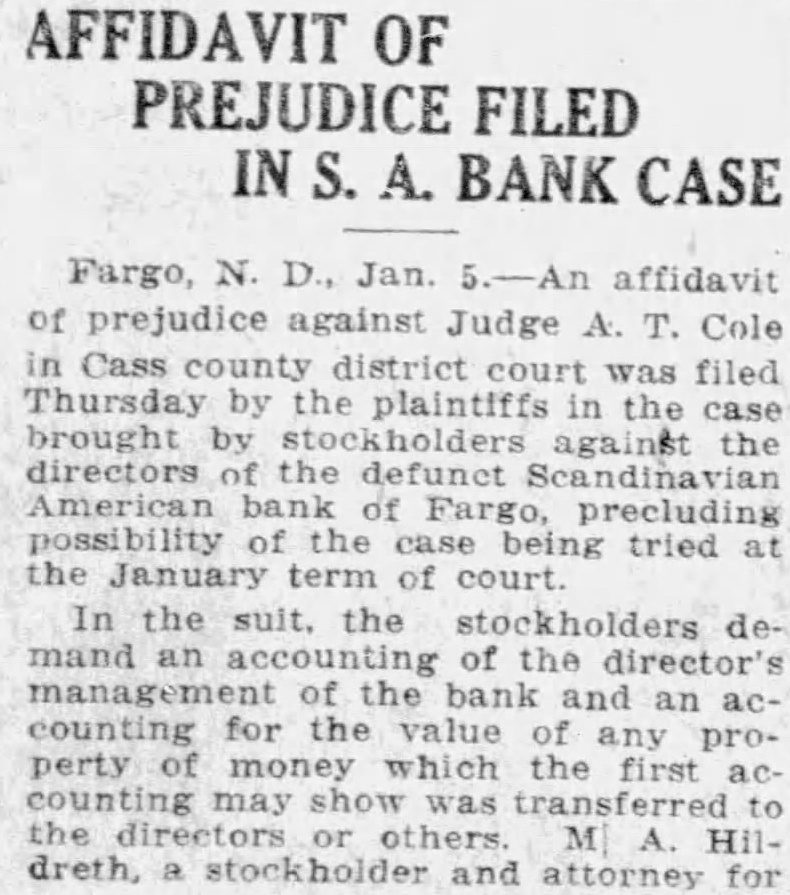
Fargo, N. D., Jan. 5.—An affidavit of prejudice against Judge A. T. Cole in Cass county district court was filed Thursday by the plaintiffs in the case brought by stockholders against the directors of the defunct Scandinavian American bank of Fargo, precluding possibility of the case being tried at the January term of court.
In the suit, the stockholders demand an accounting of the director's management of the bank and an accounting for the value of any property of money which the first accounting may show was transferred to the directors or others. M. A. Hildreth, a stockholder and attorney for
24.April 23, 1923The Bismarck TribuneBismarck, Mandan, ND
Click image to open full size in new tab
Article Text
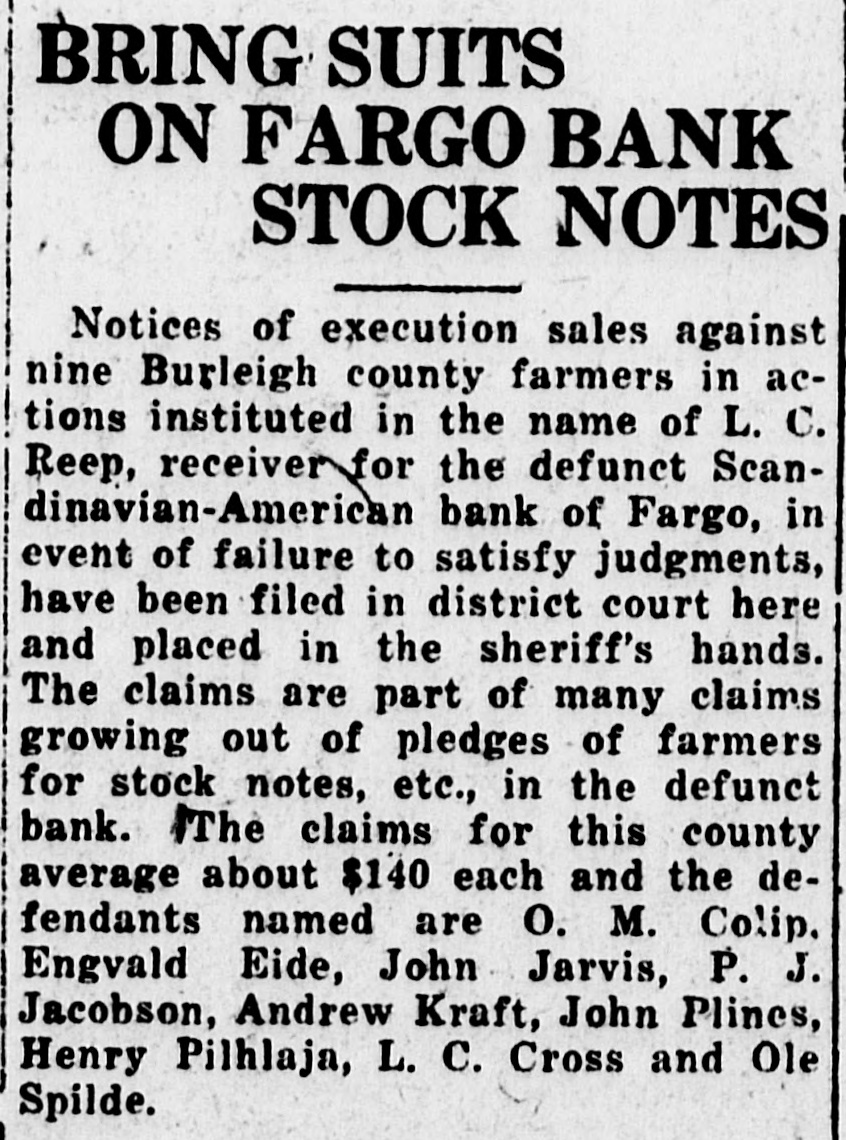
BRING SUITS ON FARGO BANK STOCK NOTES Notices of execution sales against nine Burleigh county farmers in actions instituted in the name of L. C. Reep, receiver for the defunct Scandinavian-American bank of Fargo, in event of failure to satisfy judgments, have been filed in district court here and placed in the sheriff's hands. The claims are part of many claims growing out of pledges of farmers for stock notes, etc., in the defunct bank. The claims for this county average about $140 each and the defendants named are O. M. Colip. Engvald Eide, John Jarvis, P. J. Jacobson, Andrew Kraft, John Plines, Henry Pilhlaja, L. C. Cross and Ole Spilde.
25.May 1, 1925The Bismarck TribuneBismarck, ND
Click image to open full size in new tab
Article Text
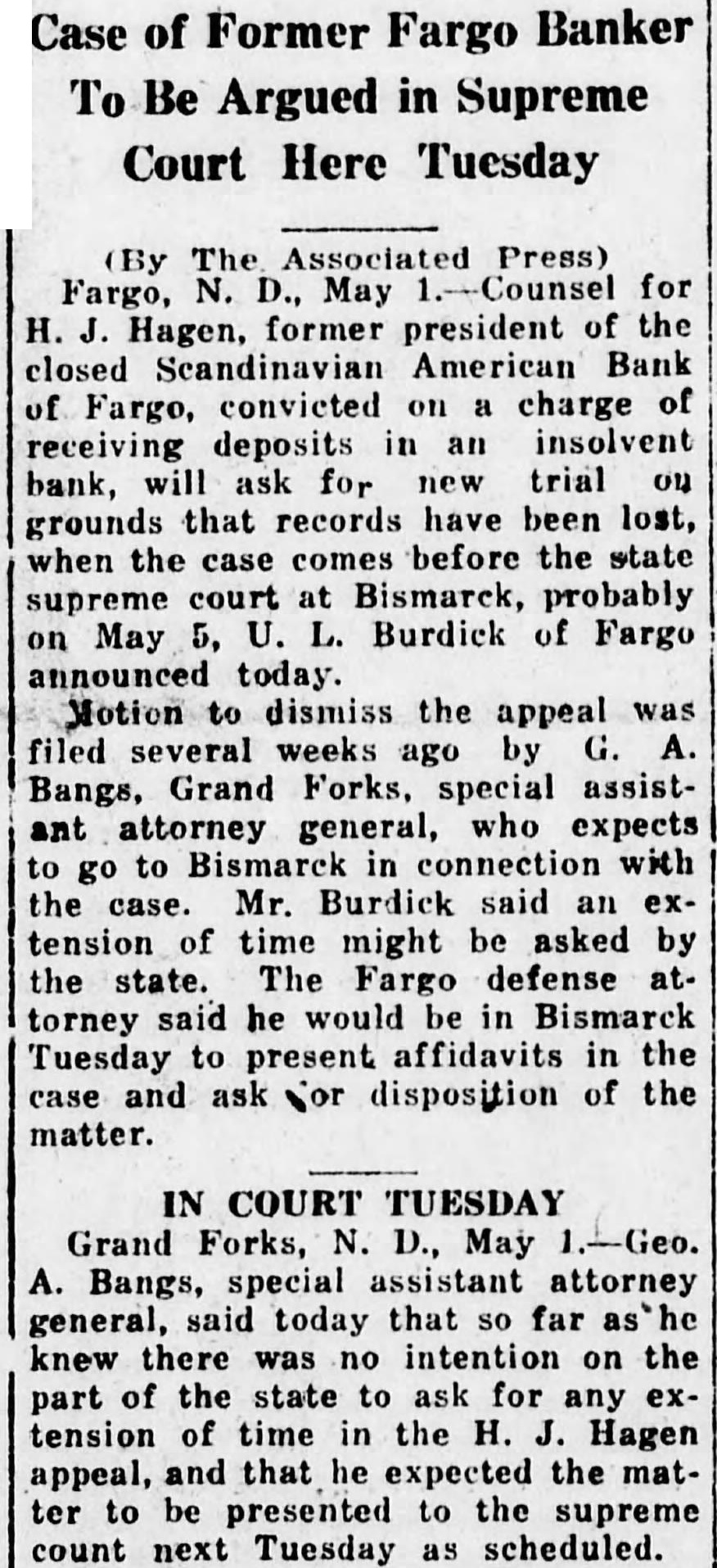
Case of Former Fargo Banker To Be Argued in Supreme Court Here Tuesday
(By The Associated Press) Fargo, N. D., May 1.—Counsel for H. J. Hagen, former president of the closed Scandinavian American Bank of Fargo, convicted on a charge of receiving deposits in an insolvent bank, will ask for new trial on grounds that records have been lost, when the case comes before the state supreme court at Bismarck, probably on May 5, U. L. Burdick of Fargo announced today.
Motion to dismiss the appeal was filed several weeks ago by G. A. Bangs, Grand Forks, special assistant attorney general, who expects to go to Bismarck in connection with the case. Mr. Burdick said an extension of time might be asked by the state. The Fargo defense attorney said he would be in Bismarck Tuesday to present affidavits in the case and ask for disposition of the matter.
IN COURT TUESDAY Grand Forks, N. D., May 1.—Geo. A. Bangs, special assistant attorney general, said today that so far as he knew there was no intention on the part of the state to ask for any extension of time in the H. J. Hagen appeal, and that he expected the matter to be presented to the supreme court next Tuesday as scheduled.
Bank runs are almost always and everywhere a deterioration of bank fundamentals.
But not for you.
You are the measure-zero exception: great fundamentals, solid bank, and yet the Diamond Dybvig fairy spread its rumor. Depositors woke up. Your collateral was not prepositioned. The Clearinghouse had it for you.
Do not pass Go. Do not collect $200. Go directly to jail… or worse.
Flag Article for Review
Flag Episode for Review
Scandinavian American Bank · Episode ID 77000971438