Bank of North Dakota (Bismarck, ND)

Episode Information

Episode UID
77002871454
Episode Type
Suspension โ†’ Reopening
Bank Type
state
Bank ID
7700287 routing
Routing Number
77-0028
Start Date
February 10, 1921
Location
Bismarck, North Dakota (46.808, -100.784)

Metadata

Model
gpt-5-mini (chosen from majority vote of a three-model LLM ensemble)
Short Digest
316480d737df48b6

Response Measures

None

Description

Suspension in Feb 1921 is clear; later receivership threatened but not finalized in these articles.

Events (1)

1. February 10, 1921 Suspension
Cause
Local Banks
Cause Details
Heavy withdrawals of public funds and many private banks refusing to honor redeposits/drafts led the Bank of North Dakota to stop payments and the industrial commission to order collections and stoppage of certain payments.
Newspaper Excerpt
The state industrial commission has issued an order stopping payment ... The state bank has outstanding $1,250,000 of past due loans ... and $5,500,000 in redeposits in private banks ... which private banks refuse to honor checks drawn by the Bank of North Dakota.
Source
newspapers

Newspaper Articles (24)

Article from The Bismarck Tribune, April 10, 1919

Click image to open full size in new tab

Article Text

# BANK HOME NOT YET SELECTED; MORRIS ABSENT Industrial Commission Unable to Enter Into Contract for Building Today # TO BE GOING IN 30 DAYS Board Discusses Issuance of Two Million Dollars in Bonds to Furnish Finances The industrial commission did not close a contract this afternoon for a home for the Bank of North Dakota in Bismarck, as it had hoped to do. Secretary Morris was unexpectedly called to St. Paul yesterday by the severe illness of one of his children, and it is probable nothing definite will be done until his return. The location is practically decided upon, but no publicity can be given the matter until a contract is signed. To Open in 30 Days. "The Bank of North Dakota will be ready for business within 30 days," said Manager J. R. Waters this afternoon. "State Architect Kurke already has prepared a floor plan; fixtures will be ordered at once, and they should be installed and ready for use inside of 30 days. The bank probably will open with a force of 12, which may be increased during the year up to as many as 100." Will Be Real Bank. The quarters assigned to the bank will be equipped with regulation banking fixtures of a type befitting the dignity of the first state-owned institution of this type in America. In addition to the banking chamber, there will be private offices for the manager and his assistant a directors' room and a general counting room for the staff. The industrial commission this afternoon took up the issuance of the $2,000,000 worth of state bonds provided by the Bank of North Dakota act for the financing of this institution. These bonds, authorized by House Bill 49, will be prepared for issue by State Treasurer Olson and will be issued as he and the governor may direct. The bonds are to bear not to exceed six per cent and will be tax exempt. They are to be turned over to the industrial commission in such denominations and amounts as (Continued on page eight)


Article from Williston Graphic, April 10, 1919

Click image to open full size in new tab

Article Text

STATE BANK OPENS DOORS AT BISMARCK STATE BANK EXAMINER WATERS MADE MANAGER OF NEW BANK Bismarck, April 5.-The first formal step toward making rural credits at cost was taken here by the state industrial commission yesterday. The Bank of North Dakota has ordered established immediately and by the last of May will be in full running order. Bismarck was named the home of the bank during the period of its fouration and organization. State Bank Examiner J. R. Waters was chosen to head the institution and was instructed to immediately organize the banking force, enroll member banks, arrange that the public funds now in other institutions be credited to the bank of North Dakota and to select a special attorney who will immediately take charge of preparing for issue the $2,000,000 of state bonds authorized by the legislature for employing a special counsel for the bank was in accordance with the action taken at last week's meeting when it was found that the attorney general's office had been guilty of circulating rumors to the effect that the bond acts were insufficient. 27 Million Deposits Under the bank act as passed by the legislature the institution must be in full operation 90 days after the bill became a law. This means that


Article from Omaha Daily Bee, October 7, 1919

Click image to open full size in new tab

Article Text

Closed Bank's Officers Waive First Hearing Fargo, N. D., Oct. 6.-President H. J. Hagen and Cashier P. R. Sherman of the Scandinavian-American bank, closed on orders of the State Bank commission, waived preliminary examination and were bound over to the district court. Each furnished $5,000 bail. P. M. Halldorson, receiver of the bank, alleged that the officers exhibited to him a false statement as to the bank's condition when he made a regular examination September 9. Bismark, Oct. 6.-An examination of the Bank of North Dakota. the state-owned institution created by an act of the last legislature, was begun here by State Auditor C. R. Kositzky, upon formal instructions from Attorney General William Langer. Langer in his letter to Kositzky stated that correspondence found in the Scandinavian-American State Bank of Fargo, which was ordered closed last Thursday, indicated that securities totalling more than $300,000 had been transferred from the Fargo bank to the state institution.


Article from The Bridgeport Times and Evening Farmer, October 8, 1919

Click image to open full size in new tab

Article Text

EXAMINE ONE MORE BANK IN NORTH DAKOTA Closing of Bank in Fargo Leads to Inquiry Into Dealings of Associate in Bismarck. Fargo, N. D., Oct. 8.-An examination of the Bank of North Dakota by State Auditor Karl R. Kositzky, to determine "what moneys, if any, have been diverted to illegal purposes," was commenced this afternoon at Bismarck, the State capital, at the instance of the Attorney General William Langer. The examination grows out of the closing at Fargo of the ScandinavianAmerican Bank, which made loans amounting to $432,000 to the National Non-Partisan League and three subsidiary corporations, and which have been termed by, the State Banking Board to be excessive and without sound security. Other developments during the day in connection with the bank closing were the waiving of preliminary examinations by H. J. Hagen, President, and F. R. Sherman, cashier. They were held for trial before the Case County District Court in November. Each officer is accused of falsifying the bank records for the purpose of deceiving a Deputy Bank Examiner as to the actual condition of the Institution. They were placed under $5,000 bonds each. Defensive measures taken by Directors of the bank and officers of the Nonpartisan League who have mutual interests because of the possible political effect of the closing of the bank were outlined today. The bank will go to the Supreme Court on a writ of certiorari, and would require members of the Banking Board to certify to the Court the record on which they have acted in closing the bank and ordering a receiver. This will make it necessary for the Attorney-General and Secretary of State, who are majority members of the Banking Board, to justify their official actions in court, provided the Court grants the application, which will probably be filed today. Another court procedure yesterday was that of the AttorneyGeneral, who applied in the Cass County District Court for the appointment of a permanent receiver. This is the procedure required by law in the liquidation of an insolvent bank. When Auditor Kositzky, in compliance with the Attorney Generals demand, went into the Bank of North Dakota to make an examination he was resisted by J. R. Waters, manager of the bank, and former State Bank Examiner. Mr. Waters returned to the bank about an hour after the State Auditor and four accountants had taken possession, and there was a hot exchange of words. Kositzky is one of the three Nonpartisan League state officials who recently declared themselves opposed to the league leaders. "It is essential for the interests of the taxpayers of North Dakota that there be an immediate examination of the Bank of North Dakota," Attorney General Langer advised Auditor Kositzky in his letter of complaint. "Under the law it is your duty to make an examination. I have information that the Bank of North Dakota has become mixed up with the Scandinavian American Bank of Fargo now in the hands of a receiver. "As Attorney General I make formal demand that you, as State Auditor, intrusted with the safeguarding of the taxpayers' money, proceed immediately to ascertain to what illegal purposes, if any those now in control of the Bank of North Dakota have diverted the money intrusted to their care." The Bank of North Dakota is an institution founded by the Nonpartisan League State Administration. It is under the maagement of *Mr. Waters, former Bank Examiner, who was charged by the State Banking Board with having given the Scandinavian American Bank of Fargo advance information as to the time examiners would enter the bank, thus permitting the bank, it is said, to prepare its records to disguise its actual condition. It has control of approximately $16,000,000, as the public bank law requires that all funds he deposited in the State Bank. The bank redeposits with private banks much of its funds. According to Manager Waters, the State Bank had about $183,000 on deposit with the Fargo Bank when it was closed. The Nonpartisan League officials and their newspapers continue to assert that the State officers have closed the Fargo bank for political purposes only. Governor Frazier has issued a statement to the effect that he will do all in his power to stop the Banking Board officers from continuing their course, and the leading Nonpartisan League newspaper in Fargo asserts that "the noose is rapidly tightening around the Attorney General's official neck."


Article from Republican Farmer, October 10, 1919

Click image to open full size in new tab

Article Text

XAMINE ONE MORE BANK IN NORTH DAKOTA Closing of Bank in Fargo Leads to Inquiry Into Dealings of Associate in Bismarck. Fargo, N. D., Oct. 8.-An examination of the Bank of North Dakota Karl R. "what moneys, if State determine Auditor Kositzky, any, have by to been diverted to illegal was this Bismarck, commenced afternoon purposes," at the State capital, at the instance of the Attorney General William Langer. The examination grows out of at of the which closing American Fargo Bank, Scandinavian- made loans the amounting to $432,000 to al subsidiary Non-Partisan League the and Nation- three corporations, and which termed by the to be excessive withhave ing Board been State and Bankout sound security. during the Other connection developments day in with the bank closing of by H. J. Hagen. aminations and were F. the waiving preliminary President, exR., Sherman, cashier. They were for trial Court in County held District before the Novem- Case ber. is accused of the for the Each bank officer records purpose falsifying of deceiving a Deputy Bank as to actual the condition Examiner of the Institution. They were placed under $5,000 bonds each. Defensive measures taken by Directors of the bank and officers of League who have because of mutual the Nonpartisan interests the poseffect of the closing were outlined of sible The the political bank bank today. will go to the Supreme on a writ of and members of Court would Board require certiorari, the Banking to certify to the Court on they have in and closing record the which bank ordering acted a the remake it for and ceiver. the of Attorney-General This will necessary Secretary State, who are majority memtify actions in bers provided their of the official Banking Board, to court, justhe Court grants the appli will be court cation, today. which Another probably procedure filed yeswas of the applied in General, terday District who that Attorney- the Cass County Court for the apa procedure This pointment is the of permanent required receiver. by law in the liquidation of an insolvent bank. When Auditor Kositzky, in compliance with the Attorney Generals demand, went into the Bank of North Dakota to make an examination he was resisted by J. R. Waters, manager of the bank, and former State Bank Examiner. Mr. Waters returned to the bank about an hour after the State Auditor and four accountants had taken possession, and there was a hot exchange of words. Kositzky is one of the three Nonpartisan League state officials who recently declared themselves opposed to the league leaders. for the the of North "It taxpayers is essential Dakota interests that of there be an immediate of of North torney Langer advised the General Bank Dakota," examination Audi- Attor Kositzky in his letter of complaint. "Under the law it is your duty to an I have the Bank of North make mation has that examination. infor- Dakota become mixed with American Bank Scandinavian in up of Far- the go now the hands of a receiver. "As Attorney General I make formal demand that you, as State Auditor, with the money, of the intrusted taxpayers' safeguarding proceed immediately to ascertain to what illepurposes, any, those in Bank of North control gal of the if Dakota now have diverted the money intrusted to their care.' The Bank of North Dakota is an institution founded by the Nonpartisan League State Administration. It is under the maagement of Mr. Waters. former Bank Examiner. who was charged by the State Banking Board with having given the Bank of as to advance dinavian information American the Fargo Scan- time examiners would enter the bank, thus permitting the bank, it is said, to prepare its records to disguise its actual condition. It has I approximately bank law $16,000.000, control as the of requires that all public


Article from Jamestown Weekly Alert, July 29, 1920

Click image to open full size in new tab

Article Text

STATE BANK BORROWS MILLION DOLLARS OF CHICAGO INTERESTS Bismarck, N. D., July 24.-The Bank of North Dakota has borrowed one million dollars in Chicago, it was said today at the offices of the industrial commission. The loan runs until March 15, 1921, and one million two hundred thousand of the five per cent bonds of the bank were put up as collateral. Interest is at seven per cent. According to W. A. Andersen, secretary of the commission, the loan was made to relieve the situation of counties drawing heavily from the bank, which has donied any member of the commission tried to borrow two million in Minneapolis.


Article from The Bismarck Tribune, November 26, 1920

Click image to open full size in new tab

Article Text

Prepared Drafts The Bank of North Dakota has prepared drafts for large sums of money to be withdrawn from banks in the state in anticipation of withdrawals after the initiated law becomes effective. The bankers committee, it is said, stood willing to continue their telegraphic communication with treasurers until all could be reached SO that there would be only a small amount of money, if any, withdrawn and consequent withdrawals from local banks made while present conditions obtain. The bankers said that they were received courteously at the Bank of North Dakota and the question of withdrawal of deposits was discussed for an hour and a half. Mr. Cathro said after the conference that he made no promises; that it was necessary for the Bank I of North Dakota to withdraw large sums of money in anticipation of withdrawals as permitted by the initiated law. One banker said today: "There isn't a bank in the state that can't get financial assistance outside the state to tide them over the period of transition under the initiated (Continued on Page Three)


Article from The Weekly Times-Record, December 9, 1920

Click image to open full size in new tab

Article Text

REFUSAL TO PAY ILLEGAL Bismarck, N. D., Dec. 7.-The resolution of the industrial commission authorizing the manager of the Bank of North Dakota, that the initiated law regarding public deposits is not retroactive and authorizing him to refuse to honor drafts of public treasurers in his discretion, was characterized as being without foundation in law by William Langer, attorney general and a member of the industrial commission yesterday. Mr. Langer declared that he had not been invited to attend the meeting of the industrial commission, of which he is a member, and that he never advised the commission that the law relating to deposit of public funds is not retroactive. "My opinion is just the contrary" he said. "My opinion as attorney-general is that this initiated law is retroactive and that it does affect deposits that have been made in the Bank of North Dakota. "There is no more sense or reason why a city or county or any other depositors that may wish to withdraw its deposits from the Bank of North Dakota should be prohibited, vexed, harassed or annoyed in so doing than if said depositor were withdrawing the money from some other bank. "The governor says: 'This initiated law passed because the people were misled and misinformed. They were told that the funds of the bank were invested outside the state.' "As a citizen of the state who campaigned among the farmers before they voted on the initiated law I know that they were neither misinformed or misled. On the contrary they knew only too well how the men whom they had entrusted as the majority of this industrial commission had appoined an ex-livery stable keeper who had never run a bank in his life as manager of the bank and when Mr. Waters, as be states, refused to commit crimes which could put him in the penitentiary, they appointed men in charge whom Townley's own newspapers had previously characterized as swindlers. "The honest attempt made by myself as the minority member of this board when I asked the state auditor to examine the bank was frustrated by the majority members of this industrial commission. The citizens of the state naturally did not care to have their public funds amounting to millions of dollars in the state Bank of North Dakota operated as it was."


Article from The Devils Lake World, December 22, 1920

Click image to open full size in new tab

Article Text

CRIPPLE THE N.P. PROGRAM Mill And Elevator Work Tied Up Along With Homes LABOR LAID OFF Withdrawals From State Are The Diretc Cause BISMARCK, N. D., Dec. 22.-The industrial commission has ordered that work on the buildings now under construction by the state home building assoication be suspended, the order first going into effect in Fargo. The reason assigned by the commission for taking this action was that the Bank of North Dakota is unable to finance the home building project now because of the heavy withdrawals of public funds by county, city, township and school treasurers. Secretary W. A. Anderson of the industrial commission said that work on the state homes will now be held up until the state is able to dispose of the bonds which have been issued to finance the building association. He also said that in all probability the same action will be taken in the case of the mill and elevator at Grand Forks. The order stops work on about 60 dwellings, 15 of which are in Fargo. "The Bank of North Dakota is unable to finance these projects now because of the law initiated by the enemies to the farmers' program taking the public funds away from the state bank," said Mr. Anderson. "Despite the assurance of the state bankers association and many of the treasurers, the officials opposed to the industrial program are withdrawing their deposits from the Bank of North Dakota. On the other hand the banks in which the public funds are redeposited claim they are in such a condition that they are unable to honor the drafts by the Bank of North Dakota on such redeposits. The result is that the daily balance in the. Bank of North Dakota are decreasing rapidly and it is unable to finance the state industrial projects any longer until the bonds are sold."


Article from The Ward County Independent, December 30, 1920

Click image to open full size in new tab

Article Text

N. D. BUILDERS FORCED TO HALT CONSTRUCTION Bismarck, N. D., Dec. 21.-Work on buildings under construction by the State Home Building association is to be suspended, according to an order of the state industrial commission. The Bank of North Dakota is unable to finance the project now, according to members of the commission, because of the withdrawal of public funds by county, township, city and school treasurers. The order goes into effect immediately.


Article from Grand Forks Herald, January 15, 1921

Click image to open full size in new tab

Article Text

Bismarck, in. 15. Several representatives extined their votes on the resolution used by the house on Thursday, with requests Governor Lynn J. Frer and members. of the industrial cimission to explain their action in reiting the proposal of the North Dako bankers to aid in solving the state's hancial difficulties. During roll call several of the representaes rose to explain their votes, sonof these being as follows: Freema Grand Forks: "I live within a mile the state mill and elevator and have vital interest in it, but I feel thatie people's money has been depositen the Bank of North Dakota, and-ey can't get it out. If this was a Meral bank it would not be allowed run 48 hours under these conditiv. If it was a state bank it would allowed to continue only by the gre of the banking board. I vote de Herel, Sheridan: "Eastern capitalisteied to dictate to the state how it shed run its affairs. If any one is to slapped in the face let it be Wall reet not our state officers. I voter compared to South Dakota. Jeison, Cass: "Compare North and'uth Dakota. South Dakota has a pulation and resources less than Nor Dakota. Both states have issued "I estate bonds; both issues have beeheld constitutional. In South Dakot$30,000,000 of these bonds have betsold, in North Dakota none. The rean is that people don't want to put the money in such a raffle as the Bill of North Dakota seems to be." jdddock of Mountrail: "I'vote no beuse the resolution is untrue in counts. conclusions and, I believe, in ination." atterson of Renville: I vote no becse it is unconstitutional to ask us tsacrifice the constitutional rights othe great state of North Dakota.' speaker Twichell, Cass: "I vote aye cause this is merely a request to the vernor and industrial commission to ggest some way out of our present fficulties or explain why the bankoffer was summarily turned own.


Article from Great Falls Tribune, February 11, 1921

Click image to open full size in new tab

Article Text

N. DAKOTA BANK CALLS LOANS PRIVATE FIRMS Industrial Commission Issues Order Stopping All the Payments. Collectors Sent Out to Gather in $6,750,000 Owing Institution. Bismarck, N. D., Feb. 10.-The state industrial commission late Thursday issued an order stopping payment on all checks drawn by the state treasurer issued in payment of hail warrants and funds issued to townships, counties and cities, and all township treasurers' checks with the exception of funds for school, penal and charitable institutions and those county treasurers' checks who are depositing all funds in the Bank of North Dakota. The bank of North Dakota has been ordered to send out men to collect from private banks all obligations due from these banks to the Bank of North Dakota. The state bank has outstanding $1,250,000 of past due loans from the private banks of North Dakota and $5,500,000 in redeposits in private banks in this state and which private banks, it is said, refuse to honor checks daawn by the Bank of North Dakota. O. E. Loftus, state bank examiner, announced that all banks with redeposits in the Bank of North Dakota had been ordered to pay the drafts of the bank immediately on their receipt or explain why they should not be forced to suspend. The order, some state officials said, may cause embarrassment to a large number of banks.


Article from The Washburn Leader, February 11, 1921

Click image to open full size in new tab

Article Text

Analysis of Audit Shows $5,000,000 of State Funds "Frozen" For Years The condition in which the Bank ed or deposited at that time in the of North Dakota has placed itself afbanks, was in less than one-eighteenth ter 18 months operation; the situof all the banks that were doing busiation that it has created for the state ness with the state bank. It is knowledge of this situation by tying up tremenduous sums of that the state administration is seekmoneys raised by taxation for running ing to keep from the public in the the state, counties cities, schools, etc., fight that it is making in Bismarck is revealed by an examination and anto prevent the house audit commitalysis of the report of the audit of the tee from making a full inquiry into the status of the bank of North bank made by Bishop, Brissman & Dakota and other industries that are Co., as of Dec. 3, and by reference to under the direction of the state indusdevelopments since then. trial commission. Here, briefly, is the situation: Nearly Five Million Frozen The Bank of North Dakota has The Bishop, Brissman & Co. audit, and the statement by the bank that loaned $1,135,000 to the Industrial have come out in the house investigaCommission to finance the North Dation, disclose, then, that the bank has kota Mill and Elevator- association a total of $4,950,898 "frozen", this beand the North Dakota Homebuilders ing apart from anything that may deassociation. velope in connection with the tremendous deposits that have been piled up The bank has invested $2,9906,069 in a few selected institutions. in farm loans for a period of 30 years. Under date of Feb. 1, the daily balThe bank has on deposit in 32 closance sheet of the Bank of North Daed banks, the sum of$539,879.18, while kota disclosed total redeposits of other liabilities from those banks the $5,698,456.54, so that the money on deposit in the group of closed banks, state bank are $369,950.09, or total liawhich is $539,879, represents nearly a bility from suspended banks of $909,tenth of all the money the bank has 829.27. on redeposit. The bank has adopted a policy of It is this condition, this freezing of favoring political friends with big dethe money in long time investments, posits and other advances; it has put heavy deposits that are tied up in closed banks, extension of credit to $444, 127.46 in the Scandinavian-Amer state industries, etc., that has brought ican bank of Fargo; it has put cn the crisis that the Bank of North $253,127.89 into a bank with $85,000 Dakota faces at the present time. combined capital and surplus; it has The guarantee of bank deposits is placed $126,123.88 in one bank with looked upon by the Bank of North combined capital and surplus of $50. Dakota as protecting it against on the redeposits in the closed banks. 000, and has made tremenduous deposits and loans to others of a group of Only $260,000 a year can be raised especially favored banks. through the guarantee, so it will take In one of the closed banks-at Donyears to realize on this form of denybrook-n bank with a combined posits. It has no guarantee covering capital and surplus of $33,400, the money loaned to banks, or advanced to them in other ways. Bank of North Dakota has deposits and other advances in' the form of loans, etc. of $93,534.31; it has $79,MUST SIGN ARTICLES 242.82 in a closed bank at Beach; it At different times our good friends has $65,966.52 in a closed bank at Miover the county send us in some very not; it has $47,111.06 in a closed bank interesting news notes, which we are at Fortuna; it has $63,588.85 in a always very glad to receive and pubclosed bank at New England; It has lish, but at times there comes to the $53,362.70 coming from a closed bank office a letter with interesting news, to at Tolley. which he writer has forgotten to sign his name. This of course is very unIn a group of 39 banks that appear to have been especially favored, infortunate, because. we have always made it a rule to never publish any cluding such institutions as the league items unless they are signed or we bank at Fargo, the Bank of North Daknow who the writer is. This makes kota has a total of $2,652,236.49 on deposti and in other forms of advances. it necessary to leave the news out of At the time this audit was complied the paper. Kindly remember, all who the Bank of North Dakota had advanat times send in items of news to ces to all the banks totaling about please sign the letter. Your name of course will not be printed unless the $13,0000,000, ao the fact that there is article demande st. We will appremore than two and a half million dolclats this if our frinds will just re. lan in 39 banks means that about member to also their letters public money loan
Article from Evening Star, February 11, 1921

Click image to open full size in new tab

Article Text

By the Associated Press. BISMARCK. N. D., February 11.The state industrial commission has issued an order stopping payment on all checks drawn by the state treasurer for funds Issued to townships. counties and cities and all township treasurers' checks, with the exception of funds for schools, penal and charitable institutions. The Bank of North Dakota was ordered to send out men to collect from private banks all obligations due from these banks to the Bank of North Dakota. The state bank has outstanding $1,250,000 past-due loans from the private banks of North Dakota and $5,500,000 in redeposits in private banks in this state, and which private banks, it is said. refuse to honor checks drawn by the Bank of North Dakota. O. E. Loatus, state bank examiner, announced that all banks with redeposits in the Bank of North Dakota had been ordered to pay the drafts of the bank immediately on their receipt or explain why they should not be forced to suspend. The order, some state officials said, may cause embarrassment to a large number of state banks. Boy Scouts Invite Harding. JACKSONVILLE.-Jacksonville Boy Scouts will relay a message from this city to St. Augustine inviting President-elect Harding to visit here during his stay in. Florida. Mr. Harding will personally receive the last scout who delivers the invitation. Bonch Magneto Company Cutx Wages SPRINGFIELD. Mass.-The American Bosch Magneto Company announced a wage reduction of 12 1/2 per cent, affecting all factory employes on an hourly. weekly or piece work basis, effective February 14.


Article from The Princeton Union, February 17, 1921

Click image to open full size in new tab

Article Text

t IN SERIOUS PLIGHT On the Verge of Financial Collapse, State of North Dakota Knows Not Which Way to Turn. to Political Strife Endangers Plan Bring About Ratification of Rehabilitation. North Dakota's finances are in It is a particularly critical condition. possible that the entanglement time may straightened out but at this acbe there is no assurance of its 'being complished. The closing of the Far- big Scandinavian-America bank at a nonuartisan league institution, go, addition to the suspension of numer- the in other financial concerns makes situation ous more complicated. Mean- the while political strife endangers state's ratification of its rehabilitascheme. In Bismarck there who are two tion diametrically opposed groups tentative discussing the terms of Chicaplans are reached by twin city and and bankers to relieve the situation which go North Dakota on the footing hireput it held before Townley and his it in lings invaded the state and placed such woeful circumstances. The groups mentioned are the button legislators who flaunt the Townley and those who are known as indepen- disdents. They are both expressing satisfaction with the terms advanced situafor rehabilitation of the financial tion. The league group is displaying sore- of over having to give up many ness their pet socialistic schemes, including of of North Dakota, bulwark whole program. On the the Bank demanding the other hand the independents are short all sorts of things, none of them of unconditional surrender on the part of of the league forces. Resignation William C. Lemke, attorney general, in e and now one of the big powers $, league circles, is one of the things they are now insisting upon. e After the caucus of the indepen- of dents, Theodore Nelson, secretary o the Independent Voters' association, y as the I. V. A., made the flat it that the of insist upon f known statement absolutely independents elimination would e Lemke from the state governHe said that the K, would have to r William commission ment. industrial be re- no vamped so that the league would longer control. At present the com- Frar mission is made up of Governor and er zier, Attorney General Lemke, John N. Hagan, commissioner of agriculture and labor. cThis is what has happened in regard to the proposed bond sale: North Dakota bankers' h e made proposals in on mittee The January find comiwhich they would undertake to a market for state bonds. The terms were rejected by the nonpartisan by S. of league caucus, though advocated A. C. Townley a of The desperate situation of the Bank the of North Dakota finally brought heads to concede whatever found should league be necessary, but they Dakota bankers d appealed to twin Then the North they city obdurate bank ers help bring them together. conference, A. At to Sunday's their C. Townle John M. Hagen and nonpartisan ley, league associates declared the that they would undertake to bring terms nleague caucus to agree to the of ce the North Dakota bankers had asor fered if the leaguers could have bthat the bonds would be taken. calls for nthe Bank of North of surance This proposal Dakota, liquidation its red as a rural credits bank, the affairs of of winding organization up the legisla- Home Id association, and new Id the arbitrary powers commission and industrial Building tion ending the present of state the wide open methods of handling vn finances. On this basis the twin city and Chiof banks and trust companies repscago resented to the conferences have- considered the matter. ly iLight thrown on the methods of the Bank of North Dakota by the special committee of the North assembly has on investigating Dakota disclosed the whole many he strange transactions, and what is alive with interest as to 22 still be in store. end the story of low F. state may instance, There the is, bank for rs got its capital stock, as related exam- by W. Cathro, its manager, when to ined by Francis J. Murphy, of Minot, for the rt start with a paid in of ft attorney banks committee. capital bank Other cash, but not this bank. The is in control of the industrial commisnas v. sion, which by law was given almost state, unlimited power to bond the s. transfer funds and otherwise manipulate state finances. The law also rek, quired all counties, cities, villages, towns and school districts to deposit


Article from Grand Forks Herald, February 22, 1921

Click image to open full size in new tab

Article Text

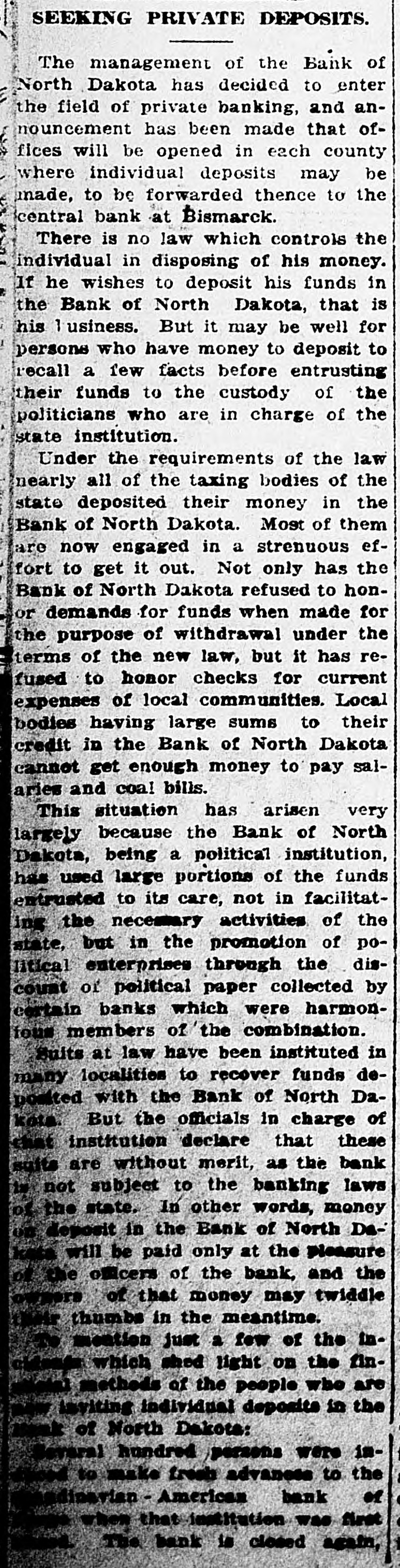
SEEKING PRIVATE DEPOSITS. The management of the Bank of North Dakota has decided to enter the field of private banking, and announcement has been made that offices will be opened in each county where individual deposits may be made, to be forwarded thence to the central bank at Bismarck. There is no law which controls the individual in disposing of his money. If he wishes to deposit his funds in the Bank of North Dakota, that is his 1 usiness. But it may be well for persons who have money to deposit to recall a few facts before entrusting their funds to the custody of the politicians who are in charge of the state institution. Under the requirements of the law nearly all of the taxing bodies of the state deposited their money in the Bank of North Dakota. Most of them are now engaged in a strenuous effort to get it out. Not only has the Bank of North Dakota refused to honor demands for funds when made for the purpose of withdrawal under the terms of the new law, but it has refused to honor checks for current expenses of local communities. Local bodies having large sums to their credit in the Bank of North Dakota cannot get enough money to pay salaries and coal bills. This situation has arisen very largely because the Bank of North Dakota, being a political institution, has used large portions of the funds entrusted to its care, not in facilitating the necessary activities of the state, but in the promotion of political enterprises through the discount of political paper collected by certain banks which were harmonfous members of the combination. Suits at law have been instituted in many localities to recover funds deposited with the Bank of North Dakota. But the officials in charge of that institution declare that these suits are without merit, as the bank in not subject to the banking laws of the state. In other words, money on deposit in the Bank of North Daketa will be paid only at the pleasure of the officers of the bank, and the owners of that money may twiddle thumbs in the meantime. mention just a few of the inwhich shed light on the finmethods of the people who are inviting individual deposits in the of North Dakota: Several hundred persons were into make fresh advances to the inavian - American bank of when that institution was first The bank is closed again,


Article from Sioux County Pioneer, February 24, 1921

Click image to open full size in new tab

Article Text

North Dakota Laws in the Making EASTERN BANKERS WITH. DRAW PROFFERED HELP Taking the position that they did not wish to be accused of dictating to the people of North Dakota how their state government should be run, the Minneapolis and Chicago bankers who took part in the conferences in Minneapolis looking toward a rehabilitation of the entire North Dakota financial situation, withdrew their proposals and left the situation as it is. It is contended by the Independents that a serious break is threatened in Nonpartisan ranks, A. C Townley, national president, being in favor of a compromise, it is said, while Messrs. Frazier, Lemke, and Hagan prepose to "sit tight" and either ride through to victory on their program or go down to defeat with it. Nonpartisans as strongly maintain that no such break exists and that it is the purpose of the organization to continue their fight along the lines already well defined. Liquidation of the Bank of North Dakota under the direction of a liquidation committee, headed by John Steen, state treasurer, and agreement to limit the industrial program to projects already undertaken, with the dissolution of the North Dakota Home Builders' association. was proposed at the Minneapolis conference between representatives of the state administration, bankers of North Dakota and representatives of one big Minneapolis financial institution present. Under the terms of the proposed compromise, which would in no manner affect the investigation of state industries being conducted at Bismarck, the following general policy would be put into effect: The state administration would enact laws that would permit the liquidation of the Bank of North Dakota down to a farm loan institution only. Pass laws that would make the sale of state bonds possible. Bring about legislative safeguarding of public moneys. on deposit in private banks, and make the state bank ineligible to receive public moneys. Dissolve the North Dakota Home Building association when work already started is completed. Restrict the industrial program to the erection and operation of the flour mill and elevator at Grand Forks. The bankers would undertake the sale of two million bonds with which to capitalize the Bank of North Dakota as a rural credit bank, and to provide a million dollar fund for financing the operation of the state mill and elevator when it is completed. Seek a market for $2,500,000 of mill and elevator bonds with which to complete the construction of the industry, and to repay the million dollars borrowed in Chicago to finance the construction work so far done. Back the sale of three million dollars of farm loan bonds with which to take up farm mortgages placed by the state bank, making that money available for return to the political subdivisions of the state, and to seek a market for such additional bonds as may be necessary to finance future farm loan operations of the state bank. A recent Minneapolis dispatch, following the dissolution of the conference, read: Negotiations for the sale of North Dakota state bonds by Minneapolis and Chicago investment firms are off. at least for the present. The sale of $6,000,000 in bonds had been contemplated as a means of putting the North Dakota bank on a sound financial basis.


Article from The Evening Herald, February 26, 1921

Click image to open full size in new tab

Article Text

BY N E A. SERVICE BISMARCK N D Feb. 24 Something is going to creek soon. in North Dakota Either the nonpartisan league. with its dream of a New Day in gover nment, Or the organized opposition of conservative political and business forces, supported by the concerted financial interests of the country The league can be killed and may be soon- but unless its leaders make a completo surrender the killing will be costly, perhaps wreeking the whole public and private financial structure of the state State is Broke Right now the state, officially is flat broke for ready money Public officials cannot get their pay checks cashed The state bank only public institution of its kind in the United States, has suspended payment. temporarly It's the crisis of a five-year political and economic battle of umparalleted bitterness, Here is the background: Two years ago the league in com plete control of state offices and legislature created the Bank of North Dakota 11 opened for business 18 months ago. 11 was to finance the program for state-owned flour mills. grain elevators, loans to home builders and farmers Bonds for $17,000,000 were authorized The bank was made depository of state, county and city funds-on which private banks had therefore paid little interest Private Banks Hit These combined measures threatened the most profitable parts of the private banking business Quite naturally the financial interests state and national united to scotch them. The big bond issues were contest ed through all the courts and their legality finally upheld by the supreme court of the United States But Ladies Aid society in church partors Friday, 7:30 D. 111. Opening session of Christian Endeavor convention in the South Methodist church Come to the above services


Article from Grand Forks Herald, March 14, 1921

Click image to open full size in new tab

Article Text

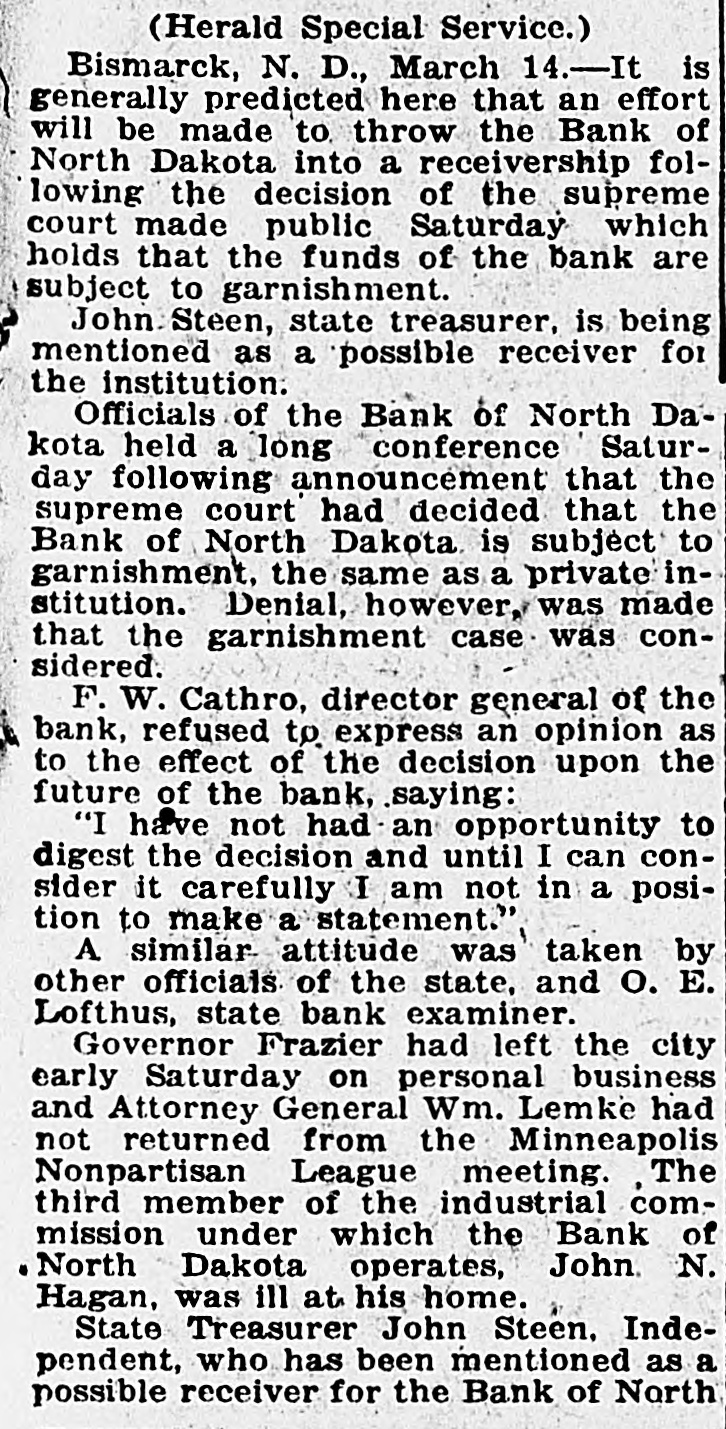
(Herald Special Service.) Bismarck, N. D., March 14.-It is generally predicted here that an effort will be made to throw the Bank of North Dakota into a receivership following the decision of the supreme court made public Saturday which holds that the funds of the bank are subject to garnishment. John Steen, state treasurer, is being mentioned as a possible receiver for the institution. Officials of the Bank of North Dakota held a long conference Saturday following announcement that the supreme court had decided that the Bank of North Dakota is subject to garnishment, the same as a private institution. Denial, however, was made that the garnishment case was considered. F. W. Cathro, director general of the bank, refused to express an opinion as to the effect of the decision upon the future of the bank, saying: "I have not had an opportunity to digest the decision and until I can consider it carefully I am not in a position to make a statement." A similar attitude was taken by other officials of the state, and O. E. Lofthus, state bank examiner. Governor Frazier had left the city early Saturday on personal business and Attorney General Wm. Lemke had not returned from the Minneapolis Nonpartisan League meeting. The third member of the industrial commission under which the Bank of North Dakota operates, John. N. Hagan, was ill at his home. State Treasurer John Steen. Independent, who has been mentioned as a possible receiver for the Bank of North


Article from The Bismarck Tribune, July 20, 1921

Click image to open full size in new tab

Article Text

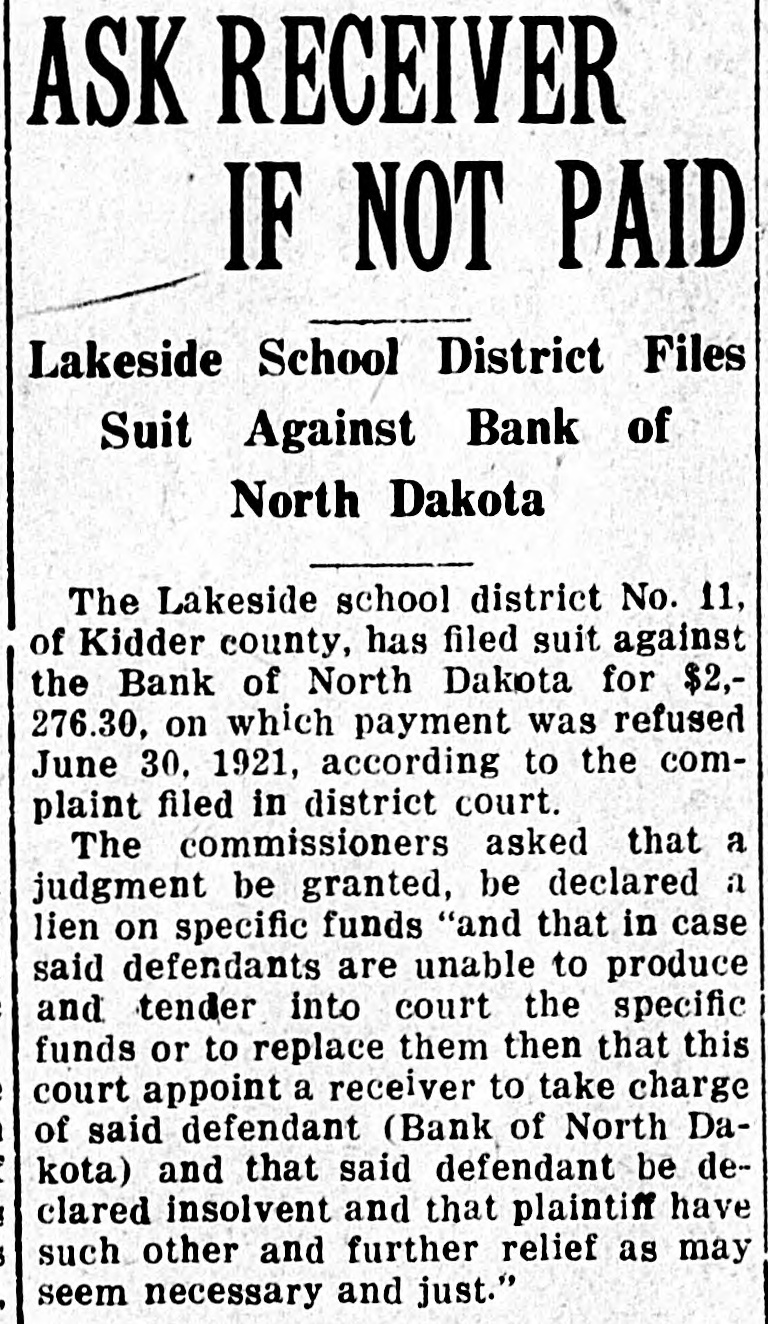
ASK RECEIVER IF NOT PAID Lakeside School District Files Suit Against Bank of North Dakota The Lakeside school district No. 11, of Kidder county, has filed suit against the Bank of North Dakota for $2,276.30, on which payment was refused June 30, 1921, according to the complaint filed in district court. The commissioners asked that a judgment be granted, be declared a lien on specific funds "and that in case said defendants are unable to produce and tender into court the specific funds or to replace them then that this court appoint a receiver to take charge of said defendant (Bank of North Dakota) and that said defendant be declared insolvent and that plaintiff have such other and further relief as may seem necessary and just."


Article from The Weekly Times-Record, October 13, 1921

Click image to open full size in new tab

Article Text

WHY PUBLISH THE LIST The reason given for the Bank of North Dakota's refusal to pay just claims against it. is invariably that it "can't collect what is due it from private banks." All right, suppose we accept that reason, for the time being, and ignore the millions tied up in delinqu real estate loans, in state industries, and in the houses of state officials. The last statement of the Bank of North Dakota shows that only 214 banks are still doing business with the Bank of North Dakota, and they have exactly $2,243,280 in redeposits, and $1,919,397 in loans. That includes more than 50 insolvent banks with a total of about $1,400,000 in loans and redeposits. Suppose the Bank of North Dakota publishes the list of banks still doing business with it. Why not let the voters know exactly what banks still have redeposits and loans, how much each has, how much is due, and what banks have refused to pay. That information was given last winter during the legislative investigation, and no serious results were noticed by the banks of the state. There was no run on the banks. Why not bring the information up to date? Such a report would disclose exactly how much money the Bank of North Dakota ha sin insolvent banks and how many of these insolvent banks are socalled "league banks." It would show how many socalled "league banks" still have money which they cannot or will not repay to the Bank of North Dakota. It would be a pretty fair guess that every independent banker who could do so, has long since ceased to do business with the Bank of North Dakota. He quit either of his own choice or because the Bank of North Dakota called on him for what he owed it. Certainly it is not reasonable to suppose that the Bank of North Dakota would register checks, while it permitted an "unfriendly banker" to retain any of its funds. "The gang that is running things at Bismarck doesn't do business that way. It doesn't sacrifice votes to protect an "unfriendly banker. Nor is it reasonable to suppose that the bank examiner would trifle very long with an "unfriendly banker" who couldn't or wouldn't pay what he owed. There would be a sign on his door in short order. The next time you read the excuse that the "private banks won't pay


Article from Every Evening, Wilmington Daily Commercial, October 22, 1921

Click image to open full size in new tab

Article Text

A COLLAPSED MILLENNIUM. Taxpayers of North Dakota have procured an injunction against the receipt of deposits by the State-controlled Bank of North Dakota. Th: motive for their action seems to be to save for themselves the proceeds of the $6,100,000 loan which the defendant State officials sought to retall here, with the result of finding that Wall Street was unsympathetic with political finance. Now the taxpayers allege that the bank is insolvent, and they are unwilling that the proceeds of the bonds should be wasted in support of the costly enterprises which the State sought to establish with the borrowed funds. If published reports may be relied upon, the taxpayers are better friends of themselves than the officials chosen to represent them and now on their defense against a recall petition. The State Bank is described as unable to meet its checks. The State is behind in payment of its salaries. The NonPartisan League's chain stores company is in receivership. Its homebuilding association cannot complete the houses it began. Work has stopped on the State-owned mill and elevator, which were the hub of the movement for the welfare of the farmers who believed in prophecies of the millennium through the ballot box. The Non-Partisan League is naturally said to be much chastened.-New York Times.


Article from The Bismarck Tribune, November 5, 1921

Click image to open full size in new tab

Article Text

SUPREME COURT SETS JAMESTOWN CASE FOR NOV. 8 Hearing Will Be Held in Supreme Court on Judge Coffey's Injunctional Order IN CASE ISSUES NEW Hearing in the "Jamestown case" upon the supreme court's order to District Judge Coffey and the plaintiffs in the action to show cause why the high courts order dissolving the Coffey order should not be made permament will be held on Tuesday, November 8, at 10 o'clock in the supreme court chambers here. The court which had postponed the hearing from Nov. 1 on its own motion today also on its own motion set the case for hearing next Tuesday. In connection with hearing on the case, in which District Judge Coffey issued an order declaring the Bank of North Dakota insolvent and prohibiting it from receiving deposits, the court will consider the motion filed in behalf of Secretary of State Hall and State Superintendent Minnie J. Nielson, defendants, who joined with plaintiffs in motion to quash supreme court's order. Unusual importance is now attached to the case since the defeat of the initiated law proposing the abolition and attorneys of payers the Bank of North Dakota who instituted and taxthe Jamestown suit have made known their intention to pursue it to the conclusion and end to have the bank held insolvent, which they hope would be followed by appaintment of the receiver to win up its affairs. The Spitzer, Rorick company band purchase contract also will enter into the case. There has been demand among some Independents that the contract be cancelled while the administration desires to deliver the bonds immediately to release the money for use in the state. In this connection Treasurer John Steen announced that he had received a letter from an eastern bond house, dated Nov. 1, asking if there were any North Dakota bonds for sale, and stating that the bond market had eased up and that bonds where formerly were not issued because of low rate of interest could be sold now.


Article from The Bismarck Tribune, November 22, 1926

Click image to open full size in new tab

Article Text

Without Due Consideration A: Associated Press dispatch credits Senator Ny., with the recommendation that the Bank of North Dakota handle the affairs of closed banks. If Senator Nye has been quoted literally, he doubtless spoke without accurate information and certainly without duecronsideration. If the receivership of closed banks is to be transferred to the Bank of North Dakota, the law under which the bank was created must be revamped. There is a serious legal question whether, under the present law, the Bank of North Dakota has authority to purchase assets. This matter was gone over at the 1925 session of the legislature, thoroughly discussed and considere at that time and rejected because those who had made a deep study of the questions involved decided that the plan was not feasible. The Bank of North Dakota is now loaded with approximately $2,000,000 worth of claims against closed banks, a large portion of which will be a total loss. It would seem hardly advisable to force this bank into the liquidation of closed banks under this condition and especially so where political pressure is more likely to be applied in the case of the Bank of North Dakota than is possible under the present scheme of handling receiverships through the courts. Even though the Nye plan possessed some merit, it would necessitate the establishment of a department of closed banks within the state bank. This would add to the expense of operation There is no doubt but that the expense of handling the affairs of closed banks under the Bank of North Dakota would be as great if not greater than now obtairs. Affairs of closed banks must necessarily be handled through the courts and if the Bank of North Dakota were to act, as Senator Nye suggests, its liquidating department must in the very nature of things operated under the supervision of the courts. Under the present system used for the liquidation of the affairs of closed banks, the average cost per bank is approximately $125 a month. In many cases the cost runs less, but this is the average arrived at from many months of experience. It is doubtless whether another advantage Senator Nye points out would inure under the Bank of North Dakota any more than is now the case under the present system of receivership. Senator Nye believes the Bank of North Dakota could realize more quickly on the assets of closed banks than is now possible. This is very doubtful. Those who have had experience with closed banks know that it is not always possible to determine the value of assets of a closed bank as soon as the institution ceases to function. Immediate liquidation of the assets is not possible except in some cases. The present system of receivership has in some 15 or 20 instances realized at once on the closed bank's assets where a local institution was willing to take over the good paper of the defunct bank. But even in these cases a receiver was necessary to liquidate assets of a questionable nature which if sold must be disposed of at an unreasonable discount to the creditors. Now that the state has initiated the present plan of handling the affairs of closed banks, it is reasonable to suppose that it would be wiser to proceed along present lines than to load new functions upon the Bank of North Dakota not logically belonging to that institution or in harmony with the purposes of its establishment by the people of this state through popular referendum.