Click image to open full size in new tab
Article Text
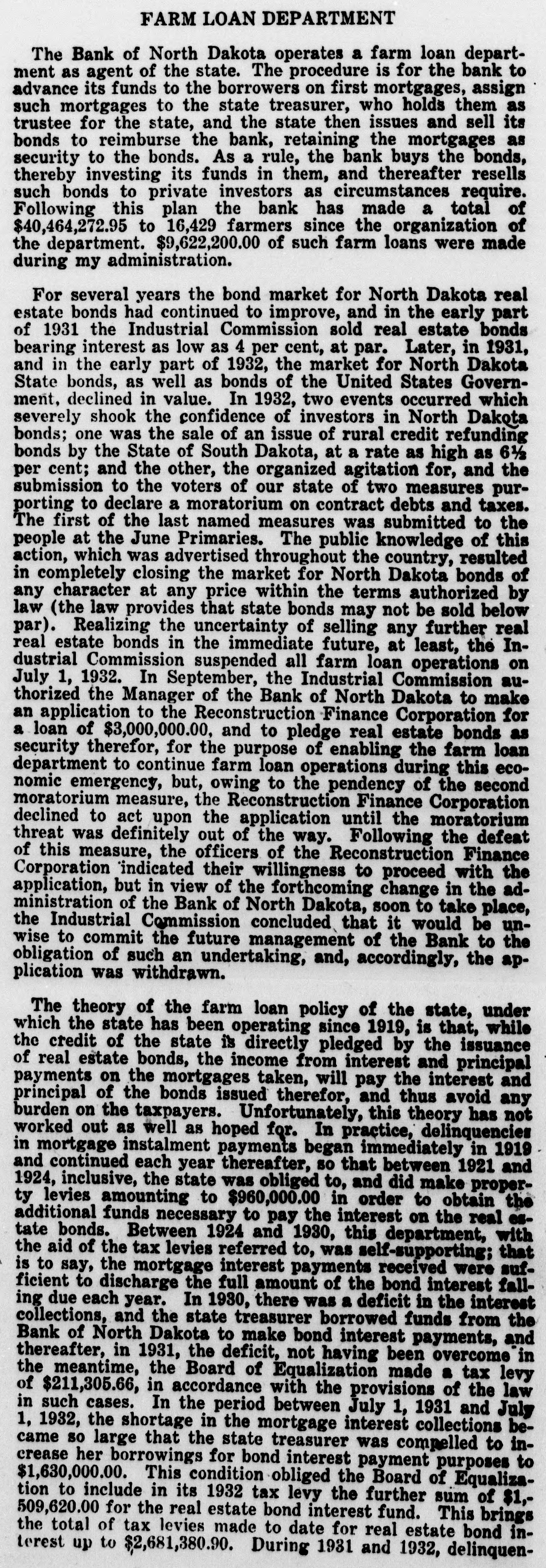
FARM LOAN DEPARTMENT The Bank of North Dakota operates a farm loan department as agent of the state. The procedure is for the bank to advance its funds to the borrowers on first mortgages, assign such mortgages to the state treasurer, who holds them as trustee for the state, and the state then issues and sell its bonds to reimburse the bank, retaining the mortgages as security to the bonds. As a rule, the bank buys the bonds, thereby investing its funds in them, and thereafter resells such bonds to private investors as circumstances require. Following this plan the bank has made a total of $40,464,272.95 to 16,429 farmers since the organization of the department. $9,622,200.00 of such farm loans were made during my administration. For several years the bond market for North Dakota real estate bonds had continued to improve, and in the early part of 1931 the Industrial Commission sold real estate bonds bearing interest as low as 4 per cent, at par. Later, in 1931, and in the early part of 1932, the market for North Dakota State bonds, as well as bonds of the United States Government, declined in value. In 1932, two events occurred which severely shook the confidence of investors in North Dakota bonds; one was the sale of an issue of rural credit refunding bonds by the State of South Dakota, at a rate as high as 6½ per cent; and the other, the organized agitation for, and the submission to the voters of our state of two measures purporting to declare a moratorium on contract debts and taxes. The first of the last named measures was submitted to the people at the June Primaries. The public knowledge of this action, which was advertised throughout the country, resulted in completely closing the market for North Dakota bonds of any character at any price within the terms authorized by law (the law provides that state bonds may not be sold below par). Realizing the uncertainty of selling any further real real estate bonds in the immediate future, at least, the Industrial Commission suspended all farm loan operations on July 1, 1932. In September, the Industrial Commission authorized the Manager of the Bank of North Dakota to make an application to the Reconstruction Finance Corporation for a loan of $3,000,000.00, and to pledge real estate bonds as security therefor, for the purpose of enabling the farm loan department to continue farm loan operations during this economic emergency, but, owing to the pendency of the second moratorium measure, the Reconstruction Finance Corporation declined to act upon the application until the moratorium threat was definitely out of the way. Following the defeat of this measure, the officers of the Reconstruction Finance Corporation indicated their willingness to proceed with the application, but in view of the forthcoming change in the administration of the Bank of North Dakota, soon to take place, the Industrial Commission concluded that it would be unwise to commit the future management of the Bank to the obligation of such an undertaking, and, accordingly, the application was withdrawn. The theory of the farm loan policy of the state, under which the state has been operating since 1919, is that, while the credit of the state is directly pledged by the issuance of real estate bonds, the income from interest and principal payments on the mortgages taken, will pay the interest and principal of the bonds issued therefor, and thus avoid any burden on the taxpayers. Unfortunately, this theory has not worked out as well as hoped for. In practice, delinquencies in mortgage instalment payments began immediately in 1919 and continued each year thereafter, so that between 1921 and 1924, inclusive, the state was obliged to, and did make property levies amounting to $960,000.00 in order to obtain the additional funds necessary to pay the interest on the real estate bonds. Between 1924 and 1930, this department, with the aid of the tax levies referred to, was self-supporting; that is to say, the mortgage interest payments received were sufficient to discharge the full amount of the bond interest falling due each year. In 1930, there was a deficit in the interest collections, and the state treasurer borrowed funds from the Bank. of North Dakota to make bond interest payments, and thereafter, in 1931, the deficit, not having been overcome in the meantime, the Board of Equalization made a tax levy of $211,305.66, in accordance with the provisions of the law in such cases. In the period between July 1, 1931 and July 1, 1932, the shortage in the mortgage interest collections became so large that the state treasurer was compelled to increase her borrowings for bond interest payment purposes to $1,630,000.00. This condition obliged the Board of Equalization to include in its 1932 tax levy the further sum of $1,509,620.00 for the real estate bond interest fund. This brings the total of tax levies made to date for real estate bond interest up to $2,681,380.90. During 1931 and 1932, delinquen-