gpt-5-mini (chosen from majority vote of a three-model LLM ensemble)
Short Digest
2e2fc2d5b17b78b4
Response Measures
None
Description
Closed by state banking authorities and placed in receivership; later liquidation contemplated.
Events (2)
1.November 17, 1920Suspension
Cause
Government Action
Cause Details
State bank examiner found reserves below legal requirements after crop failures and farmers holding wheat; bank was closed/suspended by state banking authorities.
Newspaper Excerpt
The Security State Bank of New England ... closed Nov. 17, 1920
Source
newspapers
2.December 11, 1920Receivership
Newspaper Excerpt
Arthur L. Young, deputy state treasurer, was today announced as receiver for the bank, and has taken charge.
Source
newspapers
Newspaper Articles (15)
1.November 19, 1920The Bismarck TribuneBismarck, Mandan, ND
Click image to open full size in new tab
Article Text
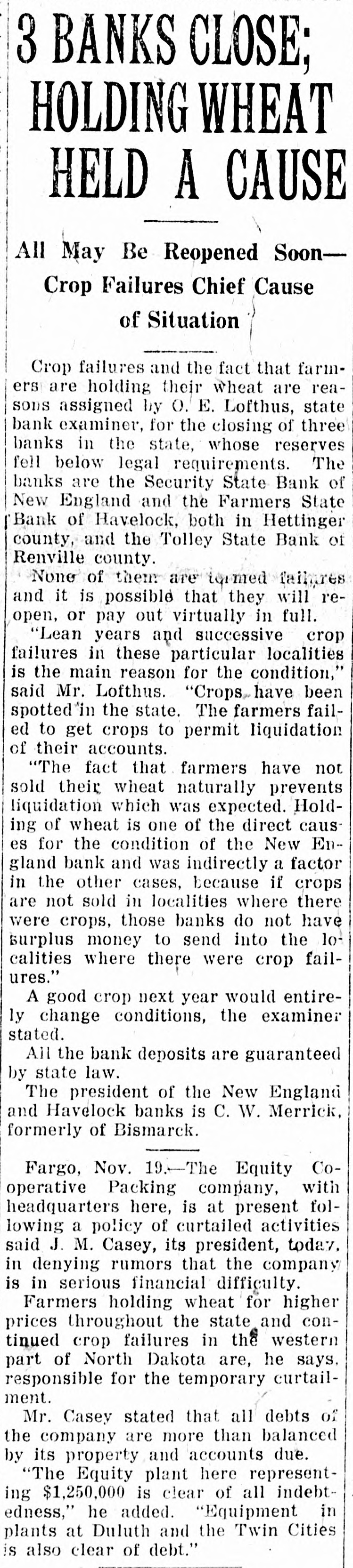
3 BANKS CLOSE; HOLDING WHEAT HELD A CAUSE All May Be Reopened SoonCrop Failures Chief Cause of Situation Crop failures and the fact that farmers are holding their wheat are reasons assigned by O. E. Lofthus, state bank examiner, for the closing of three banks in the state, whose reserves fell below legal requirements. The banks are the Security State Bank of New England and the Farmers State Bank of Havelock, both in Hettinger county, and the Tolley State Bank of Renville county. None of them are and it is possible that they will reopen, or pay out virtually in full. "Lean years and successive crop failures in these particular localities is the main reason for the condition," said Mr. Lofthus. "Crops have been spotted 'in the state. The farmers failed to get crops to permit liquidation of their accounts. "The fact that farmers have not sold their wheat naturally prevents liquidation which was expected. Holding of wheat is one of the direct causes for the condition of the New England bank and was indirectly a factor in the other cases, because if crops are not sold in localities where there were crops, those banks do not have surplus money to send into the lo calities where there were crop failures." A good crop next year would entirely change conditions, the examiner stated. All the bank deposits are guaranteed by state law. The president of the New England and Havelock banks is C. W. Merrick, formerly of Bismarck. Fargo, Nov. 19.-The Equity Cooperative Packing company, with headquarters here, is at present following a policy of curtailed activities said J. M. Casey, its president, today. in denying rumors that the company is in serious financial difficulty. Farmers holding wheat for higher prices throughout the state and continued crop failures in the western part of North Dakota are, he says. responsible for the temporary curtailment. Mr. Casey stated that all debts of the company are more than balanced by its property and accounts due. "The Equity plant here representing $1,250,000 is clear of all indebtedness," he added. "Equipment in plants at Duluth and the Twin Cities is also clear of debt."
2.November 24, 1920Every Evening, Wilmington Daily CommercialWilmington, DE
Click image to open full size in new tab
Article Text
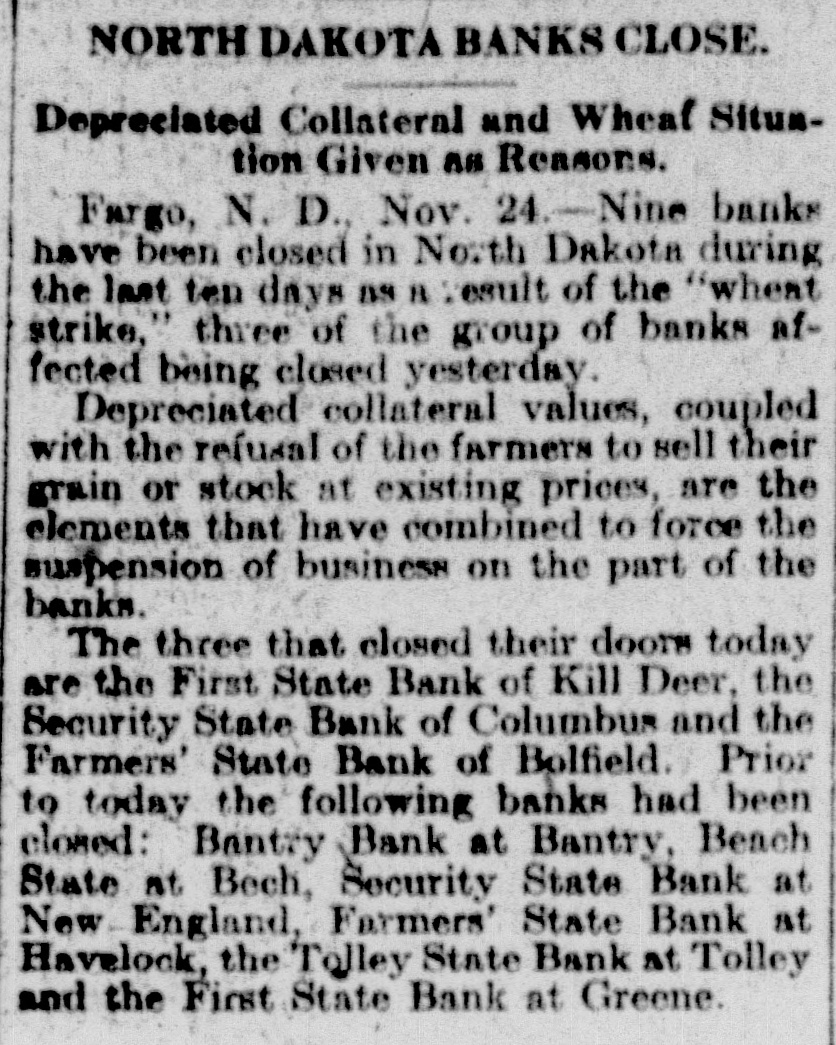
NORTH DAKOTA BANKS CLOSE. Depreciated Collateral and Wheat Situmtion Given AH Reasons. Fargo, N. D. Nov. 24. - Nine banks have been closed in North Dakota during the last ten days as R esult of the "whent strike," three of the group of banks affected being closed yesterday. Depreciated collateral values, coupled with the refusal of the farmers to sell their grain or stock at existing prices, are the elements that have combined to force the suspension of business on the part of the banks. The three that closed their doore today are the First State Bank of Kill Deer, the Security State Bank of Columbus and the Farmers' State Bank of Bolfield. Prior to today the following banks had been closed: Bantry Bank at Bantry, Beach State at Bech, Security State Bank at New England, Farmers' State Bank at Havelock, the Tolley State Bank at Tolley and the First State Bank at Greene.
3.November 25, 1920The Ward County IndependentMinot, ND
Click image to open full size in new tab
Article Text
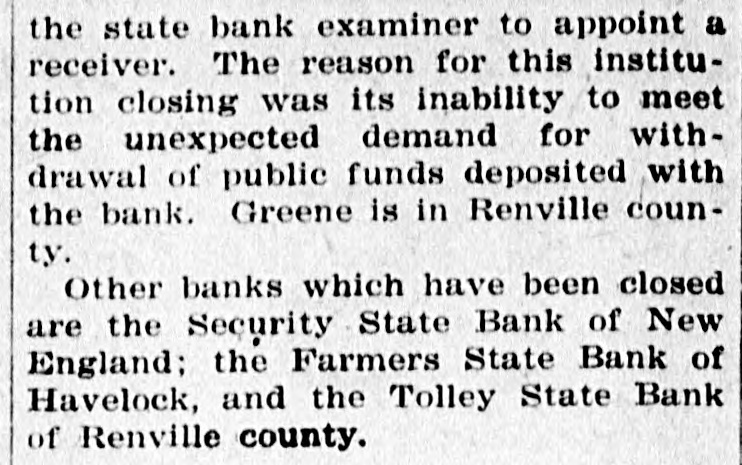
the state bank examiner to appoint a receiver. The reason for this institution closing was its inability to meet the unexpected demand for withdrawal of public funds deposited with the bank. Greene is in Renville county. Other banks which have been closed are the Security State Bank of New England; the Farmers State Bank of Havelock, and the Tolley State Bank of Renville county.
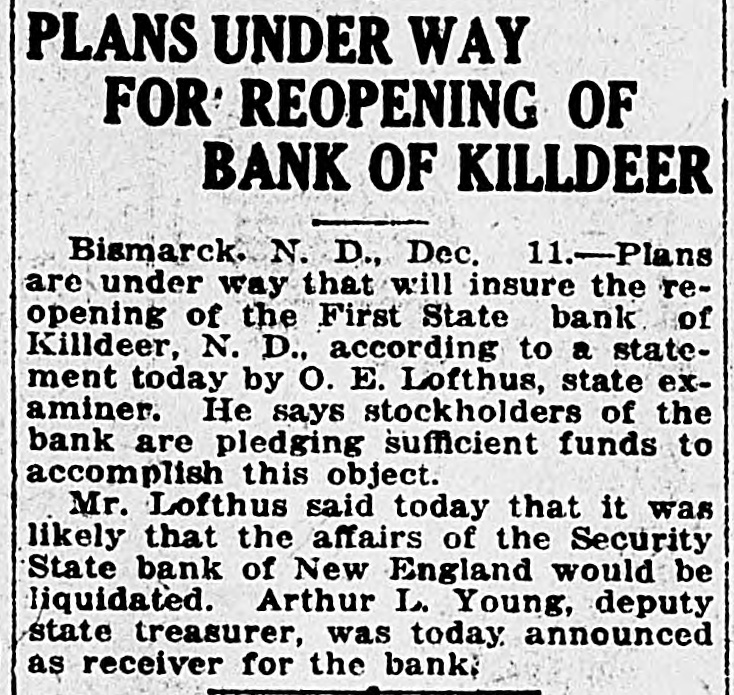
PLANS UNDER WAY FOR REOPENING OF BANK OF KILLDEER Bismarck. N. D., Dec. 11.-Plans are under way that will insure the reopening of the First State bank of Killdeer, N. D., according to a statement today by O. E. Lofthus, state examiner. He says stockholders of the bank are pledging sufficient funds to accomplish this object. Mr. Lofthus said today that it was likely that the affairs of the Security State bank of New England would be liquidated. Arthur L. Young, deputy state treasurer, was today announced as receiver for the bank,
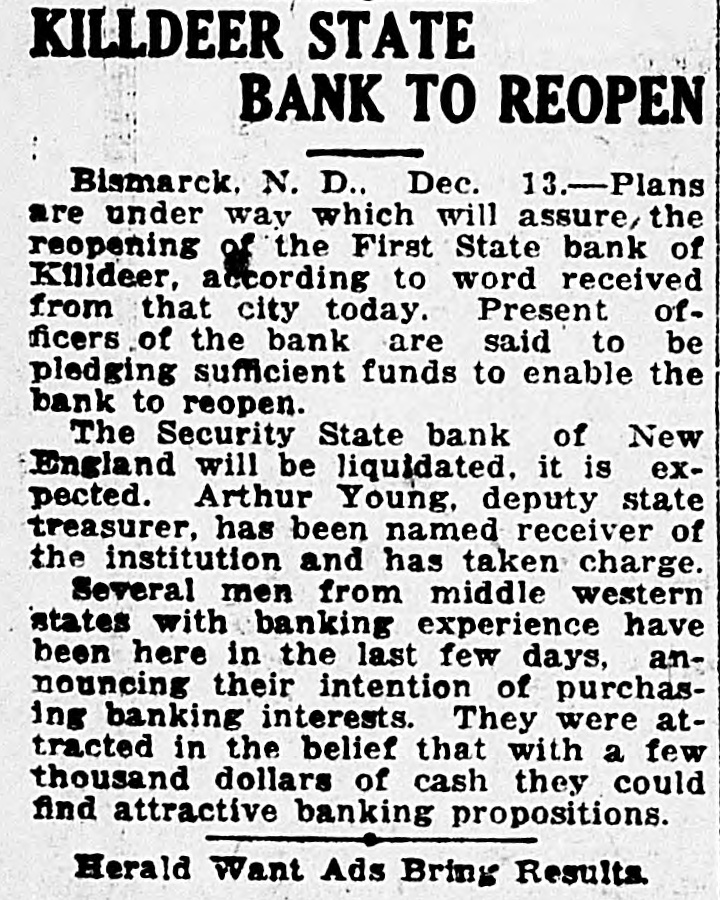
KILLDEER STATE BANK TO REOPEN Bismarck. N. D.. Dec. 13.-Plans are under way which will assure, the reopening of the First State bank of Killdeer, according to word received from that city today. Present officers of the bank are said to be pledging sufficient funds to enable the bank to reopen. The Security State bank of New England will be liquidated. it is expected. Arthur Young, deputy state treasurer, has been named receiver of the institution and has taken charge. Several men from middle western states with banking experience have been here in the last few days, announcing their intention of purchasing banking interests. They were attracted in the belief that with a few thousand dollars of cash they could find attractive banking propositions. Herald Want Ads Bring Results.
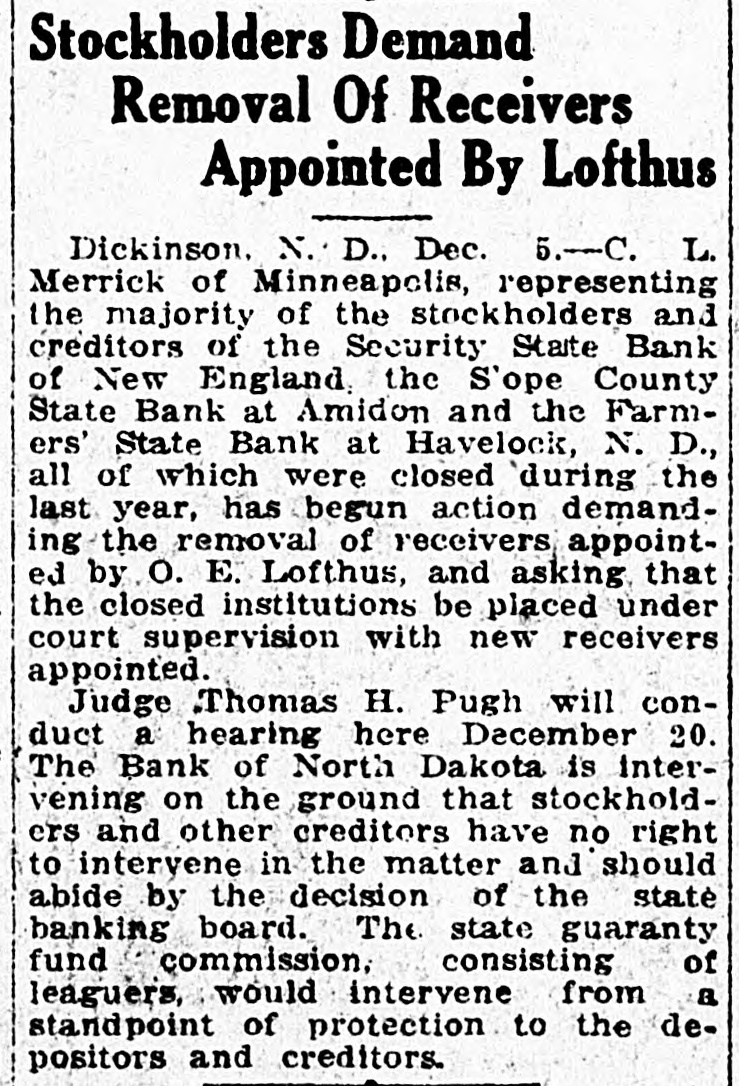
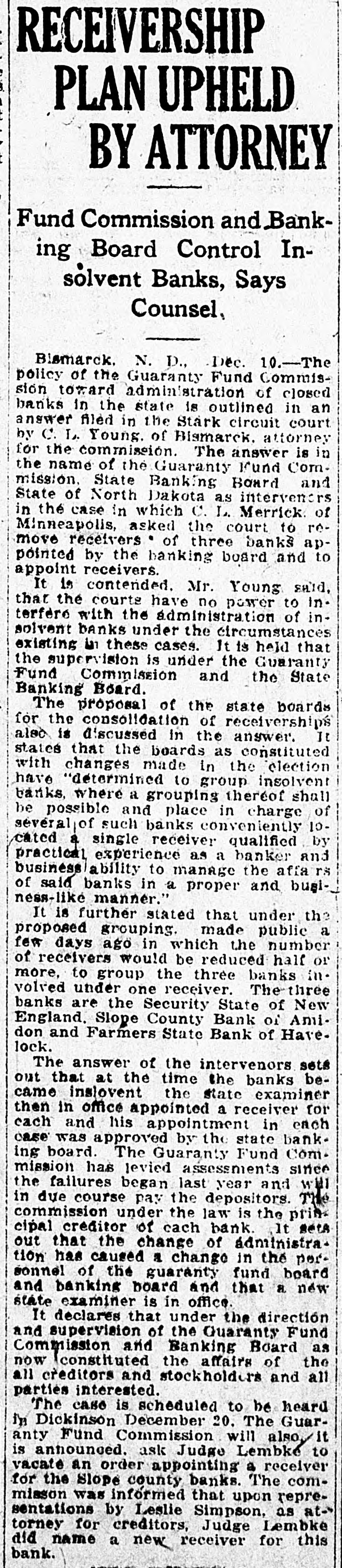
Stockholders Demand Removal Of Receivers Appointed By Lofthus Dickinson. N. D., Dec. 5.-C. L. Merrick of Minneapolis, representing the majority of the stockholders and creditors of the Security State Bank of New England, the S'ope County State Bank at Amidon and the Farmers' State Bank at Havelock, N. D., all of which were closed during the last year, has begun action demanding the removal of receivers appointed by O. E. Lofthus, and asking that the closed institutions be placed under court supervision with new receivers appointed. Judge .Thomas H. Pugh will conduct a hearing here December 20. The Bank of North Dakota is intervening on the ground that stockholders and other creditors have no right to intervene in the matter and should abide by the decision of the state banking board. The state guaranty of fund commission, consisting a leaguers, would intervene from standpoint of protection to the depositors and creditors.
7.December 5, 1921The Bismarck TribuneBismarck, Mandan, ND
Click image to open full size in new tab
Article Text
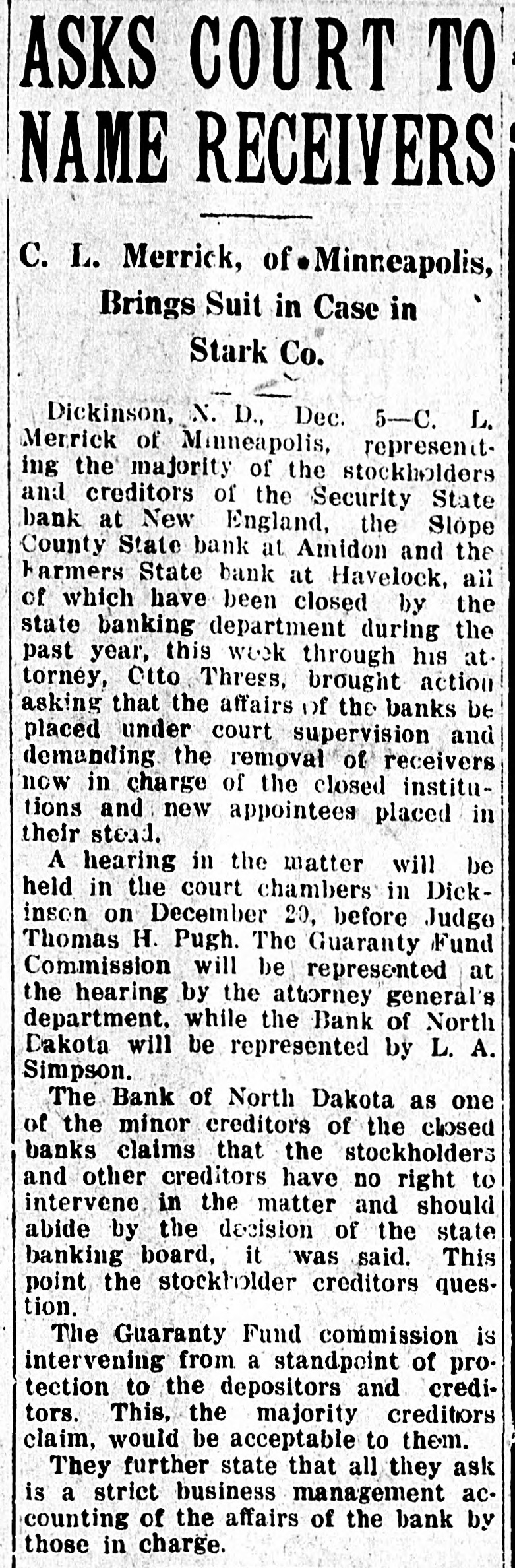
ASKS COURT TO NAME RECEIVERS C. L. Merrick, of Minneapolis, Brings Suit in Case in Stark Co. Dickinson, N. D., Dec. 5-C. L. Merrick of Minneapolis, represent ing the majority of the stockholders and creditors of the Security State bank at New England, the Slope County State bank at Amidon and the harmers State bank at Havelock, all of which have been closed by the state banking department during the past year, this week through his at torney, Ctto Thress, brought action asking that the affairs of the banks be placed under court supervision and demanding the removal of receivers now in charge of the closed institutions and new appointees placed in their stead. A hearing in the matter will be held in the court chambers in Dickinson on December 20, before Judge Thomas H. Pugh. The Guaranty Fund Commission will be represented at the hearing by the attorney general's department. while the Bank of North Dakota will be represented by L. A. Simpson. The Bank of North Dakota as one of the minor creditors of the closed banks claims that the stockholders and other creditors have no right to intervene in the matter and should abide by the decision of the state banking board, it was said. This point the stockholder creditors question. The Guaranty Fund commission is intervening from a standpoint of protection to the depositors and creditors. This, the majority creditors claim, would be acceptable to them. They further state that all they ask is a strict business management accounting of the affairs of the bank by those in charge.
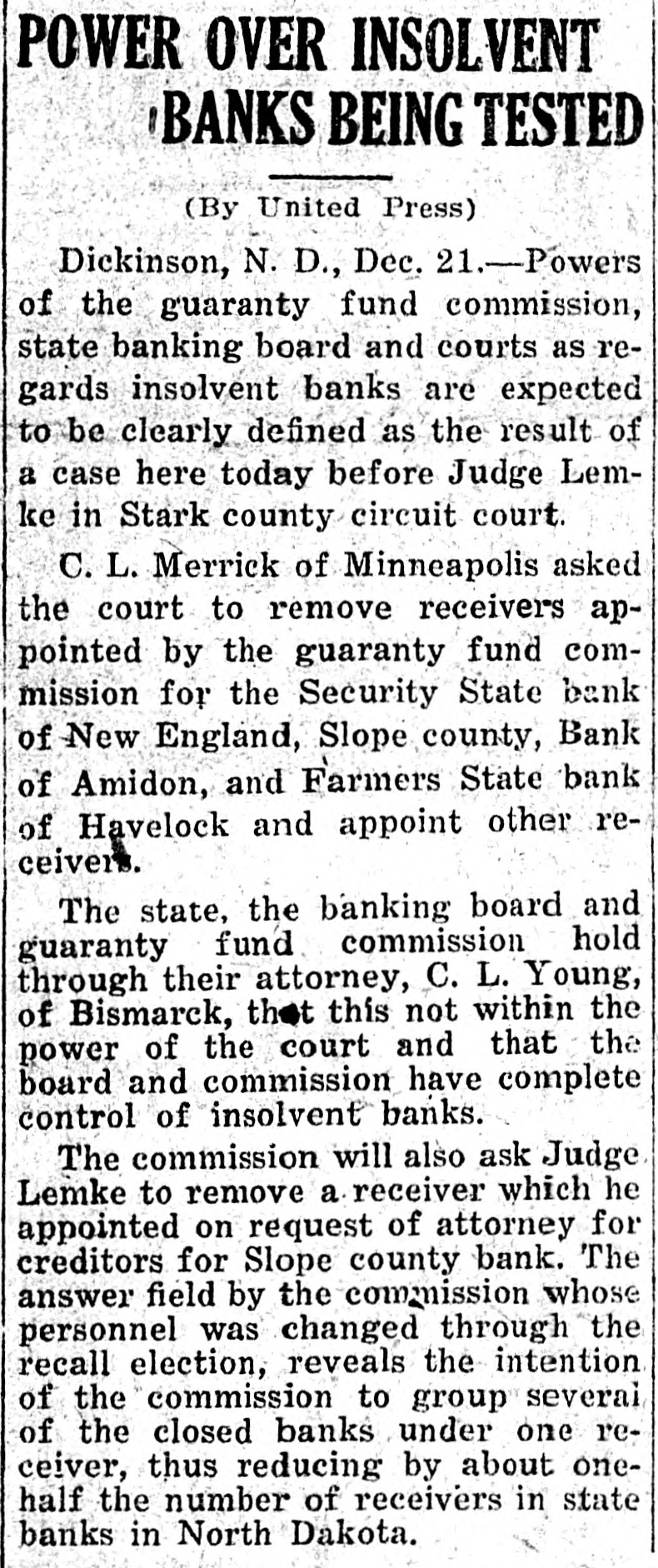
POWER OVER INSOLVENT BANKS BEING TESTED (By United Press) Dickinson, N. D., Dec. 21.-Powers of the guaranty fund commission, state banking board and courts as regards insolvent banks are expected to be clearly defined as the result of a case here today before Judge Lemke in Stark county circuit court. C.L. Merrick of Minneapolis asked the court to remove receivers appointed by the guaranty fund commission for the Security State bank of New England, Slope county, Bank of Amidon, and Farmers State bank of Havelock and appoint other receivers. The state, the banking board and guaranty fund commission hold through their attorney, C. L. Young, of Bismarck, that this not within the power of the court and that the board and commission have complete control of insolvent banks. The commission will also ask Judge Lemke to remove a receiver which he appointed on request of attorney for creditors for Slope county bank. The answer field by the commission whose personnel was changed through the recall election, reveals the intention of the commission to group several of the closed banks under one receiver, thus reducing by about onehalf the number of receivers in state banks in North Dakota.
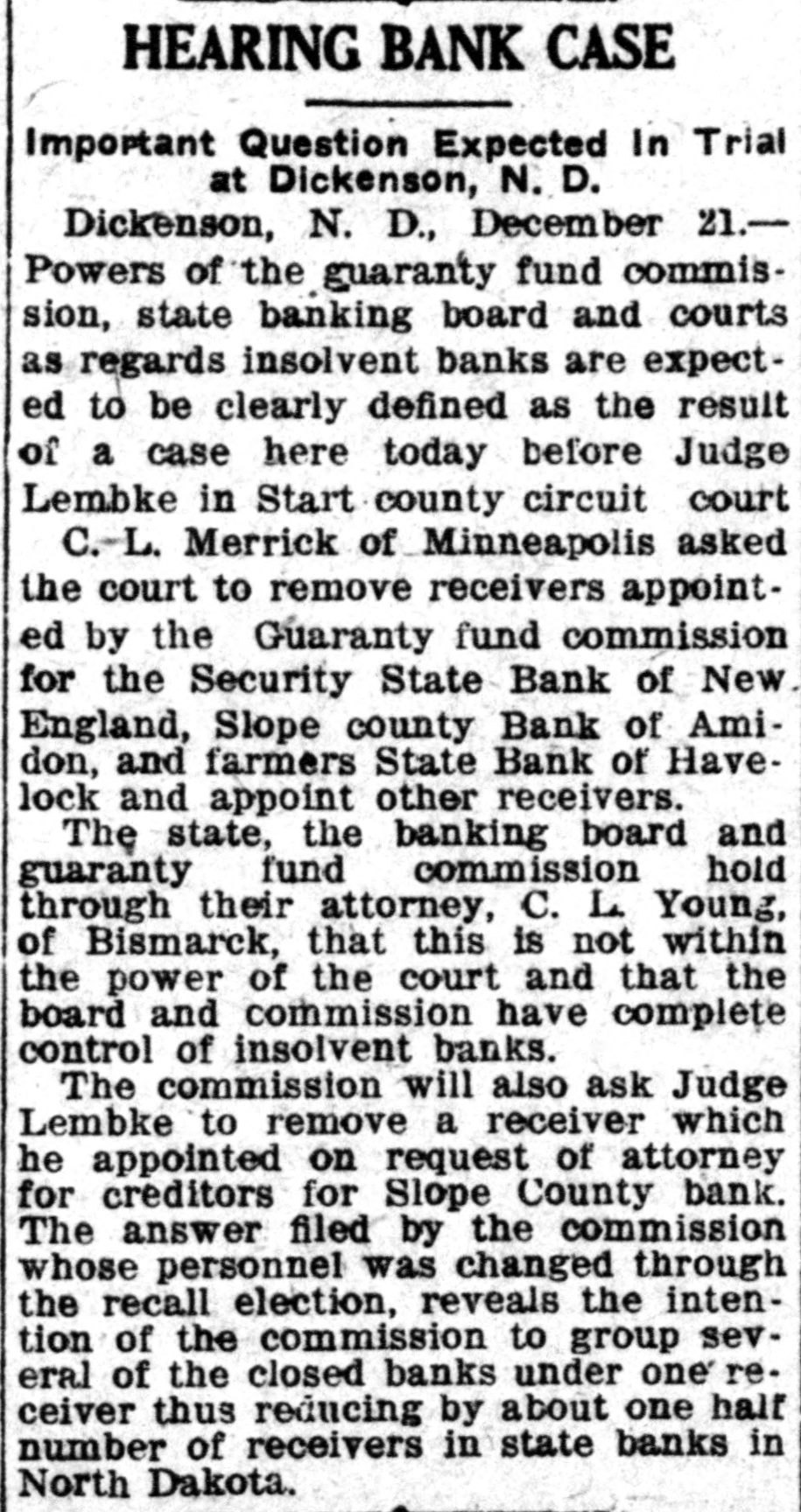
HEARING BANK CASE Important Question Expected In Trial at Dickenson, N. D. Dickenson, N. D., December 21.Powers of the guaranty fund commission, state banking board and courts as regards insolvent banks are expected to be clearly defined as the result of a case here today before Judge Lembke in Start county circuit court C.-L. Merrick of Minneapolis asked the court to remove receivers appointed by the Guaranty fund commission for the Security State Bank of New England, Slope county Bank of Amidon, and farmers State Bank of Havelock and appoint other receivers. The state, the banking board and guaranty fund commission hold through their attorney, C. L. Young, of Bismarck, that this is not within the power of the court and that the board and commission have complete control of insolvent banks. The commission will also ask Judge Lembke to remove a receiver which he appointed on request of attorney for creditors for Slope County bank. The answer filed by the commission whose personnel was changed through the recall election, reveals the intention of the commission to group several of the closed banks under one receiver thus reducing by about one half number of receivers in state banks in North Dakota.
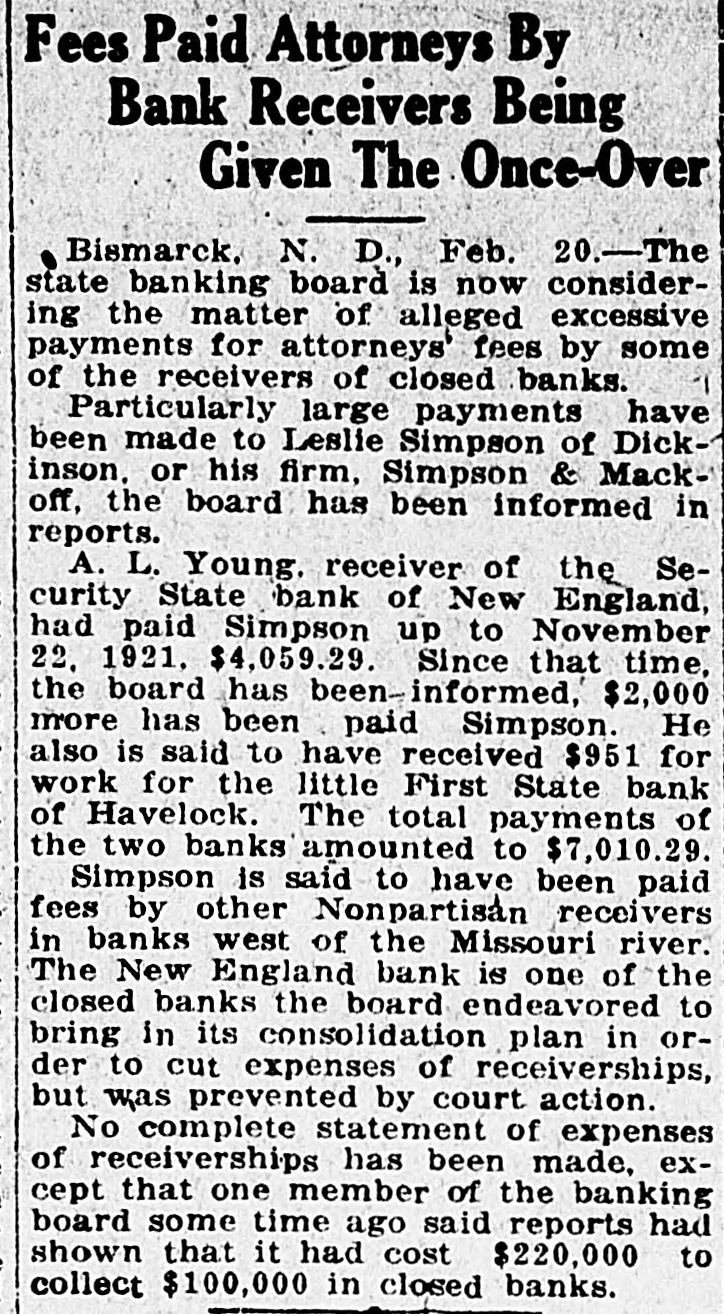
Fees Paid Attorneys By Bank Receivers Being Given The Once-Over Bismarck, N. D., Feb. 20.-The state banking board is now considering the matter of alleged excessive payments for attorneys' fees by some of the receivers of closed banks. 1 Particularly large payments have been made to Leslie Simpson of Dickinson. or his firm, Simpson & Mackoff, the board has been informed in reports. A. L. Young. receiver of the Security State bank of New England, had paid Simpson up to November 22, 1921. $4,059.29. Since that time, the board has been-informed, $2,000 more has been paid Simpson. He also is said to have received $951 for work for the little First State bank of Havelock. The total payments of the two banks amounted to $7,010.29. Simpson is said to have been paid fees by other Nonpartisan receivers in banks west of the Missouri river. The New England bank is one of the closed banks the board endeavored to bring in its consolidation plan in order to cut expenses of receiverships, but was prevented by court action. No complete statement of expenses of receiverships has been made, except that one member of the banking board some time ago said reports had shown that it had cost $220,000 to collect $100,000 in closed banks.
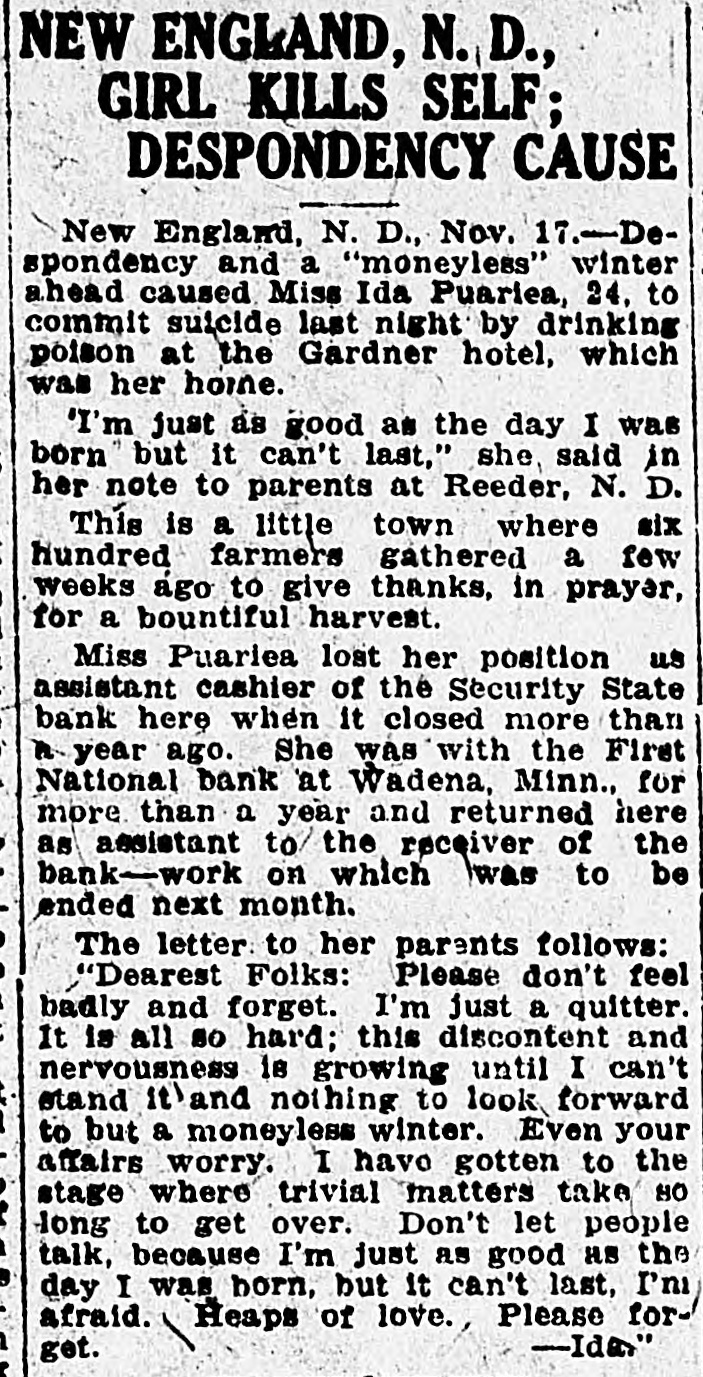
NEW ENGLAND, N.D., GIRL KILLS SELF; DESPONDENCY CAUSE New England, N. D., Nov. 17.-Despondency and a "moneyless" winter ahead caused Miss Ida Puariea, 24, to commit suicide last night by drinking poison at the Gardner hotel, which was her home. 'I'm just as good as the day I was born but it can't last," she, said in her note to parents at Reeder, N. D. This is a little town where six hundred farmers gathered a few weeks ago to give thanks, in prayer, for a bountiful harvest. Miss Puariea lost her position us assistant cashier of the Security State bank here when it closed more than n year ago. She was with the First National bank at Wadena, Minn., for more than a year and returned here as assistant to the receiver of the bank-work on which was to be ended next month. The letter to her parents follows: "Dearest Folks: Please don't feel badly and forget. I'm just a quitter. It is all so hard; this discontent and nervousness is growing until I can't stand it' and nothing to look forward to but a moneyless winter. Even your affairs worry. I have gotten to the stage where trivial matters take HO long to get over. Don't let people talk, because I'm just as good as the day I was horn, but it can't last, I'm afraid. Heaps of love. Please for-Ida" get.
13.June 7, 1923The Bismarck TribuneBismarck, Mandan, ND
Click image to open full size in new tab
Article Text
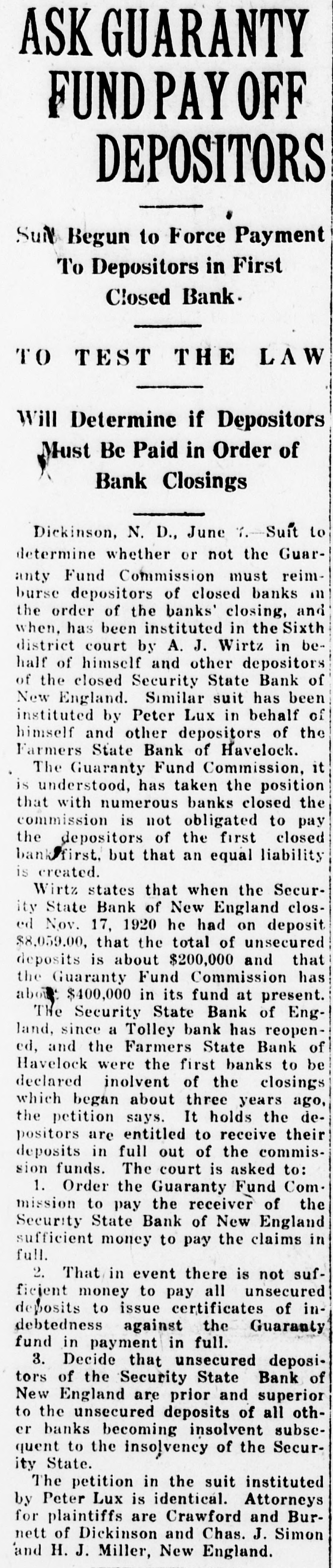
ASK GUARANTY FUND PAY OFF DEPOSITORS Suit Begun to Force Payment To Depositors in First Closed Bank TO TEST THE LAW Will Determine if Depositors Must Be Paid in Order of Bank Closings Dickinson, N. D., June T.-Suit to determine whether or not the Guaranty Fund Commission must reimburse depositors of closed banks ill the order of the banks' closing, and when, has been instituted in the Sixth district court by A. J. Wirtz in behalf of himself and other depositors of the closed Security State Bank of New England. Similar suit has been instituted by Peter Lux in behalf of himself and other depositors of the Farmers State Bank of Havelock. The Guaranty Fund Commission, it is understood, has taken the position that with numerous banks closed the commission is not obligated to pay the depositors of the first closed bank first. but that an equal liability is created. Wirtz states that when the Security State Bank of New England closed Nov. 17, 1920 he had on deposit $8,059.00, that the total of unsecured deposits is about $200,000 and that the Guaranty Fund Commission has about $400,000 in its fund at present. The Security State Bank of England, since a Tolley bank has reopened, and the Farmers State Bank of Havelock were the first banks to be declared inolvent of the closings which began about three years ago, the petition says. It holds the depositors are entitled to receive their deposits in full out of the commission funds. The court is asked to: 1. Order the Guaranty Fund Com. mission to pay the receiver of the Security State Bank of New England sufficient money to pay the claims in full. 2. That in event there is not sufficient money to pay all unsecured deposits to issue certificates of indebtedness against the Guaranty fund in payment in full. 3. Decide that unsecured depositors of the Security State Bank of New England are prior and superior to the unsecured deposits of all other banks becoming insolvent subsequent to the insolvency of the Security State. The petition in the suit instituted by Peter Lux is identical. Attorneys for plaintiffs are Crawford and Burnett of Dickinson and Chas. J. Simon and H. J. Miller, New England.
14.June 8, 1923Grand Forks HeraldGrand Forks, ND
Click image to open full size in new tab
Article Text
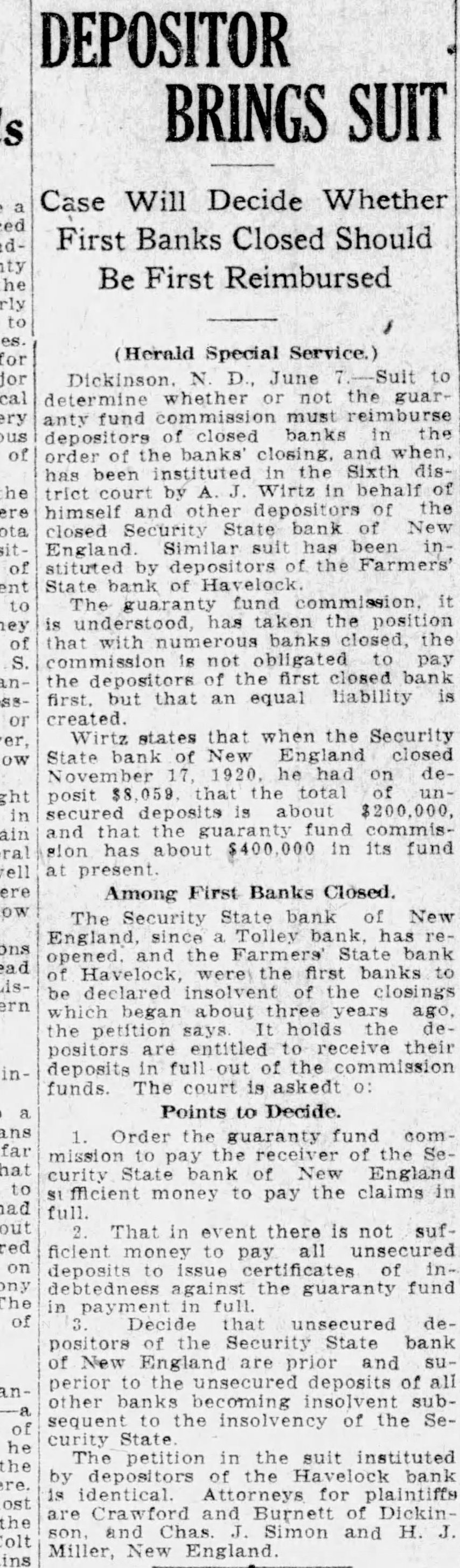
DEPOSITOR BRINGS SUIT
Case Will Decide Whether First Banks Closed Should Be First Reimbursed
(Herald Special Service.)
Dickinson, N. D., June 7.βSuit to determine whether or not the guaranty fund commission must reimburse depositors of closed banks in the order of the banks' closing, and when, has been instituted in the Sixth district court by A. J. Wirtz in behalf of himself and other depositors of the closed Security State bank of New England. Similar suit has been instituted by depositors of the Farmers' State bank of Havelock.
The guaranty fund commission, it is understood, has taken the position that with numerous banks closed, the commission is not obligated to pay the depositors of the first closed bank first, but that an equal liability is created.
Wirtz states that when the Security State bank of New England closed November 17, 1920, he had on deposit $8,059, that the total of unsecured deposits is about $200,000, and that the guaranty fund commission has about $400,000 in its fund at present.
Among First Banks Closed.
The Security State bank of New England, since a Tolley bank, has reopened, and the Farmers' State bank of Havelock, were the first banks to be declared insolvent of the closings which began about three years ago, the petition says. It holds the depositors are entitled to receive their deposits in full out of the commission funds. The court is asked to:
Points to Decide.
1. Order the guaranty fund commission to pay the receiver of the Security State bank of New England sufficient money to pay the claims in full.
2. That in event there is not sufficient money to pay all unsecured deposits to issue certificates of indebtedness against the guaranty fund in payment in full.
3. Decide that unsecured depositors of the Security State bank of New England are prior and superior to the unsecured deposits of all other banks becoming insolvent subsequent to the insolvency of the Security State.
The petition in the suit instituted by depositors of the Havelock bank is identical. Attorneys for plaintiffs are Crawford and Burnett of Dickinson, and Chas. J. Simon and H. J. Miller, New England.
15.December 13, 1924The Bismarck TribuneBismarck, Mandan, ND
Click image to open full size in new tab
Article Text
FIRST CHECKS TO DEPOSITORS ARE SENT OUT Depositors of Tolley State Bank Get 10 Per Cent Dividend from Commission TO BE CONTINUED Depositors of Banks to be Paid in Order of the Closing of Banks First checks in payment of a ten percent dividend to depositors of closed in the state before July banks offices 1. 1923. were mailed from of the Depositors Guaranty Fund Commission, it was announced by members of the commission. Other checks will be mailed as rapidly as the commission's office force is able to proceed. The first check, for $94.00. was made payable to Esther M. Gordon of Minnesota, a depositor in the Tolley State Bank. She received for the balance of her deposit in that bank a certificate of indebtedness for $940.81. which is expected to be paid at some future time. The commission has been delayed longer than expected in actual payment of checks. because of the imiamount of particularity rein the work of quired mense organizing the office force and examining claims, according to C. B. McMillan of Hannah. a member of the commission. In order to secure accurate and proper distribution of the fund and lessen the expense of administration, an office system designed to serve for a long period has been established, and the work of payment will extend over a considerable per 10d, Mr. McMillan said. of the Many depositors Tolley in State Bank will receive a dividend the first batch of checks dispatched. Out of 140 claims for deposits lost in the bank, however, but 43 filed receivers' certificates, and only those who filed receivers' certificates and obtain approval of claims, can be paid. Checks will be mailed to depositors in the order of closing of banks. it was said, and the second batch of checks will go to depositors of the Security State Bank of New England. It was emphasized again that no depositors of banks closing after 1. 1923, are to receive a diviand July dend at this time, it is not desired that they file papers at this time. The appointive members of the Depositors Guaranty Fund Commission, who are in session here to supervise the detailed work, are S. G. Severtson. Bismarck; W. N. Harris. Turtle Lake, and Mr. McMillan of Hannah. Banks To Reopen It was announced by the commission that bank conditions in the state are improving steadily, and reopening of three more closed banks is expected within a few days.
Bank runs are almost always and everywhere a deterioration of bank fundamentals.
But not for you.
You are the measure-zero exception: great fundamentals, solid bank, and yet the Diamond Dybvig fairy spread its rumor. Depositors woke up. Your collateral was not prepositioned. The Clearinghouse had it for you.
Do not pass Go. Do not collect $200. Go directly to jail… or worse.