First State Bank (Amidon, ND)

Episode Information

Episode UID
77079471465
Episode Type
Suspension โ†’ Closure
Bank Type
state
Bank ID
7707947 routing
Routing Number
77-0794
Start Date
January 10, 1922
Location
Amidon, North Dakota (46.482, -103.322)

Metadata

Model
gpt-5-mini (chosen from majority vote of a three-model LLM ensemble)
Short Digest
0adc6b5ff204df4a

Response Measures

None

Events (3)

1. January 10, 1922 Receivership
Newspaper Excerpt
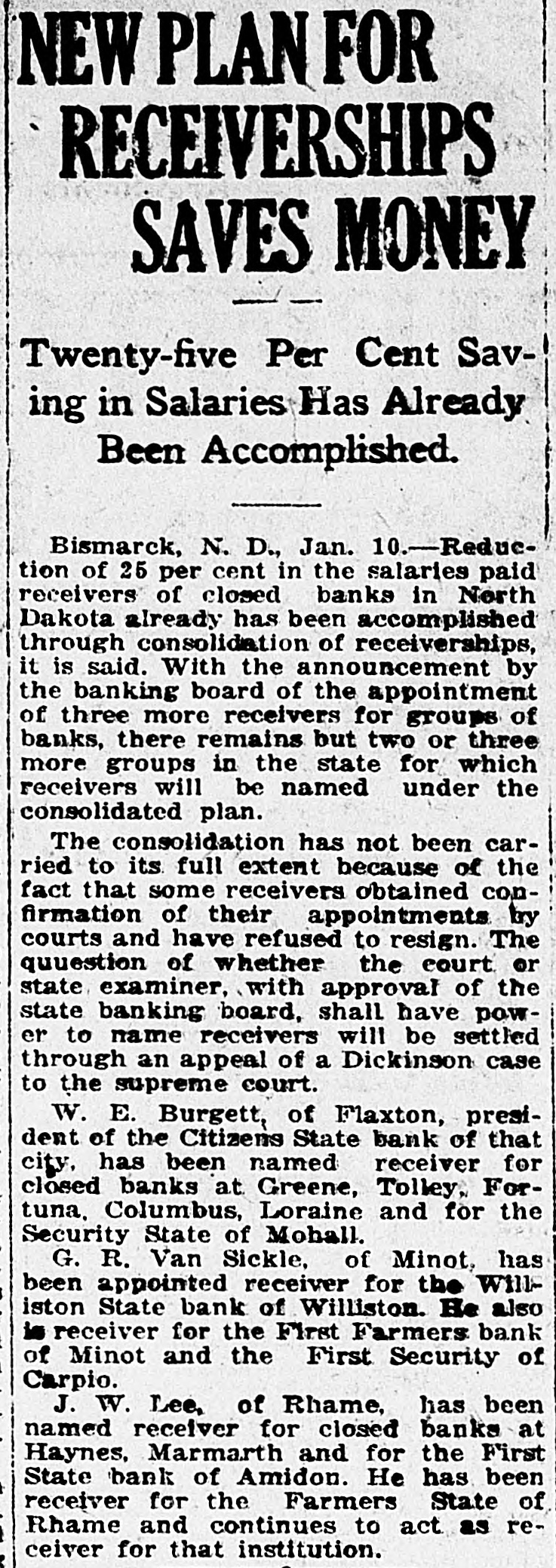
J. W. Lee, of Rhame, has been named receiver for closed banks at Haynes, Marmarth and for the First State bank of Amidon.
Source
newspapers
2. April 17, 1924 Other
Newspaper Excerpt
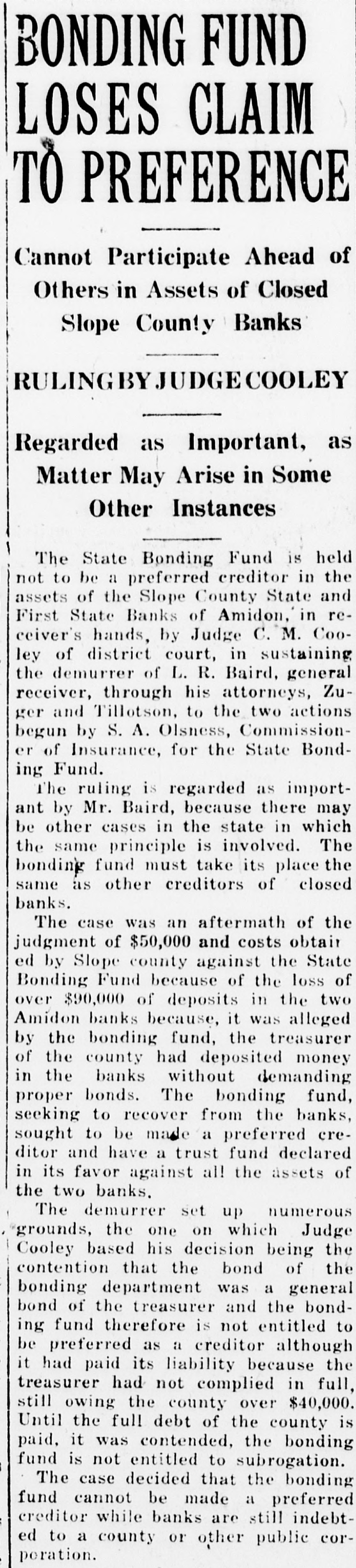
The State Bonding Fund is held not to be a preferred creditor in the assets of the Slope County State and First State Banks of Amidon, in receiver's hands.
Source
newspapers
3. * Suspension
Cause
Bank Specific Adverse Info
Cause Details
Bank was closed and placed in receivership for insolvency/closure (assets in receiver's hands).
Newspaper Excerpt
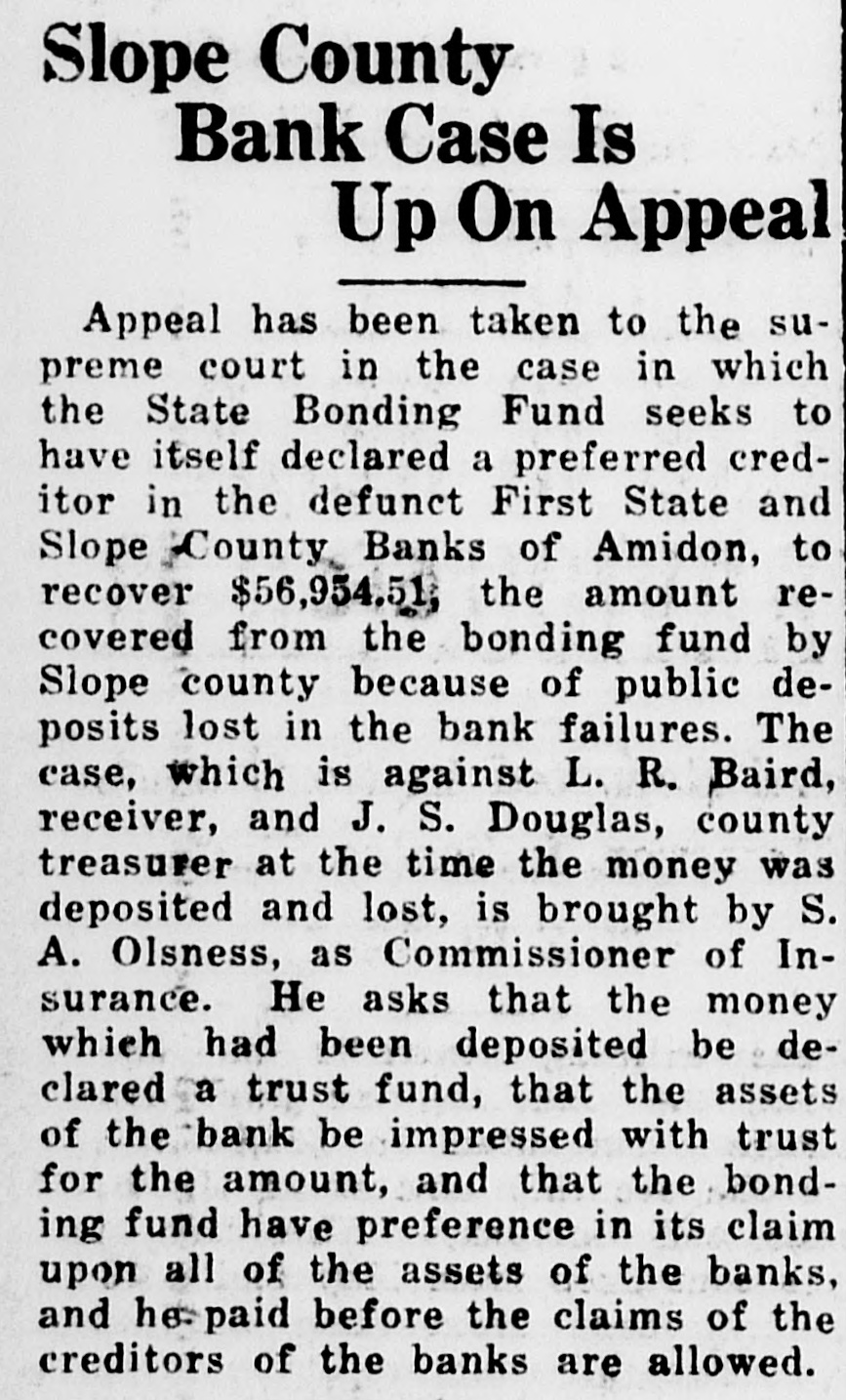
defunct First State and Slope County Banks of Amidon, in receiver's hands
Source
newspapers

Newspaper Articles (4)

Article from Grand Forks Herald, January 10, 1922

Click image to open full size in new tab

Article Text

NEW PLAN FOR RECEIVERSHIPS SAVES MONEY Twenty-five Per Cent Saving in Salaries Has Already Been Accomplished. Bismarck, N. D., Jan. 10.-Reduction of 25 per cent in the salaries paid receivers of closed banks in North Dakota already has been accomplished through consolidation of receiverships, it is said. With the announcement by the banking board of the appointment of three more receivers for groups of banks, there remains but two or three more groups in the state for which receivers will be named under the consolidated plan. The consolidation has not been carried to its full extent because of the fact that some receivers obtained confirmation of their appointments try courts and have refused to resign. The question of whether the court or state examiner, with approval of the state banking board, shall have power to name receivers will be settled through an appeal of a Dickinson case to the supreme court. W. E. Burgett, of Flaxton, president of the Citizens State bank of that city, has been named receiver for closed banks at Greene, Tolley, Fortuna. Columbus, Loraine and for the Security State of Mohall. G. R. Van Sickle, of Minot. has been appointed receiver for the Williston State bank of Williston. He also is receiver for the First Farmers bank of Minot and the First Security of Carpio. J. W. Lee, of Rhame, has been named receiver for closed banks at Haynes, Marmarth and for the First State bank of Amidon. He has been receiver for the Farmers State of Rhame and continues to act as receiver for that institution.


Article from The Bismarck Tribune, April 17, 1924

Click image to open full size in new tab

Article Text

BONDING FUND LOSES CLAIM TO PREFERENCE Cannot Participate Ahead of Others in Assets of Closed Slope County Banks RULINGBYJUDGECOOLEY Regarded as Important, as Matter May Arise in Some Other Instances The State Bonding Fund is held not to be a preferred creditor in the assets of the Slope County State and First State Banks of Amidon, in receiver's hands, by Judge C. M. Cooley of district court, in sustaining the demurrer of L. R. Baird, general receiver, through his attorneys, Zuger and Tillotson, to the two actions begun by S. A. Olsness, Commissioner of Insurance, for the State Bonding Fund. The ruling is regarded as important by Mr. Baird, because there may be other cases in the state in which the same principle is involved. The bonding fund must take its place the same as other creditors of closed banks. The case was an aftermath of the judgment of $50,000 and costs obtain ed by Slope county against the State Bonding Fund because of the loss of over $90,000 of deposits in the two Amidon banks because, it was alleged by the bonding fund, the treasurer of the county had deposited money in the banks without demanding proper bonds. The bonding fund, seeking to recover from the banks, sought to be made a preferred creditor and have a trust fund declared in its favor against all the assets of the two banks. The demurrer set up numerous grounds, the one on which Judge Cooley based his decision being the contention that the bond of the bonding department was a general bond of the treasurer and the bonding fund therefore is not entitled to be preferred as a creditor although it had paid its liability because the treasurer had not complied in full, still owing the county over $40,000. Until the full debt of the county is paid, it was contended, the bonding fund is not entitled to subrogation. The case decided that the bonding fund cannot be made a preferred creditor while banks are still indebted to a county or other public corporation.


Article from The Bismarck Tribune, July 12, 1924

Click image to open full size in new tab

Article Text

Slope County Bank Case Is Up On Appeal Appeal has been taken to the supreme court in the case in which the State Bonding Fund seeks to have itself declared a preferred creditor in the defunct First State and Slope County Banks of Amidon, to recover $56,954.51, the amount recovered from the bonding fund by Slope county because of public deposits lost in the bank failures. The case, which is against L. R. Baird, receiver, and J. S. Douglas, county treasurer at the time the money was deposited and lost, is brought by S. A. Olsness, as Commissioner of Insurance. He asks that the money which had been deposited be declared a trust fund, that the assets of the bank be impressed with trust for the amount, and that the bonding fund have preference in its claim upon all of the assets of the banks, and he paid before the claims of the creditors of the banks are allowed.


Article from The Bismarck Tribune, October 28, 1933

Click image to open full size in new tab

Article Text

Wenzel in the performance of his duties or possession of the office until his right to serve as a member of the board had been determined by the courts. Verret requested a vote on his demand to seat Pfeifer and Wenzel moved that the board go into executive session. It was carried. Preckel voting "yes" and Walker "no" and Pfeifer demanding that he be permitted to vote, asserting that he was a duly appointed and qualified member of the board. Before an executive session could be held, however, Verret again demanded a vote on the seating of Pfeifer and that the matter be recorded. Wenzel declined to put the motion and Verret then asked Preckel if this stand expressed his view. There followed the first of a long succession of silences with Preckel "on the pan." Finally he came up with the statement that he did not decline to act. Wenzel and Shafer left and the board reorganized by electing Walker as chairman, Pfeifer making and putting the motion and Preckel voting "aye." Appeared Late Friday Pfeifer appeared at Wenzel's office late Friday with the appointment from Governor Langer, designating him to take Wenzel's place, the governor having directed Wenzel's removal in an executive order late Thursday night. Wenzel told Pfeifer he refused to vacate, whereupon the latter called Verret who took up the argument in an effort to induce Wenzel to leave peaceably. This failed and Saturday Wenzel made it plain that he would stay on the job until an order was served which he considered legal or he was removed by a show of force. Wenzel's contention is that the governor has no power to suspend him pending a hearing and that the order for his suspension is illegal. Pfeifer's position was that he has been appointed to the office and wanted it, since he heretofore has been a member of the great army of unemployed. Wenzel had prepared a statement to be served upon whatever official came to oust him by force, warning him that the act is illegal and that he will be held personally responsible for his actions. Thus it appeared probable that one or more civil suits might follow the ouster. A fight against the ouster proper is considered inevitable. Pfeifer has been a resident of Slope county for 25 years, having homesteaded there in 1908. He was appointed Slope county's first register of deeds by Governor L. B. Hanna and served one term, during 1915 and 1916. In 1921, he was special deputy state examiner for the banking department, in charge of the closed First State Bank of Amidon, being Justed after the recall of Governor Lynn J. Frazier by the Nestos administration. Ardent Townley Man An ardent supporter of A. C. Towney, Pfeifer has shared the numerous adventures of that individual and participated in Townley's oil-promoting ventures throughout the state several years ago. Saturday he emphasized that his loyalty to Townley is undimmed. Born in Green Lake county, Wisconsin, 48 years ago, Pfeifer was educated in the public schools and took two years of preparatory work at Northwestern College, Naperville, Ill. Later he went to Ripon College, Ripon, Wis., for two years, playing on a football team which he declares is "the best Ripon ever had." For 11 years preceding 1925, Pfeifer said, he was in the insurance business, out recently has been a member of what he termed "Hoover's Army." Wenzel said the proceedings probably will ruin him financially but he is willing to be the goat to determine whether the governor can persistently violate the constitution of the state, ignore the rights of the courts and the rights of citizens. Any ouster by force, he contended, will make those participating in it legally liable for damages, since the courts are open as a remedy and the matter could be determined by a mandamus action begun in the regular way.