Fidelity Savings Bank (Chicago, IL)

Episode Information

Episode UID
7732990290932
Episode Type
Run β†’ Suspension β†’ Closure
Bank Type
savings
Bank ID
773299029 hash
Start Date
August 31, 1877
Location
Chicago, Illinois (41.850, -87.650)

Metadata

Model
gpt-5-mini (chosen from majority vote of a three-model LLM ensemble)
Short Digest
9cfa1944a2137aa6

Response Measures

None

Description

Run in late Aug/early Sept 1877 preceded closure and appointment of a court receiver later in September.

Events (4)

1. August 31, 1877 Run
Cause
Local Banks
Cause Details
Depositor panic fueled by recent failures/troubles at other Chicago savings banks and general distrust of savings institutions.
Measures
Paid out available cash to depositors following standard rules; officers pledged private property and directors reduced interest rate and arranged to keep some assets liquid.
Newspaper Excerpt
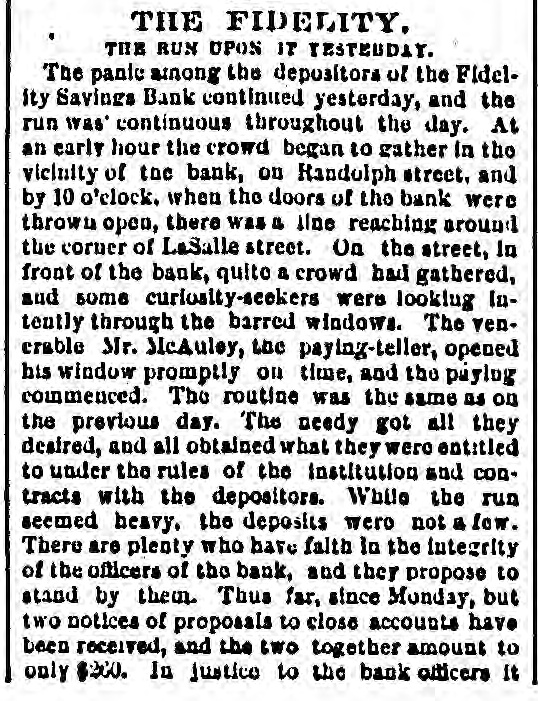
THE FIDELITY, THE RUN UPON IT YESTERDAY. The panic among the depositors of the Fidelity Savings Bank continued yesterday, and the run was continuous throughout the day.
Source
newspapers
2. September 1, 1877 Run
Cause
Local Banks
Cause Details
Continued depositor withdrawals in wake of earlier panic and distrust; officers pledged personal assets to reassure depositors.
Measures
Directors pledged personal property; continued paying out to depositors under rules; sought to reassure public and keep assets partly liquid.
Newspaper Excerpt
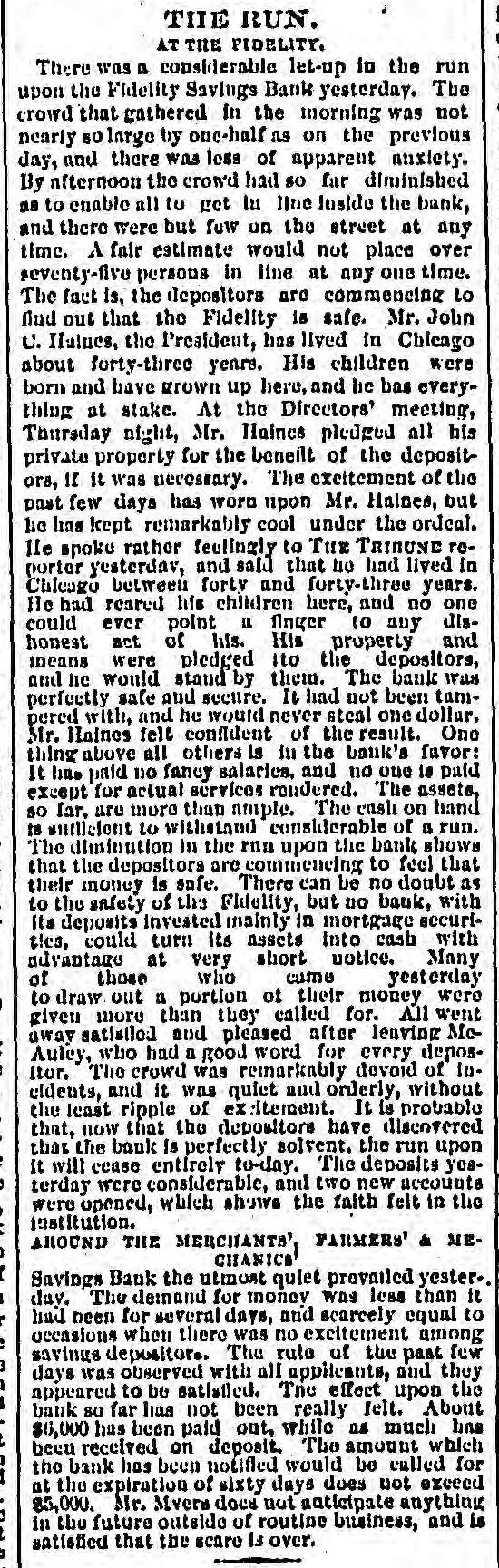
THE RUN. AT THE FIDELITY. There was a considerable let-up in the run upon the Fidelity Savings Bank yesterday.
Source
newspapers
3. September 24, 1877 Suspension
Cause
Government Action
Cause Details
Bank closed pending court action and petition for appointment of a receiver ( Superior Court ); notice posted that injunction/receiver proceedings were underway.
Newspaper Excerpt
The Fidelity Savings Bank closed its doors to-day. Proceedings for a receiver were instituted in the Superior Court.
Source
newspapers
4. September 25, 1877 Receivership
Newspaper Excerpt
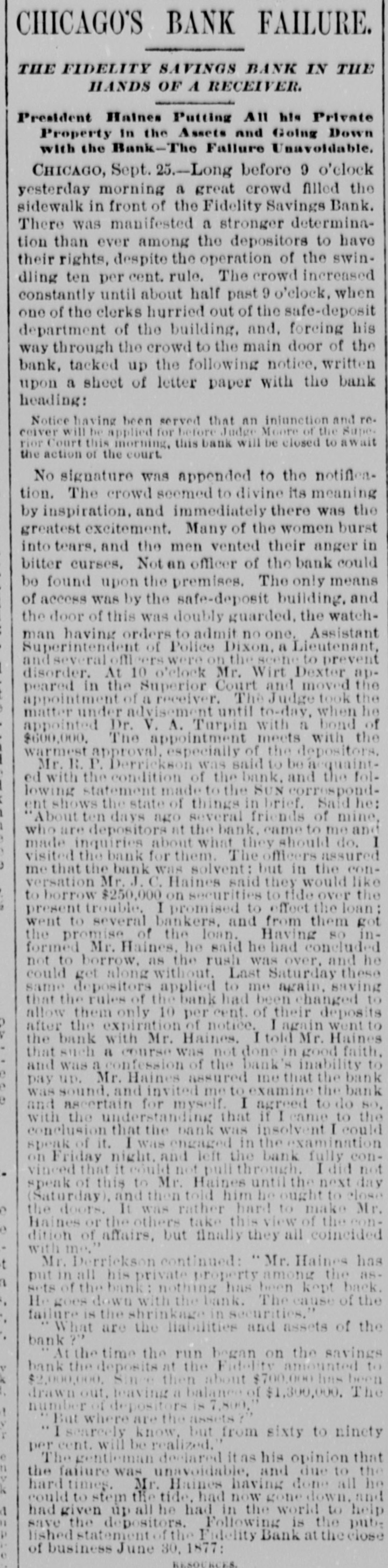
Dr. V. A. Turpin was appointed receiver for the Fidelity Savings Bank on a six hundred thousand dollar bond.
Source
newspapers

Newspaper Articles (22)

Article from Chicago Daily Tribune, August 31, 1877

Click image to open full size in new tab

Article Text

THE FIDELITY, THE RUN UPOS IT TESTEUDAY. The panic among the depositors of the Fidelity Savings Bank continued yesterday, and the run was' continuous throughout the day. At an early hour the crowd began to gather In the viciulty of the bank, on Randolph street, and by 10 o'clock. when the doors of the bank were thrown open, there was a line reaching around the corner of LaSalle street. On the street, In front of the bank, quite a crowd had gathered, and some curiosity-seekers were looking Intently through the barred windows. The venerable Mr. McAuley, the paying-teller, opened his window promptly on time, and the paying commenced. The routine was the same as on the previous day. The needy got all they desired, and all obtained what they were entitled to under the rules of the institution and contracts with the depositors. While the run seemed heavy. the deposits were not a few. There are plenty who have faith In the integrity of the officers of the bank, and they propose to stand by them. Thus far, since Monday, but two notices of proposals to close accounts have been received, and the two together amount to only $200. In justice to the bank officers it


Article from Chicago Daily Tribune, September 1, 1877

Click image to open full size in new tab

Article Text

THE RUN. AT THE FIDELITY. There was a considerable let-up in the run upon the Fidelity Savings Bank yesterday. The crowd that gathered in the morning was not nearly so large by one-half as on the previous day, and there was less of apparent anxiety. By afternoon the crowd had so far diminished as to enable all to get lu line Juside the bank, and there were but few on the street at any time. A fair estimate would not place over seventy-five persons in line at any one time. The fact is, the depositors are commencing to find out that the Fidelity is safe. Mr. John C. Halues, the President, has lived in Chicago about forty-three years. His children were born and have grown up here, and lie has everything at stake. At the Directors' meeting, Thursday night, Mr. Haines pledged all his private property for the benefit of the depositors, If it was necessary. The excitement of the past few days has worn upon Mr. Haines, but be has kept remarkably cool under the ordeal. lle spoke rather feelingly to THE TRINUND reporter yesterday, and sald that he had lived In Chicago between fortv and furty-three years. lle had reared his children here, and no one could ever point a finger to any dishonest act of his. His property and means were pledged ito the depositors, and he would stand by them. The bank was perfectly safe and secure. It had not been tampered with, and he would never steal one dollar. Mr. Haines felt confident of the result. One thing above all others is in the bank's favor: It has paid no fancy salaries, and no one is paid except for actual services rendered. The assets, so far, are more than ample. The cash on hand is sufficient to withstand considerable of a run. The diminution in the run upon the bank shows that the depositors are commencing to feel that their money is safe. There can be no doubt as to the safety of the Fldelity, but no bank, with Its deposits invested mainly in mortgage accurities, could turn its assets into cash with advantage at very short notice. Many of those who came yesterday to draw out a portion of their money were given more than they called for. All went away satisfied and pleased after leaving McAuley, who had a good word for every depositor, The crowd was remarkably devoid of lucidents, and it was quiet and orderly, without the least ripple of x itement. It is probable that, now that the depositors have discovered that the bank is perfectly solvent. the run upon it will cease entirely to-day. The deposits yesterday were considerable, and two new accounts were opened, which shows the faith felt in the institution. AROUND THE MERCHANTS', FARMERS' & MECHANICS Savings Bank the utmost quiet provailed yesterday. The demand for money was less than it had been for several days, and scarcely equal to occasions when there was no excitement among savings depositor. The rule of the past few days was observed with all applicants, and they appeared to be satisfied. The effect upon the bank so far has not been really felt. About $0,000 has been paid out, while as much line been received on deposit. The amount which the bank has been notified would be called for at the expiration of sixty days does not exceed $5,000. Mr. Mvers does uot anticipate anything in the future outside of routine business, and is satisfied that the scare is over.


Article from Chicago Daily Tribune, September 2, 1877

Click image to open full size in new tab

Article Text

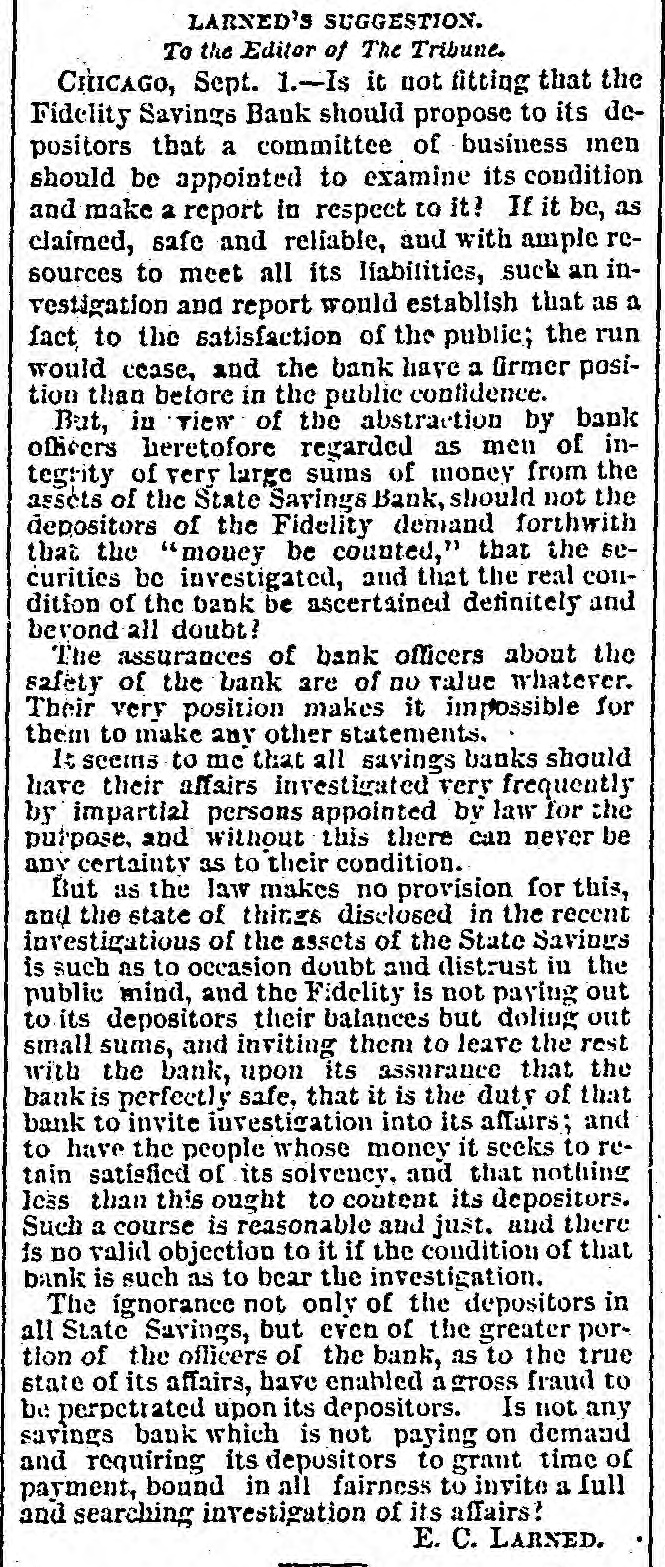
LARNED'S SUGGESTION. To the Editor of The Tribune. CHICAGO, Sept. 1.-Is it not fitting that the Fidelity Savings Bank should propose to its depositors that a committee of business men should be appointed to examine its condition and make 2 report in respect to it? If it be, as claimed, safe and reliable, and with ample resources to meet all its liabilities, such an investigation and report would establish that as a fact to the satisfaction of the public; the run would cease, and the bank have a firmer position than before in the public confidence. But, in view of the abstraction by bank officers heretofore regarded as men of integrity of very large sums of money from the assets of the State Savings Bank, should not the depositors of the Fidelity demand forthwith that the "mouey be counted," that the securities be investigated, and that the real condition of the bank be ascertained definitely and bevond all doubt? The assurances of bank officers about the safety of the bank are of no value whatever. Their very position makes it impossible for them to make any other statements. 1t seems to me that all savings banks should have their affairs investigated very frequently by impartial persons appointed by law for the purpose, and without this there can never be any certainty as to their condition. But as the law makes no provision for this, and the state of things disclosed in the recent investigations of the assets of the State Savings is such as to occasion doubt and distrust iu the public mind, and the Fidelity is not paying out to its depositors their balances but doling out small sums, and inviting them to leave the rest with the bank, upon its assurance that the bank is perfectly safe, that it is the duty of that bank to invite investigation into its affairs; and to have the people whose money it seeks to retain satisfied of its solvency, and that nothing less than this ought to content its depositors. Such a course is reasonable and just. and there is no valid objection to it if the condition of that bank is such as to bear the investigation. The Γ­gnorance not only of the depositors in all State Savings, but even of the greater portion of the officers of the bank, as to the true state of its affairs, have enabled a gross fraud to be perpetrated upon its depositors. Is not any savings bank which is not paying on demand and requiring its depositors to grant time of payment, bound in all fairness to invito a full and searching investigation of its affairs? E. C. LARNED.


Article from Chicago Daily Tribune, September 2, 1877

Click image to open full size in new tab

Article Text

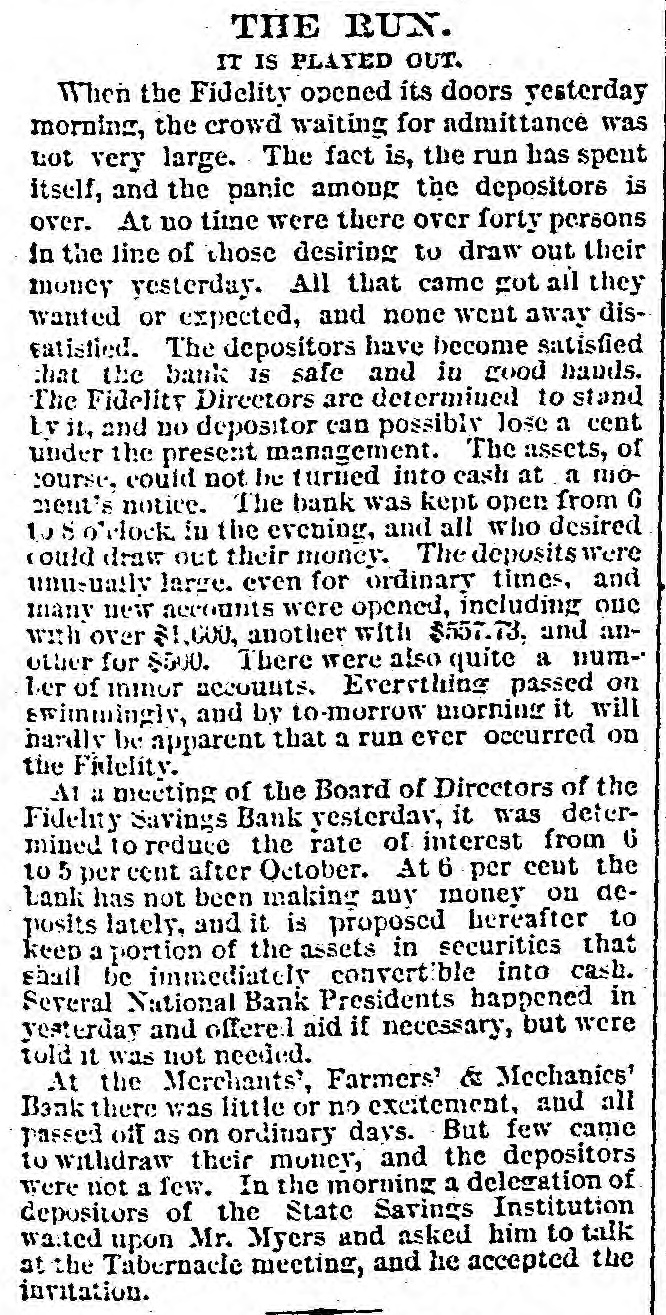
THE RUN. IT IS PLAYED OUT. When the Fidelity opened its doors yesterday morning, the crowd waiting for admittance was not very large. The fact is, the run has speut itself, and the panic among the depositors is over. At no time were there over forty persons in the line of those desiring to draw out their money yesterday. All that came got all they wanted or expected, and none went away dissatisfied. The depositors have become satisfied :hat the bank IS safe and in good hands. The Fidelity Directors are determined to stand Lv it, and no depositor can possibly Jose a cent under the present management. The assets, of course, could not be turned into cash at a moment's notice. The bank was kept open from 6 10 S o' lock in the evening, and all who desired could draw out their money. The deposits unu-ually large. even for ordinary times, and many new accounts were opened, including one with over $1,000, another with $557.73. and another for $500. There were also quite a numher of immor accounts. Everything passed on swimmingly, and by to-morrow morning it will hardly be apparent that a run ever occurred on the Fidelitv. At a meeting of the Board of Directors of the Fidelity Savings Bank yesterdav, it was determined to reduce the rate of interest from 6 to per cent after October. At 6 per cent the Lank has not been making any money on deposits lately, and it is proposed hereafter to keep a portion of the assets in securities that shall be immediately convertible into cash. Several National Bank Presidents happened in yesterday and offere.1 aid if necessary, but were told it was not needed. At the Merchants', Farmers' & Mechanics' Bank there was little or no excitement, and all passed off as on ordinary days. But few came to withdraw their money, and the depositors were not a few. In the morning a delegation of depositors of the State Savings Institution wasted upon Mr. Myers and asked him to talk at the Tabernacle meeting, and he accepted the invitation.


Article from The Cincinnati Daily Star, September 24, 1877

Click image to open full size in new tab

Article Text

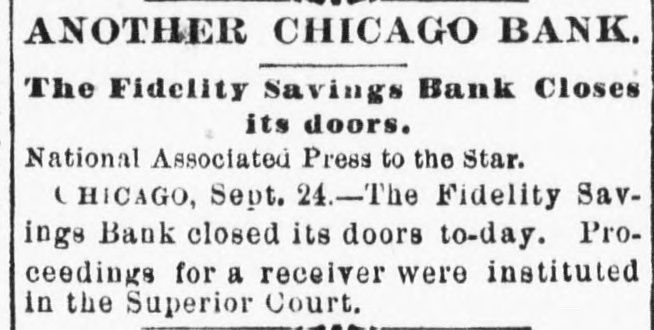
ANOTHER CHICAGO BANK. The Fidelity Savings Bank Closes its doors. National Associated Press to the Star. CHICAGO, Sept. 24.-The Fidelity Savings Bank closed its doors to-day. Proceedings for a receiver were instituted in the Superior Court.


Article from The New Orleans Daily Democrat, September 25, 1877

Click image to open full size in new tab

Article Text

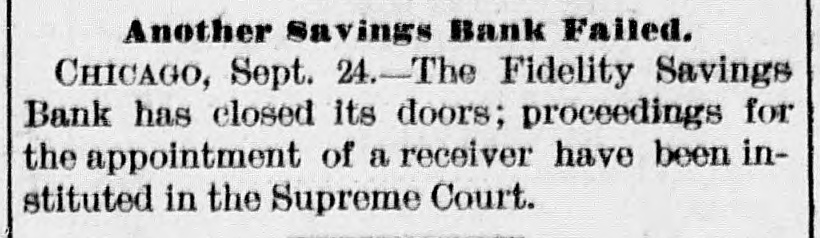
Another Savings Bank Failed. CHICAGO, Sept. 24.-The Fidelity Savings Bank has closed its doors; proceedings for the appointment of a receiver have been instituted in the Supreme Court.


Article from The Cheyenne Daily Leader, September 25, 1877

Click image to open full size in new tab

Article Text

ILLINOIS. Another Chicago Bank Closes Its Doors. Chicago, Sept. 24. Early callers at the Fidelity Savings bank this morning found its doors closed and a hastily penned card thereon informing depositors that as yet had not been served, that a petition for a receiver would be filed in the Superior court to-day, and that the bank would remain closed pending the decision of that question in the court. The motion was made, and the officers of the bank made the necessary deposition. The court decided to appoint the receiver this afternoon, by which time he hoped the officers and depositors would have agreed upon the man. The petition alleges that the officers have been sacri-


Article from The Daily Dispatch, September 25, 1877

Click image to open full size in new tab

Article Text

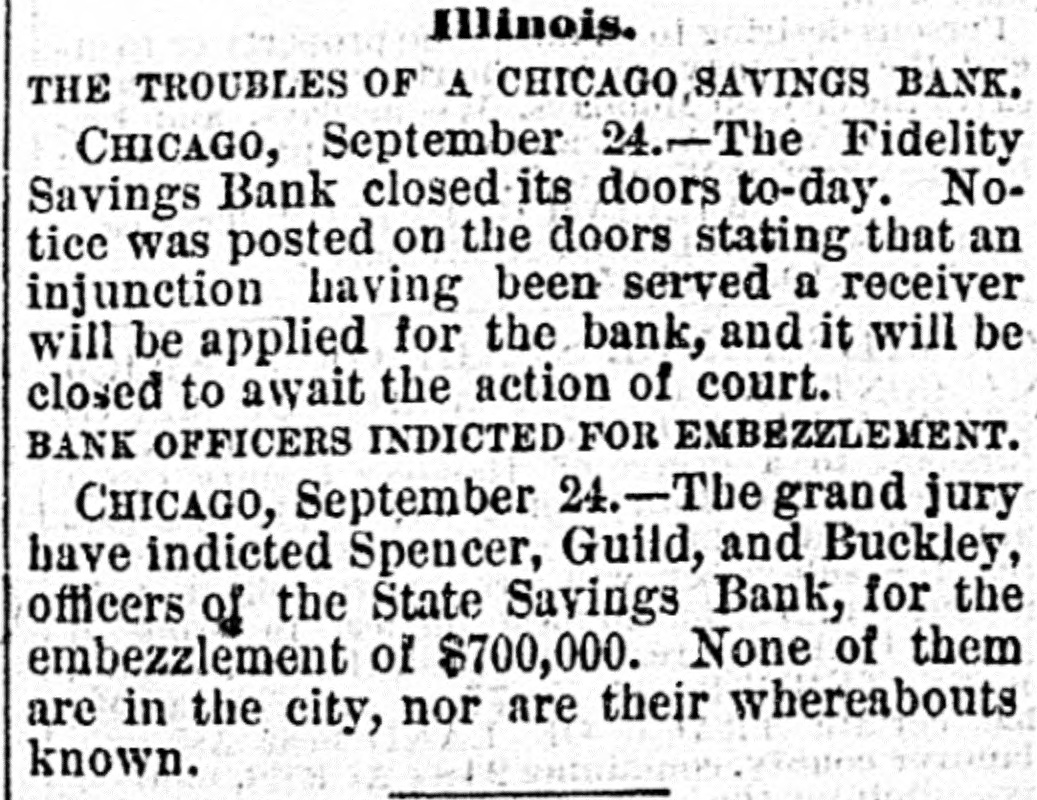
Illinois. THE TROUBLES OF A CHICAGO SAVINGS BANK. CHICAGO, September 24.-The Fidelity Savings Bank closed its doors to-day. Notice was posted on the doors stating that an injunction having been served a receiver will be applied for the bank, and it will be closed to await the action of court. BANK OFFICERS INDICTED FOR EMBEZZLEMENT. CHICAGO, September 24.-Tbe grand jury have indicted Spencer, Guild, and Buckley, officers of the State Savings Bank, for the embezzlement of $700,000. None of them are in the city, nor are their whereabouts known.


Article from The Dallas Daily Herald, September 26, 1877

Click image to open full size in new tab

Article Text

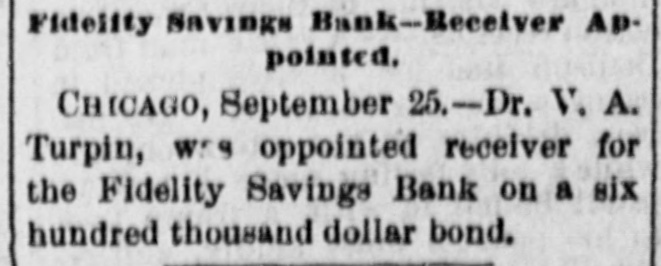
Fidelity SAVIDGS Bank-Receiver Appointed. CHICAGO, September 25.-Dr. V. A. Turpin, Was oppointed receiver for the Fidelity Savings Bank on a six hundred thousand dollar bond.


Article from The Cairo Bulletin, September 26, 1877

Click image to open full size in new tab

Article Text

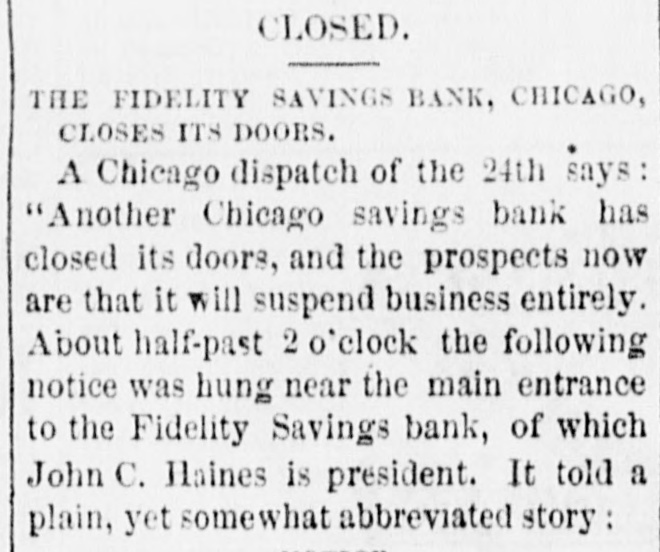
CLOSED. THE FIDELITY SAVINGS BANK, CHICAGO, CLOSES ITS DOORS. A Chicago dispatch of the 24th says: "Another Chicago savings bank has closed its doors, and the prospects now are that it will suspend business entirely. About half-past 2 o'clock the following notice was hung near the main entrance to the Fidelity Savings bank, of which John C. Haines is president. It told a plain, yet somewhat abbreviated story :


Article from Daily Kennebec Journal, September 26, 1877

Click image to open full size in new tab

Article Text

ILLINOIS. A ppointment. CHICAGO, September 25. In the Superior Court, Dr. V.A. Turpin was to-day appointed receiver of the Fidelity Savings Bank, with a bond of six hundred thousand dollars. The appointment meets the warmest approval.


Article from The Daily Dispatch, September 26, 1877

Click image to open full size in new tab

Article Text

Illinois. BANK RECEIVER APPOINTED. CHICAGO, September 25.-Dr. V.A. Turpin has been appointed receiver of the Fidelity Savings Bank, with a $600,000 bond.


Article from Vicksburg Weekly Herald, September 28, 1877

Click image to open full size in new tab

Article Text

Savings Bank Receiver. CHICAGO, Sept. 25.-Dr. V. A. Turpiu has been appointed Receiver of the Fidelity Savings Bank, with $600,000 bond.


Article from Chicago Daily Tribune, September 28, 1877

Click image to open full size in new tab

Article Text

people, and he has made quite as many in investing his own money, but they Are the mistakes incidental to average human noture. Those mistakes are now apparent in the history of the collapsed Fidelity Savings Bank. In his management of that bank be did not foresee the panic, with its attendant bankruptcios and shrinkago of values. He did not expect that the results of that panio would stretch over a period of nearly five years that real estate would depreciate from 50 to 75 por cent that the whole financial world would be plunged into confusion, or that the managers of other savings banks would turn out scoundrels and thus weaken confidence in his own. No one will deny that ho has mado gravo errors of judgment in the management of the money of his depositors, but is this any reason that the Chicago Times should treat him as if he were a jail-bird or & thief There is no trace of dishonosty to be found in the records of the bank. The assets shown by the books are there, ready for the Receiver's hand. The socurities have not been stolen. They are all ready for conversion. There has been no perversion of funds in an illegal or dishonest manner. However faulty his investments may have been, the securities were apparently good at the timo the investments were made. When the run commenced, Mr. HALNES did everything in his power to most the domands of his depositors and to pay them their money. When he was forced to close, he did the only thing left for an honorable man, by turning in all his personal property, including oven his homestend, which he might have exempted, 50 that those who had suffered by his errors might suffer as little no possible. It is still an open question whether his depositors would not have suffered less by allowing Mr. HAINES to have continued the business than by forcing the bank into the Receiver's hands. Even the prisoner at the bar has the right to plead provious good character in mitigation of his offense. Is not an honorable record for thirty years ns a public officer and private citizen to count for anything in the day of a man's misfortune Apparently not, according to the Chicago Times. Should not an honest reputation shield a man from abuso whose most heinous offense is defective judgment ? Apparently not, according to' the Chicago Times


Article from The Portland Daily Press, October 2, 1877

Click image to open full size in new tab

Article Text

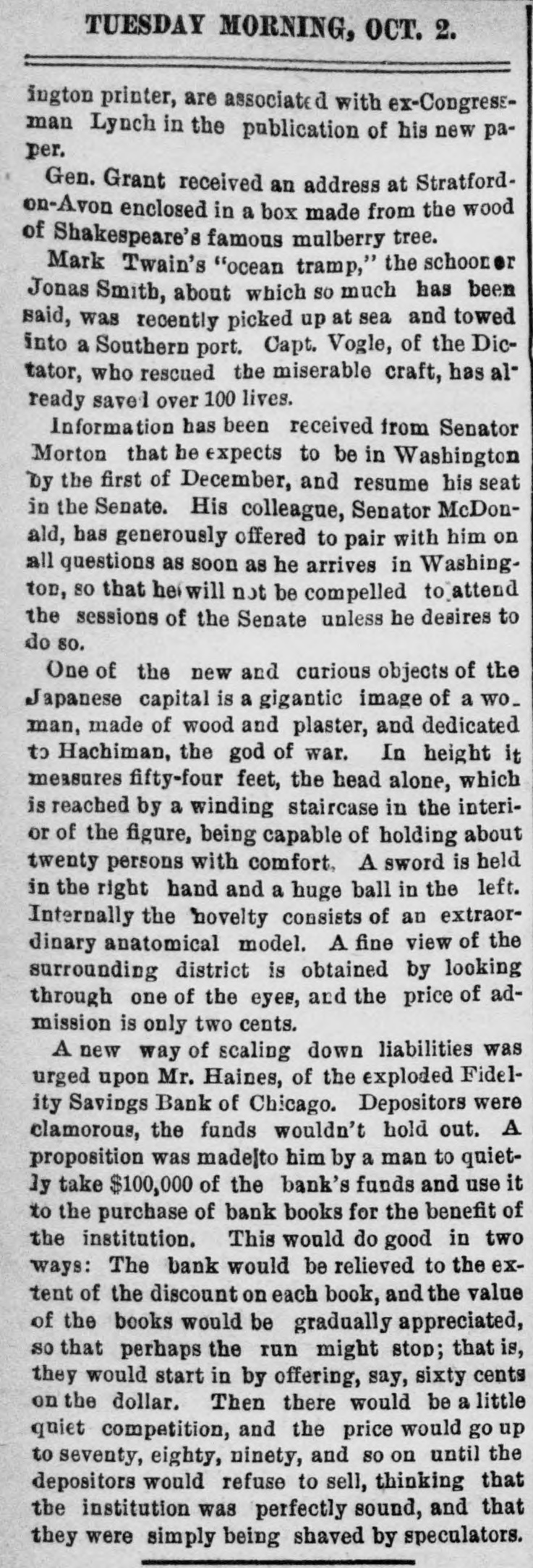
TUESDAY MORNING, OCT. 2. ington printer, are associate d with ex-Congressman Lynch in the publication of his new paper. Gen. Grant received an address at Stratfordon-Avon enclosed in a box made from the wood of Shakespeare's famous mulberry tree. Mark Twain's "ocean tramp," the schoon Jonas Smith, about which SO much has been said, was recently picked up at sea and towed into a Southern port. Capt. Vogle, of the Dictator, who rescued the miserable craft, has already savel over 100 lives. Information has been received from Senator Morton that he expects to be in Washington Dy the first of December, and resume his seat in the Senate. His colleague, Senator McDonald, has generously offered to pair with him on all questions as soon as he arrives in Washington, so that will not be compelled to attend the sessions of the Senate unless he desires to do so. One of the new and curious objects of the Japanese capital is a gigantic image of a wo_ man, made of wood and plaster, and dedicated to Hachiman, the god of war. In height it measures fifty-four feet, the head alone, which is reached by a winding staircase in the interior of the figure, being capable of holding about twenty persons with comfort, A sword is held in the right hand and a huge ball in the left. Internally the hovelty consists of an extraordinary anatomical model. A fine view of the surrounding district is obtained by looking through one of the eyes, and the price of admission is only two cents. A new way of scaling down liabilities was urged upon Mr. Haines, of the exploded Fidelity Savings Bank of Chicago. Depositors were clamorous, the funds wouldn't hold out. A proposition was made[to him by a man to quietly take $100,000 of the bank's funds and use it to the purchase of bank books for the benefit of the institution. This would do good in two ways: The bank would be relieved to the extent of the discount on each book, and the value of the books would be gradually appreciated, S0 that perhaps the run might stop; that is, they would start in by offering, say, sixty cents on the dollar. Then there would be a little quiet competition, and the price would go up to seventy, eighty, ninety, and SO on until the depositors would refuse to sell, thinking that the institution was perfectly sound, and that they were simply being shaved by speculators.


Article from The Milan Exchange, October 4, 1877

Click image to open full size in new tab

Article Text

THE Fidelity Savings Bank of Chicago suspended on the 24th. Ever since the failures of the State Savings and Merchants', Farmers' and Mechanics', the Fidelity depositors have shown their distrust of its condition by drawing out their deposits as fast as they could do so, and although the bank enforced the 60 days' rule and availed itself of all possible subterfuges to ward off the run upon its coffers, it was finally compelled to close its doors. The President of the Fidelity was John C. Haines. It had at the time of its failure about 7,800 depositors, representing some $13,000,000 to $14,000,000 of deposits. The assets, it was thought, might pay from 70 to 90 per cent. of this amount.


Article from The Post, October 11, 1877

Click image to open full size in new tab

Article Text

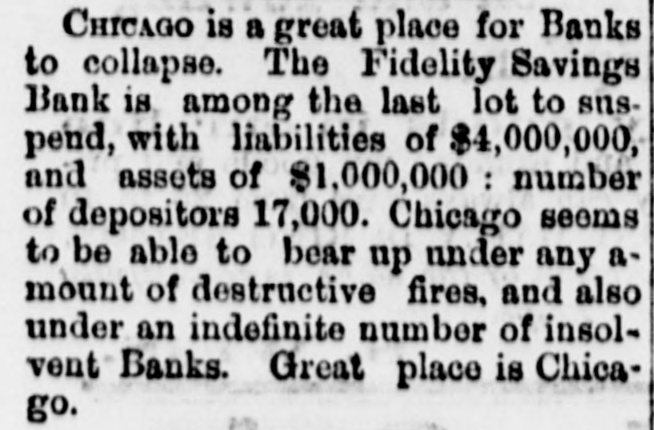
CHICAGO is a great place for Banks to collapse. The Fidelity Savings Bank is among the last lot to suspend, with liabilities of $4,000,000, and assets of $1,000,000 : number of depositors 17,000. Chicago seems to be able to bear up under any amount of destructive fires, and also under an indefinite number of insolvent Banks. Great place is Chicago.


Article from The New York Herald, October 30, 1877

Click image to open full size in new tab

Article Text

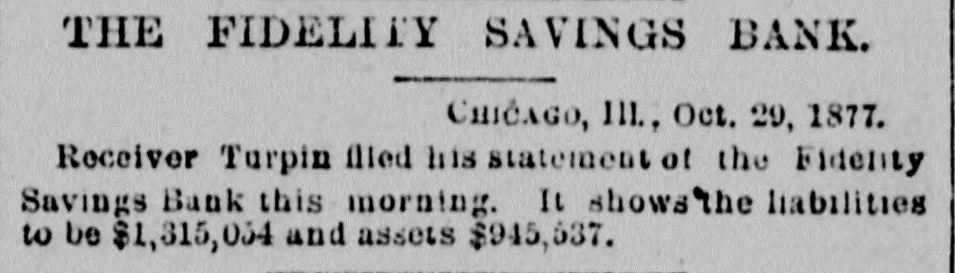
THE FIDELITY SAVINGS BANK. CHICAGO, 111., Oct. 29, 1877. Receiver Turpin filed his statement of the Fidenty Savings Bank this morning. It shows the liabilities to be $1,315,054 and assets $945,537.


Article from Helena Weekly Herald, November 1, 1877

Click image to open full size in new tab

Article Text

Savings Bank Statement. CHICAGO, October 29.-Receiver Turpin filed his statement of the Fidelity Savings Bank this morning. It shows the liabilities to be $1,315,054, and assets $745,537.


Article from Chicago Daily Tribune, November 28, 1877

Click image to open full size in new tab

Article Text

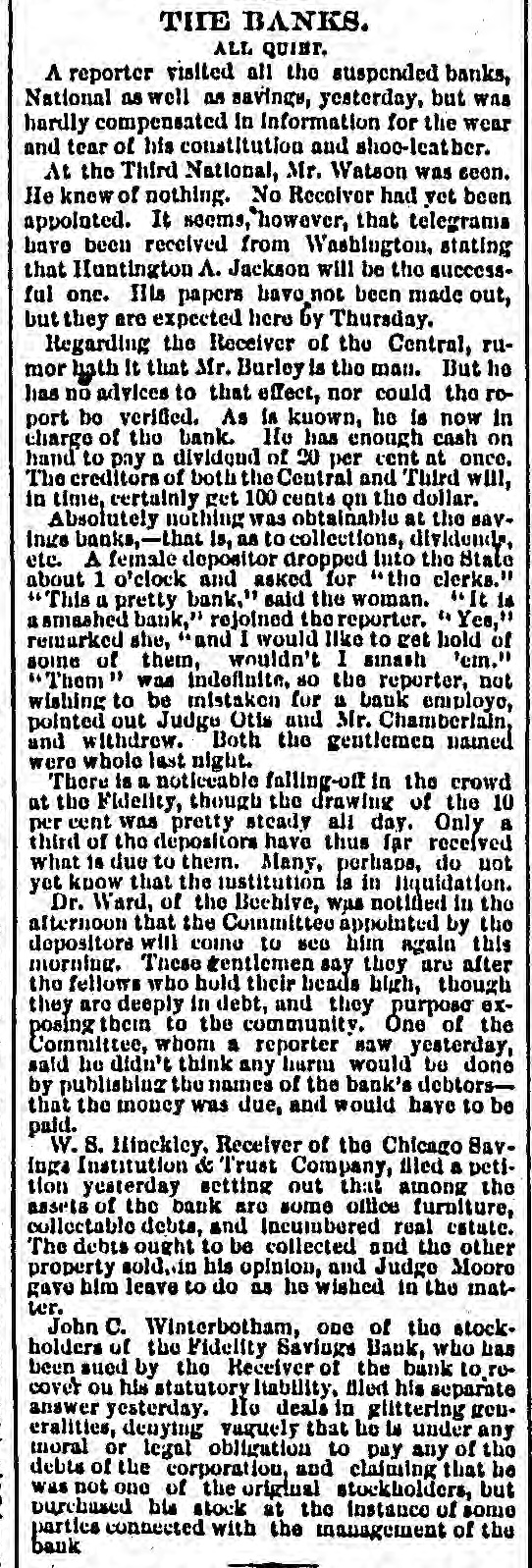
THE BANKS. ALL quier. A reporter visited all the suspended banks, National as well as savings, yesterday, but was hardly compensated In Information for the wear and tear of his constitution and shoo-leather. At the Third National, Mr. Watson was seen. He knew of nothing. No Receiver had yet been appointed. It seems, however, that telegrama have been received from Washington, stating that Huntington A. Jackson will be the successful one. Ills papers have not been made out, but they are expected here by Thursday. Regarding the Receiver of the Central, rumor bath It that Mr. Burley is the man. But he has no advices to that effect, nor could the roport be verified. As is known, he is now in charge of the bank. He has enough cash on hand to pay a dividend of 20 per cent at once. The creditors of both the Central and Third will, in time, certainly get 100 cents on the dollar. Absolutely nothing was obtainable at the savIngs banks,-that is, as to collections, dividends, etc. A female depositor dropped into the State about 1 o'clock and asked for "tho clerks." This a pretty bank." said the woman. " It is a smashed bank," rejoined the reporter. " Yes, remarked she, and I would like to get hold of some of them, wouldn't 1 smash 'em." "Them" was indefinite, 80 the reporter, not wishing to be mistaken for a bank employe, pointed out Judge Otis and Mr. Chamberlain, and withdrew. Both the gentlemen named were whole last night. There is a noticeable falling-off in the crowd at the Fidelity, though the drawing of the 10 per cent was pretty steady all day. Only a third of the depositors have thus far received what is due to them. Many, perhaps, do not yet know that the institution is in liquidation. Dr. Ward, of the Beehive, Was notified in the afternoon that the Committee appointed by the depositors will come to see him again this morning. These centlemen say they are after the fellows who hold their beads high, though they are deeply in debt, and they purpose exposing them to the community. One of the Committee, whom a reporter saw yesterday, said he didn't think any harm would be done by publishing the names of the bank's debtorsthat the money was due, and would have to be paid. W. S. Hinckley, Receiver of the Chicago SavIngra Institution & Trust Company, filed a petition yesterday setting out that among the assets of the bank are some office furniture, collectable debts, and Incumbered real estate. The debts ought to be collected and the other property sold, in his opinion, and Judge Moore gave him leave to do as he wished in the matter. John C. Winterbotham, one of the stockholders of the Fidelity Savings Bank, who has been sued by the Receiver of the bank to recover ou his statutory liability, filed his separate answer yesterday. No deals in glittering generalities, denying vaguely that he la under any moral or legal obligation to pay any of the debts of the corporation, and claiming that he was not one of the original stockholders, but purchased bis stock at the Instance of some parties connected with the management of the bank


Article from New Ulm Weekly Review, April 16, 1879

Click image to open full size in new tab

Article Text

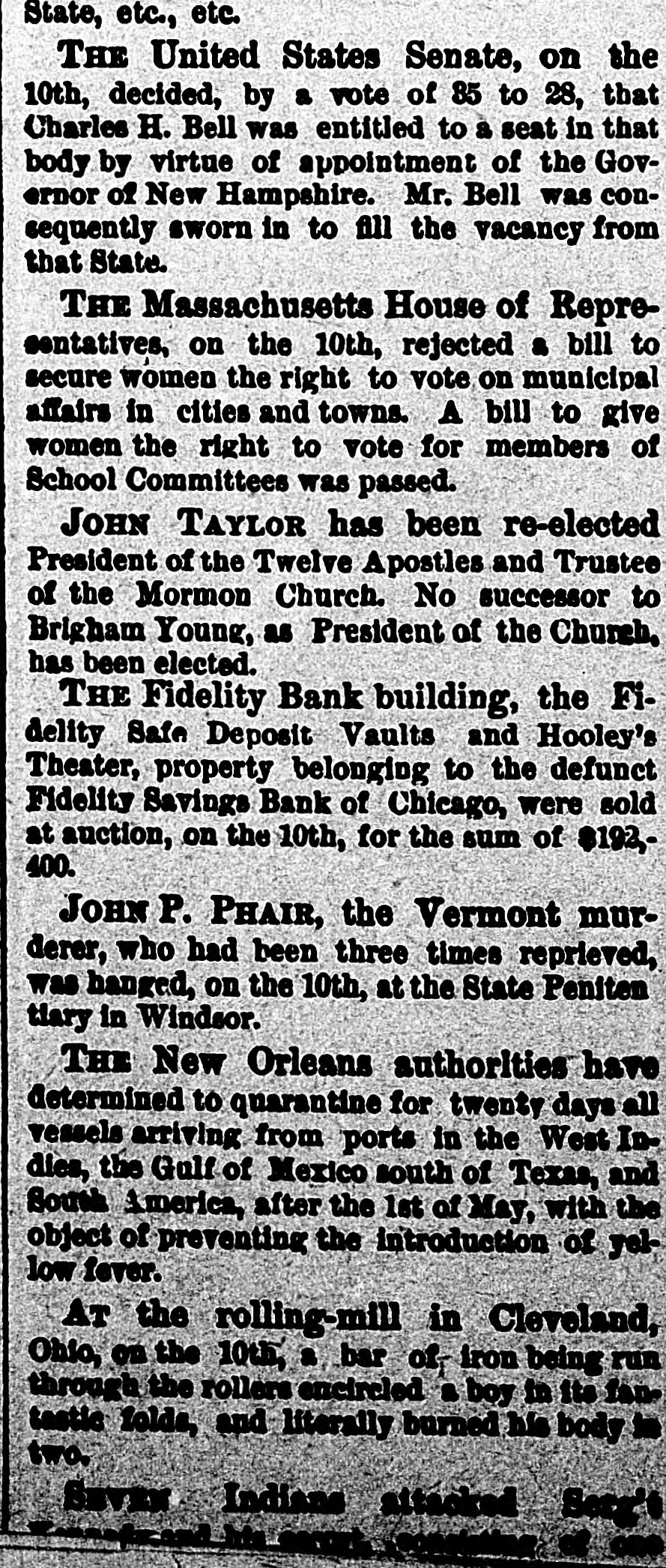
State, etc., etc. THE United States Senate, on the 10th, decided, by a vote of 85 to 28, that Charles H. Bell was entitled to a seat in that body by virtue of appointment of the Governor of New Hampshire. Mr. Bell was consequently sworn in to fill the vacancy from that State. THE Massachusetts House of Reprecentatives, on the 10th, rejected a bill to secure women the right to vote on municipal affairs in cities and towns. A bill to give women the right to vote for members of School Committees was passed. JOHN TAYLOR has been re-elected President of the Twelve Apostles and Trustee of the Mormon Church. No successor to Brigham Young, as President of the Church, has been elected. THE Fidelity Bank building, the Fidelity Safe Deposit Vaults and Hooley's Theater, property belonging to the defunct Fidelity Savings Bank of Chicago, were sold at auction, on the 10th, for the sum of $192,400. JOHN P. PHAIR, the Vermont murderer, who had been three times reprieved, was hanged, on the 10th, at the State Peniten tiary in Windsor. THE New Orleans authorities have determined to quarantine for twenty days all vessels arriving from ports in the West Indies, the Gulf of Mexico south of Texas, and South America, after the 1st of May, with the object of preventing the introduction of yellow fever. AT the rolling-mill in Cleveland, Ohio, on the 10th, a bar of iron being run through the rollers encircled a boy in its fantastic folds, and literally burned his body in two. SEVEN Indians attacked Serg't


Article from New-York Tribune, October 6, 1888

Click image to open full size in new tab

Article Text

ANOTHER ARREST IN THE OPIUM CASE. A LAWYER OF SEATTLE IMPLICATED IN THE GREAT SMUGGLING RING. Chicago, Oct. 5 (Special).-Another sensation has been developed in the great opium smuggling case, in which Erwin A. Gardner is the defendant. The mysterious Haines, whose identity has been such a stumbling block in the way of the Government officials, has at last been found and has turned out to be no other than "Charley" Halnes, a former Justice of the Peace in Chicago, who left the town under a cloud and who is a son of Elijah M. Haines, ex-Speaker of the House of Representatives of the General Assembly. His uncle is J. C. Haines, exMayor of Chicago and also the former president of the Fidelity Savings Bank, which went under in a panic a dozen years ago. Some weeks ago the papers published several letters found in the possession of Gardner and which were written by the alleged conspirator Stone, who is under indictment in New-York, to " J. C. Haines, Seattle, W. T." The letters strongly implicated Haines in the conspiracy. Inspector Crowley was ordered to preceed at once to Washington Territory, in order to settle the question about Haines. He went there several weeks ago and found that the "Dear Haines" mentioned In the letters was none other than John Charles Haines, a member of the prominent law firm of Strave, Haines & MacMiccan, of Scattle. Crowley, last Friday, placed Haines under arrest and took him before a United States Court, where he was held over in bonds of $10,000 to appear in Buffalo on October 10, to answer to the charge of conspiracy in the Gardner opium smuggling case. Haines was the leading Justice in Chicago. He was noted at that time-1873-74-for having made more money out of that office than any man in Cook County. He was reputed to have cleared between $150,000 and $200,000 in one year.