Spring Garden Bank (Philadelphia, PA)

Episode Information

Episode UID
7797437791097
Episode Type
Run โ†’ Suspension โ†’ Closure
Bank Type
trust
Bank ID
779743779 hash
Start Date
May 1, 1891*
Location
Philadelphia, Pennsylvania (39.952, -75.164)

Metadata

Model
gpt-5-mini (chosen from majority vote of a three-model LLM ensemble)
Short Digest
fb47bd8bcb464e05

Response Measures

None

Description

Comptroller involvement and 100% stockholder assessment indicate a national-bank receivership.

Events (3)

1. May 1, 1891* Run
Cause
Bank Specific Adverse Info
Cause Details
Sustained heavy withdrawals driven by underlying bank insolvency and misconduct (embezzlement, false entries) rather than mere rumors.
Newspaper Excerpt
The failure of the Spring Garden Bank in Philadelphia caused some talk, but ... the bank having been hard run for several months.
Source
newspapers
2. May 8, 1891 Suspension
Cause
Bank Specific Adverse Info
Cause Details
Bank suspended following insolvency and discovery of deficient/borrowed or worthless assets and alleged false returns and embezzlement by officers.
Newspaper Excerpt
The suspended Spring-Garden Bank ... president and cashier, respectively, of the suspended Spring-Garden Bank, was continued ...
Source
newspapers
3. July 2, 1891 Receivership
Newspaper Excerpt
Receiver Fisher of the broken Spring Garden Bank states that he believes the assets of the concern will pay over 50 per cent. of its liabilities.
Source
newspapers

Newspaper Articles (23)

Article from Pittsburg Dispatch, May 9, 1891

Click image to open full size in new tab

Article Text

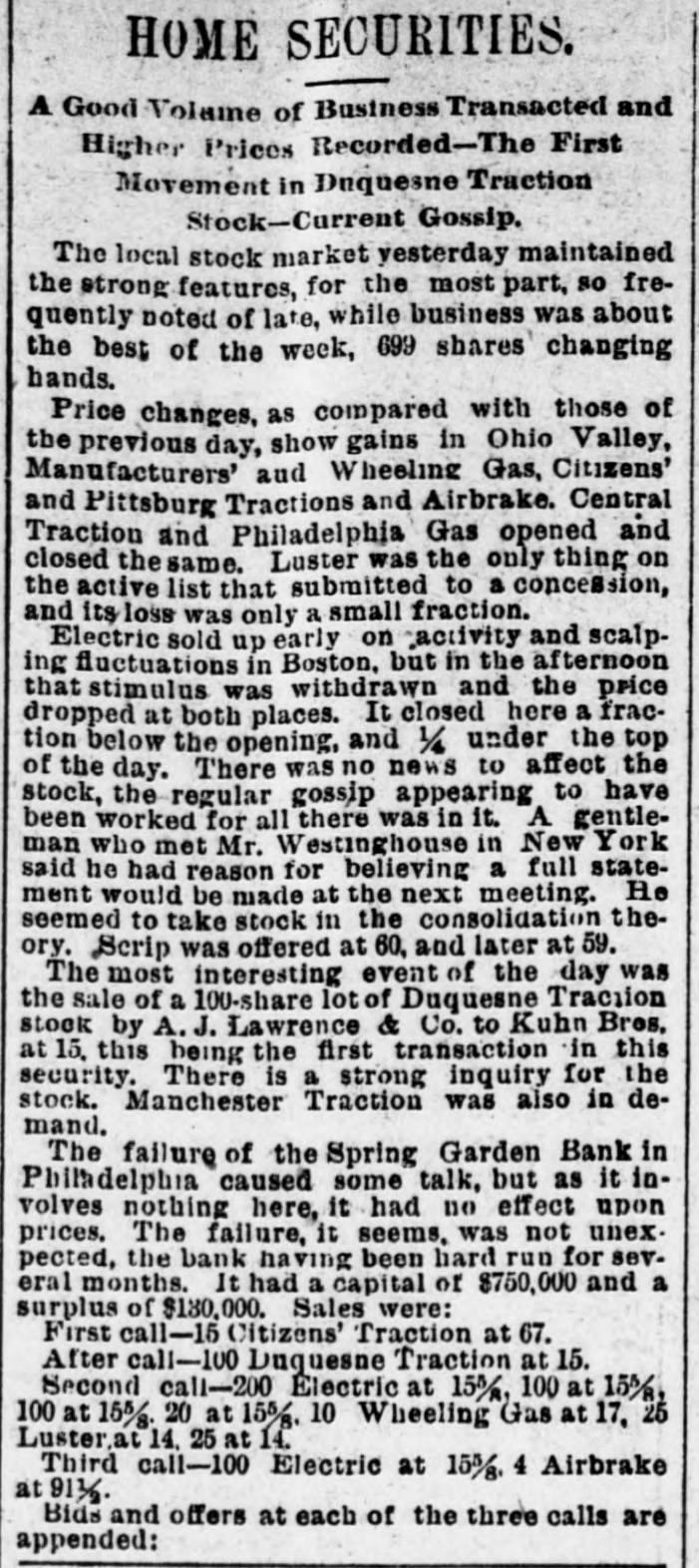
HOME SECURITIES. A Good Volame of Business Transacted and Higher Prices Recorded-The First Movement in Duquesne Traction Stock-Current Gossip. The local stock market yesterday maintained the strong features, for the most part, so frequently noted of late, while business was about the best of the week, 699 shares changing hands. Price changes, as compared with those of the previous day, show gains in Ohio Valley, Manufacturers' aud Wheeling Gas, Citizens' and Pittsburg Tractions and Airbrake. Central Traction and Philadelphia Gas opened and closed the same. Luster was the only thing on the active list that submitted to a concession, and its loss was only a small fraction. Electric sold up early on activity and scalping fluctuations in Boston, but in the afternoon that stimulus was withdrawn and the price dropped at both places. It closed here a fraction below the opening, and ยฝ under the top of the day. There was no news to affect the stock, the regular gossip appearing to have been worked for all there was in it. A gentleman who met Mr. Westinghouse in New York said he had reason for believing a full statement would be made at the next meeting. He seemed to take stock in the consolidation theory. Scrip was offered at 60, and later at 59. The most interesting event of the day was the sale of a 100-share lot of Duquesne Traciion stock by A. J. Lawrence & Co. to Kuhn Bros, at 15. this being the first transaction in this security. There is a strong inquiry for the stock. Manchester Traction was also in demand. The failure of the Spring Garden Bank in Philadelphia caused some talk, but as it involves nothing here, it had no effect upon prices. The failure, it seems, was not unex. pected, the bank having been hard run for several months. It had a capital of $750,000 and a surplus of $130,000. Sales were: First call-15 Citizens' Traction at 67. After call-100 Duquesne Traction at 15. Second call-200 Electric at 150/A, 100 at 15%, 100 at 155/8. 20 at 155/8. 10 Wheeling Gas at 17, 25 Luster at 14. 25 at 14. Third call-100 Electric at 155/8. 4 Airbrake at 913/2. Bids and offers at each of the three calls are appended:

Article from The Evening World, May 9, 1891

Click image to open full size in new tab

Article Text

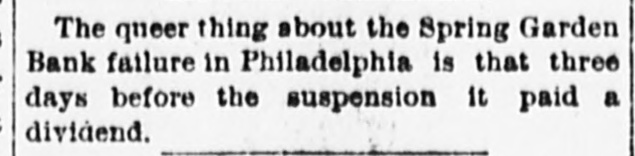
The queer thing about the Spring Garden Bank failure in Philadelphia is that three days before the suspension it paid a dividend.


Article from New-York Tribune, May 21, 1891

Click image to open full size in new tab

Article Text

THE PENN TRUST COMPANY'S CONDITION. Philadelphia, May 20.-A statement of the condition of the Penn Safe Deposit and Trust Company, which assigned the day the Spring Garden Bank suspended, was made to-day, and shows an apparent deficit of $97,000. Hope was expressed that the assignee would be able to realize on some of the company's assets and largely reduce the apparent deficit.


Article from Richmond Dispatch, May 22, 1891

Click image to open full size in new tab

Article Text

Philadelphia's Spring-Garden Bank Cases. PEILADELPHIA, May 21.-Owing to theabsence of important witnesses the hearing this morning of Francis W. Kennedy and Henry H. Kennedy, president and cashier, respectively, of the suspended Spring-Garden Bank, was continued until Saturday next, ball in $5,000 being


Article from Los Angeles Herald, May 24, 1891

Click image to open full size in new tab

Article Text

The Kennedys Held. PHILADELPHIA, May 23.-Francis W. Kennedy and Henry H. Kennedy, president and cashier, respectively, of the suspended Spring Garden bank, were today held in $10,000 bail, after their preliminary hearing.


Article from The Delta Independent, June 3, 1891

Click image to open full size in new tab

Article Text

BY TELEGRAPH. Two Iowa ministers have been rested for counterfeiting. The Illinois Senate has passed the World's Fair bill appropriating $1,000,000. A cyclone passed near Boise City, Idaho, last week, doing damage to the extent of $10,000. The Pennsylvania Legislature has passed a bill providing for a State Constitutional convention. Steady-going Maine is excited by a recent attempt to rob a train. The bandits were unsuccessful. The St. Louis police have caught several very clever thieves, one of whom they believe to be the robber of Moffatt, at Deaver. The striking stage drivers of Paris have won their fight, the government having used its influence to bring the companies to terms. Clark W Hatch, who has had so much trouble of late, has been acquitted at Worcester, Massachusetts, of the charge of passing a forged check. An attempt was made in Cincinnati to play baseball last Sunday despite the orders of the mayor to the country, and the two nines were promptly arrested. The Mexican government ordered the Chilian vessel Esmarelda to leave Acapulco, but was obliged to furnish with coal in order to enable it to do so. A bicycle race from Bordeaux to Paris, a distance of 358 miles, was won by the Englishman. Milis, in 26 hours and 35 minutes. The Frenchmen were no where. The will of the late millionaire John T. Farish has been filed for probate in New York. It donates $280,000 to missions, hospitals and other charitable purposes. An additional $2,500,000 is to be raised by subscription among wealthy people in Chicago for the World's Fair. The ways and means committee wants $3,000,000 more money raised. Grover Cleveland as referee in a suit against New York City has rendered a second decision awarding 8600 per foot damages. His first award was $100 per foot. Both sides will appeal. Seventeen Florida senators hid in the woods to prevent Senator Call's reelection, but fifty-one out of 100 members were present and elected Call. The antiCall men threaten to contest. The city of Ogden, Utah. is stirred up because of charges of various kinds made against it and the new Methodist university by Sam Small, who has been president of the university. A dissipated Austrian baron fought a duel in Jackson Park, Chicago, with Southener the other day. The cause was an opera singer, the weapons rapiers, and the result a serious wound in the baron's neck. At Washington. Indiana, 100 German miners abandoned the strikers and went to work last Monday. A fight ensued between them and the Irish miners and a German named Stoll was fatally injured. The intercollegiate running broad s jump record was broken at the intercola legiate contests at St. Louis, when C. S. Reber jumped 22 feet 71/2 inches, thus t smashing the 22 foot 6-inch of A. Sherman of Yale. 0 The cruiser Charleston has reached a Peruvian port and is reported not to have seen the Itala It will join the Chilian squadron, and it is believed that the Itata will be surrendered to the United States without a fight. The affairs of the Spring Garden o Bank of Philadelphia are in much worse condition than at first believed. Much of the assets are worthless notes, and among the collateral are two notes aggregating $70,000 drawn by a fictitious person. The Nashville & Chattanooga rail: road, which was seized by the government during the war and redeemed by the company for $1,000,000, payable in twenty years, announces its readiness to pay its last payment of $500,000 to the government on June 1. The Newfoundland Legislature has passed a coercion bill on Saturday night, with closed doors. The people disregard the governor's proclamation of the queen's birthday. The British flax halyards were cut down and an attempt made to burn down the royal standard on the government house. The reports from French commanders stopping the sale of bait to Americans in Newfoundland are confirmed. Steam launches from the French war ships drove the boats from the sides of the American schooners. They also took up the nots of ) Newfoundland fishermen, putting then: ashore. The outrage is a great loss to the inhabitants and to American fishermen. Dispatches received at Paris from Grand Passam, a French settlement of Upper Guiana. on the gold coast of Africa near the mouth of the Passam river, say that the French expedition sent into the central interior to avenge the death of the French travelers, has fought a battle with a force of about 800 natives, killing many of them and subduing the surround ing country. There is likely to be serious trouble between the Navajo Indiana and Colorado prospectors. The miners claim they have a right to drive stakes wherever they please, whether is be om the property of man or an Indian, so logs as the


Article from The Seattle Post-Intelligencer, June 9, 1891

Click image to open full size in new tab

Article Text

what was valueless to him but might possibly help the bank and save others. Being a collateral holder, under the law he could not be assessed upon the stock. hence any supposition that he could have parted with the stock to avoid assessment was without foundation in fact. Last autumn Marsh claimed that the bank had strained itself to help its customers and wanted help, and the firm paid off all discounts so fast as they fell due. Later, when the run came, Marsh used to come to the firm, saying that he had no one to go to, and assuring them that everything was right, precisely as he did at the clearing-house. He pressed Wanamaker to buy the Lucas building and seashore property and to loan paper for use at the clearing-house to recover other collateral, all of which Wanamaker declined. About 8 o'clock the night before the failure, Marsh called on Wanamaker in Washington to say that he had been to the comptroller and informed him of his doubts about the issued stock, and asked Wanamaker whether he could in any way help the bank. Wanamaker said "No," and the interview ended. In conclusion, Wanamaker said that instead of the bank losing a penny by him, he had been its only profitable customer. Responding to questions by Elting, Wanamaker said that he borrowed money on the stock Lucas gave him until there was a question about its verity, and then he gathered it up and held it. Elting said he had been told that $200,000 or upward of money was obtained at one time from Bardsley by Marsh and loaned to Wanamaker. The latter responded that he never heard of it. He had never had a cent from Bardsley as an individual or as treasurer, directly oe indirectly, through Marsh or Jones or anybody else. Councilman Smith said: "You now have no other choice except to regard the possession of the Reading stock as fully equivalent for the return of the bank stock." "I make no claim against the Lucas estate," answered Wanamaker. Drew, in his testimony today, said that he still thought that the assets of the bank would be able to pay the deposits dollar for dollar. When asked if he included $900,000 in due bills held by Bardsley, he said that he did not, as there were no traces of the money ever having been paid into the bank. Frank Brenten, ex-treasurer of the Millward Cliff Cracker Company, a warrant for whose arrest on a charge of conspiracy with President Kennedy, of the Spring Garden bank, to defraud the cracker company, is out, has disappeared and cannot be found. The grand jury this afternoon returned a true bill of indictment against John Bardsley, ex-city treasurer, charged with appropriating funds belonging to the city. A meeting of the depositors of the suspended Spring Garden bank tonight condemned Bank Examiner Drew and called upon the proper authorities to ask for his resignation. WASHINGTON CITY, June 8.-The president had a conference today with Secretary Foster and Comptroller Lacey in regard to the case of the Keystone National bank, of Philadelphia, as a result of which he dictated a letter to Mayor Stuart, acknowledging receipt of the resolutions of the council calling for governmental investigation of the bank, and saying he will facilitate a thorough examination of the affairs of the bank to the full extent of his powers, and will see that any officer of the government found guilty of wrong-doing in that connection is held to strict accountability for his action.


Article from The Morning Call, June 9, 1891

Click image to open full size in new tab

Article Text

Bank Examiner Drew Condemned. PHIDADELPHIA, June 8.-A meeting of the depositors of the suspended Spring Garden Bank to-night condemned Bank Examiner Drew, and called upon the proper authorities to ask for his resignation.


Article from Sturgis Advertiser, June 11, 1891

Click image to open full size in new tab

Article Text

IN THE EAST. INCORPORATION papers were filed at Columbus, o., of the Consolidated Oatmeal company, with a capital stock of $350,000. All the oatmeal mills of the country are thus brought under one management. Ex- SENATOR MILLER, of New York, president of the Nicaraugua Canal company, expresses himself more than satisfied with the condition of affairs in the canal work and confidently expects it to be open to business in 1897. THE directors of the American Sugar Refining company have decided to declare a full semi-annual dividend on preferred stock and set aside enough to provide for the dividend on preferred stock for the rest of the year. THE application of Mr. O'Neil to enjoin Eugene Kelly, the treasurer of the fund raised at the Dillon and O'Brien meeting in New York from sending the money to Justin McCarthy, was denied by Judge Bartlett in the Kings county supreme court. THE Indianapolis fast train ran into a tornado near Crothersville. The engine and train swayed fearfully and the passengers were panic stricken. The train was running nearly fifty miles an hour and it is believed its speed alone saved it from being wrecked. PRESIDENT KENNEDY and Cashier Kennedy, of the Spring Garden bank, Philadelphia, which failed recently. have been held in bonds of $20,000 and $15.000, respectively, to answer to the charge of making false returns, false entries and for embezzlement. THE presidential train, in its trip ended last week, was on portions of twenty-two different railroads, and the average speed of the train when running was scheduled at thirty-three miles an hour, but often when time had been lost between terminals of roads sixtysix miles an hour was run. SECRETARY TRACY says the next step will be to send the Etata back to the United States to stand trial. There is no expectation the officers and crew have jeopardized their liberty by surrendering. It is believed in official circles the Etata is not likely to suffer heavily as a result of her escapade. ASSISTANT SECRETARY NETTLETON directed the return to their native countries of two Italians and one Swedish immigrant who, since their arrival in January have become paupers. Under the new law they can be returned at the expense of the company bringing them. This is the first order of the kind issued by the treasury department and indicates the vigor with which the new law is to be enforced. THE arguments in the famous contest over the will of Samuel J. Tilden has been argued at great length before the New York court of appeals. The judge will take it under advisement and give


Article from The Evening Herald, July 2, 1891

Click image to open full size in new tab

Article Text

Spring Garden Bank's Assets. PHILADELPHIA, July 2.-Receiver Fisher of the broken Spring Garden Bank states that he believes the assets of the concern will pay over 50 per cent. of its liabilities.


Article from Waterbury Evening Democrat, July 2, 1891

Click image to open full size in new tab

Article Text

Spring Garden Bank's Assets. PHILADELPHIA, July 2.-Receiver Fisher of the broken Spring Garden Bank states that he believes the assets of the concern will pay over 50 per cent. of its liabilities.


Article from Telegram-Herald, July 2, 1891

Click image to open full size in new tab

Article Text

To Probe the Reystone Seandal. PHILADELPHIA, July 1.-Comptroller Lacey, through Receiver Yardley, of the Keystone bank, has sent a communication to Mayor Steart saying that the government desires to see the persons who wrecked the Keystone and Spring Garden banks prosecuted and asking the mayor to recommend two experts to represent the government in the investigation.


Article from Telegram-Herald, July 2, 1891

Click image to open full size in new tab

Article Text

Hope for Depositors. PHILADELPHIA, July 1. - Receiver Fish, of the Spring Garden bank, announces that he has about $1,600,000 in bills receivable and cash and real-estate assets from which several hundred thousand dollars are expected to be realized. This will be equal to the payment of over SJ per ceat. to the depositors.


Article from The Evening Herald, August 19, 1891

Click image to open full size in new tab

Article Text

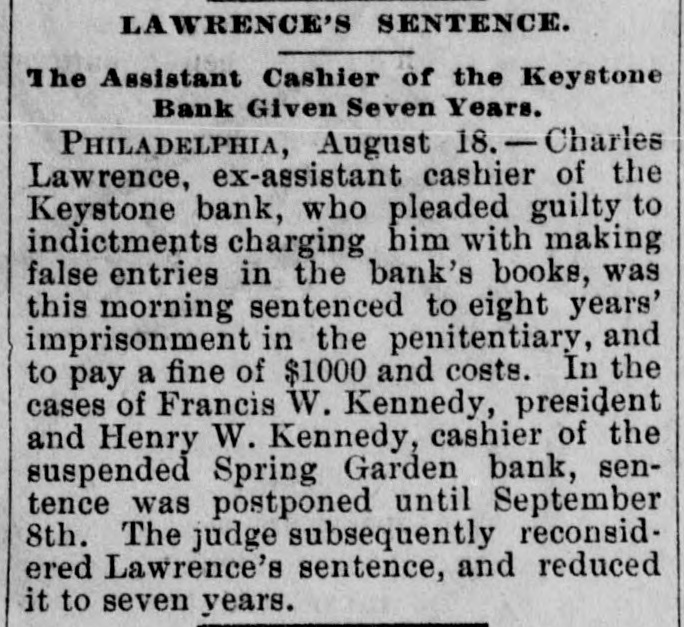
Eight Years for is Bank Wrecker, PHILADELPHIA, Aug. 19.-Charles Lawrence, ex-assistant cashier of the Keystone Bank, who pleaded guilty to the indictments found against him of complicity in wrecking the bank, was sentenced to eight years' imprisonment. The sentences of Francis W. Kennedy, president, and Henry H. Kennedy, cashier of the suspended Spring Garden Bank, were suspended until Sept. 8.


Article from Waterbury Evening Democrat, August 19, 1891

Click image to open full size in new tab

Article Text

Eight Years for a Bank Wrecker. PHILADELPHIA, Aug. 19.-Charles Lawrence, ex-assistant cashier of the Keystone Bank, who pleaded guilty to the indictments found against him of complicity in wrecking the bank, was sentenced to eight years' imprisonment. The sentences of Francis W. Kennedy, president, and Henry H. Kennedy, cashier of the suspended Spring Garden Bank, were suspended until Sept. 8.


Article from Los Angeles Herald, August 20, 1891

Click image to open full size in new tab

Article Text

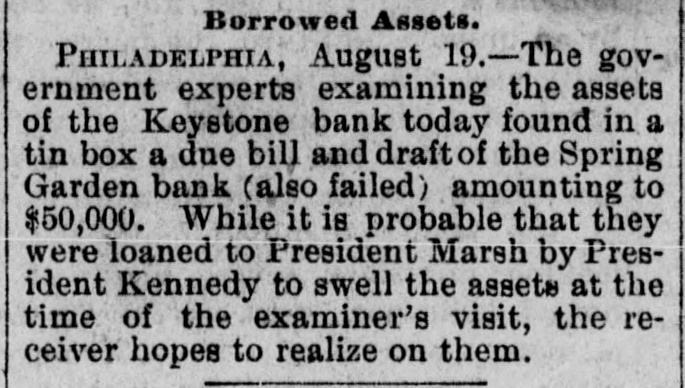
Borrowed Assets. PHILADELPHIA, August 19.-The government experts examining the assets of the Keystone bank today found in a tin box a due bill and draft of the Spring Garden bank (also failed) amounting to $50,000. While it is probable that they were loaned to President Marsh by President Kennedy to swell the assets at the time of the examiner's visit, the receiver hopes to realize on them.


Article from The Redwood Gazette, September 24, 1891

Click image to open full size in new tab

Article Text

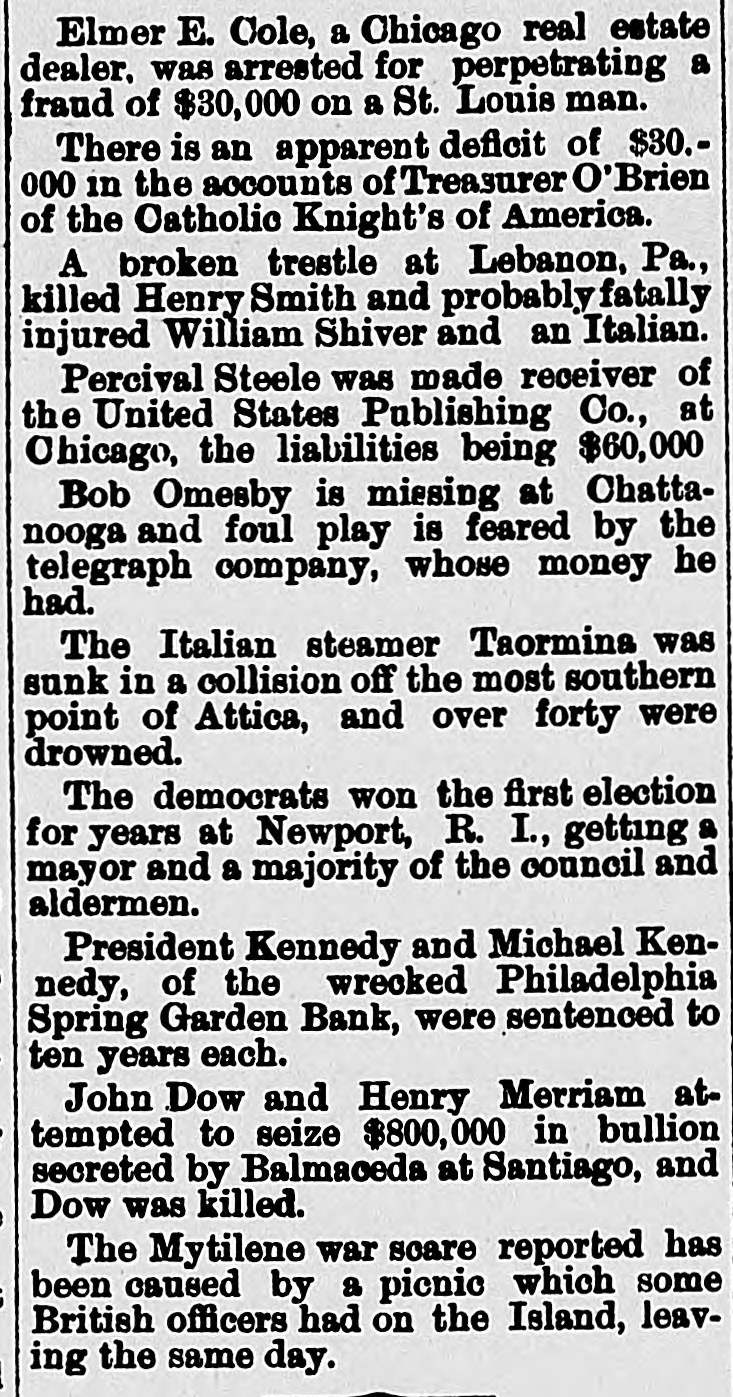
Epitome of the Week. INTERESTING NEWS COMPILATION. FROM WAS 'GTON. THE president and family have reurned to Washington. IN August the United States exported $28,853,510 worth of breadstuffs and E7,602,050 worth of beef and hog prodnets. A BULLETIN from the census office says the increase in the consumption of malt liquors which require hops in their manufacture in the United States was from 344,605,485 gallons in 1879 to 779,897,426 gallons in 1889. IN the first sixteen days of September the United States paid $5,555,000 to old soldiers for pensions. at the ance in IT was headquarters claimed Washington Farmers' Alli- that members of of fifty-five the next congress would the lower vote for house all the measures of the alliance, and at least four in the senate. THE president has appointed Senator Francis Hendricks collector of the port of New York, to succeed J. Sloat Fassett, resigned. THE president has signed the proclamation to homestead the opening entry settlement newly ceded and Indian lands in the eastern part of Oklahoma. THE business failures in the United States during the seven days ended on the 18th numbered 239, against 214 the preceding week and 190 for the corresponding week last year. THE EAST. IN Philadelphia the president and of the wrecked cashier Spring years' Garden imbank were sentenced to ten prisonment. FLAMES at the corner of Fulton and Nassau street in New York caused a loss of $500,000. THE republicans of Massachusetts in Boston convention Allen, at Lowell, for nominated `harles H. of governor. The platform eulogizes President Harrison's administration; calls for he enforcement of civil and political ights in every quarter and purity of elections; opposes unlimited coinage of silver; declares that the McKinley bill and reciprocity have done enormous to the the evits of good country; favors the liquor legislation traffic; restricting also all proper legislation in the interests of the laboring classes. people's party was at Greensburg, organized THE Pennsylvania the and abolition the platform adopted demands of national banks; condemns alien of land; demands free silver governownership and unlimited coinage; and direct ment control of railroads, a vote of the people for president, vice president and United States senators. said W. the treasurer IT was of that Montgomery F. Slingluff, Trust Company of Norristown, Pa., had einbezzled $180,000. democrats of New York in conat P. Flower for governor. vention Roswell THE Saratoga Springs nominated The reaffirms the trines set forth in the of platform as democratic the platforms free coinage doc1884 and 1888; opposes of silver dollars not of the intrinsic value of any other dollar of the United States: denounces the Sherman silver bill. the McKinley tariff and the Blaine reciprocity treaties, and indorses the administration of Gov. Hill. THOMAS L. SHIELDS, secretary and treasurer of the Allegheny Heating Company at Pittsburgh, Pa., was said to be short over $100,000 in his accounts. FLAMES destroyed the buildings and stocks in C. Baker & Co.'s lumber yard in Worcester. Mass. Loss, $100,000. ON the 17th Boston celebrated its as a 69th as a city. popu261st anniversary anniversary The town city's and lation is about 450,000, the legal voters number 90,000 and the valuation is over $800,000,000. THE James Vick Company, dealers in seeds at Rochester, N. Y., made application for a receiver. The liabilities were said to be between $175,000 and $200,000. IT was said that James E. Ostrander, treasurer of the Ulster county savings institution at Kingston, N. Y., was a defaulter to the amount of $60,000.


Article from Mineral Point Tribune, December 5, 1891

Click image to open full size in new tab

Article Text

which is a necessary preliminary to the formulation and adoption of a better one. Neither does there seem to be any clear understanding of what is really involved in a bank examination. I have held for some years, and still hold, that the methods of examination now practiced are really useless, and that there is only one method which is at once practical and efficient. # EVIDENCES OF USELESSNESS. "In speaking of bank examinations I would include not only those by the regu- larly appointed national bank examiners, but by the examiners for the courts and by committees of directors. I say advised- ly that they are all failures and that they are so necessarily. That they are useless Philadelphia alone affords ample evidence. The national bank examiner did not pre- vent the downfall of the Keystone and Spring Garden Banks or the serious de- falcation in the Manufactures' National Bank. The court examiners did not pre- vent, or discover until too late, the defal- cations in the Provident Life or Union Trust. "The directors in all these corporations gave no hint that there was any dishon- esty, notwithstanding it was rampant, and in the cases of the Columbian bank and the Bank of America, not a sign of the internal rottenness was found by the di- rectors, or if found, was concealed. I only mention cases which have become public, but almost numberless cases could be cited of matters seriously affecting corporations which go on undetected for years, and when found, ofter by mere accident, are quietly written off. "I think I need not adduce 'urther evi- dence in support of the position I take that 'bank examiners do not examine,' and will put the question in another form --'can bank examiners examine?' To this I emphatically say no. Now, in order to put the matter clearly, I will take up sep- arately the different classes of examiners and endeavor to show why, in my opinion, they cannot examine. # WHY EXAMINERS FAIL. "As to the national bank examiners, their deficiencies can, perhaps, best be shown by stating what ought to be the qualifications for such a position. They should be familiar with the commercial world. They should be possessed of wide experience as accountants, and therefore capable of detecting manipulation. They should be perfectly conversant with the general run of the business of each bank examined. They should have some knowl- edge of commercial law. "If such be necessarily the qualifications it will follow logically: That no mere bookkeeper can satisfactorily fill the posi- tion; that no examiner should have more banks to examine than he can personally handle; and in my opinion no examiner should exclusively examine banks. "It needs very little argument to show that a man with political influence, or even a good bookkeeper, will not make an efficient bank examiner. # EXAMINER'S ASSISTANTS OF NO USE. "It needs years of practice and exper- ience to detect fraud quickly, and the ex- perience must not only have been long but wide. But if for argument sake such a man be had, can he under the present sys- tem examine in a proper manner? I think he cannot for several reasons. In examining a bank, or in fact, any busi- ness, many points which require the nicest judgment must come up, and if an assistant of little experience be employed he will probably overlook them, or may even mislead his principal; therefore I claim that an examiner should only examine as many as he can personally handle. "The national bank examiner has so many banks to examine that he cannot do his work efficiently. This overloading of the examiner leads to another difficulty. In order to economize his time and get through his work he is compelled to have pretty regular time for visiting each bank, and when he does make a visit must finish the examination without interruption. Consequently bank officials have a shrewd idea when to expect the examiner, which dishonest ones fail not to take advantage of. Bank book-keeping is generaly man- aged on a system which does not readily


Article from The Olympia Tribune, December 9, 1891

Click image to open full size in new tab

Article Text

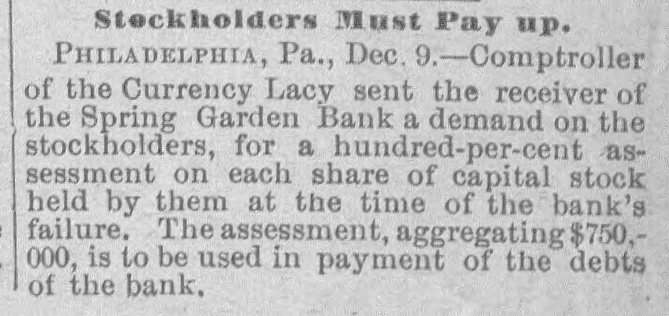
Stockholders Must Pay up. PHILADELPHIA, Pa., Dec. 9.-Comptroller of the Currency Lacy sent the receiver of the Spring Garden Bank a demand on the stockholders, for a hundred-per-cent assessment on each share of capital stock held by them at the time of the bank's failure. The assessment, aggregating $750,000, is to be used in payment of the debts of the bank.


Article from Los Angeles Herald, December 10, 1891

Click image to open full size in new tab

Article Text

Stockholders Cinched. PHILADELPHIA, Dec. 9.-Comptroller of the Currency Lacey has sent the receiver of the Spring Garden bank a demand on the stockholders for a 100 per cent assessment on each share of capital stock held by them at the time of the bank's failure. The assessment, aggregating $750,000, is to be used to pay the debts of the bank.


Article from The Salt Lake Herald, December 10, 1891

Click image to open full size in new tab

Article Text

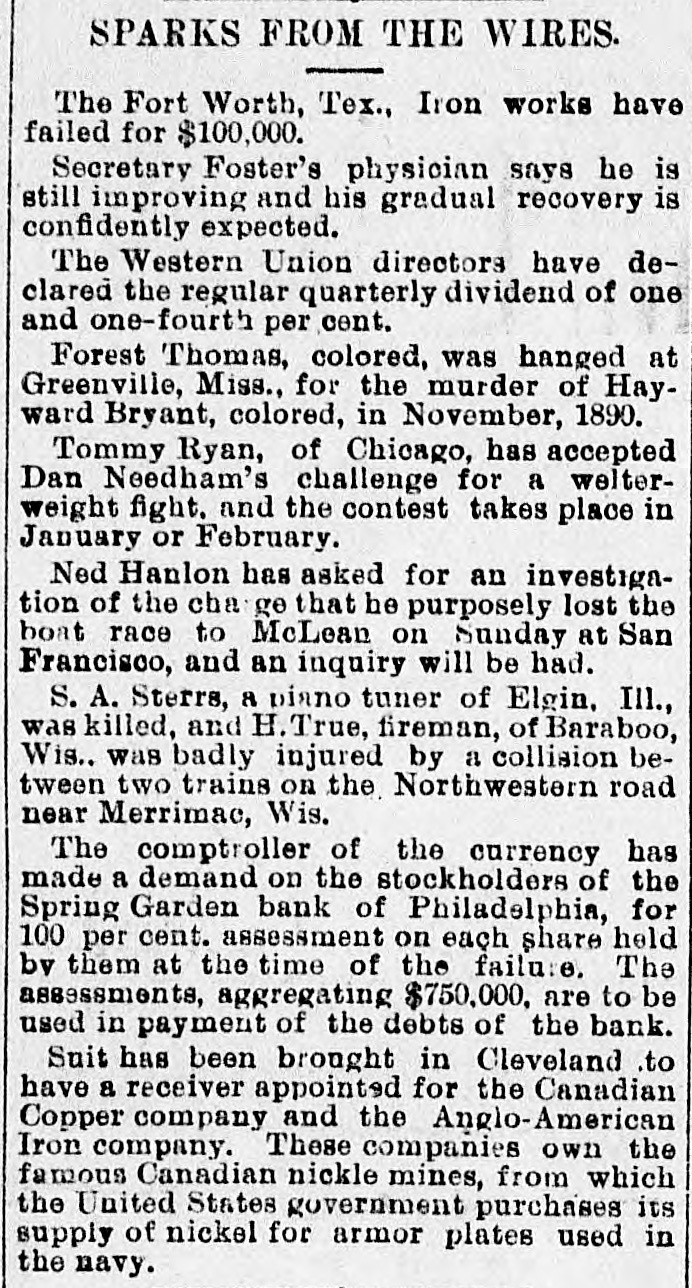
Spring Garden Bank Stockholders Assessed. PHILADELPHIA, Dec. 9.-Comptroller of the Currency Lacey, has sent the receiver of the Spring Garden bank a demand on the stockholders for 100 per cent. assessment on each share of the capital stock held by them at the time of the bank's failure. The assessments, aggregating $750,000 are to be used in payment of the debts of the bank.


Article from Telegram-Herald, December 11, 1891

Click image to open full size in new tab

Article Text

A Rig Assessment PHILADELPRIA, Dec 1a-Comptroller Lacey has seut to Gen. B. F. Fisher, receiver of the Spring Garden bank, demand of the shareholders for a 100 per cent assessment on each share of the sapital stock heid by them at the time of the bank's failure The assessmeat aggregates $750,000 to be used in payment of the debts of the bank


Article from Mexico Weekly Ledger, October 20, 1904

Click image to open full size in new tab

Article Text

SURPLUS AND DEFICIT. Comparison by Bryan to the Credit of Cleveland's Administration Speaking of the panic of 1893. William J. Bryan says in the current is. sue of the Commoner: "The first indication of its coming appeared November 11, 1890, when the New York Clearing House Association voted its certificates to banks in need of assistance. November 17 the Boston Clearing House did likewise. Barker Bros. & Co., bankers, of Philadelphia, failed with liabilities of $5,000,000. Mr. Bryan then gives a long list of failures, beginning with the United Rolling Stock Company, of Chicago, November 22, 1890, and end. ing with that of the Spring Garden Bank, of Philadelphia, May 8, 1891. Then came the Homestead and other great labor troubles. followed by the election of Cleveland to the Presidency. In May, 1893, there were more failures, and finally the raids on the United States Treasury. January 17, 1894, the Administration ordered a $50,000,000 bond issue. August 1, 1894, the Wilson tariff went into ef. fect." Continuing with his most interesting and timely retrospect, Mr. Bryan says: "It will be observed that the Cleveland Administration ordered the $50.000,000 bond issue January 17. 1894. That was seven months before the Wilson bill became a law. Perhaps it is not significant, but in view of Mr. Roosevelt's claim, it is at least interesting, that the first indications of the panic occurred November 11. 1890, a little more than thirty days after the McKinley tariff bill became a law. From that date the panic raged and while its effects were felt for it reached in 1893 and during stage several years, which its the worst early time days of 1894, during all of the McKinley tariff law was in effect. "It may not be out of place to point out that when the Democratic Adminthe 1889, there was ernment, istration surrendered Mar h 4, reins of gov- in the Federal Treasury the largest surWhen the of plus party in went history. out power, Republican March 4, 1893, there was a large deficit and the incoming Administration was finally persuaded to make the bond 18. to sues had at which one it's time Republican thought predecessor be necessary, but had skillfully avoided"