National Bank (New York, NY)

Episode Information

Episode UID
7807228090449
Episode Type
Run โ†’ Suspension โ†’ Reopening
Bank Type
state
Bank ID
780722809 hash
Start Date
May 11, 1837
Location
New York, New York (40.714, -74.006)

Metadata

Model
gpt-5-mini (chosen from majority vote of a three-model LLM ensemble)
Short Digest
e88a64ae109d5627

Response Measures

None

Description

Event is a city-wide suspension connected to the Panic of 1837; articles name the National as joining suspension and later paying specie.

Events (3)

1. May 11, 1837 Run
Cause
Macro News
Cause Details
Part of the broader Panic of 1837 causing heavy withdrawals and a large drain of specie from New York banks.
Measures
Heavy withdrawals; banks later coordinated suspension of specie payments.
Newspaper Excerpt
A prodigious crowd gathered in Wall street and filled it full all the morning... the drain of gold and silver on the banks amounted to $1,300,000.
Source
newspapers
2. May 11, 1837 Suspension
Cause
Macro News
Cause Details
Collective suspension of specie payments by New York banks in response to the specie drain and panic conditions.
Newspaper Excerpt
Resolved, That, under existing circumstances, it is expedient and necessary to SUSPEND PAYMENTS IN SPECIE.
Source
newspapers
3. October 12, 1837 Reopening
Newspaper Excerpt
It is probable... we should not be surprised to see several banks compelled to shut their doors altogether. At any rate the apprehension has already compelled the banks to begin to pay specie. We learn that the following banks now pay their five dollar notes in specie: ... National Bank ... .
Source
newspapers

Newspaper Articles (7)

Article from The Herald, May 11, 1837

Click image to open full size in new tab

Article Text

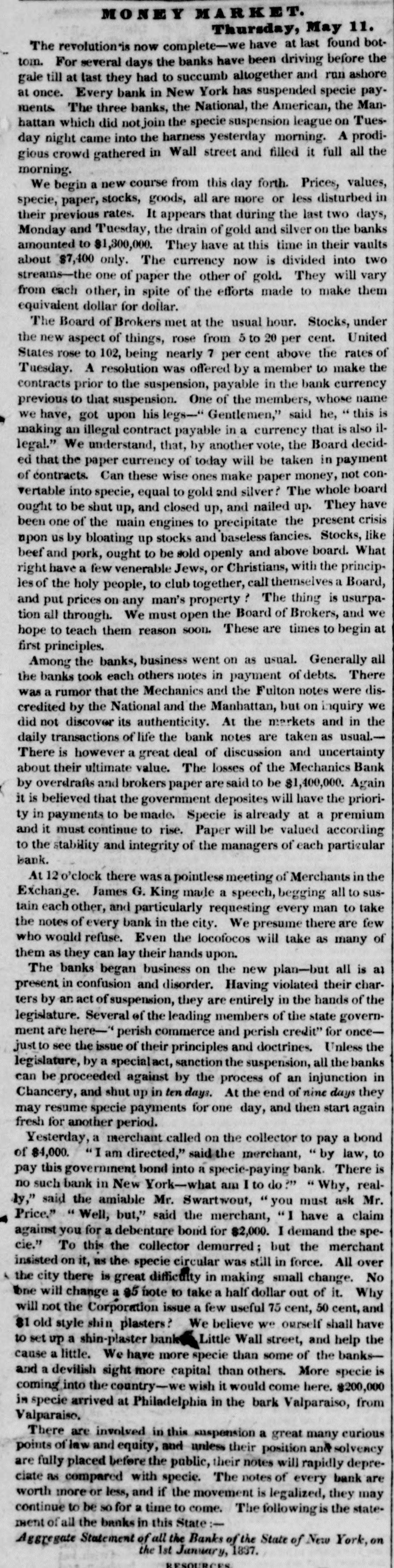
MONEY K Thursday, May 11. The revolution's now complete-we have at last found bottom. For several days the banks have been driving before the gale till at last they had to succumb altogether and run ashore at once. Every bank in New York has suspended specie payments The three banks, the National, the American, the Manhattan which did not join the specie suspension league on Tuesday night came into the harness yesterday morning. A prodigious crowd gathered in Wall street and filled it full all the morning. We begin a new course from this day forth. Prices, values, specie, paper, stocks, goods, all are more or less disturbed in their previous rates. It appears that during the last two days, Monday and Tuesday, the drain of gold and silver on the banks amounted to $1,300,000. They have at this time in their vaults about $7,400 only. The currency now is divided into two streams-the one of paper the other of gold. They will vary from each other, in spite of the efforts made to make them equivalent dollar for dollar. The Board of Brokers met at the usual hour. Stocks, under the new aspect of things, rose from 5 to 20 per cent. United States rose to 102, being nearly 7 per cent above the rates of Tuesday. A resolution was offered by a member to make the contracts prior to the suspension, payable in the bank currency previous to that suspension. One of the members, whose name we have, got upon his legs-" Gentlemen," said he, " this is making an illegal contract payable in a currency that is also illegal." We understand, that, by another vote, the Board decided that the paper currency of today will be taken in payment of contracts. Can these wise ones make paper money, not convertable into specie, equal to gold and silver? The whole board ought to be shut up, and closed up, and nailed up. They have been one of the main engines to precipitate the present crisis upon us by bloating up stocks and baseless fancies. Stocks, like beef and pork, ought to be sold openly and above board. What right have a few venerable Jews, or Christians, with the principles of the holy people, to club together, call themselves a Board, and put prices on any man's property The thing is usurpation all through. We must open the Board of Brokers, and we hope to teach them reason soon. These are times to begin at first principles. Among the banks, business went on as usual. Generally all the banks took each others notes in payment of debts. There was a rumor that the Mechanics and the Fulton notes were discredited by the National and the Manhattan, but on inquiry we did not discover its authenticity. At the markets and in the daily transactions of life the bank notes are taken as usual.There is however a great deal of discussion and uncertainty about their ultimate value. The losses of the Mechanics Bank by overdrafts and brokers paper are said to be $1,400,000. Again it is believed that the government deposites will have the priority in payments to be made. Specie is already at a premium and it must continue to rise. Paper will be valued according to the stability and integrity of the managers of each particular bank. o'clock there was a pointless meeting of Merchants in the Exchange. James G. King made a speech, begging all to sustain each other, and particularly requesting every man to take the notes of every bank in the city. We presume there are few who would refuse. Even the locofocos will take as many of them as they can lay their hands upon. The banks began business on the new plan-but all is al present in confusion and disorder. Having violated their charters by an act of suspension, they are entirely in the hands of the legislature. Several of the leading members of the state government are here perish commerce and perish credit" for oncejust to see the issue of their principles and doctrines. Unless the legislature, by a specialact, sanction the suspension, all the banks can be proceeded against by the process of an injunction in Chancery, and shut up in ten days. At the end of nine days they may resume specie payments for one day, and then start again fresh for another period. Yesterday, a merchant called on the collector to pay a bond of $4,000. "I am directed," said the merchant, " by law, to pay this government bond into a specie-paying bank. There is no such bank in New York-what am I to do?" " Why, really," said the amiable Mr. Swartwout, " you must ask Mr. Price." " Well, but," said the merchant, "I have a claim against you for a debenture bond for $2,000. I demand the specie." To this the collector demurred; but the merchant insisted on it, as the specie circular was still in force. All over the city there is great difficulty in making small change. No Ibne will change a 85 note to take a half dollar out of it. Why will not the Corporation issue a few useful 75 cent, 50 cent, and 81 old style shin plasters? We believe we ourself shall have to set up a shin-plaster bank Little Wall street, and help the cause a little. We have more specie than some of the banksis and a devilish sight more capital than others. More specie coming into the country-we wish it would come here. $200,000 in specie arrived at Philadelphia in the bark Valparaiso, from Valparaiso. There are involved in this suspension a great many curious points of law and equity, and unless their position and solvency are fully placed before the public, their notes will rapidly depreciate as compared with specie. The notes of every bank are worth more or less, and if the movement is legalized, they may continue to be so for a time to come. The following is the statement of all the banks in this State: :Aggregate Statement of all the Banks of the State of New York, on the 1st January, 1837. RESOURCES
Article from Rutland Herald, May 16, 1837

Click image to open full size in new tab

Article Text

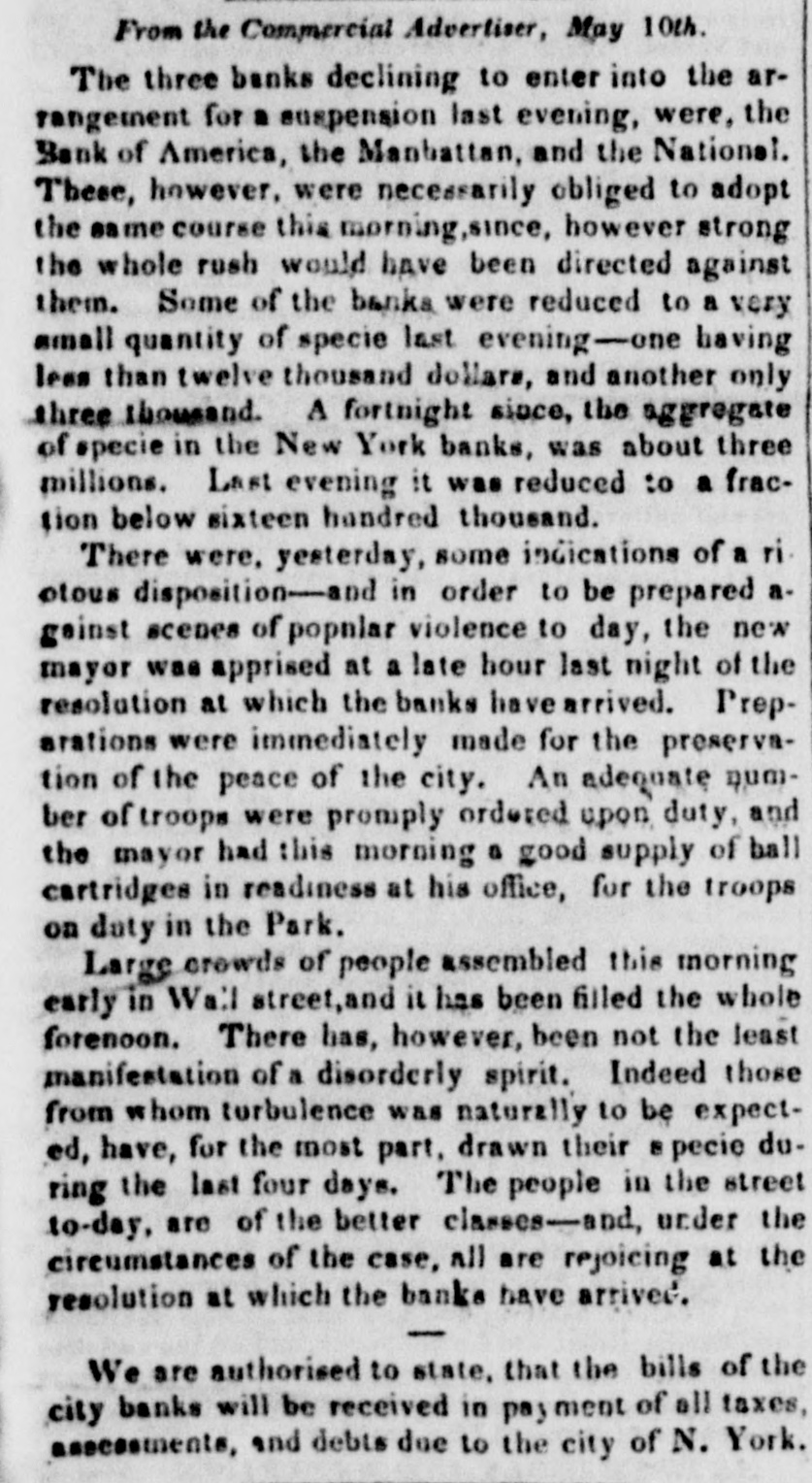
From the Commercial Advertiser, May 10th. The three banks declining to enter into the arrangement for a suspension last evening, were, the Bank of America, the Manbattan, and the National. These, however, were necessarily obliged to adopt the same course this morning, since, however strong the whole rush would have been directed against them. Some of the banks were reduced to a very small quantity of specie last evening-one having less than twelve thousand dollars, and another only three thousand. A fortnight since, the aggregate of specie in the New York banks, was about three millions. Last evening it was reduced to a fraction below sixteen hundred thousand. There were, yesterday, some indications of a ri otous disposition-and in order to be prepared against scenes of popniar violence to day, the new mayor was apprised at a late hour last night of the resolution at which the banks have arrived. Preparations were immediately made for the preservation of the peace of the city. An adequate quaber of troops were promply ordered upon duty, and the mayor had this morning a good supply of ball cartridges in readiness at his office, for the troops on duty in the Park. Large crowds of people assembled this morning early in Wall street, and it has been filled the whole forenoon. There has, however, been not the least manifestation of a disorderly spirit. Indeed those from whom turbulence was naturally to be expected, have, for the most part, drawn their 8 pecie during the last four days. The people in the street to-day. are of the better classes-and, under the circumstances of the case, all are rejoicing at the resolution at which the banks have arrived. We are authorised to state, that the bills of the city banks will be received in pay ment of all taxes, assessments, and debts due to the city of N. York.


Article from Vermont Telegraph, May 17, 1837

Click image to open full size in new tab

Article Text

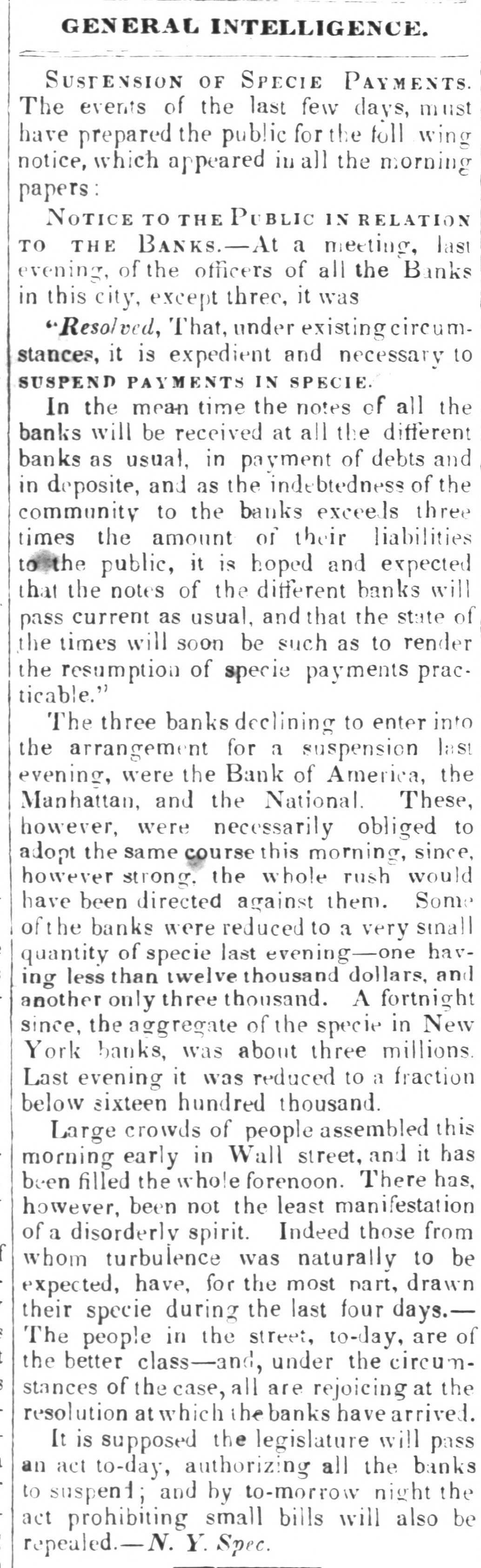
GENERAL INTELLIGENCE. SUSTENSION OF SPECIE PAYMENTS. The events of the last few days, must have prepared the public for the toll wing notice, which appeared in all the morning papers : NOTICE TO THE PUBLIC IN RELATION TO THE BANKS.-At a meeting, last evening, of the officers of all the Banks in this city, except three, it was "Resolved, That, under existing circumstances, it is expedient and necessary to SUSPEND PAYMENTS IN SPECIE. In the mean time the notes of all the banks will be received at all the different banks as usual, in payment of debts and in deposite, and as the indebtedness of the community to the banks exceeds three times the amount of their liabilities to the public, it is hoped and expected that the notes of the different banks will pass current as usual, and that the state of the times will soon be such as to render the resumption of specie payments practicable." The three banks declining to enter into the arrangement for a suspension last evening, were the Bank of America, the Manhattan, and the National These, however, were necessarily obliged to adopt the same course this morning, since, however strong. the whole rush would have been directed against them. Some of the banks were reduced to a very small quantity of specie last evening-one having less than twelve thousand dollars, and another since, the only aggregate three thousand. of the specie A fortnight in New York banks, was about three millions. Last evening it was reduced to a fraction below sixteen hundred thousand. Large crowds of people assembled this morning early in Wall street, and it has been filled the whole forenoon. There has, however, been not the least manifestation of a disorderly spirit. Indeed those from whom turbulence was naturally to be expected, have, for the most part, drawn their specie during the last four days.The people in the street, to-day, are of the better class-and, under the circumstances of the case, all are rejoicing at the resolution at which the banks have arrived. It is supposed the legislature will pass an act to-day, authorizing all the banks to suspend; and by to-morrow night the act prohibiting small bills will also be repealed.- Y. Spec.


Article from Morning Herald, August 1, 1837

Click image to open full size in new tab

Article Text

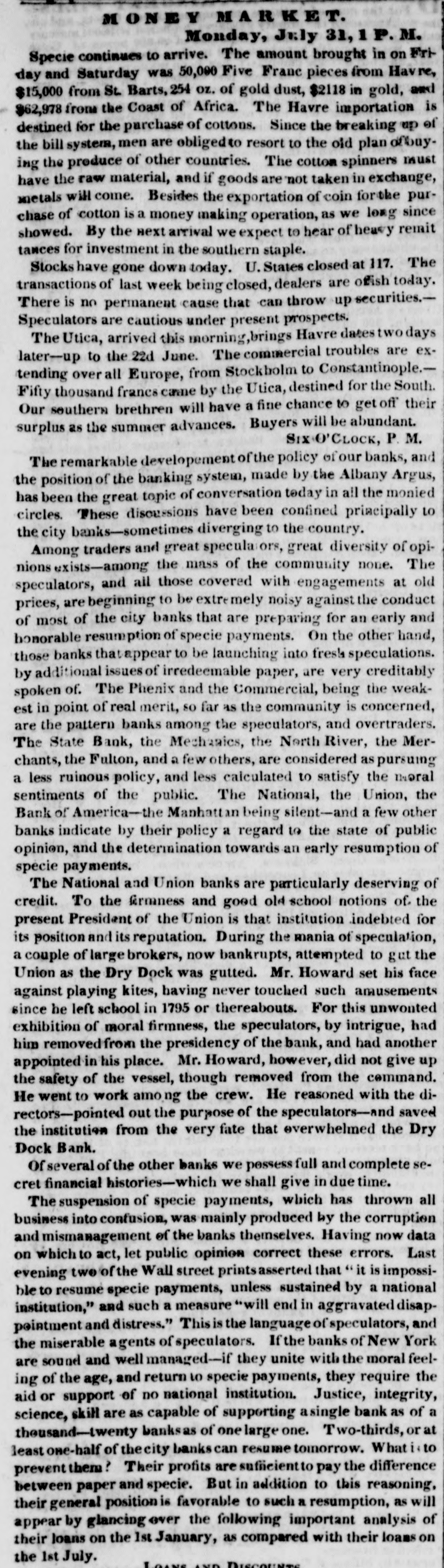
MONEY R K ET. Monday, July 31, P. M. Specie continues to arrive. The amount brought in on Friday and Saturday was 50,000 Five Frane pieces from Havre, $15,000 from St. Barts, 254 oz. of gold dust, $2118 in gold, and $62,978 from the Coast of Africa. The Havre importation is destined for the purchase of cottons. Since the breaking up of the bill system, men are obliged to resort to the old plan ofbuying the produce of other countries. The cotton spinners must have the raw material, and if goods are not taken in exchange, metals will come. Besides the exportation of coin for the purchase of cotton is a money making operation, as we long since showed. By the next arrival we expect to hear of heavy remit tances for investment in the southern staple. Stocks) have gone down today. U. States closed at 117. The transactions of last week being closed, dealers are ofish today. There is no permanent cause that can throw upsecurities.Speculators are cautious under present prospects. The Utica, arrived this morning,brings Havre dates two days later-up to the 22d June. The commercial troubles are extending over all Europe, from Stockholm to Constantinople.Fifty thousand francs came by the Utica, destined for the South. Our southern brethren will have a fine chance to get off their surplus as the summer advances. Buyers will be abundant. Six O'Clock, P. M. The remarkable developement of the policy of our banks, and the position of the banking system, made by the Albany Argus, has been the great topic of conversation today in all the monied circles. These discussions have been confined principally to the city banks-sometimes diverging to the country. Among traders and great speculators, great diversity of opinions exists-among the mass of the community none. The speculators, and all those covered with engagements at old prices, are beginning to be extre mely noisy against the conduct of most of the city banks that are preparing for an early and honorable resumption of specie payments. On the other hand, those banks that appear to be launching into fresh speculations. by additional issues of irredeemable paper, are very creditably spoken of. The Phenix and the Commercial, being the weakest in point of real merit, so far as the community is concerned, are the pattern banks among the speculators, and overtraders. The State Bank, the Mechanics, the North River, the Merchants, the Fulton, and a few others, are considered as pursuing a less ruinous policy, and less calculated to satisfy the moral sentiments of the public. The National, the Union, the Bank of America-the Manhatt an being silent-and a few other banks indicate by their policy a regard to the state of public opinion, and the determination towards an early resumption of specie payments. The National and Union banks are particularly deserving of credit. To the firmness and good old school notions of the present President of the Union is that institution indebted for its position and its reputation. During the mania of speculation, a couple of large brokers, now bankrupts, attempted to get the Union as the Dry Dock was gutted. Mr. Howard set his face against playing kites, having never touched such amusements since be left school in 1795 or thereabouts. For this unwonted exhibition of moral firmness, the speculators, by intrigue, had him removed from the presidency of the bank, and had another appointed in his place. Mr. Howard, however, did not give up the safety of the vessel, though removed from the command. He went to work among the crew. He reasoned with the directors-pointed out the purpose of the speculators-and saved the institution from the very fate that everwhelmed the Dry Dock Bank. Of several of the other banks we possess full and complete secret financial histories-which we shall give in due time. The suspension of specie payments, which has thrown all business into confusion, was mainly produced by the corruption and mismanagement of the banks themselves. Having now data on which to act, let public opinion correct these errors. Last evening two of the Wall street printsasserted that it is impossible to resume specie payments, unless sustained by a national institution," and such a measure "will end in aggravated disappointment and distress." This is the language of speculators, and the miserable agents of speculators. If the banks of New York are sound and well managed-if they unite with the moral feeling of the age, and return to specie payments, they require the aid or support of no national institution. Justice, integrity, science, skill are as capable of supporting asingle bank as of a thousand-twenty banksas of one large one. Two-thirds, or at least one-half of the city banks can resume tomorrow. Whatisto prevent then Their profits are sufficient to pay the difference between paper and specie. But in addition to this reasoning, their general position is favorable to such a resumption, as will appear by glancing ever the following important analysis of their loans on the 1st January, as compared with their loans on the 1st July. LIANE AND DISCOUNTS


Article from Morning Herald, August 2, 1837

Click image to open full size in new tab

Article Text

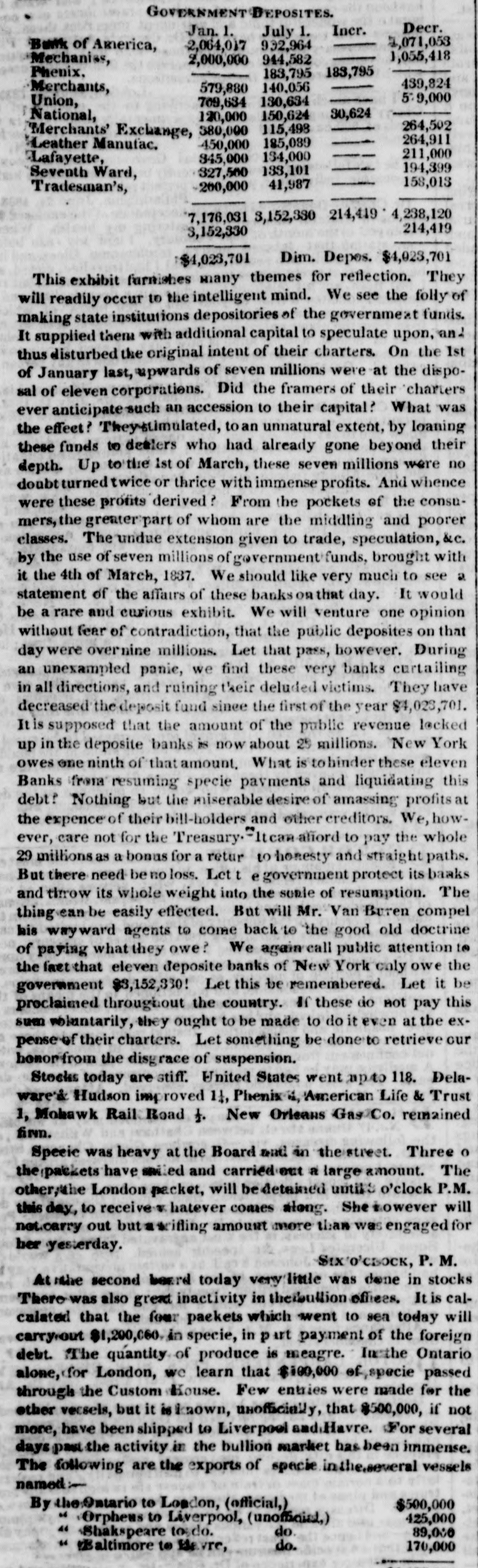
GOVERNMENT DEPOSITES. Decr. Incr. Jan. 1. July 1. 2,071,053 932,964 Bank of America, -2,064,017 1,055,418 Mechaniss, 944,582 2,000,000 Phenix. 183,795 183,795 439,824 140,056 579,880 Merchants, 5:9,000 Union, 130,634 709,634 30,624 National, 150,624 120,000 264,502 115,498 380,000 Merchants' Exchange, 264,911 Leather Manufac. 185,089 450,000 211,000 134,000 Lafayette, 345,000 194,399 133,101 327,500 Seventh Ward, 158,013 41,987 200,000 Tradesman's, 4,238,120 214,419 7,176,031 3,152,330 214,419 3,152,330 Dim. Depos. $4,023,701 $4,023,701 This exhibit furnishes many themes for reflection. They will readily occur to the intelligent mind. We see the folly of making state institutions depositories of the government funds. It supplied them with additional capital to speculate upon, anthus disturbed the original intent of their charters. On the 1st of January last, upwards of seven millions were at the disposal of eleven corporations. Did the framers of their charters ever anticipate such an accession to their capital? What was the effect? Theystimulated, to an unnatural extent, by loaning these funds to detters who had already gone beyond their depth. Up to the 1st of March, these seven millions were no doubtturned twice or thrice with immense profits. And whence were these profits derived? From the pockets of the consumers, the greater part of whom are the middling and poorer classes. The undue extension given to trade, speculation, &c. by the use of seven millions of government funds, brought with it the 4th of March, 1837. We should like very much to see a statement of the affairs of these banks OR that day. It would be a rare and curious exhibit. We will venture one opinion without fear of contradiction, that the public deposites on that day were overnine millions. Let that pass, however. During an unexampled panie, we find these very banks curtailing in all directions, and ruining their deluded victims. They have decreased the deposit fund since the first of the year $4,023,701. It is supposed that the amount of the public revenue locked up in the deposite banks is now about 25 millions. New York owes one ninth of that amount, What is tobinder these eleven Banks from resuming specie payments and liquidating this debt? Nothing but the miserable desire of amassing profits at the expence of their bill-holders and other creditors. We, however, care not for the Treasury."In can afford to pay the whole 29 millions as a bonus for a retur to honesty and straight paths. But there need be no loss. Let t government protect its baaks and throw its whole weight into the some of resumption. The thing-ean be easily effected. But will Mr. Van Buren compel his way ward agents to come back to the good old doctrine of paying what they owe? We again call public attention to the fact that eleven deposite banks of New York coly owe the government $3,152,330! Let this be remembered. Let it be proclaimed throughout the country. If these do not pay this sum voluntarily, they ought to be made to do it even at the expense of their charters. Let something be done retrieve our honorfrom the disgrace of suspension. Stocks today are stiff. United States went ap to 118. Delaware'& Hudson aproved 11, Phenix 4, American Life & Trust 1, Mokawk Rail Road 1. New Orleans Gas Co. remained firm. Speeie was heavy at the Board and in the street. Three o the packets have smiled and carried out a large amount. The other,the London packet, will be detained untile o'clock P.M. this day, to receive . hatever comes along. She towever will netcarry out but a rifling amount more than was engaged for her yesterday. Stx'o'clock, P. M. At the second board today very little was done in stocks There was also great inactivity in therbullion offices. It is calculated that the four paekets which went to sea today will carry.out $1,200,000. in specie, in part payment of the foreign debt. The quantity of produce is meagre. Inc the Ontario alone, for London, we learn that $100,000 of specie passed through the Custom House. Few entries were made for the other vecsels, but it is known, unofficially, that $500,000, if not more, have been shipped to Liverpool and Havre. For several days past the activity in the bullion market has been immense. The following are the exports of specie inthe.several vessels named $500,000 By the Ontario to London, (official,) as 425,000 Orpheus to Liverpool, (unofficial,) do 44 Shakspeare todo. 89,000 " do. Baltimore to Havre, 170,000


Article from Morning Herald, October 12, 1837

Click image to open full size in new tab

Article Text

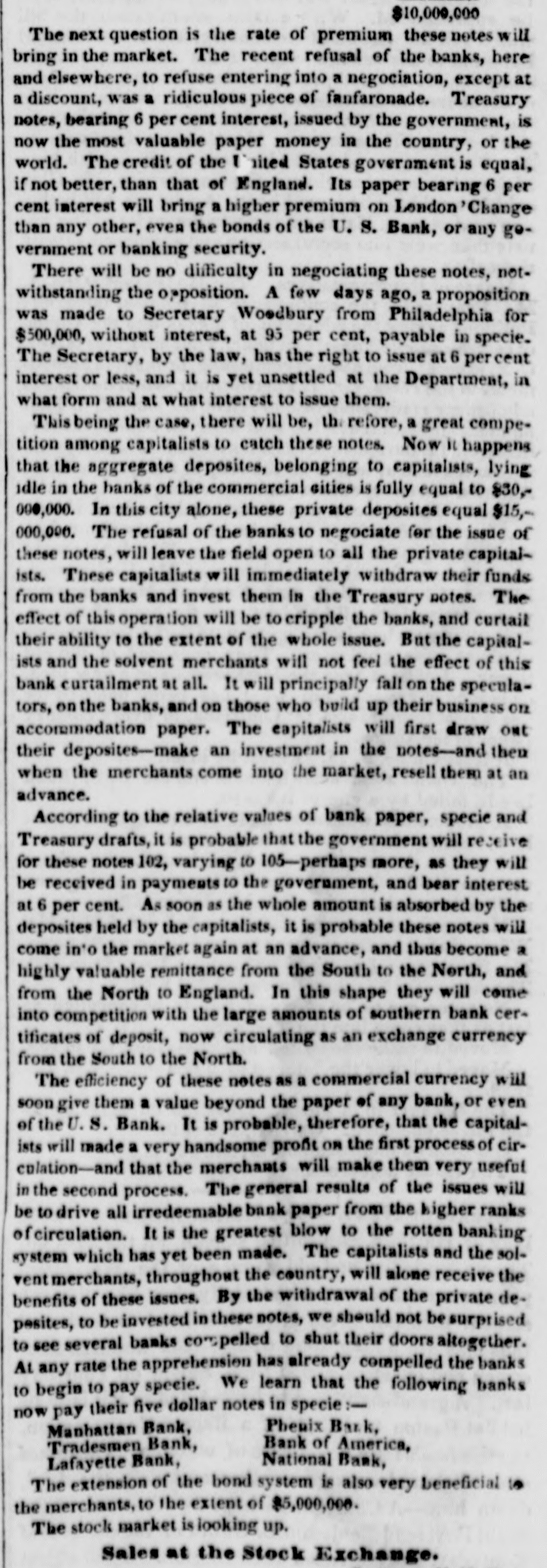
$10,000,000 The next question is the rate of premium these notes will bring in the market. The recent refusal of the banks, here and elsewhere, to refuse entering into a negociation, except at a discount, was a ridiculous piece of fanfaronade. Treasury notes, bearing 6 per cent interest, issued by the government, is now the most valuable paper money in the country, or the world. The credit of the I ited States government is equal, if not better, than that of England. Its paper bearing 6 per cent interest will bring a higher premium on London Change than any other, even the bonds of the U.S. Bank, or any government or banking security. There will be no difficulty in negociating these notes, notwithstanding the opposition. A few days ago, a proposition was made to Secretary Woodbury from Philadelphia for $500,000, without interest, at 95 per cent, payable in specie. The Secretary, by the law, has the right to issue at 6 per cent interest or less, and it is yet unsettled at the Department, in what form and at what interest to issue them. This being the case, there will be, th refore, a great competition among capitalists to catch these notes. Now it happens that the aggregate deposites, belonging to capitalists, lying idle in the banks of the commercial cities is fully equal to $30, 000,000. In this city alone, these private deposites equal $15,000,000. The refusal of the banks to negociate for the issue of these notes, will leave the field open to all the private capitalists. These capitalists will immediately withdraw their funds from the banks and invest them in the Treasury notes. The effect of this operation will be to cripple the banks, and curtail their ability to the extent of the whole issue. But the capitalists and the solvent merchants will not feel the effect of this bank curtailment at all. It will principally falt on the speculators, on the banks, and on those who build up their business on accommedation paper. The capitalists will first draw out their deposites-make an investment in the notes-and then when the merchants come into the market, resell them at an advance. According to the relative values of bank paper, specie and Treasury drafts, it is probable that the government will receive for these notes 102, varying to 105-perhaps more, as they will be received in payments to the government, and bear interest at 6 per cent. As soon as the whole amount is absorbed by the deposites held by the capitalists, it is probable these notes will come in'o the market again at an advance, and thus become a highly valuable remittance from the South to the North, and from the North to England. In this shape they will come into competition with the large amounts of southern bank certificates of deposit, now circulating as an exchange currency from the South to the North. The efficiency of these notes as a commercial currency will soon give them a value beyond the paper of any bank, or even of the U.S. Bank. It is probable, therefore, that the capitalists will made a very handsome profit OR the first process of circulation-and that the merchants will make them very useful in the second process. The general results of the issues will be to drive all irredeemable bank paper from the higher ranks efcirculation. It is the greatest blow to the rotten banking system which has yet been made. The capitalists and the solent merchants, throughout the country, will alone receive the benefits of these issues. By the withdrawal of the private deposites, to be invested in these notes, we should not be surprised to see several banks compelled to shut their doors altogether. At any rate the apprehension has already compelled the banks to begin to pay speeie. We learn that the following banks now pay their five dollar notes in specie:Pheuix Bank, Manhattan Bank, Tradesmen Bank, Bank of America, National Bank, Lafayette Bank, The extension of the bond system is also very beneficial to the merchants, to the extent of $5,000,000. The stock market is looking up. Sales at the Stock Exchange.


Article from Indiana State Sentinel, September 26, 1843

Click image to open full size in new tab

Article Text

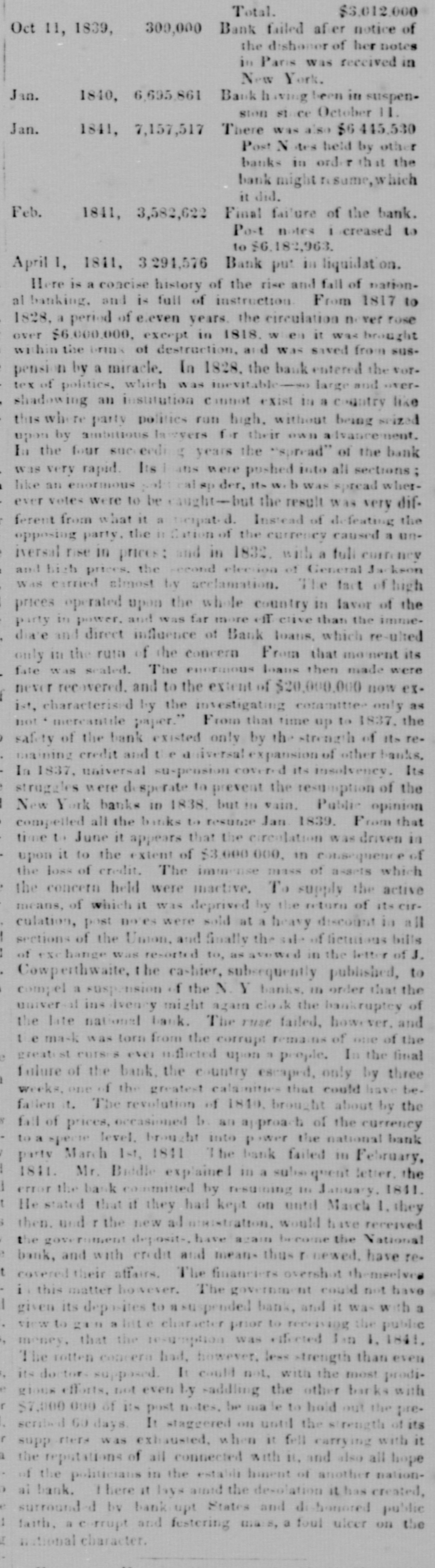
Total. $3,012,000 300,000 Bank failed after notice of Oct 11, 1839, the dishoner of her notes in Paris was received in New York. Jan. 6,695,861 1840, Bank having been in suspenSton st ce October 11. Jan. There was also $445,530 7,157,517 1841, Post N tes held by other banks in order that the bank might n sume, which it did. Feb. Final failure of the bank. 1811, 3,582,622 Po-t notes i creased to to $6,182,963. April 1, 1811, 3291,576 Bank put in liquidation. Here is a coacise history of the rise and fall of national banking. and is full of instruction From 1817 to 1828, a period of e.even years. the circulation n. ver rose over $6,000,000, except in 1818. when it was brought within the Brink of destruction, and was saved from suspension by a miracle. In 1828. the bank entered the vortex of politics, which was inevitable- large and overshadowing an institution Cannot exist in a country like this who re party politics run high. without being seized upon by ambitious lawyers for their own advancement. In the four succeedi g years the "spread" of the bank was very rapid. Its ats were pushed into all sections; like an enotinous salt cal sp der, its w.b was spread whenever votes were to be caught-but the result was very different from what it a ticipated. Instead of defeating the opposing party. the in Cation of the currency caused a universal rise in prices: and in 1832 with a full currency and high prices. the second election of General Ja kson was carried almost by acclamation. The fact of high prices operated upon the whole country in lavor of the party in power. and was far more off crive than the immedate and direct influence of Bank loans, which re-ulted only in the rula of the concern From that moment its fate was sealed. The enermous loans then made were never recovered. and to the extent of $20,000,000 now exist, characterised by the investigating committee only as not mercantile paper." From that time up to 1837. the safety of the bank existed only by the strength of its remaining credit and the d liversal expansion of other banks. In 1837, universal su-pension covered its insolvency. Its struggles were desperate to prevent the restruption of the New York banks in 1838. but in vain. Public opinion compelled all the banks to resure Jan 1839. From that time to June it appears that the circulation was driven in upon it to the extent of $3,000 000 in consequence of the loss of credit. The immense mass of assets which the concera held were inactive. To supply the active means, of which it was deprived by the return of its circulation, post no'es were sold at a heavy discount in all sections of the Umion. and finally the sale of licturious bills of exchange was resorted to, as avowed in the letter of J. Cowperthwaite, the ca-hier, subsequently published, to compel a suspension of the N. Y banks, in order that the universi ins Avency might again clock the bankruptcy of the lite national bank. The rise failed, however. and the ma-k was tora from the corrupt remains of one of the greatest curses ever inflicted upon a people. In the final future of the bank. the country escaped. only by three weeks, one of the greatest calamities that could have befallen it. The revolution of 1810. brought about by the fall of prices, occasioned b. an approach of the currency to a specie level. brought into power the national bank party March 1-1, 1811 The bank failed in February, 1811. Mr. Biddle explaine! in a abouncent letter. the error the bank committed by resuming 11. January. 1841. He stated that it they had kept on until March 1. they then. und r the new ad interstration, would have received the government deposit-. have again become the National bank, and with credit and mean. thus newed. have ret covered their affairs. The financiers oversho themselves this matter however, The government could not have | given its deposites to suspended bank, and it was with a view to gan alite character prior to receiving the public , money. that the resumption was effected In 1. 1841. The rotten concera had, however, less strength than even its doctor supposed. I could not. with the most prodiit gious efforts. not even by saddling the other banks with r $7,000 000 of its post notes. be ma le to hold out the prescribed 60 days It staggered on until the strength of its r supp riers was exhausted, when it fell carrying with it the reputations of all connected with ii. and also all hope of the politicians in the estalile hment of another nationai bank. there it lays amid the desolation it has created, surrounded by bank upt States and dishonored public faith. corrupt and festering mas a foul ulcer on the national character.