Manhattan Savings Institution (New York, NY)

Episode Information

Episode UID
7825352190946
Episode Type
Suspension โ†’ Run โ†’ Reopening
Bank Type
savings
Bank ID
782535219 hash
Start Date
October 28, 1878
Location
New York, New York (40.714, -74.006)

Metadata

Model
gpt-5-mini (chosen from majority vote of a three-model LLM ensemble)
Short Digest
6c9cabc3c9dcf16c

Response Measures

None

Description

Suspension invoked under the bank's sixty-day rule after a large daytime burglary; reopening prompted a brief run that subsided.

Events (3)

1. October 28, 1878 Suspension
Cause
Bank Specific Adverse Info
Cause Details
Large daytime burglary/robbery of vault stealing nearly $2.7M in securities and cash, prompting the bank to invoke its 60-day payment rule.
Newspaper Excerpt
For the purpose of preventing loss to depositors it is ordered that no payments be made without sixty days' notice.
Source
newspapers
2. March 13, 1879 Reopening
Newspaper Excerpt
for the first time since the robbery of its safe in October last that institution was opened for business.
Source
newspapers
3. March 13, 1879 Run
Cause
Bank Specific Adverse Info
Cause Details
Depositors withdrew funds upon resumption due to lingering alarm from the prior large robbery and earlier suspension.
Measures
Police detail arranged order in lines; bank announced cash and available securities, and officers arranged conversion of securities to cash to meet demands.
Newspaper Excerpt
Crowds of depositors... long before 10 o'clock... Not more than $100,000 withdrawn.
Source
newspapers

Newspaper Articles (20)

Article from New-York Tribune, October 28, 1878

Click image to open full size in new tab

Article Text

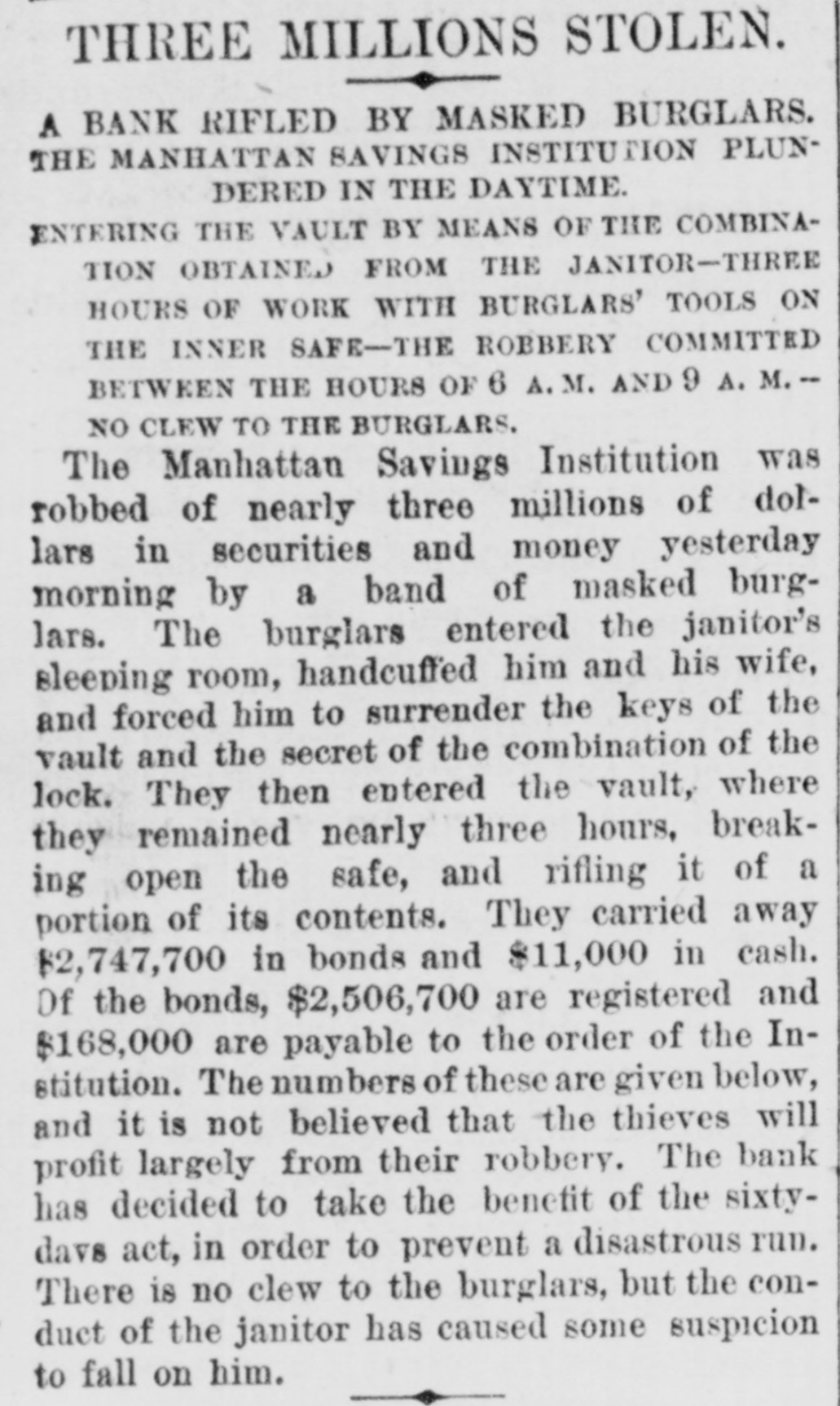
THREE MILLIONS STOLEN. A BANK RIFLED BY MASKED BURGLARS. THE MANHATTAN SAVINGS INSTITUTION PLUNDERED IN THE DAYTIME. ENTERING THE VAULT BY MEANS OF THE COMBINATION OBTAINED FROM THE JANITOR-THREE HOURS OF WORK WITH BURGLARS' TOOLS ON THE INNER SAFE-THE ROBBERY COMMITTED BETWEEN THE HOURS OF 6 A.M. AND 9 A. M.NO CLEW TO THE BURGLARS. The Manhattan Savings Institution was robbed of nearly three millions of dollars in securities and money yesterday morning by a band of masked burglars. The burglars entered the janitor's sleeping room, handcuffed him and his wife, and forced him to surrender the keys of the vault and the secret of the combination of the lock. They then entered the vault, where they remained nearly three hours, breaking open the safe, and rifling it of a portion of its contents. They carried away $2,747,700 in bonds and $11,000 in cash. Of the bonds, $2,506,700 are registered and $168,000 are payable to the order of the Institution. The numbers of these are given below, and it is not believed that the thieves will profit largely from their robbery. The bank has decided to take the benefit of the sixtydavs act, in order to prevent a disastrous run. There is no clew to the burglars, but the conduct of the janitor has caused some suspicion to fall on him.


Article from The Daily Dispatch, October 29, 1878

Click image to open full size in new tab

Article Text

The Great Robbery in New York. NEW YORK, October 28.-The robbery of the Manhattan Savings Institution is the sensation in banking circles. A notice has been posted in the bank, which says : " For the purpose of preventing loss to depositors it is ordered that no payments be made without sixty days' notice. The surplus of the bank is more than sufficient to cover any probable loss that may be sustained by reason of the robbery." A great number of depositors have given the necessary notice. The directors were in secret session to-day. Every available detective in town has been assigned to the case. It is possible that the amount taken may be more than first stated, since the contents of a number of tin boxes, which contained many valuables that the bank is not responsible for, have disappeared.


Article from The Lambertville Record, October 30, 1878

Click image to open full size in new tab

Article Text

THREE MILLIONS STOLEN-A Bank Rifled by Masked Burglars.-The Manhattan Savings Institution of New York city was robbed of nearly three millions of dollars in securities and money on Sunday morning by a band of masked burglars. The burglars entered the janitor's sleeping room, handcuffed him and his wife, and forced him to surrender the keys of the vault and the secret of the combination of the lock. They then entered the vault, where they remained nearly three hours, breaking open the safe and rifling it of a portion of its contents. They carried away $2,747,700 in bonds and $11,000 in cash. Of the bonds, $2,506,700 are registered and $168,000 are payable to the order of the institution. The numbers of these are given by the New York press, and it is not believed that the thieves will profit largely from their robbery. The bank has decided to take the benefit of the sixty days act, in order to prevent a disastrous run. There is no clue to the burglars, but the conduct of the janitor has caused some suspicion to fall on him.


Article from River Falls Journal, October 31, 1878

Click image to open full size in new tab

Article Text

RAILROAD ACCIDENT. At Marshiand Junction, en the 27th inst. a freighttrain on the Chicago & Northwestern railroad was run into by a wild train on the Green Bay road, which was switching, throw. ing the engine of the former train and a box car into the ditch; also wrecking a car on the wild train. The engineer of the Northwestern train, Michael Ford, and his fireman John Kier, were burled in the wreck of the locomotive, and severely bruised and slightly scalded, but, ortunately, not seriously injured. GREAT BANK ROBBERY. The Manhattan Savings institution was 01 the morning of Sunday, the 97th of October, 1878, robbed of securities to the amount of $2,757,700, of which $2,505,700 were registered in the name of the institution and not negotiable, and $168,000 are made payable to it, and $73,000 are in coupon bonds, ;and $11,000 in cash. For the preventing the loss to deposi t ors, it is demanded advisable that no payment be made without sixty days, notice, as provided by the laws of the institution. The ntegrity of the janitor is suspected. ATTEMPTED LYNCHING. A good deal of excitement was produced la Louisville, Ky., on the 25th inst., by the ap.


Article from Iowa County Democrat, November 1, 1878

Click image to open full size in new tab

Article Text

provided by the by-laws of the institution. EDWARD SCHELL, president. CHARLES F. ALVORD, secretary. LATER. A New York telegram of Oct. 28th gives further particulars as follows: The gigantic robbery* of the Manhattan savings institution is the sensation in banking circles. A notice has been posted in the bank saying, for the purpose of preventing loss to depositors, it is ordered no payment be made without 60 days notice. The surplus of the bank is more than sufficient to cover any probable loss that may be sustained by reason of the robbery. A great number of depositors have given the necessary notice. The directors were in secret session to-day. It is said to be the rule for janitors of bank buildings in this city to have the combination of vaults. Every available detective in town has been assigned to the case. The Evening Post says, so far as can be ascertained, no arrests have been made yet. Supt. Walling said, this morning, he could give no new information about the case; denied he professed last night to have a clue to the robbers, and if he had one he would not admit it. The janitor and watchman are at the bank to-day, helping to straighten out the matter. Augustus Schell, democratic candidate for mayor, and brother of the president, says the bank will have a surplus of $500,000 of all the coupon bonds stolen which were counted as lost. Great crowds continued all the morning about the bank. The robbers left behind a skeleton key, also three pair of hand cuffs. Of 40 or 50 boxes stored away 20 had been opened and their contents rifled. It is possible the amount taken may be $3,000,000. since the contents of a number of tin boxes containing coin and government bonds, with which the sides of the vault were lined have disappeared.


Article from The Sun, November 2, 1878

Click image to open full size in new tab

Article Text

Mr. Schell's Bank Talking of Resuming. The Manhattan Savings Bank directors are to meet next Tuesday to discuss the question of resuming business. The officers of the bank favor immediate resumption. and one of the directors said yesterday that he thought Lusiness will be going on as usual by the latter part or next week. Large depositors might be prevented by the sixty-day rule from withdrawing their money immediately. but he was of opinion that the smaller depositors would be paid without delay. The police do not report any progress in unravelling the my 5+ tery of the robbery.


Article from The Sun, November 5, 1878

Click image to open full size in new tab

Article Text

Mr. AUGUSTUS SCHELL, a leading director of the Manhattan Savings Institution, failed to take needed precautions to protect that institution from burglars who robbed it of securities amounting in value to nearly three millions of dollars. Mr. AUGUSTUS SCHELL was acting President and general manager of the Union Trust Company when that company was robbed of $375,000 by the Secretary, CHARLES T. CARLTON. While Mr. Schell professed himself utterly unable to account for the rumors afloat affecting the stability of the company." the Secretary was a fugitive from justice. The fraudulent practices of the Secretary dated back four years, and. according to the receiver of the company, could only have happened "because the management of the company's affairs was undoubtedly very loose." Mr. AUGUSTUS SCHELL, with his record as a private trustee, now comes forward RH the King and Clown candidate for a great public trust-no less than the Chief Magistracy of the first city on the American continent. What guarantee have the citizens of New York that Mr. AUGUSTUS SCHELL would discharge the public trust any better than he has the private ones: that he would protect the city Treasury any better than he did the vaults of the Manhattan Institution for Savings: that he would be less blind to wholesale theft and fraud under his very eyes than he was in the Union Trust Company?


Article from San Marcos Free Press, November 9, 1878

Click image to open full size in new tab

Article Text

The Great Bunk Robbery. OVER THREE MILLIONS STOLEN-CONDITION OF THE BANK-DETECT IVES AT WORK. NEW YORK. Oct. 28.-The gigantic robbery of the Manhattan Savings institution is the sensation in banking circles. A notice has been posted in the bank saying: "For the purpose of preventing loss to depositors. it is ordered that no payments be made without sixty days' notice. The surplus of the bank is more than sufficient to cover any probable loss that may be sustained by reason of the robbing." A great number of depositors have given the necessary notice. The directors were in secret session to-day. It is said to be the rule for janitors of bank buildings in this city to have the combination of vaults. Every available detective in town has been assigned to the case. The Evening Post says : "So far as can be ascertained no arrests have been made. Superintendent Walling said this morning that he could give no new information about the case and denied that he professed last night to have a clue to the rob, bers; and said if he had one he would not admit it." The janitor and nightwatchman are at the bank to-day helping to straighten out matters. Augustus Schell, Democratic candidate for Mayor, and brother of the President of the bank, says the bank will have a surplus of $500,000 if all the coupon- bonds stolen were counted as lost. Great crowds continued all day about the bank.. The robders left behind a skeleton key; also, three pair of hand-euffs. Of forty or fifty boxes stored away about twenty had been opened and their contents rifled. It is possible the amount taken may be more than three millions since the contents of a number of tin boxes containing gold coin and government bonds, with which the sides of the vault were lined, have disappeared.


Article from Northern Tribune, November 9, 1878

Click image to open full size in new tab

Article Text

THE Manbattan savings bank, New York city, was robbed of about $3.000,000 in money and securities"on the morning of October 28. by seven masked men. who, by holding pistols at the head of the watehman and his family and threatening their lives. forced him to give up the combination to the safe-lock. All but $75,000 of the stolen securities were registered and will ultimately be saved to the bank. Meanwhile the bank has suspended payment for 60 days,


Article from The Sun, December 17, 1878

Click image to open full size in new tab

Article Text

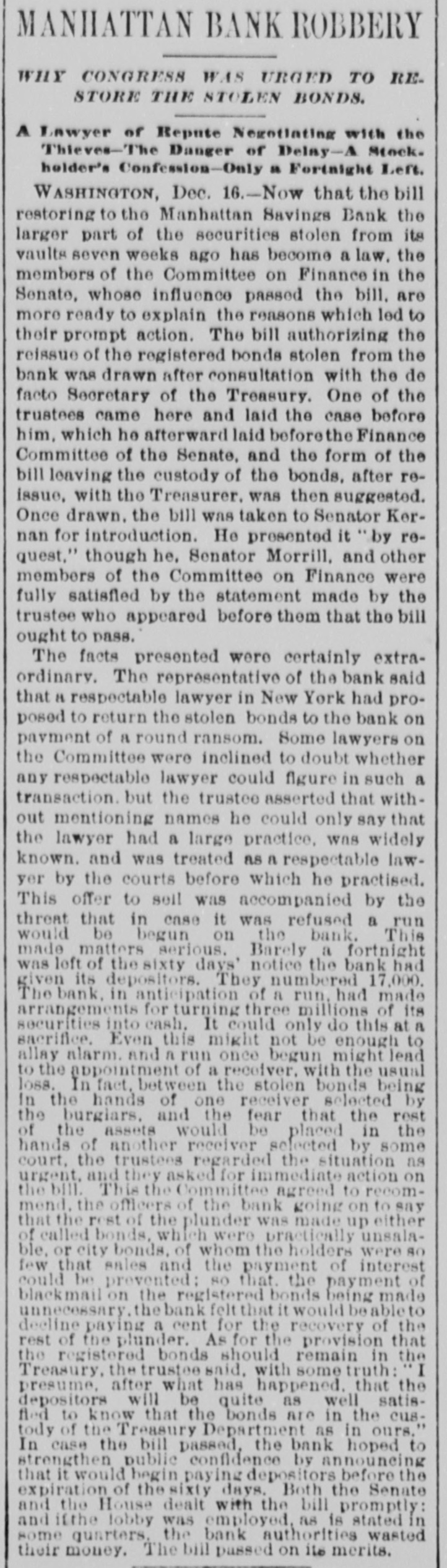
MANHATTAN BANK ROBBERY WHY CONGRESS WAS URGED TO RESTORE THE STOLEN BONDS. A Lawyer of Repute Negotiating with the Thieves-The Danger of Delay-A Stock. holder's Confession-Only a Fortnight Left. WASHINGTON, Dec. 16.-Now that the bill restoring to the Manhattan Savings Bank the larger part of the securities stolen from its vaults seven weeks ago has become a law. the members of the Committee on Finance in the Senate, whose influence passed the bill. are more ready to explain the reasons which led to their prompt action. The bill authorizing the reissue of the registered bonds stolen from the bank was drawn after consultation with the de facto Secretary of the Treasury. One of the trustees came here and laid the case before him, which he afterward laid before the Finance Committee of the Senate, and the form of the bill leaving the custody of the bonds, after reissue. with the Treasurer. was then suggested. Once drawn. the bill was taken to Senator Kernan for introduction. He presented it by request," though he, Senator Morrill, and other members of the Committee on Finance were fully satisfled by the statement made by the trustee who appeared before them that the bill ought to pass. The facts presented were certainly extraordinary. The representative of the bank said that a respectable lawyer in New York had proDosed to return the stolen bonds to the bank on payment of a round ransom. Some lawyers on the Committee were inclined to doubt whether any respectable lawyer could figure in such a transaction but the trustee asserted that without mentioning names he could only say that the lawyer had a large practice. was widely known. and was treated as a respectable lawyer by the courts before which he practised. This offer to seil was accompanied by the threat that in case it was refused a run would be begun on the bank. This made matters serious. Barely a fortnight was left of the sixty days' notice the bank had given its depositors. They numbered 17,000. The bank. in anticipation of a run, had made arrangements for turning three millions of its securities into cash. It could only do this at a sacrifice. Even this might not be enough to allay alarm. And a run once begun might lead to the appointment of a receiver, with the usual loss. In fact, between the stolen bonds being In the hands of one receiver selected by the burgiars. and the fear that the rest of the assets would be placed in the hands of another receiver selected by some court, the trustees regarded the situation as urgent, and they asked for immediate action on the bill. This the Committee agreed to recommend. the officers of the bank going on to say that the rest of the plunder was made up either of called bonds, which were bractically unsalable, or city bonds, of whom the holders were so few that sales and the payment of interest could be prevented: so that. the payment of blackmail on the registered bonds being made unnecessary. the bank felt that it would be ableto decline paying a cent for the recovery of the rest of the plunder. As for the provision that the registered bonds should remain in the Treasury. the trustee said, with some truth: "I presume. after what has happened. that the depositors will be quite as well satisfled to know that the bonds are in the custody of the Treasury Department as in ours." In case the bill passed, the bank hoped to strengthen public confidence by announcing that it would begin paying depositors before the expiration of the sixty days. Both the Senate and the House dealt with the bill promptly: and ifthe lobby was employed, as is stated in some quarters, the bank authorities wasted their money. The bill passed on its merits.


Article from New-York Tribune, January 30, 1879

Click image to open full size in new tab

Article Text

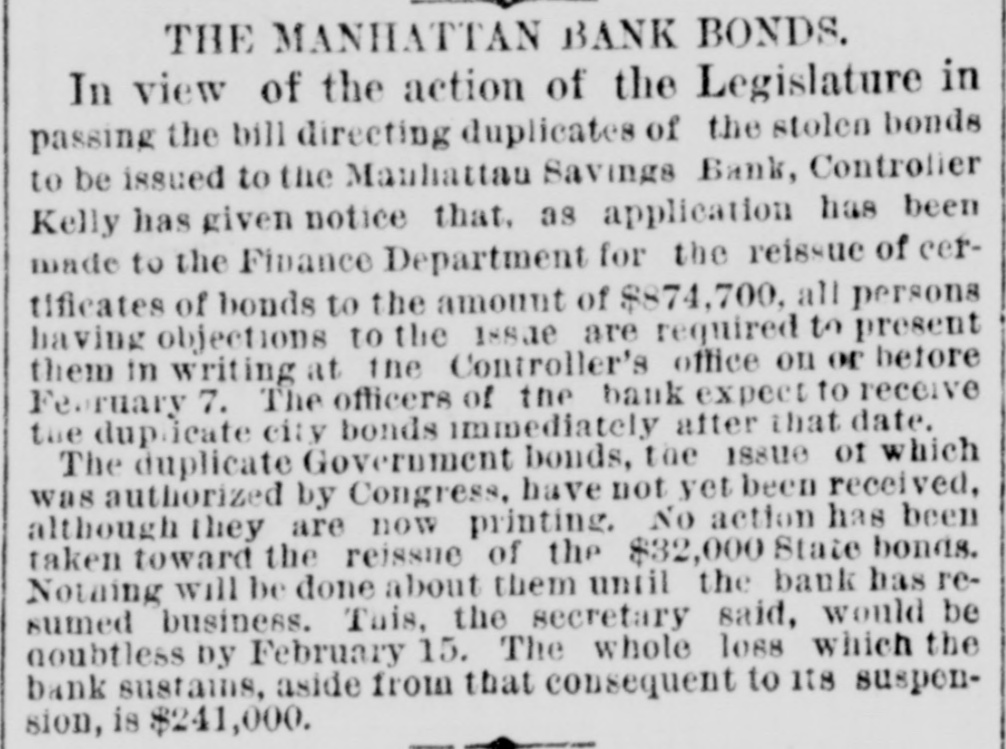
THE MANHATTAN BANK BONDS. In view of the action of the Legislature in passing the bill directing duplicates of the stolen bonds to be issued to the Manhattau Savings Bank, Controlier Kelly has given notice that. as application has been made to the Finance Department for the reissue of certificates of bonds to the amount of $874,700, all persons having objections to the Issue are required to present them in writing at the Controller's office on or before February 7. The officers of the bank expect to receive the duplicate city bonds immediately after that date. The duplicate Government bonds, the issue of which was authorized by Congress. have not yet been received, although they are now printing. No action has been taken toward the reissue of the $32,000 State bonds. Notaing will be done about them until the bank has resumed business. Tais, the secretary said, would be coubtless by February 15. The whole loss which the bank sustains, aside from that consequent to its suspension, is $241,000.


Article from The New York Herald, February 16, 1879

Click image to open full size in new tab

Article Text

MANHATTAN SAVINGS BANK. PRESIDENT SCHELL'S EFFORTS TO HAVE THE INJUNCTION REMOVED-PROBABLE RESUMPTION THIS WEEK. A report gained credence yesterday among the depositors of the Manhattan Savings Institution that payments would be made, and a considerable number of depositors called to ascertain the truth of the rumor. A HERALD reporter learned at the bank that President Richard Schell had gone to Albany and was endeavoring to secure the removal of the injunction, granted by the Legislature, ordering the bank to suspend business until duplicates of the stolen bonds were reissued. On Friday the city bonds were received at the bank from the Comptroller. They were for the following sums and of the following denomination:-Central Park fund, $22,700; New York revenue bond, $200,000; New York county accumulated seven per cent debt, due 1886 and 1887, $250,000; New York county Court House six per cent stock, $202,000, and New York improvement seven per cent stock. Nothing now remains as an obstacle to the resumption of the regular business of the bank but the removal of the injunction, and its officials are confident of being able to begin before the middle of next week. The bank has on hand over $3,000,000 in cash and available securities, HOPE FOR A SEASON BIDS THE WORLD FAREWELL. John Hope, son of Jimmy Hope, the burglar, who is charged with complicity in the robbery of the bank, was placed under $25,000 bail by Justice Flammer yesterday at the Jefferson Market Court. Warden Finn ordered his immediate transfer to the Tombs, and the prisoner was placed in the van, manacled with two other prisoners, and guarded by the warden and several keepers, and driven rapidly to the Tombs, where, in the evening, after being searched, he was assigned to cell No. 39, on the second tier, formerly occupied by John Scannell, when the latter was awaiting trial for killing Tom Donohoe. Special precautions will be taken to prevent any attempt to escape from the Tombs.


Article from Knoxville Daily Chronicle, February 20, 1879

Click image to open full size in new tab

Article Text

VARIETIES. Fifty Sioux Indian children are at the Hampton (Va.) Normal Institute. An Alabama farmer, who is now over eighty years of age, has plowed one of bis fields for sixiy-two consecutive years. One of these periodical revolutions which are indigenous to Mexic) and South America is going on now in Venezuela. A free trade coalition is being formed in the German Reichstag under the leadership of Herr Delbruck, the former Minister of State. The Sprinfield Union says that a lady of that city has found a daughter who was stolen from her twenty-seven years age. Verily, truth is sometimes stranger than fiction. There is a plan on foot to nominate Sam. Tilden in 1880 as a vindication of his character, and then have him resign in favor of Bayard. Yes, do that. He will resign, there's no doubt of that in the world. The Soldiers' Orphan Home it Columbus, Ohio, was destroyed by fire on the morning of the 17.h. The loss is estimated at $75,000; no lives were lost and no serlous accidents occurred, which argues well for the system of the authorities. The Bureau of Engraving and Printing had to be run on last Sunday to supply the demands for the new four per cent. bonds. Such a thing has only happened once before in the history of the Government, and that was during the "late unpleasantness." The Manhattan Savings Bank, which was compelled to suspend payment on account of an immense amount of bonds being stolen from them. are about ready to open again. The Government and New York City have issued new ones to replace them. As an instance of the change of public opinion in regard to suitable literature for young ladies, which has taken place in the last fifty years, we clip the following from the "blue laws" of Mt. Holyoke Seminary: "No young lady shall devote more than one hour a day to miscellaneous reading. The Atlantic Monthly, Shakespeare, Scott's Works, Robinson Crusoe, and other immoral works are strictly prohibited. The Boston Record. Mis sionary Herald, Doddridge's Rise and Progress, and Washington's Farewell Address, are earnestly recommended for light reading."


Article from New-York Tribune, March 13, 1879

Click image to open full size in new tab

Article Text

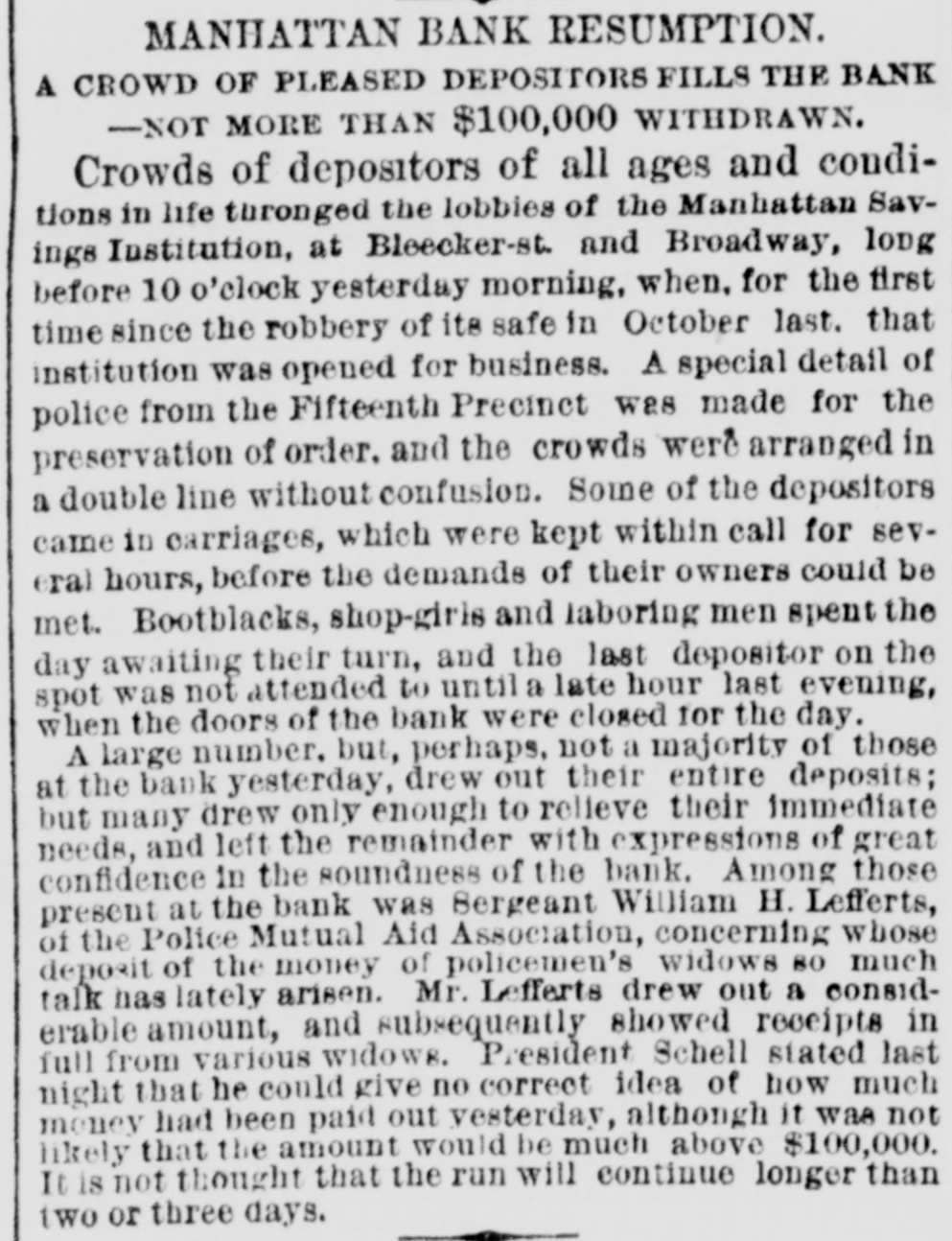
MANHATTAN BANK RESUMPTION. A CROWD OF PLEASED DEPOSITORS FILLS THE BANK -NOT MORE THAN $100,000 WITHDRAWN. Crowds of depositors of all ages and conditions in life turonged the lobbies of the Manhattan Savings Institution, at Bloocker-st. and Broadway, long before 10 o'clock yesterday morning, when. for the first time since the robbery of its safe in October last. that institution was opened for business. A special detail of police from the Fifteenth Precinct was made for the preservation of order. and the crowds were arranged in a double line without confusion. Some of the depositors came in carriages, which were kept within call for several hours, before the demands of their owners could be met. Bootblacks, shop-girls and laboring men spent the day awaiting their turn, and the last depositor on the spot was not attended to until a late hour last evening, when the doors of the bank were closed for the day. A large number. but, perhaps, not a majority of those at the bank yesterday, drew out their entire deposits; but many drew only enough to relieve their immediate needs, and left the remainder with expressions of great confidence in the soundness of the bank. Among those present at the bank was Bergeant William H. Lefferts, of the Police Mutual Aid Association, concerning whose deposit of the money of policemen's widows 80 much talk has lately arisen. Mr. Lefferts drew out a considerable amount, and subsequently showed receipts in full from various widows. President Schell stated last night that he could give no correct idea of how much money had been paid out yesterday, although it was not likely that the amount would be much above $100,000. It is not thought that the run will continue longer than two or three days.


Article from Daily Press and Dakotaian, March 14, 1879

Click image to open full size in new tab

Article Text

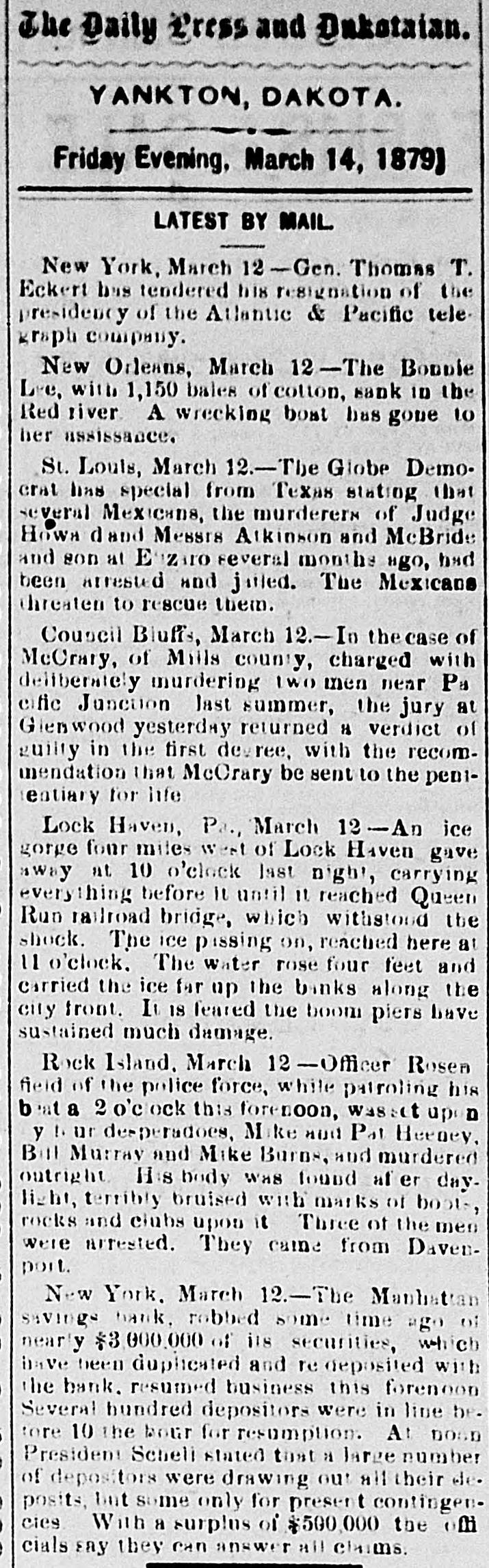
The Daily Tress and Dukotaian. YANKTON, DAKOTA. Friday Evening, March 14, 1879) LATEST BY MAIL. New York, March 12-Gen. Thomas T. Eckert bus tendered his resignation of the presidency of the Atlantic & Pacific telegraph company. New Orleans, March 12-The Bonnie Lee, with 1,150 bales of cotton, sank in the Red river. A wrecking boat has gone to her assissance. St. Louis, March 12.-The Globe Democrat has special from Texas stating that several Mexicans, the murderers of Judge Howa dand Messrs Atkinson and McBride and son at Enzaro several months "go, had been arrested and juled. The Mexicans threaten to rescue them. Couscil Bluffs, March 12.-In the case of McCrary, of Mills county, charged with deliberately murdering two men near Pa cific Junction last summer, the jury at Gienwood yesterday returned a verdict of guilty in the first degree, with the recommendation that McCrary be sentito the pententiary for life Lock Haven, Pa., March 12-An ice gorge four miles West of Lock Haven gave away at 10 o'clock last night, carrying everything before It until 11 reached Queen Run railroad bridge, which withstood the shock. The ice passing on, reached here at 11 o'clock. The water rose four feet and carried the ice for up the banks along the city front. It IS feared the boom piers have sustained much damage. Rock Island, March 12-Officer Rosen field of the police force, while patroling his beat a 2 o'clock this forenoon, wasset upo n y 1. or desperadoes, Mike and Pat Heeney, Bill Murray and Mike Burns, and murdered outright. His body was found at er daylight, terribly bruised with marks of boots, rocks and clubs upon it Three of the men were arrested. They came from Davenport. New York, March 12.-The Manhattan savings bank, robbed some time "go of nearly $3,000,000 of its securities, which have been duplicated and TO deposited with the bank. resumed business this forenoon Several hundred depositors were in line be. fore 10 the bour for resumption. At DOSD President Schell stated that a large number of depositors were drawing out all their de. posits, but some only for present contingencies With a surplus of $500,000 the offi cials say they can answer all claims.


Article from The New York Herald, March 18, 1879

Click image to open full size in new tab

Article Text

THE RUN ON THE Manhattan Savings Bank is about over, the depositors having drawn less than the burglars did.


Article from The Sun, March 19, 1879

Click image to open full size in new tab

Article Text

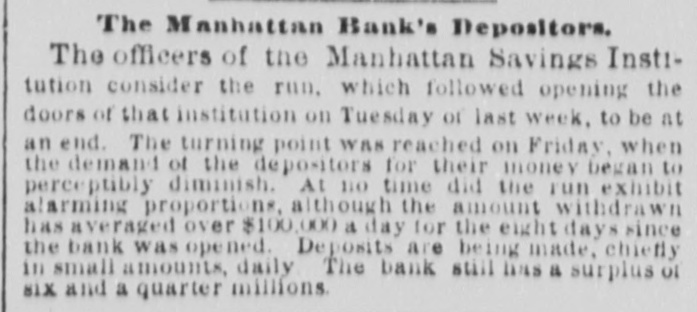
The Manhattan Bank's Depositors. The officers of the Manhattan Savings Institution consider the run. which followed opening the doors of that institution on Tuesday or last week, to be at an end. The turning point was reached on Friday, when the demand of the depositors for their money began to perceptibly diminish. At no time did the run exhibit alarming proportions, although the amount withdrawn has averaged over $100,000 a day for the eight days since the bank was opened. Deposits are being made, chiefly in small amounts, daily The bank still has a surplus of SIX and a quarter millions.


Article from The Morning News, October 21, 1893

Click image to open full size in new tab

Article Text

plicates make them difficult to obtain. The law provides that "Whenever it appears to the Secretary of the Treasury by clear and unequivocal proof that any interest-bearing bond of the United States has, without bad faith on the part of the owner, been destroyed in whole or in part, or so defaced as to impair its value to the owner, and such bond is identified by number and description, the Secretary of the Treasury shall, under such requirements and with such restrictions as to time and retention for security or otherwise as he may prescribe, issue a duplicate thereof, having the same time to run, bearing like interest as the bond SO proved to have been destroyed or defaced," etc. The owner of the destroyed or defaced bond is to surrender the remains of the bond and file a penal bond with the treasurer in double the amount of the destroyed or defaced bond and the interest on it with two good securities. For a registered bond to be issued in duplicate, the owner of the original has only to file a bond in the amount of the original and interest. These penal bonds are perpetual, as are all bonds made to the United States. Every officer of the treasury who is under bond to-day can be held under that bond fifty years hence if any shortage can be traced to his administration. His securities are never released. It is not easy to get together bondsmen for $500,000, and it has happened not infrequently that the owners of bonds that have been destroyed have gone to congress for relief. When a duplicate bond is issued it is always registered. The largest amount ever issued by the government in duplicate bonds was $1,600,000. These were issued under special act of congress of Dec. 19, 1878, to the Manhattan Savings Institution of New York. They were registered bonds which were stolen from the bank in the robbery made famous by Inspector Byrnes' book, "The Great Bank Robbery 19 The robbers of the Manhattan got eight bonds of $50,000 each, and 120 bonds of $10,000 each. All of these bonds were on the books of the register of the treasury as the property of the Manhattan Savings Institution. That institution went into the hands of a receiver as a result of "the great bank robbery," and as it was next to impossible to give a bond for $1,000,000, and absolutely impossible to prove that the missing bonds had been destroyed, the bank had to come to congress. Congress directed the Secretary of the Treasury to issue duplicates of the bonds "upon evidence clear and satisfactory to him being furnished that they have not been assigned, but are still the property of said institution." and on the further condition that a number of them be held in trust by the Secretary of the Treasury until such time as would secure the United States from loss. ISSUING NEW GOVERNMENT BONDS. The business of issuing a new set of bonds is a matter of some moment to the officials of the treasury department, because it involves a great deal of labor in the bureau of engraving and printing, in the register's office and in the treasurer's office. It takes some time for the bureau of engraving and printing to get out an issue of bonds. The engraving is a slow process. Then the paper must be prepared. The issue of the renewal bonds of 1891 was printed on paper ten years old which was lying in the vaults of the bureau. It had to be taken out and wet down, and it was not ready for use for ten days. Bonds go through the presses three times. First the tint is printed on the face of them. Then the form on the front is printed in black, and then the form on the back is printed also in black. These bonds were printed from plates which were made in 1876. The bond issue of 1891 was a reissue of the bonds of 1876; so the bonds were printed alike. It is astonishing how little wear there is on the tempered steel plates from which bonds are printed. But this is not more remarkable than the process of freshening the plate which has been worn a little. If a bond platelooks at all dull under the microscope, it is put into the transfer press and thecylinders with which the design wes cutinto it are rolled over it again. Any one who has seen the fine hair lines in the engraving on a bank note or a greenback will appreciate the marvelous accuracy of a machine which can be adjusted SO that the original cylinder, passing over the engraved plate seven or eight years after the original engraving, will cut again into the same lines and simply deepen the impression. The variation of the thousandth part of an inch in the adjustment of the cylinder would blur the plate and ruin it. The cost of transferring from the cylinders alone is about $50 a plate, and that feature of the preparation of a bond issue would cost the government fully $3,000. The cost of engraving and printing would bring the expense of issuing a new series of bonds up to about $15,000. The registered bond is about fourteen inches long by six inches wide. The old coupon bond was eighteen by twenty-four inches


Article from El Paso Herald, October 12, 1918

Click image to open full size in new tab

Article Text

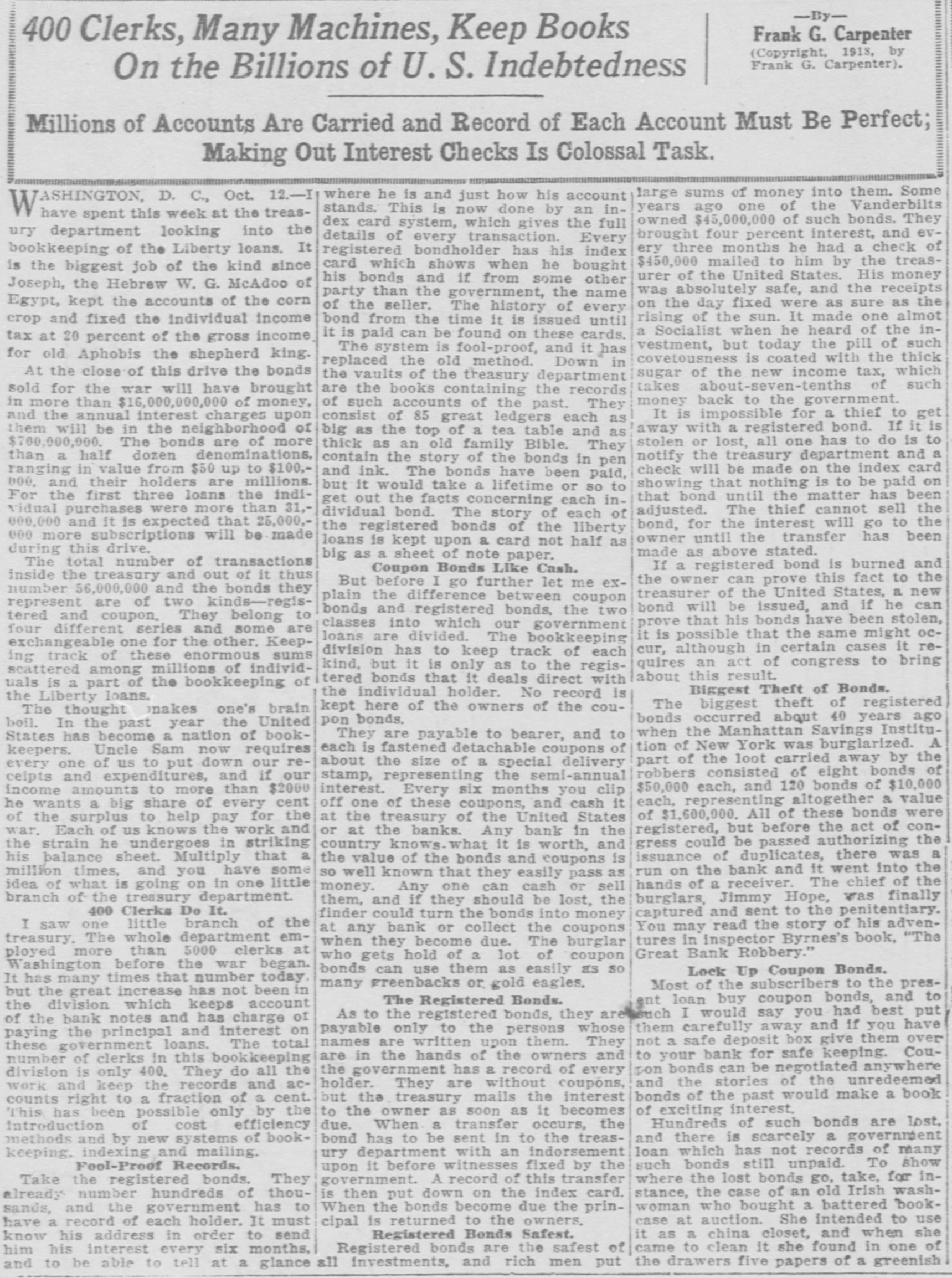
-ByFrank G. Carpenter 400 Clerks, Many Machines, Keep Books (Copyright, 1918, by Frank G. Carpenter). On the Billions of U. S. Indebtedness Millions of Accounts Are Carried and Record of Each Account Must Be Perfect; Making Out Interest Checks Is Colossal Task. large sums of money into them. Some where he is and just how his account ASHINGTON, D. C., Oct. 12.-I years ago one of the Vanderbilts stands. This is now done by an inW have spent this week at the treasowned $45,000,000 of such bonds. They dex card system, which gives the full ury department looking into the brought four percent interest, and evdetails of every transaction. Every ery three months he had a check of bookkeeping of the Liberty loans. It registered bondholder has his index $450,000 mailed to him by the treascard which shows when he bought is the biggest job of the kind since urer of the United States. His money his bonds and if from some other Joseph, the Hebrew W. G. McAdoo of was absolutely safe, and the receipts party than the government, the name Egypt, kept the accounts of the corn on the day fixed were as sure as the of the seller. The history of every rising of the sun. It made one almot crop and fixed the individual income bond from the time it is issued until a Socialist when he heard of the init is paid can be found on these cards. tax at 20 percent of the gross income vestment, but today the pill of such The system is fool-proof, and it has for old Aphobis the shepherd king. covetousness is coated with the thick replaced the old method. Down in At the close of this drive the bonds sugar of the new income tax, which the vaults of the treasury department takes about-seven-tenths of such sold for the war will have brought are the books containing the records money back to the government. in more than $16,000,000,000 of money, of such accounts of the past. They It is impossible for a thief to get and the annual interest charges upon consist of 85 great ledgers each as away with a registered bond. If it is them will be in the neighborhood of big as the top of a tea table and as stolen or lost, all one has to do is to $700,000,000. The bonds are of more thick as an old family Bible. They than a half dozen denominations, notify the treasury department and a contain the story of the bonds in pen check will be made on the index card ranging in value from $50 up to $100,and ink. The bonds have been paid, 000, and their holders are millions. showing that nothing is to be paid on but it would take a lifetime or 80 to For the first three loans the indithat bond until the matter has been get out the facts concerning each invidual purchases were more than 31,adjusted. The thief cannot sell the dividual bond. The story of each of 000,000 and it is expected that 25,000,bond, for the interest will go to the the registered bonds of the liberty 000 more subscriptions will be made owner until the transfer has been loans is kept upon a card not half as during this drive. made as above stated. big as a sheet of note paper. The total number of transactions If a registered bond is burned and Coupon Bonds Like Cash. inside the treasury and out of it thus the owner can prove this fact to the But before I go further let me exnumber 56,000,000 and the bonds they treasurer of the United States, a new plain the difference between coupon represent are of two kinds-regisbond will be issued, and if he can bonds and registered bonds, the two tered and coupon. They belong to prove that his bonds have been stolen, classes into which our government four different series and some are it is possible that the same might ocloans are divided. The bookkeeping exchangeable one for the other. Keepcur, although in certain cases it redivision has to keep track of each ing track of these enormous sums quires an act of congress to bring kind, but it is only as to the regisscattered among millions of individabout this result. tered bonds that it deals direct with uals is a part of the bookkeeping of Biggest Theft of Bonds. the individual holder. No record is the Liberty loans. The biggest theft of registered kept here of the owners of the couThe thought nakes one's brain bonds occurred abqut 40 years ago pon bonds. boil. In the past year the United when the Manhattan Savings InstituThey are payable to bearer, and to States has become a nation of booktion of New York was burglarized. A each is fastened detachable coupons of keepers. Uncle Sam now requires part of the loot carried away by the about the size of a special delivery every one of us to put down our rerobbers consisted of eight bonds of stamp, representing the semi-annual ceipts and expenditures, and if our $50,000 each, and 120 bonds of $10,000 income amounts to more than $2000 interest. Every six months you clip each, representing altogether a value off one of these coupons, and cash it he wants a big share of every cent of $1,600,000. All of these bonds were of the surplus to help pay for the at the treasury of the United States registered, but before the act of conwar. Each of us knows the work and or at the banks. Any bank in the gress could be passed authorizing the the strain he undergoes in striking country knows.what it is worth, and issuance of duplicates, there was a his balance sheet. Multiply that a the value of the bonds and coupons is run on the bank and it went into the million times, and you have some SO well known that they easily pass as hands of a receiver. The chief of the idea of what is going on in one little money. Any one can cash or sell branch of the treasury department. burglars, Jimmy Hope, was finally them, and if they should be lost, the 400 Clerks Do It. captured and sent to the penitentiary. finder could turn the bonds into money I saw one little branch of the You may read the story of his advenat any bank or collect the coupons treasury. The whole department emtures in inspector Byrnes's book, "The when they become due. The burglar ployed more than 5000 clerks at Great Bank Robbery." who gets hold of a lot of coupon Washington before the war began. bonds can use them as easily as SO Lock Up Coupon Bonds. It has many times that number today, many greenbacks or. gold eagles. Most of the subscribers to the presbut the great increase has not been in ent loan buy coupon bonds, and to The Registered Bonds. the division which keeps account such I would say you had best put As to the registered bonds, they of the bank notes and has charge of them carefully away and if you have payable only to the persons whose paying the principal and interest on not a safe deposit box give them over names are written upon them. They these government loans. The total are in the hands of the owners and to your bank for safe keeping. Counumber of clerks in this bookkeeping pon bonds can be negotiated anywhere the government has a record of every division is only 400. They do all the and the stories of the unredeemed holder. They are without coupons, work and keep the records and acbonds of the past would make a book but the treasury mails the interest counts right to a fraction of a cent. of exciting interest. to the owner as soon as it becomes This has been possible only by the Hundreds of such bonds are lost, introduction of cost efficiency due. When a transfer occurs, the and there is scarcely a government bond has to be sent in to the treasmethods and by new systems of bookloan which has not records of many ury department with an indorsement keeping, indexing and mailing. such bonds still unpaid. To show Fool-Proof Records. upon it before witnesses fixed by the where the lost bonds go, take, for inTake the registered bonds. They government. A record of this transfer stance, the case of an old Irish washis then put down on the index card. already number hundreds of thouwoman who bought a battered bookWhen the bonds become due the prinsands, and the government has to case at auction. She intended to use have a record of each holder. It must cipal is returned to the owners. it as a china closet, and when she Registered Bonds Safest. know his address in order to send came to clean it she found in one of Registered bonds are the safest of him his interest every six months, of a five drawers and the rich men all greenish a investments, put papers able tell be at and to to glance

Article from The Birmingham Age-Herald, October 13, 1918

Click image to open full size in new tab

Article Text

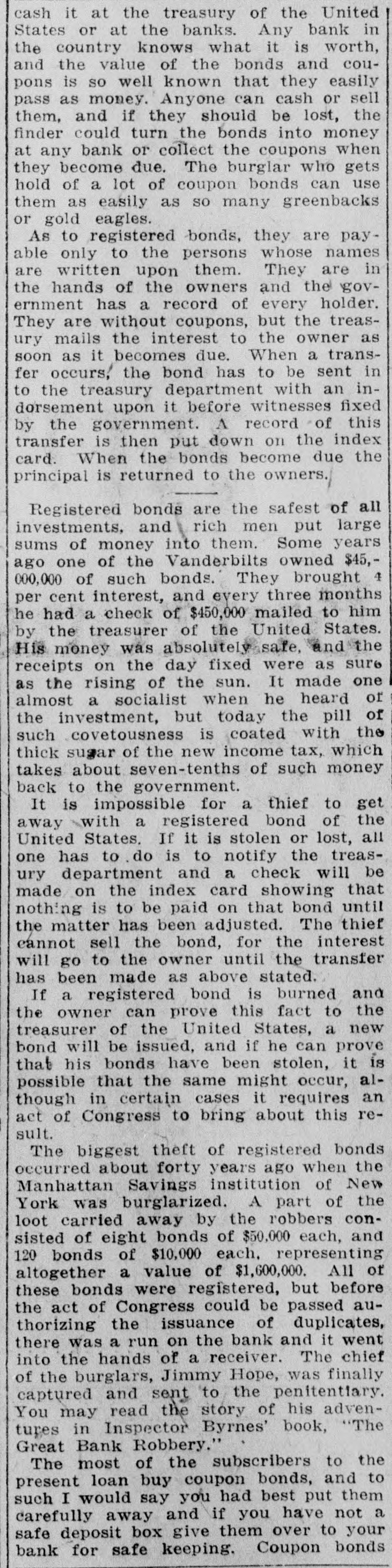
cash it at the treasury of the United States or at the banks. Any bank in the country knows what it is worth, and the value of the bonds and coupons is so well known that they easily pass as money. Anyone can cash or sell them, and if they should be lost, the finder could turn the bonds into money at any bank or collect the coupons when they become due. The burglar who gets hold of a lot of coupon bonds can use them as easily as SO many greenbacks or gold eagles. As to registered bonds, they are payable only to the persons whose names are written upon them. They are in the hands of the owners and the government has a record of every holder. They are without coupons, but the treasury mails the interest to the owner as soon as it becomes due. When a transfer occurs, the bond has to be sent in to the treasury department with an indorsement upon it before witnesses fixed by the government. A record of this transfer is then put down on the index card. When the bonds become due the principal is returned to the owners. Registered bonds are the safest of all investments, and rich men put large sums of money into them. Some years ago one of the Vanderbilts owned $45,000,000 of such bonds. They brought 4 per cent interest, and every three months he had a check of $450,000 mailed to him by the treasurer of the United States. His money was absolutely safe, and the receipts on the day fixed were as sure as the rising of the sun. It made one almost a socialist when he heard of the investment, but today the pill of such covetousness is coated with the thick sugar of the new income tax, which takes about seven-tenths of such money back to the government. It is impossible for a thief to get away \with a registered bond of the United States. If it is stolen or lost, all one has to do is to notify the treasury department and a check will be made on the index card showing that nothing is to be paid on that bond until the matter has been adjusted. The thief cannot sell the bond, for the interest will go to the owner until the transfer has been made as above stated. If a registered bond is burned and the owner can prove this fact to the treasurer of the United States, a new bond will be issued, and if he can prove that his bonds have been stolen, it is possible that the same might occur, although in certain cases it requires an act of Congress to bring about this result. The biggest theft of registered bonds occurred about forty years ago when the Manhattan Savings institution of New York was burglarized. A part of the loot carried away by the robbers consisted of eight bonds of $50,000 each, and 120 bonds of $10,000 each, representing altogether a value of $1,600,000. All of these bonds were registered, but before the act of Congress could be passed authorizing the issuance of duplicates, there was a run on the bank and it went into the hands of a receiver. The chief of the burglars, Jimmy Hope, was finally captured and sent to the penitentiary. You may read the story of his adventures in Inspector Byrnes' book, "The Great Bank Robbery." The most of the subscribers to the present loan buy coupon bonds, and to such I would say you had best put them carefully away and if you have not a safe deposit box give them over to your bank for safe keeping. Coupon bonds