gpt-5-mini (chosen from majority vote of a three-model LLM ensemble)
Short Digest
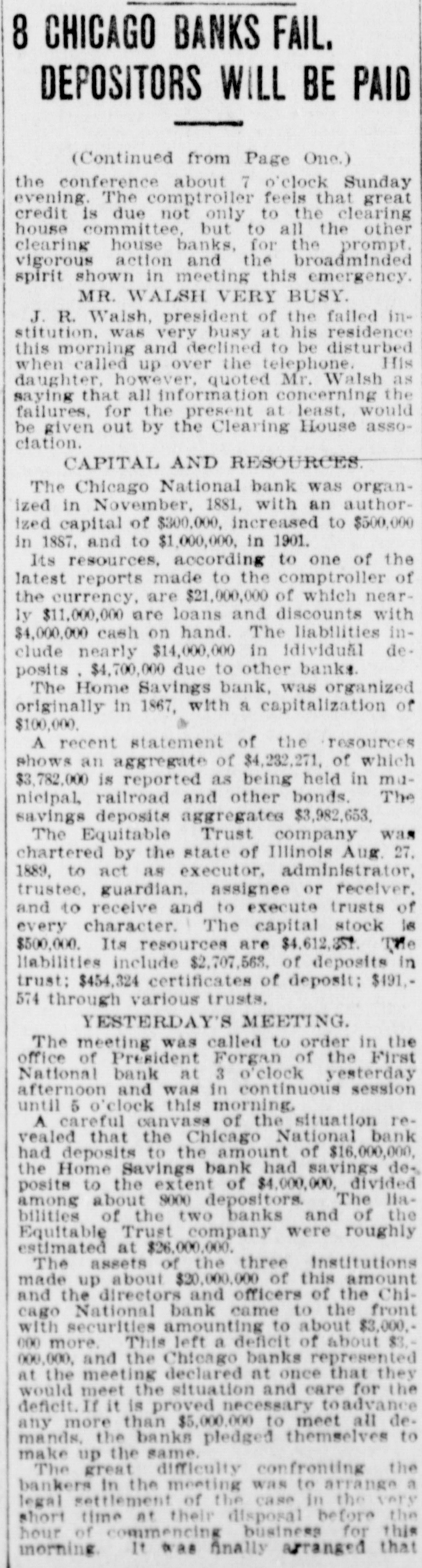
20dbd19ef17c5017
Response Measures
None
Description
Clearing-house banks paid depositors; institution was placed in liquidation following Walsh's bad railroad/coal loans.
Events (3)
1.December 18, 1905Suspension
Cause
Bank Specific Adverse Info
Cause Details
Suspension due to heavy, illiquid loans and investments in John R. Walsh's railroad and coal enterprises.
Newspaper Excerpt
The Chicago National, the Home Savings and the Equitable Trust Co., three institutions ... suspended operations on the 18th.
Source
newspapers
2.December 19, 1905Run
Cause
Bank Specific Adverse Info
Cause Details
Withdrawals and runs were driven by the insolvency/liquidation of the Walsh-controlled banks and disclosure of their bad railroad/coal loans.
Measures
Chicago clearing-house banks pledged support, took over holdings and arranged for depositors to be paid in full.
Newspaper Excerpt
Runs continue on the Chicago National and Home Savings banks, but there is no excitement.
Source
newspapers
3.April 18, 1911Receivership
Newspaper Excerpt
Illinois appellate court today upheld the appointment of a receiver for the Chicago National Bank and Home Savings Bank.
Source
newspapers
Newspaper Articles (25)
1.December 18, 1905The Daily TribuneFlorence, CO
Click image to open full size in new tab
Article Text
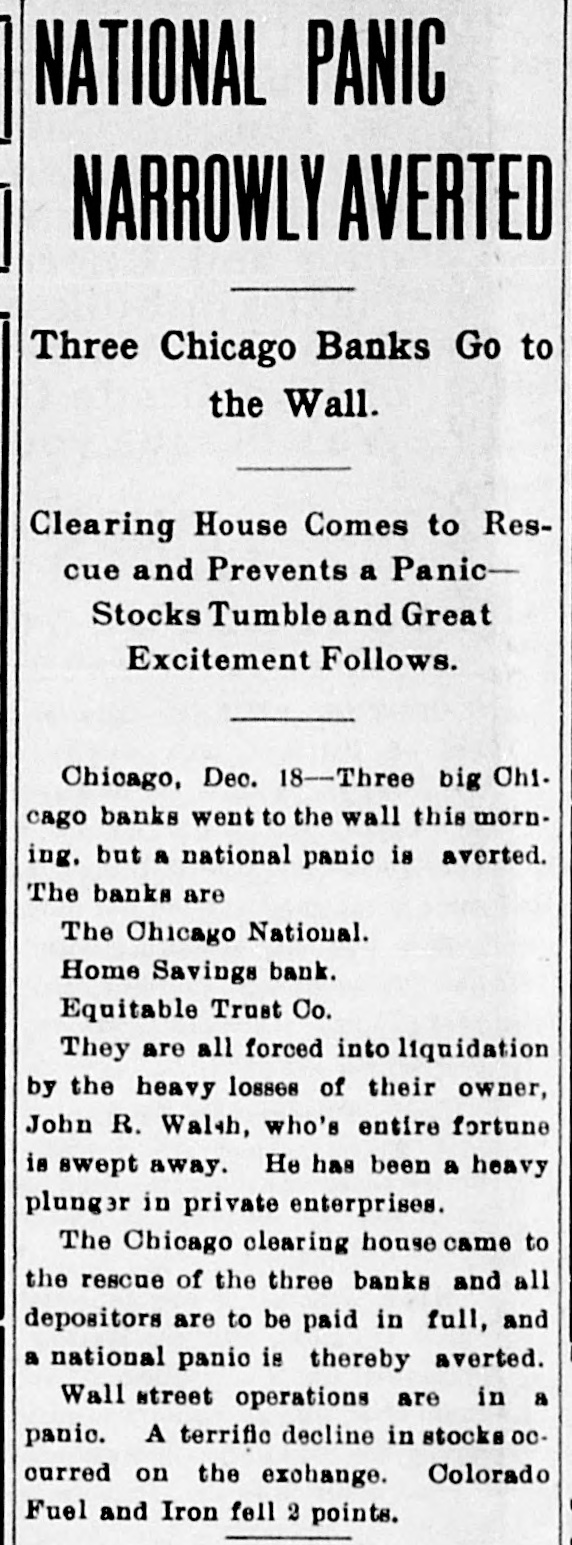
NATIONAL PANIC NARROWLY AVERTED Three Chicago Banks Go to the Wall. Clearing House Comes to Rescue and Prevents a PanicStocks Tumble and Great Excitement Follows. Chicago, Dec. 18--Three big Chicago banks went to the wall this morning. but a national panic is averted. The banks are The Chicago National. Home Savings bank. Equitable Trust Co. They are all forced into liquidation by the heavy losses of their owner, John R. Walsh, who's entire fortune is swept away. He has been a heavy plunger in private enterprises. The Chicago clearing house came to the rescue of the three banks and all depositors are to be paid in full, and a national panic is thereby averted. Wall street operations are in a panic. A terrific decline in stocks 00curred on the exchange. Colorado Fuel and Iron fell 2 points.
2.December 19, 1905The Morning AstorianAstoria, OR
Click image to open full size in new tab
Article Text
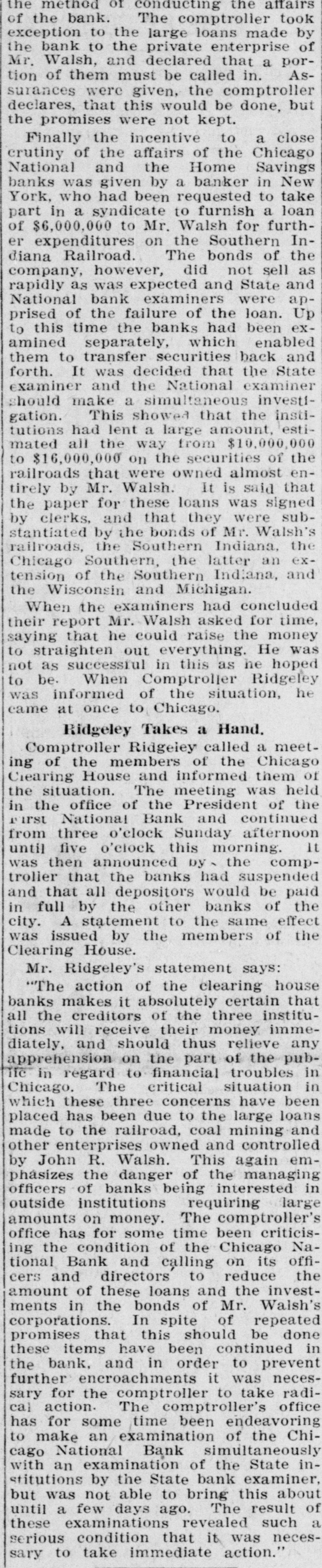
James B. Forgan, president of the First National bank, as head of the clearing house committee of the Chicago Associated banks, gave forth the statement. The assets of these institutions, it was asserted, were involved in coal and railway properties of John R. Walsh, the president of the Chicago National bank. John R. Walsh, head of the institutions which have been declared insolvent, was not at the meeting. The following were the members of the committee at the meeting. James B. Forgan, chairman; John J. Mitchell, James H. Eckles, Orson B. Smith, Ernest A. Hamill. The statement was issued at the offices of the First National bank. It is as follows: "The Chicago National bank, the Home Savings bank, and Equitable Trust Company, which have been controlled and managed by John R. Walsh and his associates have concluded to wind up their affairs and quit business in this city. After a thorough and careful examination of their affairs by the Chicago clearing house banks, it is stated that all of the depositors of these institutions will be paid in full upon demand, the Chicago Clearing House banks having pledged themselves to this result, thus putting all the resources of the Chicago banks behinb the depositers of these three institutions. The difficulty with the institutions has been that investments have been made in assets connected with the railway and coal enterprises of John R. Walsh. "These assets were not immediately available to meet deposits and have been taken over on terms which will enable the three institutions to pay their dem positors in full. Mr. Ridgly, comptroller of the currency, and Charles Eubank, of the auditor's department at Springfield, were seem and expressed themselves as greatly pleased with the action of the Chicago banks, and stated that it rekected great credit upon the associated banks of Chicago which have again indicated their ability to meet and emergency in a manner entirely satisfactory to the public." The meeting of the Chicago clearing house association began at noon Sunday. Notices were sent to the members of the board by Mr. Forgan after it 00 had been learned of the condition of the banks and the trust company. t Clerks were notified and fifty or more with ten stenographers hurried to the First-National Bank. Behind closed doors the Clearing House Association be gan its work of finding a way that might enable them to ride the financial sea in safety. That a panic would be likely to follow was the first thought of the committee. Resolutions were adopted and heads of other banks. pledged themselves to give assistance. The amount involved in the failure would not be stated by 8 the committee members. it All informatin concerning the meetW ing of the committee was kept secret W until three o'clock this morning and half
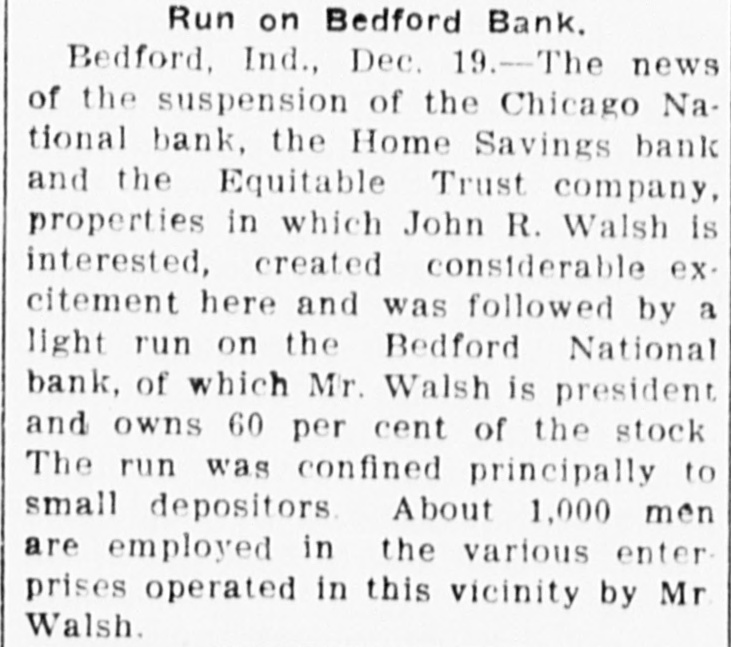
Condition in Chicago. Chicago, Dec. 19.-Practically normal conditions were restored in local banking circles to-day, and there was not the slightest surface indication or the disturbance caused yesterday by the suspension of the Walsh banks. The runs continue on the Chicago National and Home Savings banks, but there is no excitement. United States District Attorney Morrison and State Attorney Healy both stated this morning that nothing in connection with the position of the bank nad been called to their attention.
4.December 19, 1905Rock Island ArgusRock Island, IL
Click image to open full size in new tab
Article Text
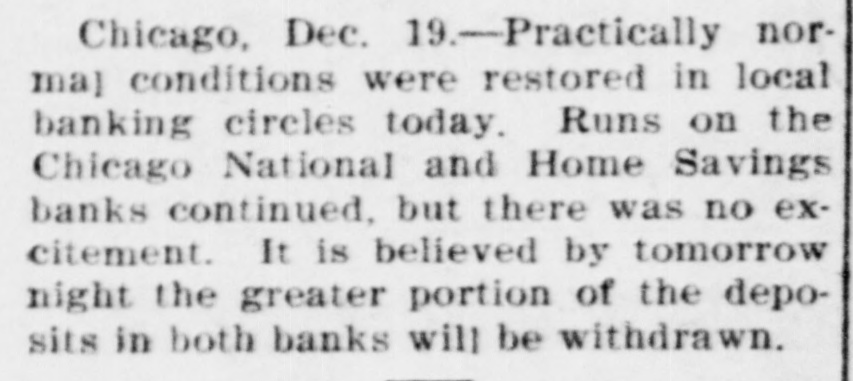
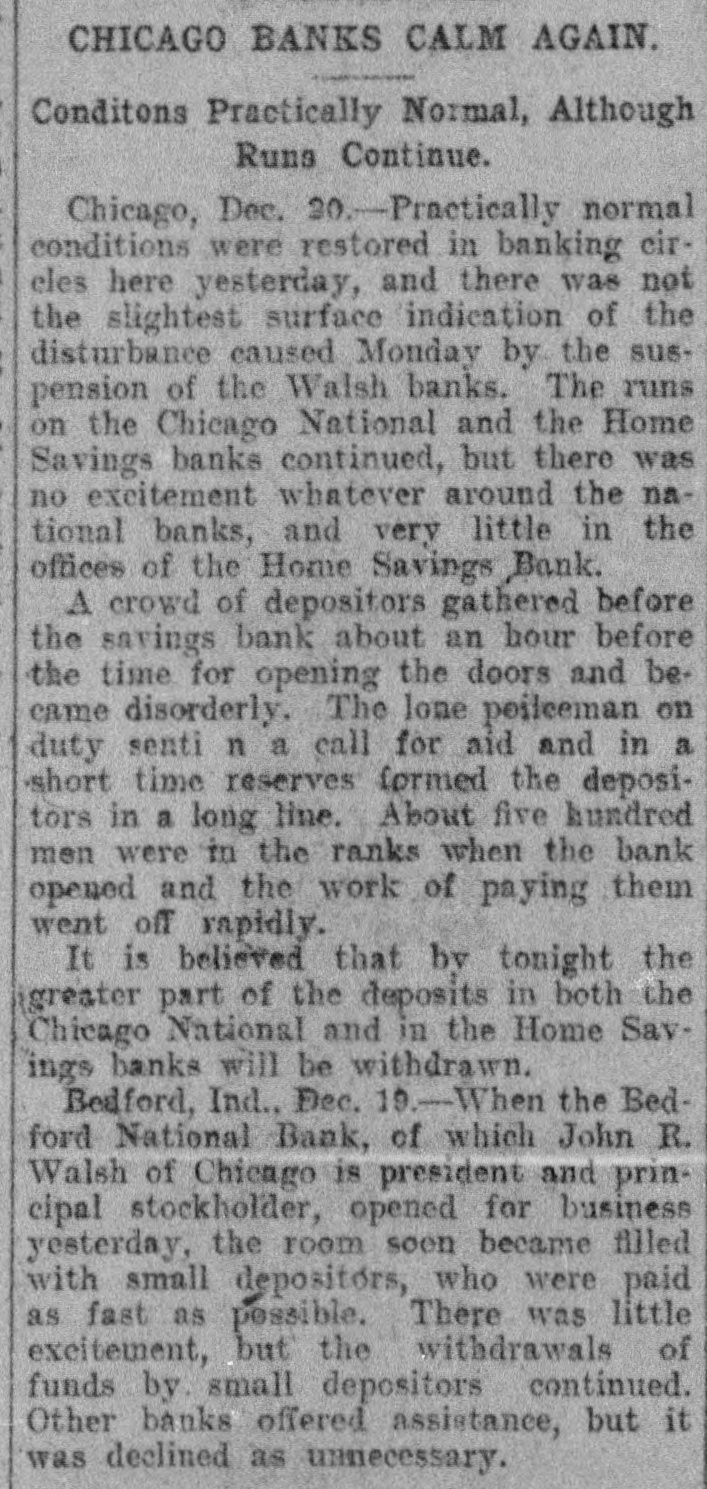
Chicago, Dec. 19.-Practically norma) conditions were restored in local banking circles today. Runs on the Chicago National and Home Savings banks continued, but there was no excitement. It is believed by tomorrow night the greater portion of the deposits in both banks will be withdrawn.
5.December 19, 1905The Hawaiian StarHonolulu, HI
Click image to open full size in new tab
Article Text
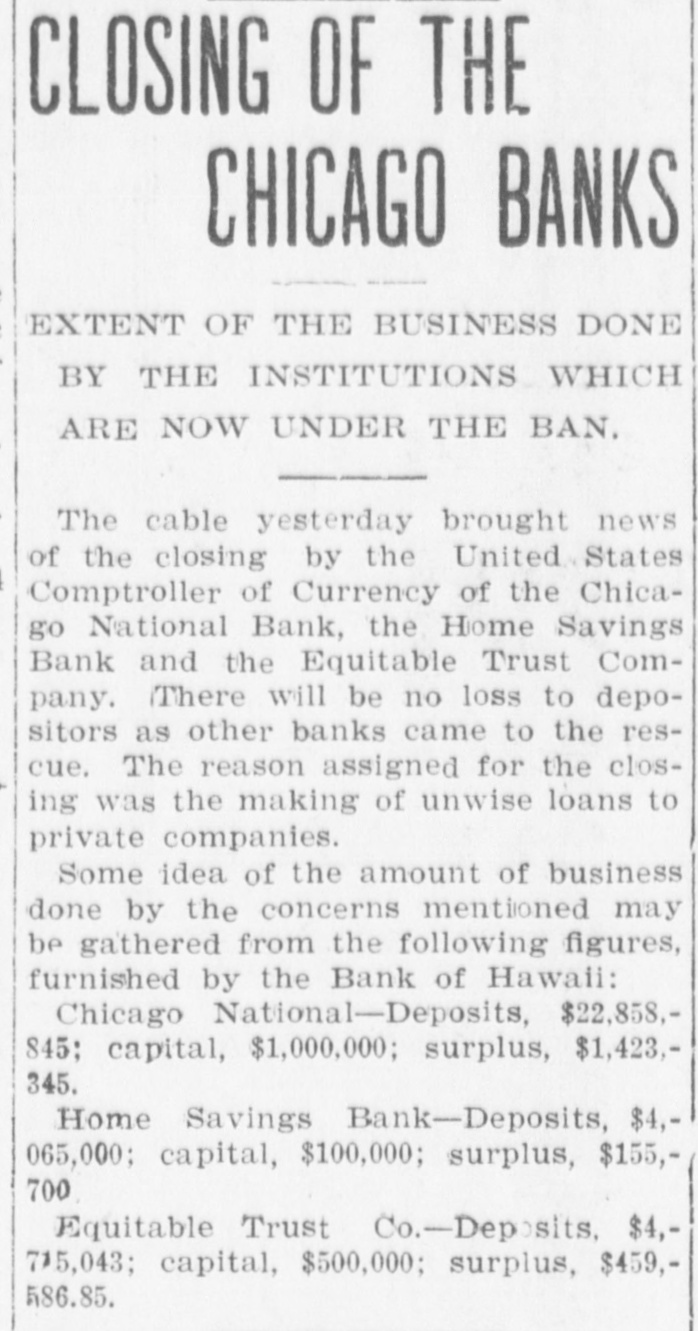
CLOSING OF THE CHICAGO BANKS EXTENT OF THE BUSINESS DONE BY THE INSTITUTIONS WHICH ARE NOW UNDER THE BAN. The cable yesterday brought news of the closing by the United States Comptroller of Currency of the Chicago National Bank, the Home Savings Bank and the Equitable Trust Company. There will be no loss to depositors as other banks came to the rescue. The reason assigned for the closing was the making of unwise loans to private companies. Some idea of the amount of business done by the concerns mentioned may be gathered from the following figures, furnished by the Bank of Hawaii: Chicago National-Deposits, $22,858.845; capital, $1,000,000; surplus, $1,423,345. Home Savings Bank-Deposits, $4,065,000; capital, $100,000; surplus, $155,700 Equitable Trust Co.-Deposits, $4,715,043; capital, $500,000; surplus, $459,586.85.
All Quiet in Chicago. Chicago, Dec. 19.-Practically normal conditions were restored in local banking circles today and there was not the slightest ripple on the surface to indicate that trouble was caused yesterday by the suspension of the Walsh banks. Runs continue on the Chicago National and Home Savings bank, but there is no excitement. United States District Attorney Morrison and State's Attorney Healy both stated this morning that nothing in connection with the operation of the bank had been called to their attention.
7.December 20, 1905Arizona RepublicanPhoenix, AZ
Click image to open full size in new tab
Article Text
HARDLY A RIPPLE. Of the Great Financial Disturbance at Chicago. Chicago, Dec. 19.-Practically normal conditions were restored in the local banking circles today. There was not the slightest surface indication of the disturbance caused yesterday by the suspension of the Walsh banks. The runs on the Chicago National and the Home Savings continue, but there is no excitement around the banks.
8.December 21, 1905Herald and NewsRandolph, VT
Click image to open full size in new tab
Article Text
Heavy Bank Failures. Monday, the failure was announced of three of the largest financial institutions in Chicago, the Chicago National bank, the Home Savings bank and the Equitable Trust company. The total liabilities are $26,000,000, with assets estimated at $16,000,000. The failures were due to the unprofitable nature of heavy railroad investments made by the principal owner of the banks, John R. Walsh. A panic was averted by the prompt action of the allied banks of Chicago, which came to the rescue and pledged that every dollar due depositors should be paid. Mr. Walsh expects that the assets will realize much more than the estimate, and that the banks will prove to have been solvent.
Chicago Banks Recovering. Chicago, Dec. 19.-Practically normal conditions were restored in local banking circles Tuesday and there was not the slightest surface Indication of the disturbance caused Monday by the suspension of the Walsh banks. The runs on the Chicago National and Home Savings banks continued but there was no excitement whatever around the National bank and but very little In the offices of the Home Savings bank.
10.December 22, 1905The Black Hills Union and Western Stock ReviewRapid City, SD
Click image to open full size in new tab
Article Text
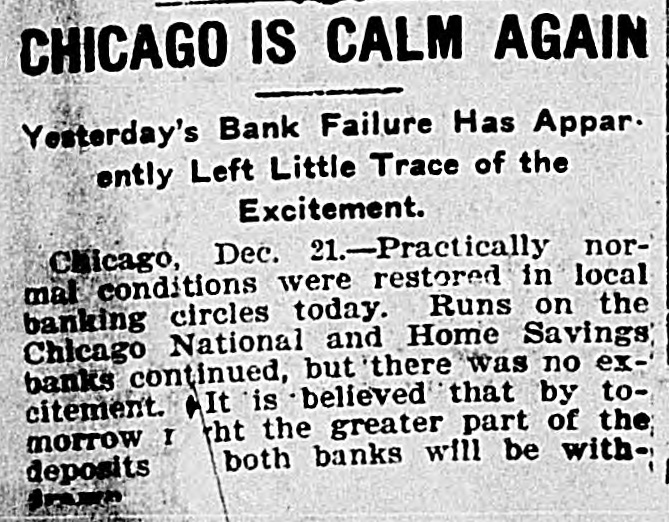
CHICAGO IS CALM AGAIN Yesterday's Bank Failure Has Apparently Left Little Trace of the Excitement. Chicago, Dec. 21.-Practically normal conditions were restored in local banking circles today. Runs on the Chicago National and Home Savings banks continued, but there was no ex-' citement. AIt is believed that by tomorrow I tht the greater part of the both banks will be withdeposits from:
11.December 22, 1905The CommonwealthGreenwood, MS
Click image to open full size in new tab
Article Text
The Chicago National, the Home Savings and the Equitable Trust Co., three banks controlled by Jno. R. Walsh, suspended operations on the 18th. Liabilities $26,000,000, assets $29,000,000. Loans to Walsh's other interests brought about the failure.
12.December 23, 1905St. Tammany FarmerCovington, LA
Click image to open full size in new tab
Article Text
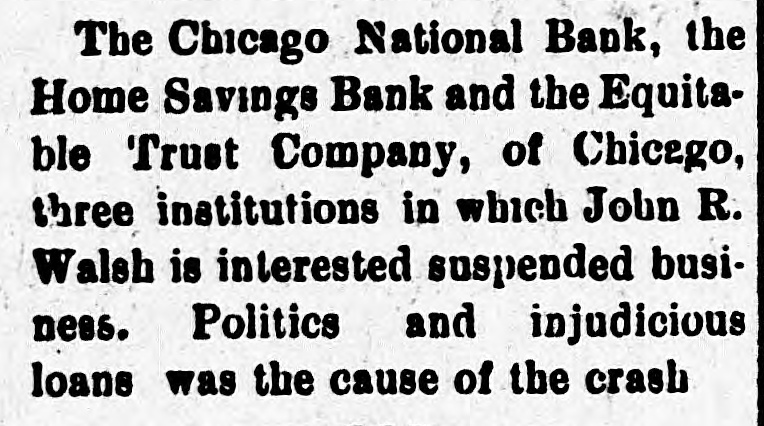
The Chicago National Bank, the Home Savings Bank and the Equitable Trust Company, of Chicago, three institutions in which John R. Walsh is interested suspended business. Politics and injudicious loans was the cause of the crash
13.December 27, 1905The Miller SunMiller, SD
Click image to open full size in new tab
Article Text
HREE BANKS QUIT. ICAGO INSTITUTIONS OF JOHN R. WALSH GO OUT. icago National, Equitable Trust Company and Home Savings Bank Close Business-Two Banks Alone Carry $22,500,000 of Deposits. Liquidation of the Chicago National nk, the Home Savings Bank, and , Equitable Trust Company, all of icago, was announced at 3:30 lock Monday morning by representves of the Chicago Clearing House sociation, after a session lasting thteen hours. James B. Forgan, esident of the First National Bank, head of the clearing house commit: of the Chicago Associated banks, ve forth the statement. The assets these institutions. it was asserted, re involved in coal* and railway perties of John R. Walsh, Presiit of the Chicago National Bank. el statement was issued in the office the First National Bank. It is as lows: "The citizens of Chicago will unibtedly be surprised to learn that : Chicago National Bank, the Home vings Bank, and the Equitable Company, which have been conlled, managed, and officered by in R. Walsh and his associates e concluded to wind up their afrs and quit business in the city of icago, but they will be gratified to rn that after a thorough and careexamination of their affairs by the icago Clearing House banks that of the depositors of these instituas will be pand in full upon dend, the Chicago clearing house ks having pledged themselves to s result, thus putting all the rerees of the Chicago banks behind depositors of these three instituis. The difficulty with the instituhs has been that their investments e been made in assets connected h the railway and coal enterprises John R. Walsh. These assets were immediately available to meet deits in full." The meeting of the Chicago Clearing use Association began at noon Sun. Notices were sent members of the rd by Mr. Forgan after the condition the banks and the trust company had n learned. Clerks were notified and y or more with their stenographers ried to the First National bank. Bed closed doors the Clearing House sociation began its work of finding a y that might enable them to ride the incial sea in safety. That a panic would be likely to fol- was the first thought of the comtee. Resolutions were adopted and ds of other banks pledged themselves give assistance. The amount involvin the failure would not be discussed the committee members. in addition to the formal statement the failure, the following announcent was made, signed by the clearing ise committee of the Chicago assocbanks: pa To the Public: Depositors of the Chio National bank, the Home Savings k. and the Equitable Trust Company
Three of the largest financial institutions in the West-the Chicago National bank. the Home Savings bank and the Equitable Truet company of Chicago-all under the control of J. R Walsh - suspended operations on Monday and went into liquadation. Their liabilities are $26,000,000, their nominal assets $16 000,000.
15.January 31, 1908Twice-A-Week Plain DealerCresco, IA
Click image to open full size in new tab
Article Text
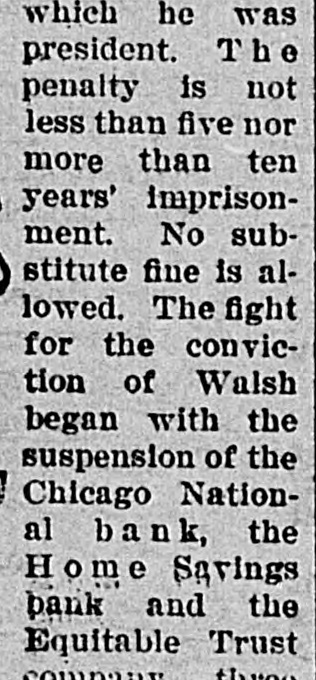
which he was president. The penalty is not less than five nor more than ten years' imprisonment. No substitute fine is allowed. The fight for the conviction of Walsh began with the suspension of the Chicago National bank, the Home Savings bank and the Equitable Trust comporr three
16.February 1, 1908Morris TribuneMorris, MN
Click image to open full size in new tab
Article Text
which he was president. The penalty is not less than five nor more than ten years' imprisonment. No substitute fine is allowed. The fight for the conviction of Walsh began with the suspension of the Chicago Nation al bank, the Home Savings bank and the Equitable Trust comnenr three
which he was president. The penalty is not less than five nor more than ten years' imprisonment. No substitute fine is allowed. The fight for the convietion of Walsh began with the suspension of the Chicago National bank. the Home Savings bank and the Equitable Trust company three
18.November 7, 1909The Washington HeraldWashington, DC
Click image to open full size in new tab
Article Text
names. When it comes to the matter of the law's dealing with them there begins to be a sharp divergence. Charles W. Morse already has tasted of the bitterness of imprisonment. John R. Walsh has not spent an hour in jail, although the crime of which he was convicted and is now under sentence of five years' imprisonment in the Federal penitentiary in Leavenworth, Kans., was committed four years ago, Morse, through the devotion of his wife, regained his liberty, only to be thrust back behind the bars. It was a long and hard task to procure the bond in the first place, It served only as a temporary expedient. Walsh goes to his office in Chicago every day when his seventy-two years will allow him to go, and that is most 01 the time. In spite of his three-score years and twelve. he still has a lot of the energy and fight that made him in former days one of the most conspicuous capitalists and financiers in the West. He has been privileged to be with his devoted family, whose loyalty, in a quieter way, is as beautiful as that of Mrs. Morse toward the Wall street banker He is as welcome as in the old days to the clubs. Those in whose debt he is to the extent of millions are about the last men in Chicago to say for publication anything against the man who weeked the Chicago National Bank and its allied institutions. Similarity of Crimes. Morse and Walsh both were charged with transgressing the banking laws. They used the money of others in a way that the statutes did not sanction, if the charges against them be true. There may have been differences of detail in the alleged wrongful things they did. but the principle involved was the same Compared with Walsh, the Wall street man is still in the prime of life. He might spend a term in prison and come out strong and ready to begin life over again. Recent reports that he added $7,000,000 to his fortune the short time he was out on bond, whether true or not, indicate that the blows that have fallen on him have not put him out of the running as a winner of wealth. For him there is hope after whatever penalty he may pay For Walsh a prison cell probably would mean, sooner or later, a death chamber Mr Walsh is used to hard work, to reckoning with vast detail. Prison life will be no laughing matter for such a man. He has for years been a lord of business over men, brooking no interference with his will He can't be that in Leavenworth. His age renders it unlikely that he will be able to do any physical work His friends feel that once he is restrained behind iron bars the warrant of his death will have been virtually signed. That is the reason they are making with him SO vigorous a fight to ward off the day of reckoning. In the case of this man the mills of the courts are grinding slowly In one month more it will be four years since the three banks, of which Walsh was the executive head, quit doing business and the associated banks of Chicago began to pay the depositors what Walsh owed them The man whose financiering wrecked the banks is still under a big obligation to the Institutions which came to the rescue of the hundreds of depositors. His debt to them is something like $7,000,000 It is the supreme effort of Mr. Walsh just now to raise money to satisfy these creditors, 80 that he will not have to sacrifice many millions of dollars of securities and property History of Walsh's Crime, It was on the morning of December 18. 1905, that the Chicago National Bank, the Home Savings Bank, and the Equitable Trust Company ceased to do business and closed their doors. That was on a Monday morning. Far into the night of Sunday-In fact, till almost the coming of dawn-representatives of the other banks in the Chicago clearing-house had been in conference trying to devise a way to save the banks from wreck and the city from a financial panic. Walsh and his advisers were in that conference. The man who had presided as the financial genius over the trio of banking institutions protested long and loudly that if he were given one more opportunity he would ward off collapse. Over the business of the banks went experts. They scrutinized this account and that. They observed with alarm the long list of menacing obligations, gasped with surprise when informed of the manner in which the funds of the bank-the money of the depositors-were being used to promote private enterprises. They reckoned up the securities for liabilities, figured closely on the conversion possibilities of collateral at hand. They were disposed to be eminently fair, but when they were through canvassing the situation its general aspect was SO forbidding that closing the doors of the institutions was decided on. How Panic Whs Averted. That was the beginning of the end The next morning, which was Monday, there were notices on the Walsh banks which told their tale briefly. The newspapers, which had been purposely let into the secret to help save Chicago from a panic, contained long stories of the fall of the Walsh banks. Every story was quick to say that the associated banks had agreed in conference to guarantee the payment of all deposits, dollar for dollar. All the depositors had to do was to find out what his balance was and write out a check for the amount to another bank chosen for the doing of his future business. He would be given credit for the amount Those who preferred might take their books to the failed banks after they reopened and get their money there. In saving the depositors from losing a cent in the Walsh banks the institutions coming to the rescue were saving themselves the burden of a "scare," which might have far-reaching consequences and precipitate other crashes. On the 5th of October, 1909. nearly four years after that memorable Monday morning, the Circuit Court of Appeals affirmed the sentence of five years running against Mr. Walsh, who had been duly convicted in the lower Federal court for violating the banking laws. Owes Banks $7,000,000. At the time the sentence was affirmed, as already stated. Mr. Walsh owed the banks which stood between his institutions and a local financial panic over $7,000,000. secured by the stock and bond issues of certain corporations in which Walsh was interested. The interest havdefaulted
19.April 19, 1911The SunNew York, NY
Click image to open full size in new tab
Article Text
MAY HOLD BILLINGS LIABLE. Court Decision in Walsh Bank Case Held to Point That Way. CHICAGO. April 18. -Judge Jesse A. Baldwin, sitting in the branch Appellate Court, handed down an opinion to-day in which he upheld the appointment of a receiver for the Chicago National Bank and Home Savings Bank, of which John R. Walsh was formerly president. The decision to-day grew out of suits begun against C. K. G. Billings and the directors of the banks to prevent the latter from accepting a settlement from Billings in lieu of his alleged liability. Billings was formerly a director of the banks. The decision of the branch Appellate Court was pointed out by Attorney Jacob Newman, representing several stockholders. to mean that Billings is liable for losses suffered by stockholders in the sum of $3,000,000 by reason of his negligence as a director.
20.April 19, 1911Omaha Daily BeeOmaha, NE
Click image to open full size in new tab
Article Text
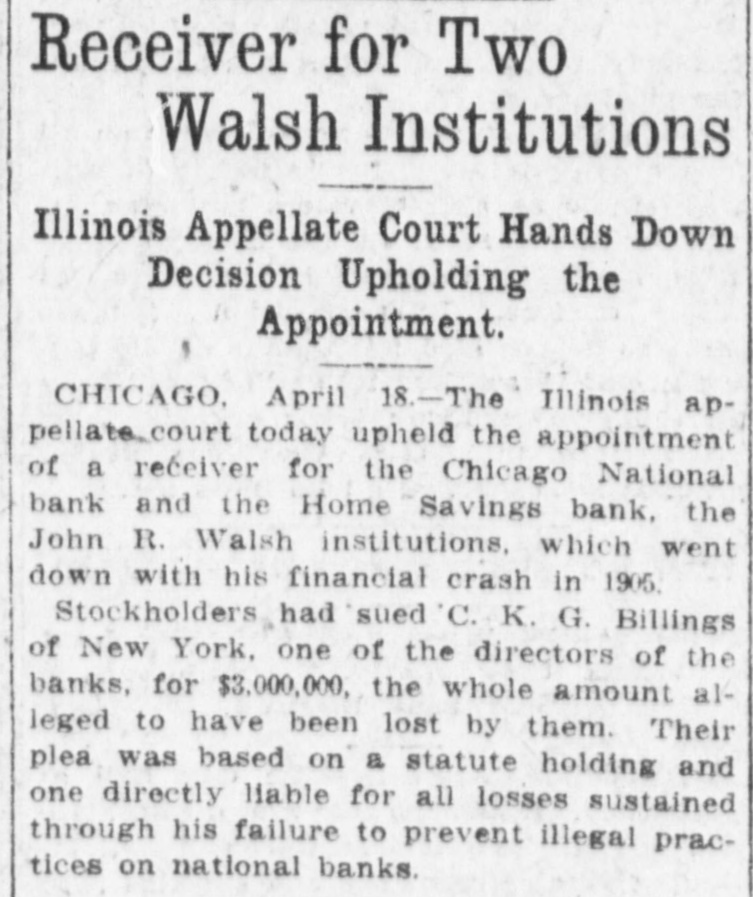
Receiver for Two Walsh Institutions Illinois Appellate Court Hands Down Decision Upholding the Appointment. CHICAGO. April 18.-The Illinois appellate court today upheld the appointment of a receiver for the Chicago National bank and the Home Savings bank, the John R. Walsh institutions, which went down with his financial crash in 1905. Stockholders had sued C. K. G. Billings of New York, one of the directors of the banks, for $3,000,000, the whole amount alleged to have been lost by them. Their plea was based on a statute holding and one directly liable for all losses sustained through his failure to prevent illegal practices on national banks.
21.May 25, 1911New-York TribuneNew York, NY
Click image to open full size in new tab
Article Text
MORSE AND WALSH STAY Continued from first page. denied, with leave to renew the same after January 1, 1913. In reaching these conclusions I follow the recommendation of the Attorney General. In denying the Walsh application the President said, in part: John R. Walsh was convicted of misapplication of the funds of the Chicago National Bank while its president. His pardon is asked, first, because his violations of laws were technical and did not involve moral turpitude and secured him no financial benefit; second. because all the depositors of his banks were paid through the sacrifice of his private fortune; third, because he was, in doing what he did, attempting to upbuild industries of substantial benefit to the country; fourth, because he is an old man. in ill health, not likely to live long, and one who has borne a good reputation and lived a life of simplicity and not of self-indulgence. The facts are that Walsh owned a large interest in three banks-the Chicago National Bank, the Equitable Trust Company and the Home Savings Bank-the latter two Illinois state corporations. He absolutely controlled them. although there was a substantial minority interest in all of them held by others. He used them to furnish the money for the development of several railroads, limestone quarries, coal mines and other enterprises. Using his control of these banks, he took their funds and invested them in enterprises of the character mentioned, either by direct purchase of the bonds, which he had caused to be issued, or by lending from the funds of the bank money on "dummy" notes secured by such bonds as collateral. He risked nearly the whole funds of the three banks in the security of these enterprises, and because of these investments the banks failed. The allied banks of Chicago, in order to prevent a panic, took over the Walsh banks' holdings and Walsh's properties and paid the depositors in full, but in the liquidation the allied banks will
22.May 25, 1911Daily Kennebec JournalAugusta, ME
Click image to open full size in new tab
Article Text
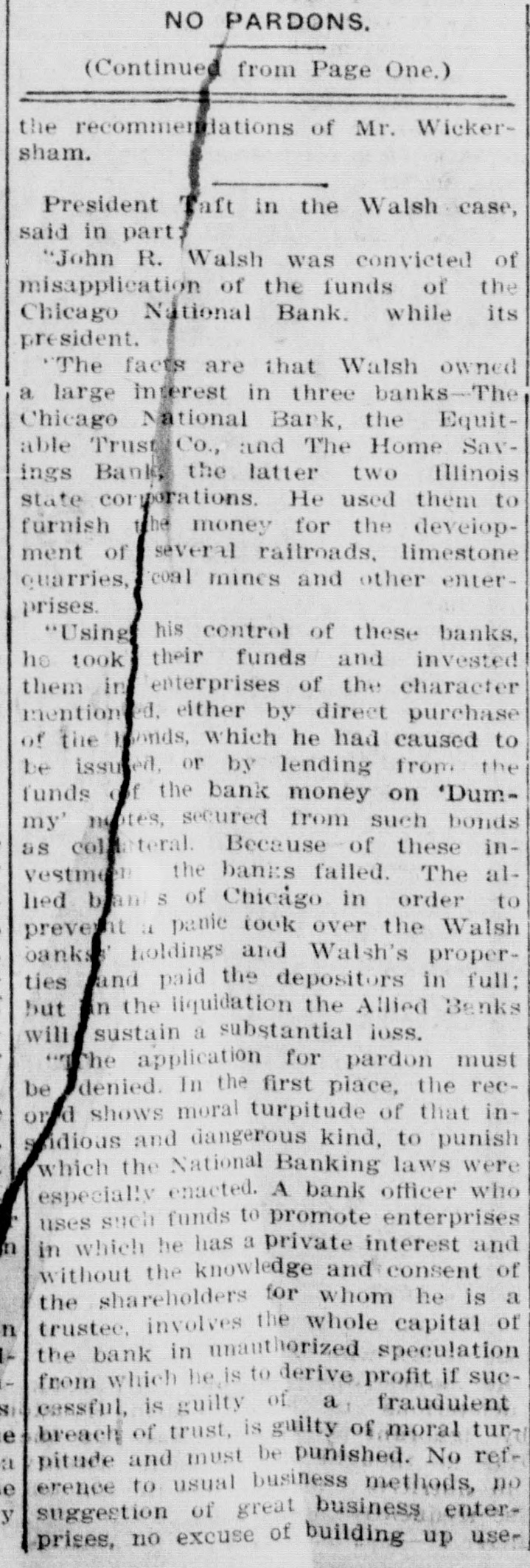
NO PARDONS. (Continued from Page One.) the recommendations of Mr. Wickersham. President Taft in the Walsh case, said in part: "John R. Walsh was convicted of misapplication of the funds of the Chicago National Bank. while its president. "The facts are that Walsh owned a large interest in three banks-The Chicago National Bark, the Equitable Trust.Co., and The Home Savings Bank, the latter two Illinois state corporations. He used them to furnish tahe money for the development of several railroads, limestone quarries, coal mines and other enterprises. "Using his control of these banks, he took their funds and invested them in enterprises of the character mentioned. either by direct purchase of the Lounds, which he had caused to be issued, or by lending from the funds of the bank money on 'Dummy' notes, secured from such bonds as collecteral. Because of these investmen the banks falled. The alhed ban of Chicago in order to prevent a panie took over the Walsh bankss' holdings and Walsh's properties and paid the depositors in full; but an the liquidation the Allied Banks will sustain a substantial loss. "The application for pardon must be denied. In the first place, the record shows moral turpitude of that inidious and dangerous kind, to punish which the National Banking laws were especially enacted. A bank officer who uses such funds to promote enterprises n in which he has a private interest and without the knowledge and consent of the shareholders for whom he is a trustee, involves the whole capital of n the bank in unauthorized speculation 1from which he is to derive profit if sucis cessful, is guilty of a, fraudulent breach of trust, is guilty of moral ture a pitude and must be punished. No reference to usual business methods, no e suggestion of great business entery prises, no excuse of building up use-
23.October 10, 1911The Marion Daily MirrorMarion, OH
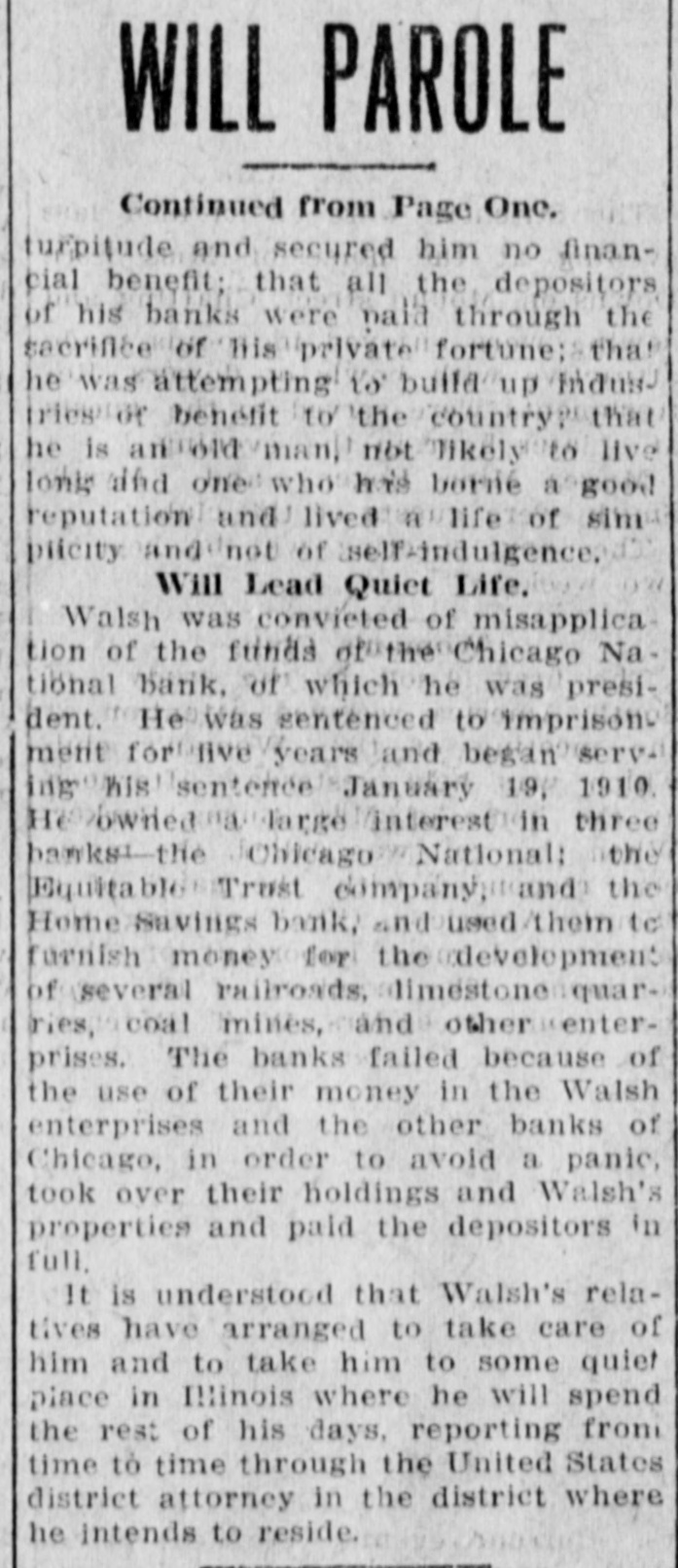
PRISON DOORS WILL OPEN SOON FOR JOHN R. WALSH Atty.-Gen. Wickersham Approves Board's Recommendation For Parole. WASHINGTON, Oct. 10. - Although official announcement was withheld, it became known today that Attorney-General Wickersham has approved the recommendation of the board of parole that John R. Walsh, the Chicago bank wrecker, be paroled from the Leavenworth penitentiary. In refusing to make public announcement of his decision the attorney-general is merely following the unbroken precedent of the department to maintain secrecy about such matters. This rule was originally established for the protection of prisoners whose efforts to reform would be hampered by publication of their crimes and imprisonment. Walsh made his formal application when the board of parole of the department of justice made its annual visit to Leavenworth last week. The hoard acted favorably on the application and its recommendation was presented to Attorney-General Wickersham yesterday by Superintendent Ladow. The actual date of Walsh's release, life all other details, is withheld by the department of justice and the date on which the aged banker will obtain his liberty will only be known when he is released at Leavenworth. Walsh's parole, with the usual restrictions, requiring him to make regular report to the prison officials. follows an unsuccessful attempt to obtain a pardon from President Taft. On May 24 last, the president refused, saying: "It would defeat the object of the law and present a demoralizing difference between the punishment meted out of the ordinary criminal whose ojrcumstances have naturally led him into crime and one whose position in society should have made for him the strongest restraint against violation of the law." Walsh's plea to the parole board was the same as to the presidentthat his violations of the laws were technical and did not involve moral turpitude and secured him no financial benefit; that all the depositors were paid through the sacrifice of his private fortune, that he was attempting to build up industries of benefit to the country: that he is an old man; net likely to live long. and one who has borne a good reputation and lived a life of simplicity and not of selfindulgence. Walsh was convicted of misapplication of the funds of the Chicago National bank of which he was president. He was sentenced to imprisonment for five years, and began serving his sentence January 19, 1910. He owned a large Interest in three banks -the Chicago National. the Equitable Trust Co. and the Home Savings bank, and used them to furnish money for the development of several railroads, limestone quarries, coal mines and other enterprises. The banks failed because of the use of their money in the Walsh enterprises and the other banks of Chicago, in order to avoid a panic, took over their holdings and Walsh's properties and paid. the depositors in full.
25.October 23, 1911The Daily Star-MirrorMoscow, ID
Click image to open full size in new tab
Article Text
PAROLED BANK WRECKER DIES IN CHICAGO HOME penniless newsboy, and had become CHICAGO, Oct. 23.-John R. Walsh, the former banker died here at his the greatest financial power in the city before his immense failure which home today from heart failure. He was due to the lending of depositors' was released from Leavenworth prison money to bolster up his railroad and on parole a week last Saturday. coal properties in eastern Illinois. At Walsh had been serving a five-year the time of the failure the other Chisentence in connection with the wreckcago bankers averted a panic by asing of his three banks, the Chicago Nasuming his liabilities. tional, Home Savings, and Equitable, The family believes death was due in Chicago in 1905. He was convicted to Walsh's brooding over his downand sentenced upon 53 counts in 1908. fall. Walsh began life in Chicago as a
Bank runs are almost always and everywhere a deterioration of bank fundamentals.
But not for you.
You are the measure-zero exception: great fundamentals, solid bank, and yet the Diamond Dybvig fairy spread its rumor. Depositors woke up. Your collateral was not prepositioned. The Clearinghouse had it for you.
Do not pass Go. Do not collect $200. Go directly to jail… or worse.