gpt-5-mini (chosen from majority vote of a three-model LLM ensemble)
Short Digest
7d78556e483a4c5b
Response Measures
None
Description
Receiver appointed and bank placed in liquidation after depositor flight tied to Charles W. Morse; closure permanent.
Events (3)
1.October 1, 1907*Run
Cause
Bank Specific Adverse Info
Cause Details
Depositors deserted the bank after association with Charles W. Morse and the 1907 financial crisis, causing heavy withdrawals.
Measures
Paid checks as presented and tried to remain open; directors sought support from clearing-house and other financiers.
Newspaper Excerpt
we will open our doors tomorrow. We paid all checks today as fast as they were presented.
Source
newspapers
2.January 27, 1908Receivership
Newspaper Excerpt
the decision to go into liquidation was reached ... and now it has passed into the hands of a receiver, having been deserted by most of its depositors since Mr. Morse was forcibly eliminated three months ago.
Source
newspapers
3.January 27, 1908Suspension
Cause
Bank Specific Adverse Info
Cause Details
Continued depositor withdrawals and insolvency concerns tied to Morse's mismanagement and losses led to closing and decision to liquidate.
Newspaper Excerpt
the Bank of North America ... passed into the control of Charles W. Morse... now it has passed into the hands of a receiver, having been deserted by most of its depositors
Source
newspapers
Newspaper Articles (24)
1.April 3, 1906The SunNew York, NY
Click image to open full size in new tab
Article Text
FATHER, TOO, ROBBED BANK. ELDER TURNEY MADE AWAY WITH $106,000 IN 1877. on Who Has Now Stolen $34,000 Was a Clerk There at the Time-Loss Made Up and Hushed Up-Edna Leonard Held Blameless for the Son's Thefte After Joseph A. Turney, the embezzling note teller of the Bank of North America, bad waived examination yesterday morning in the Tombs police court and had been held in $10,000 bail it becam known that bis father had stolen $106,000, with the connivance of another clerk. from the same bank in 1877. The father restored $6,000 to the bank, and the directors made up the loss and hushed it up rather than have the safety of the bank imperilled by a run. The elder Turney died about three years ago a respected citizen. The name of the young woman who has figured in the son's case also became public She is Miss Edna M. Leonard, who keeps a boarding house at 358 West Fortysixth street. The bank officials say that their investigations show that Miss Leonard is entirely blameless for Turney's steal. ings and they are convinced that his rela. tions with her were solely those of a businoss friend. Miss Leonard admitted yesterday that she knew Turney, and said she had been "unfortunate enough to have her name mixed up in the affair." but she declared most positively that she knew nothing of the man' 's stealings and had not shared in them. The bank officials are satisfied that she is telling the truth. They Bay that her house is respectable and that they have dropped that side of the case The disclosure of the stealings of the elder Turney came as a surprise to the present officials of the Bank of North America. A former director of the bank dictated at his office a statement about the old embezzlement. He said that he got the full particulars from the late William Dowd. who was once president of the Bank of North America. and also was vice-president of the Clearing House. This is what the former director wrote out himself "One morning in 1877 the paying teller, Mr. Turney, went to Mr. Dowd and confessed that he had for a long time been abstracting funds of the bank with the connivance of another clerk and that the money had been lost in speculation. The amount stolen reached $106,000. *The examiners were about to inquire into the bank's condition. Turney realized that it was no longer possible to cover up the deficit. He had carried it along for several years, but the amount had become 60 large that discovery was inevitable. Turney and his accomplice were able to raise $6,000. so that the actual loss to the bank was $100,000. "In view of the general condition of affairs, of the former good character of Mr. Turney. his long and faithful services to the bank and another reason, which need not be mentioned, the officers decided to keep the matter to themselves. Mr. Turney secured employment else= where and, SD far as we know, led an upright life. He died about three years ago a respected citizen." The statement went on to say that Joseph Turney was employed in the bank at that time as a boy, but was not discharged because it was thought such a course would be unjust to him. and that he grew up to be one of the most valued clerks in the institution and had such a capacity for work that he could do almost twice as much work as any one in the bank. He was the oldest employee of the bank. The former director who revealed the father's crime added "All his old friends are grieved to learn that this young man. who has been in the bank for thirty-three years, has followed in the footsteps of his father and, like him. has been detected in a defalcation though of much less proportions." The former director said privately in explanation of his words 'another reason which need not be mentioned.' that it was in troublous financial times and a run was feared if the defalcation should become known. He understood from Mr. Dowd that the directors made good the loss and that the bank did not lose anything. President Curtis and the other present officials of the bank were astonished at the story Mr Curtis said the books of had been destroyed and that he could not verify the story from them We simply know nothing about it," he said. Coming from the source it does it is undoubtedly true. but we have no record of it here. Vice-President Lee said yesterday that Miss Leonard had told him all she knew about Turney without reserve, and convinced him absolutely of the truth of her story. She came to this city from a small town in Pennsylvania and about fourteen months ago bought out the furniture of the West Forty-sixth street house from a Miss Edith Singerland and got a leass at $1,000 a year from the Astor estate. Miss Leonard is only 22 years old and is comely The agent of the property, Edward Ashforth of 51 West Forty-second street. said yesterday that she was "a good tenant and prompt pay. Investigation showed that the lodgers in the house were above reproach. and Mr. Lee said he was convinced that the house was entirely respectable He said Turney had become acquainted with the young woman in a legitimate way and had been acting as a businessmenton for her, because of her inexperience. The charge against Turnev was changed yesterday in the Tombs police court from grand larceny to forgery in the third degree. Turney pleaded not guilty and was held for the Grand Jury Later in the day Cashier Wire had interview with Turney and it was said that Turney had given certain valuable information Mr Lee. the vice-resident of the bank. said that no further defalcation had been discovered and that no one else had been im: licated The police were called into the case again yesterday, but for what purpose was not revealed. It is known that every statement that Turney has made to the bank officials is being verified The officials said yesterday that they were con. vinced that he stole the $34,000 in comparatively small amounts
2.October 24, 1907The Salt Lake HeraldSalt Lake City, UT
Click image to open full size in new tab
Article Text
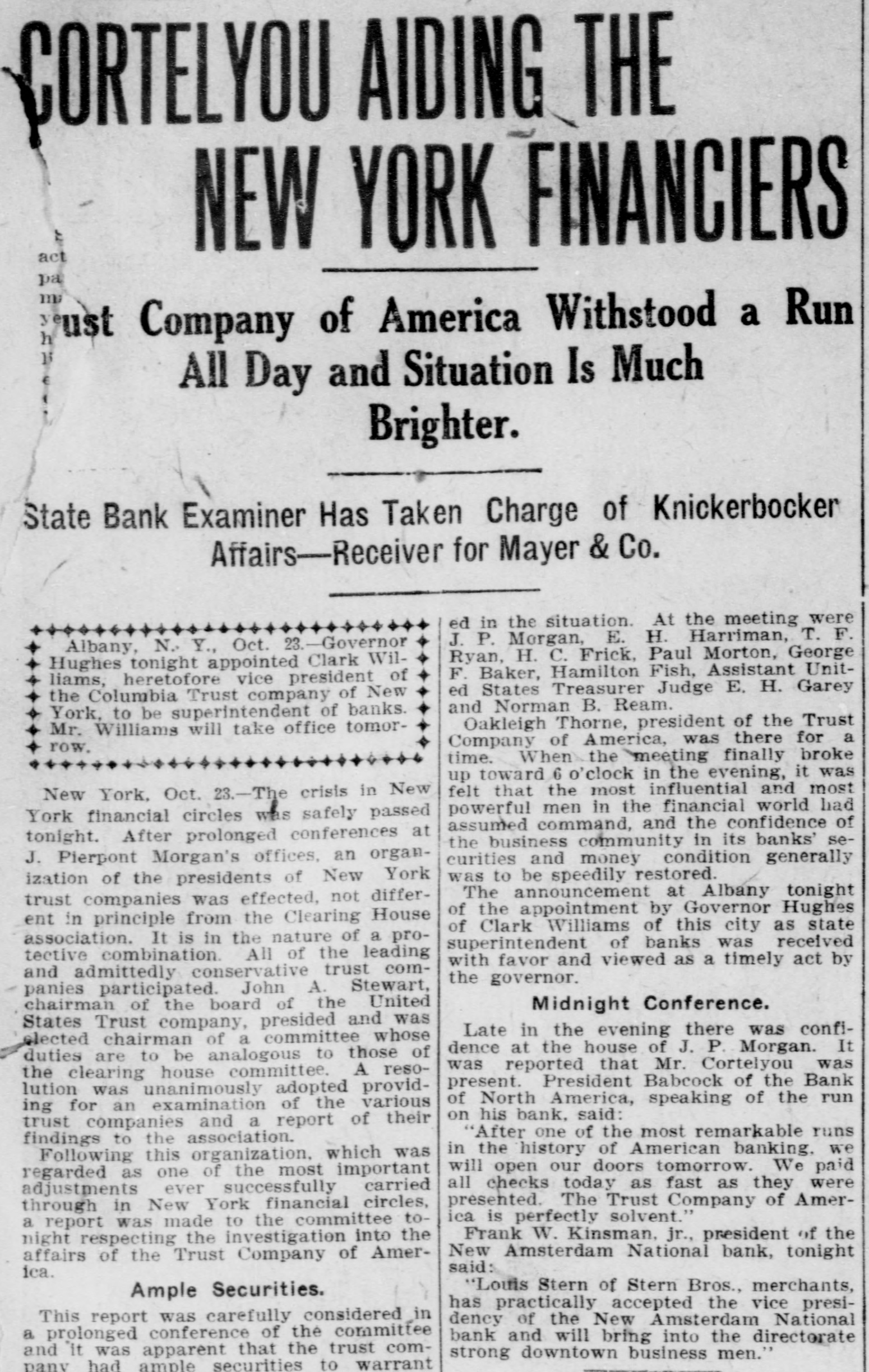
CORTELYOU AIDING THE NEW YORK FINANCIERS act mi ust Company of America Withstood a Run h All Day and Situation Is Much Brighter. State Bank Examiner Has Taken Charge of Knickerbocker Affairs-Receiver for Mayer & Co. ed in the situation. At the meeting were J. P. Morgan, E. H. Harriman, T. F. Albany, N. Y., Oct. 23.-Governor Ryan, H. C. Frick, Paul Morton, George Hughes tonight appointed Clark WilF. Baker, Hamilton Fish, Assistant Unitliams, heretofore vice president of ed States Treasurer Judge E. H. Garey the Columbia Trust company of New and Norman B. Ream. York, to be superintendent of banks. Oakleigh Thorne, president of the Trust Mr. Williams will take office tomorCompany of America, was there for a row. time. When the meeting finally broke up toward 6 o'clock in the evening, it was felt that the most influential and most New York, Oct. 23.-The crisis in New powerful men in the financial world had York financial circles was safely passed assumed command, and the confidence of tonight. After prolonged conferences at the business community in its banks' seJ. Pierpont Morgan's offices, an organcurities and money condition generally was to be speedily restored. ization of the presidents of New York The announcement at Albany tonight trust companies was effected, not differof the appointment by Governor Hughes ent in principle from the Clearing House of Clark Williams of this city as state association. It is in the nature of a prosuperintendent of banks was received tective combination. All of the leading with favor and viewed as a timely act by and admittedly conservative trust comthe governor. panies participated. John A. Stewart, chairman of the board of the United Midnight Conference. States Trust company, presided and was Late in the evening there was confielected chairman of a committee whose dence at the house of J. P. Morgan. It duties are to be analogous to those of was reported that Mr. Cortelyou was the clearing house committee. A resopresent. President Babcock of the Bank lution was unanimously adopted providof North America, speaking of the run ing for an examination of the various on his bank, said: trust companies and a report of their "After one of the most remarkable runs findings to the association. in the history of American banking, we Following this organization, which was will open our doors tomorrow. We paid regarded as one of the most important all checks today as fast as they were adjustments ever successfully carried presented. The Trust Company of Amerthrough in New York financial circles, ica is perfectly solvent." a report was made to the committee toFrank W. Kinsman. jr., president of the night respecting the investigation into the New Amsterdam National bank, tonight affairs of the Trust Company of Amersaid: ica. "Louis Stern of Stern Bros., merchants, Ample Securities. has practically accepted the vice presiThis report was carefully considered in dency of the New Amsterdam National a prolonged conference of the committee bank and will bring into the directorate and it was apparent that the trust comstrong downtown business men." panv had ample securities to warrant
3.January 27, 1908Evening StarWashington, DC
Click image to open full size in new tab
Article Text
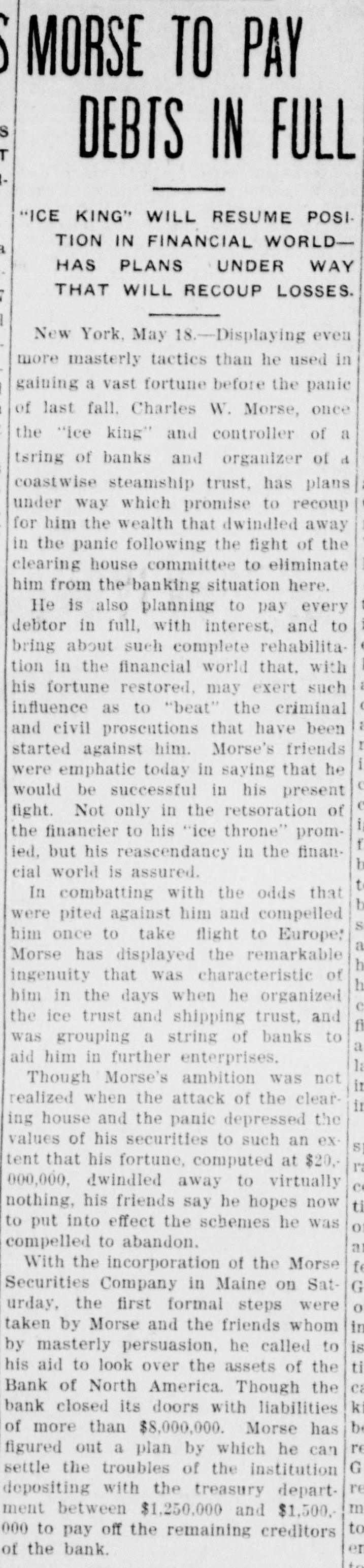
NORTH AMERICA BANK FAILS. New York Institution Has Done Business for Over Fifty Years. NEW YORK, January 27. - Fifty years after it was founded in 1851 the Bank of North America. at the height of its prosperity, passed into the control of Charles W. Morse. He had it six years. and now it has passed into the hands of a receiver, having been deserted by most of its depositors since Mr. Morse was forcibly eliminated three months ago. The decision to go into liquidation was reached late yesterday afternoon after an all-day conference between W. B. Ridgely, controller of the currency; W. F. Havemeyer, who became president of the bank to try to extricate it from its embarrassments, and Bronson Winthrop. counsel for the bank. Some comparison of the figures cf the present with those contained in. the statment of the bank made last August shows how hard the bank has been hit by the recent panic. In August last the total deposits of the bank were $19.500,000. According to the statement of the controller they have now shrunk to $3,831,482.42 The deposits from other banks in August were $8,200,000, and have since shrunk to $1,082,422.04. The Bank of North America was a founded in 1851 by John I. Fiske with capital stock of $1,000,000. Two months later Mr. Fiske lost his health and retired. He was succeeded by the late William F. Havemeyer, former mayor of New York and father of the present president of the bank. During his term the bank was successful, but he resigned at the end of ten years. He was succeeded by the cashier. Isaac Seymour. Mr. Seymour was president until 1863. when he died suddenly while attending service in Trinity Church. John Yelverton, then the cashier. was chosen president. In 1867. before there was a law against the overcertification of depositors' checks, and when it was the custom of banks to oblige their customers in that way, a brokerage firm got its account overcertified by $200.000. This was such a shock to Mr. Yelverton that he died within a few days. He was succeeded by John J. Donaldson, who had been a member of the firm of H. B. Claflin & Co. and had retired from the dry goods business with a fortune. He was president until 1873, when in the panic of that year there were several large overdrafts, which were so serious that the bank's capital was reduced to $700,000. Mr. Donaldson then decided to go back into the dry goods business. and he was succeeded by William Dowd, who had been a director. Mr. Dowd gave the bank one of the best administrations it ever had. He restored its position and accumulated considerable surplus. He was also president of the Clearing House Association. Mr. Dowd's health failed in 1891 and Mr. Van Norden was elected. He remained at the head of the bank until 1902. During Mr. Van Norden's presidency the bank made still further progress. The capital was restored to $1,000,000. The surplus grew to $1,000,000. and large dividends were paid. and the deposits increased from $3,000,000 to $25.000,000. The deposits had reached the latter figure on the day when the bank celebrated its fiftieth anniversary with a dinner at the Metropolitan Club. at which 100 of the leading bankers of the country were present. In January. 1902, Charles M. Morse and his friends bought not only Mr. Van Norden's interest, but the stock of many of the directors and individual stockholders. and Mr. Morse became vice president.
4.January 27, 1908The Washington HeraldWashington, DC
Click image to open full size in new tab
Article Text
New York, Jan. 26.-Fifty years after it was founded in 1851. the Bank of North America, at the height of its prosperity, passed into the control of Charles W. Morse. He had it six years. Now it has passed into the hands of a receiver, having been deserted by most of its depositors since Morse was forcibly eliminated three months ago. After an all-day conference between those interested in the affairs of the National Bank of North America, it was decided late this afternoon to close the bank and liquidate. The decision was reached by President W. F. Havemeyer, Bronson Winthrop, counsel for the bank, and Comptroller of the Currency W. B. Ridgely.
5.January 30, 1908The Detroit TimesDetroit, MI
Click image to open full size in new tab
Article Text
a national bank examiner, is in charge. Depositors' Steady Withdrawal. The closing of the Bank of North America, another Morse institution, was the direct cause of the Amsterdam's closing. Depositors ever since last Thursday have been quickly withdrawing funds, and out of town banks, which were warned by correspondents, have reduced their balances. The bank was closed to prevent a run and to give all depositors an equal chance. F. W. Kinsman, Jr., president of the bank. issued this statement: The bank had recovered fully from the effects of the panic and had retired its clearing house certificates from $1,750,000 down to $300,000, and the bank was on an upward and successful movement. No loss will be sustained. by the depositors and the stockholders will receive a substantial dividend. F. W. KINSMAN. JR. The assets amount to $4,482,016.20. The individual deposits are $2,065,272.40. Severe Blow to Theatrical Mcn. The closing of the bank is a severe blow to many theatrical firms, managers of theaters, actors, actresses, hotel and restaurant owners, gamblers, bookmakers and the sporting element in the Tenderloin. Owing to its location at Thirty-ninth-st. and Broadway, the bank was heavily patronized by many of the most important concerns in the Tenderloin, including Opulent chorus girls. Caruso had $40,000 on deposit. The Mechanics and Traders' bank closed because of the demand of the clearing house that it settle $1,900,000 certificates still outstanding. The bank has ample collateral, but it is unable to get cash at this time. Against the $1,900,000 certificates, the clearing house holds, according to the directors, $6,000,000 of approved collateral. The directors also declare that the bank is solvent and that its closing is due only to the fact that they desired to avoid preferential payments. The Thomas interests controlled the bank previous to the October flurry and accommodated F. Augustus Heinze for a large amount.
6.February 13, 1908The Plymouth TribunePlymouth, IN
Click image to open full size in new tab
Article Text
Will Not Favor John D. John D. Rockefeller has $120,000 of his gilt-edged bonds in the collapsed bank of North America in New York and has been told by the receiver that he must take the same chance as the humblest depositor in getting his money out.
7.March 13, 1908The Detroit TimesDetroit, MI
Click image to open full size in new tab
Article Text
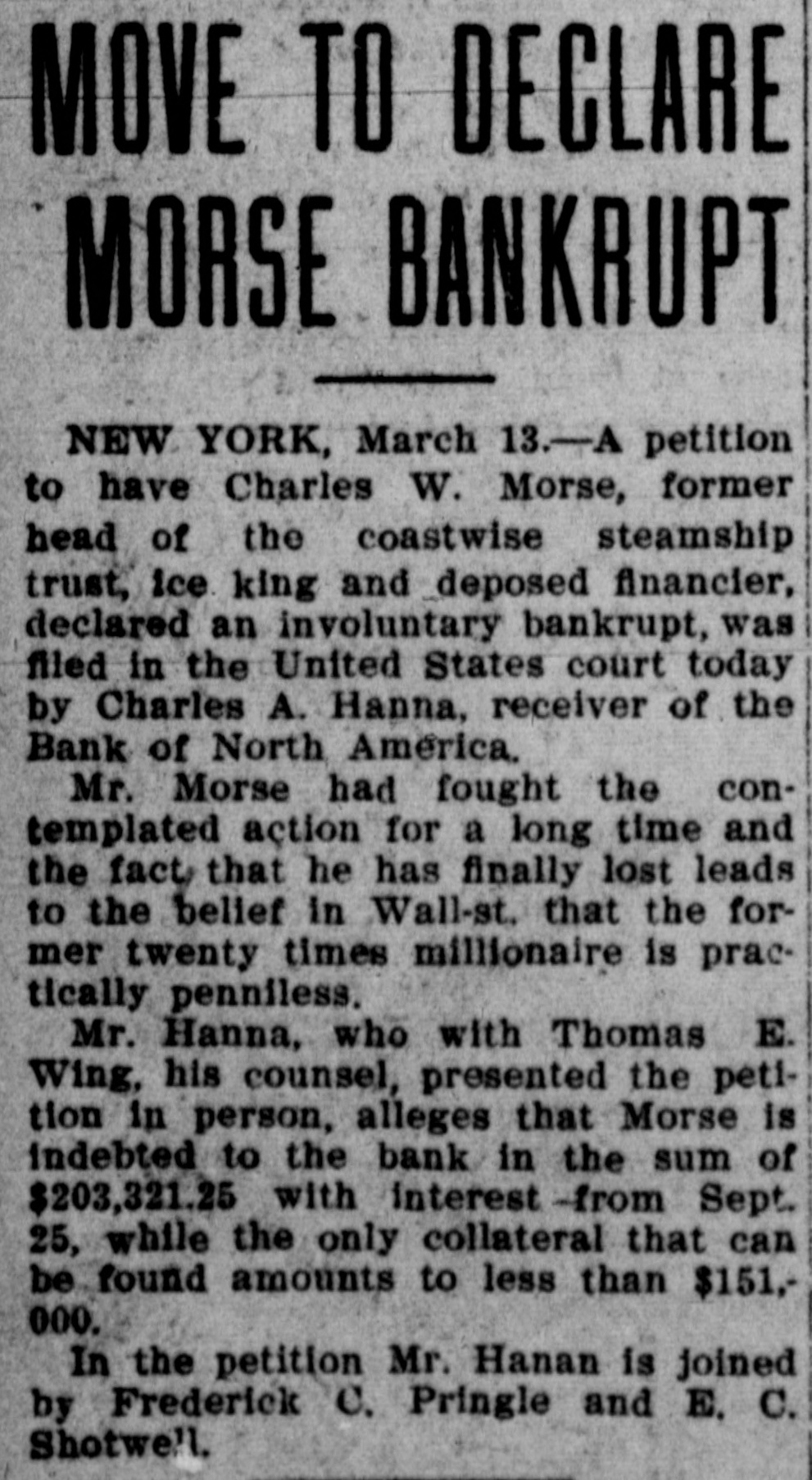
MOVE TO DECLARE MORSE BANKRUPT NEW YORK, March 13.-A petition to have Charles W. Morse, former head of the coastwise steamship trust, ice king and deposed financier, declared an involuntary bankrupt, was filed in the United States court today by Charles A. Hanna, receiver of the Bank of North America. Mr. Morse had fought the contemplated action for a long time and the fact that he has finally lost leads to the belief in Wall-st. that the former twenty times millionaire is practically penniless. Mr. Hanna, who with Thomas E. Wing, his counsel, presented the petition in person, alleges that Morse is indebted to the bank in the sum of $203,321.25 with interest from Sept. 25, while the only collateral that can be found amounts to less than $151,000. In the petition Mr. Hanan is joined by Frederick C. Pringle and E. C. Shotwell.
8.March 13, 1908The Daily TelegramClarksburg, WV
Click image to open full size in new tab
Article Text
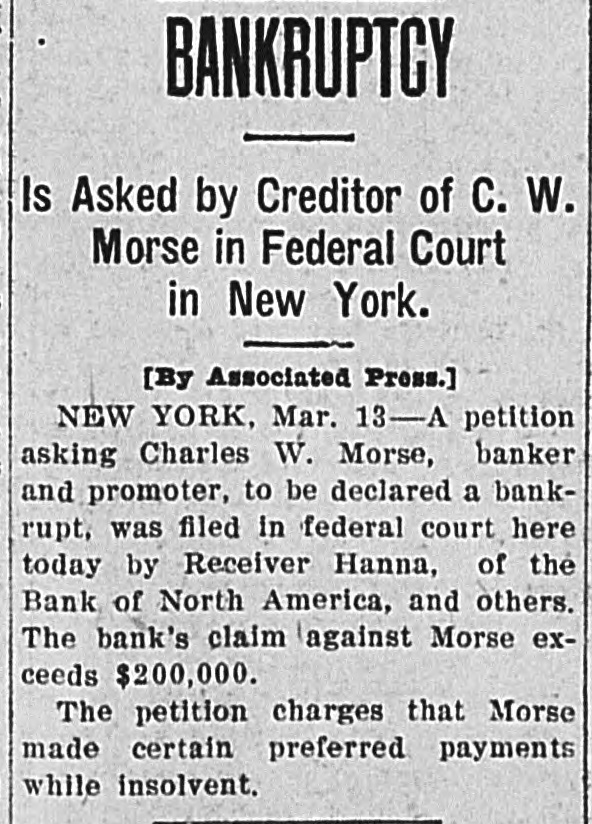
BANKRUPTCY Is Asked by Creditor of C. W. Morse in Federal Court in New York. [By Associated Press.] NEW YORK, Mar. 13-A petition asking Charles W. Morse, banker and promoter, to be declared a bankrupt, was filed in federal court here today by Receiver Hanna, of the Bank of North America, and others. The bank's claim against Morse exceeds $200,000.. The petition charges that Morse made certain preferred payments while insolvent.
9.March 14, 1908Pine Bluff Daily GraphicPine Bluff, AR
Click image to open full size in new tab
Article Text
No Receiver For Charles W. Morse Hearst News Special to the Graphic. New York, March 13.-Federal Judge Hough today refused to appoint a receiver for Charles W. Morse, the indicted ice king, until the issue as to whether petitioners against Morse are his creditors be settled. A bankruptcy petition was also filed against Morse by Receiver Hanna of the Bank of North America and two stockholders of the defunct institution.
10.March 14, 1908Daily PressNewport News, VA
Click image to open full size in new tab
Article Text
PETITIONERS DECLARE MORSE IS BANKRUPT Twenty Times Millionaire is Said Now to be Penniless-Owes Bank $203,321.25. NEW YORK, March 13-A petition to have Charles W. Morse, former head of the Coastwise Steamship trust, ice king and deposed financier, declared an involuntary bankrupt was filed in the United States Court today by Charles A. Hanna, receiver of the Bank of North America. Mr. Morse had fought the contemplated action for a long time, and the fact that he has finally lost leads to the belief in Wall street that the former 20-times millionaire is practically penniless. Mr .Hanna, who, with Thomas Ewing, his counsel, presented the petition in person, alleges that Morse is indebte to the bank in the sum of $203,321.25, with interest from September 25th, while the only collateral that can be found amounts to less than $151,000. Till the petition Mr. Hanna is joined by Frederick C. Pringle, a broker, of 43 Exchange Place, and Edward C. Shotwell, also a broker In the same building.
BANKRUPTCY Is Asked by Creditor of c. W. Morse in Federal Court in New York. [By Associated Press.] NEW YORK, Mar. 13-A petition asking Charles W. Morse, banker and promoter, to be declared a bankrupt, was filed in federal court here today by Receiver Hanna, of the Bank of North America, and others. The bank's claim against Morse exceeds $200,000. The petition charges that Morse made certain preferred payments while insolvent.
12.July 14, 1908The Morris County ChronicleMorristown, NJ
Click image to open full size in new tab
Article Text
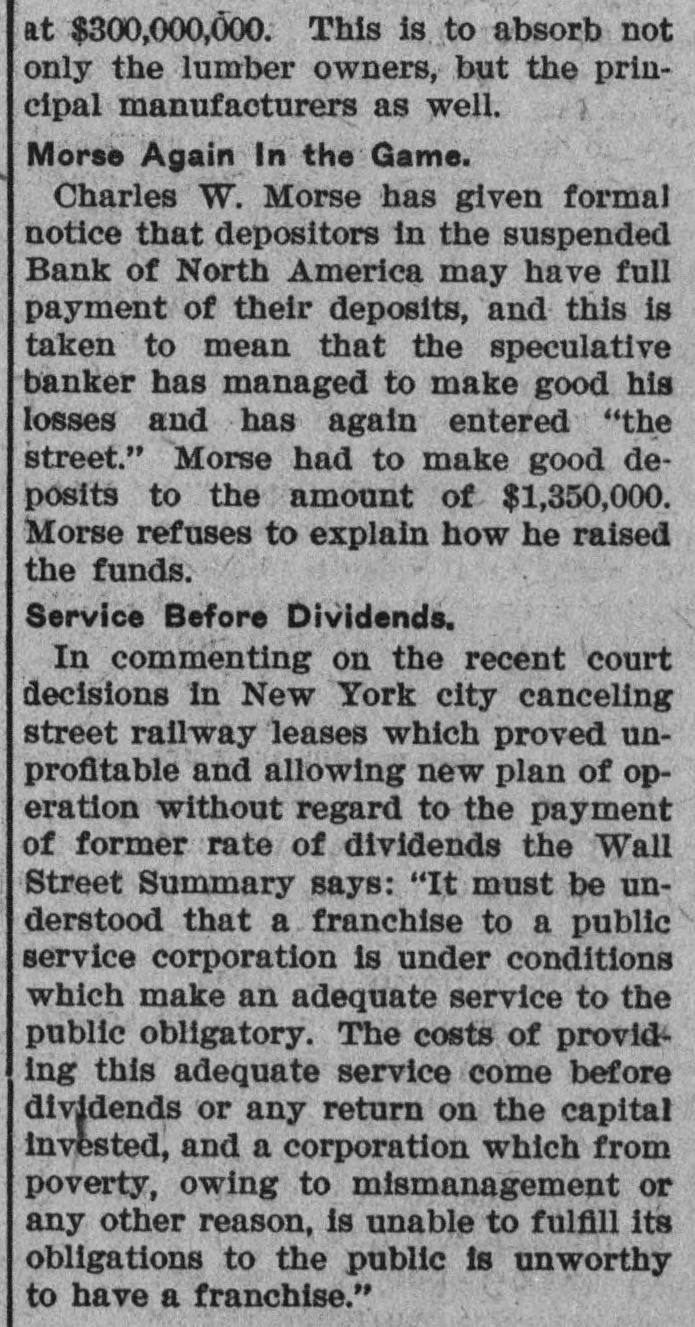
at $300,000,000. This is to absorb not only the lumber owners, but the principal manufacturers as well. Morse Again In the Game. Charles W. Morse has given formal notice that depositors in the suspended Bank of North America may have full payment of their deposits, and this is taken to mean that the speculative banker has managed to make good his losses and has again entered "the street." Morse had to make good deposits to the amount of $1,350,000. Morse refuses to explain how he raised the funds. Service Before Dividends. In commenting on the recent court decisions in New York city canceling street railway leases which proved unprofitable and allowing new plan of operation without regard to the payment of former rate of dividends the Wall Street Summary says: "It must be understood that a franchise to a public service corporation is under conditions which make an adequate service to the public obligatory. The costs of providing this adequate service come before dividends or any return on the capital invested, and a corporation which from poverty, owing to mismanagement or any other reason, is unable to fulfill its obligations to the public is unworthy to have a franchise."
13.July 17, 1908Twice-A-Week Plain DealerCresco, IA
Click image to open full size in new tab
Article Text
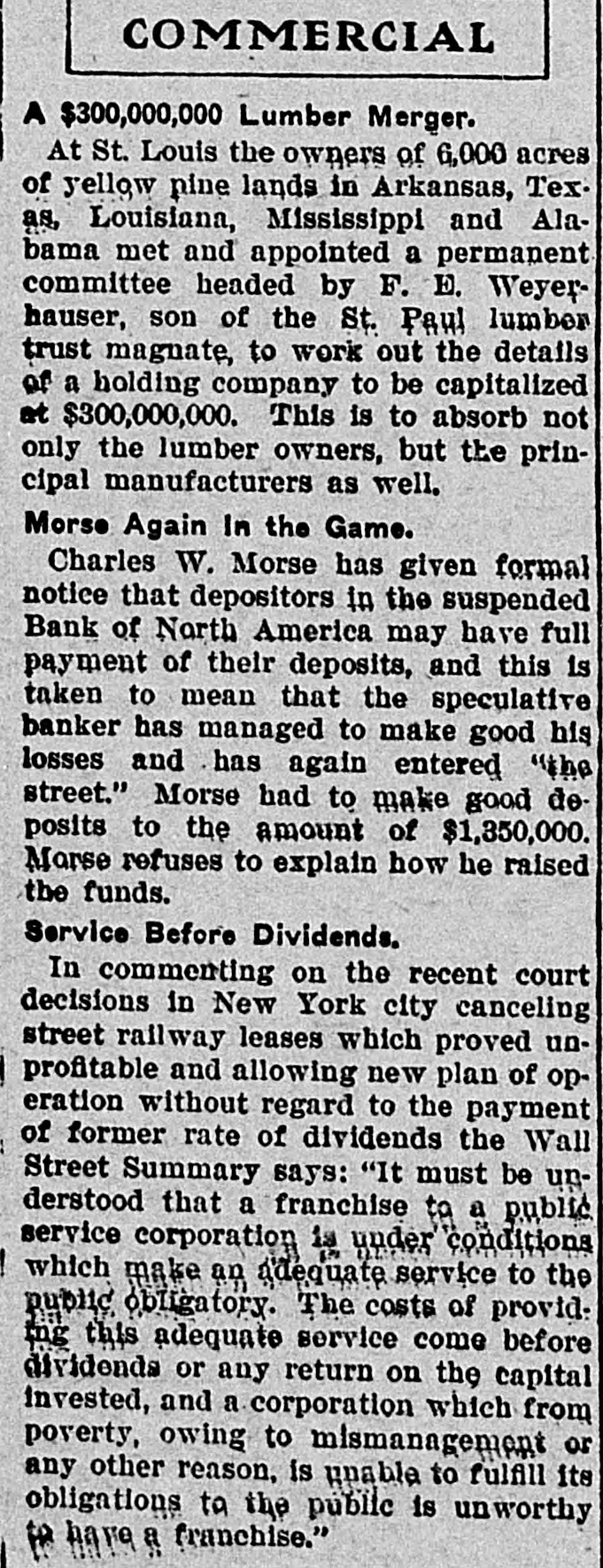
COMMERCIAL A $300,000,000 Lumber Merger. At St. Louis the owners of 6,000 acres of yellow pine lands in Arkansas, Tex. as, Louisiana, Mississippi and Alabama met and appointed a permanent committee headed by F. E. Weyerhauser, son of the St. Paul lumber trust magnate, to work out the details of a holding company to be capitalized at $300,000,000. This is to absorb not only the lumber owners, but the principal manufacturers as well. Morse Again In the Game. Charles W. Morse has given formal notice that depositors in the suspended Bank of North America may have full payment of their deposits, and this is taken to mean that the speculative banker has managed to make good his losses and has again entered "the street." Morse had to make good deposits to the amount of $1,350,000. Morse refuses to explain how he raised the funds. Service Before Dividends. In commenting on the recent court decisions in New York city canceling street railway leases which proved unprofitable and allowing new plan of operation without regard to the payment of former rate of dividends the Wall Street Summary says: "It must be understood that a franchise to a public service corporation is under conditions which make an adequate service to the public obligatory. The costs of provid. ing this adequate service come before dividends or any return on the capital invested, and a corporation which from poverty, owing to mismanagement or any other reason, is unable to fulfill its obligations to the public is unworthy to have a franchise."
14.August 10, 1908Daily Kennebec JournalAugusta, ME
Click image to open full size in new tab
Article Text
sets Realization Co., and who hoped to regain control of the bank of North America's assets by means of the plan which the acting controller of the currency has voted, regards the rejection of his offer as unwarranted.
As a consequence of the decision taken by the acting controller it is now regarded as probable that the Wall-street Exchange building, in which the bank of North America has its offices, will be sold by the receiver to satisfy the claims of the creditors.
15.October 26, 1908The Detroit TimesDetroit, MI
Click image to open full size in new tab
Article Text
# MISLAID MILLION
# OF STEAMSHIP
# CO. STOCK
SURPRISING FACT ADDUCED IN
TESTIMONY OF CASHIER WIRE,
OF CHAS. W. MORSE'S BANK-
OTHER SENSATIONS.
NEW YORK, Oct. 26. -The surprising fact that $1,000,000 stock of the Consolidated Steamship Co., listed as being in the possession of the Bank of North America, has disappeared and could not be found, was brought out today, in the cross-examination of Cashier Wire, of the bank, at the trial of Chas. W. Morse and Alfred H. Curtis, charged with over-certification and other violations of the banking laws.
Ex-Judge Olcott, questioning the witness for the defense, brought out the fact that the securities were missing. "I do not know where the stock was," the witness testified.
An effort was made to show that Wm. H. Havemeyer had loans in the bank in the name of Miss J. A. Smith, his secretary.
Evidence also was adduced, to show that Morse drew a check for $126,000 in favor of Otto Heinze & Co., three days before the Bank of North America suspended, and while his cash balance was but $3,000.
16.October 28, 1908The Salt Lake HeraldSalt Lake City, UT
Click image to open full size in new tab
Article Text
New York, Oct. 27.-The expected split between Charles W. Morse, bank promoter, financier and "ice trust" organizer, and Alfred H. Curtis. president of the National Bank of North America, both of whom are under indictment, charging them jointly with violation of the national banking laws. came today with the swearing in of Curtis as the first witness of the defense in the trial before Judge Hough in the United States court here. Before the beginning of Mr. Curtis' examination the court had heard argument on behalf of both defendants on motions to dismiss the indictments, and had yielded on a few minor points, dismissing the counts charging conspiracy and misappropriation in one specific instance, but maintaining fifty-five counts charging overcertification. making of false reports, misapplication and the use of Tunds of depositors for speculative purpose. Before calling the former president of the suspended Bank of North America to
17.November 6, 1908The Evening StatesmanWalla Walla, WA
Click image to open full size in new tab
Article Text
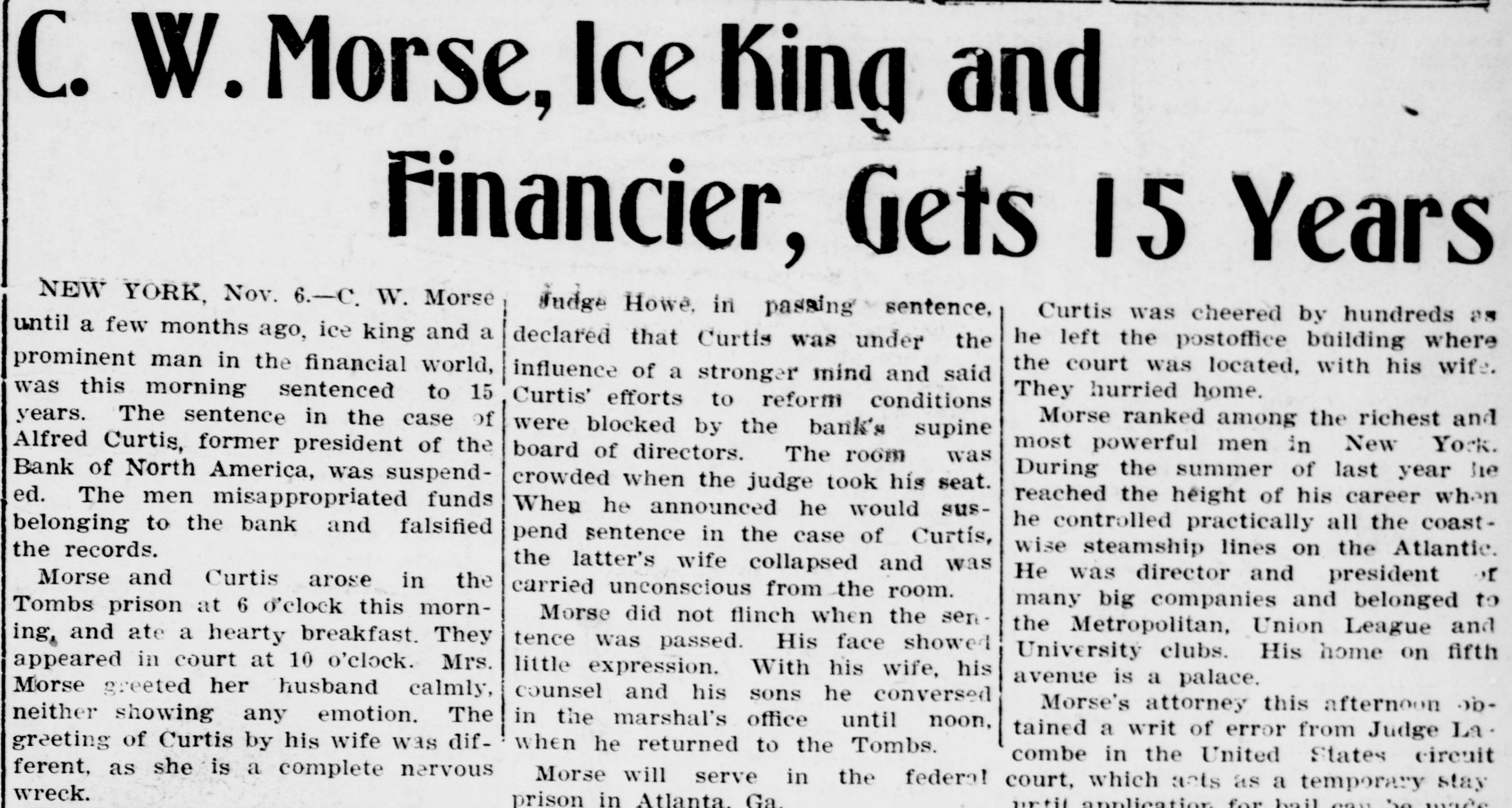
C. W. Morse, Ice King and Financier, Gets 15 Years NEW YORK Nov. 6.-C. W. Morse Judge Howe, in passing sentence, Curtis was cheered by hundreds as until a few months ago, ice king and a declared that Curtis was under the he left the postoffice building where prominent man in the financial world, the court was located, with his wife. influence of a stronger mind and said They hurried home. was this morning sentenced to 15 Curtis' efforts to reform conditions years. The sentence in the case of Morse ranked among the richest and were blocked by the bank's supine most powerful men in New York. Alfred Curtis, former president of the board of directors. The room was During the summer of last year he Bank of North America, was suspendcrowded when the judge took his seat. reached the height of his career when ed. The men misappropriated funds When he announced he would sushe controlled practically all the coastbelonging to the bank and falsified pend sentence in the case of Curtรญs, the records. wise steamship lines on the Atlantic. the latter's wife collapsed and was r He was director and president Morse and Curtis arose in the carried unconscious from the room. many big companies and belonged to Tombs prison at 6 o'clock this mornMorse did not flinch when the senthe Metropolitan, Union League and ing, and ate a hearty breakfast. They tence was passed. His face showed University clubs. His home on fifth appeared in court at 10 o'clock. Mrs. little expression. With his wife, his avenue is a palace. Morse greeted her husband calmly, counsel and his sons he conversed Morse's attorney this afternoon obneither showing any emotion. The in the marshal's office until noon, tained a writ of error from Judge La. greeting of Curtis by his wife was difwhen he returned to the Tombs. combe in the United States circuit ferent, as she is a complete nervous Morse will serve in the federal court, which acts as a temporary stay wreck. application prison in Atlanta. Ga.
18.December 3, 1908The JeffersonianThomson, Atlanta, GA
Click image to open full size in new tab
Article Text
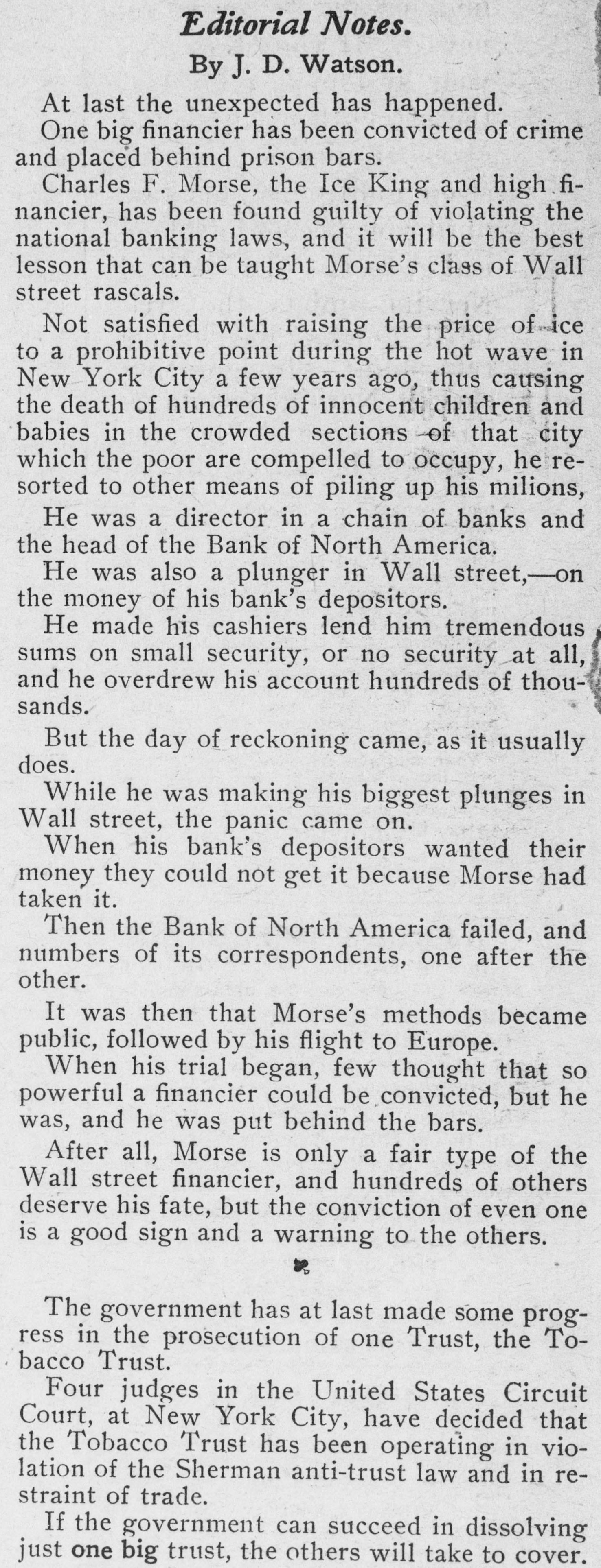
# Editorial Notes.
By J. D. Watson.
At last the unexpected has happened.
One big financier has been convicted of crime and placed behind prison bars.
Charles F. Morse, the Ice King and high financier, has been found guilty of violating the national banking laws, and it will be the best lesson that can be taught Morse's class of Wall street rascals.
Not satisfied with raising the price of ice to a prohibitive point during the hot wave in New York City a few years ago, thus causing the death of hundreds of innocent children and babies in the crowded sections of that city which the poor are compelled to occupy, he resorted to other means of piling up his milions,
He was a director in a chain of banks and the head of the Bank of North America.
He was also a plunger in Wall street, on the money of his bank's depositors.
He made his cashiers lend him tremendous sums on small security, or no security at all, and he overdrew his account hundreds of thousands.
But the day of reckoning came, as it usually does.
While he was making his biggest plunges in Wall street, the panic came on.
When his bank's depositors wanted their money they could not get it because Morse had taken it.
Then the Bank of North America failed, and numbers of its correspondents, one after the other.
It was then that Morse's methods became public, followed by his flight to Europe.
When his trial began, few thought that so powerful a financier could be convicted, but he was, and he was put behind the bars.
After all, Morse is only a fair type of the Wall street financier, and hundreds of others deserve his fate, but the conviction of even one is a good sign and a warning to the others.
The government has at last made some progress in the prosecution of one Trust, the Tobacco Trust.
Four judges in the United States Circuit Court, at New York City, have decided that the Tobacco Trust has been operating in violation of the Sherman anti-trust law and in restraint of trade.
If the government can succeed in dissolving just one big trust, the others will take to cover.
19.December 3, 1908Heppner GazetteHeppner, OR
Click image to open full size in new tab
Article Text
TRADE AND INDUSTRY. Minneapolis has in sight a million-dollar gas plant, through which it is proposed to reduce the price of gas from $1 to 80 cents a thousand. It is expected by Land Commissioner Dokken, of South Dakota, that he will dispose of 5,000 acres of the State building lands in Meade County this fall. The roduction of creamery butter in Minnesota increased 9,000,000 pounds in four years and now reaches the total of 87,044,817 pounds for the year 1907. Charles W. Morse, organizer and promoter of the American Ice Company and the Consolidated Steamship Company. and who until the panic of a year ago controlled several banks in New York. is facing a jury in the criminal branch of the United States Circuit Court on the charge of illegal banking in connection with the failure of the Bank of North America. The record for September of the Minnesota Bureau of Grain Inspection broke a record, the number of cars inspected being almost double the number inspected in September last year. The figures show the total number of cars inspected at 23,765, while the number for the corresponding time last year was 12,576 cars. The largest individual day was Sept. 20, when 1,200 cars were inspected. The department attributes the excellent record to the good roads of the country this year, early movements of grain and top market prices.
20.December 9, 1908The Evening WorldNew York, NY
Click image to open full size in new tab
Article Text
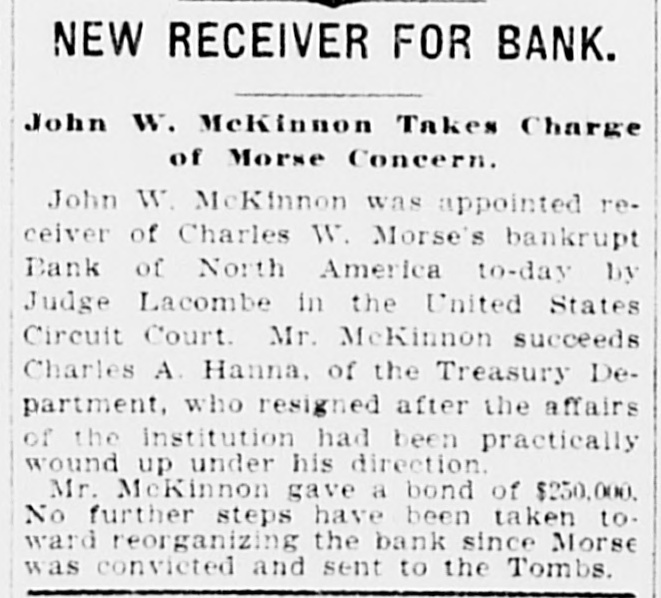
NEW RECEIVER FOR BANK. John W. McKinnon Takes Charge of Morse Concern. John W. McKinnon was appointed receiver of Charles W. Morse's bankrupt Bank of North America to-day by Judge Lacombe in the United States Circuit Court. Mr. McKinnon succeeds Charles A. Hanna, of the Treasury Department, who resigned after the affairs of the institution had been practically wound up under his direction. Mr. McKinnon gave a bond of $250,000. No further steps have been taken to. ward reorganizing the bank since Morse was convicted and sent to the Tombs.
21.October 8, 1911The Washington HeraldWashington, DC
Click image to open full size in new tab
Article Text
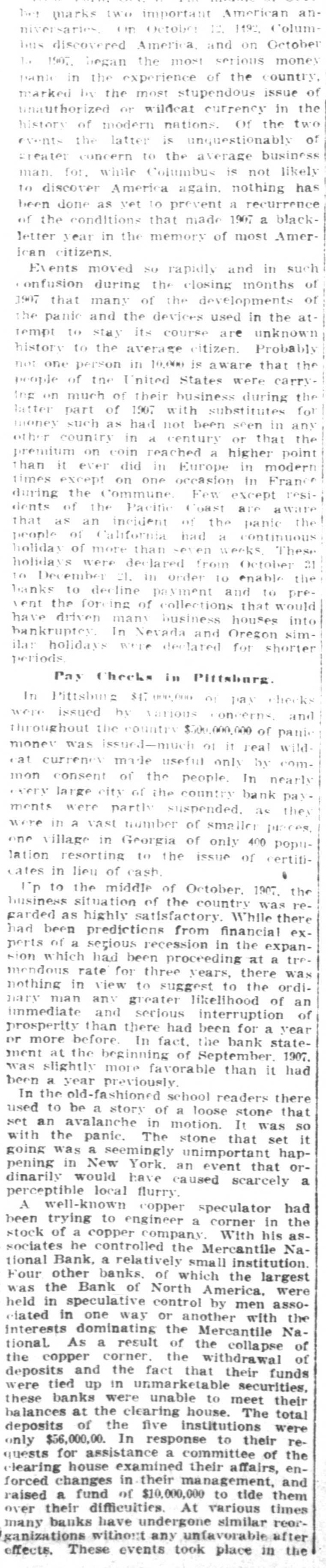
ber marks two important American an-
niversaries. On October 12, 1492, Colum-
bus discovered America, and on October
1, 1907, began the most serious money
panic in the experience of the country,
marked by the most stupendous issue of
unauthorized or wildcat currency in the
history of modern nations. Of the two
events the latter is unquestionably of
greater concern to the average business
man, for, while Columbus is not likely
to discover America again, nothing has
been done as yet to prevent a recurrence
of the conditions that made 1907 a black-
letter year in the memory of most Amer-
ican citizens.
Events moved so rapidly and in such
confusion during the closing months of
1907 that many of the developments of
the panic and the devices used in the at-
tempt to stay its course are unknown
history to the average citizen. Probably
not one person in 10,00 is aware that the
people of the United States were carry-
ing on much of their business during the
latter part of 1907 with substitutes for
money such as had not been seen in any
other country in a century or that the
premium on coin reached a higher point
than it ever did in Europe in modern
times except on one occasion in France
during the Commune. Few except resi-
dents of the Pacific Coast are aware
that as an incident of the panic the
people of California had a continuous
holiday of more than seven weeks. These
holidays were declared from October 21
to December 21, in order to enable the
banks to decline payment and to pre-
vent the forcing of collections that would
have driven many business houses into
bankruptcy. In Nevada and Oregon sim-
ilar holidays were declared for shorter
periods.
# Pay Checks in Pittsburg.
In Pittsburg $4700.000 of pay checks
were issued by various concerns, and
throughout the country $500,000,000 of panic
money was issued-much of it real wild-
cat currency made useful only by com-
mon consent of the people. In nearly
every large city of the country bank pay-
ments were partly suspended, as they
were in a vast number of smaller pieces,
one village in Georgia of only 400 popu-
lation resorting to the issue of certifi-
cates in lieu of cash.
Up to the middle of October, 1907, the
business situation of the country was re-
garded as highly satisfactory. While there
had been predictions from financial ex-
perts of a serious recession in the expan-
sion which had been proceeding at a tre-
mendous rate for three years, there was
nothing in view to suggest to the ordi-
nary man any greater likelihood of an
immediate and serious interruption of
prosperity than there had been for a year
or more before. In fact, the bank state-
ment at the beginning of September, 1907,
was slightly more favorable than it had
been a year previously.
In the old-fashioned school readers there
used to be a story of a loose stone that
set an avalanche in motion. It was so
with the panic. The stone that set it
going was a seemingly unimportant hap-
pening in New York, an event that or-
dinarily would have caused scarcely a
perceptible local flurry.
A well-known copper speculator had
been trying to engineer a corner in the
stock of a copper company. With his as-
sociates he controlled the Mercantile Na-
tional Bank, a relatively small institution.
Four other banks, of which the largest
was the Bank of North America, were
held in speculative control by men asso-
ciated in one way or another with the
interests dominating the Mercantile Na-
tional. As a result of the collapse of
the copper corner, the withdrawal of
deposits and the fact that their funds
were tied up in unmarketable securities,
these banks were unable to meet their
balances at the clearing house. The total
deposits of the five institutions were
only $56,000,00. In response to their re-
quests for assistance a committee of the
clearing house examined their affairs, en-
forced changes in their management, and
raised a fund of $10,000,000 to tide them
over their difficulties. At various times
many banks have undergone similar reor-
ganizations without any unfavorable after
effects. These events took place in the
22.June 8, 1912Brownsville HeraldBrownsville, TX
Click image to open full size in new tab
Article Text
SOLVENT BANKS FORCED TO CLOSE THROUGH -PRESSURE OF NEW YORK CLEARING HOUSE Investigation Intended to Show that the Function of the Clearing House Enables it to Control Destiny of New York Banks. Associated Press. New York, June 7-Testimony intended to show that the Oriental Bank of New York was forced to the wall by the New York clearing house committee during the aftermath of the panic in 1907, although it was solvent, was given today before the house committee investigating the money trust. Three other banks, the Bank of North America and the New Amsterdam Bank, in both of which Chas. W. Morse was interested, and the Mechanics and Traders, were similiarly compelled to close though solvent, was testified. The testinmony was elicited in an effort to demonstrate that the functions of the clearing house enables it to control the destiny of New York's financial institutions, and should be subject to regulation.
23.June 8, 1912Daily Kennebec JournalAugusta, ME
Click image to open full size in new tab
Article Text
TESTIMONY TO SHOW How Power of New York Clearing House Forces Solvent Banks to Wall. New York, June 7.-Testimony intended to show how the power of the New York Clearing House committee was used to force a solvent bank to the wall during the aftermath of the panic of 1907, with the result that the "fair reputation" of its president was "blasted," was dramatically unfolded, today, before the Pujo committee of the House of Representatives which is investigating the socalled money trust. The testimony was elicited by Samuel Untermyer, `special counsel of the committee, in his effort to demonstrate that the functions of the Clearing House enable it to control the destiny of New York's financial institutions and should be subject to regulation by law. The bank around which the testimony centered was the Oriental, organized in 1853, and one of the charter members of the Clearing House Association, but it was testified that three other banks, the Bank of North America and the New Amsterdam National Bank, in both of which Charles W. Morse was interested, and the Mechanics' and Traders, were similarly compelled through the action of the Clearing House, to close their doors, although all proved to have been solvent. Their financial decease was the result, it was testified, of a demand made by the Clearing House committee, three months after the panie, that they redeem their Clearing House loan certificates in the case of the Oriental fol-
24.June 11, 1912The Farmer and MechanicRaleigh, NC
Click image to open full size in new tab
Article Text
CLEARING HOUSE IS RESPONSIBLE For Forcing a Solvent Bank Out of Business According to Testimony Before the Committee of the House Which Which is Investigating. New York, June 7.-Testimony intended to show how the power of the New York clearing house committee was used to force a solvent bank to the wall during the aftermath of the panic of 1907 with the result that the "fair reputation" of the president was "blasted" was dramatically presented today before the committee of the house, which is investigating the money trust. The testimony was elicited by Samuel Untermyer, special counsel of the committee, in his effort to demonstrate that the functions of the clearing house enable it to control the destiny of New York's financial ininstitutions and should be subject to regulation by law. The bank around which the testimony centered was the Oriental, organized in 1853, and one of the charter members of the Clearing House Association, but it was testified that three other banks, the Bank of North America and the New Amsterdam National Bank, in both of which cases with Morse was interested and the Mechanics and Traders were similarly compelled through the action of the clearing house to close, although all. proved to have been solvent. Their financial decease was the result, it was testified, of a demand made by the clearing house committee three months after the panic began, that they redeem their clearing house loan certificates and in the case of oriential followed a promise that association would stand by it "to the last ditch." Mr. Untermyer had on the stand William Shere, manager of the clearinghouse association; Jomes G. Cannon, president of the Fourth National Bank, who recently became a member of the clearing house committee; R. W. Jones, president of the Oriential at the time of the panic, and Erskine Hewitt and Chas. A. Beekman, directors of the bank.
Bank runs are almost always and everywhere a deterioration of bank fundamentals.
But not for you.
You are the measure-zero exception: great fundamentals, solid bank, and yet the Diamond Dybvig fairy spread its rumor. Depositors woke up. Your collateral was not prepositioned. The Clearinghouse had it for you.
Do not pass Go. Do not collect $200. Go directly to jail… or worse.