Farmers & Merchants Bank (Sioux Rapids, IA)

Episode Information

Episode UID
7965803391251
Episode Type
Suspension โ†’ Closure
Bank Type
private
Bank ID
796580339 hash
Start Date
March 17, 1904
Location
Sioux Rapids, Iowa (42.893, -95.151)

Metadata

Model
gpt-5-mini (chosen from majority vote of a three-model LLM ensemble)
Short Digest
73fce97e28bff200

Response Measures

None

Description

Bank failed and receivers were appointed amid owner W. E. Brown's alleged fraudulent transfers; cashier's suicide noted in trial coverage.

Events (2)

1. March 17, 1904 Receivership
Newspaper Excerpt
A. J. Wilson, receiver of the banks testified that Brown's liabilities were more than $500,000.
Source
newspapers
2. March 17, 1904 Suspension
Cause
Bank Specific Adverse Info
Cause Details
Bank failed amid insolvency and alleged fraudulent transfers by owner W. E. Brown; indictment for receiving deposits after bank was insolvent
Newspaper Excerpt
W. E. Brown ... owner of the Farmers' and Merchant's Bank at Sioux Rapids ... all failed, was indicted by a Buena Vista county grand jury
Source
newspapers

Newspaper Articles (2)

Article from Evening Times-Republican, March 17, 1904

Click image to open full size in new tab

Article Text

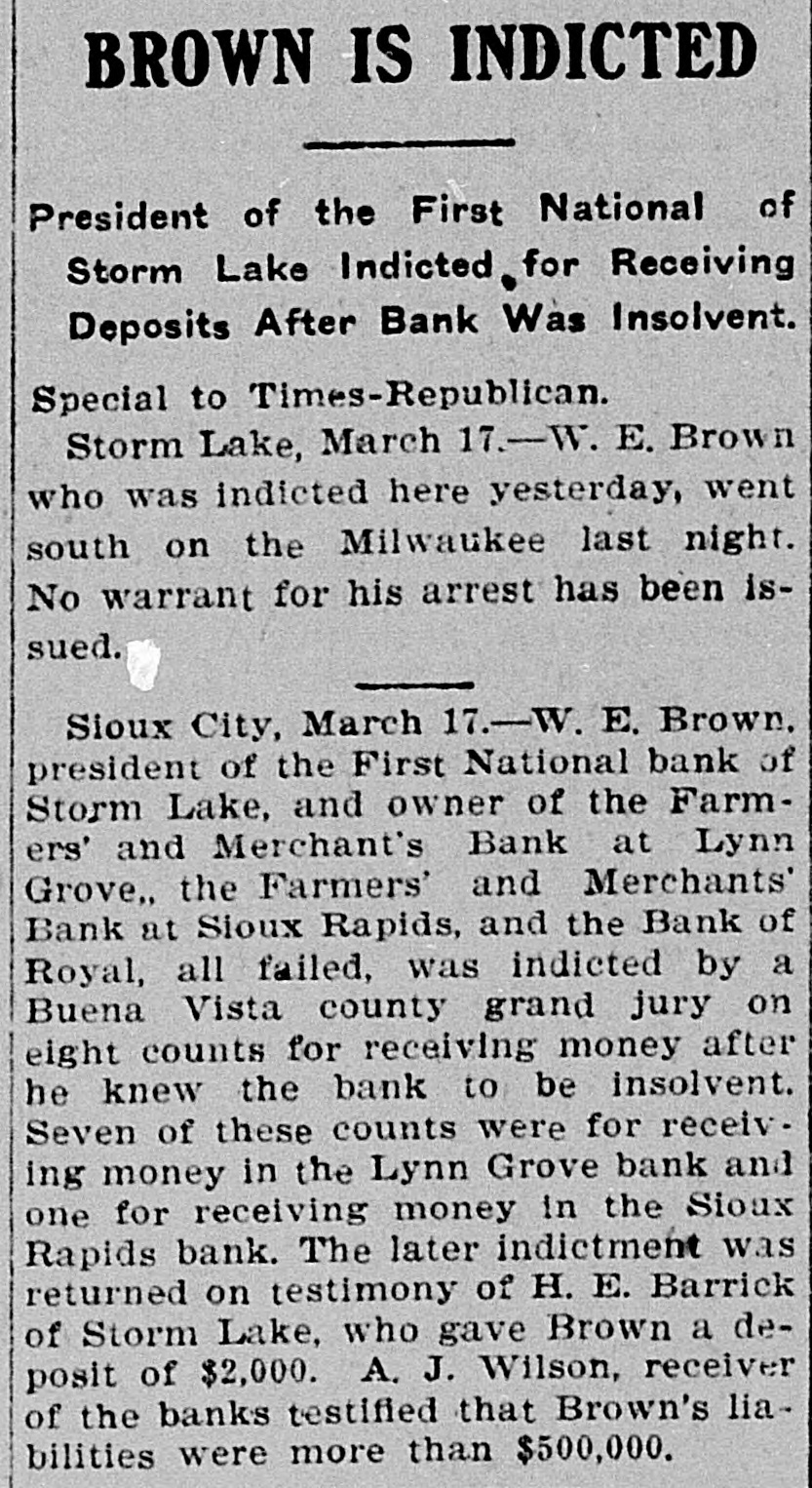
BROWN IS INDICTED President of the First National of Storm Lake Indicted for Receiving Deposits After Bank Was Insolvent. Special to Times-Republican. Storm Lake, March 17.-W. E. Brown who was indicted here yesterday, went south on the Milwaukee last night. No warrant for his arrest has been issued. Sioux City, March 17.-W. E. Brown. president of the First National bank of Storm Lake, and owner of the Farmers' and Merchant's Bank at Lynn Grove., the Farmers' and Merchants' Bank at Sioux Rapids, and the Bank of Royal, all failed, was indicted by a Buena Vista county grand jury on eight counts for receiving money after he knew the bank to be insolvent. Seven of these counts were for receiving money in the Lynn Grove bank and one for receiving money in the Sioux Rapids bank. The later indictment was returned on testimony of H. E. Barrick of Storm Lake, who gave Brown a deposit of $2,000. A. J. Wilson, receiver of the banks testified that Brown's liabilities were more than $500,000.


Article from Evening Times-Republican, October 6, 1905

Click image to open full size in new tab

Article Text

THE TRIAL OF BROWN Some Interesting Testimony in Case -Against the Storm Lake Banker HAD BIG PERSONAL OVERDRAFT Government Trying to Show That Brown Had Passed Worthless Certificates to Branch Banks When He Knew They Were Insolvent-Employes Give Testimony. Special to Times-Republican. Sioux City, Oct. 6.--In the trial of W. E. Brown, the Storm Lake banker, charged with fraudulent banking, some interesting testimony has been developed. The government is trying to prove that Brown used the Farmers' and Mechanics' bank of Linn Grove and. Sioux Rapids in order to reduce his personal overdraft at the First National bank of Storm Lake through the means of passing worthless certificates of deposit from one bank to the other. Brown, accused of falsely reporting to the comptroller of the currency and falsifying the books of the First National bank of Storm Lake, sat unmoved throughout the trial, toying with a pencil or marking down figures on a piece of paper. The testimony in question was given by L. R. Crowell, who a number of years was bookkeeper of the bank at Sioux Rapids. Crowell testified that the Farmers' and Merchants bank of Linn Grove and Sioux Rapids were owned by Brown. The direct examination was long, but the gist of his testimony was that Brown finding he had a personal overdraft of $10,800 in the First National bank of Storm Lake, issued a certificate of deposit from the Sioux Rapids bank to the one at Storm Lake for $8,000, thus leaving the personal overdraft of $2,800. This transaction took place when H. W. Mayne was cashier of the bank at Sloux Rapids. Shortly after the deal Mayne shot himself and the bank went into the hands of Receiver F. F. Faville. The latter, on investigating, found that no record of the issuance of the certificate of deposit was kept on the books of the bank at Sioux Rapids. "Who arranged these transactions?" he was asked. "Mr. Brown.' "How could he issue the certificate of deposit from the bank at Sloux Rapids without it getting on your books?" "Mr. Brown kept blanks for this purpose at his office at Storm Lake." Further testifying Crowell said in order to balance out the account at the bank at Sioux Rapids, Brown had issued a certificate of deposit from the