gpt-5-mini (chosen from majority vote of a three-model LLM ensemble)
Short Digest
02228320305da3cf
Response Measures
None
Description
President committed suicide prior to suspension; state later assumed control and liquidated the bank.
Events (4)
1.June 6, 1931Suspension
Cause
Bank Specific Adverse Info
Cause Details
Frozen assets cited by state banking commissioner; president Arthur L. Hubbard committed suicide about a month earlier.
Newspaper Excerpt
The Union Trust Company, with deposits of $4,500,000, is open today only for the purpose of receiving ninetyday notices of intention to withdraw deposits... assigned frozen assets as the cause for suspension of general business.
Source
newspapers
2.June 16, 1933Other
Newspaper Excerpt
Officials of the Union Trust company went to Indianapolis, today to lay before the state banking commission details of the proposed plan for reopening the institution... contemplates establishment of guaranty fund and organization of holding company to segregate assets and speed liquidation and distribution among the common depositors.
Source
newspapers
3.July 24, 1933Receivership
Newspaper Excerpt
UNION TRUST IN STATE'S HANDS... The state banking department is in complete charge of the bank... The machinery permitting Mr LaPlante to take over the Union Trust company was put into operation immediately upon his arrival here and Mr. Obenchain was to file notice of the state's action in superior court... under the 1933 Indiana bank code the state stepped in.
Source
newspapers
4.August 3, 1933Other
Newspaper Excerpt
The Union Trust Company filed a petition late today... asking Judge Fred Bingham to issue a rule calling upon the state banking department to show why it should not return the liquidation of the bank to its officers.
Source
newspapers
Newspaper Articles (17)
1.June 6, 1931The Indianapolis TimesIndianapolis, IN
Click image to open full size in new tab
Article Text
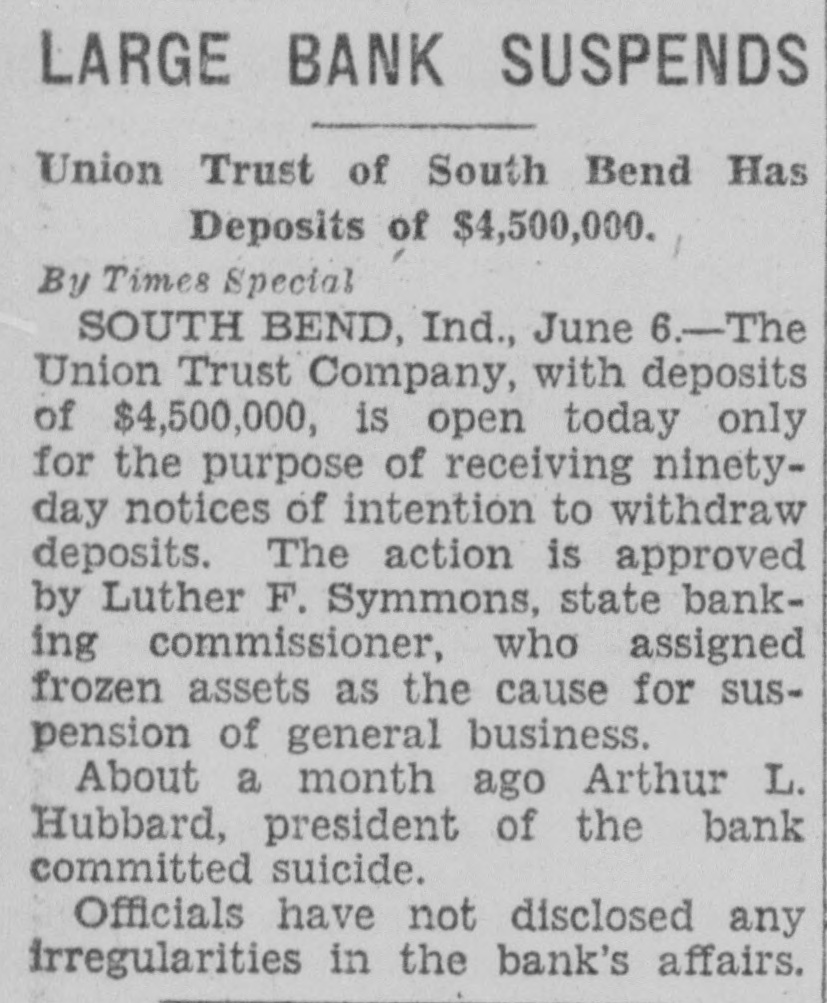
LARGE BANK SUSPENDS Union Trust of South Bend Has Deposits of $4,500,000. By Times Special SOUTH BEND, Ind., June 6.-The Union Trust Company, with deposits of $4,500,000, is open today only for the purpose of receiving ninetyday notices of intention to withdraw deposits. The action is approved by Luther F. Symmons, state banking commissioner, who assigned frozen assets as the cause for suspension of general business. About a month ago Arthur L. Hubbard, president of the bank committed suicide. Officials have not disclosed any irregularities in the bank's affairs.
2.June 6, 1931Vidette-Messenger of Porter CountyValparaiso, IN
Article Text
SOUTH BANK South Bend, June Union Trust Company, South Bend, one of the Indiana banks, today was open only to receive notices of intention to withdraw deposits, it announced. The action was approved Luther Symons, state banking who commissioner, from that frozen assets caused the suspension of regular business.
3.July 20, 1931The South Bend TribuneSouth Bend, IN
Article Text
MOVING BEGUN BY UNION TRUST
With its new quarters in the Union Trust building ready for OCcupancy, the Union Trust company began the transfer of records and equipment from the temporary headquarters in the Associates building. Frederick Cunningham, newlyelected said that the tailed plan for and liquidation, which was to have been announced to-day, was not completed. The is expected later this week. The bank will resume its former quarters in the Union Trust buildand partition has been installed dividing from the First Bank Trust company.
4.February 19, 1932The South Bend TribuneSouth Bend, IN
Article Text
CAN'T FORECAST DIVIDENDS
Payment to Depositors Hinges on Bank's Debtors and Real Estate Demand.
[Statement Page Eight. Section Following suggestion of the department of banking of Indiana, the Union Trust company of South Bend, through president, Frederick Cunningham, to-day sued statement of the condition of the bank as of Feb. 18, 1932. The includes, not only digest of the resources and liabilities, but also an explanation of the policy of liquidation being followed by officers and board of direcThe bank suspended June 1931. The statement. signed by Mr. follows: the suggestion of the department banking of are pleased hand statement of the the Union company as Feb. 18, 1932. This presented in the by the for the use of agents in closed in Indiana. "In addition to the assets of the bank listed this report, and in cash which the erty of the savings depositors the Union pany segregated for their benefit.
Divest Selves of Trusts. "We further have and which the property of the holders of UnTrust certificates and is segregated for their benefit. required by law. we have divested ourselves of trusts as rapidly as possible. The remaining securities and the segregated belonging the trusts do not appear the "Our of all expenses for the period 1931, date We officers and employes our list the salaries erage per month. One our officers serving without compensation. We are paying no tainer fees and legal expenses so far have been practically nil. "Our policy as to acceptance of assigned accounts for application on loans or the purchase of assets, has been definitely fixed by our board of directors. Generally we will accept such accounts only for the reduction purchase of assets of doubtful value which under present cannot be reduced to cash. By accepting assigned accounts such the maining are Can't Forecast Dividends. "It is impossible under existing conditions to forecast our ability pay cash dividends our depositWhen our debtors are able to pay in cash when the open for to and for real estate, will be able to "It has been our constant deavor fixed policy during the liquidation of the bank to talk with such will call the bank and to give them all the formation which they are justly entitled. We profoundly regret that cannot at this time make any statement when and in amounts will be able to pay dividends.'
5.April 12, 1932The South Bend TribuneSouth Bend, IN
Article Text
FOR DIVIDEND DEPOSITORS
10 Per Cent Distribution, Same as Union, Planned if Plea Succeeds.
EMMONS MADE PRESIDENT
Succeeds E. H. Miller, Sr., Who Resigned; Haberle is Board Chairman.
The American Trust company, which closed last June 13, will apply to the Reconstruction Finance corporation for loan sufficient to distribute per cent dividend all depositors, was announced day. Such dividend, based on $3,044,in deposits on March would release $304,425.06 to local persons whose funds been tied up in the institution. The closed Union Trust company also seeking Reconstruction Finance loan for per cent dividend amounting to $276,000 and these projected dividends, together $41,376.12 distribution already declared Union Trust savings investors' accounts, makes total which may be released depositors. Announcement of the preparation an application the Finance corporation by the American Trust nection the election Emmons of the bank to M. Miller, resigned Mr. agent the institution since the closing. John B. Haberle has been elected the board succeed Mr. Miller and Albert named vice Rerick elected Albert McGann secretary and Titus trust officer. Mr. Emmons, Mr. Mr. Rerick, Mr. McGann M. Sanders, who represents the stockholders' and depositors' committee. Other members of the stockholders' and depositors' committee George Harrop and Herman Ries. the Haberle, Mr. Emmons, Fulk, Mr. Rerick. Alexis Coquillard, Adler, K. Vitus Jones and Herbert Sharlock. The were meeting Monday Takes Time for Results.
Referring to the application to the Finance corpoMr. "It proposed to present an application loan to Reconcorporation which to pay dividend positors approximately cent. The application and supplemental forms are in process and will be ready to file with within time. difficult this money available for ment depositors but the the officials release the fund can procured. should borne mind, however, that take time and efto obtain desired Emmons said that the stockholders presented with reports Monday's meeting covering all phases the liquidation. Chief among these reoprts was ing net reduction assets since the closing. Deposits have transfer of posit by assignments, Surplus Reduced. Surplus and undivided profits show reduction, according to Emmons, since the closthe difference tween the earnings the since closing and losses sustained on the sale securities held banks as collateral for loans. The collateral was sold
6.June 2, 1932The TimesHammond, IN
Article Text
IT MIGHT EASILY BE ADOPTED IN HAMMOND
Civic Leaders Studying Plan Impressed With Its Practical Value
Hammond may very easily adopt the South Bend plan for stimulating business and liquidating closed banks, a committee of Hammond civic leaders reported today after spending yesterday in South Bend studying the plan in detail.
Mayor Charles O. Schonert, who headed the committee, was particularly impressed with practical value of the plan. Other members of the committee who asserted that the scheme may be adopted in Hammond, were Ed Simon, president of the Manufacturers' association; Irving Chayken, president of the Merchants' association, and John H. Rippe, receiver of the American Trust and Savings bank.
The committee now proposes to report their findings to all bank receivers in Hammond and then to Superior Judges Virgil S. Reiter and Clyde Cleveland, who maintain supervision over receiverships of closed state banks in this city.
PUBLIC MASS MEETING
Then, a public mass meeting will be held to place all details before the general public so that depositors of closed banks may be in a position to decide whether or not they wish to adopt the plan in the banks in which they maintain deposits.
The committee arrived in South Bend early yesterday morning and immediately went into conference in the Chamber of Commerce headquarters there with George Firmin, secretary-manager of the chamber; C. F. Cunningham and W. W. Austin, liquidating agents for the Union Trust company, and Albert McGann and J. D. Emmons, liquidating agents for the American Trust and Savings bank.
Following the morning conference, the group visited each closed bank which is participating in the plan. They studied the technical operation there and plied the liquidating agents with a host of questions.
The Hammond committee learned that depositors first obtain an assignment of their deposits from the bank in which their money was deposited. This assignment then is used as currency for merchandise, rent, professional services, and food.
7.June 2, 1932The TimesHammond, IN
Article Text
PUBLIC MASS MEETING
Then, a public mass meeting will be held to place all details before the general public so that depositors of closed banks may be in a position to decide whether or not they wish to adopt the plan in the banks in which they maintain deposits.
The committee arrived in South Bend early yesterday morning and immediately went into conference in the Chamber of Commerce headquarters there with George Firmin, secretary-manager of the chamber; C. F. Cunningham and W. W. Austin, liquidating agents for the Union Trust company, and Albert McGann and J. D. Emmons, liquidating agents for the American Trust and Savings bank.
Folowing the morning conference, the group visited each closed bank which is participating in the plan. They studied the technical operation there and plied the liquidating agents with a host of questions.
The Hammond committee learned that depositors first obtain an assignment of their deposits from the bank in which their money was deposited. This assignment then is used as currency for merchandise, rent, professional services, and food.
Grocery stores accept the assignments up to 60 per cent of their face value. Furniture dealers, jewelry stores, and second hand automobile dealers accept the assignments up to 100 per cent of their face value,
(Continued on Page Eleven)
8.June 2, 1932The TimesHammond, IN
Article Text
PUBLIC MASS MEETING
Then, a public mass meeting will be held to place all details before the general public so that depositors of closed banks may be in a position to decide whether or not they wish to adopt the plan in the banks in which they maintain deposits.
The committee arrived in South Bend early yesterday morning and immediately went into conference in the Chamber of Commerce headquarters there with George Firmin, secretary-manager of the chamber; C. F. Cunningham and W. W. Austin, liquidating agents for the Union Trust company, and Albert McGann and J. D. Emmons, liquidating agents for the American Trust and Savings bank.
Following the morning conference, the group visited each closed bank which is participating in the plan. They studied the technical operation there and plied the liquidating agents with a host of questions.
The Hammond committee learned that depositors first obtain an assignment of their deposits from the bank in which their money was deposited. This assignment then is used as currency for merchandise, rent, professional services, and food.
Grocery stores accept the assignments up to 60 per cent of their face value. Furniture dealers, jewelry stores, and second hand automobile dealers accept the assignments up to 100 per cent of their face value,
(Continued on Page Eleven)
9.June 2, 1932The TimesHammond, IN
Article Text
IT MIGHT EASILY BE ADOPTED IN HAMMOND
Civic Leaders Studying Plan Impressed With Its Practical Value
Hammond may very easily adopt the South Bend plan for stimulating business and liquidating closed banks, a committee of Hammond civic leaders reported today after spending yesterday in South Bend studying the plan in detail.
Mayor Charles O. Schonert, who headed the committee, was particularly impressed with practical value of the plan. Other members of the committee who asserted that the scheme may be adopted in Hammond, were Ed Simon, president of the Manufacturers' association; Irving Chayken, president of the Merchants' association, and John H. Rippe, receiver of the American Trust and Savings bank.
The committee now proposes to report their findings to all bank receivers in Hammond and then to Superior Judges Virgil S. Reiter and Clyde Cleveland, who maintain supervision over receiverships of closed state banks in this city.
PUBLIC MASS MEETING
Then, a public mass meeting will be held to place all details before the general public so that depositors of closed banks may be in a position to decide whether or not they wish to adopt the plan in the banks in which they maintain deposits.
The committee arrived in South Bend early yesterday morning and immediately went into conference in the Chamber of Commerce headquarters there with George Firmin, secretary-manager of the chamber; C. F. Cunningham and W. W. Austin, liquidating agents for the Union Trust company, and Albert McGahn and J. D. Emmons, liquidating agents for the American Trust and Savings bank.
Following the morning conference, the group visited each closed bank which is participating in the plan. They studied the technical operation there and plied the liquidating agents with a host of questions.
The Hammond committee learned that depositors first obtain an assignment of their deposits from the bank in which their money was deposited. This assignment then is used as currency for merchandise, rent, professional services, and food.
Grocery stores accept the assignments up to 60 per cent of their face value. Furniture dealers, jewelry stores, and second hand automobile dealers accept the assignments up to 100 per cent of their face value.
10.June 13, 1932The TimesHammond, IN
Article Text
RESERVATIONS ARE LIMITED
So many reservations are pouring in for the luncheon meeting to be held Friday noon when the South Bend bank aid plan is to be discussed, that sponsors of the meeting are forced to limit the attendance to 75, Irving Chayken, president of the Hammond Merchants' association, announced today.
He said reservations will be distributed among all organizations in the city, but that each organization must limit its representation to five members.
Four liquidating agents of closed South Bend banks will be present to explain their plan for hastening liquidation and stimulating business. They are C. F. Cunningham and W. W. Austin of the Union Trust company, and J. D. Emmons and Albert McGann of the American Trust and Savings bank.
Mayor Charles O. Schonert, who is sponsoring the movement to introduce the plan in Hammond, will preside at the meeting. He has mailed invitations to the following organizations.
Parent-Teachers associations, ward civic organizations, luncheon clubs, Chamber of Commerce, Merchants' association, Manufacturers' association, depositors' committees, bank receivers, superior court judges, aldermen and various civic leaders.
Mr. Chayken today is wiring the state banking department requesting the presence of a representative of that department at the conference so that his opinion concerning its adaptability to Hammond's peculiar situation may be obtained.
Mayor Schonert proposes to hold the meeting in session until some definite decision is reached on the issue.
11.June 26, 1932The South Bend TribuneSouth Bend, IN
Article Text
STATE COURT'S DELAY IN BANK RULING SCORED
"Pathetic," Says One Receiver; "Dilatory" Second Charges.
AFFECTED
Public Funds Held Up; Also Prevents Distribution of $20,000 in County.
More than $20,000 is lying dormant in St. Joseph county bank vaults awaiting decision by the Indiana supreme court that will provide for the distribution of the money by receivers for three defunct banks in the county. The same decision will directly effect nearly $1,000,000 in public funds tied up in three other closed South Bend which are now in the liquidation. Definite action by the higher court has been for nearly since the test case was transferred to that court from the Indiana court, where on file nearly two years before justices of that court disagreed decision. Since the Cound its way to the supreme court, several similar appeals have been taken from every section of the state. estimated that throughout the state effected by court's delay in handing down ruling.
Calls Delay Attorney Orie Parker, who represents Miss Ethel receivfor the Franklin Trust company, declared: pathetic the way the court delays action on an important issue of that kind.' Schurz, receiver for the North Liberty State bank said: supreme court has the reputation being dilatory. or years making decision and, from past experiences, another five years before the ruling is made. The Franklin company has about $8,000 for the question the priority claims on public funds blocks the payment the money to depositThis question must be setin the higher Mr. Schurz said today that he could distribute about $8,000 if the priority claim dispute was The blocking the payment $5,000 ready the hands of Citizens' Trust Savings bank. receiver for Lakeville State bank
Three Banks Affected. Three other large South Bend closed and in the process liquidation, are also hampered by the dispute to priority. They are Union Trust company half million dollars being held in public funds. The bank about $100,000 public funds tied up, of which $85,000 belongs to Bend school Over $100,000 school funds being held the American Trust comSeveral townships also have pany. funds in the closed South Bend banks. was pointed out that suits against surety bond signers coverthe money these banks have ing but determination been priority claims would exonerate the bond signers in event the public funds are given priority. Only recently the Union ship the town of this county, awarded in superior court No. against bond covering in Lakeville State the amounting to bank, $20,000. Will Be Appealed. This decision to be appealed the supreme court Attorney Walter Arnold, was said Saturday. petition by the receiver of the following the judgment, distribute blocked by town and until the higher court rules on the claims. The Washington State bank has one payment of 10 per but time that sufficient addithe tional funds were available to meet claims in the event the priority court ruled their favor. higher Continued Page Six. Column
12.June 16, 1933The South Bend TribuneSouth Bend, IN
Article Text
STATE BOARD REOPEN BANK
Union Trust Lay Details Before Commissioners.
REORGANIZATION READY
Establishment of Guaranty Fund and Holding Company Included.
Officials of the Union Trust company went to Indianapolis, today to lay before the state banking commission details of the proposed plan for reopening the institution. If the plan, which is similar to that being pursued by the American Trust company, is approved by the state banking commission the reorganization machinery will be set up immediately. The Union Trust plan contemplates the establishment of guranty fund, probably from the assets of the affiliate First & Union company, and the organization of holding company to segregate the assets and speed liquidation and distribution among the common depositods. The of depositors has been duced 12,000 to about 5,000 during the last two years proposed to the Union Trust company from its quarters the First Bank Trust buildthe quarters of the South Bend State bank, liquidation which has been taken over by the Union Trust The bank officials carrying the plan today are Cunningham. Austin and Harold Robertson. liquidating ficers, and Walter R. Arnold, attorney Accompanying them were two officials of Washington State bank, which closed its doors two one-half years ago and went The Washington State liquidating officers, and Harry Pravat, are considering plan reorgan ization for their and will discuss the matter with the state department. meeting of directors of the Washington State bank to have been held late Thursday to discus the reopening proposal but was postponed until week cause number of the directors were absent from the city.
13.June 16, 1933The South Bend TribuneSouth Bend, IN
Article Text
Union Trust Action Dismissed by Slick FILED;
U. S. Judge Declares Suit is Out of Jurisdiction.
Declaring his court was without jurisdiction to hear the case, Federal Judge Thomas W. Slick today dismissed the suit of Miss Florence B. Robinson, of Chicago, to collect $400,000 in county funds from Woodson S. Carlisle and F. Cunningham, as directors of the closed Union Trust company, on behalf of St. Joseph county tax payers. Attorney Harold T. Miller, local counsel for Miss Robinson, who Friday eliminated Vincent Bendix and Walter Buettner as co-defendants, said today that similar suit would be refiled soon in court, possibly next week. The original suit named the county board co-defendants with the four rectors alleged of citizenship which would enable the cause be filed federal court instead of the state courts Friends of the court pointed out that the real party interest Joseph county and that consequently the board commissioners should be the plaintiff in the suit and such being the case diversity of citizenship would Complaint Explained. Mr Miller explained today that the reason the county commissioners had been named co-defendants as set forth in complaint, they had allegedly refused and failed to sue the directors for recovery of the county funds deposit in the Union Trust company when closed June 1931 the suit which will filed Miss Robinson alone the complainant, Miller said. will prepared with plenty authority tax payer well as resident tax payer suing municipal funds. The fact that Miss Robinson resident of Illinois and be named are of Indiana and the is more than should give the federad court time. In opinion the suit, Judge Slick stated plain that this action is brought by the plaintiff for and behalf St Joseph county In fact, plaintiff in her prayer relief against the two defendants. who directors of the Union Trust company, in the sum of coverable for and on behalf of plaintiff for St Joseph county. Benefit to Board.
"St. Joseph county transacts business by and through its board of county which board is, under the statutes of Indiana, body corporate The then the interests of and for the benefit of the board of county commissioners of St. Jo. seph county. well settled principle of law that federal courts in determining their own jurisdiction based adverse citizenship will align realign the parties cording to their interest. St. seph county or the board of commissioners St. Joseph county should be aligned as plaintiff; not defendant When this alignment is made no jurisdiction remains in this court 80, title 28 U. S. which section 37 the judicial mode, provides in any suit in district court shall appear to the of district at any time such suit has that such suit does not really and substantially involve dispute controversy properly within the jurisdiction of said district court the said district court shall proceed no further therein, but shall dismiss the suit justice may require and shall make such order as to costs as shall be
14.July 24, 1933The South Bend TribuneSouth Bend, IN
Article Text
UNION TRUST IN STATE'S HANDS
Liquidating Committee is Supplanted by J. E. B. LaPlante.
Continued from Page One. Column Seven
W. W. Austin and Woodson S. Carlisle. Mr. Obenchain will replace Harold Robertson as attorney for the liquidating activities "The state banking department is in complete charge of the bank but we do not contemplate any immediate changes in the clerical personnel, Mr LaPlante said. Release Deposits. The state liquidating agent said he has received no instructions from regarding the Washington State bank and American Trust company other state institutions here which are in voluntary liquidation He also explained that for the time being the department will concern itself only with accelerating the release of deposits in institutions which are in voluntary liquidation. It was indicated that no assistants to aid Mr. LaPlante in the liquidation of the Union Trust will be named at present The machinery permitting Mr LaPlante to take over the Union Trust company was put into operation immediately upon his arrival here and Mr. Obenchain was to file notice of the state's action in superior court this afternoon accordance with the 1933 Indiana bank code similar notice was to be posted on the doors of the Union Trust company
Minimum Expense. The salary of Mr. LaPlante which will be determined by the work with which he is confronted, will be small, he said, because of the state's determination to carry on efficient liquidation at miniimum f S wateB el ET S H RD All fees. expenses and salaries of the liquidation must be approved by court in which the notice is filed by Mr. Obenchain and will be accompanied by regular reports on the progress of liquidation. Asked if the state's action throws into discard the plan of Union Trust officials to reorganize and reopen under proposal similar to that of the American Trust company Mr LaPlante said The 1933 banking law provides that reorganization may be about even after the state has stepped
15.August 4, 1933The Indianapolis StarIndianapolis, IN
Article Text
BANK STARTS SUIT ON STATE CONTROL
[Special to The Indianapolis Star.] SOUTH BEND, Ind., Aug. 3.-The Union Trust Company filed a petition late today Superior court asking Judge Fred Bingham to issue a rule calling upon the state banking department to show why it should not return the liquidation of the bank to its officers. The decision to take court action reached at meeting of the bank's board of directors today. The bank's voluntary liquidation was taken July 24 by J. E. B. Laplante on behalf of the state banking department. The bank had ten days in which to take the matter into Laplante and Roland Obenchain, the meeting Thursday and advised that court action would be taken. Representative in Congress uel B. Pettengill has been retained by the to in the legal action. Laplante ceeded Austin and Woodson Carlisle, members of the voluntary liquidation committee.
16.August 17, 1933The South Bend TribuneSouth Bend, IN
Article Text
STATE ASSUMES DUTIES AT BANK
Takes Over Walkerton Institution; Name Clements Aid.
J. B. E. LaPlante. state liquidating chief for closed banks in the South Bend-Gary district, today took over the Farmers' State bank of Walkerton upon instructions from Indianapolis. State control of the bank, which has been closed since Feb. 27, 1931, was ordered by Richard A. McKinley, director of the new state department of financial institutions. It is the third closed bank to be taken over, the Union Trust and Washington State bank. both of South Bend. having been under northern Indiana. state control three weeks. Mr. LaPlante announced that Milo W. Slick, who has been serving as liquidating agent of the Farmers' State bank of Walkerton. will continue in active charge of affairs as special representative of the state department. Walter L. Clements former city attorney of South Bend, has been designated as attorney to act for Mr. LaPlante and the state department. A formal notice stating that the bank is "insolvent or in imminent danger of insolvency" was filed by Mr. Plante in superior court No today. The notice claims that state control is necessary for the "best interest of the depositors. Mr. LaPlante, who is directing the activities of three appraisers at the Union Trust company. said he has no information as to whether the state will take over any other smaller banks in the the county county. Since the Farmers' State bank of Walkerton closed its doors following heavy run it has paid out dividends amounting to 36 per cent on its total deposit liability. Mr. LaPlante explained. boys. The present book value of the bank's assets as estimated by Mr. LaPlante $105,000 as against remaining deposit liability of $72,000.
17.February 3, 1934The South Bend TribuneSouth Bend, IN
Article Text
DELAY HEARING IN BANK TANGLE
Bingham Grants Request for More Time; Set for Feb. 12.
The hearing before Superior Judge J. Fred Bingham of controversial legal issues involving liquidation of the First National bank, the Union Trust company and the South Bend State bank, scheduled for Friday afternoon, has been postponed to Feb. 12, first day of the February term of court.
Continuance was asked by the state department of financial institutions, which filed the petition for the hearing, to provide more time in which to prepare information for the court on the tangled affairs of the three institutions.
The petition sets out in detail contracts made between the South Bend State, which was located in the Uptown district, and the two downtown institutions, whereby the latter agreed to take over all assets of the smaller bank in an effort to protect its creditors.
No one realized then, the petition says, that the city was on the threshold of a long depression which later was to sweep the two large banks themselves into liquidation. The contracts provided the First National and Union Trust should not suffer losses in the handling of the other bank's affairs, according to the petition, but large losses, totaling nearly $100,000, have been recorded.
The court is asked to construe the contracts to determine whether they are indemnifying instruments, protecting the two institutions from losses in the transfer.
Complicating the matter are two contracts made between the downtown institutions themselves later when heavy runs threatened their closing. Finally all three banks were in liquidation. But they had the identical officers and boards of directors. The petition charges that certain transactions between the banks effected by this interlocking directorate had the effect of defrauding certain creditors.
One charge specifically says that more than $31,000 worth of building bonds, taken over by the First National from the South
Bank runs are almost always and everywhere a deterioration of bank fundamentals.
But not for you.
You are the measure-zero exception: great fundamentals, solid bank, and yet the Diamond Dybvig fairy spread its rumor. Depositors woke up. Your collateral was not prepositioned. The Clearinghouse had it for you.
Do not pass Go. Do not collect $200. Go directly to jail… or worse.