
First National Bank (Chicago, IL)

Episode Information

Episode UID
801201
Episode Type
Run Only
Bank Type
national
Bank ID
80 national
Charter Number
8
Start Date
January 1, 1900*
Location
Chicago, Illinois (41.850, -87.650)

Metadata

Model
gpt-5-mini (chosen from majority vote of a three-model LLM ensemble)
Short Digest
0319f91a072a7ae2

Response Measures

Accommodated withdrawals, Capital injected

Description

Account is a retrospective retelling with approximate dating; precise year of the Walsh episode not specified.

Events (2)

1. June 22, 1863 Chartered
Source
historical_nic
2. January 1, 1900* Run
Cause
Bank Specific Adverse Info
Cause Details
President John R. Walsh diverted bank funds to his railroad enterprise, violating laws and causing insolvency that precipitated heavy withdrawals.
Measures
Local bankers pooled funds and injected millions into the bank's treasury following Marshall Field's advice to pay obligations and stop the run.
Newspaper Excerpt
they poured their millions of dollars into the treasury of that bank and kept pouring it in until the run on the bank was satisfied
Source
newspapers

Newspaper Articles (2)

Article from The Idaho Republican, September 29, 1920

Click image to open full size in new tab

Article Text

something that happened ten years after the other events that I told you about when he used his fortune to prevent a panic and to keep business stabilized. You may wonder why I am saying so much about Marshall Field, but to me he is a dictionary of good business principles and we ca.. afford to saturate ourselves in them. We can afford to study his operations a great deal and take plenty of time to let it soak into us. What I told you about how he prevented a painic during the world's fair applies in some measure to a condition right here in Bingham county at the present time. This other story that I am going to tell you is a little different but it applies to a set of circumstances that confront somebody in Bingham county right now. Thoughtful persons will see the connection and will draw a lesson from it and apply it to their business transactions, to their own advantage and the advantage of their fellow men in the county. # Walsh Bank Failure About the beginning of the present century John R. Walsh was the president of the First National bank of Chicago. It was a very strong bank and Mr. Walsh was a big man in business. He conceived a plan to build a connecting line with the Chicago & Central Illinois railroad to tap the coal mines of Central Illinois and taking a direct short cut into Chicago. It was a good enterprise, a bold stroke and was capable of releiving some of the other roads of their burdens of freight, and quickening the delivery of coal into Chicago. Mr. Walsh thought he could build the road and he went about it with his private fortune. When his own money was used up he used the bank's money, loaning it to himself and his railroad company. In doing this he violated the banking laws more severely than the Anderson bank at Idaho Falls violated the banking laws when it loaned upwards of a hundred thousand dollars to A. J. Stanger, who went about buying sheep and writing checks on the Anderson bank when he had no money to his credit. It was against the law for the Anderson bank to loan more than $40,000 to any one man. It was a violation of the laws for Mr. Walsh to take money out of the First National Bank of Cnicago to back his railroad enterprise. Before the road was completed Mr. walsh and the bank were in so deep that they were financially embarrassed and had to give an accounting and 'fess up. If Mr. Walsh had succeeded with his enterprise he would have come thru all right and he would have been considered a great man. # Big Bank Failure Mr. Walsh failed and the bank failed for many millions. Big failures like this are what start financial panics. When one firm cannot pay, another firm depending on them canot pay and many other firms depending on them fail, and so the damage goes on down the line until everybody connected wtih it fails. Then all the firms depending on these firms are embarrassed, they cannot pay their employes and their various other obligations, work stops pay checks do not come any longer, families go hungry, and there is a condition which we call a panic. # Consternation Among Bankers The First National Bank of Chicago was such a large bank, such a financial pillar for all the other banks in the city, that they called a meeting to see what could be done. It was a terrible surprise to find that this man walsh had goth in so deep and was involved in criminal charges. It was a terrible shock to all the other bankers to find that what was supposed to be one of the best banks in town was involved in failure and that involved them and they too, might fail. All of the enterprises depending on their own banks might fail and as they considered the matter there seemed to be no end to the failures that were likely to follow. These men sat in conference all day and all night trying to plan some way to prevent the failure. This tremendous amount of debts was no obligation of theirs and it was a criminal affair. The men responsible for it could not pay and it was not their own debt to pay, so they spent a great deal of time going over the matter to see how it all came about. But after they had been in conference twenty-four hours they were still confronted with the fact that the firm had failed and that unless something was done pretty quick, other firms would fail
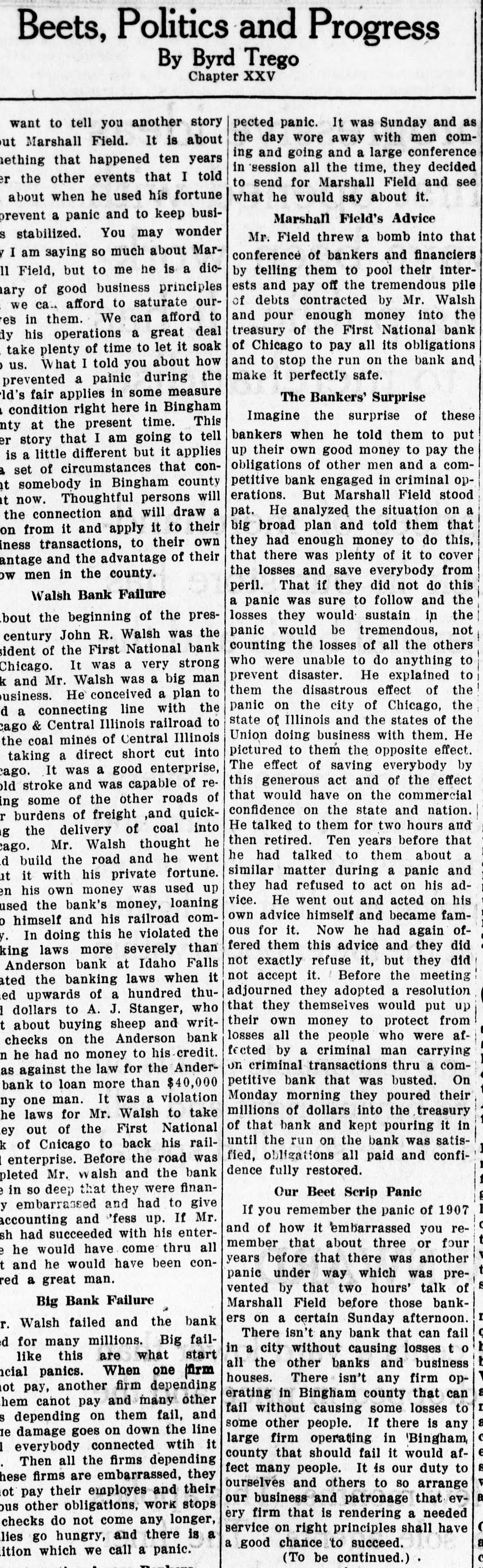

Article from The Idaho Republican, September 29, 1920

Click image to open full size in new tab

Article Text

# Beets, Politics and Progress By Byrd Trego Chapter XXV I want to tell you another story about Marshall Field. It is about something that happened ten years after the other events that I told about when he used his fortune to prevent a panic and to keep business stabilized. You may wonder why I am saying so much about Marshall Field, but to me he is a dictionary of good business principles that we can afford to saturate ourselves in them. We can afford to apply his operations a great deal and take plenty of time to let it soak into us. What I told you about how he prevented a painic during the World's fair applies in some measure to the condition right here in Bingham county at the present time. This other story that I am going to tell you is a little different but it applies to a set of circumstances that confront somebody in Bingham county right now. Thoughtful persons will see the connection and will draw a lesson from it and apply it to their business transactions, to their own advantage and the advantage of their fellow men in the county. # Walsh Bank Failure About the beginning of the present century John R. Walsh was the president of the First National bank of Chicago. It was a very strong bank and Mr. Walsh was a big man in business. He conceived a plan to build a connecting line with the Chicago & Central Illinois railroad to reach the coal mines of Central Illinois and taking a direct short cut into Chicago. It was a good enterprise, a bold stroke and was capable of relieving some of the other roads of their burdens of freight, and quick-ing the delivery of coal into Chicago. Mr. Walsh thought he would build the road and he went at it with his private fortune. When his own money was used up he used the bank's money, loaning it to himself and his railroad company. In doing this he violated the banking laws more severely than the Anderson bank at Idaho Falls violated the banking laws when it loaned upwards of a hundred thousand dollars to A. J. Stanger, who went about buying sheep and writing checks on the Anderson bank when he had no money to his credit. It was against the law for the Anderson bank to loan more than $40,000 to any one man. It was a violation of the laws for Mr. Walsh to take money out of the First National bank of Chicago to back his railroad enterprise. Before the road was completed Mr. walsh and the bank were in so deep that they were financially embarrassed and had to give an accounting and 'fess up. If Mr. Walsh had succeeded with his enterprise he would have come thru all right and he would have been considered a great man. # Big Bank Failure Mr. Walsh failed and the bank closed for many millions. Big failures like this are what start financial panics. When one firm cannot pay, another firm depending on them canot pay and many other firms depending on them fail, and the damage goes on down the line with everybody connected wtih it. Then all the firms depending on these firms are embarrassed, they cannot pay their employes and their various other obligations, work stops and checks do not come any longer, families go hungry, and there is a condition which we call a panic. It was Sunday and as the day wore away with men coming and going and a large conference in session all the time, they decided to send for Marshall Field and see what he would say about it. # Marshall Field's Advice Mr. Field threw a bomb into that conference of bankers and financiers by telling them to pool their interests and pay off the tremendous pile of debts contracted by Mr. Walsh and pour enough money into the treasury of the First National bank of Chicago to pay all its obligations and to stop the run on the bank and make it perfectly safe. # The Bankers' Surprise Imagine the surprise of these bankers when he told them to put up their own good money to pay the obligations of other men and a competitive bank engaged in criminal operations. But Marshall Field stood pat. He analyzed the situation on a big broad plan and told them that they had enough money to do this, that there was plenty of it to cover the losses and save everybody from peril. That if they did not do this a panic was sure to follow and the losses they would sustain in the panic would be tremendous, not counting the losses of all the others who were unable to do anything to prevent disaster. He explained to them the disastrous effect of the panic on the city of Chicago, the state of Illinois and the states of the Union doing business with them. He pictured to them the opposite effect. The effect of saving everybody by this generous act and of the effect that would have on the commercial confidence on the state and nation. He talked to them for two hours and then retired. Ten years before that he had talked to them about a similar matter during a panic and they had refused to act on his advice. He went out and acted on his own advice himself and became famous for it. Now he had again offered them this advice and they did not exactly refuse it, but they did not accept it. Before the meeting adjourned they adopted a resolution that they themselves would put up their own money to protect from losses all the people who were affected by a criminal man carrying on criminal transactions thru a competitive bank that was busted. On Monday morning they poured their millions of dollars into the treasury of that bank and kept pouring it in until the run on the bank was satisfied, obligations all paid and confidence fully restored. # Our Beet Scrip Panic If you remember the panic of 1907 and of how it embarrassed you remember that about three or four years before that there was another panic under way which was prevented by that two hours' talk of Marshall Field before those bankers on a certain Sunday afternoon. There isn't any bank that can fail in a city without causing losses to all the other banks and business houses. There isn't any firm operating in Bingham county that can fail without causing some losses to some other people. If there is any large firm operating in Bingham county that should fail it would affect many people. It is our duty to ourselves and others to so arrange our business and patronage that every firm that is rendering a needed service on right principles shall have a good chance to succeed. (To be continued.).