Bank of Connersville (Connersville, IN)

Episode Information

Episode UID
804817890658
Episode Type
Suspension โ†’ Closure
Bank Type
private
Bank ID
80481789 hash
Start Date
October 13, 1854
Location
Connersville, Indiana (39.641, -85.141)

Metadata

Model
gpt-5-mini (chosen from majority vote of a three-model LLM ensemble)
Short Digest
16ca756583ac8e18

Response Measures

None

Description

Suspended in October 1854 and subsequently wound up/liquidated by state authorities over 1855โ€“1856.

Events (4)

1. October 13, 1854 Suspension
Cause
Local Banks
Cause Details
Panic and contagion from failures and suspensions of nearby banks and a broader Indiana free-bank note panic that led brokers to refuse Connersville notes.
Newspaper Excerpt
The Kentucky Trust Co. Bank, Covingington, suspended to-day. Notes of the Bank of Connersville, Ind., refused.
Source
newspapers
2. October 25, 1854 Other
Newspaper Excerpt
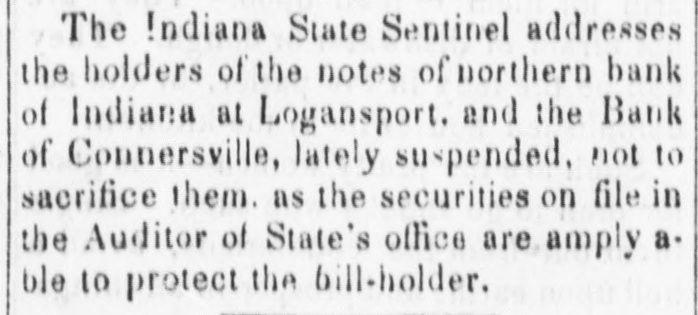
the Bank of Connersville, lately suspended, not to sacrifice them, as the securities on file in the Auditor of State's office are amply able to protect the bill-holder.
Source
newspapers
3. June 11, 1855 Other
Newspaper Excerpt
The Auditor of the State of Indiana notifies holders of the circulating notes ... Bank of Connersville ... to return the same to the office for cancellation, ... and a pro rata dividend thereon declared.
Source
newspapers
4. April 23, 1856 Receivership
Newspaper Excerpt
The Auditor of the State of Indiana gives notice that the notes of the following Free Banks have been placed in liquidation, and gives notice to the holders of the notes of said banks to have them at his office for redemption ... Bank of Connersville.
Source
newspapers

Newspaper Articles (24)

Article from The Evansville Daily Journal, October 19, 1854

Click image to open full size in new tab

Article Text

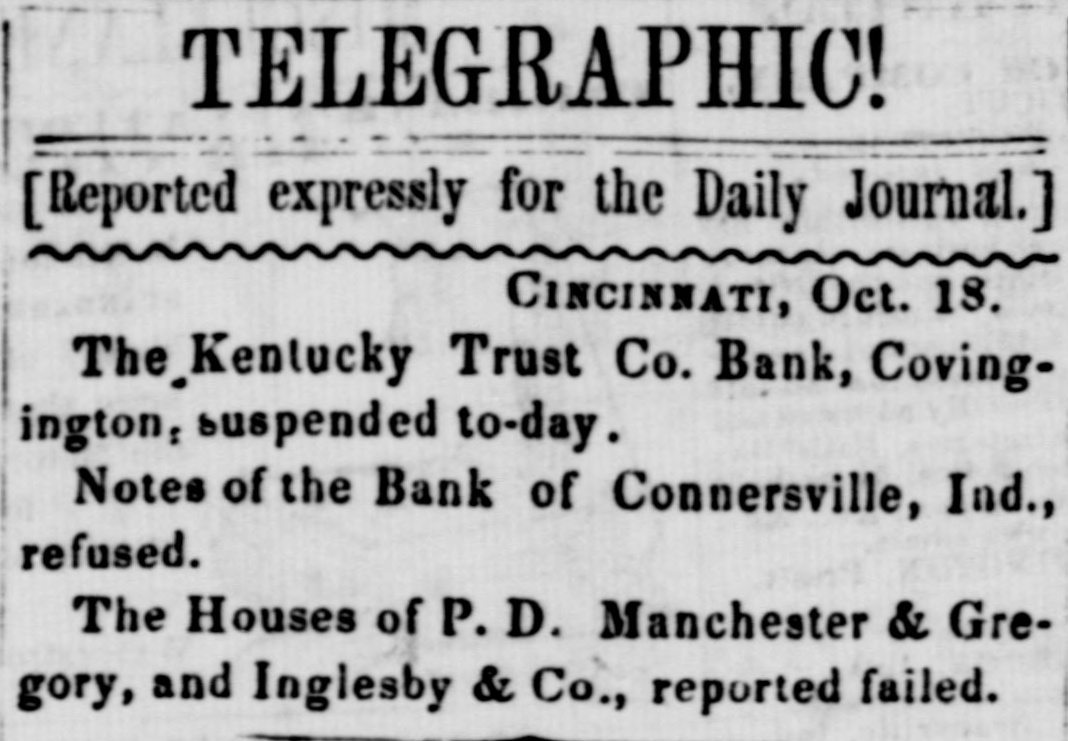
TELEGRAPHIC! [ Reported expressly for the Daily Journal.] CINCINNATI, Oct. 13. The Kentucky Trust Co. Bank, Covingington, suspended to-day. Notes of the Bank of Connersville, Ind., refused. The Houses of P. D. Manchester & Gregory, and Inglesby & Co., reported failed.


Article from Meigs County Telegraph, October 24, 1854

Click image to open full size in new tab

Article Text

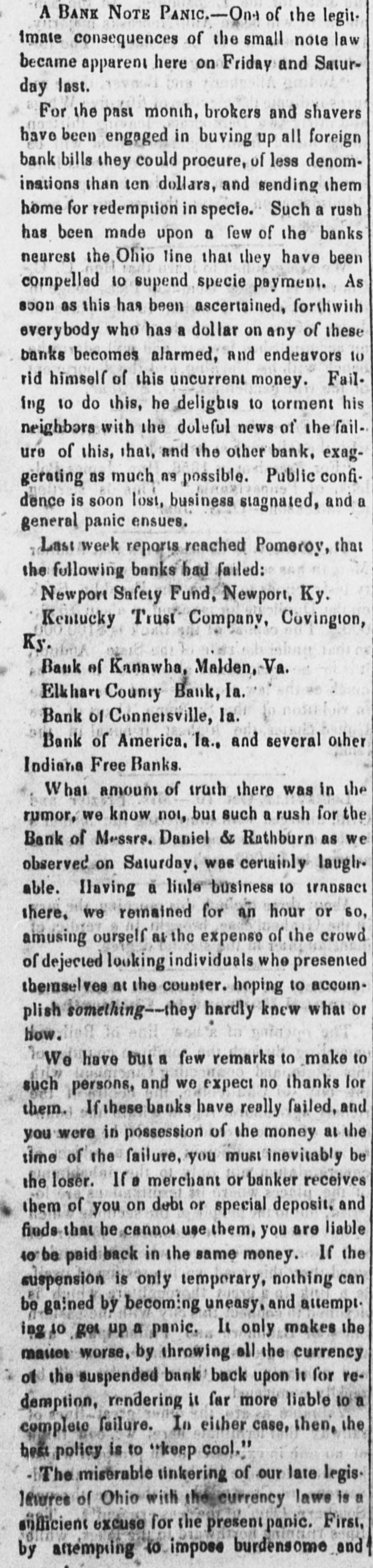
# A BANK NOTE PANIC. One of the legitimate consequences of the small note law became apparent here on Friday and Saturday last. For the past month, brokers and shavers have been engaged in buying up all foreign bank bills they could procure, of less denominations than ten dollars, and sending them home for redemption in specie. Such a rush has been made upon a few of the banks nearest the Ohio line that they have been compelled to supend specie payment. As soon as this has been ascertained, forthwith everybody who has a dollar on any of these banks becomes alarmed, and endeavors to rid himself of this uncurrent money. Failing to do this, he delights to torment his neighbors with the doleful news of the failure of this, that, and the other bank, exaggerating as much as possible. Public confidence is soon lost, business stagnated, and a general panic ensues. Last week reports reached Pomeroy, that the following banks had failed: Newport Safety Fund, Newport, Ky. Kentucky Trust Company, Covington, Ky. Bauk of Kanawha, Malden, Va. Elkhart County Bank, Ia. Bank of Connersville, Ia. Bank of America, Ia., and several other Indiana Free Banks. What amount of truth there was in the rumor, we know not, but such a rush for the Bank of Messrs. Daniel & Rathburn as we observed on Saturday, was certainly laughable. Having a little business to transact there, we remained for an hour or so, amusing ourself at the expense of the crowd of dejected looking individuals who presented themselves at the counter, hoping to accomplish something--they hardly knew what or how. We have but a few remarks to make to such persons, and we expect no thanks for them. If these banks have really failed, and you were in possession of the money at the time of the failure, you must inevitably be the loser. If a merchant or banker receives them of you on debt or special deposit, and finds that he cannot use them, you are liable to be paid back in the same money. If the suspension is only temporary, nothing can be gained by becoming uneasy, and attempt-ing to get up a panic. It only makes the matter worse, by throwing all the currency of the suspended bank back upon it for re-demption, rendering it far more liable to a complete failure. In either case, then, the best policy is to "keep cool." -The miserable tinkering of our late legis-leures of Ohio with the currency laws is a sufficient excuse for the present panic. First, by attempting to impose burdensome and


Article from The Evansville Daily Journal, October 25, 1854

Click image to open full size in new tab

Article Text

The Indiana State Sentinel addresses the holders of the notes of the Northern Bank of Indiana at Logansport, and the Bank of Connersville, lately suspended, not to sacrifice them, as the securities on file in the Auditor of State's office are amply able to protect the bill-holder.


Article from New-York Daily Tribune, October 25, 1854

Click image to open full size in new tab

Article Text

SECOND BOARD R R Erie 74g $8,000 Frie Con. Bds. 71 46 #80 do 50 694 500 ILL Cen R.R. Bds b8 46 do 50 .860 294 100 Cumberland Coal b80 46 500 do 299 do 100 40g al5 50 do 68 do 100 aGO 45g do b60 29 100 do 200 see 452 do 100 Rg 500 Penn & Lehigh Zinc b8 403 do 100 b8 728 200 Reading R. R 08 80 N. Y. Central R. R #8 72 do 100 bao 881 300 do 14 do 100 15 Clave C & Cip. R. R 101 b5-72 do 100 5 Chic & Rook Lald. R.R. 78 95 15 Mich So. R. * TUESDAY, Oct. 24-P. M. There was & better feeling prevailing at the Morning Board to-day, but at the Second Board the quotations were not sustained. The closing prices, however, show generally an improvement on yesterday. losed at 45%, an advance of Erie which touched 461 V cent.; Reading was I P cent. better; Hudson I River improved 1: Central was active but fell off I # cent.: a bear sale of 100 shares was made at 871, seller 6 months; Harlem, Canton, Cumberland, &sc., were steady; Delawaresold at 116; Lebigh Zinc sold at 21, a further advance; Nicaragua was firm at 23. In Railroad Bonds the market is rather firm. The loading bear made a sale of $25,000 Erie's, 1883, at 821, seller 12 months, and offered the new unissued loan at 80 on the same terms. Illinois Central sold at 691 Erie Incomes 92, which is an improvement of 1 . cent. There is some inquiry for the m from parties who propose to bid for the new loan, for which they are taken in payment. Convertibles sold at 741; New-York Centrals 872, and the Real Estate Bonds 80. Virginia 6a sold at 95 which was the only transaction in State Stocks. Governments were held strongly and there were no transactions. The market for Exchange has been heavy for this steamer, and as some concession in rates was made there have been some large transactions. Sterling ranges from 9 to 22 et., but first-class bills other than bankers have been sold at 9j@9f. A considerot. able lot of Canadian bank bills sold at 91 Francs have been plenty at 5.15@5.121. The market generally has been very irregular Freights continue dull. To Liverpool about 10,000 bush. Corn, 4@4jd.; 200 or 300 bales Cotton, jd.; Resin, 10@12d.; 350 bbls. Oil, and 50 tuns Bacon, 15/. To London, 700 bble. Oil, 17/6. To Ireland, a direct port, B charter was made at 7jd. To Bremon, 5,000 gale. and 1,000 bble. Oil were taken on private terms. To Havre, small engagements Cotton, 4c.; Ashes, $6@$8. A charter was made to Attakapas and back at 87, for Sagar and Molasses. The receipts at the Sub-Treasury were $327,088; paid, $14,616; balance, $6,551,343. Of the receipts, $200,000 were from the Bank of America on a transfer draft to New-Orleans, and was 6 portion of the balance of the Mexican fund. The Bank of Commerce also paid out $500,000 of the Mexican fund remaining in that bank, of which $100,000 was in coin. The whole remaining balance of the Mexican fund will probably be drawn from the banks in a few days. There are some small amounts of coin coming in from the West, but there are also remittances to the West of about the same amount. About $200,000 will go over to Boston for the steamer to-morrow. The Knickerbocker Savings Institution advertises that that institution will probably not meet with any loss through the suspension of the Knickerbocker Bank. The bulk of the deposits, it is stated, is secured by bonds and mortgages, and the managers counsel patience upon the part of the depositors The National Exchange Bank project, and the Empire City Bank, have been merged. Mr. A. M. Binninger, who was President of the former institution, has been elected to fill the vacancy of President of the Empire City, and the latter Bank will be removed to the building intended for the occupancy of the National Exchange. The new Board consists of A. M. Binninger, Elijah F. Pardy, William Adams, Leonard H. Church, Jonathan Purdy, William J. Staples, Isaac 0. Barker, Samuel Leggett, Jasper W. Hughes, George F. Nesbitt, Dennis Harris, Robert L. Mabey, and Joseph 0. Dorr. Mr. Barker, Vice-President, who has been acting President, has resigned, and the Cashier, Mr. L. H. Charch. fills the vacancy. Mr. R. T. Creamer has been elected Cashier. Thenew banking-house is on the corner of Greenwich and Duane-streets. Mr. Thompson furnishes the annexed information in relation to Indiana Banks: The following Indians Free Banks are 2 $ cent. discount, vis: Bank of Auburn, Aabura;" Bank of Bridgeport, Bridgeport; IndianaStock Bank, Laporte; Kalamazoo Bank, Albion; Merchants Bank, Springfield: New-York and Virginia State Stock Bank, Evansville; Plymouth Bank Plymouth Southern Indiana Bank, Terra Haute; Wabash Valley Bank, Logansport. All other Free Banks in Indiana except the Bank of Connersville, Eikhart County Bank and Northern Indiana Bank will be taken antilfurther notice at 15 cent. discount. The three above named Banks supposed to have failed, and are selling at 50 to 60 cents on the dollar. Any changes that may take place from day to day I will communicate to THE TRIBUNE


Article from Glasgow Weekly Times, October 26, 1854

Click image to open full size in new tab

Article Text

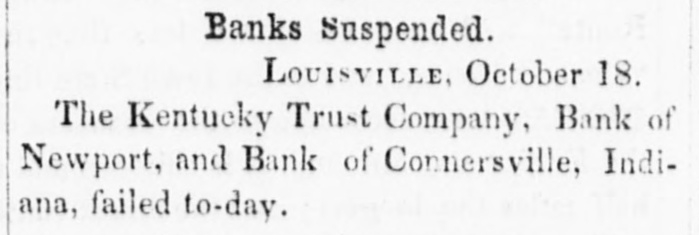
Banks Suspended. LOUISVILLE, October 18. The Kentucky Trust Company, Bank of Newport, and Bank of Connersville, Indiana, failed to-day.


Article from Glasgow Weekly Times, October 26, 1854

Click image to open full size in new tab

Article Text

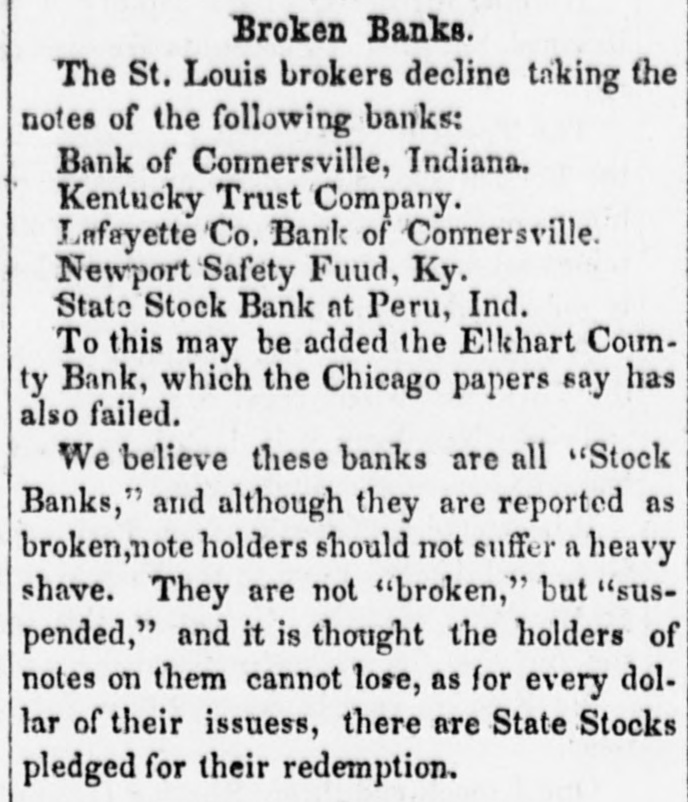
Broken Banks. The St. Louis brokers decline taking the notes of the following banks: Bank of Connersville, Indiana. Kentucky Trust Company. Lafayette Co. Bank of Connersville. Newport Safety Fund, Ky. State Stock Bank at Peru, Ind. To this may be added the Elkhart County Bank, which the Chicago papers say has also failed. We believe these banks are all "Stock Banks," and although they are reported as broken, note holders should not suffer a heavy shave. They are not "broken," but "suspended," and it is thought the holders of notes on them cannot lose, as for every dollar of their issuess, there are State Stocks pledged for their redemption.


Article from Plymouth Banner, October 26, 1854

Click image to open full size in new tab

Article Text

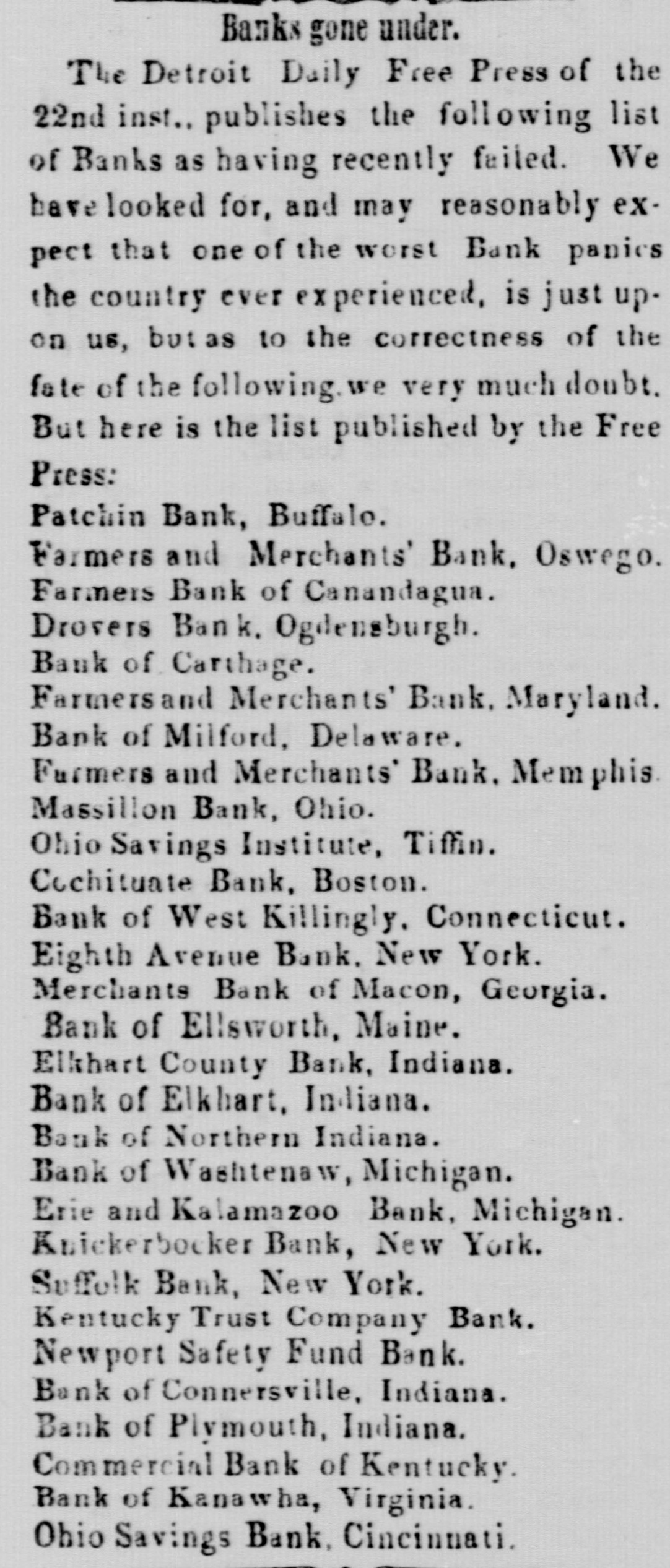
Banks gone under. The Detroit Daily Free Press of the 22nd inst., publishes the following list of Banks as having recently failed. We have looked for, and may reasonably expect that one of the worst Bank panics the country ever experienced, is just upon us, butas to the correctness of the fate of the following we very much doubt. But here is the list published by the Free Press: Patchin Bank, Buffalo. Farmers and Merchants' Bank, Oswego. Farmers Bank of Canandagua. Drovers Bank. Ogdensburgh. Bank of Carthage. Farmersand Merchants' Bank, Maryland. Bank of Milford, Delaware, Furmers and Merchants' Bank, Memphis. Massillon Bank, Ohio. Ohio Savings Institute, Tiffin. Cochituate Bank, Boston. Bank of West Killingly, Connecticut. Eighth Avenue Bank. New York. Merchants Bank of Macon, Georgia. Bank of Ellsworth, Maine. Elkhart County Bank, Indiana. Bank of Elkhart, Indiana. Bank of Northern Indiana. Bank of Washtenaw, Michigan. Erie and Kalamazoo Bank, Michigan. Knickerbocker Bank, New York. Suffolk Bank, New York. Kentucky Trust Company Bank. Newport Safety Fund Bank. Bank of Connersville, Indiana. Bank of Plymouth, Indiana. Commercial Bank of Kentucky. Bank of Kanawha, Virginia. Ohio Savings Bank, Cincinnati.


Article from Spirit of the Times, October 31, 1854

Click image to open full size in new tab

Article Text

The Indiana State Sentinel addresses the Stock holders of the Northern Bank of Indiana at Logansport, and the Bank of Connersville lately suspended, not to sacrifice them as the securities on file in the Auditor of State's office are amply able to protect the bill-holder.


Article from Demoine Courier, November 2, 1854

Click image to open full size in new tab

Article Text

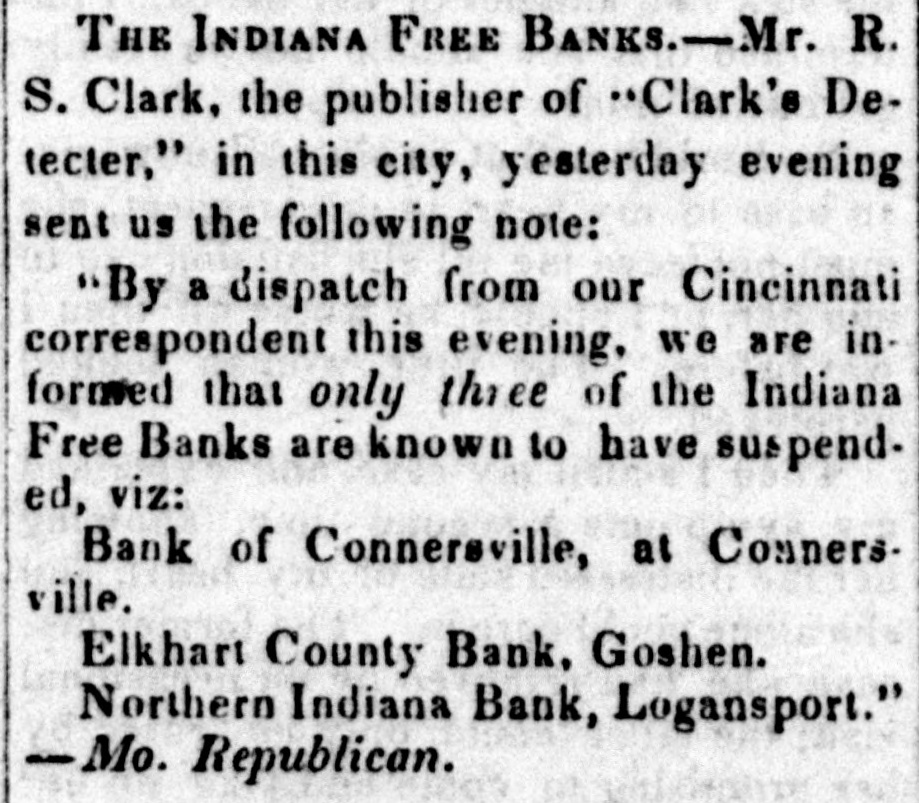
THE INDIANA FREE BANKS.-Mr. R. S. Clark, the publisher of Clark's Detecter," in this city, yesterday evening sent us the following note: "By a dispatch from our Cincinnati correspondent this evening, we are in formed that only three of the Indiana Free Banks are known to have suspended, viz: Bank of Connersville, at Connersville. Elkhart County Bank, Goshen. Northern Indiana Bank, Logansport." -- -Mo. Republican.


Article from The Jackson Standard, November 2, 1854

Click image to open full size in new tab

Article Text

The Indiana State Sentinel addresses the holders of the notes of northern bank of Indiana at Logansport. and the Bank of Connersville, lately suspended, not to sacrifice them. as the securities on file in the Auditor of State's office are amply a. ble to protect the bill-holder.


Article from Gallipolis Journal, November 2, 1854

Click image to open full size in new tab

Article Text

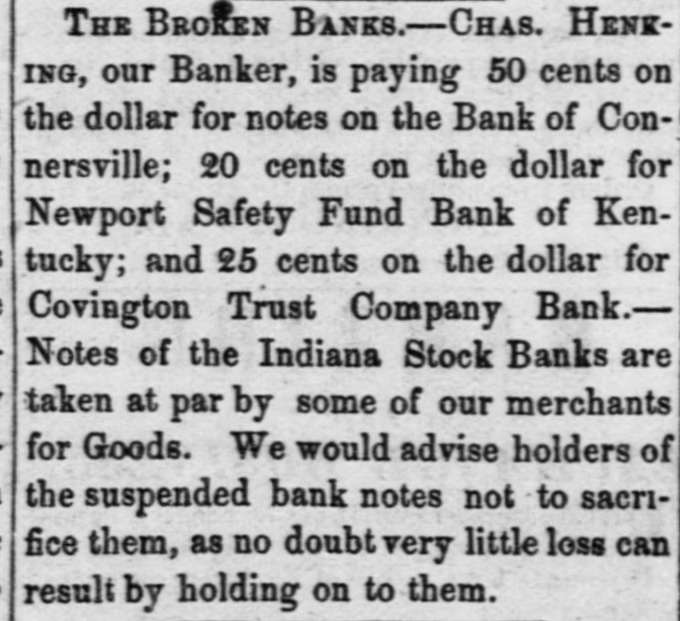
THE BROKEN BANKS.-CHAS. HENKING, our Banker, is paying 50 cents on the dollar for notes on the Bank of Connersville; 20 cents on the dollar for Newport Safety Fund Bank of Kentucky; and 25 cents on the dollar for Covington Trust Company Bank.Notes of the Indiana Stock Banks are taken at par by some of our merchants for Goods. We would advise holders of the suspended bank notes not to sacrifice them, as no doubt very little less can result by holding on to them.


Article from The Kalida Venture, November 3, 1854

Click image to open full size in new tab

Article Text

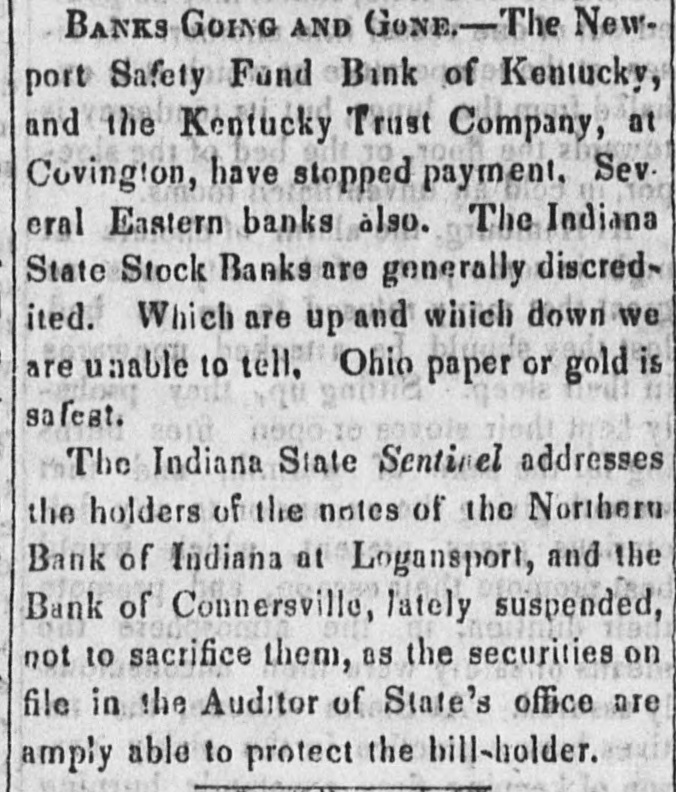
BANKS GOING AND GONE.-The Newport Safety Fond Bink of Kentucky, and the Kentucky Trust Company, at Covington, have stopped payment. Sev. eral Eastern banks also. The Indiana State Stock Banks are generally discredited. Which are up and which down we are unable to tell, Ohio paper or gold is safest. The Indiana State Sentivel addresses the holders of the notes of the Northern Bank of Indiana at Logansport, and the Bank of Connersville, lately suspended, not to sacrifice them, as the securities on file in the Auditor of State's office are amply able to protect the bill-holder.


Article from Minnesota Weekly Times, November 7, 1854

Click image to open full size in new tab

Article Text

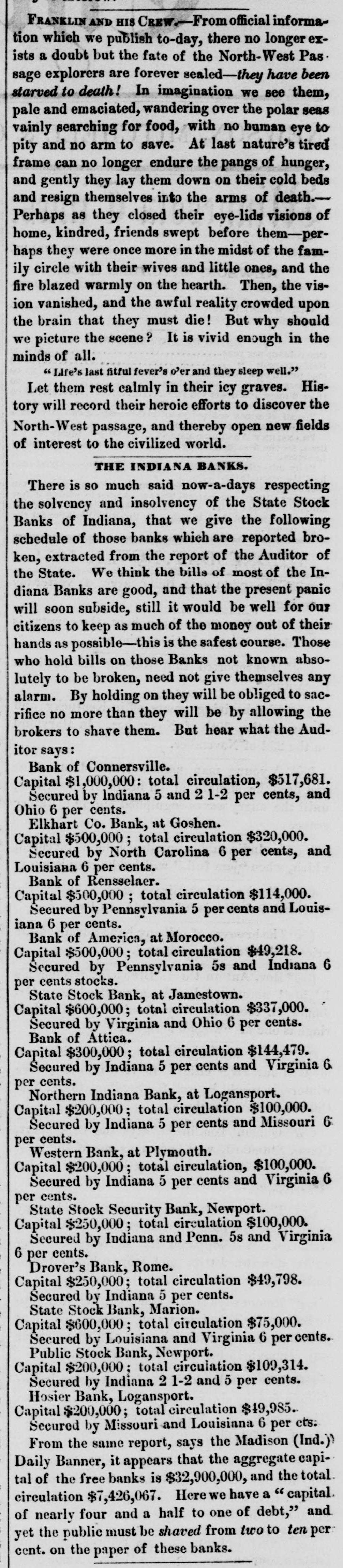
FRANKLIN AND HIS CREW.From official information which we publish to-day, there no longer exists a doubt but the fate of the North-West Pas. sage explorers are forever sealed-they have been starved to death! In imagination we see them, pale and emaciated, wandering over the polar seas vainly searching for food, with no human eye to pity and no arm to save. At last nature's tired frame can no longer endure the pangs of hunger, and gently they lay them down on their cold beds and resign themselves into the arms of death.Perhaps as they closed their eye-lids visions of home, kindred, friends swept before them-perhaps they were once more in the midst of the family circle with their wives and little ones, and the fire blazed warmly on the hearth. Then, the vision vanished, and the awful reality crowded upon the brain that they must die! But why should we picture the scene? It is vivid enough in the minds of all. last fitful fever's o'er and they sleep well." Let them rest calmly in their icy graves. History will record their heroic efforts to discover the North-West passage, and thereby open new fields of interest to the civilized world. THE INDIANA BANKS. There is so much said now-a-days respecting the solvency and insolvency of the State Stock Banks of Indiana, that we give the following schedule of those banks which are reported broken, extracted from the report of the Auditor of the State. We think the bills of most of the Indiana Banks are good, and that the present panic will soon subside, still it would be well for our citizens to keep as much of the money out of their hands as possible-this is the safest course. Those who hold bills on those Banks not known absolutely to be broken, need not give themselves any alarm. By holding on they will be obliged to sacrifice no more than they will be by allowing the brokers to shave them. But hear what the Auditor says: Bank of Connersville. Capital $1,000,000: total circulation, $517,681. Secured by Indiana 5 and 21-2 per cents, and Ohio 6 per cents. Elkhart Co. Bank, at Goshen. Capital $500,000; total circulation $320,000. Secured by North Carolina 6 per cents, and Louisiana 6 per cents. Bank of Rensselaer. Capital $500,000 total circulation $114,000. Secured by Pennsylvania 5 per cents and Louisiana 6 per cents. Bank of America, at Morocco. Capital $500,000; total circulation $49,218. Secured by Pennsylvania 5s and Indiana 6 per cents stocks. State Stock Bank, at Jamestown. Capital $600,000; total circulation $337,000. Secured by Virginia and Ohio 6 per cents. Bank of Attica. Capital $300,000; total circulation $144,479. Secured by Indiana 5 per cents and Virginia 6. per cents. Northern Indiana Bank, at Logansport. Capital $200,000; total circulation $100,000. Secured by Indiana 5 per cents and Missouri 6 per cents. Western Bank, at Plymouth. Capital $200,000; total circulation, $100,000. Secured by Indiana 5 per cents and Virginia 6 per cents. State Stock Security Bank, Newport. Capital $250,000 total circulation $100,000. Secured by Indiana and Penn. 5s and Virginia 6 per cents. Drover's Bank, Rome. Capital $250,000; total circulation $49,798. Secured by Indiana 5 per cents. State Stock Bank, Marion. Capital $600,000; total circulation $75,000. Secured by Louisiana and Virginia 6 per cents. Public Stock Bank, Newport. Capital $200,000 total circulation $109,314. Secured by Indiana 1-2 and 5 per cents. Hosier Bank, Logansport. Capital $200,000; total circulation $49,985. Secured by Missouri and Louisiana 6 per cts. From the same report, says the Madison (Ind.) Daily Banner, it appears that the aggregate capital of the free banks is $32,900,000, and the total. circulation $7,426,067. Herewe have a " capital of nearly four and a half to one of debt," and yet the public must be shaved from two to ten per cent. on the paper of these banks.


Article from Daily Davenport Gazette, November 7, 1854

Click image to open full size in new tab

Article Text

The Daily Bazette. Davenport, November 7, 1854. Monetary. The Cincinnati Railroad Record, which is always well posted on monetary affairs, in its last number contains the following nformation:"We see no reason for the panic which exists in regard to all Indiana money, and the history of the last few days shows the unnecessary Facrifice which the timid are always too quick to make. Brokers, whose business it is to make money out of monetary transactions, are always ready to buy uncurrent bills as low as they can get them, and this is sometimes governed by the competition among themselves; but it is certainly unwise to submit to an enormous shave, before it is determined whether the note is good or bad. "With reference to the Savings Bank of this city it is expected to re-open in ten days or two weeks. The Bank of Connersville is also expected to resume. The notes of this bank are secured by State Stocks, some of which are above par. The depos. itors are said to be few in number and well secured. "The Kentucky Trust Co. will close up, and has already been put in the hands of Trustees who were not heretofore connected with the Bank. They are Judge W. B. Kinkead and Sa uel J. Walker, Esq. John W. Stevenson, Esq., is selected as attorney. It is designed, if it can legally be done, to pay first the depositors either wholly or in part, and then billholders. Under this arrangement the billholder is expected to receive 80 cents on the dollar."


Article from Clearfield Republican, November 8, 1854

Click image to open full size in new tab

Article Text

The Indiana State Sentinel diveses the holders of the Notes of the Northern Bank of Indiana, at Logansport, and the Bank of Connersville, lately suspended, not to sacrifice them, as the securities on file in the Auditors of State's office are amply able to protect the bill holders.


Article from The Cedar County Advertiser, November 11, 1854

Click image to open full size in new tab

Article Text

Monetary. The Cincinnati Railroad Record, which is always well posted on monetary affairs, in its last number contains the following information:"We see no reason for the panic which xists in regard to all Indiana money, and the history of the last few days shows the unnecessary sacrifice which the timid are always too quick to make. Brokers, whose business it is to make money out of monetary transactions, are always ready to buy uncurrent bills as low as they can get them, and this is sometimes governed by the competition among themselves; but it is certainly unwise to submit to an enormous shave, before it is determined whether the note is good or bad. "With reference to the Savings Bank of this city it is expected to re-open in ten days or two weeks. The Bank of Connersvile is also expected to resume. The notes of this bank are secured by State Stocks, some of which are above par. The depositors are said to be few in number and well secured. "The Kentucky Trust Co. will close up, and has already been put in the hands of Trustees who were not heretofore connected with the Bank. They are Judge W. B. Kinkead and Samuel J. Walker, Esq. John W. Stevenson, Esq., is selected as attorney. It is designed, if it can legally be done, to pay first the depositors either wholly orlin part, and then bill-holders. Under this arraegement the billholder is expected to receive 80 cents on the dollar."


Article from The Evansville Daily Journal, November 29, 1854

Click image to open full size in new tab

Article Text

Free Bank Money. There is only one reason why every individual should not take freely of the paper of every one of our State Stock Banks, and that is, the money is. not taken in bank, and will not buy exchange. This objection may hold good with those who have to buy exchange, but is no objection, or should not be with those who have no exchange to buy.The money is all perfectly secure, and if farmers, mechanics and laboring men would determine to take every dollar they could get oi it, there would be no difficulty in the way of a good, sate, secure home currency. If the bankers and merchant's won't take it of you, pay it out to somebody elue that will. It will not be long before the merchants will be glad to get hold of a currency which they find out circulates freely among the people.' There is but three Banks in the State whose paper is uncurrent, and they are better secured than one half of the balance. These banks are the Northern Indiana Bank at Logansport, the Elkhart County Bank, and the Bank, of Connersville. The Northern Indiana Bank is secured by $91,000 in Indiana 5 per cent. Bank bonds, and $5,000 in Virginia 6 per cents. The Journal of this morning, justly remarks that the "5 per cent. Bank Bonds of Indiana, which always paid their interest promptly, and were always at par, when other State securities were down at 50 per cent below par. And then the stock is owned entirely in our own State, where the individual liability clause can be made available for any beficit. It is impossible for the bill holders to lose on the circulation of this Bank, unless they blindly allow themselves to be fleeced by intersted parties." The Eikhart County Bank of Goshen, is secured by $150 000 Virginia 6 per cents, $73,000 Louisiana 6 per cents, $35,000 N. Carolina 6 per cents, and $25,000 Indiana 21 per cent. These latter stocks were received by the Auditor at 55 cents on the dollar.Who can doubt the security of the bank, with such stock as a basis? The Connersville Bank is secured principaliy by Indiana 5 per cents, $190,000 Indiana 21 per cents, $12,000 Indiana 5 per cents Bank bonds, and $31,000 Ohio 6 per cent Canal bonds. This bank has authorized the Auditor of State to deliver up to bill holders its stocks at their market value, when presented in quantities of $1,000. The owners of this Bank are responsible men, although ore of them has been somewhat embariassed by the failures of the Cincinnati banks. We have no doubt of the solvency of all three of these banks, and that they will pay specie in a lew days, to every body but brokers and sharpers, and no Indianian will bla ne them for refusing to submit to the runs of the carpet bag gentry. Keep it before the people, that we continue to take paper of either of these Banks, in payment for the Courier, for advertising, for job work, or wind work. Don't be backward, gentlemen-sent it along. [Lafayette Cour.


Article from Daily Davenport Gazette, December 13, 1854

Click image to open full size in new tab

Article Text

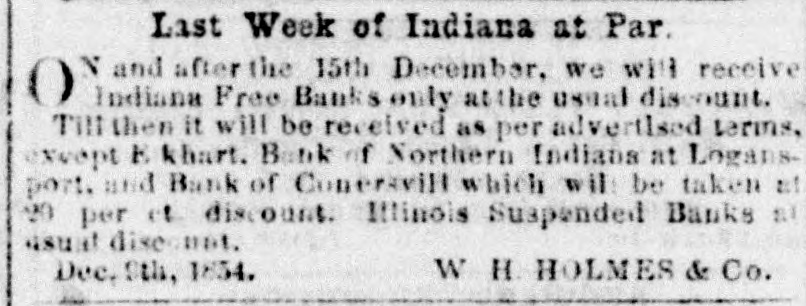
Last Week of Indiana at Par. N and after the 15th December, we will receive 0 Indiana Free Banks only atthe usual discount. Till then it will be received as per advertised terms, except E khart. Bank of Northern Indiana at Logansport, and Bank of Conersvill which wil: be taken at 90 per et. discount. Illinois Suspended Banks BI asual discount. W H.HOLMES & Co. Dec. Sth, 1834.


Article from The New York Herald, June 11, 1855

Click image to open full size in new tab

Article Text

I Total $63,245,655 63,373,976 128,321 The cash receipts of the Morris Canal for the week ending on Saturday, 2d inst., were $8,816, against $7,570 for the corresponding work last year, being an increase of $1,276. The receipts for the year up to the 26th alt. were $51,312. against $45,458 to same date last year, being an increase thus far this year of $5,854. At a meeting of the Western Railroad stockhold ers, held on Tue day, the 5th inst., it was decided, by the large majority of two to one, not to accept the act of the Legislature which authorizes the company to issue six per cent bonds, to pay for the purchase of the Hudson and Berkshire Railroad, and construct a second track from Springfield to Albany. After this vote was decided, a reconside. ration was called for, on a "stock vote," and carried. The question or acceptance was then taken and decided in the affirmative. The Courier says:The opponents of this measure have used great exer. tionsto defeat it, but finding themselves in the minority, submit to the result in the cheerful spirit of true republicanism. doubtedly more The increasing. than c line un. formed without the completion of the second track, and the managers express the confident belief that there will be no curtailment of the regular dividends. The sinking fund already amounts to $30 per share, and the stock ought fetch par, including the July dividend. The state Treasurer of New Jersey has given no. nce that an injunction having been issued from the Court of Chancery restraining the Americau Exchange Bank at Cape May Court House from exerclaing any of the privileges or franchises granted under the State act, the notes will be redeemed at the Treasury office at Frenton. on and after July 20. The gross receipts of the Hudson River Railroad Company during the eight months ending May 31, 1855, amounted to $1,345,252 05, against $1,199,954 53 for the corresponding period the previous year, showing an increase of $145 297 52. The Newark Advertiser gives the following sy nopsis of the decision of the Chancellor of New Jersey in the case of the Morris and Essex Railroad. The company will probably appeal, as the points at issue are of the greatest importance:The Chancellor appears to have given much time and attention to the subject, which is not only important to this city, but of very general importance, inssmuch as it is deemed to settle the law in the case. The opinion, we are informed, is very erudite, and exhausts the subject. The court comes to the conclusion that no railroad company, in the absence of legislative permission, has a ight to lay its railway along any public highway, in town or country, with the consent of the proper authorities-it indeed, any other than legislative authority can effectually be given in the premises. If a company does, without such authority. thus lay down its track, the track becomes at once a public nuisance or obstruction to the street or highway, and as such may forth with be removed. The Chancellor, we understand, retains the injunction for a short time, to afford the complainants an opportunity to appeal from the decision, if they shall see fit to do so. The opinion and judgment of the court fully sustain the action of the city authorities in the matter and but . short time will elapse before the final adjudication of the matter will have taken place, even though an appeal be taken. Should no appeal be taken, however, in & rea. sonable time, the injunction will be removed. of course, and the Common Council permitted to remove the track. In this case it may be done, in fact, at the expense of the parties claiming to own the track, for it is provided, we believe, by section 5 of the ordinance, entitled "An ordinance to remove obstructions from the streets and for other purposes." that the Street Commissioner, Mayor. or any or either of the members of the Common Council, may order any article or thing whatsoever which they may deem an obstruction or nuisance in or upon any street of the city, to be removed, and if it be not removed forthwith, then to remove and seil the same, and out of the proceeds of the sale reimburse the city for the expense of the removal of the obstruction. We understand that the Chancellor has made no order yet to remove the track, and the city will not move fur. ther in the matter till official authority to do so is recoived. The receipts of the Beaver Meadow Railroad and Coal Company, since the commencement of the sea$54,429 58 son to the 2d inst, amount to 36,022 To correspending date last year $18,406 79 Increase (over 50 per cent) The coal tonnage for the past week was 14,641 tons, against 11,072 tons in the corresponding week last year. The State Auditor of Indiana notifies holders of the circulating notes of the Merchants' Bank at Lafayette, Merchants' Bank at Springfield, Greene County Bank at Bloomfield, Government Stock Bank at Lofayette, Laurel Bank at Laurel, Bank of Connersville at Connersville, Wabash Valley Bank at Logansport, Bank of T. Wadswortb, of Hartford, at Michigan City, to return the same to the office for cancellation, on or before the 15th day of July next, that the outstanding circulation may be determined as accurately as possible, and a pro rata dividend thereon declared. Certificates for the amount returned will be issued, and the dividend on the respective banks paid upon presentation of the certificates at the Auditor's office, after the 15th of August next. The Lancaster Daily says, in relation to the failure of the Lancaster Savings Instititution, through its Treasurer, Mr. Boughter:The amount of defalcation is reported to be $300,000. Before his arrest Mr. Boughter had assigned over to the trustees all his real estate and other property, amounting in value to $120,000, leaving an unbalanced deficit estimated at $180,000. The capital stock of the institution was $50,000, all paid which, taken from $180,000, leaves $130,000 to be lost by the depositors. The depo. aits are set down at $550,000; and from this statement it is estimated that the depositors will realize from 75 to 80 per cent on their deposits. Some seem inclined to believe that they will eventually realize the whole, and that the institution will be again put into operation. The Auditor of the State of Obto has just issued his report for the last fiscal year. The revenue and expenditures were as follows:-FINANCES OF OHIO-RECEIPTS AND DISBURSEMENTS. Receipts. Taxes of 1853, and delinquencies of pre$2,851,571 vious years. 477,264 26 Canal tolls, fines, water remts, &e 39,813 13 Dividends on railroads and other stocks 106,250 82 Surplus revenue-principal and interest 149,748 51 Proceeds of sales of school lands 93,455 Other sources 762,830 57 Balance in State Treasury Nov. 15, 1853

Article from Western Reserve Chronicle, December 5, 1855

Click image to open full size in new tab

Article Text

Sp n. and which was attached in No York by one Hopper, some months ago, has been restored to him by order of the Court. THE Postmaster General has decided that a pen mark made over or opposite an article in a newspaper with the sole object of calling attention to the article, will not subject the paper to letter postage. WASHINGTON, Nov. 20. According to the present dete rmination. no copies of the President's Message will be sent out for newspapers, as heretofore, in advance of its delivery in Congre THE Bridgeport, (Conn.) Farmer, says that Mr. Adolphus Beers, while fishing one y in a brook at Stratford, discovered and has in his possession what purports to be a diamond of the best water. He is officred two hundred dollars for his prize. AT a land sale at W noni, Wisconsin, a stranger undertook to overbid a settle, when the crowd reized him with the design of drowning him in the river. He dre a revolver and shot three of them, though not fatally. THE little town of Solon, Ohio, with a Pol ulation of only 1035, manufactures two hundred and fifty tons of cheese per annum. GLOVES.-Belgium is the great glove manufactory of the world. It is stated that from one establishment last year, 400 000 dozen pairs were exported to England and America. There are three thousand hands employed. The Chicago J urnal says the follow. ing Indiana banks have been wound up, and their securities sold. The bills are worth, according to the sum realized, the following figures Bank of Cornersville, 87 cents; Wabash Valley Bank, 63 cts.; Green County Bank, 81 cents; Mer chant's Bank. Lafayette, 90 cents ; Laurel Bank, 62 cents Government Stock Bank' 80 cents. THOMAS FRANCIS MEAGHER was married in New York on Wednesday, to Miss Townsand. It is rumored that her father has cut her off with "a shilling" in consequence. RARE PORT.-If the Newport News may be relied upon, the citizens of Cov. ington indulged in very novel amuse ments That paper of the 19th says: "We understand thst a lady, for a wager of $20, walked one square and back, on Saturday night, maked, without detection; in the event of which she was to have the money. The feat was pre formed on Main street, Covington, betweeen Fourth and Fifth streets, at no later than a quarter after ten. The night was very dark." MASSACHUSETTS.-Dr. Chaffee, the new K.N. Member of Congress from this State, is said to be an old fashioned Abolitionist. At any rate, he has long been known as a determined Free Soiler, and voted the Republican State Ticket at the late election, though himself running on the other side. We count his vote safe for a freedom-loving organization of the House, for Reeder and Free Kansas all the way through, and for the impeachment of Kane, should the House find time to waste on game of that size. THE MULT/PLICATION TABLE.-Many persons are not aware that this ingenious table was invented by the Greek Phil osopher Pythagoras, 538 years before Christ, and is consequently 2393 years old. Scholars as they wade through the intricate mazes of "twice one are two," will please ponder upon this intereting fact. THE Southern Statesman, published at Prattville, Alabama, urges the "appropriation of every dollar in the State Treasury," if recessary, for the purpose of foreing slaveryinto Kansas! It urges the calling of County and State Conventions for the purpose of organizing Southern "Kansas Aid Societies." A PROJECT has been started in Louisiana to connect the Mississippi River with Lake Borgne by a canal, cut from a point eleven miles below New Or eans, to an in ersection at Bayou Phillipou. It is believed that by the construction of this work up country produce conld be landed at Mobile, and other places of consumption along the sea be rd, at one-half the cost of freight charges, and vice versa, by the avoidan e of the re-shipments and expense of consignment at New Orleans. The proposed canal will be less than four miles in length, and w Il cost about $600,000. It will contain a single lock and will carry vessels drawing eight feet of water. The project seems to find favor NAM Ouk


Article from The Daily Gate City, April 23, 1856

Click image to open full size in new tab

Article Text

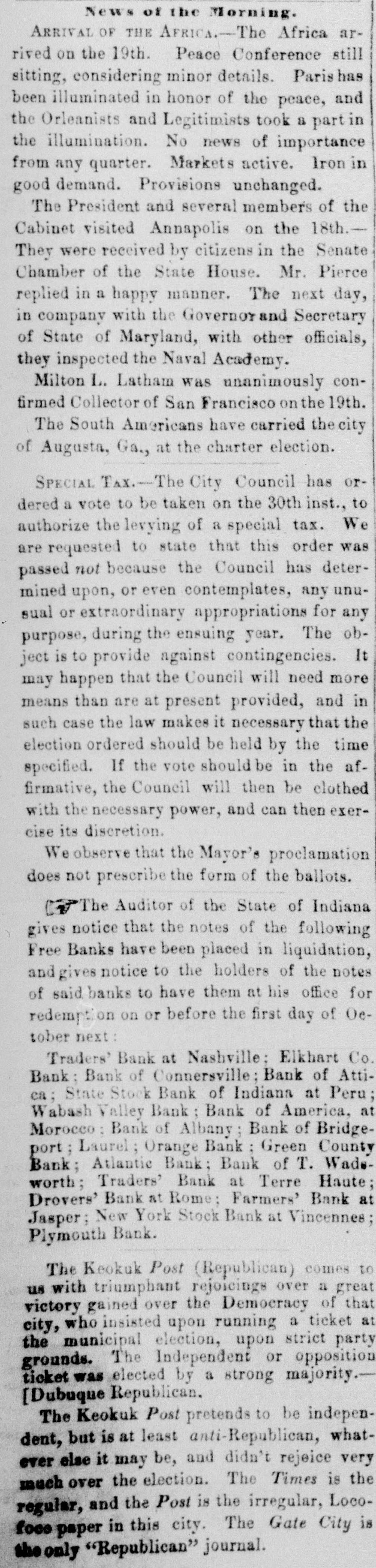
News of the Morning. ARRIVAL OF THE AFRICA.-The Africa arrived on the 19th. Peace Conference still sitting, considering minor details. Paris has been illuminated in honor of the peace, and the Orleanists and Legitimists took a part in the illumination. No news of importance from any quarter. Markets active. Iron in good demand. Provisions unchanged. The President and several members of the Cabinet visited Annapolis on the 18th.They were received by citizens in the Senate Chamber of the State House. Mr. Pierce replied in a happy manner. The next day, in company with the Governor and Secretary of State of Maryland, with other officials, they inspected the Naval Academy. Milton L. Latham was unanimously confirmed Collector of San Francisco on the 19th. The South Americans have carried the city of Augusta, Ga, at the charter election. SPECIAL Tax.-The City Council has ordered a vote to be taken on the 30th inst., to authorize the levying of a special tax. We are requested to state that this order was passed not because the Council has determined upon, or even contemplates, any unusual or extraordinary appropriations for any purpose, during the ensuing year. The object is to provide against contingencies. It may happen that the Council will need more means than are at present provided, and in such case the law makes it necessary that the election ordered should be held by the time specified. If the vote should be in the affirmative, the Council will then be clothed with the necessary power, and can then exercise its discretion. We observe that the Mayor's proclamation does not prescribe the form of the ballots. The Auditor of the State of Indiana gives notice that the notes of the following Free Banks have been placed in liquidation, and gives notice to the holders of the notes of said banks to have them at his office for redemption on or before the first day of Oetober next: Traders' Bank at Nashville: Elkhart Co. Bank: Bank of Connersville: Bank of Attica; State Stock Bank of Indiana at Peru; Wabash Valley Bank : Bank of America, at Morocco: Bank of Albany; Bank of Bridgeport; Laurel; Orange Bank Green County Bank; Atlantic Bank; Bank of T. Wadeworth; Traders' Bank at Terre Haute; Drovers' Bank at Rome: Farmers' Bank at Jasper; New York Stock Bank at Vincennes; Plymouth Bank. The Keokuk Post (Republican) comes to us with triumphant rejoicings over a great victory gained over the Democracy of that city, who insisted upon running a ticket at the municipal election, upon strict party grounds. The Independent or opposition ticket was elected by a strong majority.[Dubuque Republican. The Keokuk Post pretends to be independent, but is at least anti-Republican, whatever else it may be, and didn't rejeice very much over the election. The Times is the regular, and the Post is the irregular, Locofoce paper in this city. The Gate City is the only "Republican" journal.


Article from Indiana American, July 3, 1857

Click image to open full size in new tab

Article Text

Suspended Banks, Where redeemed, and rates paid: Bank of Attica, Auditor's 'k South Pend, par 89 Traders' B'k, Nashville. 92 Offi e,at B*k of merica, 87e.) *k of T. Waksworth, 91 B'k of Alb ny 90e. Wabash Vall y bank, 92 Allantic B'k, " 80c Wayne Bank, LogansAgricultural B'k, " par port, par " I'k Concersville, 87c. Wayne Bank, at Rich" Elkh rt Co. Wk, 97c. mond, par 91.5'k of North America Farmers's B'k, Jasper Laurel 'k, 90 82 at Clinton, wirth rn Indiana B'k, 83/Suvings H'k of Indiana Orange B'k. 69 par at Connersvilie, B'k Perrys Ille par{B'k of Warsaw, CentB'k of Rockport, par ral B'k Indianapolis, par 90 State Stock bank, Peru, 85 Kalama zou b'k, " " " Marion, 905 The above comprises all the Free Banks that are properly secured and within the operations of the General Banking Law of this State: astemically


Article from The New York Herald, December 14, 1860

Click image to open full size in new tab

Article Text

FINANCIAL AND COMMERCIAL. THURSDAY, Dec. 13-6 P. M. The better feeling in mercantile circles which was remarked yesterday was prevalent to-day also, though we cannot quote any very marked improvement in paper. First class signatures continue to pass at 12 a 15 a 18 por cent, and the demand for paper is still quite light. Considerable surprise is expressed at the cool manner is which the news of our crisis seems to have been received II England. When the Europa sailed, the English had before them quotations of sterling exchange here at 101 a 102, with no demand at the decline, and quotations of stocks generally lower than any which have been sent over since. Yet in the face of this, the Bank reduces the rate of interest, not ยฝ, but 1 per eent, and American stocks are maintained 5 a 6 per cent above our prices. The favorite theory in Wall street is that the English had not had time to realize the seriousness of our situation: that they were incredulous as to the purpose of the Southern States; and that when they receive the news by the Persia and the steamers which followed her, they will feel less hopeful, the Bank will raise the rate of interest, and cotton and stocks will fall. The stock market opened to-day with a better demand for State stocks, which are beginning to recover from the panic, but with an increased supply of New York Central, mainly in consequence of the unsatisfactory nature of the report. That document, of which we shall pub. Hsb 8 me extracts when our columns are less crowded, shows, DR we stated yesterday, a net profit for the year of only 6ยฝ per cent. It will confirm the belief of those who have all along asserted that the Central was never run for FO small a proportion of the gross earnings as has been stated in the reports. The expenses have for some years been larger than was confessed, and the consequence is that now, with gross earnings largely increased over last year, the directors are forced to confess that their net earnings are less. still, notwithstanding the adverse effect of these dis. closures on the market, the scaroity of stock began to affect prices after the first board, and there was a general rally, which lasted till the close of business, the market being quite firm at the close. The following were the last quotations of the day:-United States 5's 1874, 89% a 90; Indianas, 90: Virginia 6's, 76 a 79; Tennessee 6's, 71% a72; Missouri 6's, 66 a 3/2; Canton, 13 a 14; Cumberland Coal preferred, 8 a 10: Pacific Mail, 79 a ยฝ; New York Central, 73ยฝ a 74; Erie, 28 a ยฝ; Hudson River, 39 a %; Harlem, 1336 a %: Harlem preferred, 31% a 321/21 Reading, 32% a 33; Michigan Central, 47 a M; Michigan Southern and Northern Indiana, 12% a 13; Michigan Southern and Northern Indiana guaranteed, 27% a 28ยฝ; Panama, 112 a 116; Illinois Central, 583/4 a ยฝ; Galena and Chicago, 62 & ยฝ; Cleveland and Toledo, 24% a ยฝ; Chicago and Rock Island, 471/2 a 48; Chicago, Burlington and Quincy, 63 a 64; Delaware, Lackawana and Western, 73 a 75; Ilinois Central bonds, 87 a ยฝ. The business of the Sub-Treasury was as follows today $100,045 85 Receipts 36,000.00 -For customs 328,170 93 Payments Balance 2,685,995 72 The exchanges at the Bank Clearing House this morning were $17,673,192 90, and the balances $1,224,978 78. The Boston and Lowell Railroad has declared a semiannual dividend of four per cent, payable January 4. The Philadelphia Ledger of December 13 says:--There is no change in the money market. The only rates at which any paper sells at all are 15 a 18 a 24 per cent, and nothing but first class signatures can be passed at these rates. The discount brokers report absolute dulnees in their business. The applications at bank continue pressing, though the demand is met with more liberality than would be supposed, considering the current rates of paper on the street. Call loans are effected at 7 a 8 per cent. The Buffalo Commercial Advertiser says:The following free banks of Indiana have been thrown out :-Brookville Bank, at Brookville; Bank of Syracuse, at Syracuse: Bank of Indiana, at Michigan City: Indiana Reserve Bank, at Kokomo; Fayette County Bank; Bank of Connersville; Hoosier Bank, at Logansport. They are all winding up, and, it is said, have less than $1,000 each in circulation. The notes are secured by bonds given to the Auditor when the securities were surrendered. The New Orleans Picayune of Saturday last, December 8, says:Under the influence of the New York despatches, foreign exchange gave way 1a1% per cent this morning, and negotiations could only be effected with difficulty Clear sterling was dealt in moderately, at 95 a 98, the latter an extreme figure for the best. Drafts with doeumentary evidence are not offered. Francs are duil and tending downward. Probably the correct quotation would be 5f. 90 & 5f. 80, though an exceptional name might bring a fraction over. Time bills on the North are wholly unsaleable. Sight was transacted at 1ยฝ a 1% per cent discount. Altogether the market closed heavily. The money market continues in statu quo. Outside loans are made in rare instances at extravagant rates, but, as a general rule, there is no settled price for anything. The suspension of several prominent houses has as hat lessened the pressing demand for money, with. out increasing the supply, 80 that practically we are no better off. But in the meanwhile the banks are daily growing stronger, and being already in a position to withstand any assault, they will shortly begin to look around for casual investments. In fact, there is an inclination to entertain proposals for new discounts, though on a limited


Article from New-York Daily Tribune, December 14, 1860

Click image to open full size in new tab

Article Text

Brookville Bank, at Brookville; Bank of Syracuse, at Syracus Bank of Indiana, at Michigan City; Indiana Reserve Bank Kokomo Fayette County Bank; Bank of Connersville Hoosi Bank, at Logansport. They are all winding up, and. it is asi have learthan 6 1,000 each in circulation. The notes are seen by bonds given to the Auditor when the securities were surren dered." The N. O. Picayune says: Under the influence of the New ork dispatches/Foreign exchange gave way 1011 P cent this morning, and negotiations could only be effected with difficulty. Clear sterling was dealt in moderately, at the latter an extreme figure, for the best. Drafts with documentary evidence are not offered. Francs are dull and tending downward. Probably the correct quotation would be 5f.90@5f. 80, though an exceptional name might bring a fraction over. Time bills on the North are wholly unsalable. Sight RS transacted at Han centidiscount. Altogether the market closed heavily. The money market continues in statu gue. Outside loans are made in rare instances at extravagant rates. but, as a general rnle. there is no settled price for anything. The enspension of several prominent houses has somewhat lessened the pressing demand for money, without increasing the supply, so that practically we are no better off. But, in the meanwhile, the banks are daily growing stronger, and being already in a position to withstand any assault, they will shortly begin to look around for casual investments. In fact, there is an inclination to entertain proposals for new discounts, though on a limited footing, but this feeling is held in abeyance until we can arrive at some definite idea as to the course of the banks. The receipts of specie this week amount to $423,627, of which $16,427 was from Texas, $2,000 from Brazos. $180,200 from m Havana. and $225,000 from New York. The shipments comprise a few insignificant parcels not worth noticing. There is no market for unearrent money." The Bank officers of Louisville have had a meeting and decided not to suspend. Annexed is the report of the Committee of Stockholders of the New-York Central Road submitted to the meeting on Wednesday. The remarks in regard to the closing of the construction account are neteworthy: The undersigned, members of the Committee appointed by the Stockholders of the New York Central Railroad Company, for the purpose of examining into the accounts and transactions of the said Company, and to report thereon, respectfully report that they have devoted themselves to such an examination of the affairs of the Company in the general office as they have deemed needful and a portion of them have personally examined the oad and structures during the last month, and they are happy to say, that every facility for a thorough and minute examination of the accounts and management of the affairs of the Company as afforded by the officers and persons having charge of the Va jous partmer ts. The accounts of the Company have been found to be in the usual good order. and to correspond with the statements in the annual report for the last fiscal year. This report shows a net income, applicable to dividends, of 6 $ cent, and an expenditure, in maintaining and operating the road, of 61 49-100 cent of its gross receipts. These facts will, doubtless, be among the first to engage the attention of the stockholders, asshowings small per centage of net income upon the capital, and a large per centage of expenses, as compared with the receipts. They are, however, in a great degree the legitimate result of sound policy adopted by this Company, and which must eventually be adopted by all railroad companies that have their roads substantially completed, and mean to avoid ultimate bankruptcy, the policy of treating the account as substantially closed. Durin the past year only 380 have been charged to construction account, and that amount consists of $61,272 paid for real estate purchased, 106 paid for the construction of new engine and r-houses, chiefly on the grounds of the Company at West Albany, paid for new track toward completing the double track betw Syracuse and Rochester, and $1,555 ended on station buildings. These items we consider fairly chargeable to construction account, if such an account is allowable, being substantial additions to the value of the property. About twelve miles of the new double track have been constructed during the year, which, with side tracks and turn outs, amount to about twenty miles of new single track. It is desirable, no doubt, to have this line of double track completed as the means of the Company will admit. The expenditure for the construction of the machine-shop at West Albany, as we understand from the engineer, is already mostly made, and it seems to us that the next most pressing ne. ceasity of the Company is for further accommodations for the freight traffic in the City of Albamy. In regard to the expenses of the last year, it should also be borne in mind that the previous year was one of remarkable depression in the business of the road, necessitating the most limited expenditure, and consequently throwing an increased amount into the business of this year. We do not ourselves feel competent to say what proportion the expenditures of this road should bear to its receipts, nor do we believe that this question as to railroads generally can be determined with any degree of accuracy by any statistics as yet furnished. Nearly all the figures we have on the subject are derived from the experience of roads having a construction BC: count. and, where such is the case, they are entirely unreliable, as their accuracy is wholly dependent upon the charges to that account, and we think the experience of this road is beginning to show that a much larger allowance must be made out of the receipts of roads generally, for annual expenses, than has heretofore been thought necessary The income of the road from passenger receipts for the last three years had show but a very inconsiderable variation in amount, while the freight traffic varies in amount from year to year, according to circumstances beyond the control of the Company but has thus far shown. as will be seen by a table annexed, an almost invariable reduction in price. These considerations seem to us to suggest, with great force, the policy of avoiding all expenditures, except such as can be made from surplus income, and such as. when made, will diminish the annual expenditures to an amount equivalent at least to the interest of their costs. Under the operation of the sinking funds during the last year there have been extinguished: $180,000 Of the Debt Certificates. 90,000 Of the Bonds Issued for Railroad Stocks 20,000 Of the Bonds Issued for Real Estate Of the Bonds to Stockholders of Buffalo and Niagara 4,000 Road Falls All of which we have examined and found duly cancelled. Bonds of the old Companies have been extinguished as follows $1,000.00 Company Of the Albany and Schenecta 65,669 34 Of the kester and Syracuse Company 8,696 31 Of the Buifalo and Rochester 12,000.00 Of the Rochester, Lockport and Niagara Falls 10,000 00 Of the Buffalo and Niagara Falls. Also Bond Issued by this Company to Telegraph 10,000.00 Company $401,365 65 Total On the 13th of November three of your Committee commenced an examination of the track of the road, machine-shops, stations, &c. They found the track in good condition, and the bridging greatly improved: 580 lineal feet of iron superstructure has been substituted for old wood structures, and the remainder of the bridges required for immediate use have been repaired and strengthened, and nearly all have been covered. A considerable expense has been incurred in the substitution of embankment for trestle bridging, which is a permanent improvement. 349, 100 cross have been purchased and paid for during the fiscal year, at an average cost of 33 4 10 cents per tie, and most of these have been laid in thetrack. This is fair average of the number of cross ties required annually for keeping the track in good condition. The machine-shops were in good order, and the roadway and its management fully up to the standard reported last year; but whether more or less than the requisite number of men were employed to keep in good condition the road and rolling stock of the Company, is difficult for the Committee to determine. A good and substantial elevator has been erected at Buffalo, at a cost of about $80,000, which is of sufficient capacity for storing 500,000 bushels of grain. Markets.-CAREFULLY REPORTED FOR THE N. Y. THIRUNE. THURSDAY, Dee. 13, 1860. ASHES-The demand is moderate for both kinds; prices are nominalat $5. COTTON- market is steady, with a fair demand sales of 3,000 bales, 2,000 in transitu. We repeat quotations. Middling Uplands and Gulf 10@10fc. sales have been made BH follows: 30 bags St. Domingo at llgc.; 200 mats Java at 16@16fe., and 50 bags Laguayra 14a 14je.