First National Bank (Gering, NE)

Episode Information

Episode UID
806201489
Episode Type
Suspension โ†’ Closure
Bank Type
national
Bank ID
80620 national
Charter Number
8062
Start Date
January 11, 1924
Location
Gering, Nebraska (41.826, -103.660)

Metadata

Model
gpt-5-mini (chosen from majority vote of a three-model LLM ensemble)
Short Digest
74a22d4e9a370eff

Response Measures

None

Receivership Details

Depositor recovery rate
16.8%
Date receivership started
1924-02-26
Date receivership terminated
1930-12-31
OCC cause of failure
Governance
Share of assets assessed as good
12.1%
Share of assets assessed as doubtful
60.6%
Share of assets assessed as worthless
27.2%

Description

Receivership and subsequent dividends are documented in later articles (1926โ€“1930).

Events (7)

1. January 23, 1906 Chartered
Source
historical_nic
2. January 11, 1924 Suspension
Cause
Government Action
Cause Details
Bank closed and affairs taken into custody by the federal comptroller after insolvency problems tied to overextension of credits and falling agricultural prices.
Newspaper Excerpt
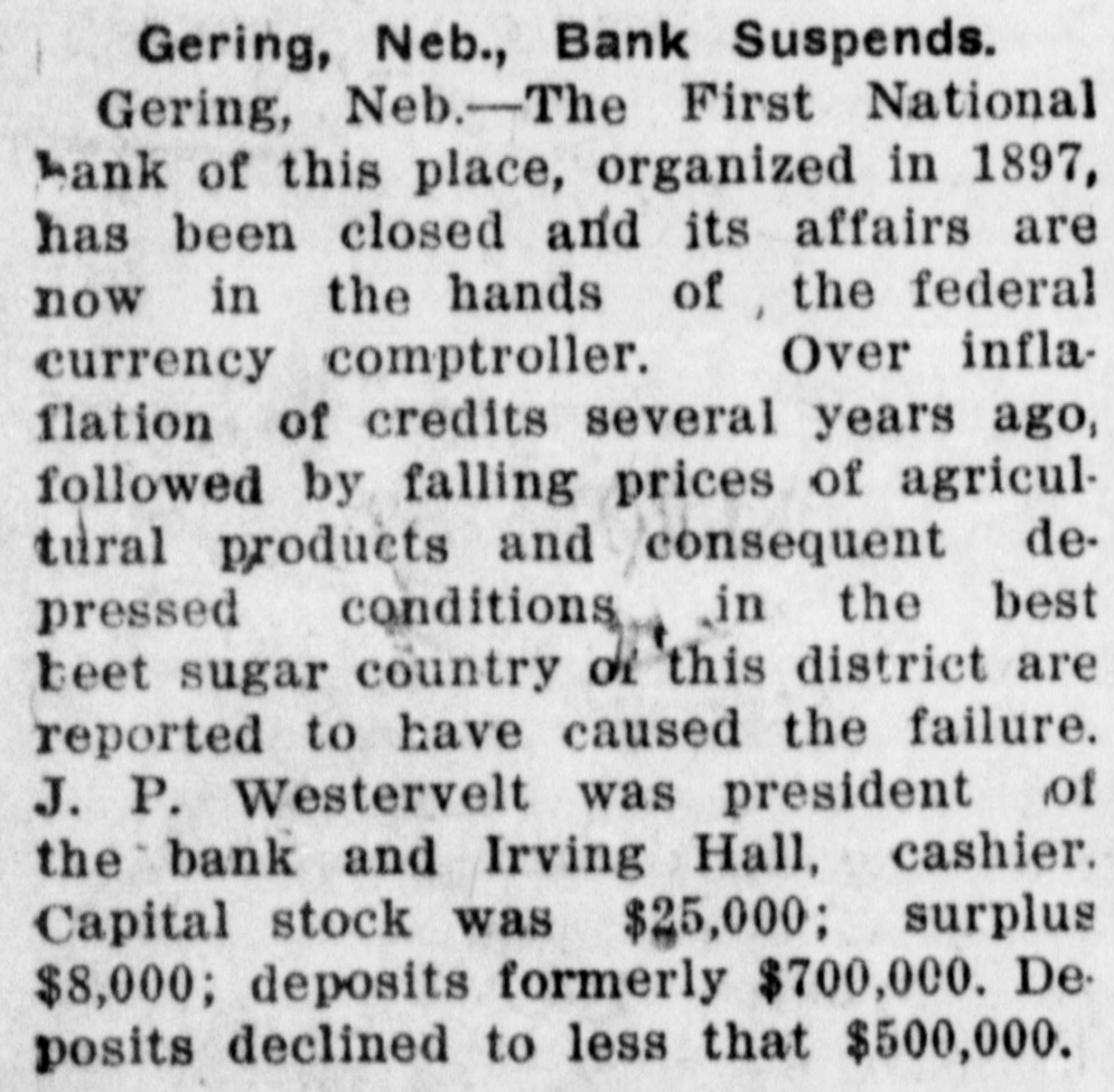
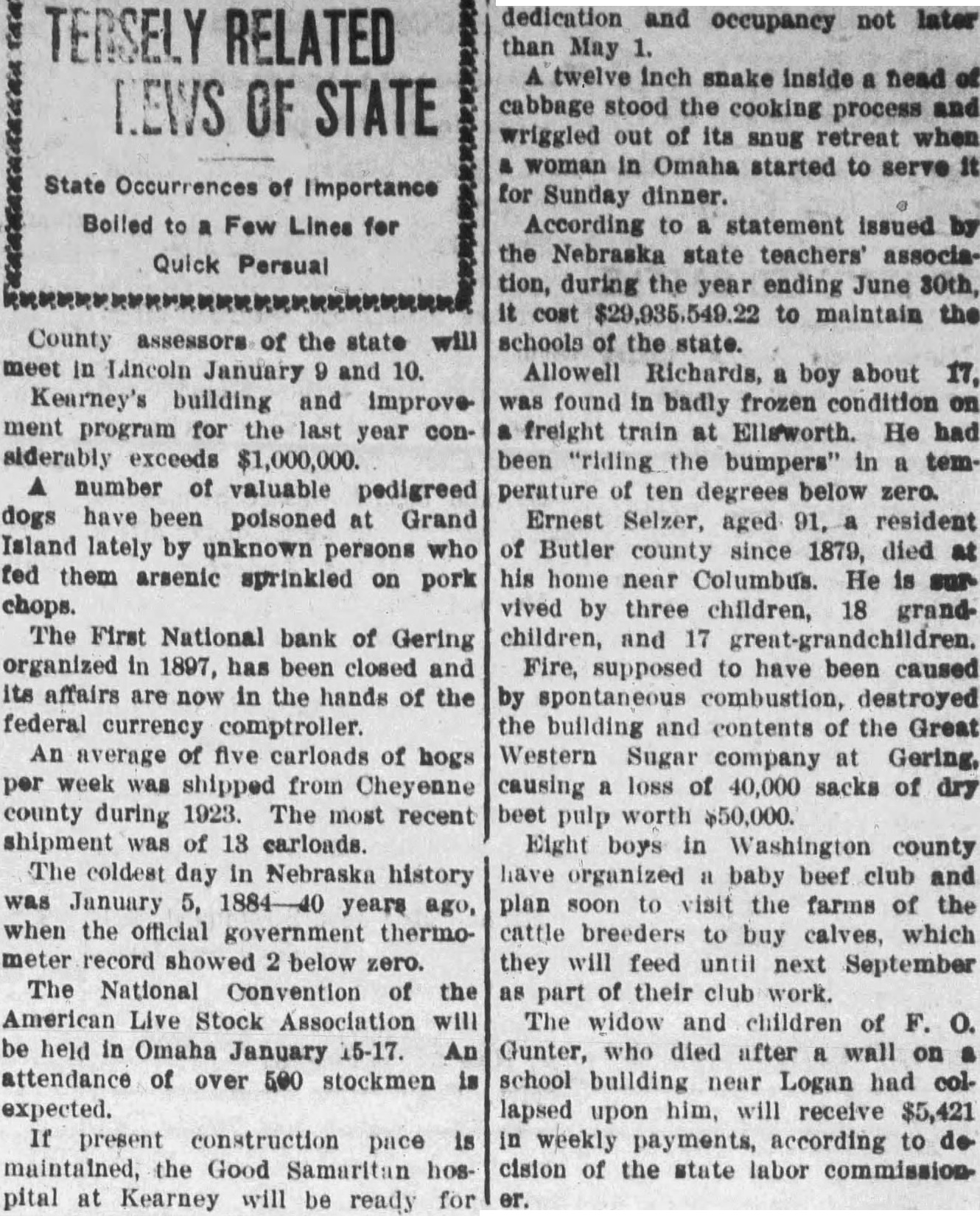
The First National Bank of this place, organized in 1897, has been closed and its affairs are now in the hands of the federal currency comptroller.
Source
newspapers
3. February 26, 1924 Receivership
Source
historical_nic
4. February 26, 1924 Receivership
Newspaper Excerpt
Known receivership date (government records) for the First National Bank, Gering; later articles refer to the bank now in receiver's hands.
Source
newspapers
5. February 13, 1926 Other
Newspaper Excerpt
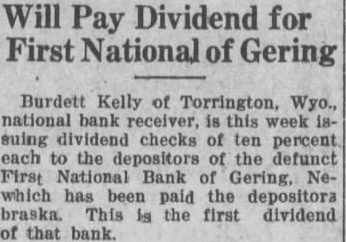
Burdett Kelly ... national bank receiver ... issuing dividend checks of ten percent each to the depositors of the defunct First National Bank of Gering.
Source
newspapers
6. November 20, 1927 Other
Newspaper Excerpt
Central National Bank v. First National Bank of Gering, now in receiver's hands (court litigation over claims against assets).
Source
newspapers
7. November 1, 1930 Other
Newspaper Excerpt
Gering Bank Receiver to Pay Last Dividend ... final payments of depositors' claims against the old First National bank Gering will be made next week.
Source
newspapers

Newspaper Articles (11)

Article from Thomas County Clipper, January 10, 1924

Click image to open full size in new tab

Article Text

Run On Iowa Bank By a decision of its board of directors, the Iowa State Bank at Atlantic failed to open its doors Wednesday morning. The action followed recent withdrawals of deposits occasioned by rumors that the bank was not in the most solid condition, and to the poor showing made in the last statement of condition published last Friday. It had a capital stock of $50,000 and deposits of more than $300,000. The Sioux Falls National Bank, organized May 1, 1882, one of the oldest banks in South Dakota, closed its doors this week. It was capitalized for $150,000 and the statement of December 31 shows it had deposits of $2,500,000. The Bennett County Bank at Martin, South Dakota, failed to open its doors last Monday morning. This is in the Pine Ridge Indian reservation, about thirteen miles north of the Nebraska state line. The bank will be reopened soon under new management. A similar bank swindling case like they had in Halsey came to light with the closing of the Citizens' State Bank at Parker, in south-east part of South Dakota, where fifty thousand dollars' worth of worthless notes had been taken in exchange for certificates of deposit by men connected with the bank. B. F. Swan, the cashier, Frank R. Beddow, H. J. Caulsfield and a dozen other men, formerly residents of Sioux City, Iowa, are being arrested as fast as they can be located by Deputy State Sheriff N. J. Folsom. They used the money in some colonization scheme. In North Platte valley two banks in Garden county were consolidated this week when Nebraska State Bank had taken over the Oshkosh State Bank as a precautionary measure. Oshkosh is a county seat town. Among the numerous failures down in North Platte valley the latest to close its doors is the old First National Bank at Gering, county seat of Scotts Bluff county, which was organized back in 1897. It had a capital stock of $25,000, surplus $8,000, and deposits that formerly were $700,000 have declined to less than $500,000. Gering has yet another national bank and one state bank. Across the Platte river the city of Scottsbluff has about six banks.


Article from The Mellette County Pioneer, January 11, 1924

Click image to open full size in new tab

Article Text

Gering, Neb., Bank Suspends. Gering, Neb.-The First National Bank of this place, organized in 1897, has been closed and its affairs are now in the hands of the federal currency comptroller. Over inflaflation of credits several years ago, followed by falling prices of agricultural products and consequent depressed conditions in the best beet sugar country of this district are reported to have caused the failure. J. P. Westervelt was president of the bank and Irving Hall, cashier. Capital stock was $25,000; surplus $8,000; deposits formerly $700,000. Deposits declined to less that $500,000.


Article from Oakland Independent and Republican, January 11, 1924

Click image to open full size in new tab

Article Text

TERSELY RELATED NEWS OF STATE State Occurrences of Importance Boiled to a Few Lines for Quick Persual County assessors of the state will meet in Lincoln January 9 and 10. Kearney's building and improvement program for the last year considerably exceeds $1,000,000. A number of valuable pedigreed dogs have been poisoned at Grand Island lately by unknown persons who fed them arsenic sprinkled on pork chops. The First National bank of Gering organized in 1897, has been closed and its affairs are now in the hands of the federal currency comptroller. An average of five carloads of hogs per week was shipped from Cheyenne county during 1923. The most recent shipment was of 13 carloads. The coldest day in Nebraska history was January 5, 1884โ€”40 years ago, when the official government thermometer record showed 2 below zero. The National Convention of the American Live Stock Association will be held in Omaha January 15-17. An attendance of over 500 stockmen is expected. If present construction pace is maintained, the Good Samaritan hospital at Kearney will be ready for dedication and occupancy not later than May 1. A twelve inch snake inside a head of cabbage stood the cooking process and wriggled out of its snug retreat when a woman in Omaha started to serve it for Sunday dinner. According to a statement issued by the Nebraska state teachers' association, during the year ending June 30th, it cost $29,935,549.22 to maintain the schools of the state. Allowell Richards, a boy about 17, was found in badly frozen condition on a freight train at Ellsworth. He had been "riding the bumpers" in a temperature of ten degrees below zero. Ernest Selzer, aged 91, a resident of Butler county since 1879, died at his home near Columbus. He is survived by three children, 18 grandchildren, and 17 great-grandchildren. Fire, supposed to have been caused by spontaneous combustion, destroyed the building and contents of the Great Western Sugar company at Gering, causing a loss of 40,000 sacks of dry beet pulp worth $50,000. Eight boys in Washington county have organized a baby beef club and plan soon to visit the farms of the cattle breeders to buy calves, which they will feed until next September as part of their club work. The widow and children of F. O. Gunter, who died after a wall on a school building near Logan had collapsed upon him, will receive $5,421 in weekly payments, according to decision of the state labor commissioner.


Article from Nebraska Signal, January 31, 1924

Click image to open full size in new tab

Article Text

POLITICAL JOCKEYING. Long ago it was easy to see that it would not be to the political advantage of Governor Charles Bryan and Senator George Norris, one a democrat and the other something else, to be candidates for the same office at the same time and therefore it was not surprising that neither Mr. Bryan nor Mr. Norris filed for a nomination until Mr. Bryan had made a purely business trip to Washington. Mr. Bryan stated to the reporters after he got back to Lincoln that he had an interview with Senator Norris upon state business but that he did not discuss with the senator the political questions in which they are both interested. We accept the governor's statement as the truth, but the senator and the governor were not the only people in Washington at that time and no one politically wise in Nebraska history has the least doubt that considerable information of one kind and another was conveyed between these two interesting politicians at about the time our governor spent a week mingling with the politicians gathered at Washington. As soon as the governor got home he announced that he had made up his mind to run for a second term and immediately thereafter petitions for a third term for Senator Norris were filed and he accepted the nomination Saturday before the ink on the petitions was dry. We are not suggesting that the information picked up by our governor at Washington related principally to anything about Senator Norris, or that there was any direct bargaining between the two, the Norris matter being merely one of the factors. William G. McAdoo, leading candidate for the democratic nomination for president, was very ably and fully represented at Washington while the democratic national committee was in session and that was the week selected by our governor to go to Washington on business for the state. There is every reason to believe that persons representing our governor and Mr. McAdoo entered into some kind of a treaty of peace under which McAdoo was to keep out of Nebraska and let Governor Bryan take the Nebraska delegation to the democratic national convention in his vest pocket. No sooner had our governor reached home than he received a telegram from Mr. McAdoo personally assuring him, Charley Bryan, of his very high esteem and stating that because of their long friendship he would make no campaign in Nebraska for McAdoo delegates. Nobody will doubt that Governor Bryan promised something in return for that telegram. What that promise was will become better known when the democratic national convention meets in New York next June. Probably another promise was that Arthur Mullen should have whatever it is that he wants, national committeeman, the senatorial nomination, or whatever. Arthur has a long head and a very excellent pull. Politicians are pretty well convinced that some arrangement was made at Washington in regard to the democratic senatorial nomination in Nebraska. It is easy to see why Governor Bryan and Senator Norris did not want to contend for the same office. While they belong, in name at least, to opposing political parties, both expect to draw much strength from the non-partisan league element in the state. While that term does not cover all of their hopes outside of the voters who always stick to their party tickets, whether democratic or republican, it will answer fairly well for a general description. Governor Bryan does not command the confidence of a majority of his own party and he has to trade hard to get a nomination from his own party. After he gets it he has to beat the drum and attract the floating vote, the discontented vote from all political elements. Senator Norris seldom makes any pretension about being a republican any more except for the purpose of getting on the party ticket in the regular way. His most active supporters and political promoters are persons like C. A. Sorenson, who is still a democrat unless he has recently joined the republican party. Mr. Sorenson appears to be the senator's political agent at present. The Norris petitions were filed by Sorenson. The belief is general that Sorenson knew all along that Norris would be a candidate for a third term if it could be made to appear that there would be any chance for his re-election. OVER FINANCING. During the first three weeks of this month twelve South Dakota banks were forced to close. Crime was not charged in any case as far as we have heard. The banks were unable to collect their loans when they became due and their depositors could not be paid when they wanted to use their money. Somewhat similar conditions have been prevailing in North Dakota. The unusual occurances have caused investigations of the probable causes to be made. Two important national banks in Nebraska and two or three very small state banks have been closed recently for somewhat similar reasons. The reorganization of the First National Bank of Gering in this state has been effected and depositors will lose nothing. In North Dakota there is one bank for every 700 people. In South Dakota there is one bank for every 800 people. North Dakota and South Dakota are young and rather poor states. It costs a lot of money, relatively speaking, to run even a small bank. Most of the business must be done upon the money of depositors. When these depositors want their money the banks have to close unless they are able to force their borrowers to pay up. You can't get red blood out of a white turnip. It seems merely an expression of common sense to say that South Dakota and North Dakota have twice as many banks as they ought to have. Banks are extremely important, but banks are a great burden upon any community when they are too numerous. Last year the total wheat crop of South Dakota was worth about twenty million dollars. Both of the Dakotas are wheat states primarily. Of course they raise other things but wheat is their big money crop. Last year the people of South Dakota spent fifty million dollars for automobiles, gas, oil, tires and other auto supplies and accessories. It is difficult to subtract fifty from twenty without getting somebody into trouble. Of course the people of South Dakota ought to have a grand and glorious time but it seems to be quite clear that they can't do it on wheat. When the people of North and South Dakota ask the general government, as they have been doing for a number of months, to buy their wheat at double the market price it is quite clear that they are asking something that the people of the rest of the United States are not going to permit congress to do. The war does not seem to be over in any industry except farming, especially wheat farming. The wheat farmers could have looked forward to the probability that the end of the war would make it necessary to very greatly cut down the wheat acreage, but it is strong and few of us are willing to accept the statistics of history. The continued turmoil in Europe has made it impossible for us to sell much wheat abroad. There is still a good market in this country for milk products, poultry and eggs. The rest of the world will wonder why the South Dakota farmers did not earlier turn some of their wheat lands to the production of forage crops and the ultimate production of milk products. Inevitably that will be one of the answers. Under present conditions the shotgun method of farming will not do. Some work in the spring and some work in the summer will take care of a wheat crop. Cows, hogs and hens make work necessary every day in the year but they bring the coin. Nebraska legislators long ago saw the danger that would lie in getting the state over banked. It is over banked but not to the extent that the thing has occurred in the Dakotas. For one thing eastern Nebraska is richer and more firmly established and better able to withstand market and financial fluctuations. Attempts by the legislature to check bank promotion was denounced as a movement on the part of the "interests", whatever that means. The movement was really in the interest of all of the people and The Signal is glad it supported the general principle. Many catastrophes would have been averted in the Dakotas if half of the banks could have been prevented from being established. erable number of people have strong religious objections to dancing a school teacher is very foolish to weaken her influence by eating of the forbidden fruit. This is all aside from the moral aspect of the case. In any community where there is objection to dancing, especially if the members of the school board, representing public opinion, hold dancing and dancers in disrepute, any young woman with sense enough to teach ought to have sense enough to avoid flouting public opinion. She should seek work among the kind of people she wants to be. No doubt the time will come when young women teachers will be able to smoke cigarets in some communities because everybody else is doing it. Just at present we know of no such community. Probably a young woman who is out of her teens will not harm her health by smoking cigarets in moderation and if young men are to be given that privilege without the least question on the part of anybody there is no reason why the privilege should not be accorded to young women who demand it. No doubt there will always be those who will assert that no young woman is fit to become a mother if she smokes cigarets. Reformers will always have work before them. Before continuing further with the debate it may be well to have the editor of the Fairbury News hand in a definition of the term "unseemly hours." All wars are caused by a difference of opinion.


Article from Star-Herald, February 13, 1926

Click image to open full size in new tab

Article Text

Will Pay Dividend for First National of Gering Burdett Kelly of Torrington, Wyo., national bank receiver, is week suing dividend checks of ten percent each the depositors of the defunct First National Bank of Gering, Newhich been paid the depositora braska. This the first dividend that bank.


Article from Minatare Free Press, February 18, 1926

Click image to open full size in new tab

Article Text

Dr Colbert dentist, new loca tion, First National Bank building Scottsbluff. Phone W221 good crowd attended the public sale of Harold Catlett on Tuesday of this week Things sold ex ceptionally well with the exception of a few head of milk stock, which should have brought a higher price The Nine Mile community reports very good farm bureau meet ing last Saturday night. Besides the motion pictures and farm bureau talk a special black face comedy act was put on by Phil Hodges and Emmet Frymire Burdett Kelly of Torrington national bank receiver, is this week issuing dividend checks of ten per cent each to the depositors of the defunct First National Bank of Gering. This is the first dividend which has been paid the depositors of that bank Mr and Mrs. C. B. Turner and little daughters Kathryn and Mar gery Helen left Bayard last Tuesday for their new home at Grand Island They have many friends in the val ley who regret their departure but whose best wishes will follow them to their new home Our graduates succees Steady demand for our students. Low cost Student help with expenses Can help several now Enter any week Personal instruction New equipment just arrived Accredited established school Platte Valley Commercial College, Scottsbluff Nef18 braska. Mr. and Mrs Roy Babbit entertained the laboratory bunch of the sugar factory Friday evening Mr Babbitt has been at the head of this department for several years but now retiring to take the position of assistant superintendent of the Min atare factory This party was in the nature of a farewell The Babbitts have secured a good residence and expect to move in a month Mitchell Index. Ignacio Leon was discharged in district court at Gering this week on an instructed verdict by Judge Barron Leon was arrested several weeks ago on a liquor charge and has been confined in the coun jail since that time The evidence of the case was such that the judge instructed the verdict, it being brought out that Leon was a visitor in the home at the time of the raid and his companions assumed all blame. Rev Claude Fausnaugh. wife and two children arrived last week from Nodaway Iowa, to assume the pastorate of the Presyterian church of this city This church has been without regular pastor since M Goss resigned last spring Mr Faus naugh is a very agreeable person to meet and no doubt the church will show a splendid growth under his leadership The Free Press is glad to welcome the Fausnaugh family to Minatare A double wedding was performat the court house Saturday when Charles Lackey of Minatare and Miss Marguerite Imus of Bayard. and Chauney Imus and Artis Lackey were married. Charles Lackey is the son of Mr. and Mrs. Mitchell Lackey of Minatare. and Artis Lackey IS the daughter of Mr and Mrs William M Lackey The two young people are cousins Marguerite and Chauncey Imus are children of Mr and Mrs Giles Imus of Bayard. The parents of the couples were present at the The regular farm bureau meeting was held at McGrew last Tuesday night. February Presi dent R. 1. Franklin reported that the farm bureau was taking up the matter of getting scales for weigh ing cattle at the McGrew stock yards and that the officials would be down as soon as the roads were in shape to go over the matter. They feel certain that they will get the accomodations asked for The hall was packed, and the applause of the younger people especially at the close of the comedy reel was proof that the community meetings furnish real enjoyment to the people. MARCELLING PHONE 104 FOR appointments. FOR SALE WILD HAY C.S. Maynard, Minatare Route 2 f18m4*


Article from Lincoln Journal Star, November 20, 1927

Click image to open full size in new tab

Article Text

THREE JUSTICES JOIN IN DISSENT Insist That Decision in Central National Bank Case Overturns Settled Law in Nebraska. Justices Good, Eberly and Thompson of the supreme court joined in a dissenting opinion in somewhat celebrated case Central National bank of Lincoin against the First National bank of Gering, now in receiver's hands, The suit was brought to have prior claim declared in favor of the Lincoln bank upon all of the assets of the failed bank for the $5,000 worth or notes sent it for collection, all of which were but for which no remittance was made When the case was first decided the bank was denied any preference on the ground that it had not traced its money into any fund or asset of the bank. Justices Rose, Day and Chief Justice Goss dissented. and on the rehearing they were joined by Judge Dean, who had voted with the majority before, and the former dissenting opinion, for all practical purposes, became the majority and controlling opin- The dissenting opinion calls at tention to what asserted to be fact, that the majority opinion "Is recrudescence of the philosophy and principles promulgated in the once leading but overruled and almost discredited case of McLeod vs. Evans, 66 Wis. Wisconsin later overruled this opinion, note from Pomeroy' Equity Jurisprudence is quoted to show that Nebraska is one of number of western states that repudiated the doctrine laid down. The dissenting judges say that the profession entitled to know full effect of the majority opinion as applied to previous decis ions. "We earnestly protest," they add, "that the public is entitled to have the law stated from this bench not only with clearness and cer tainty as to the disposition of the now before the court, but also to have the full effect upon prior decisions The contention is also made that majority opinion ignores the policy and interpretation the national banking act as made by federal decisions and denies the reeciver the right that statute secures. It is "also said to be in opposition to the trend of legal which, evidenced by both statute and decision, toward greater uniformity. Citations and argument are set forth in support of these declaralions. One federal supreme court decision says that any attempt by state to interfere national banks is void, and it is urged that decision is binding on the state supreme court. Another decision cited that property coming into receiver's hands is not trust propIn conclusion the dissenting Justices say the decision violates the of uniformity, since If na tional bank receiver is haled be Tore state court, one course of action will be required of him, while if in the same city, the action be before federal court the direct opposite will be necessarily enjoined. Because the majority opinfon is deemed by them to be a denial of right created and vested statute, they dissent, adding that the effect on the majority opinion is to require the comptroller of the curTency exercise his official powers this in of The federal statute of his creation.


Article from Scottsbluff Republican, November 22, 1927

Click image to open full size in new tab

Article Text

THREE JUDGES JOIN IN DISSENTING VOTE FAMOUS INSIST THAT THE DECISION OF COURT OVERTHROWS SETTLED NEBRASKA LAW Jutices Good, Eberly and Thompof the supreme court have joinin dissenting opinion in the somewhat celebrated case of the Central National bank Lincoln against the First National bank of Gering, now in receiver's hands, the State Journal. The suit brought to have prior preferclaim declared in favor of the Lincoln bank upon all of the assets of the failed bank for the worth of notes sent for collection, all of which were collected, but for when no remittance was made. When the case was first decided the bank denied any preference the ground that had not traced 103 money into any fund or asset of the bank. Justice Day and Chief Justice Goss dissented, and on the rehearing they joined by Judge Dean, who had voted with majority before, and the former dissenting opinion, for all practical purposes, became the majority opinion. The dissenting opirion calls attention what asserted to fact, that the majority opinion recrudescence of philosophy and principles promulgated in the once leading but now overruled and almost universally discredited McLeod Evans, 66 Wis. Wisconsin later overruled this opinion, and note from Pomeroy's Equity is quoted to show that Nebraska one of number western states that repudiated the down. The dissenting judges say that the profession entitled to know the full effect of the majority opinion as applied to previous decisions. earnestly protest,' they add, "that the public entitled to have the law stated from this bench not only with clearness and certainty to the disposition of the now before the court, but also have the full effect upon prior contention also made that The majority opinion ignores policy interpretation of the national act as made by federal debanking cisions and denies the receiver the right that statute secures. It also said to be in opposition to the trend legal development which, evidenced by both statute and decision, toward greater uniformCitations and arguments are forth in of these decsupport larations. One federal supreme court decision says that any attempt state to interfere with nationbanks void, and urged decision is binding on the that state court. Another supreme cision cited says that property cominto receiver's hands not trust the dissenting tices the decision violates say rule of unformity, since tional bank receiver hauled fore state court, course will be required of him, action if in the same city, the action while before federal court the opposite will be necessarily joined. Because the majority deemed by them to created and vested statute, they dissent, federal that the effect on the adding opinion is to unlawfully jority the of the curquire exercise his official powers to in contravention the this case federal statute of his creation. The Iowa-Nebraska Light and Power company has just purchased plant and now furnishing the electric service at Steinauer Burchard. transmission line will be constructed from soon ton to Humboldt and will serve both of these At this time current being over line from Pawnee City.


Article from Nebraska Legal News, November 26, 1927

Click image to open full size in new tab

Article Text

SUPREME COURT OF THE STATE OF NEBRASKA CENTRAL NATIONAL BANK, COLN V. FIRST NATIONAL BANK, GERING (Continued from Page One) of the property constituting the foundation of plaintiff's suit, or any of the proceeds thereof, as part or whole of any specific assets which reached the possession of the representatives of the comptroller when this bank was taken over by that department. As to three items of property then carried on the books of the Gering bank as "Real estate, $11,940", Furniture and fixtures, $4,906.25", Other real estate, $14,000", it is conceded that they became the property of the Gering bank long prior to the transactions before us; that, under the circumstances of the case, it was physical impossibility for the property in suit, or of any of the proceeds thereof, to have entered into, or to have become incorporated in, any of the properties above named, or in the consideration parted with by the Gering bank for the same. The majority opinion accords the Lincoln bank preference against all the assets of the Gering bank, including even as to the items of real and personal property last set out, and makes the claim of that bank prior charge and an equitable lien against the same. As bearing on the reasons upon which the majority opinion is based, attention is called to the following excerpt: "The proposition that the trust fund did not enter into the purchase of the bank building, furniture, fixtures or bills receivable, as reason for not granting plaintiff the relief sought, will not stand the test of analysis or justify the failure to charge the mass of assets with plaintiff's claim. It destroys itslef when reduced to definite philosophy. The principal mediums of exchange in the business world are credits, commercial paper, checks, drafts and securities. Equity looks through the mere forms which property is held to substance and reason for the purpose of dealing justly with conditions as they exist. Though the converted trust funds were not originally hid in or mingled with the kinds of property enumerated, the bank indebtedness was nevertheless reduced by the proceeds used for banking purposes. The general indebtedness with which those items of property were burdened was decreased to the extent of the trust fund wrongfully verted and used by the insolvent bank. The outstanding obligations of defendant would have been greater to the extent of when the receiver took charge, if they had not been reduced by the proceeds of the notes. The financial disaster of the insolvent bank might have occurred earlier, with still greater liabilities, except for the unlawful use of the converted proceeds in banking transactions. All that seems to me to be 'manifest', in considering plaintiff's right to preference over general creditors, is that it immaterial whether the converted proceeds were used to purchase the bank building, furniture, fixtures and bills receivable or reduced the insolvent bank's indebtedness by which those items of property were burdened." Central Nat. Bank First Nat. Bank, 115 Neb. 745. True, the language just quoted appears in the former dissenting opinion by Rose, J., but the following also appears in the present majority opinion: "Four members of the court entertain the view that the dissenting opinion contains the better solution of the question presented by the appeal (Central Nat. Bank First Nat. Bank, 213 745, 115 Neb.), and it is therefore adopted as the opinion of the court." In this connection also appears the majority opinion the further statement: "That the assets augmented by proceeds of the notes is also a proper deduction from the evidence." While it is deemed that the conclusion last stated is refuted by the facts as detailed in the opinion by Good, and in the concurring opinion by Eberly, J., no good can be served by their further discussion. However, careful examination of the majority opinion, especially in view of the language of Rose, quoted, inevitably leads to the conclusion that we have before recrudescence of the philosophy and principles promulgated in the once leading, but now over-ruled, and almost universally discredited, case of McLeod Evans, 66 Wis. 401. The result arrived at, the controlling principles announced, and application made to the facts as assumed to be reflected by the record in the Wisconsin court, are in all respects identical with the majority opinion in the present case. Cole, in that opinion says in part: conclusion is irresistable, from the facts, that the proceeds of the trust property found its way into Hodges' (the insolvent trustee) hands, and used by him either to pay off his debts or to increase his assets. In either case, it would go to the benefit of his estate. We do not understand that it is necessary to trace the trust fund into some specific property in order to enforce the trust." Accordingly, that court awarded lien by preference for the entire amount received by Hodges. But, as set forth in the former majority opinion by Good, J., in this case, this doctrine was expressly overruled in Nonotuck Silk Co. Flanders, 87 Wis. 237. Without rurther discussion we will content ourselves with reference to note in Pomeroy, Equitable Jurisprudence (4th ed.) 2386, Sec. 1049, where, after stating the rule as announced in the opinion by Good, J., it continues: "The contrary holding confuses the lien with the trustee's personal liability. Such confusion harmless in its results when the trustee is solvent; but where his assets are insufficient to pay his debts, the question becomes important as between the beneficiary and the general creditors. To extend the lien in such case to the general mass of the trustee's assets is to pervert the character of the personal liability of the trustee-a 'simple' equitable to render the cestui que trust preferred creditor, irrespective of his inability to establish any right of property in a specific portion of the trustee's estate. Such, however, was the result attained, for time, by the decisions in of which have since been repudiated group of western states, nearly all by the courts which rendered them: McLeod Evans, 66 Wis. 401, 57 Am. Rep. 287, 28 N. W. 175, 214, (but see Nonotuck Silk Co. Flanders, 87 Wis. 237, 58 N. W. 383; Burnham Barth, 89 Wis. 362, 62 N. 96); Davenport Plow Co. Lamp, 80 Ia. 722, 20 Am. St. Rep. 442, 45 W. 1049, (but see Bradley Chesebrough, 111 Ia. 126, 82 W. 472; compare Whitcomb Carpenter, 134 la. 227, 10 928, 111 W. 825; McCutchen Roush, 139 Ia. 351, 115 W. 903; Myers Board of Education, Kan. 87, 37 Am. St. Rep. 263, 32 Pac. 658, (but see Travelers Ins. Co. Caldwell, 59 Kan. 156, 52 Pac. 440; Kansas State Bank First State Bank, 62 Kan. 788), 64 Pac. 634); Carley Graves, 85 Mich. 468, Am. St. Rep. 99, 48 (but see Board of Fire Water Commissioners Wilkinson, 119 Mich. 655, 44 L. R. A. 493); State Bruce, 17 Idaho 134 Am. Rep. 245, 1916C, 102 Pac. 831, (see Bellevue State Bank Coffin, 22 Idaho, 210), 125 Pac. 816); Capital Nat. Bank Coldwater Nat. Bank, 49 Neb. 786, 59 Am. St. Rep. 572, 69 W. 115, (but see State Bank of Commerce, 54 Neb. 725, 75 N. 28; City of Lincoln Morrison. 64 Neb. 822, 57 A. 885." The note, quoted, correctly indicates that in State Bank of Commerce, 54 Neb. 725, and in City of Lincoln Morrison, 64 Neb. 822, this court refused to follow McLeod Evans, supra, and denied preference as to trust funds which "might have been" or "were dissipated" in payment of the indebtedthe trustee. In City of Lincoln Morrison, supra, this position reaffirmed. and Pound, C., who liveres the opinion of this court, says, in substance: not able to agree" with the rule stated McLeod Evans, supra. Certainly, these former opinions, last referred to, have been seriously limited, or materially modified, not wholly overruled, by the latest pronouncement of the present majority. Conceding that the majority are right in the instant case (which We do not), the profession is entitled to know the full effect of the same as applied to previous decisions. We earnestly protest that the public entitled to have the law stated from this bench, not only with clearness and certainty as to the disposition of the case now before the court, but also to have its full effect upon prior decisions declared. Other serious objections to the majority opinion are that it overlooks the fact that the fundamental issue here presented is controlled by the "national bank act", ignores the policy and interpretation of that act as made by the federal decisions, and fairly denies to the receiver here the right which that statute secures. Then, too, it in opposition to the trend of legal development which, as evidenced both by statute and decision, is towards greater uniformity. With reference to the national bank act, the supreme court of the United States said at very early day: consider that act as constituting by itself complete system for the establishment and government of national banks, prescribing the manner in which they may be formed, the amount of circulating notes they may issue, the security to be furnished for the redemption of those in circulation; their obligations as depositaries of public moneys, and as such to furnish curity for the deposits, and designatthe consequence of their failure to redeem their notes, their liability to be placed in the hands of a receiver, and the manner, in such event, in which their affairs shall be wound up, their circulating notes redeemed, and other debts paid or their property applied towards such payment. Everything essential to the formation of the banks, the issue, security, and redemption of their notes, the winding up of the institutions, and the distribution of their effects, are fully provided for, as in a separate code by itself, neither limited nor enlarged by other statutory provisions with respect to the settlement of demands against insolvents or their estates." Cook County Nat. Bank United States, 107 U. S. 445. The controlling question before the court in Cook County Nat. Bank United States, Supra, was whether the United States was entitled to preference against the receiver of the bank under section 3466, Rev. St. S., then existing, which provided: "Whenever any person indebted to the United States is insolvent, or whenever the estate of any deceased debtor, in the hands of the executors or administrators, is insufficient to pay all the debts due from the deceased, the debts due to the United States shall be first satisfied; and the priority hereby established shall extend as well to cases in which debtor. not having sufficient property to pay all his debts, makes voluntary assignment thereof, or in which the estate and effects of an absconding, concealed, or absent debtor are attached by process of law, as to cases in which an act of bankruptcy committed." This claim of preference on part of the government was denied by the court in the following language: "This section (national bank act) provides for the distribution of the entire assets of the bank, giving no preference to any claim except for moneys to imburse the United States for adredeeming the notes. When this reimbursement is fully provided for, the balance of the assets, as the proceds are received, is subject to ratable dividend on all claims proved to the satisfaction of the receiver, or adjudicated by a court of competent jurisdiction. Any sum remaining after the payment of all these claims to be handed over to the stockholders in proportion to their respective shares. These provisions could not be carried out it the United States were entitled to priority in the payment of demand not arising from advances to redeem the circulating notes. The balance, after reimbursement of the advances, could not be distributed, as directed, by a ratable dividend to all holders of claim; that is, to all creditors." Cook County Nat. Bank United States, supra. It may be said in this connection that this decision is in line with the executive practice as evidenced by an opinion rendered by the attorney general of the United States in 1871. 13 Opinions of Attorneys General, 528. This federal statute was again be- fore the supreme court of the United States in Davis Elmira Savings Bank, 275. New York had enacted law providing: "All the property of any bank or trust pany which shall become shall, after providing for the payment of its circulating notes, be applied in the place to the payment in full of any sum or sums of money deposited therewith by any savings bank." The receiver of an insolvent national bank, under authority of the comptroller of currency, declined to accede to demand for preferred payment under the terms of the state law, predicating his refusal on the ground that the preference was prohibited by the national bank act. The state law was sustained by the state courts, but on appeal to the supreme court of the United States the courts New York were reversed, the state law held invalid, and the preference denied. Mr. Justice White, who reviews the previous decisions of the court, in delivering the opinion of the court, says in part: "National banks are instrumentalities of the federal government, created for public purpose, and as such necessarily subject to the paramount authority of the United States. It follows that an attempt, by a state, to define their duties or control the conduct of their affairs is absolutely void, wherever such attempted exercise of authority expressly conflicts with the laws of the United States, and either frustrates the purpose of the national legislation, or impairs the efficiency of these agencies of the federal government to discharge the duties, for the performance of which they were created. These principles are axiomatic, and are sanctioned by the repeated adjudications of this court." Davis Elmira Savings Bank, supra. (To be continued next week)

Article from Nebraska Legal News, December 3, 1927

Click image to open full size in new tab

Article Text

SUPREME COURT OF THE STATE OF NEBRASKA CENTRAL NATIONAL BANK, LINCOLN, vs. FIRST NATIONAL BANK, GERING No. 25214. Filed Nov. 10, 1927. (Continued from last week.) All must concede that the term "assets" and the requirement that the comptroller of currency must "make a ratable dividend," etc., must be defined and determined in view of all the provisions of the national bank act; that this act being a federal statute and each of the parties litigant being creatures of the same statute, its provisions are binding upon this court and its construction by the supreme court of the United States must be conformed to by us. The majority opinion seeks to control the comptroller of currency through the receiver of the Gering bank. It is to be remembered in this connection, as stated by Caldwell, Circuit Judge, in McDonald V. State of Nebraska, 101 Fed. 171: "A receiver of a national bank appointed by the comptroller of the currency in pursuance of the act of congress is charged by the laws of the United States with the execution of certain duties in the performance of which he acts as an agent and officer of the United States. His office is created and his duties defined by an act of congress. In contemplation of law every action brought by or against him in his official capacity arises under the laws of the United States. This action is brought against the receiver in his official capacity for an alleged breach of his official duty to the plaintiff imposed on him by the laws of the United States, and the circuit court had undoubted jurisdiction of the case. Myers V. Hettinger, 37 C. C. A. 369, 94 Fed. 370; Price V. Abbott, 17 Fed. 506; Platt V. Beach, 2 Ben 303, Fed. Cas. No. 11215; Stanton V. Wilkeson, 8 Ben. 357, Fed. Cas. No. 13299; Kennedy V. Gibson, 8 Wall. 498; Bank V. Kennedy, 17 Wall. 19; United States V. Hartwell, 6 Wall. 385; Armstrong V. Ettlesohn, 36 Fed. 209; Stephens V. Bernays, 41 Fed. 401; Bock V. Perkins, 139 U. S. 628; Hot Springs Independent School Dist. V. First Nat. Bank, 61 Fed. 417." Furthermore, the policy of this federal statute, and of its administration, as construed by the comptroller of currency, and as judicially interpreted by the federal courts, necessitates the presumption "that promissory notes, bonds, and other property coming to the hands of the receiver were not procured by the use of, and are not, trust property." Empire State Surety Co. V. Carroll County, 194 Fed. 593. It must be conceded that the national bank act makes no distinction between claims of creditors by contract and claims of creditors based on tort. The comptroller is required to make a "ratable dividend" on both. Both classes of claims thus share equally. The line of demarcation between the respective rights of owners of "trust funds" and assets subject to the claim of creditors is necessarily involved in determining what of the properties of the insolvent bank are statutory "assets", from the proceeds of which the "ratable division is to be made". As construed by the federal courts, all property coming to the receiver is presumed to constitute statutory "assets", save and except property affirmatively shown by claimant to be property owned by him, or its proceeds likewise affirmatively traced to, and identified in, specific property in such receiver's possession. The use of trust funds in the payment of trustees' possession. The use of trust funds in the payment of trustees' debts in this connection is universally held an insufficient foundation On which to base a claim of preference. This construction of this federal statute is binding upon this court, and to fail to conform to it is th deny the receiver a right which it secures. Indeed, we are not without cases directly in point. As we have already stated, the majority opinion herein substantially identical with McLeod V. Evans, supra. The latter case affirms the proposition that "the conclusion is irresistible, from the facts, that the proceeds of the trust property found its way into Hodges' hands (the trustee) and were used by him either to pay off his debts or to increase his assets. In either case, it would go to the benefit of his estate. We do not understand that it is necessary to trace the trust fund into some specific property in order to enforce the trust. If it can be traced into the estate of the defaulting agent or trustee, this is sufficient." In Philadelphia Nat. Bank V. Dowd, 2 R. A. 480, 38 Fed. 172, Seymour, J., reviewed McLeod V. Evans (not at that time overruled) and other cases, and announced the following conclusion: "The statute forbidding preference in the distribution of the assets of insolvent national banks is not believed to prevent a beneficiary from following any trust money, held for him by a bank, into any new investment thereof made by the bank. If however, the doctrine could be carried to the extent claimed in the Wisconsin or even in the Texas case, it would seem to be an unlawful preference under the act of congress." This* case, last referred to, is not cited as a controlling authority, but merely as an interesting judicial appraisement of the principles underlying the present majority opinion and which form its essential foundation. "The right of congress to determine to what extent a state court shall be permitted to entertain actions against national banks, and how far these institutions shall be subject to state control, is undeniable." 3 R. C. L. 688, Sec. 320. The supreme importance and unqualified necessity of having the powers of the comptroller of currency, a national federal officer, EXercised in all states in accordance with one uniform rule construed in one uniform manner, is beyond dispute or cavil. As our majority now have it, on the question of right to preference, if he, by his representative, the national bank receiver, is hauled before a Nebraska tribunal, one course of action will be required of him; while, if, in the same city, the action be before a federal court, the direct opposite will be necessarily enjoined. All this, as part of an orderly (?) course of judicial administration, is now established for the first time in Nebraska, in face of the admitted trend of juridicial development (especially in matters pertaining to commerce and commercial law) toward even greater unfiormity, as evidenced both by statutes and decisions. Truly, the mere statement of the conditions created is an unstinted condemnation of the cause. Remembering our duty to enforce federal statutes, as construed by the supreme court of the nation, and that whatever power this court has in the case before us is derived, not from state laws, but from federal enactments, and conferred, at least, upon an implied condition that the rule of uniformity should ever prevail, for the reasons stated, and, in particular, because it is in effect a denial of a right created and vested by a federal statute, we dissent from the disposition of this case made by the majority, the effect of which is to unlawfully require the comptroller of currency, as a sworn officer of the United States, to exercise his official powers in the instant case in contravention of the terms of the federal statute of his creation.


Article from Star-Herald, November 1, 1930

Click image to open full size in new tab

Article Text

Gering Bank Receiver to Pay Last Dividend Final payments of depositors' claims against the old First National bank Gering will made next week. Korka, Sterling, Colo., receiver the bank, has sent notice that he be the light office GerThursday, Friday and the week, that those Saturday accounts should him. His statement not give the amounts payments.