National Bank of Commerce (Rochester, NY)

Episode Information

Episode UID
811101494
Episode Type
Suspension โ†’ Closure
Bank Type
national
Bank ID
81110 national
Charter Number
8111
Start Date
June 21, 1924
Location
Rochester, New York (43.155, -77.616)

Metadata

Model
gpt-5-mini (chosen from majority vote of a three-model LLM ensemble)
Short Digest
34b070a0abe9cf4a

Response Measures

None

Receivership Details

Date receivership started
1924-06-21
Date receivership terminated
1933-03-01
OCC cause of failure
Governance
Share of assets assessed as good
1.8%
Share of assets assessed as doubtful
36.4%
Share of assets assessed as worthless
61.8%

Description

Receiver appointed and assets/liabilities assumed by National Bank of Rochester; receivership date known 1924-06-21.

Events (3)

1. February 27, 1906 Chartered
Source
historical_nic
2. June 21, 1924 Receivership
Source
historical_nic
3. June 21, 1924 Receivership
Newspaper Excerpt
Rensselaer L. Curtis, appointed receiver for the old National Bank of Commerce by Comptroller of the Currency Henry M. Dawes, opened offices yesterday at No. 54 State street, preparatory to his work of supervising this disposal of the assets of the bank.
Source
newspapers

Newspaper Articles (2)

Article from Democrat and Chronicle, July 9, 1924

Click image to open full size in new tab

Article Text

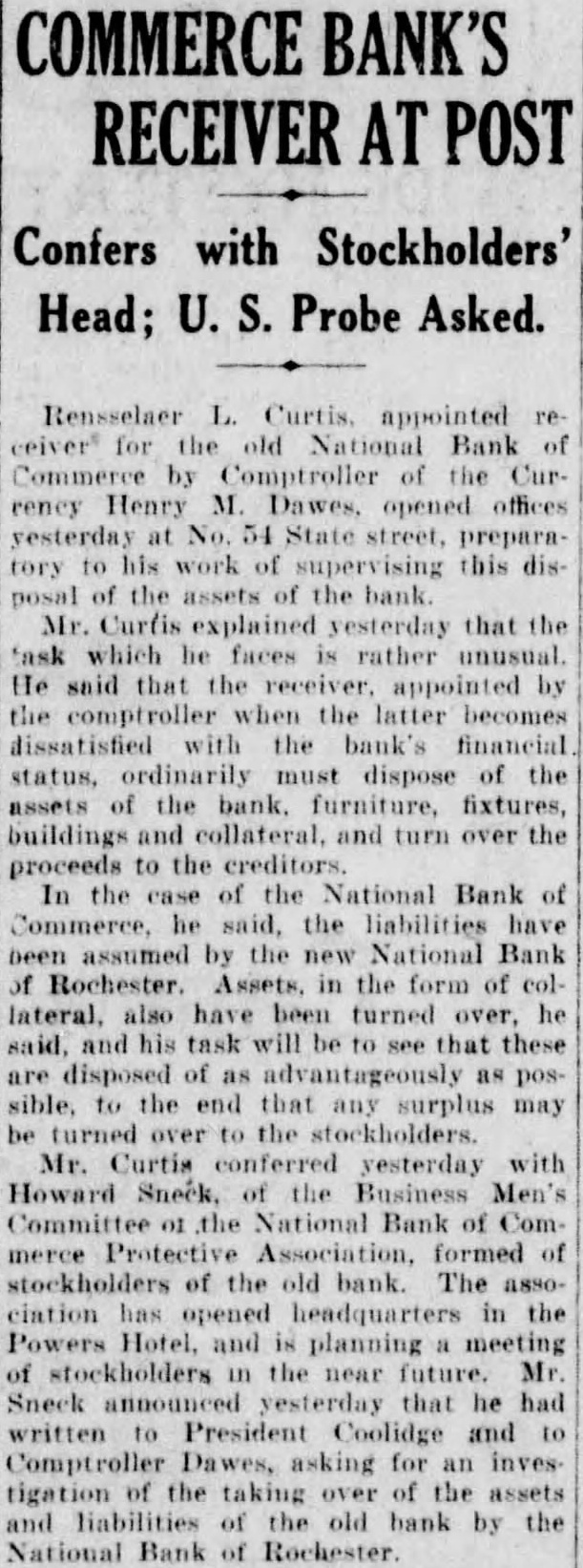
COMMERCE BANK'S RECEIVER AT POST Confers with Stockholders' Head; U. S. Probe Asked. Rensselaer L. Curtis, appointed receiver for the old National Bank of Commerce by Comptroller of the Currency Henry M. Dawes, opened offices yesterday at No. 54 State street, preparatory to his work of supervising this disposal of the assets of the bank. Mr. Curtis explained yesterday that the task which he faces is rather unusual. He said that the receiver, appointed by the comptroller when the latter becomes dissatisfied with the bank's financial status, ordinarily must dispose of the assets of the bank, furniture, fixtures, buildings and collateral, and turn over the proceeds to the creditors. In the case of the National Bank of Commerce, he said, the liabilities have been assumed by the new National Bank of Rochester. Assets, in the form of collateral, also have been turned over, he said, and his task will be to see that these are disposed of as advantageously as possible, to the end that any surplus may be turned over to the stockholders. Mr. Curtis conferred yesterday with Howard Sneck, of the Business Men's Committee of the National Bank of Commerce Protective Association, formed of stockholders of the old bank. The association has opened headquarters in the Powers Hotel, and is planning a meeting of stockholders in the near future. Mr. Sneck announced yesterday that he had written to President Coolidge and to Comptroller Dawes, asking for an investigation of the taking over of the assets and liabilities of the old bank by the National Bank of Rochester.

Article from Democrat and Chronicle, October 29, 1924

Click image to open full size in new tab

Article Text

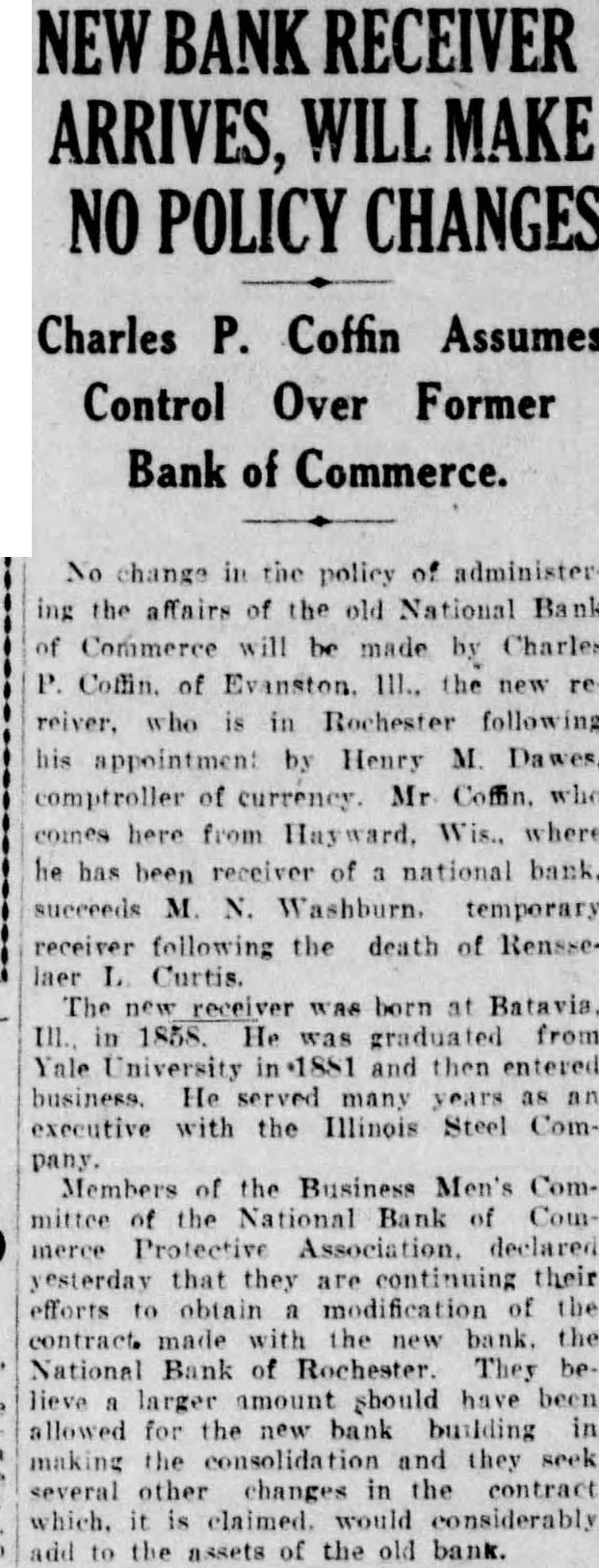
NEW BANK RECEIVER ARRIVES, WILL MAKE NO POLICY CHANGES Charles P. Coffin Assumes Control Over Former Bank of Commerce. No change in the policy of administering the affairs of the old National Bank of Commerce will be made by Charles P. Coffin, of Evanston, Ill., the new receiver, who is in Rochester following his appointment by Henry M. Dawes, comptroller of currency. Mr. Coffin, who comes here from Hayward, Wis., where he has been receiver of a national bank, succeeds M. N. Washburn, temporary receiver following the death of Rensselaer L. Curtis. The new receiver was born at Batavia, Ill., in 1858. He was graduated from Yale University in 1881 and then entered business. He served many years as an executive with the Illinois Steel Company. Members of the Business Men's Committee of the National Bank of Commerce Protective Association, declared yesterday that they are continuing their efforts to obtain a modification of the contract made with the new bank, the National Bank of Rochester. They believe a larger amount should have been allowed for the new bank building in making the consolidation and they seek several other changes in the contract which, it is claimed, would considerably add to the assets of the old bank.