Williamsburg Bank (Williamsburg, PA)

Episode Information

Episode UID
8208872191164
Episode Type
Run โ†’ Suspension โ†’ Closure
Bank Type
trust
Bank ID
820887219 hash
Start Date
December 14, 1896
Location
Williamsburg, Pennsylvania (40.462, -78.204)

Metadata

Model
gemini-3-flash-preview (chosen from majority vote of a three-model LLM ensemble)
Short Digest
d8a873d5ccb28234

Response Measures

None

Description

The bank was an unincorporated branch or affiliate of the First National Bank of Hollidaysburg and was also known as Jack and Watson, Morrow & Co.

Events (3)

1. December 14, 1896 Run
Cause
Local Banks
Cause Details
A run triggered by the failure of the First National Bank of Hollidaysburg and a dispute with the Pennsylvania Railroad regarding deposit withdrawals.
Newspaper Excerpt
The result of this contention between the railway company and the banks was a steady run on the institutions by the minor depositors, and they succumbed this morning. after withstanding the run for seven days.
Source
newspapers
2. December 14, 1896 Suspension
Cause
Local Banks
Cause Details
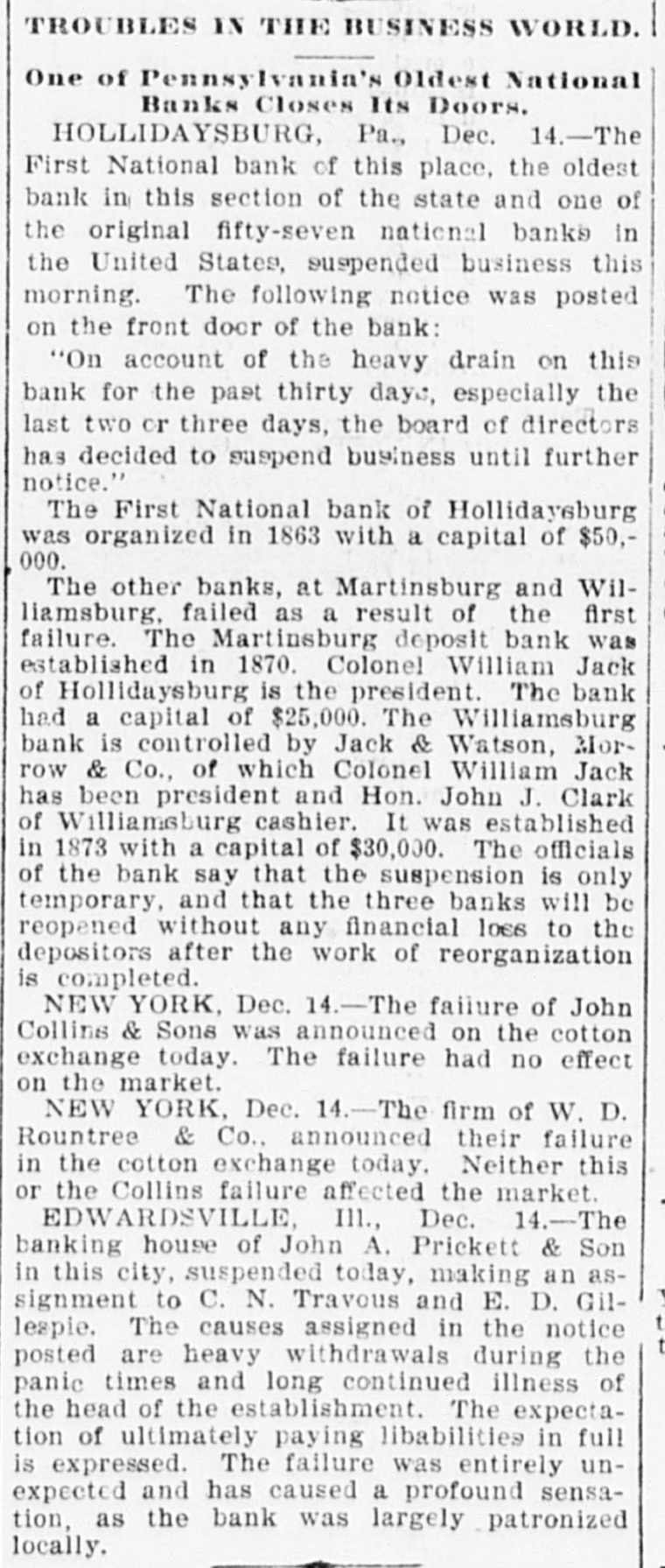
Suspended as a result of the failure of the First National Bank of Hollidaysburg, which controlled it.
Newspaper Excerpt
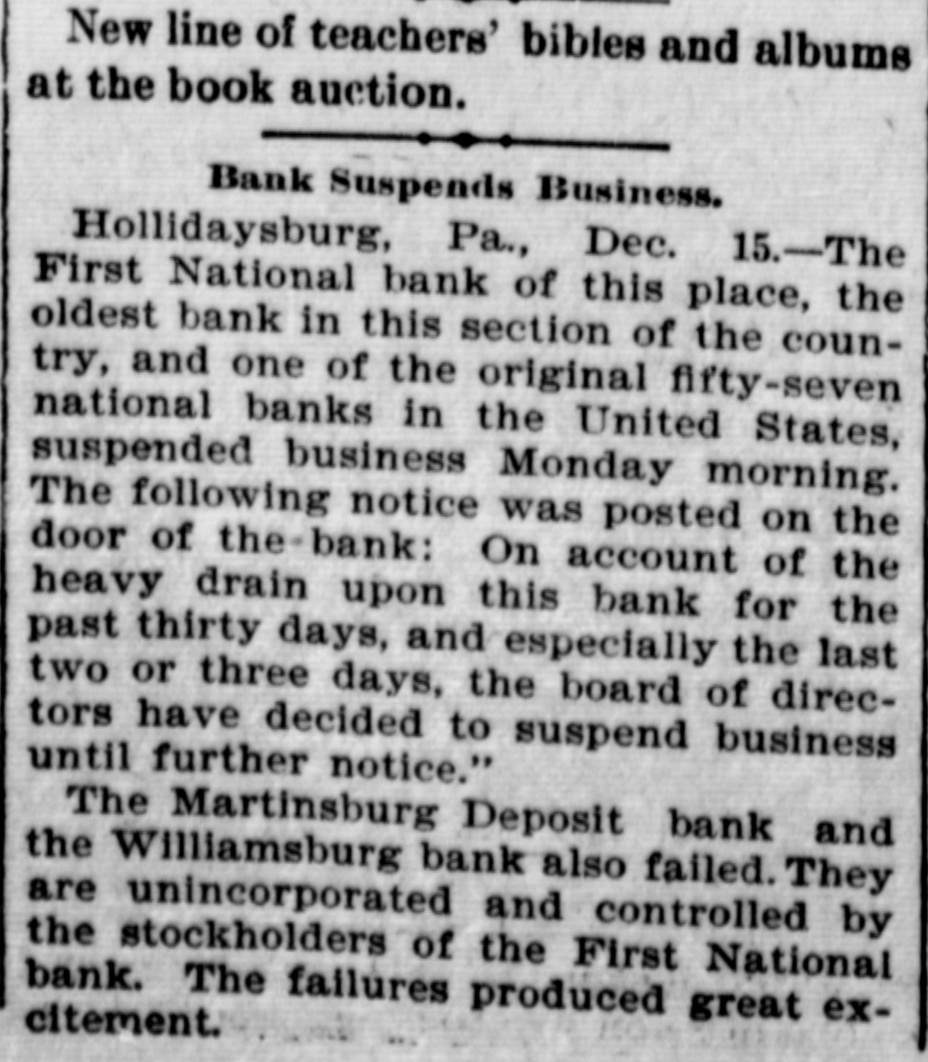
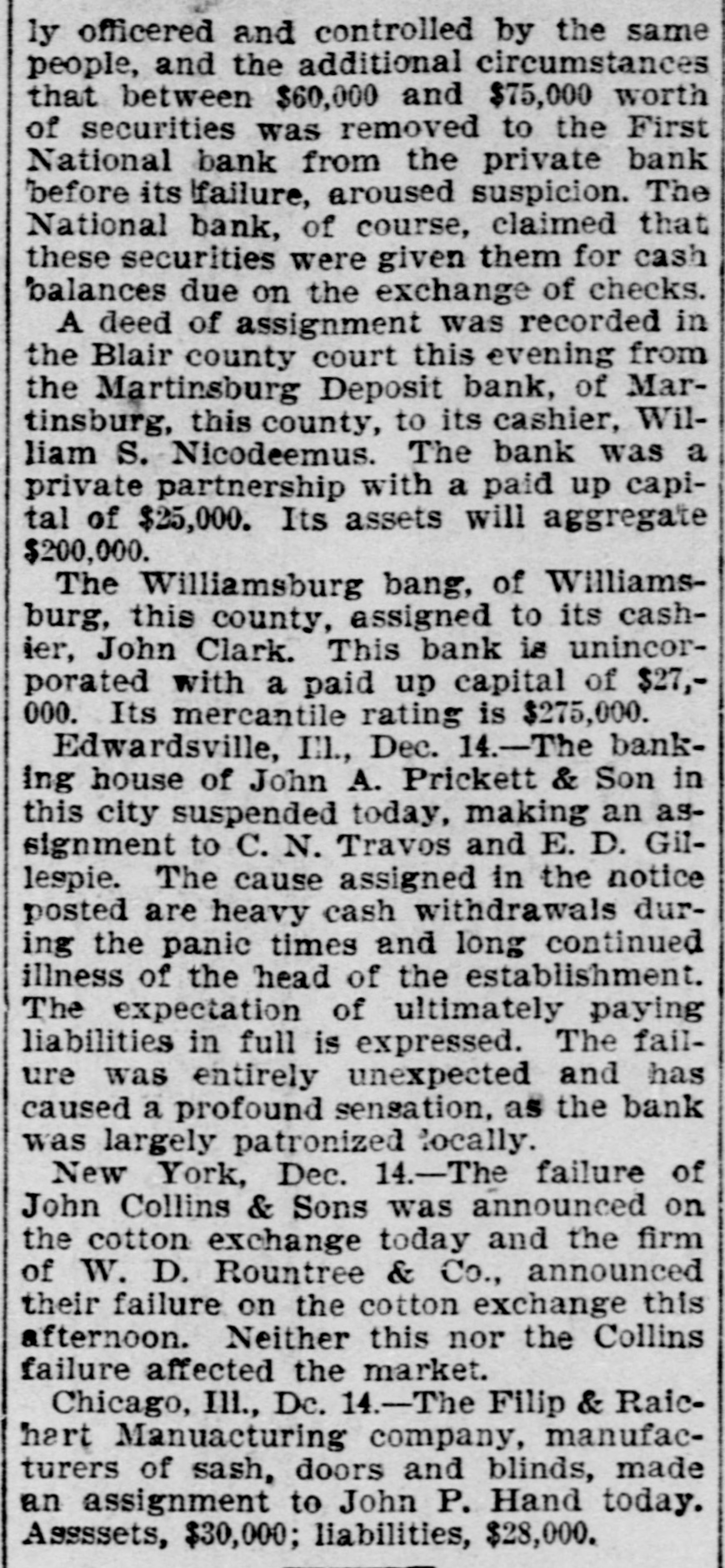
The Williamsburg bank, of Williamsburg, this county, assigned to its cashier, John Clark. This bank is unincorporated with a paid up capital of $27,000.
Source
newspapers
3. January 5, 1897 Receivership
Newspaper Excerpt
The Williamsburg bank, which went down in the crash. is said to be a hopeless wreck, and its affairs will be settled up by an assignee.
Source
newspapers

Newspaper Articles (23)

Article from The Topeka State Journal, December 14, 1896

Click image to open full size in new tab

Article Text

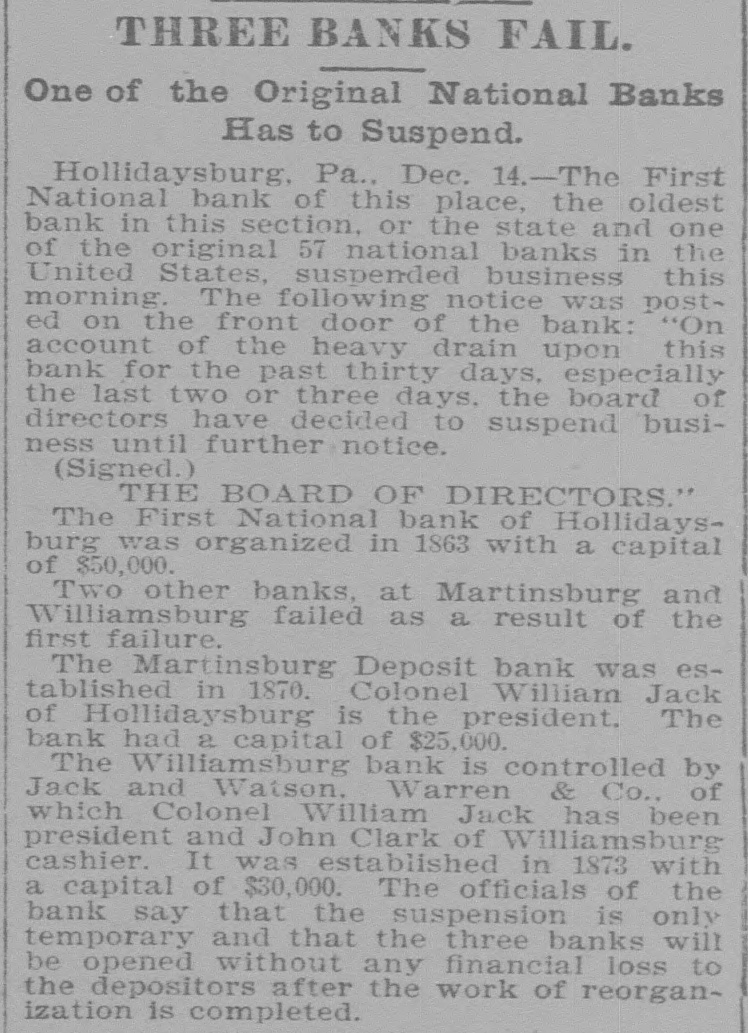
THREE BANKS FAIL. One of the Original National Banks Has to Suspend. Hollidaysburg, Pa., Dec. 14.-The First National bank of this place, the oldest bank in this section, or the state and one of the original 57 national banks in the United States, suspended business this morning. The following notice was posted on the front door of the bank: "On account of the heavy drain upon this bank for the past thirty days, especially the last two or three days. the board of directors have decided to suspend business until further notice. (Signed.) THE BOARD OF DIRECTORS." The First National bank of Hollidaysburg was organized in 1863 with a capital of $50,000. Two other banks, at Martinsburg and Williamsburg failed as a result of the first failure. The Martinsburg Deposit bank was established in 1870. Colonel William Jack of Hollidaysburg is the president. The bank had a capital of $25,000. The Williamsburg bank is controlled by Jack and Watson. Warren & Co., of which Colonel William Jack has been president and John Clark of Williamsburg cashier. It was established in 1873 with a capital of $30,000. The officials of the bank say that the suspension is only temporary and that the three banks will be opened without any financial loss to the depositors after the work of reorganization is completed.


Article from Rock Island Argus, December 14, 1896

Click image to open full size in new tab

Article Text

More Prosperity. Hollidaysburg, Pa., Dec. 14.-The First National bank of this place, the oldest bank in this section, one of the original 57 national banks in the United States, suspended this morning on account of heavy drawing on funds in the past few days. Two other banks at Martinsburg and Williamsburg failed as a result. The Hollidaysburg bank had $50.000 capital, the Martinsburg de posit bank $25,000, and the Williamsburg bank $30,000.


Article from The Evening Tribune, December 14, 1896

Click image to open full size in new tab

Article Text

NATIONAL BANKS SUSPEND TWO INSTITUTIONS IN PENNSYLVANIA CLOSE THEIR DOORS. The Bank at Hollidaysburg One of the Origi nal Banks of the Country. [Special Dispatch to the TRIBUNE.] Philadelphia, Dec. 14. The First National Bank of Hollidaysburg, Pa., the oldest banking institution in this section and one of the original 57 National Banks in the United States, suspended payment this morning. The Deposit Bank of Martinsburg, Pa., and the Williamsburg Bank of Williamsburg, Pa., have also closed their doors. The two latter institutions were run in connection with the former, and have been looked upon as sound institutios.


Article from Deseret Evening News, December 14, 1896

Click image to open full size in new tab

Article Text

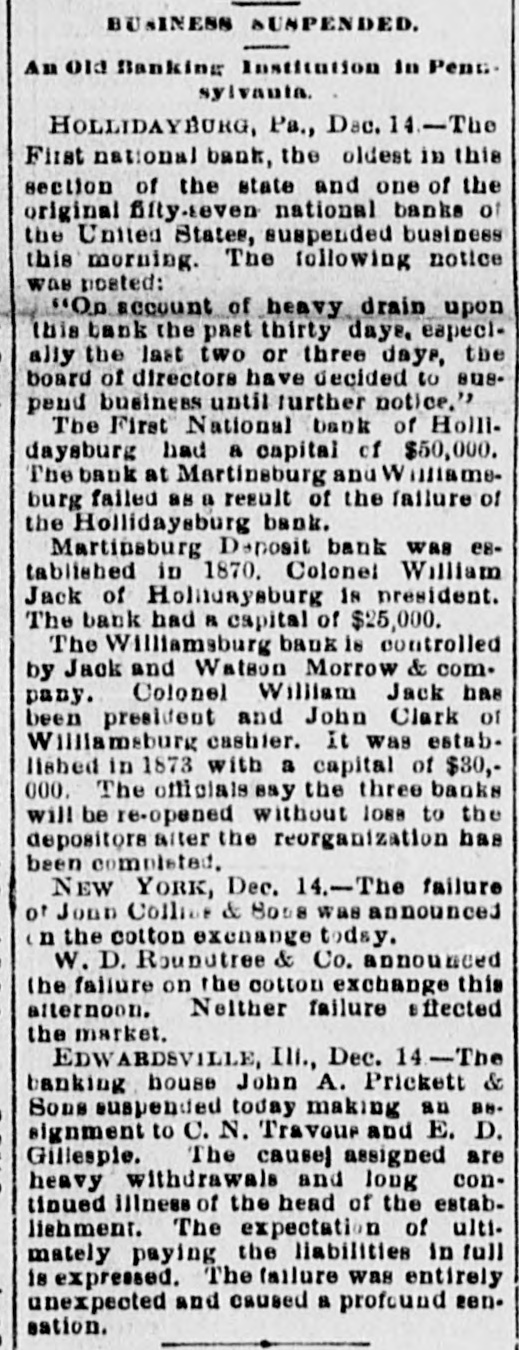
BUSINESS SUSPENDED. An 014 Banking Institution in Pennsylvanta. HOLLIDAYBURG, Pa., Dac. 14-The First national bank, the oldest in this section of the state and one of the original fifty-seven national banks of the United States, suspended business this morning. The following notice was posted: "On account of heavy drain upon this bank the past thirty days. espectally the last two or three days, the board of directors have decided to suspend business until further notice." The First National bank of Hollidaysburg had a capital of $50,000. The bank at Martinsburg and W illameburg failed as a result of the failure of the Hollidaysburg bank. Martinsburg Deposit bank was established in 1870. Colonel William Jack of Holituaysburg is president. The bank had a capital of $25,000. The Williamsburg bank is controlled by Jack and Watson Morrow & company. Colonel William Jack has been president and John Clark of Williamsburg cashier. It was established in 1873 with a capital of $30,000. The officials say the three banks will be re-opened without loss to the depositors after the reorganization has been completed. NEW YORK, Dec. 14.-The failure of Jonn Colline & Sons was announced on the cotton exenange today. W. D. Roundtree & Co. announced the failure on the cotton exchange this alternoon. Neither failure effected the market. EDWARDSVILLE, III., Dec. 14-The banking house John A. Prickett & Sons suspended today making an BH. signment to C. N. Travous and E. D. Gillespie. The causej assigned are heavy withdrawals and long continued illness of the head of the establishment. The expectation of ultimately paying the liabilities in full is expressed. The failure was entirely unexpected and caused a profound eensation.


Article from Alexandria Gazette, December 14, 1896

Click image to open full size in new tab

Article Text

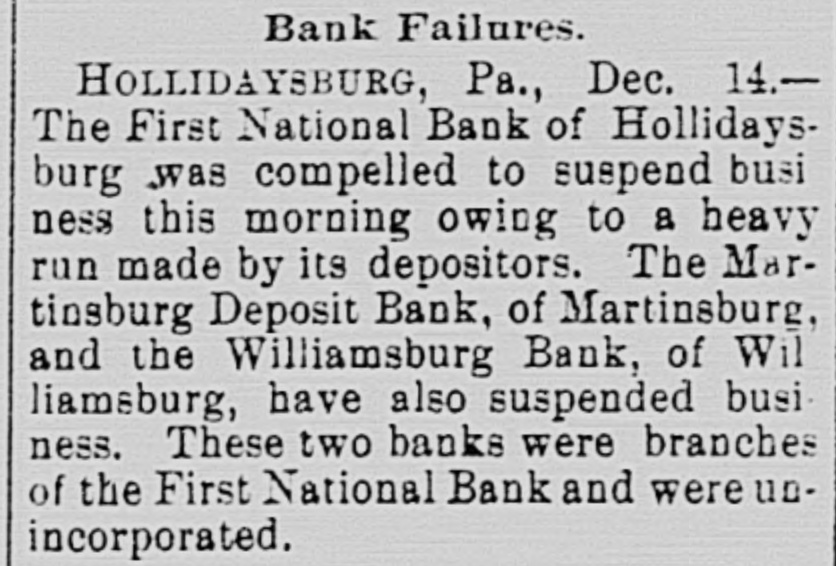
Bank Failures. HOLLIDAYSBURG, Pa., Dec. 14.The First National Bank of Hollidaysburg was compelled to suspend busi ness this morning owing to a heavy run made by its depositors. The Martinsburg Deposit Bank, of Martinsburg, and the Williamsburg Bank, of Wil liamsburg, have also suspended business. These two banks were branches of the First National Bank and were unincorporated.


Article from Kansas City Daily Journal, December 15, 1896

Click image to open full size in new tab

Article Text

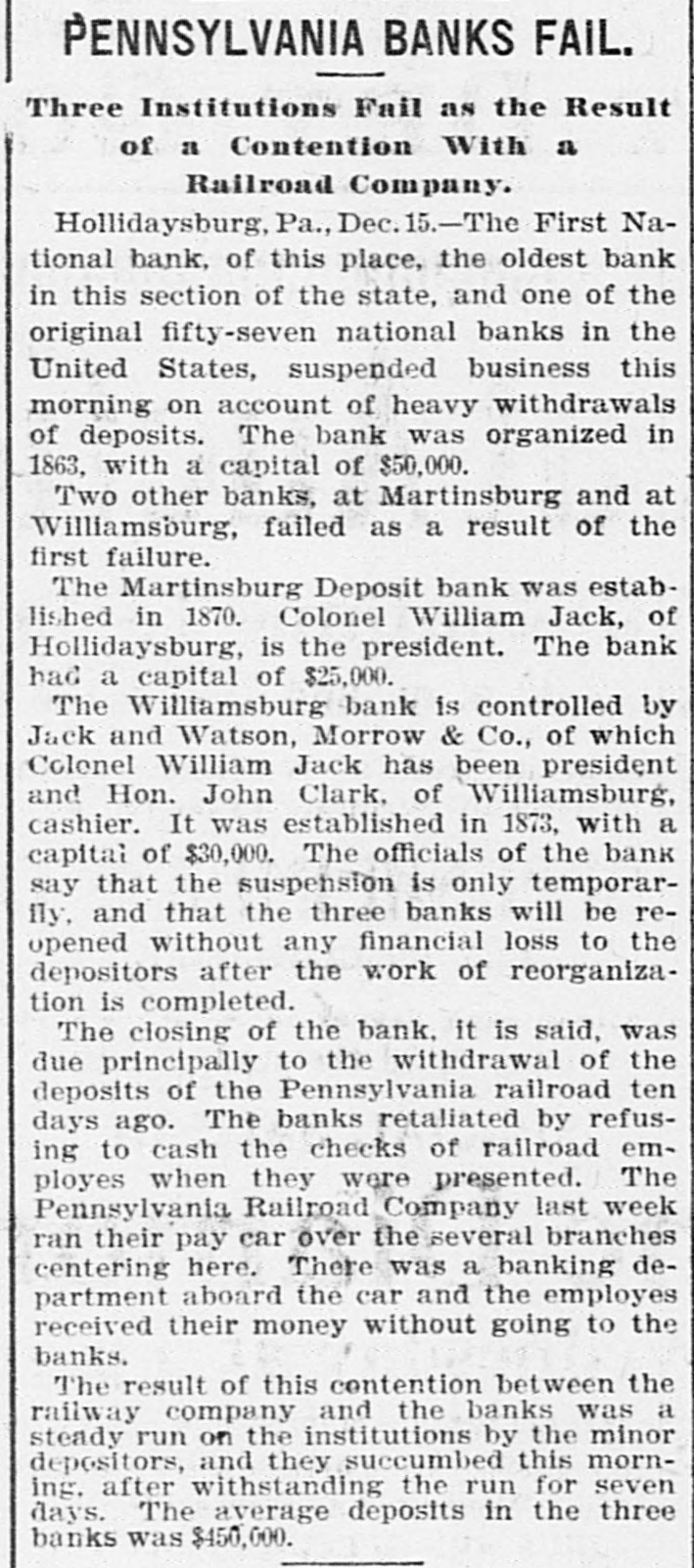
PENNSYLVANIA BANKS FAIL. Three Institutions Fail as the Result of a Contention With a Railroad Company. Hollidaysburg, Pa., Dec. 15.-The First National bank, of this place, the oldest bank in this section of the state, and one of the original fifty-seven national banks in the United States, suspended business this morning on account of heavy withdrawals of deposits. The bank was organized in 1863, with a capital of $50,000. Two other banks, at Martinsburg and at Williamsburg, failed as a result of the first failure. The Martinsburg Deposit bank was established in 1870. Colonel William Jack, of Hollidaysburg, is the president. The bank had a capital of $25,000. The Williamsburg bank is controlled by Jack and Watson, Morrow & Co., of which Colonel William Jack has been president and Hon. John Clark, of Williamsburg, cashier. It was established in 1873, with a capital of $30,000. The officials of the bank say that the suspension is only temporarily, and that the three banks will be reopened without any financial loss to the depositors after the work of reorganization is completed. The closing of the bank. it is said, was due principally to the withdrawal of the deposits of the Pennsylvania railroad ten days ago. The banks retaliated by refusing to cash the checks of railroad employes when they were presented. The Pennsylvania Railroad Company last week ran their pay car over the several branches centering here. There was a banking department aboard the car and the employes received their money without going to the banks. The result of this contention between the railway company and the banks was a steady run on the institutions by the minor depositors, and they succumbed this morning. after withstanding the run for seven days. The average deposits in the three banks was $450,000.


Article from The Wilmington Daily Republican, December 15, 1896

Click image to open full size in new tab

Article Text

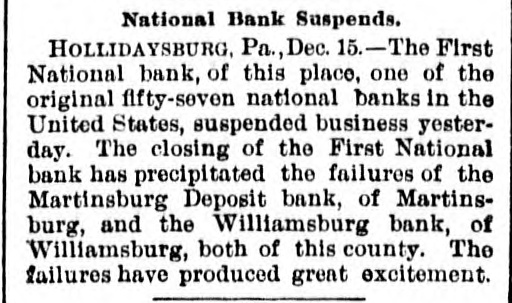
National Bank Suspends. HOLLIDAYSBURG, Pa., Dec. 15.-The First National bank, of this place, one of the original fifty-seven national banks in the United States, suspended business yesterday. The closing of the First National bank has precipitated the failures of the Martinsburg Deposit bank, of Martinsburg, and the Williamsburg bank, of Williamsburg, both of this county. The failures have produced great excitement.


Article from The Copper Country Evening News, December 15, 1896

Click image to open full size in new tab

Article Text

New line of teachers' bibles and albums at the book auction. Bank Suspends Business. Hollidaysburg, Pa., Dec. 15.-The First National bank of this place, the oldest bank in this section of the country, and one of the original fifty-seven national banks in the United States, suspended business Monday morning. The following notice was posted on the door of the-bank: On account of the heavy drain upon this bank for the past thirty days, and especially the last two or three days, the board of directors have decided to suspend business until further notice." The Martinsburg Deposit bank and the Williamsburg bank also failed. They are unincorporated and controlled by the stockholders of the First National bank. citement. The failures produced great ex-


Article from The Wichita Daily Eagle, December 15, 1896

Click image to open full size in new tab

Article Text

ly officered and controlled by the same people, and the additional circumstances that between $60,000 and $75,000 worth of securities was removed to the First National bank from the private bank before its failure, aroused suspicion. The National bank, of course, claimed that these securities were given them for cash balances due on the exchange of checks. A deed of assignment was recorded in the Blair county court this evening from the Martinsburg Deposit bank, of Martinsburg, this county, to its cashier, William S. Nicodeemus. The bank was a private partnership with a paid up capital of $25,000. Its assets will aggregate $200,000. The Williamsburg bang, of Williamsburg, this county, assigned to its cashier, John Clark. This bank is unincorporated with a paid up capital of $27,000. Its mercantile rating is $275,000. Edwardsville, Ill., Dec. 14.-The banking house of John A. Prickett & Son in this city suspended today, making an assignment to C. N. Travos and E. D. Gillespie. The cause assigned in the notice posted are heavy cash withdrawals during the panic times and long continued illness of the head of the establishment. The expectation of ultimately paying liabilities in full is expressed. The failure was entirely unexpected and has caused a profound sensation, as the bank was largely patronized locally. New York, Dec. 14.-The failure of John Collins & Sons was announced on the cotton exchange today and the firm of W. D. Rountree & Co., announced their failure on the cotton exchange this afternoon. Neither this nor the Collins failure affected the market. Chicago, III., Dc. 14.-The Filip & Raichart Manuacturing company, manufacturers of sash, doors and blinds, made an assignment to John P. Hand today. Assssets, $30,000; liabilities, $28,000.


Article from The Saint Paul Globe, December 15, 1896

Click image to open full size in new tab

Article Text

BUSINESS DIFFICULTIES. HOLIDAYSBURG. Pa., Dec. 14.-The First National bank of this place, the oldest bank in this section of the state, and one of the original fifty-seven banks in the United States, suspended this morning. Two other banks, at Martinsburg and Williamsburg, failed as 8. result of the first failure. The Martinsburg Deposit bank was established in 1870. Col. William Jack, of Hollidaysburg, is the president. The bank had a capital of $25,000. The Williamsburg bank is controlled by Watson, Morrow & Co. It was established in 1873, with a capital of $30,000. The closing of the banks, It is said, was due principally to the withdrawal of the deposits of the Pennsysvania railroad company ten days ago. The total of deposits in the three banks was $450,000. The banks have been distrusted in financial circles since Sept. 18 last. On that day the private banking house of Gardner, Morrow & Co., of this city, failed, with liabilities of $325,000 and assets so far as ascertained, of $92,000. The intimate relations existing between the four banks, the fact that they were mainly officered and controlled by the same people, and the additional circumstances that between $60,000 and $75,000 worth of securities was removed to the First National bank from the private bank before its failure aroused suspicion. The national bank officers claimed that these securities were given them for cash balances due on the exchange of checks. A deed of assignment was recorded in the Blair county court this evening from the Martinsburg Deposit bank of Martinsburg, this county, to its cashier, Wm. S. Nicodemus. The bank was a private partnership with a paid up capital of $25,000. Its assets will aggregate $200,000. The Williamsburg bank, of Williamsburg, this county, assigned to its cashier, John Clark. This bank is unincorporated with a paid up capital of $27,000. Its merchant rating is $175,000. New York, Dec. 14.-The firm of W. D. Rountree & Co. announced their failure on the cotton exchange this afternoon. Neither this nor the Collins failure affected the market. Edwardsville, III., Dec. 14.-The banking house of John A. Prickett & Sons, in this city, suspended today, making an assignment to S. N. Travous and E. D. Gillespie. Chicago, Dec. 14.-The Filip & Rachart Manufacturing company, manufacturers of sash, doors and blinds, made an assignment to John R Hand today. Assets, $30,000; liabilities, $28,000. WALL STREET TALK. The entire $3,200,000 issue of Louisville & Nashville refunding bonds put on the open market the latter part of the preceding week has been sold to investors in various parts of the country. A syndicate of New York bankers made a good thing on the deal, as they purchased the whole issue at par and sold out for prices ranging from 102 to 105. Sugar will sell ex-dividend tomorrow. The Standard Oil people have been making large loans on this specialty. Big Four earnings for the first week in December decreased $1,451. Edison Illuminating company shows an increase for November of $39,680. President Depew says the Vanderbilts have not had a controlling interest in the New York Central since 1880. A break in cotton and some troubles among the cotton houses attracted some attention in Wall street, mainly because the market had nothing else to talk about. The occurrence in question is a direct result of a break in the price of cotton. That rate of discount in London open market advanced 1/8 today, to 31/4 per cent. NEW YORK MONEY. NEW YORK, Dec. 14.-Money on call easy at 11/4@2 per cent; last loan, 1ยฝ, closed at 1ยฝ @2 per cent. Prime mercantile paper, 4@5 per cent. Sterling exchange firmer, with actual business in bankers' bills $4.86%@4.87 for demand, and $4.83%@4.84 for sixty days. Posted rates, $4.84ยฝ and $4.871/2@4.88. Commercial bills, $4.821/2. Bar silver, 65%o. Silver certificates, 65%@65%c. FOREIGN FINANCIAL. NEW YORK. Dec. 14.-The Evening Post's London financial cablegram: The stock markets were idle and dull today, except for Kaffirs. Americans sagged all day because of the absence of business, and the lower New York prices. The close was at the lowest. Consols were flat on the continental demands for gold. PLAN UNDESIRABLE. NEW YORK, Dec. 14.-Messrs. J. P. Stewart, Edward King and Alexander E. Orr, of the committee under the trust debenture of the Union Pacific railway company, have issued a circular to the holders of Union Pacific collateral trust notes stating that in the opinion of the committee, he proposed plan of reorganizaion is undesirable. BANK CLEARINGS. St. Paul-$837,842.67. Minneapolis-$1,675,084.64. New York-Clearings, $79,497,359; balances, $4,341,648. Boston-Clearings, $13,800,397; balances, $2,122,375. CHICAGO MONEY. CHICAGO, Dec. 14.-Money steady, unchanged. New York exchange 50c premium. Foreign exchange firm; demand, $4.86%; sixty days, $4.84.
Article from Omaha Daily Bee, December 15, 1896

Click image to open full size in new tab

Article Text

TROUBLES IN THE BUSINESS WORLD. One of Pennsylvania's Oldest National Banks Closes Its Doors. HOLLIDAYSBURG, Pa., Dec. 14.-The First National bank of this place, the oldest bank in this section of the state and one of the original fifty-seven national banks in the United States, suspended business this morning. The following notice was posted on the front door of the bank: "On account of the heavy drain on this bank for the past thirty days, especially the last two or three days, the board of directors has decided to suspend business until further notice." The First National bank of Hollidaysburg was organized in 1863 with a capital of $50,000. The other banks, at Martinsburg and Williamsburg, failed as a result of the first failure. The Martinsburg deposit bank was established in 1870. Colonel William Jack of Hollidaysburg is the president. The bank had a capital of $25,000. The Williamsburg bank is controlled by Jack & Watson, Morrow & Co., of which Colonel William Jack has been president and Hon. John J. Clark of Williamsburg cashier. It was established in 1873 with a capital of $30,000. The officials of the bank say that the suspension is only temporary, and that the three banks will be reopened without any financial loss to the depositors after the work of reorganization is completed. NEW YORK, Dec. 14.-The failure of John Collins & Sons was announced on the cotton exchange today. The failure had no effect on the market. NEW YORK, Dec. 14.-The firm of W. D. Rountree & Co., announced their failure in the cotton exchange today. Neither this or the Collins failure affected the market. EDWARDSVILLE, III., Dec. 14.-The banking house of John A. Prickett & Son in this city, suspended today, making an assignment to C. N. Travous and E. D. Gillespie. The causes assigned in the notice posted are heavy withdrawals during the panic times and long continued illness of the head of the establishment. The expectation of ultimately paying libabilities in full is expressed. The failure was entirely unexpected and has caused a profound sensation, as the bank was largely patronized locally.


Article from The Wilmington Daily Republican, December 16, 1896

Click image to open full size in new tab

Article Text

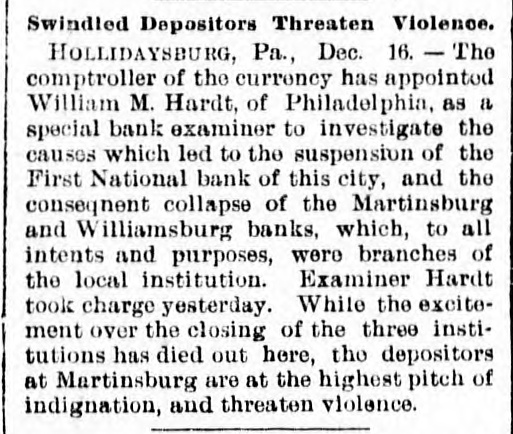
Swindled Depositors Threaten Violence. HOLLIDAYSBURG, Pa., Dec. 16. - The comptroller of the currency has appointed William M. Hardt, of Philadelphia, as a special bank examiner to investigate the causes which led to the suspension of the First National bank of this city, and the conseqnent collapse of the Martinsburg and Williamsburg banks, which, to all intents and purposes, were branches of the local institution. Examiner Hardt took charge yesterday. While the excitement over the closing of the three institutions has died out here, the depositors at Martinsburg are at the highest pitch of indignation, and threaten violence.


Article from The Somerset Herald, December 16, 1896

Click image to open full size in new tab

Article Text

Serious Financial Troubles at Hollidaysburg Hollidaysburg, Pa. Dec. 14.-The following notice was posted on the front door of the First National bank at 8:30 this morning: "On account of the heavy drain upon this bank for the past 30 days, and especially the last two or three days, the Board of Directors have decided to suspend business until further notice." Signed by Board of Directors. The First National bank is the oldest national bank in this section of the State, and one of the 57 original national banks in the United States. Its closing has precipitated the failure of the Martinsburg Deposit bank, of Martinsburg, this county, and of the Williamsburg bank, of Williamsburg, this county. These two banks were incorporated and controlled by the stockholders of the First National bank.


Article from The Evening Herald, December 16, 1896

Click image to open full size in new tab

Article Text

Swindled Depositors Threaten Violence. HOLLIDAYSBURG, Pa., Dec. 16. - The comptroller of the currency has appointed William M. Hardt, of Philadelphia, as a special bank examiner to investigate the causes which led to the suspension of the First National bank of this city, and the conseqnent collapse of the Martinsburg and Williamsburg banks, which, to all intents and purposes, were branches of the local institution. Examiner Hardt took charge yesterday. While the excitement over the closing of the three institutions has died out here, the depositors at Martinsburg are at the highest pitch of indignation, and threaten violence.


Article from Evening Journal, December 16, 1896

Click image to open full size in new tab

Article Text

Depositors Threaten Violence. HOLLIDAYSEURG, Pa., Dec. 16.-The comptroller of the currency has appointed William M. Hardt of Philadelphia as a special bank examiner to investigate the causes which led to the suspension of the First National bank of this city and the consequent collapse of the Martinsburg and Williamsburg banks, which to all intents and purposes were branches of the local institution. Examiner Hardt has taken charge. It will not be known for several days whether or not Comptroller Eckels will permit the banks to resume business. While the excitement over the closing of the three institutions has died out here, the depositors at Martinsburg are at the highest pitch of indignation and threaten violence.


Article from The Record-Union, December 16, 1896

Click image to open full size in new tab

Article Text

BANK FAILURE. A Heavy Run Causes a Pennsylvania Concern to Suspend. PITTSBURG, Dec. 14.-The First National Bank of Hollidaysburg suspended business this morning, owing to a heavy run made by its depositors. This bank was organized in 1863 and capiItalized at $50,000. It is one of the oldest national banks in the United States. The excitement over the closing of the bank has been intensified by the news that the Martinsburg Deposit Bank of Martinsburg and the Williamsburg Bank of Williamsburg have also suspended business. These two banks are branches of the First National Bank. The total capital of the three institutions is about $100,000. The officials say the suspension is temporary and that the three banks will be reopened without financial difficulties after the work of reorganization is completed.


Article from Delaware Gazette and State Journal, December 17, 1896

Click image to open full size in new tab

Article Text

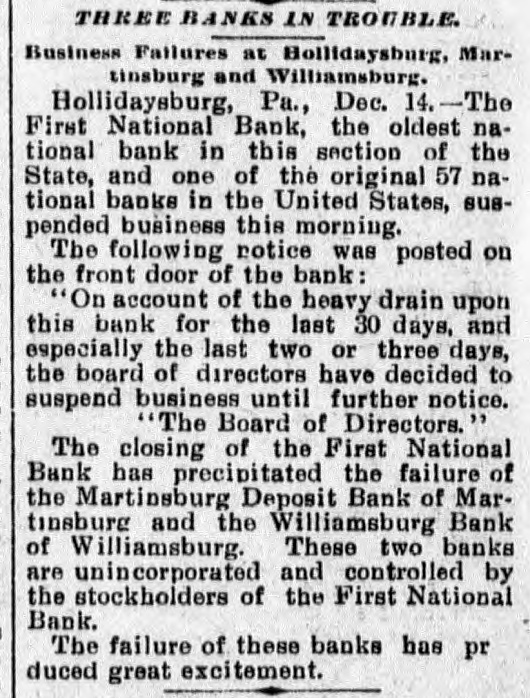
THREE BANKS IN TROUBLE. Business Failures at Hollidaysburg, Martinsburg and Williamsburg. Hollidaysburg, Pa., Dec. 14.-The First National Bank, the oldest national bank in this section of the State, and one of the original 57 national banks in the United States, suspended business this morning. The following notice was posted on the front door of the bank: "On account of the heavy drain upon this bank for the last 30 days, and especially the last two or three days, the board of directors have decided to suspend business until further notice. "The Board of Directors." The closing of the First National Bank has precipitated the failure of the Martinsburg Deposit Bank of Martinsburg and the Williamsburg Bank of Williamsburg. These two banks are unincorporated and controlled by the stockholders of the First National Bank. The failure of these banks has pr duced great excitement.


Article from The Cambria Freeman, December 18, 1896

Click image to open full size in new tab

Article Text

BLAIR county got an overdose of McKinley prosperity or. Monday when the First National Bank of Hollidaysburg, as well as the Martinsburg Deposit Bank, and the Williamsburg Bank, closed their doors. The officials of the respective banks say that the suspension is only temporary.


Article from The Cambria Freeman, December 18, 1896

Click image to open full size in new tab

Article Text

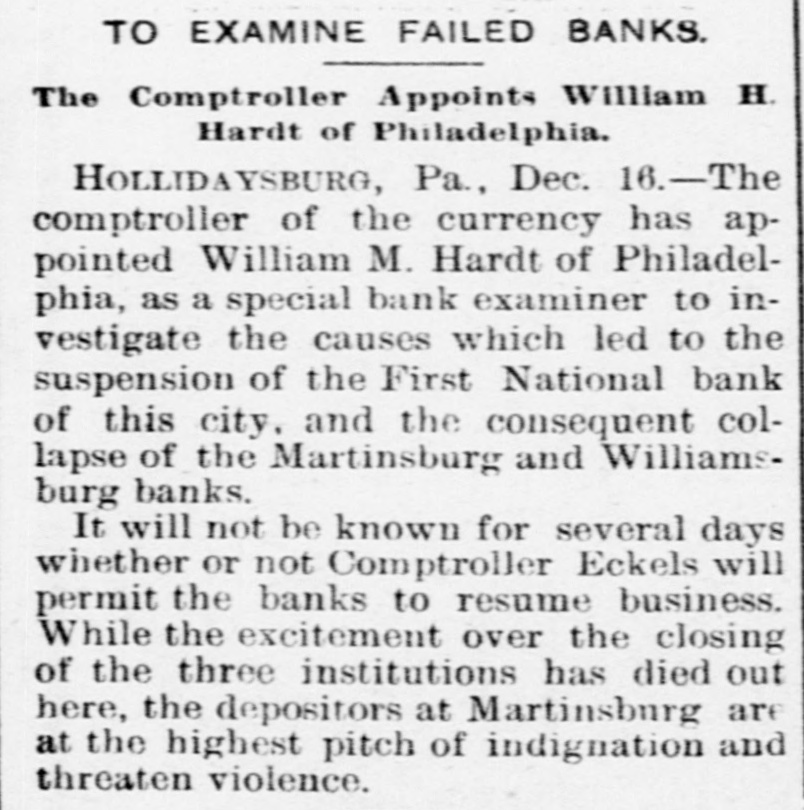
TO EXAMINE FAILED BANKS. The Comptroller Appoints William H. Hardt of Philadelphia. Hollidaysburg, Pa., Dec. 16.-The comptroller of the currency has appointed William M. Hardt of Philadelphia, as a special bank examiner to investigate the causes which led to the suspension of the First National bank of this city, and the consequent collapse of the Martinsburg and Williamsburg banks. It will not be known for several days whether or not Comptroller Eckels will permit the banks to resume business. While the excitement over the closing of the three institutions has died out here, the depositors at Martinsburg are at the highest pitch of indignation and threaten violence.


Article from The Kimball Graphic, December 19, 1896

Click image to open full size in new tab

Article Text

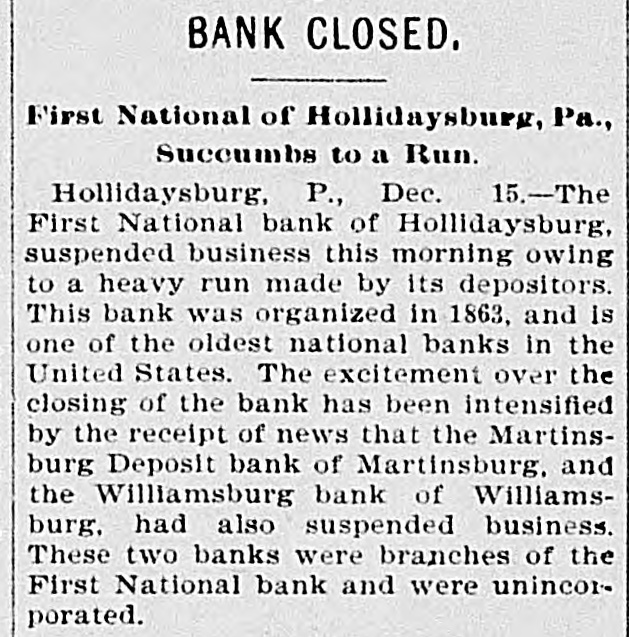
BANK CLOSED. First National of Hollidaysburg, Pa., Succumbs to a Run. Hollidaysburg, P., Dec. 15.-The First National bank of Hollidaysburg, suspended business this morning owing to a heavy run made by its depositors. This bank was organized in 1863, and is one of the oldest national banks in the United States. The excitement over the closing of the bank has been intensified by the receipt of news that the Martinsburg Deposit bank of Martinsburg, and the Williamsburg bank of Williamsburg. had also suspended business. These two banks were branches of the First National bank and were unincorporated.


Article from The Diamond Drill, December 19, 1896

Click image to open full size in new tab

Article Text

COULDN'T STAND THE DRAIN. First National Bank of Hollidaysburg, Pa., and Its Two Branches Closed. Hollidaysburg. Pa., Dec. 15.-The First national bank, of Hollidaysburg, was compelled to suspend business Monday morning owing to a heavy run made by its depositors. This bank was organized in 1863, is capitalized at $50,000, and is one of the 57 oldest national banks in the United States. The excitement over the closing of the First national bank has been intensified by the reception of the news that the Martinsburg Deposit bank, of Martinsburg,and the Williamsburg bank, of Williamsburg, had also suspended business. These two banks were branches of the First national bank and were unincorporaterd.


Article from Pullman Herald, December 19, 1896

Click image to open full size in new tab

Article Text

FOUR EASTERN BANKS GO DOWN. Three in Pennsylvania and One in Illinois. Holl daysburg, Pa., Dec. 14.-The First National bank, the oldest in this section of the state, and one of the original 57 national banks of the United States, suspended business this morning. The following notice was posted: On account of a heavy drain upon this bank the past 30 days, especially the ast two or three days, the board of directors have decided to suspend business until further notice." The bank had a capital of $50,000. The banks at Martinsburg and Williamsburg failed as a result of the failure of the Hollidaysburg bank. The Martinsburg deposit bank was established in 1870. Colonel William Jack of Hollidaysburg is president. It had a capital of $25,000. The Villiamsburg bank is controlled by Jack and Watson Morrow. Colonel William Jack has been president and John Clark of Williamsburg cashier. It was established in 1873, with a capital of $30,000. The officials say the three banks will be opened without loss to the depositors, after reorganization is completed. An Illinois Bank. Edwardsville, Ill., Dec. 14.-The banking house of John A. Prickett & Son sus. pended today, making an assignment to C. N. Traveus and E. D. Gillespie. The cause assigned is heavy withdrawals and the long continued illness of the head of the establishment. An expectation of ultimately paying liabilities in full is expressed. The failure was entirely unexpected, and caused a profound sensation. On Trial for Fraud. Denver, Dec. 14.-The trial of Charles O. Dow, Sidney McClenken and O. O. Miller, charged with frauds in connection with the failure of the Commercial National bank of this city in 1893, was begun in the United States district court before Judge Hallett. On the Cotton Exchange. New York, Dec. 14.-The failure of John Collins & Sons was announced on the cotton exchange this afternoon. The failure did not affect the market.


Article from The Indianapolis Journal, January 6, 1897

Click image to open full size in new tab

Article Text

Other Business Troubles. CHICAGO, Jan. 5.-Upon an intervening petition and information filed by Attorney General Maurice T. Moloney, Judge Payne this evening appointed George Shilling. Dr. George Emerick and Paul O. Stensland receivers of the International Building, Loan and Investment Union, fixing their bonds at $100,000 each. These are the same receivers appointed by Judge Payne last Saturday. Under the information and petition filed to-day by the attorney general the newly appointed receivers are to dissolve the union, settle up all its affairs and gradually work it out of existence. HOLLIDAYSBURG. Pa., Jan. 5.-Assurances were to-day given to the depositors of the First National Bank of Hollidaysburg and the Martinsburg Deposit Bank, which closed their doors three weeks ago, that both would be able to resume business in a few days. The Williamsburg bank, which went down in the crash. is said to be a hopeless wreck, and its affairs will be settled up by an assignee. TOLEDO, Jan. 5.-A dispatch sent out from Albany, N. Y., stated that the Milburn Wagon Company had gone into the hands of a receiver. The statement is an error. The Milburn company is located here and is in excellent financial condition. The firm which went into receivership was an Albany house. which acted as local agent for the Milburns. SEDALIA. Mo., Jan. 5.-The Van Wagener-Hanney Shoe Company, the oldest and largest house in the city, closed its doors this morning on a deed of trust. John Montgomery. jr., is trustee. The failure is a bad one, but the amount of assets and liabilities are not given.