Allemania Bank (St Paul, MN)

Episode Information

Episode UID
8209705591165
Episode Type
Run โ†’ Suspension โ†’ Reopening
Bank Type
state
Bank ID
820970559 hash
Start Date
January 1, 1897
Location
St Paul, Minnesota (44.944, -93.093)

Metadata

Model
gpt-5-mini (chosen from majority vote of a three-model LLM ensemble)
Short Digest
913cba40c39b2cd2

Response Measures

None

Description

Closure/suspension followed a run triggered by the Bank of Minnesota failure; later receivership and an attempted reorganization led to officers resuming control.

Events (4)

1. January 1, 1897 Run
Cause
Local Banks
Cause Details
Run triggered by panic after failure/closing of the Bank of Minnesota and runs on other local St. Paul banks.
Measures
Called on bank examiner; paid out large sums before closing; invoked assignments/sixty-days notice used by savings banks elsewhere.
Newspaper Excerpt
The Allemania bank ... closed its doors. ... they had been suffering from the panic, the failure being due to the combined holding and withdrawing of deposits.
Source
newspapers
2. January 4, 1897 Suspension
Cause
Local Banks
Cause Details
Direct suspension/assignment resulting from depositor runs caused by prior local bank failures and panicky withdrawals.
Newspaper Excerpt
The Allemania bank ... closed its doors at noon ... the directors directed it was best for all concerned, that they close. ... bank officials promptly called on the bank examiner to take possession of the bank, and that official is now in charge.
Source
newspapers
3. January 5, 1897 Receivership
Newspaper Excerpt
Maurice Auerbach, president of the Union Bank, was to-day appointed receiver of the Allemania Bank under bond of $200,000.
Source
newspapers
4. April 1, 1897* Other
Newspaper Excerpt
The report says the assets ... were worthless. The directors were heavy borrowers and were guilty of misstatements. ... petitioned the district court ... a reorganization of the bank ... receivers were thereupon discharged, and the officers of the bank resumed control of its affairs and issued ... certificates of deposit for the amount of their respective claims.
Source
newspapers

Newspaper Articles (25)

Article from The Topeka State Journal, January 4, 1897

Click image to open full size in new tab

Article Text

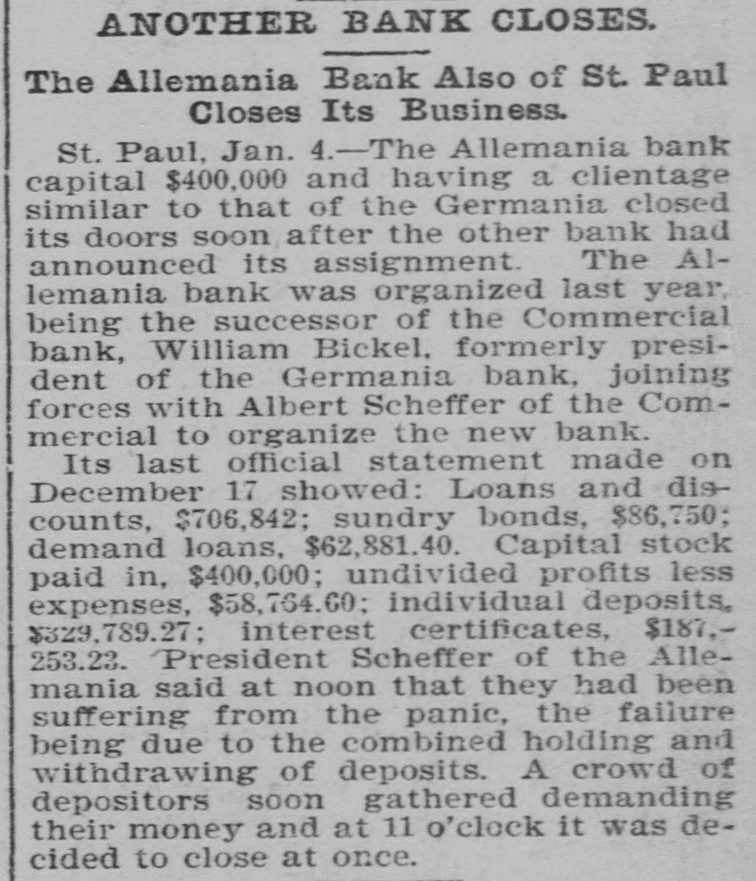
ANOTHER BANK CLOSES. The Allemania Bank Also of St. Paul Closes Its Business. St. Paul, Jan. 1.-The Allemania bank capital $400,000 and having a clientage similar to that of the Germania closed its doors soon after the other bank had announced its assignment. The Allemania bank was organized last year, being the successor of the Commercial bank, William Bickel, formerly president of the Germania bank, joining forces with Albert Scheffer of the Commercial to organize the new bank. Its last official statement made on December 17 showed: Loans and discounts, $706,842; sundry bonds, $86,750; demand loans, $62,881.40. Capital stock paid in, $400,000; undivided profits less expenses, $58,764.60; individual deposits, $329,789.27; interest certificates, $187,253.23. President Scheffer of the Allemania said at noon that they had been suffering from the panic, the failure being due to the combined holding and withdrawing of deposits. A crowd of depositors soon gathered demanding their money and at 11 o'clock it was decided to close at once.


Article from Las Vegas Daily Optic, January 4, 1897

Click image to open full size in new tab

Article Text

MINNEAPOLIS, Minn., January 4.The West Side bank, of St. Paul, closed its doors, caused by the failure of the Allemania Bank. There was a heavy run on the Minnesota State Savings bank, 10-day, and it took advantage of the sixty-days' notice.


Article from Las Vegas Daily Optic, January 4, 1897

Click image to open full size in new tab

Article Text

Other Banks Close Down. ST. PAUL, Minn., January 4. -The Germania bank, of this city, closed its doors, this morning. The capital was $400,000; surplus, $59,000. On De. cember 17th, the loans and discounts amounted to $975,000 and its deposits, $1,091,968. ST. PAUL, Minn., January -The Allemania bank, which closed its doors at noon, to-day, had a capital of $400,. 000; loans and discounts, $706,842; deposits, $602,305. ST. PAUL, Minn., January 4. / -The annoubcement made by officials of the bank that, if assigned to Peter M Kerst, the cashier, the directors directed it was best for all concerned, that they close. The bank stood a run for nearly two weeks, its depositors begin ning to withdraw when the Bank of Minnesota closed, on December 22d.


Article from The Daily Morning Astorian, January 5, 1897

Click image to open full size in new tab

Article Text

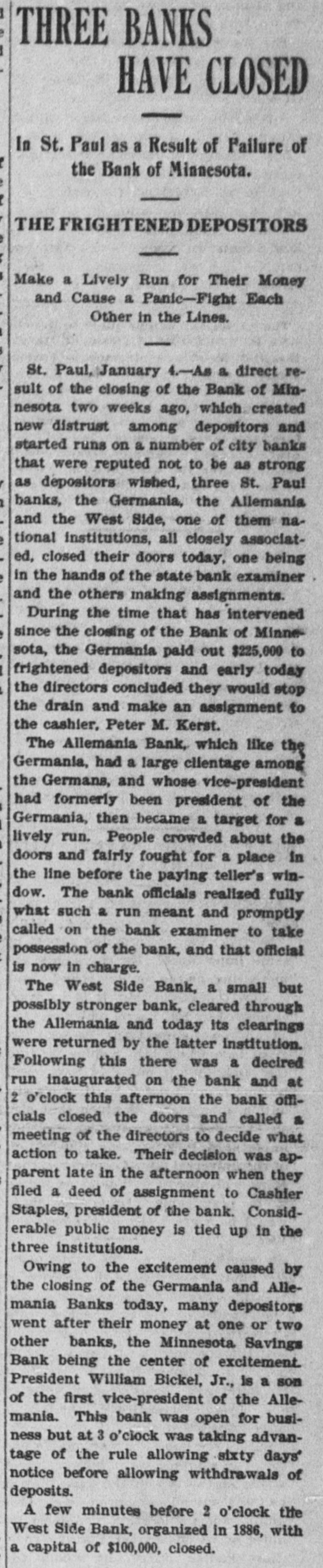
THREE BANKS HAVE CLOSED In St. Paul as a Result of Failure of the Bank of Minnesota. e / THE FRIGHTENED DEPOSITORS e : I Make a Lively Run for Their Money and Cause a Panic-Fight Each Other in the Lines. I I r St. Paul, January 4.-As a direct re: sult of the closing of the Bank of Minnesota two weeks ago, which created new distrust among depositors and started runs on a number of city banks that were reputed not to be as strong as depositors wished, three St. Paul r banks, the Germania, the Allemania a and the West Side, one of them nae tional institutions, all closely associat: ed, closed their doors today, one being in the hands of the state bank examiner e : and the others making assignments. . During the time that has intervened since the closing of the Bank of Minne e : sota, the Germania paid out $225,000 to i frightened depositors and early today i the directors concluded they would stop the drain and make an assignment to the cashier, Peter M. Kerst. The Allemania Bank, which like the Germania, had a large clientage among the Germans, and whose vice-president had formerly been president of the Germania, then became a target for a lively run. People crowded about the doors and fairly fought for a place in the line before the paying teller's window. The bank officials realized fully what such a run meant and promptly called on the bank examiner to take possession of the bank, and that official is now in charge. The West Side Bank, a small but possibly stronger bank, cleared through the Allemania and today its clearings were returned by the latter institution. Following this there was a decired run inaugurated on the bank and at 2 o'clock this afternoon the bank offlcials closed the doors and called a meeting of the directors to decide what action to take. Their decision was apparent late in the afternoon when they filed a deed of assignment to Cashier Staples, president of the bank. Considerable public money is tied up in the three institutions. Owing to the excitement caused by the closing of the Germania and Allemania Banks today, many depositors went after their money at one or two other banks, the Minnesota Savings Bank being the center of excitement. President William Bickel, Jr., is a son of the first vice-president of the Allemania. This bank was open for business but at 3 o'clock was taking advantage of the rule allowing sixty days' notice before allowing withdrawals of deposits. A few minutes before 2 o'clock the West Side Bank, organized in 1886, with a capital of $100,000, closed.


Article from The Bryan Daily Eagle, January 5, 1897

Click image to open full size in new tab

Article Text

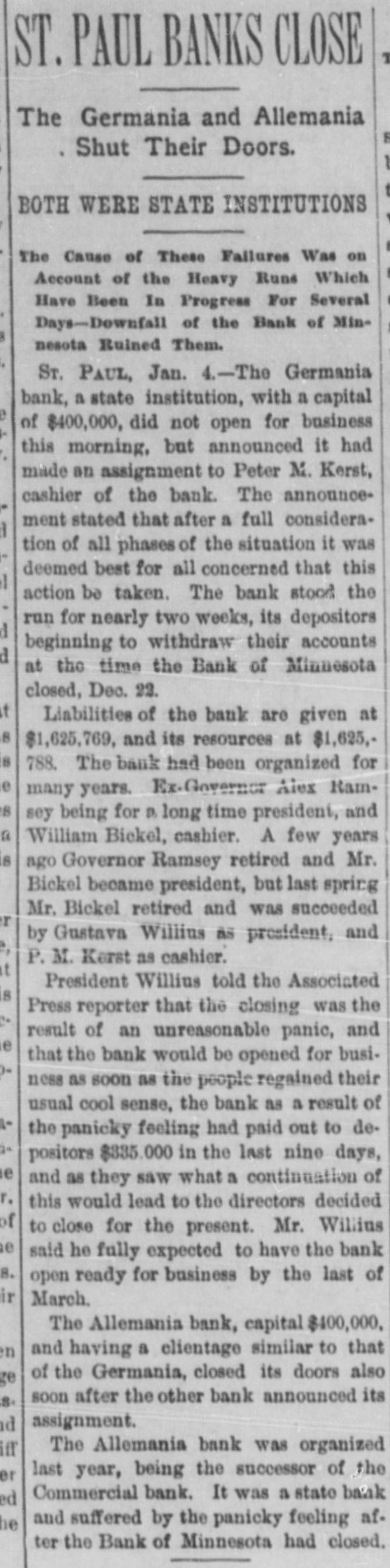
ST. PAUL BANKS CLOSE The Germania and Allemania Shut Their Doors. BOTH WERE STATE INSTITUTIONS The Cause of These Failures Was on Account of the Heavy Runs Which Have Been In Progress For Several Days-Downfall of the Bank of Minnesota Ruined Them. Sr. PAUL, Jan. 4.-The Germania bank, a state institution, with a capital of $400,000, did not open for business this morning, but announced it had made an assignment to Peter M. Kerst, cashier of the bank. The announcement stated that after a full consideration of all phases of the situation it was deemed best for all concerned that this action be taken. The bank stood the run for nearly two weeks, its depositors beginning to withdraw their accounts at the time the Bank of Minnesota closed, Dec. 22. Liabilities of the bank are given at 8 $1,625,769, and its resources at $1,625,8 788. The bank had been organized for e many years. Ex-Governor Aiox Ram8 sey being for a long time president, and a William Bickel, cashier. A few years 8 ago Governor Ramsey retired and Mr. Bickel became president, but last spring Mr. Bickel retired and was succeeded T by Gustava Willius as president, and P. M. Kerst as cashier. President Willius told the Associated 8 Press reporter that the closing was the result of an unreasonable panic, and e that the bank would be opened for business as soon as the people regained their usual cool sense, the bank as a result of the panicky feeling had paid out to depositors $835.000 in the last nine days, e and as they saw what a continuation of ฮ“. this would lead to the directors decided of to close for the present. Mr. Willius e said he fully expected to have the bank B. open ready for business by the last of ir March. The Allemania bank, capital $400,000, and having a elientage similar to that n of the Germania, closed its doors also az soon after the other bank announced its is assignment. The Allemania bank was organized iff last year, being the successor of the er Commercial bank. It was a state bank and suffered by the panicky feeling afhe ter the Bank of Minnesota had closed.


Article from The Indianapolis Journal, January 5, 1897

Click image to open full size in new tab

Article Text

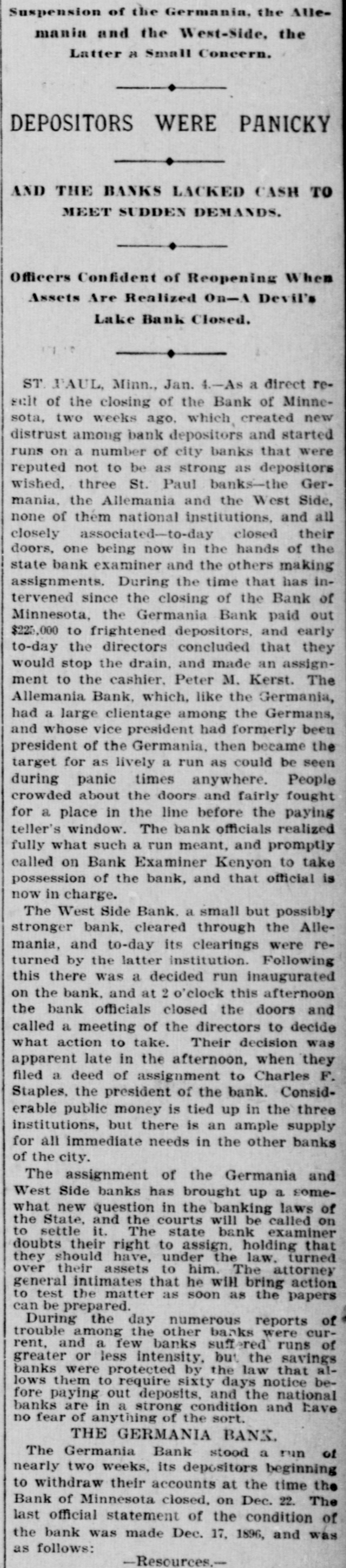
Suspension of the Germania, the Allemania and the West-Side, the Latter a Small Concern. DEPOSITORS WERE PANICKY AND THE BANKS LACKED CASH TO MEET SUDDEN DEMANDS. Officers Confident of Reopening When Assets Are Realized On-A Devil's Lake Bank Closed. ST. PAUL, Minn., Jan. 4.-As a direct reselt of the closing of the Bank of Minnesota, two weeks ago, which created new distrust among bank depositors and started runs on a number of city banks that were reputed not to be as strong as depositors wished, three St. Paul banks-the Germania, the Allemania and the West Side, none of them national institutions, and all closely associated-to-day closed their doors, one being now in the hands of the state bank examiner and the others making assignments. During the time that has intervened since the closing of the Bank of Minnesota, the Germania Bank paid out $225,000 to frightened depositors, and early to-day the directors concluded that they would stop the drain, and made an assignment to the cashier. Peter M. Kerst. The Allemania Bank, which, like the Germania, had a large clientage among the Germans, and whose vice president had formerly been president of the Germania, then became the target for as lively a run as could be seen during panic times anywhere. People crowded about the doors and fairly fought for a place in the line before the paying teller's window. The bank officials realized fully what such a run meant, and promptly called on Bank Examiner Kenyon to take possession of the bank, and that official is now in charge. The West Side Bank. a small but possibly stronger bank, cleared through the Allemania, and to-day its clearings were returned by the latter institution. Following this there was a decided run inaugurated on the bank, and at 2 o'clock this afternoon the bank officials closed the doors and called a meeting of the directors to decide what action to take. Their decision was apparent late in the afternoon, when they filed a deed of assignment to Charles F. Staples, the president of the bank. Considerable public money is tied up in the three institutions, but there is an ample supply for all immediate needs in the other banks of the city. The assignment of the Germania and West Side banks has brought up a somewhat new question in the banking laws of the State, and the courts will be called on to settle it. The state bank examiner doubts their right to assign. holding that they should have, under the law. turned over their assets to him. The attorney general intimates that he will bring action to test the matter as soon as the papers can be prepared. During the day numerous reports of trouble among the other banks were current, and a few banks suffered runs of greater or less intensity, but the savings banks were protected by the law that allows them to require sixty days notice before paying out deposits, and the national banks are in a strong condition and have no fear of anything of the sort. THE GERMANIA BANK. The Germania Bank stood a run of nearly two weeks, its depositors beginning to withdraw their accounts at the time the Bank of Minnesota closed, on Dec. 22. The last official statement of the condition of the bank was made Dec. 17, 1896, and was as follows: -Resources


Article from The Greenville Times, January 6, 1897

Click image to open full size in new tab

Article Text

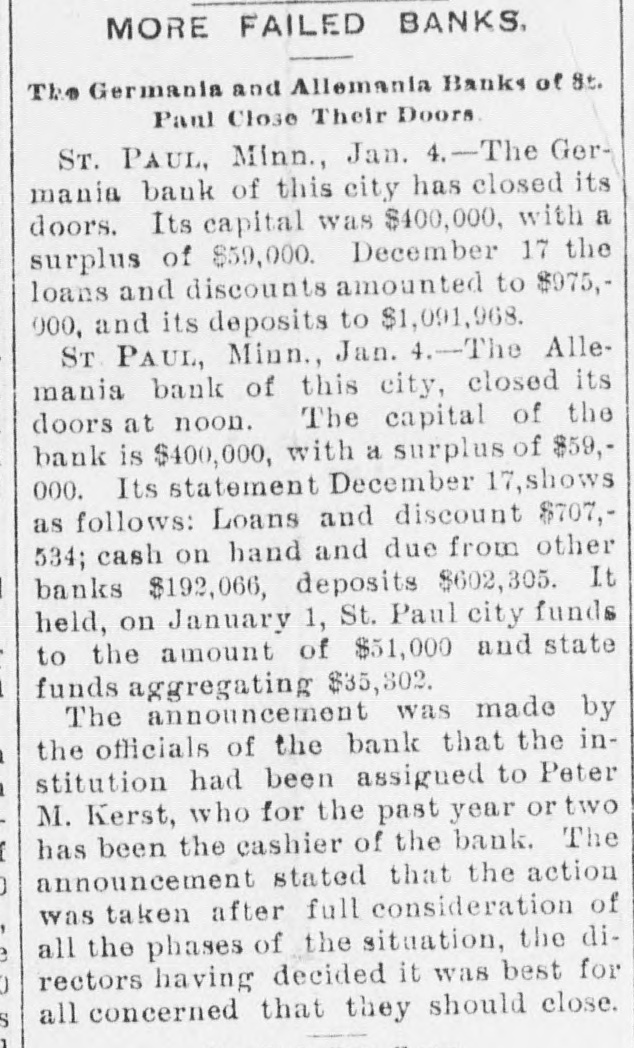
MORE FAILED BANKS. The Germania and Allemania Banks of St. Paul Close Their Doors ST. PAUL, Minn., Jan. 4. - The Germania bank of this city has closed its doors. Its capital was $400,000, with a surplus of $59,000. December 17 the loans and discounts amounted to $975,900, and its deposits to $1,091,968. ST PAUL, Minn., Jan. 4.-The Allemania bank of this city, closed its doors at noon. The capital of the bank is $400,000, with a surplus of $59,000. Its statement December 17, ,shows as follows: Loans and discount $707,534; cash on hand and due from other banks $192,066, deposits $602,305. It held, on January 1, St. Paul city funds to the amount of $51,000 and state funds aggregating $35,302. The announcement was made by the officials of the bank that the institution had been assigned to Peter M. Kerst, who for the past year or two has been the cashier of the bank. The announcement stated that the action was taken after full consideration of all the phases of the situation, the directors having decided it was best for all concerned that they should close.


Article from The Morning News, January 6, 1897

Click image to open full size in new tab

Article Text

ST. PAUL'S BROKEN BANKS. Steps Taken to Straighten Out Their Affairs. St. Paul, Minn., Jan. 5. -Maurice Auerbach, president of the Union Bank, was to-day appointed receiver of the Allemania Bank under bond of $200,000. The board of directors of the Germania held a special meeting and appointed a committee of seven stockholders to take measures for the speedy reorganization of the bank. Charles F. Staples was made assignee of the West Side Bank. Early in the day there was a slight run on a couple of banks, but everything quieted down quickly, and no further trouble is expected among the financial institutions here. St. Paul still has five national, six state and three savings banks, with deposits aggregating $20,000,000. Bad business methods wrecked the Bank of Minnesota, and the others were forced to close by panicky depositors.


Article from Richmond Dispatch, January 6, 1897

Click image to open full size in new tab

Article Text

ST, PAUL BANK SITUATION. Two Small Runs-No Further Trouble Anticipated. ST. PAUL, MINN., January 5.-Maurice Auerbach, president of the Union Bank, was to-day appointed receiver of the Allemania Bank, under a bond of $200,000. The Board of Directors of the Germania held a special meeting, and appointed a committee of stockholders to take measures for the speedy reorganization of the bank. Charles F. Staples was made assignee of the Westside Bank. Early in the day there were slight runs on a couple of banks, but everything quieted down quickly, and no further trouble is expected among the financial institutions here. St. Paul still has five national, six State, and three savings banks, with deposits aggregating $20,000,000. Bad. business methods wrecked the Bank of Minnesota, and the others were forced to close by panicky depositors.


Article from El Paso Daily Herald, January 7, 1897

Click image to open full size in new tab

Article Text

Another Bank Gone. EAU CLAIRE, Wis., Jan. 7.-The Commercial bank with a capital of $30. 000 closed today; due to the suspension of the Allemania bank at St. Paul.


Article from The Princeton Union, January 7, 1897

Click image to open full size in new tab

Article Text

BANKS GO UNDER THREE MORE FINANCIAL INSTITUTIONS CLOSE THEIR DOORS. The Germania Bank and a Branch and the Recently Organized Allefania Bank Suspend as the Result of a Run-Runs Are Made on Other Banks, but It Is Thought That No More Failures Will Occur. St. Paul, Jan. 6. - The Germania Bank of St. Paul, a state institution, capital $400,000, did not open for business to-day, but announced its assignment to Peter M. Kerst, who for the past two years has been cashier of the bank. The bank stood a run for nearly two weeks, its depositors beginning to withdraw their accounts at the time the Bank of Minnesota closed on Dec. 22. The last official statement of the condition of the bank was made Dec. 17, 1896, and was as follows: Resources - Loans and discounts, $975,420.53; overdrafts, secured and unsecured, $2,355.70; stocks and bonds, $87,890.36; banking house, $253,847.10; furniture and fixtures, $10,328; other real estate, $40,158.47; current expenses,$13,742.54; taxes paid, $2,131.50; due from banks, $59,259.78; checks and cash items, $2,535.73: exchanges for clearing, $27,607.45; currency, $42,339; nickels and cents, $244.59; gold, $103,560; silver, $4,347.25; total resources, $1,625,768.01. Liabilities - Capital stock. $400,000; surplus and undivided profits, $58,797.27; dividends unpaid, $2; bank building loan, $75,000; individual deposits subject to check, $345,191.44; demand certificates of deposit, $633,019.70; certified checks, $11,450.02; cashier's checks, $4,305.41; due to banks, $90,103.17; total liabilities, $1,625,768.01. President Willius told an Associated Press representative to-day that the closing was the result of an unreasonable panic and that the bank would be opened for business just as soon as the people resumed their usual cool senses. The bank, as a result of the panicky feeling, has paid out to depositors $250,000 in the last nine days, and as they saw what the continuation of this would lead to, the directors had decided to close for the present. Mr. Willius says he fully expects to have the bank reopened and ready for business by the last of March. The Allemania Goes. The Allemania bank, capital $400,000, and having a clientage similar to that of the Germania bank, closed its doors also soon after the other bank had announced its assignment. The Allemania bank was organized last year, being the successor of the Commercial bank. This bank was also a sufferer by the panicky feeling after the Bank of Minnesota had closed. Its last official statement at the close of business Dec. 17, 1896, as follows: Resources - Loans and discounts, $706,842.28; sundry bonds. $86,750; overdrafts, $1,978.19; bank building, $6,000; furniture and fixtures, $13,12.31; due from other banks, $35,929.59; gold, $42,500; currency, $25,000 silver, nickels, etc., $4,467.85; cash items, $10,173.87; exchanges for clear ing house, $11,114.28; demand loans $62,881.40; total resources, $1,061, 009.97. Liabilities - Capital stock paid in $400,000; undivided profits, less ex
Article from The Columbia Herald, January 8, 1897

Click image to open full size in new tab

Article Text

IN ONE DAY. Three St. Paul Banks Close Their Doors and Quit Business: ST. PAUL, Jan. 4.-As a direct result of the closing of the Bank of Minnesota two weeks ago, which created new distrust among bank depositors and started runs on a number of city banks that were reputed to be as strong as depositors wished, three St. Paul banks, the Germania, the Allemania and the West Side, none of them national institutions, and all closely associated, to-day closed their doors, one being now in the hands of the State Bank Examiner and the others making assignments. The last report of the condition of the Germania Bank was made Dec. 17, and showed a capital stock of $400,000 and individual deposits to the amount of $345,191.00. The Allemania Bank was organized last year. and had a capital stock of $400,000. Its last statement showed individual deposits to the amount of $329,789.27. The West End Bank was organized in 1886, with a capital of $100,000. The total assets are $217,024.17, and the deposits amounted to $113,546.


Article from The San Francisco Call, January 8, 1897

Click image to open full size in new tab

Article Text

A Wisconsin Bank Failure. EAU CLAIRE, Wis,, Jan. 7.-The Commercial Bank, capital $30,000, closed today, due to the suspension of the Allemania Bank of St. Paul.


Article from The Times, January 8, 1897

Click image to open full size in new tab

Article Text

ST. PAUL BANKS CLOSED. The Germania, Allemania and West Side Suspend Payment. St. Paul, Jan. 5.-The Germania bank, a state institution, capital $400,000, did not open for business Monday, but announced its assignment to Peter M. Kerst, who for the past year or two, has been the cashier of the bank. The announcement stated that this action was taken after full consideration of all phases of the situation, as it was deemed best for all concerned that this action be taken. The bank stood a run for nearly two weeks, its depositors beginning to withdraw their accounts at the time the Bank of Illinois closed on Dec. 22. The Allemania bank, capital $400,000, and having a clientage similar to that of the Germania, closed its doors also soon after the other bank had announced its assignment. A few minutes before 2 o'clock the West Side bank, organized in 1886, with a capital of $100,000, closed its doors. The president, C. F. Staples, told the Associated Press representative that the bank cleared through the Allemania, and had its clearings returned because of the closing of the bank. This was but one of the causes that lead to the closing of the West Side bank, which had suffered considerably from the general shaky condition of financial affairs. Public funds were on deposit in all three of the closed banks. The state had $10,546.05 in the Germania; $35,302.54 in the Allemania, and $3,646.63 in the West Side bank. The county treasurer had deposited $9,635.35 in the Germania; $26,215.35 in the Allemania, and $7,554.84 in the West Side bank. City Treasurer Horst had on deposit city funds in the Germania $49,793.82; in the Allemania, $151,455.50, and in the West Side bank, $21,894.50.


Article from Barbour County Index, January 13, 1897

Click image to open full size in new tab

Article Text

One Failure Caused Another. EAU CLAIRE, Wis., Jan. 8.-The Commercial bank of Eau Claire, capital $30,000, closed to-day. The failure is due to the suspension of the Allemania bank of St. Paul.


Article from Elmore Bulletin, January 13, 1897

Click image to open full size in new tab

Article Text

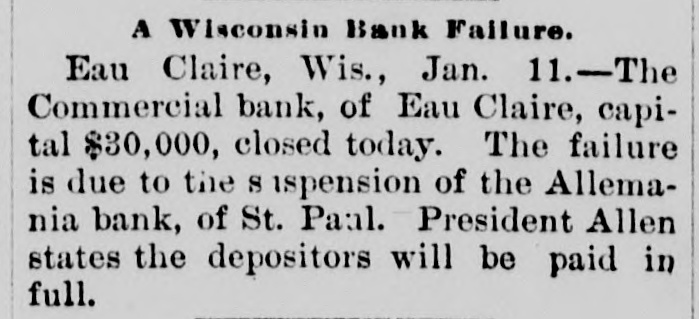
A Wisconsin Bank Failure. Eau Claire, Wis., Jan. 11.-The Commercial bank, of Eau Claire, capital $30,000, closed today. The failure is due to the suspension of the Allemania bank, of St. Paul. President Allen states the depositors will be paid in full.


Article from Crawford Avalanche, January 14, 1897

Click image to open full size in new tab

Article Text

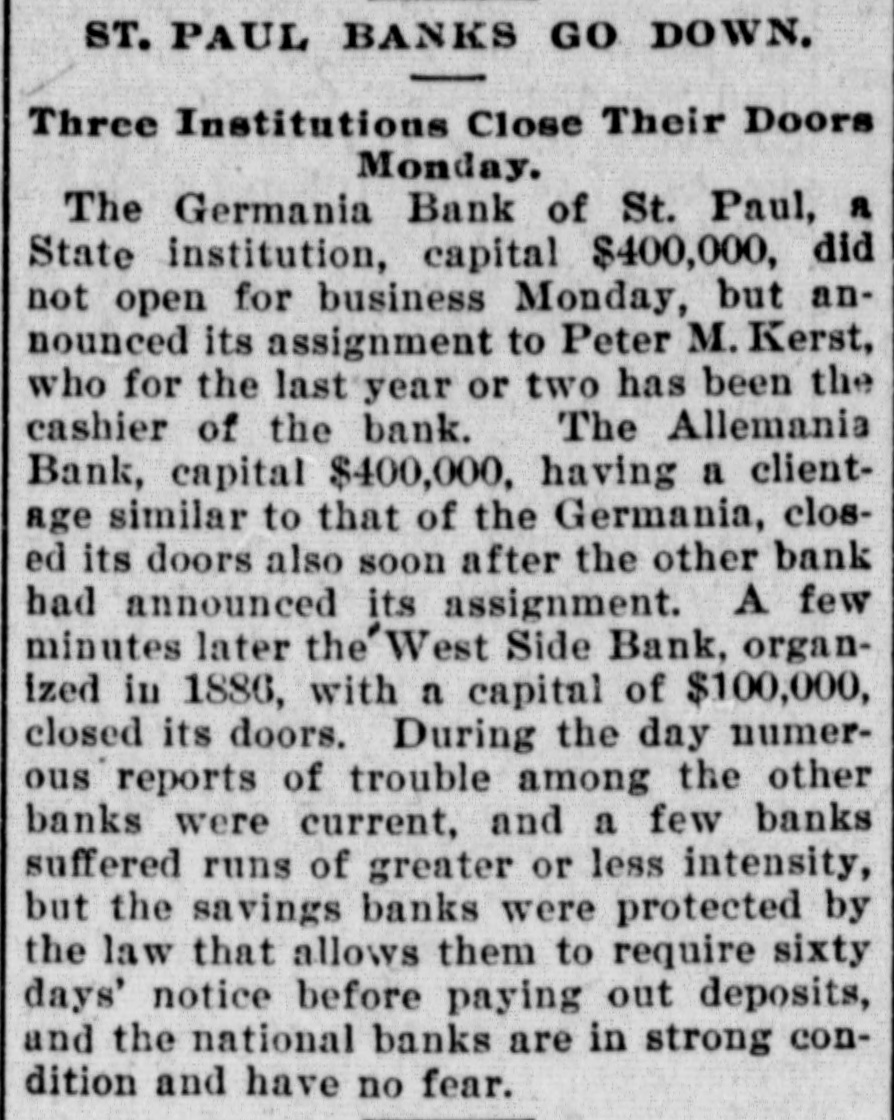
ST. PAUL BANKS GO DOWN. I Three Institutions Close Their Doors Monday. The Germania Bank of St. Paul, ั State institution, capital $400,000, did not open for business Monday, but announced its assignment to Peter M. Kerst, who for the last year or two has been the cashier of the bank. The Allemania Bank, capital $400,000, having a clientage similar to that of the Germania, closed its doors also soon after the other bank had announced its assignment. A few minutes later the West Side Bank, organized in 1886, with a capital of $100,000, closed its doors. During the day numerous reports of trouble among the other banks were current, and a few banks suffered runs of greater or less intensity, but the savings banks were protected by the law that allows them to require sixty days' notice before paying out deposits, and the national banks are in strong condition and have no fear.


Article from Aberdeen Herald, January 14, 1897

Click image to open full size in new tab

Article Text

A Wisconsin Bank Failure. Eau Claire, Wis., Jan. 11.-The Commercial bank, of Eau Claire, capital $30,000, closed today. The failure is due to the S ispension of the Allemania bank, of St. Paul. President Allen states the depositors will be paid in full.


Article from Lincoln County Leader, January 14, 1897

Click image to open full size in new tab

Article Text

A Wisconsin Bank Failure. Eau Claire, Wis., Jan. 11.-The Commercial bank, of Eau Claire, capital $30,000, closed today. The failure is due to the suspension of the Allemania bank, of St. Paul. President Allen states the depositors will be paid in


Article from Lincoln County Leader, January 14, 1897

Click image to open full size in new tab

Article Text

A Wisconsin Bank Failure. Eau Claire, Wis., Jan. 11.-The Commercial bank, of Eau Claire, capital $30,000, closed today. The failure is due to the suspension of the Allemania bank, of St. Paul. President Allen states the depositors will be paid in


Article from The Indianapolis Journal, April 7, 1897

Click image to open full size in new tab

Article Text

MINNESOTA BANKS. Sensational Disclosures as to Failed Concerns of the Twin Cities. ST. PAUL, Minn., April 6.-The joint legislative committee investigating insolvent banks to-day made public the testimony secured during the past two months. The committee investigated banks in St. Paul and Minneapolis, and some of the disclosures are sensational in the extreme. As to the Bank of Minnesota, W. H. Lightner, one of the receivers. stated that on Oct. 7 $135,606 was due to the bank from the Fort Dearborn National Bank of Chicago. This balance was incorrect. The accounts between these two banks were falsified to the extent of $100,000. At the time of the failure of the bank there was owing to it by the bank officials the following sums: William Dawson, sr., about $90,000: William Dawson, jr., $59,950: R. A. Smith did owe the bank $50,000, and has since paid $35,000. In addition to that William Dawson, jr., was guarantor of $35,000, of which $30,000 was overdrawn. As to the cause of the failure of the bank it was testified that William Dawson, sr., owed it $281,000. As to the Scandia Bank, of Minneapolis, the committee state that its failure, according to the evider ce, was honest and it may yet pay in full. Lack of judgment in loans caused its suspension. Taking up the case of the Washington Bank of Minneapolis, the committee says that it went under for want of paid-up capital, direct and indirect loans to its officers and from a lack of supervision. Assets were accepted at par when practically worthless. Stock was simply issued without capital or paid in part in securities of doubtful or worthless character. Dwelling upon the affairs of the Allemania Bank of St. Paul, the report says the assets, or a large portion of them, were worthless. The directors were heavy borrowers and were guilty of misstatements. As to the affairs of the Minnesota Savings Bank of St. Paul, directly or indirectly, the committee states the officers were borrowers to an amount more than double the capital stock. The character of their accounts is shown by the asset of $10,000 cash they exhibited, when the receiver found it to be $1 in actual coin. Their loans were worthless. The last examination was made in October, 1895, and on its evidence the bank examiner ought to have closed it then.


Article from The Times, April 8, 1897

Click image to open full size in new tab

Article Text

SENSATIONAL DISCLOSURES MADE A Legislative Committee Investigating Bank Failures. St. Paul, Minn., April 7.-The jointlegislative committee investigating insolvent banks in this city and Minneapolis has made public the testimony secured during the past two months. Some of the disclosures are highly sensational. As to the Bank of Minnesota, of which William Dawson, Sr., was the president, and William Dawson, jr., cashier, W. H. Lightner, one of the receivers, stated that on October 7 $135,606 was due to the bank from the Fort Dearborn National Bank of Chicago. The balance, he said, was incorrect, accounts between these two banks being falsified to the extent of $100,000. At the time of the failure of the bank there was owing to it by the officials the following sums: William Dawson, sr., about $90,000; William Dawson, jr., $59,950: R. A. Smith, $50,000, of which he has since paid $35,000. In addition to that, William Dawson, jr., was guarantor of $53,000, of which $30,000 was overdrawa. As to thecause of the failure of the bank, it was testified that William Dawson, sr., owed it $281,000. The schedules of assets and liabilities of William Dawson, jr., have been filed in the district court. The assets are placed at $239,168.78, and the liabilities, $868,452.47. The face value of the assets is much higher. By far the largest portion of Mr. Daw. son's direct liabilities consists of in dividual notes. A few of these are secured, but most of them only by the indorsement of William Dawson, sr. As to the Scandia Bank, of Minneapolis, the committee states that its failure, according to the evidence, was honest, and it may yet pay in full. The committee says that the Washington Bank, of Minneapolis, went under for want of paid-up capital, direct and indirect loans to its officers, and from a lack of supervision. Dwelling upon the affairs of the Allemania Bank, of St. Paul, the report says that the assets, or a large portion of them, were worthless. The directors, it states, were heavy borrowers, and were guilty of misstatements. As to the affairs of the Minnesota Savings Bank, of St. Paul, the committee states the officers were borrowers. directly or indirectly. to an amount more than double the capital stock.


Article from The Copper Country Evening News, April 8, 1897

Click image to open full size in new tab

Article Text

ACCOUNTS FALSIFIED. Legislative Committee Investigates Some Bank Failures. DISCLOSURES ARE SENSATIONAL. Lack of Honest Supervision by Directors Is Shown-Great Overdrafts Made by Private Individuals- Allemania's Assets Were Worthless and Its Directors Were Heavy Borrowers-The Scaudia Failure Was Honest and May Pay Out. St. Paul April S.-The joint legisla. tive committee investigating insolvent banks Tuesday made public the testimony secured during the past two months. The committee investigated banks in St. Paul and Minneapolis, and some of the disclosures are sensational in the extreme. As to the Bank of Minnesota W. H. Lightner, one of the re. ceivers, stated that on Oct.*7 $135,605.95 was due the bank from the Fort Dearborn National bank of Chicago. This balance was incorrect. The accounts Between these two banks were falsified to the extent of $100,000. The testimony shows that it was customary for the Dawsons to sell St. Paul Plow company notes through remittances to Boston Such notes were sold to the amount of $40,000. crediting the amount to the Merchants National bank of New York. On the morning of Dec. 22 they paid notes the amount of $40,000 in the Bank of Minnesota. These were St. Paul Plow company notes. Due from Officials. At the time of the failure of the bank there was owing to it by the bank offi. cials the following sums: William Dawson Sr., about $90,000; William Dawson, Jr., $59,900: R. A. Smith did owe the bank $50,000. and has since paid $35.000. In addition to that, William Daw. son. Jr., was guarantor of $53,000, of which $30,000 was overdrawn. As to the cause of the failure of the bank, it was testified that William Dawson, Sr., owed It $281,000 During the last thirteen months before suspension William Daw. non, Sr., the St. Paul Plow company, and the Gladstone Land company borrowed $550,000 from the bank. Scandia bank of Minneapolis-Its fallure was honest, according to the evidence, and it may yet pay 100 cents on the dollar. There was no indebtedness direct or indirect on the part of the of. ficials Lack of judgment in loans toused its suspension. Had No Capital. Washington bank of Minneapolis-It went under for want of paid up capital. Second, as a result of loans made directly or indirectly to officers, and, third, from lack of honest supervision. The directors knew, or seemed to care nothing about its business, then en arged from the private bank of Johnson. Haugan & Co., to the Washington bank. Assets were accepted at par when practically worthless. Stock was sim ply issued without the capital or paid in part in securities of doubtful or worthless character. It never should have been allowed to start up. The committee were unable to find all the although they found enough to cause them to assert that the books show that as money was paid into the bank, it was used by the officers to square their old debts. so that at n time was the bank in a solvent condi tion. The committee was unable learn the names of the stockholders an t falled to secure the stockholders' ledg and transfer book. Directors Were Borrowers. Allemania bank of St. Paul-The as sets. or a large portion of them. cam from the old Commercial bank. an were worthless. The directors wer heavy borrowers and were guilty misstatements. We found that nearl all their quick assets failed to show tingent liability on rediscount. Minnesota Savings bank of St. PaulDirectly or indirectly the officers wer borrowing to an amount more than dou ble the capital stock. The character their accounts is shown by the asset of $10.000 cash they exhibited when th The receiver found it to be $1 in actual coin loans were worthless. The last ex ination was made in October, 189 and on its evidence the bank examine ought to have closed it then. After ex amination in 1895 it was not inspecte by the examiner again until its susper sion. notwithstanding the fact that knew of its precarious condition in 189 Confederate Memorial Day. Sew Orleans, April 8.-Confedera Temorial Day, which is also a legal ho iday, was celebrated with a milita parade, of which marched to the tom the Army of Northern Virginia, Co artiller home salute W ar each tomb. The set cer mies of the day took place at the Co emerate monument, where an immen crowd gathered. Onion Supply Short. San Francisco, April 8.-There is scarcity of onions in the local mark Dealers say that all the California cr was shipped as soon as gathered to eastern and southeastern states t a corner has been effected in a is Washington and Oregon crop. So she the supply in this state that tv carloads to were shipped from Reno, Ne Los Angeles, which seems like sen ing coal to New Castle. Lamont for Railroad President. New York, April 8.-It is stated


Article from The Morning News, May 18, 1897

Click image to open full size in new tab

Article Text

BANK PRESIDENT INDICTED. His Personal Account With the Institution Overdrawn. St. Paul, Minn., May 17.-Another sensational indictment in the bank cases was reported by the grand jury to-night. The Allemania Bank was among those that failed during the past winter, into whose affairs the grand jury has been looking, and this indictment was for grand larceny against Albert Scheffer, president of the institution. The ground for the charge is an overdraft on his personal account to the amount of $6,475. Scheffer has for several years been prom. inent in politics in the northwest. The Allemania closed its doors because of a run inugurated after some other banks had failed, and has been going through the preliminary steps for reorganization.


Article from The Minneapolis Journal, July 3, 1902

Click image to open full size in new tab

Article Text

Other decisions to-day were as follows: Ramsey County. Wm. F. Hunt, as receiver of the Allemania bank, appellant, vs. Charles G. Rooseu, respondent. First-The Allemania bank of St. Paul, a banking corporation organized under the laws of the state, became insolvent in 1897, and receivers were appointed to take charge of and wind up its affairs. Subsequently, in April following the appointment of receivers, a majority of the creditors petitioned the district court of Ramsey county to permit and authorize, under chapter 69, laws 1897, a reorganization of the bank on the terms and conditions of that statute, but was, after due hearing, ordered dismissed. Some four months subsequently, but without notice to creditors and interested parties, the same petition was again presented to that court, but to a judge other than the judge who had previously ordered its dismissal, who, without knowledge of the prior dismissal, granted its prayer and ordered the entry of final judgment approving and adopting the proposed plan of reorganization, and adjudging and determining therein and thereby that all stockholders who should pay any portion of their liability as such to aid and assist in the purposes of the reorganization should be released from their statutory liability to the extent of the amount so paid The receivers were thereupon discharged, and the officers of the bank resumed control of its affairs and issued to all the creditors, payable in five equal annual instalments certiflicates of deposit for the amount of their respective claims, which the creditors accepted and retained, and at no time did any of them, who are now creditors, in any way call in question the validity of the reorganization or the judgment authorizing it. Defendant was a stockholder of the corporation and paid, in reliance upon the terms of the judgment, one-half the par value of the stock held by him to aid in the reorganization; which was effected in the interests of creditors and for the payment of their debts. It is held, first, that the findings of the trial court to the effect that all the creditors of the bank acquiesced in and ratified the proceedings under the reorganization, are sustained by the evidence; and, second, that though the judgment adopting and approving the plan of reorganization was void, because based upon a petition which had been dismissed, and creditors who acquiesced therein and accepted and retained benefits accruing therefrom are estopped from now calling the validity of such proceedings in question. Second-Section 4, chapter 69, laws 1897, construed and held to preserve and con-