Article Text
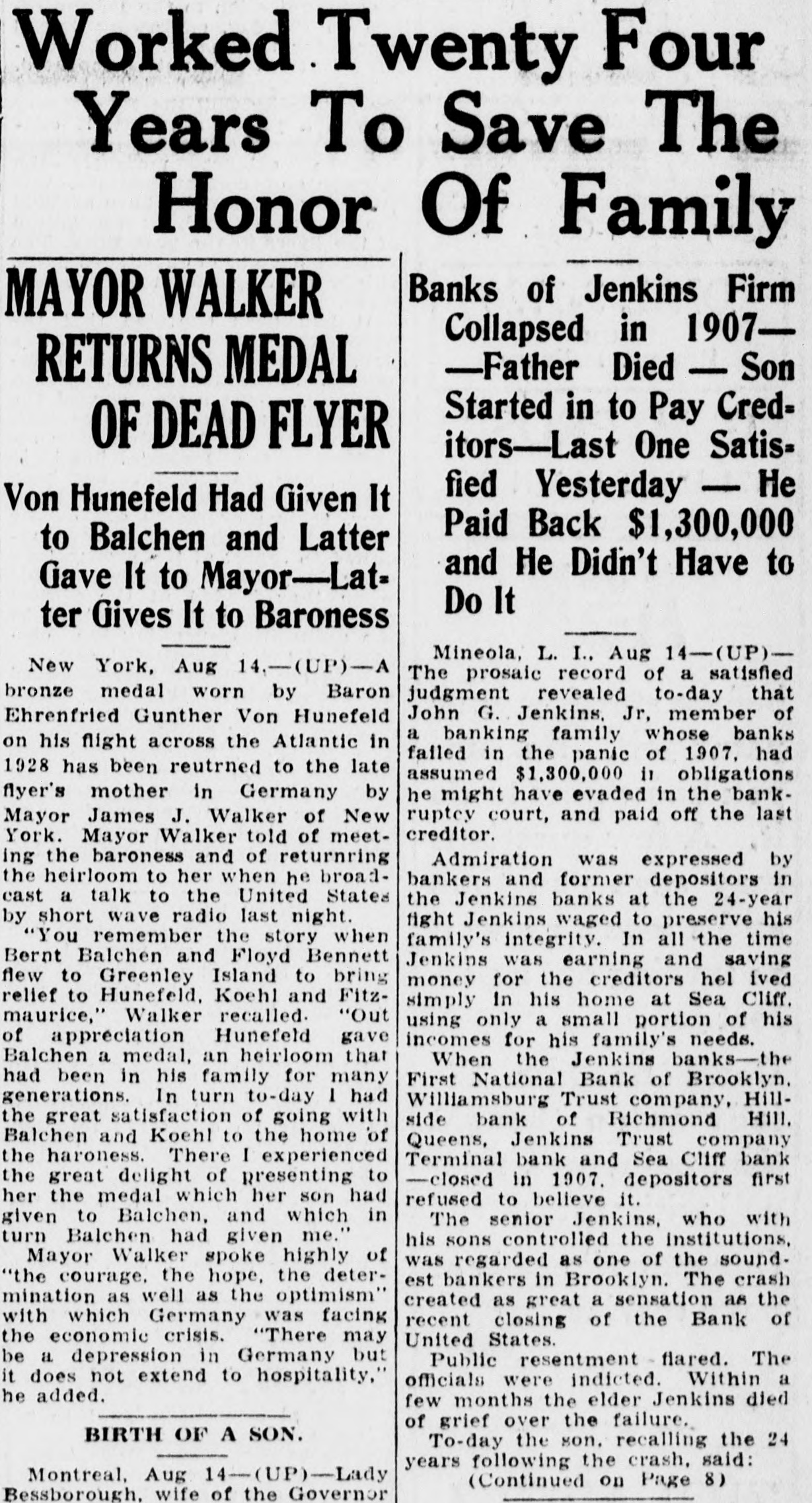
NO REST FOR BANKERS. FOUR MORE INDICTMENTS. Jenkins Brothers and Director of Their Trust Company Named. Four more indictments in the Brooklyn bank cases will be handed down by the Kings County grand jury this morning Three of them are against John G. Jenkins, jr. Frank Jenkins and Frederiek Jenkins, who are already under indictment for forgery in the third degree The fourth is against a director of the Jenkins Trust Company who has admitted responsibility for certain loans. Stephen Baldwin, counsel for the entire Jenkins family, made arrangements last night to have the three brothers in court this morning, to be arraigned before the county judge and released on bail. It is also understood that John G. Jenkins. sr., expects to be in court. No attempt will be made to arrest any of the Jenkinses or to take their pictures at police headquarters. Indictments in the Brooklyn Bank and perhaps another in the Borough Bank case will not be handed down until next week. Although not a word has been made public regarding the affairs of the First National Bank, of Brooklyn, of which John G. Jenkins, sr., is prestdent, it was learned last night that the directorate, which was depleted by the resignation of almost the entire board last May, was filled up by members of that family, so that since then it has been practically a Jenkins institution throughout. has Under its charter the First National Bank nine directors. On May 17 of this year, when the row occurred in the board, the directors were John G. Jenkins, sr., president; Frank Jenkins, John J. Cooney, Marshall S. Driggs, Joseph Huber Moses May, Mortimer L Reynolds, John W. Weber and Theodore F. Jackson. Six of the directors retired as a result of the trouble and members of the Jenkins family were chosen to take their places in all except one case. The following list of directors, as it was at the time of suspension, has never before been made public and will be a surprise to many: John G. Jenkins, sr., father; John T. G. Jenkins, jr., son; Frank Jenkins, son: Edward Jenkins, son; Frederick Jenkins, son: Wilson W Jenkins, son; Fenwick B. Small, son-in-law; S. H. Coombs, personal counsel, and Theodore F. Jackson. The elder Mr. Jenkins, who is said to be the oldest banker in the state, was restive under the old board. As the present board is composed of bers of his family almost entirely, he doubtless memhad little trouble in handling things sired from June as he deIt until the day the bank suspended. seems that prior to the famous meeting of May the 17 several of the directors had objected bonds character of some of the stocks and to owned by the institution, and had voted to have special committee examine and report on the sets. This committee, consisting of Moses May and asJohn J. Cooney, made the examination in cashier. morning with the aid of Isaac Hamburger, the the The latter's activity in the affair evidently sembled gered Mr. Jenkins. When the directors were anin the afternoon and the committee asabout to make its report Mr. Jenkins said, brusque- was ly: "Wait a minute now. gentlemen!" Then he ordered a clerk to get him some figures upstairs. When the clerk returned Mr. Jenkins turned to the cashier and said: "I want you to take a month's vacation. The cashier was dumfounded So were many of the directors, who were his friends. They protested they had a right to know, as they were directors "No, you are not!" Mr. Jenkins is alleged to have replied. "You are only a lot of chair warmers." This, of course, greatly angered the directors, and when Mr. Jenkins offered to buy out their stock if they would resign from the board they consented. At a meeting held within a week, Mr Cooney, Mr. Driggs, Mr. Huber, Mr. May and Mr. Reynolds resigned one after the other, and the Jenkins directors were elected. Both Mr. Jackson and Mr. Weber were in Europe at the time, but Mr. Weber resigned as soon as he returned, early in August. Mr. Jenkins paid $390 a share for 150 shares belonging to Mr. May, ten shares of Mr. Cooney's and twelve shares belonging to Mr. Reynolds. He refused to buy 220 shares held by the Williamsburg Fire Insurance Company. of which Mr. Driggs IS president, and also refused to buy twenty shares held by Mr. Reynolds. It is said that Mr. Jenkins now owns or controls 1,700 of the 3,000 shares of the bank. At that time the First National Bank had deposits amounting to $5,700,000. When the directors retired they took out deposits aggregating some $2,000,000. At the time of suspension the deposits were only $3,500,000 in round figures. On that showing the bank was clearing for the Williamsburg Trust Company, with deposits of nearly $8,000,000. and the Jenkins Trust Company. with deposits of about $4,000,000. At a meeting of the depositors of the Brooklyn Bank in Historical Hall last night. C. M. Stafford, counsel for the depositors' committee. admitted that resumption was practically impossible. A resoluasking the Supreme Court to appoint C. M. Hig. gins, one of the large depositors, permanent receiver. was passed. Mr. Higgins consented to serve, if appointed, without compensation. "We demand of the officers and stockholders of the International Trust Company restitution. said Mr. Stafford. "We demand that this company, which played with our securities and our assets for two weeks under a void and illegal merger. return to the receiver of the Brooklyn Bank the $244,000 in securities and over $72,000 in cash. We want to cut loose absolutely and forever from the International Trust Company, its officers and directors." David Bandler, associated with Mr. Stafford, said that from what he could learn the $1,000,000 capital stock and surplus of the International Trust Com. pany was tied up as follows: Real estate. $257,000; Brooklyn Bank stock, $182,000, and claim against the Borough Bank, $562,932. Justice Kelly in the Brooklyn Supreme Court yesterday handed down a decision in favor of the Brooklyn Bank against Frank A. Barnaby a real estate dealer, for $13,665 and accrued interest, being the unpaid balance on a note for $68,000 discounted in February. 1894. George W. Adams, cashier of the Oriental Bank, wrote to the receivers of the Borough Bank terday, refusing to return the $250,000 note that yesbeen repudiated by the Borough's directors. also has the $30,000 balance of the Borough Bank held by the Oriental. Mr. Adams said the cash would be held as additional collateral on the the receivers are made permanent they note. will sue If the Oriental both for the money and the note The South Brooklyn Co-operative Building Loan Association put in a preferred and $52,172.57 claim for a deposit in the Borough yesterday National Surety Company also claims preference The for $125,000, on the ground that it is an assigned claim for state money. According to the receivers, Howard C. Pyle, who has been an active figure in the depositors' mittee, has an unsecured note for $12,000 in com- the Borough Bank. His personal deposit is $1,588.40 and the deposit of the firm is $4,159.97 Bank At a metting of the depositors of the Borough yesterday it was unanimously voted to ask Justice Betts at Kingston to-morrow for an tension of a month in the temporary receivership. exIf he does not show a disposition to grant this change of venue may be applied for. Ballots were