Article Text
the country lost $191,566,488 between the 10th of November, 1910, and the 7th of January, 1911, the dates upon which comparisons are based, as shown by the responses to the calls of the Comp- troller of the Currency.
There are a number of contributing causes that make for just such condi- tions.. In the city of New York alone, where $158,000,000 loss occurred in the deposits, the hundreds of corporations pay out about $225,000,000 in interest and dividend accounts on January 1 of each year, the amount varying but the fig- ures representing the approximate dis- tribution at the beginning of 1911. Checks go out on the evening of De- cember 31. January 1 was a holiday, also January 2. Many of these checks were mailed to out-of-town investors, although New York investors received the greater part.
There was much uncertainty in the market for securities at that time and it is but natural to suppose that much of this money was placed in savings banks and trust companies that it might earn a little interest pending reinvestment. The natural shifting of funds between trust companies, savings banks, and national banks is such an important factor that no actual com- parisons could be made without the showing of all three classes of fiscal institutions.
Deposits were larger during the pre- holiday activity of November than in the after-the-holiday dullness of Jan- uary-the always quiet month, the dull- est save midsummer.
It may seem rather strange, but it is a fact that when business is decidedly lively the apparent deposits in banks are larger than in dull times. There is a lively interchange of checks in periods of trade activity, and checks almost in- variably count in deposits as double. A check for $50,000 paid by this corporation to that contractor is deposited in the latter's bank. He is given credit for the deposit, but the money standing back of that check, the money that honors it, is over in the other bank un- til the next day at clearings-that is, as a rule. The only way in which such doubling would not show would be on balances between banks.
On Friday of last week the clearings of the banks of New York were $476,784,000, balances $29 759,532; of Baltimore, $6,519,- 000; balances, $803,999; Philadelphia, $32,- 049,000; Chicago, $53,000,000, and Boston, $28,000,000. It is easy to see how a drop in the daily clearings through a let-up in trade would cause an apparent loss in individual deposits.
Another reason is readily found in the fact that much of the reinvestment in the first few days of January of this year was in the bond market, and many drew their funds from banks for the purpose of participating in bond pur- chases. Then deposits would shrink, and the underwriter of the bonds, having made a sale, would, certainly in many instances, pay off the loans to the bank, thereby increasing the cash in banks but not in the deposits, and the state- ment showed a gain in cash of $20,000,000 and a reduction in loans of $48,000,000.
But there was yet another reason that contributed to this "mystery." The passing of the Robin banks and the smash of the Carnie Trust Company brought some uneasiness and withdraw- al of deposits both on account of timid individuals and some who were not timid.
The sales of stocks on the New York Exchange in January, 1911, were 9,884,169 shares; in January, 1910, 24,116,544 shares. The bond offerings, new issues, in January, 1911, totaled $141,400,000; short- term notes, $36,000 and the stocks $55,- 000,000, a total of $232,000,000. January, 1911, the bond sales increased 70 per cent over the December, 1910, sales. Cause enough for a loss of deposits.
### Since January 7 Over $100,000,000 Has Been Added to Individual Deposits in New York Banks
Two of the larger industrial corpora- tions have established offices in New York city, where their obligations are listed for the benefit of anyone interest- ed. In this way commercial paper brok- ers will be able to tell just what the aggregate of the corporated borrowings are, and whether paper in their posses- sion is genuine or not. The listing will also give date of paper, length of time to run from making, and all other infor- mation necessary.
This is a step in the right direction- the direction of financial publicity, and in the line of policy desired by Comp- troller Murray.
Chicago, St. Paul, Minneapolis, Pitts- burg, St. Leuis, Philadelphia, and some other cities have a most rigid inspection of bank conditions. The banks conduct their own examinations and the super- vision is much more elaborate and more frequent than State or national bank examinations.
Chicago did not take the bull by the horns until it was obliged to put up $7,000,000 to save disaster when the Walsh banks went down.
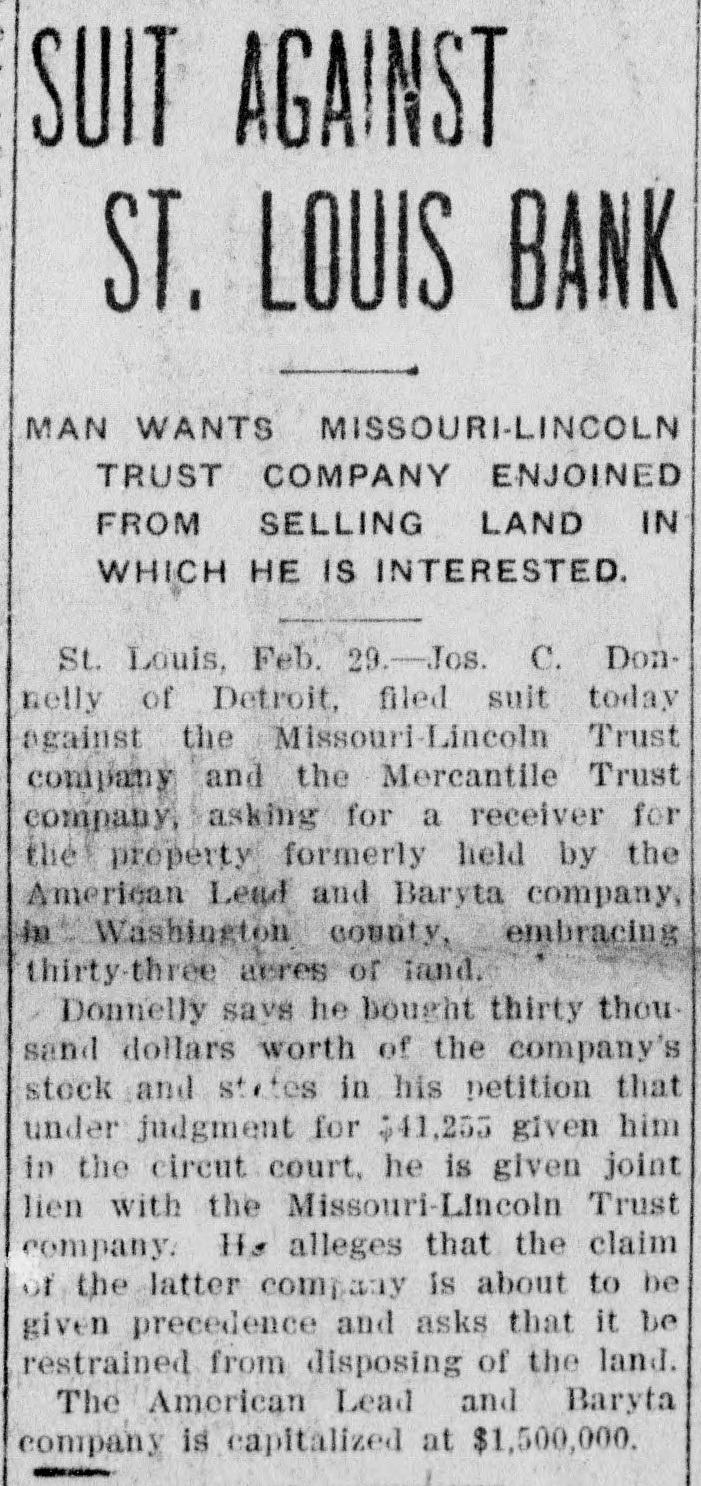
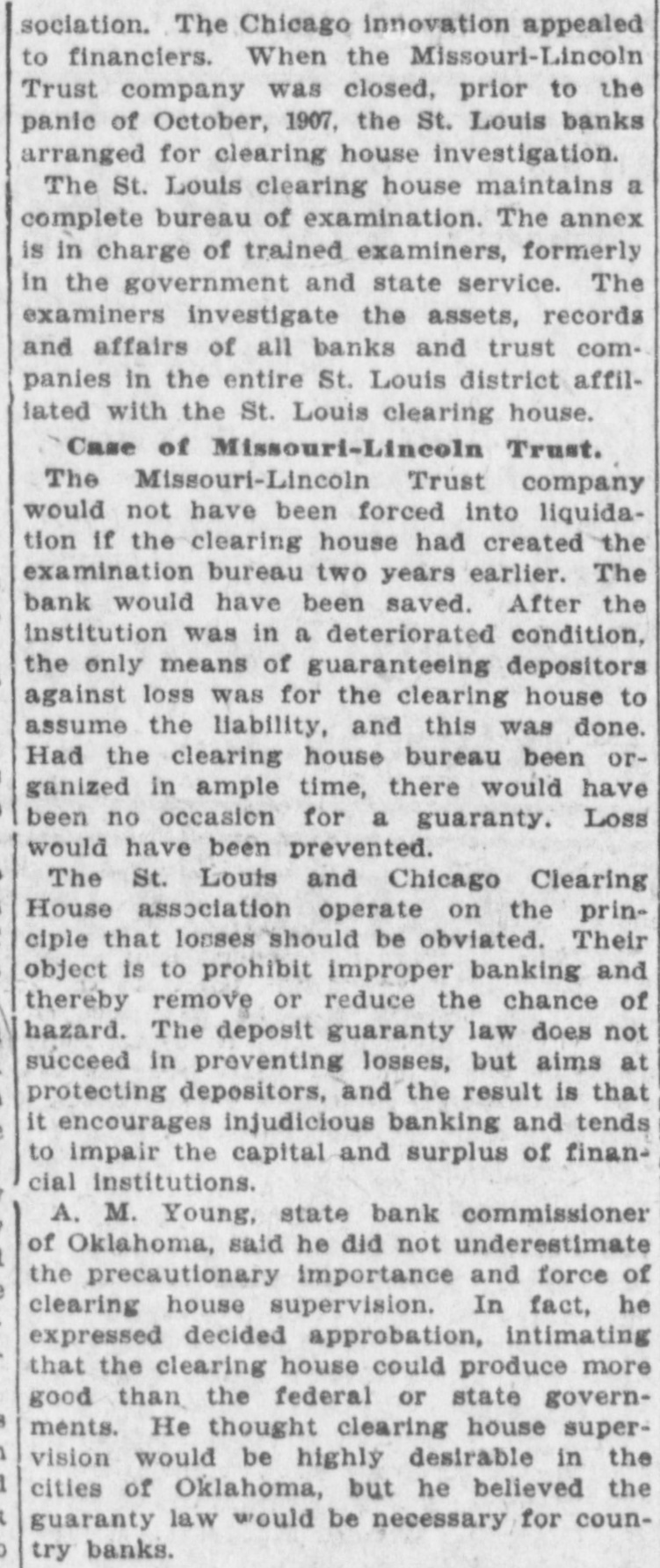
St. Louis kept aloof until they had to hand over $1,500,000, and agree to ad- vance $1,000,000 more in connection with the Missouri Lincoln Trust Company suspension.
All of the fifty-eight banks and trust companies doing business in Chicago are under clearing house supervision. With a high-grade $25,000 a year examiner and seven assistants, the clearing house has determined to prevent wildcat financing. The report of the head examiner shows cash on hand; past due paper, bad debts, loans to bank directors, loans to corporations in which bank directors are interested, and the character of assets representing the bank's surplus, capi- tal, and undivided profits.
A copy of this report is handed to the president of the bank and each director is notified that the report awaits his in- spection. Another copy is filed under seal in the clearing house, but is not opened unless something wrong devel- ops in the bank thus carefully searched. No director can claim ignorance as an excuse. If rottenness develops, rehabili- tation follow quickly or a closure before further loss is sustained.
In St. Louis the examiners, before as- suming duties, are compelled to agree not to take office with any bank or trust company within 300 miles of St. Louis for three years after leaving the service. Thus the secrets of the exami- nations are guarded.