Farmers State Bank (Wamego, KS)

Episode Information

Episode UID
83028771450
Episode Type
Suspension → Closure
Bank Type
state
Bank ID
8302877 routing
Routing Number
83-0287
Start Date
October 13, 1920
Location
Wamego, Kansas (39.202, -96.305)

Metadata

Model
gpt-5-mini (chosen from majority vote of a three-model LLM ensemble)
Short Digest
81df43bfcc8f464c

Response Measures

None

Description

Voluntary closing followed by liquidation under the state bank commissioner after the cashier's death; later dividend paid to depositors.

Events (4)

1. October 13, 1920 Receivership
Newspaper Excerpt
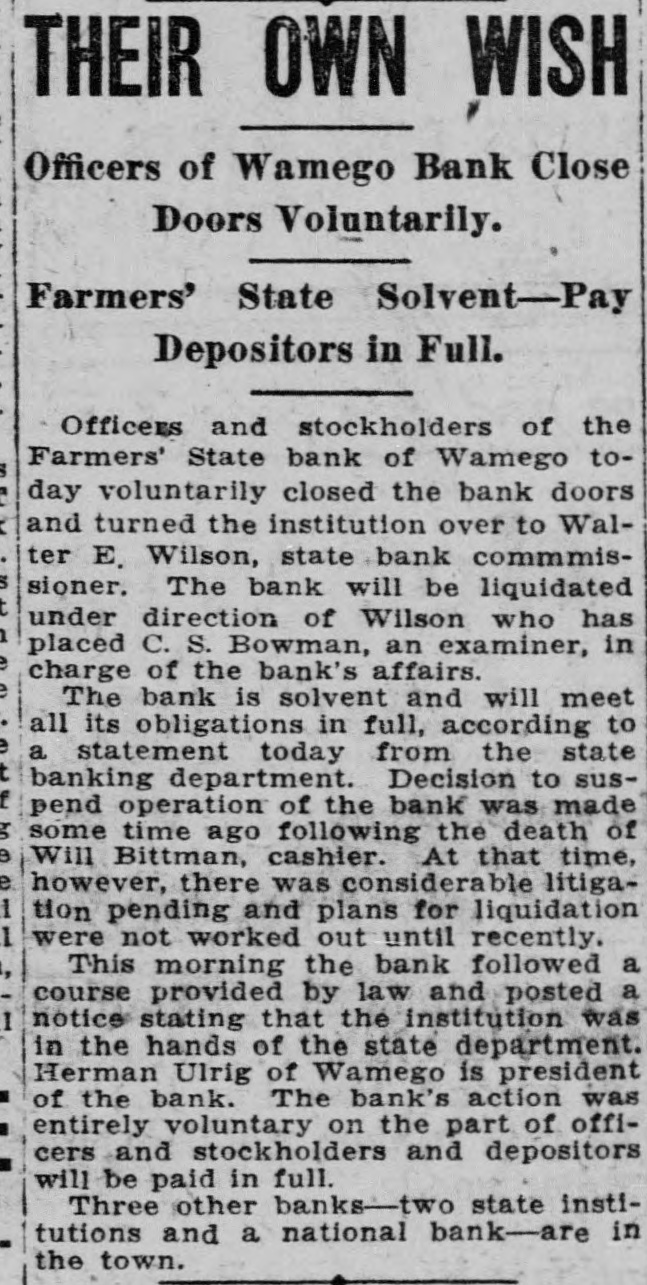
turned the institution over to Walter E. Wilson, state bank commmissioner. The bank will be liquidated under direction of Wilson who has placed C. S. Bowman, an examiner, in charge of the bank's affairs.
Source
newspapers
2. October 13, 1920 Suspension
Cause
Voluntary Liquidation
Cause Details
Officers and stockholders voluntarily closed the bank and turned it over to the state bank commissioner following the death of the cashier.
Newspaper Excerpt
Officers of Wamego Bank Close Doors Voluntarily. Farmers' State Solvent-Pay Depositors in Full. Officers and stockholders of the Farmers' State bank of Wamego today voluntarily closed the bank doors and turned the institution over to Walter E. Wilson, state bank commmissioner.
Source
newspapers
3. October 14, 1921 Other
Newspaper Excerpt
The Farmers State bank. Wamego, $25,000 capital, October 14. 1921.
Source
newspapers
4. December 15, 1923 Other
Newspaper Excerpt
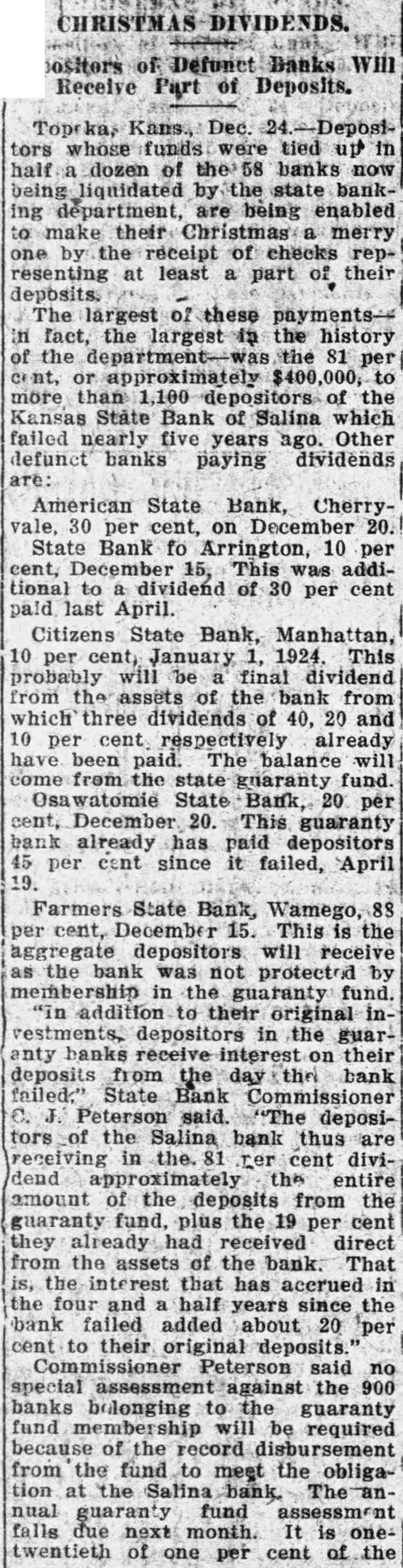
Farmers State Bank, Wamego, 88 per cent, December 15. This is the aggregate depositors will receive as the bank was not protected by membership in the guaranty fund.
Source
newspapers

Newspaper Articles (4)

Article from The Topeka State Journal, October 13, 1920

Click image to open full size in new tab

Article Text

THEIR OWN WISH Officers of Wamego Bank Close Doors Voluntarily. Farmers' State Solvent-Pay Depositors in Full. Officers and stockholders of the Farmers' State bank of Wamego today voluntarily closed the bank doors and turned the institution over to Walter E. Wilson, state bank commmissioner. The bank will be liquidated under direction of Wilson who has placed C. S. Bowman, an examiner, in charge of the bank's affairs. The bank is solvent and will meet all its obligations in full, according to a statement today from the state banking department. Decision to suspend operation of the bank was made some time ago following the death of Will Bittman, cashier. At that time, however, there was considerable litiga1 tion pending and plans for liquidation were not worked out until recently. This morning the bank followed a course provided by law and posted a notice stating that the institution was in the hands of the state department. Herman Ulrig of Wamego is president of the bank. The bank's action was entirely voluntary on the part of officers and stockholders and depositors will be paid in full. Three other banks-two state institutions and a national bank-are in the town.


Article from The Topeka State Journal, September 27, 1921

Click image to open full size in new tab

Article Text

BANKS DID WELL Made Good Record During Financial Depression. More Than 1,100 Now in Operation in Kansas. SEVEN FAILURES THIS YEAR Mismanagement and Dishonesty Given as the Cause. Heaviest Losses of Year Were Hanover and Coffeyville. The failure of two Kansas banks in September brings the totals to seven for the year to date and to twelve for the period of deflation, since May 15, 1920. "Kansas banks have weathered the storm of financial depression remarkably well," said J. H. Sandell, assistant state bank commissioner. "Where twelve state banks have failed more than 1)100 have continued to operate. Investigation has disclosed that the banks which have failed have done so in practically every instance because of mismanagement or dishonesty of officials. In most instances bank cashiers and other officials stole from bank funds to speculate in oil or other enterprises. When deflation came their holdings diminished and they were unable to make good their thefts as they undoubtedly had hoped. Readjustments Are Made. "Where bank officials were honest and the great majority of them are -the banking department has worked successfully with them to make the necessary readjustments to meet new conditions." Sample reasons shown for failures in the past are: "Cashier speculated in oil and lost." "Negligence on the part of bank directors and speculation on part of acting officers." "Defalcation of cashier. He dealt extensively on board of trade and covered up losses with forged papers." From 1900 to 1919 inclusive there were twenty bank failures in this state or an average of one a year. From 1892, when the first failure was recorded after establishment of the banking department, until 1899 there were 69 failures. Thirty-three of these were in 1893, the panic year. Numerous other banks closed temporarily. In Kansas bank failures of the last two years, the heaviest losses to depositors probably will be in the Hanover State Bank of Hanover and the Peoples State Bank of Coffeyville, the banking department believes. There is no way to estimate the exact loss until numerous law suits are decided. Seven Were Guaranteed. Seven of the twelve defunct banks were guaranteed under the depositors' guaranty law. Neither the Hanover nor the Coffeyville bank were guaranteed. In the other three non-guaranteed banks present indications are there will be no losses to depositors. Of the seven guaranteed banks it now appears at least three and possibly five will require drafts on the guaranty fund. List of Bank Failures. The list of failed banks follows: The Aulne State bank, Amine, (guaranteed), May 15. 1920. The Hanover State bank, Hanover, May 14, 1920. The Farmers State bank. Wamego, $25,000 capital, October 14. 1921. The Homewood State bank. Homewood, $10,000 (guaranteed), December 6. 1920. The Wellsford State bank, Wellsford, $10,000, December 18, 1920. The People's State bank, Coffeyville, $25,000. January 20. 1921. The Farmers State bank, Le Loup, $10,000 (guaranteed), February 4, 1921. Kansas The Banking Trust company. City, Kan., ($100,000), April 23. 1921. The People's State bank. Salina ($100,000). guaranteed, July 18, 1921. The Farmers State bank, Spring Hill, $20,000 (guaranteed), August 8. 1921. The Citizens State bank, Manhattan, $50,000 (guaranteed), September 19. 1921. The Farmers State bank. McCune, $15,000 (guaranteed), September 22, 1921.


Article from The Iola Register, December 24, 1923

Click image to open full size in new tab

Article Text

CHRISTMAS DIVIDENDS. Depositors of Defunct Banks Will Receive Part of Deposits. Topeka, Kans., Dec. 24.—Depositors whose funds were tied up in half a dozen of the 58 banks now being liquidated by the state banking department, are being enabled to make their Christmas a merry one by the receipt of checks representing at least a part of their deposits. The largest of these payments—in fact, the largest in the history of the department—was the 81 per cent, or approximately $400,000, to more than 1,100 depositors of the Kansas State Bank of Salina which failed nearly five years ago. Other defunct banks paying dividends are: American State Bank, Cherryvale, 30 per cent, on December 20. State Bank of Arrington, 10 per cent, December 15. This was additional to a dividend of 30 per cent paid last April. Citizens State Bank, Manhattan, 10 per cent, January 1, 1924. This probably will be a final dividend from the assets of the bank from which three dividends of 40, 20 and 10 per cent respectively already have been paid. The balance will come from the state guaranty fund. Osawatomie State Bank, 20 per cent, December 20. This guaranty bank already has paid depositors 45 per cent since it failed, April 19. Farmers State Bank, Wamego, 88 per cent, December 15. This is the aggregate depositors will receive as the bank was not protected by membership in the guaranty fund. "In addition to their original investments, depositors in the guaranty banks receive interest on their deposits from the day the bank failed," State Bank Commissioner C. J. Peterson said. "The depositors of the Salina bank thus are receiving in the 81 per cent dividend approximately the entire amount of the deposits from the guaranty fund, plus the 19 per cent they already had received direct from the assets of the bank. That is, the interest that has accrued in the four and a half years since the bank failed added about 20 per cent to their original deposits." Commissioner Peterson said no special assessment against the 900 banks belonging to the guaranty fund membership will be required because of the record disbursement from the fund to meet the obligation at the Salina bank. The annual guaranty fund assessment falls due next month. It is one-twentieth of one per cent of the


Article from Smith County Journal, December 27, 1923

Click image to open full size in new tab

Article Text

CHRISTMAS PRESENTS TO DEPOSITORS OF DEFUNCT BANKS Depositors whose funds were tied up in half a dozen of the fifty-eight banks now being liquidated by the state banking department are being enabled to make their Christmas a merry one by the receipt of checks representing at least a part of their deposits. The largest of these payments—in fact the largest in the history of the department—was the 81 per cent, or approximately $400,000 to more than 1,100 depositors of the Kansas State bank of Salina which failed nearly five years ago. Other defunct banks paying dividends are: American State bank, Cherryvale, 30 per cent on December 20. State Bank of Arrington, 10 per cent, December 15. This was additional to a dividend of 30 per cent paid last April. Citizens State bank, Manhattan, 10 per cent, January 1, 1924. This probably will be a final dividend from the assets of the bank from which three dividends of 40 20 and 10 per cent respectively already have been paid. The balance will come from the state guaranty fund. Osawatomie State Bank, 20 per cent, December 20. This guaranty bank already has paid depositors 45 per cent since it failed, April 19. Farmers State Bank, Wamego, 88 per cent, December 15. This is the aggregate depositors will receive as the bank was not protected by membership in the guaranty fund. "In addition to their original investments, depositors in the guaranty banks receive interest on their deposits from the day the bank failed." State Bank Commissioner C. J. Peterson said, "The depositors of the Salina bank thus are receiving in the 81 per cent dividend approximately the entire amount of the deposits from the guaranty fund, plus the 19 per cent they already had received direct from the assets of the bank. That is, the interest that has accrued in the four and a half years since the bank failed added about 20 per cent to their original deposits." Commissioner Peterson said no special assessment against the 900 banks belonging to the guaranty fund membership will be required because of the record disbursement from the fund to meet the obligation at the Salina bank. The annual guaranty fund assessment falls due next month. It is one-twentieth of 1 per cent of the total deposits in each bank. This will add approximately $300,000 to the guaranty fund which was reduced to approximately $500,000 by the Salina payment according to Commissioner Peterson. "The guaranty fund has proven to be a wonderful asset to banking and business interests generally during the last year," said Mr. Peterson. "In addition to securing depositors against loss it serves as a security for the state at large, for all business—in this state especially agriculture—is closely related to the banking business. There is no occasion for such a thing as a run on a bank nor a financial depression in a community, or in the state, as long as the guaranty fund operates."—Topeka State Journal.