Farmers State Bank (McCune, KS)

Episode Information

Episode UID
83044771461
Episode Type
Suspension β†’ Closure
Bank Type
state
Bank ID
8304477 routing
Routing Number
83-0447
Start Date
September 22, 1921
Location
McCune, Kansas (37.355, -95.017)

Metadata

Model
gpt-5-mini (chosen from majority vote of a three-model LLM ensemble)
Short Digest
d835e19de443c229

Response Measures

None

Description

Closure followed apparent embezzlement/absconding of the cashier E.D. (or E. D.) Dolson.

Events (3)

1. September 22, 1921 Suspension
Cause
Bank Specific Adverse Info
Cause Details
Cashier E. D. (E.D.) Dolson absconded on Sept. 22, 1921; alleged embezzlement leading to bank closure.
Newspaper Excerpt
The Farmers State bank. McCune, $15,000 (guaranteed), September 22, 1921.
Source
newspapers
2. September 20, 1922 Receivership
Newspaper Excerpt
Farmers State Bank, McCune. (listed among banks operating under private receivers.)
Source
newspapers
3. June 12, 1926 Other
Newspaper Excerpt
Dolson ... came back ... in the custody of sheriff ... No proceedings against Dolson who alleged have stolen $200,000 from the Farmers State Bank of McCune, which closed September 1921.
Source
newspapers

Newspaper Articles (5)

Article from The Topeka State Journal, September 27, 1921

Click image to open full size in new tab

Article Text

BANKS DID WELL Made Good Record During Financial Depression. More Than 1,100 Now in Operation in Kansas. SEVEN FAILURES THIS YEAR Mismanagement and Dishonesty Given as the Cause. Heaviest Losses of Year Were Hanover and Coffeyville. The failure of two Kansas banks in September brings the totals to seven for the year to date and to twelve for the period of deflation, since May 15, 1920. "Kansas banks have weathered the storm of financial depression remarkably well," said J. H. Sandell, assistant state bank commissioner. "Where twelve state banks have failed more than 1)100 have continued to operate. Investigation has disclosed that the banks which have failed have done so in practically every instance because of mismanagement or dishonesty of officials. In most instances bank cashiers and other officials stole from bank funds to speculate in oil or other enterprises. When deflation came their holdings diminished and they were unable to make good their thefts as they undoubtedly had hoped. Readjustments Are Made. "Where bank officials were honest and the great majority of them are -the banking department has worked successfully with them to make the necessary readjustments to meet new conditions." Sample reasons shown for failures in the past are: "Cashier speculated in oil and lost." "Negligence on the part of bank directors and speculation on part of acting officers." "Defalcation of cashier. He dealt extensively on board of trade and covered up losses with forged papers." From 1900 to 1919 inclusive there were twenty bank failures in this state or an average of one a year. From 1892, when the first failure was recorded after establishment of the banking department, until 1899 there were 69 failures. Thirty-three of these were in 1893, the panic year. Numerous other banks closed temporarily. In Kansas bank failures of the last two years, the heaviest losses to depositors probably will be in the Hanover State Bank of Hanover and the Peoples State Bank of Coffeyville, the banking department believes. There is no way to estimate the exact loss until numerous law suits are decided. Seven Were Guaranteed. Seven of the twelve defunct banks were guaranteed under the depositors' guaranty law. Neither the Hanover nor the Coffeyville bank were guaranteed. In the other three non-guaranteed banks present indications are there will be no losses to depositors. Of the seven guaranteed banks it now appears at least three and possibly five will require drafts on the guaranty fund. List of Bank Failures. The list of failed banks follows: The Aulne State bank, Amine, (guaranteed), May 15. 1920. The Hanover State bank, Hanover, May 14, 1920. The Farmers State bank. Wamego, $25,000 capital, October 14. 1921. The Homewood State bank. Homewood, $10,000 (guaranteed), December 6. 1920. The Wellsford State bank, Wellsford, $10,000, December 18, 1920. The People's State bank, Coffeyville, $25,000. January 20. 1921. The Farmers State bank, Le Loup, $10,000 (guaranteed), February 4, 1921. Kansas The Banking Trust company. City, Kan., ($100,000), April 23. 1921. The People's State bank. Salina ($100,000). guaranteed, July 18, 1921. The Farmers State bank, Spring Hill, $20,000 (guaranteed), August 8. 1921. The Citizens State bank, Manhattan, $50,000 (guaranteed), September 19. 1921. The Farmers State bank. McCune, $15,000 (guaranteed), September 22, 1921.
Article from The Topeka State Journal, September 20, 1922

Click image to open full size in new tab

Article Text

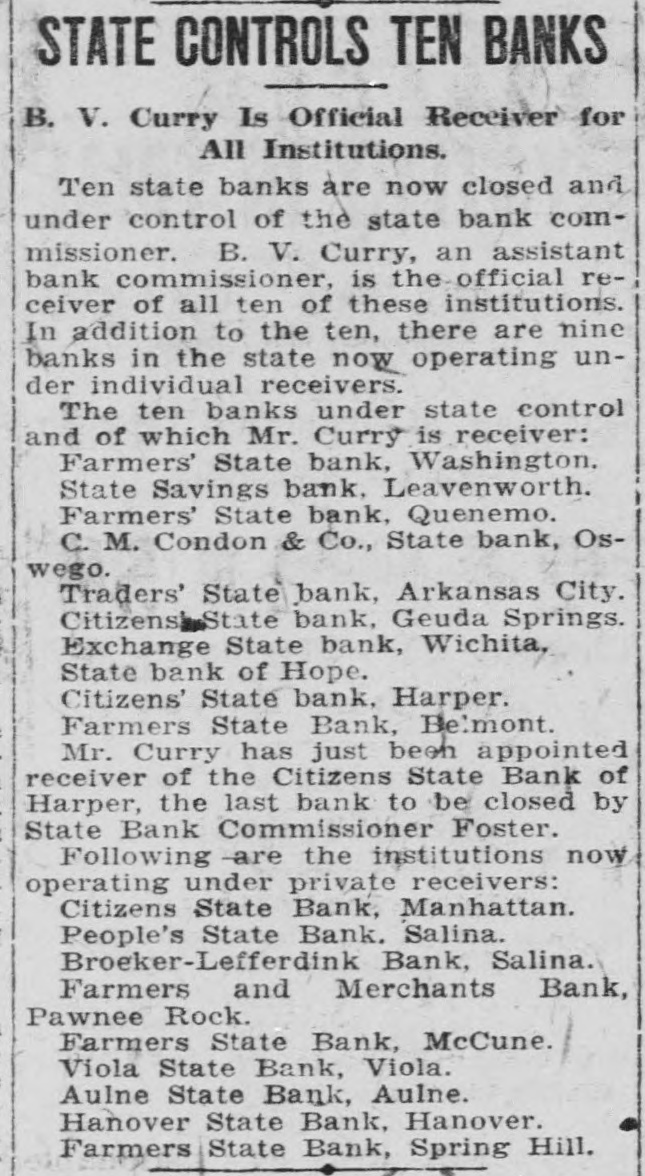
STATE CONTROLS TEN BANKS B. V. Curry Is Official Receiver for All Institutions. Ten state banks are now closed and under control of the state bank commissioner. B. V. Curry, an assistant bank commissioner, is the official receiver of all ten of these institutions. In addition to the ten, there are nine banks in the state now operating under individual receivers. The ten banks under state control and of which Mr. Curry is receiver: Farmers' State bank, Washington. State Savings bank, Leavenworth. Farmers' State bank, Quenemo. C. M. Condon & Co., State bank, Oswego. Traders' State bank, Arkansas City. Citizens State bank, Geuda Springs. Exchange State bank, Wichita, State bank of Hope. Citizens' State bank, Harper. Farmers State Bank, Belmont. Mr. Curry has just been appointed receiver of the Citizens State Bank of Harper, the last bank to be closed by State Bank Commissioner Foster. Following -are the institutions now operating under private receivers: Citizens State Bank, Manhattan. People's State Bank. Salina. Broeker-Lefferdink Bank, Salina. Farmers and Merchants Bank, Pawnee Rock. Farmers State Bank, McCune. Viola State Bank, Viola. Aulne State Bank, Aulne. Hanover State Bank, Hanover. Farmers State Bank, Spring Hill.


Article from Kansas City Journal, April 15, 1923

Click image to open full size in new tab

Article Text

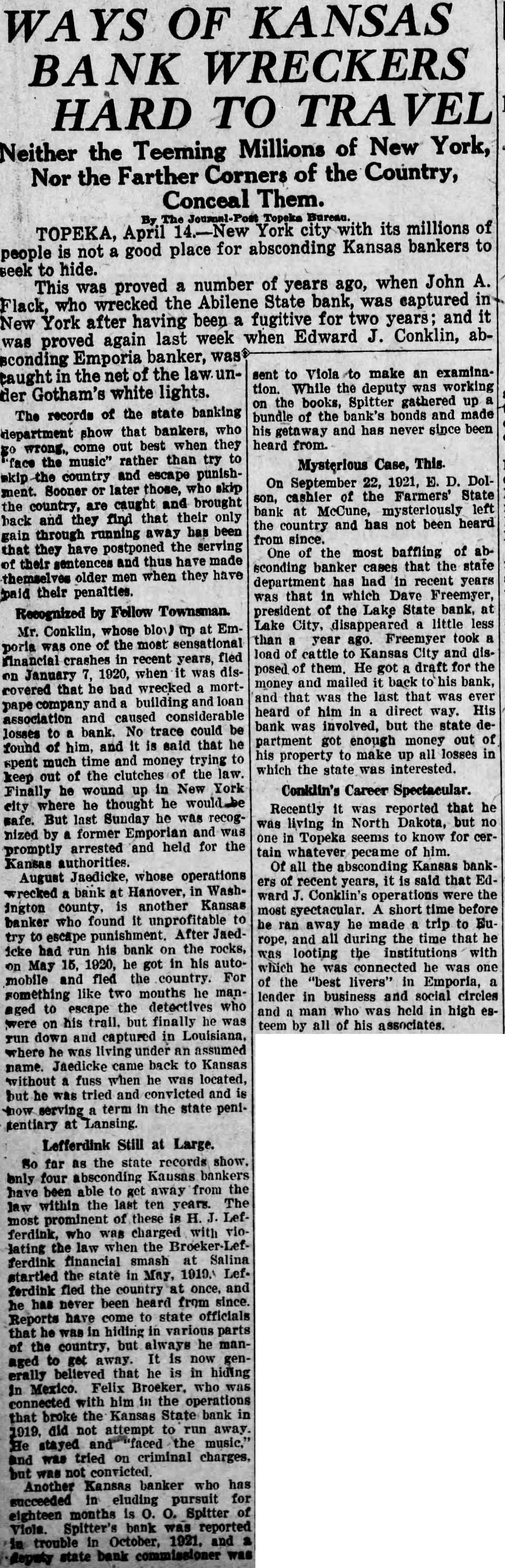
WAYS OF KANSAS BANK WRECKERS HARD TO TRAVEL Neither the Teeming Millions of New York, Nor the Farther Corners of the Country, Conceal Them. By The Journal-Post Topeka Bureau. TOPEKA, April 14.β€”New York city with its millions of people is not a good place for absconding Kansas bankers to seek to hide. This was proved a number of years ago, when John A. Flack, who wrecked the Abilene State bank, was captured in New York after having been a fugitive for two years; and it was proved again last week when Edward J. Conklin, absconding Emporia banker, was caught in the net of the law under Gotham's white lights. The records of the state banking department show that bankers, who go wrong, come out best when they "face the music" rather than try to skip the country and escape punishment. Sooner or later those, who skip the country, are caught and brought back and they find that their only gain through running away has been that they have postponed the serving of their sentences and thus have made themselves older men when they have paid their penalties. Recognized by Fellow Townsman. Mr. Conklin, whose blow up at Emporia was one of the most sensational financial crashes in recent years, fled on January 7, 1920, when it was discovered that he had wrecked a mortgage company and a building and loan association and caused considerable losses to a bank. No trace could be found of him, and it is said that he spent much time and money trying to keep out of the clutches of the law. Finally he wound up in New York city where he thought he would be safe. But last Sunday he was recognized by a former Emporian and was promptly arrested and held for the Kansas authorities. August Jaedicke, whose operations wrecked a bank at Hanover, in Washington county, is another Kansas banker who found it unprofitable to try to escape punishment. After Jaedicke had run his bank on the rocks, on May 15, 1920, he got in his automobile and fled the country. For something like two months he managed to escape the detectives who were on his trail, but finally he was run down and captured in Louisiana, where he was living under an assumed name. Jaedicke came back to Kansas without a fuss when he was located, but he was tried and convicted and is now serving a term in the state penitentiary at Lansing. Lefferdink Still at Large. So far as the state records show, only four absconding Kansas bankers have been able to get away from the law within the last ten years. The most prominent of these is H. J. Lefferdink, who was charged with violating the law when the Broeker-Lefferdink financial smash at Salina startled the state in May, 1919. Lefferdink fled the country at once, and he has never been heard from since. Reports have come to state officials that he was in hiding in various parts of the country, but always he managed to get away. It is now generally believed that he is in hiding in Mexico. Felix Broeker, who was connected with him in the operations that broke the Kansas State bank in 1919, did not attempt to run away. He stayed and "faced the music," and was tried on criminal charges, but was not convicted. Another Kansas banker who has succeeded in eluding pursuit for eighteen months is O. O. Spitter of Viola. Spitter's bank was reported in trouble in October, 1921, and a deputy state bank commissioner was sent to Viola to make an examination. While the deputy was working on the books, Spitter gathered up a bundle of the bank's bonds and made his getaway and has never since been heard from. Mysterious Case, This. On September 22, 1921, E. D. Dolson, cashier of the Farmers' State bank at McCune, mysteriously left the country and has not been heard from since. One of the most baffling of absconding banker cases that the state department has had in recent years was that in which Dave Freemyer, president of the Lake State bank, at Lake City, disappeared a little less than a year ago. Freemyer took a load of cattle to Kansas City and disposed of them. He got a draft for the money and mailed it back to his bank, and that was the last that was ever heard of him in a direct way. His bank was involved, but the state department got enough money out of his property to make up all losses in which the state was interested. Conklin's Career Spectacular. Recently it was reported that he was living in North Dakota, but no one in Topeka seems to know for certain whatever became of him. Of all the absconding Kansas bankers of recent years, it is said that Edward J. Conklin's operations were the most spectacular. A short time before he ran away he made a trip to Europe, and all during the time that he was looting the institutions with which he was connected he was one of the "best livers" in Emporia, a leader in business and social circles and a man who was held in high esteem by all of his associates.


Article from Lexington Herald-Leader, September 14, 1923

Click image to open full size in new tab

Article Text

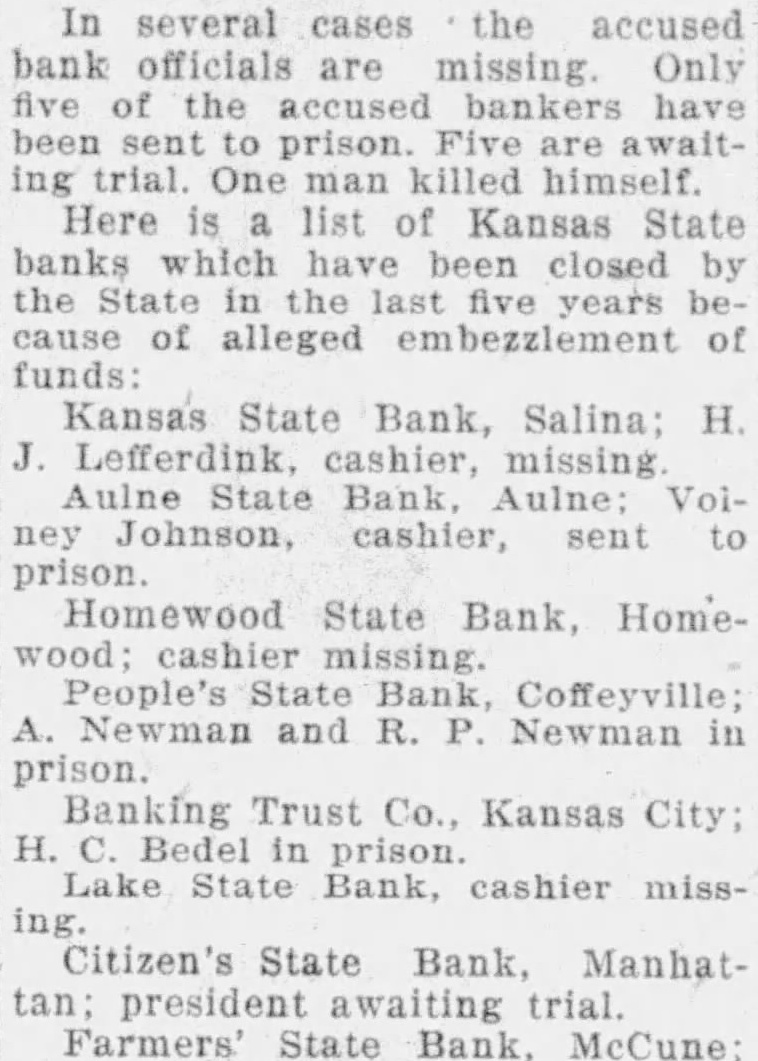
In several cases the accused bank officials are missing. Only five of the accused bankers have been sent to prison. Five are awaiting trial. One man killed himself. Here is a list of Kansas State banks which have been closed by the State in the last five years because of alleged embezzlement of funds: Kansas State Bank, Salina; H. J. Lefferdink, cashier, missing. Aulne State Bank, Aulne; Volney Johnson, cashier, sent to prison. Homewood State Bank, Homewood; cashier missing. People's State Bank, Coffeyville; A. Newman and R. P. Newman in prison. Banking Trust Co., Kansas City; H. C. Bedel in prison. Lake State Bank, cashier missing. Citizen's State Bank, Manhattan; president awaiting trial. Farmers' State Bank, McCune;


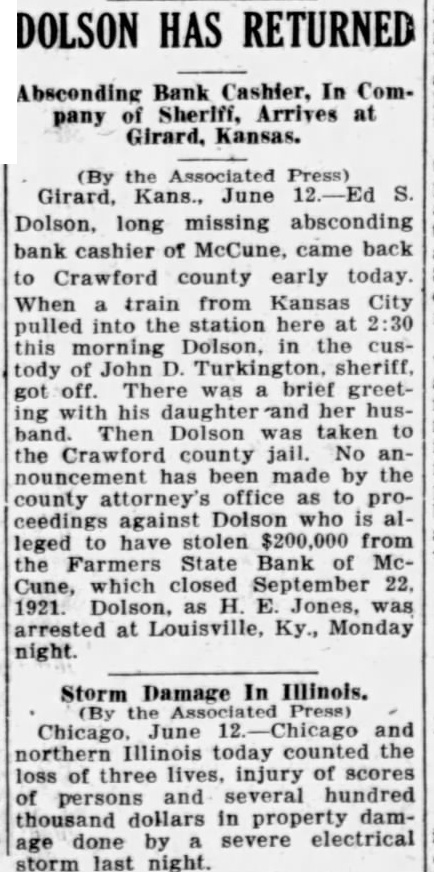
Article from The Iola Register, June 12, 1926

Click image to open full size in new tab

Article Text

DOLSON HAS RETURNED Absconding Bank Cashier, In Company Sherlff, Arrives at Girard, Kansas. the Associated Press) Girard, Kans., June Dolson, long missing absconding bank cashier of McCune, came back to Crawford county early today. When train from Kansas City pulled into the station here this morning Dolson, in the custody of John sheriff, There was brief greetwith his daughter and her husband. Then Dolson taken the Crawford county jail. No anhas been made by the county office as ceedings against Dolson who leged have stolen $200,000 from the Farmers State Bank of McCune, which closed September 1921. Dolson, as arrested at Louisville, Ky., Monday night. Storm Damage In Illinois. June and northern Illinois today the three lives, injury of scores loss of of and hundred persons thousand dollars in property damdone by severe electrical age storm last night.