Some articles use the variant spelling Charleston (OCR/typographical variant) for Charlestown.
Events (3)
1.February 22, 1895Run
Cause
Bank Specific Adverse Info
Cause Details
Large withdrawals triggered by impaired income from poor western investments and depositors moving funds across state lines
Measures
Injunction limiting payments to 15% of each deposit to allow conversion of assets to cash
Newspaper Excerpt
an injunction ... restraining the Connecticut River savings bank of Charlestown, N. H., from paying any depositor a sum exceeding 15 per cent of his deposit ... The withdrawals had been quite large for the past few weeks and notices of withdrawal were increasing so largely
Source
newspapers
+34 days
2.March 28, 1895Receivership
Newspaper Excerpt
The trustees of the Connecticut River Savings bank ... voted to petition the court to place the bank in the hands of a receiver.
Source
newspapers
+4 days
3.April 1, 1895*Suspension
Cause
Bank Specific Adverse Info
Cause Details
Trustees petitioned for a receiver after continued withdrawals and impaired assets from poor western investments
Newspaper Excerpt
the Connecticut River savings bank, which suspended a week ago
Source
newspapers
Newspaper Articles (14)
1.February 22, 1895Vermont PhœnixBrattleboro, Bellows Falls, Ludlow, VT
Click image to open full size in new tab
Article Text
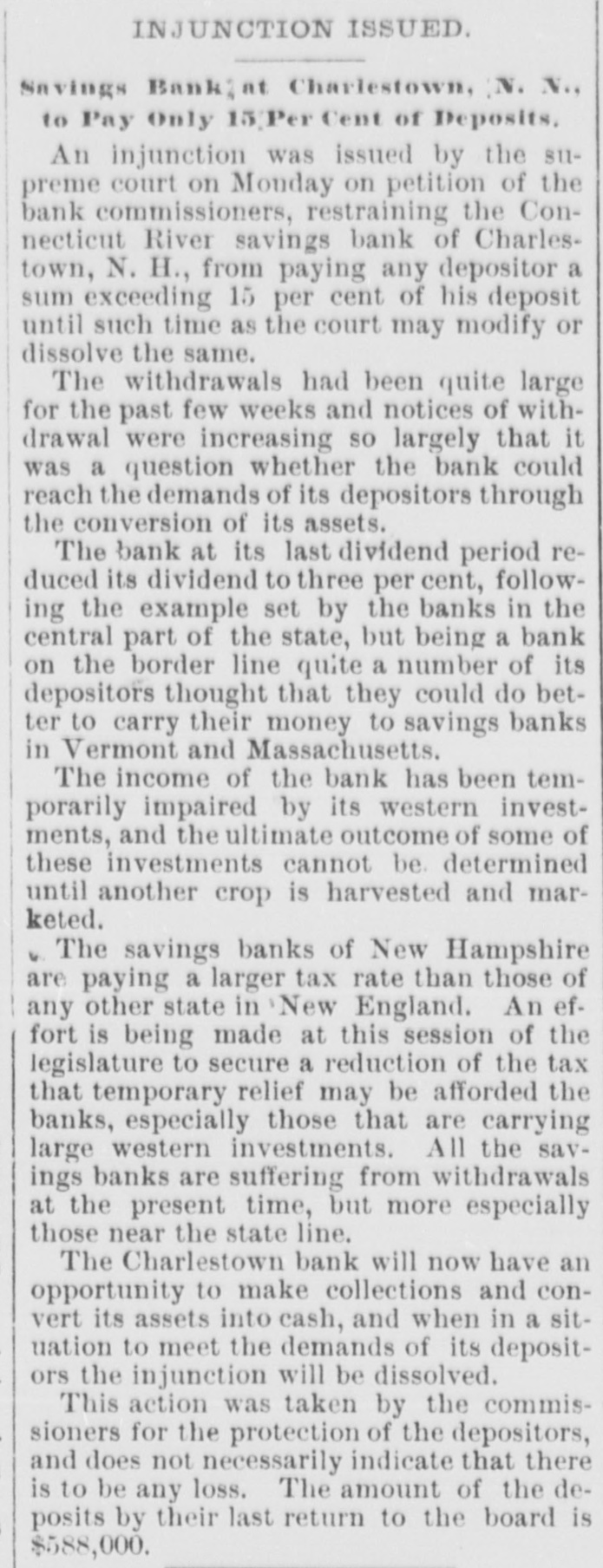
INJUNCTION ISSUED
Savings Bank,at Charlestown, :N. N., to Pay Only 15/Per Cent of Deposits. An injunction was issued by the supreme court on Monday on petition of the bank commissioners, restraining the Connecticut River savings bank of Charlestown, N. H., from paying any depositor a sum exceeding 15 per cent of his deposit until such time as the court may modify or dissolve the same. The withdrawals had been quite large for the past few weeks and notices of withdrawal were increasing so largely that it was a question whether the bank could reach the demands of its depositors through the conversion of its assets. The bank at its last dividend period reduced its dividend to three per cent, following the example set by the banks in the central part of the state, but being a bank on the border line quite a number of its depositors thought that they could do better to carry their money to savings banks in Vermont and Massachusetts. The income of the bank has been temporarily impaired by its western investments, and the ultimate outcome of some of these investments cannot be. determined until another crop is harvested and marketed. - The savings banks of New Hampshire are paying a larger tax rate than those of any other state in New England. An effort is being made at this session of the legislature to secure a reduction of the tax that temporary relief may be afforded the banks, especially those that are carrying large western investments. All the savings banks are suffering from withdrawals at the present time, but more especially those near the state line. The Charlestown bank will now have an opportunity to make collections and convert its assets into cash, and when in a situation to meet the demands of its depositors the injunction will be dissolved. This action was taken by the commissioners for the protection of the depositors, and does not necessarily indicate that there is to be any loss. The amount of the deposits by their last return to the board is $588,000.
2.March 28, 1895Santa Fe Daily New MexicanSanta Fe., Santa Fe, NM
Click image to open full size in new tab
Article Text
Receiver Asked For
Charleston, N. H., Mch. 28.-Trustees of the Connecticut River Savings bank to-day voted to petition the court to place the bank in the hands of a receiver.
3.March 28, 1895Evening StarWashington, DC
Click image to open full size in new tab
Article Text
A Bank Wants a Receiver
CHARLESTON, N. H., March 28.-The trustees of the Connecticut River Savings Bank at a meeting today voted to petition the court to place the bank in the hands of a receiver. Bank Commissioners Hatch and Baker recently completed an examination of the bank's accounts.
4.March 29, 1895The Anaconda StandardAnaconda, MT
Click image to open full size in new tab
Article Text
CHARLESTON, N. H., March 28. - The trus. tees of the Connecticut River Savings bank today voted to petition the court to place the bank in the hands of a receiver.
5.March 29, 1895Great Falls Weekly TribuneGreat Falls, MT
Click image to open full size in new tab
Article Text
In Hard Lines, CHARLESTON, N. H. March 28.-- The trustees of the Connecticut River Savings bank today voted to petition the court to place the bank in the hands of a receiver.
6.March 29, 1895The HeraldLos Angeles, CA
Click image to open full size in new tab
Article Text
A Bank Wants a Receiver CHARLISTON. N. H., March 28.-The trustees of the Connecticut River Savings Bankstoday voted to petition the courtito place the bank in the hands of a receiver. :
7.April 5, 1895Idaho County Free PressGrangeville, ID
Click image to open full size in new tab
Article Text
Sparks From the Wires
The rise in silver and subsequent decline in foreign exchange continues in Mexico. Attorney Erwin has moved for a new trial for Harry Hayward. Erwin urged that new evidence had been discovered. Field Marshal Sir Patrick Grant, governor of Chelsea hospital, and the oldest officer in the British army, is dead. Trustees of the Connecticut River Savings bank at Charleston, N. H., voted to petition the court to place the bank in the hands of receivers. Douglas M. Canfield, proprietor of the Victoria hotel, New York, made an assignment to O. P. Breen, the manager. He said the liabilities of about $75,000 would be more that covered with the as sets.
8.April 11, 1895Ellsworth AmericanEllsworth, ME
Click image to open full size in new tab
Article Text
Another argument in favor of New Englanders' investing their money at home is furnished by the Connecticut River Savings bank, of Charlestown, N. H., whose trustees have voted to apply to the supreme court for a receiver. By reason of poor western investments, the depositors will lose at least twenty-five per cent.
9.April 11, 1895The Providence NewsProvidence, RI
Click image to open full size in new tab
Article Text
Treasurer Olcott Dead
CHARLESTOWN, N. H., April 11.-George Olcett, treasurer of the Connecticut River Savings bank, which has just passed into the hands of a receiver, died yesterday, aged 57. He had been treasurer of the bank for more than 30 years.
10.April 18, 1895Iron County RegisterIronton, MO
Click image to open full size in new tab
Article Text
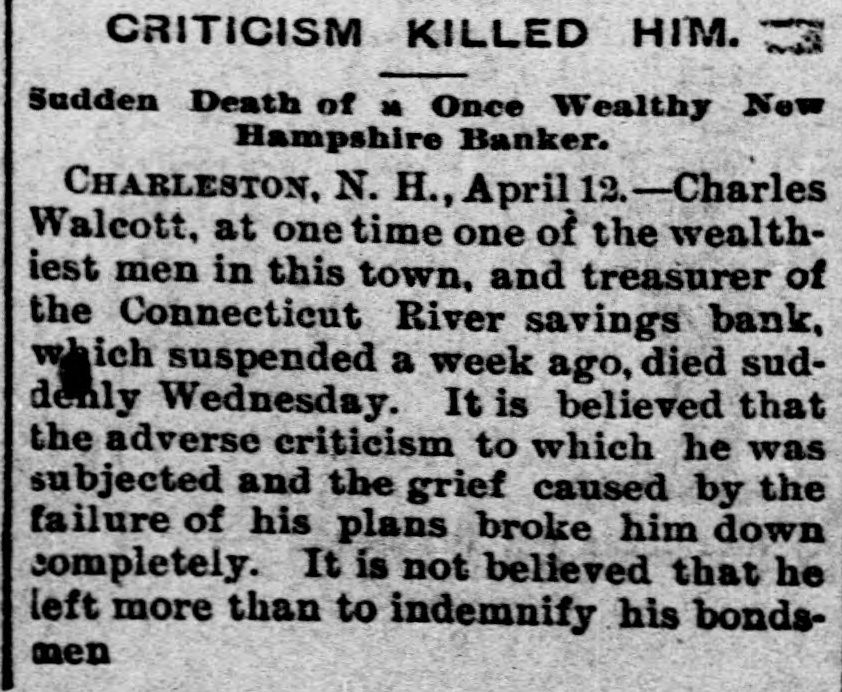
CRITICISM KILLED HIM
Sudden Death of M Once Wealthy New Hampshire Banker. CHARLESTON, N. H., April 12.-Charles Walcott, at one time one of the wealthiest men in this town, and treasurer of the Connecticut River savings bank, which suspended a week ago, died suddenly Wednesday. It is believed that the adverse criticism to which he was subjected and the grief caused by the failure of his plans broke him down completely. It is not believed that he left more than to indemnify his bondsmen
11.December 27, 1895Vermont PhœnixBrattleboro, Bellows Falls, Ludlow, VT
Click image to open full size in new tab
Article Text
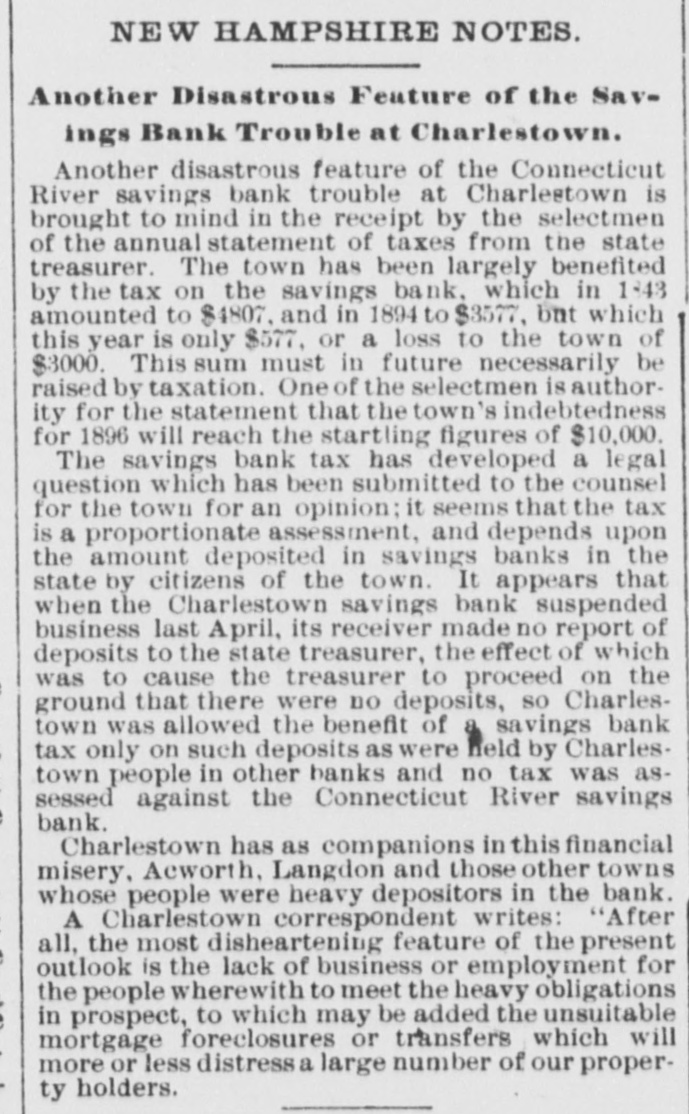
NEW HAMPSHIRE NOTES
Another Disastrous Feature of the Savings Bank Trouble at Charlestown. Another disastrous feature of the Connecticut River savings bank trouble at Charlestown is brought to mind in the receipt by the selectmen of the annual statement of taxes from the state treasurer. The town has been largely benefited by the tax on the savings bank, which in 1843 amounted to $4807. and in 1894 to $3577, but which this year is only $577. or a loss to the town of $3000. This sum must in future necessarily be raised by taxation. One of the selectmen is authority for the statement that the town's indebtedness for 1896 will reach the startling figures of $10,000. The savings bank tax has developed a legal question which has been submitted to the counsel for the town for an opinion; it seems that the tax is a proportionate assessment, and depends upon the amount deposited in savings banks in the state by citizens of the town. It appears that when the Charlestown savings bank suspended business last April, its receiver made no report of deposits to the state treasurer, the effect of which was to cause the treasurer to proceed on the ground that there were no deposits, so Charlestown was allowed the benefit of & savings bank tax only on such deposits as were held by Charlestown people in other banks and no tax was assessed against the Connecticut River savings bank. Charlestown has as companions in this financial misery, Acworth, Langdon and those other towns whose people were heavy depositors in the bank. A Charlestown correspondent writes: "After all, the most disheartening feature of the present outlook is the lack of business or employment for the people wherewith to meet the heavy obligations in prospect, to which may be added the unsuitable mortgage foreclosures or transfers which will more or less distress a large number of our property holders.
12.January 1, 1897Vermont PhœnixBrattleboro, Bellows Falls, Ludlow, VT
Click image to open full size in new tab
Article Text
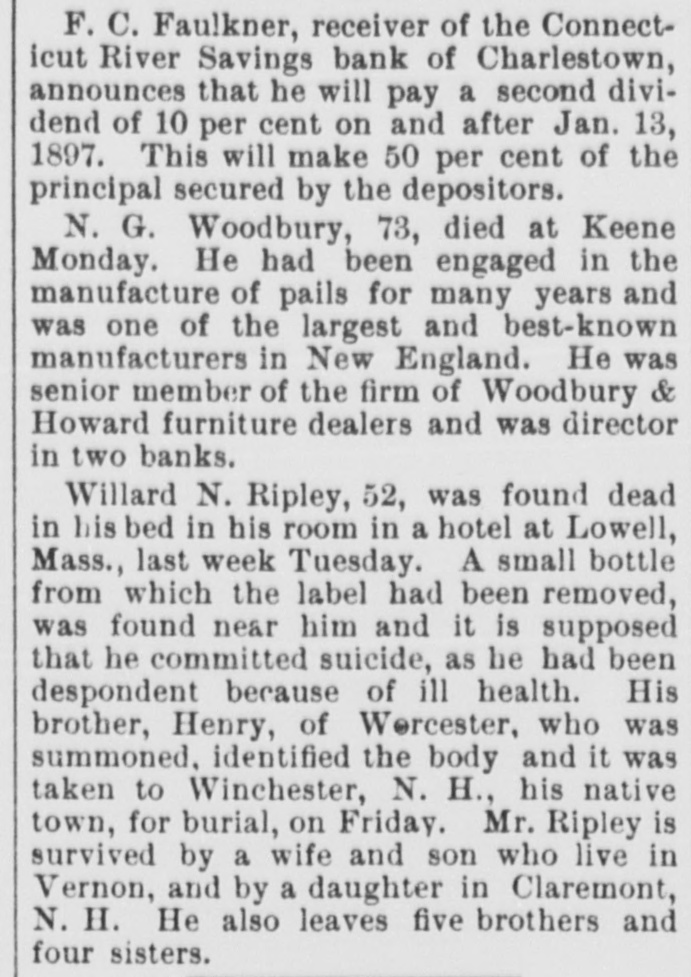
F. C. Faulkner, receiver of the Connecticut River Savings bank of Charlestown, announces that he will pay a second dividend of 10 per cent on and after Jan. 13, 1897. This will make 50 per cent of the principal secured by the depositors. N. G. Woodbury, 73, died at Keene Monday. He had been engaged in the manufacture of pails for many years and was one of the largest and best-known manufacturers in New England. He was senior member of the firm of Woodbury & Howard furniture dealers and was director in two banks. Willard N. Ripley, 52, was found dead in his bed in his room in a hotel at Lowell, Mass., last week Tuesday. A small bottle from which the label had been removed, was found near him and it is supposed that he committed suicide, as he had been despondent because of ill health. His brother, Henry, of Worcester, who was summoned, identified the body and it was taken to Winchester, N. H., his native town, for burial, on Friday. Mr. Ripley is survived by a wife and son who live in Vernon, and by a daughter in Claremont, N. H. He also leaves five brothers and four sisters.
13.July 30, 1897Vermont PhœnixBrattleboro, Bellows Falls, Ludlow, VT
Click image to open full size in new tab
Article Text
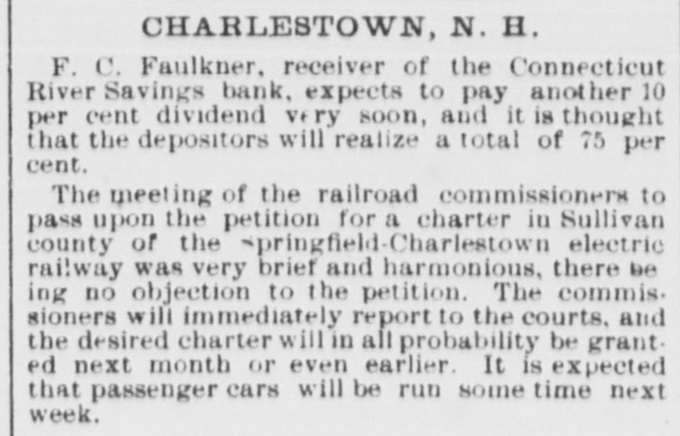
CHARLESTOWN, N. H. F. C. Faulkner, receiver of the Connecticut River Savings bank, expects to pay another 10 per cent dividend very soon, and it is thought that the depositors will realize a total of 75 per cent. The meeting of the railroad commissioners to pass upon the petition for a charter in Sullivan county of the springfield-Charlestown electric railway was very brief and harmonious, there be ing no objection to the petition. The commis. sioners will immediately report to the courts, and the desired charter will in all probability be grant. ed next month or even earlier. It is expected that passenger cars will be run some time next week.
14.November 10, 1899Vermont PhœnixBrattleboro, Bellows Falls, Ludlow, VT
Click image to open full size in new tab
Article Text
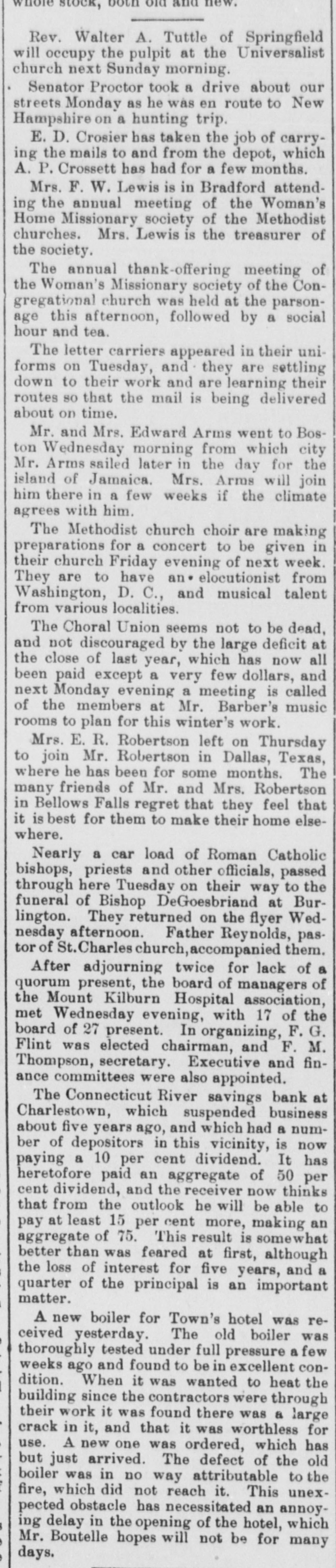
Rev. Walter A. Tuttle of Springfield will occupy the pulpit at the Universalist church next Sunday morning. Senator Proctor took a drive about our streets Monday as he was en route to New Hampshire on a hunting trip. E. D. Crosier has taken the job of carrying the mails to and from the depot, which A. P. Crossett has had for a few months. Mrs. F. W. Lewis is in Bradford attending the annual meeting of the Woman's Home Missionary society of the Methodist churches. Mrs. Lewis is the treasurer of the society. The annual thank-offering meeting of the Woman's Missionary society of the Congregational church was held at the parsonage this afternoon, followed by a social hour and tea. The letter carriers appeared in their uniforms on Tuesday, and they are settling down to their work and are learning their routes so that the mail is being delivered about on time. Mr. and Mrs. Edward Arms went to Boston Wednesday morning from which city Mr. Arms sailed later in the day for the island of Jamaica. Mrs. Arms will join him there in a few weeks if the climate agrees with him. The Methodist church choir are making preparations for a concert to be given in their church Friday evening of next week. They are to have an elocutionist from Washington, D. C., and musical talent from various localities. The Choral Union seems not to be dead, and not discouraged by the large deficit at the close of last year, which has now all been paid except a very few dollars, and next Monday evening a meeting is called of the members at Mr. Barber's music rooms to plan for this winter's work. Mrs. E. R. Robertson left on Thursday to join Mr. Robertson in Dallas, Texas, where he has been for some months. The many friends of Mr. and Mrs. Robertson in Bellows Falls regret that they feel that it is best for them to make their home elsewhere. Nearly a car load of Roman Catholic bishops, priests and other officials, passed through here Tuesday on their way to the funeral of Bishop DeGoesbriand at Burlington. They returned on the flyer Wednesday afternoon. Father Reynolds, pastor of St. Charles church, accompanied them. After adjourning twice for lack of a quorum present, the board of managers of the Mount Kilburn Hospital association, met Wednesday evening, with 17 of the board of 27 present. In organizing, F. G. Flint was elected chairman, and F. M. Thompson, secretary. Executive and finance committees were also appointed. The Connecticut River savings bank at Charlestown, which suspended business about five years ago, and which had a number of depositors in this vicinity, is now paying a 10 per cent dividend. It has heretofore paid an aggregate of 50 per cent dividend, and the receiver now thinks that from the outlook he will be able to pay at least 15 per cent more, making an aggregate of 75. This result is somewhat better than was feared at first, although the loss of interest for five years, and a quarter of the principal is an important matter. A new boiler for Town's hotel was received yesterday. The old boiler was thoroughly tested under full pressure a few weeks ago and found to be in excellent condition. When it was wanted to heat the building since the contractors were through their work it was found there was a large crack in it, and that it was worthless for use. A new one was ordered, which has but just arrived. The defect of the old boiler was in no way attributable to the fire, which did not reach it. This unexpected obstacle has necessitated an annoying delay in the opening of the hotel, which Mr. Boutelle hopes will not be for many days.
Bank runs are almost always and everywhere a deterioration of bank fundamentals.
But not for you.
You are the measure-zero exception: great fundamentals, solid bank, and yet the Diamond Dybvig fairy spread its rumor. Depositors woke up. Your collateral was not prepositioned. The Clearinghouse had it for you.
Do not pass Go. Do not collect $200. Go directly to jail… or worse.
Flag Article for Review
Flag Episode for Review
Connecticut River Savings Bank · Episode ID 8384091291142