First National Bank (Bayonne, NJ)

Episode Information

Episode UID
845401368
Episode Type
Run โ†’ Suspension โ†’ Closure
Bank Type
national
Bank ID
84540 national
Charter Number
8454
Start Date
December 1, 1913*
Location
Bayonne, New Jersey (40.669, -74.114)

Metadata

Model
gpt-5-mini (chosen from majority vote of a three-model LLM ensemble)
Short Digest
d8e21b636e48d933

Response Measures

Capital injected, Full suspension, Books examined

Other: Directors offered to put up substantial collateral/cash to restore reserves; later the Union Trust Company agreed to take over the failed bank (assumption/merger by another institution).

Receivership Details

Depositor recovery rate
76.3%
Date receivership started
1913-12-08
Date receivership terminated
1922-09-30
OCC cause of failure
Losses
Share of assets assessed as good
56.5%
Share of assets assessed as doubtful
23.7%
Share of assets assessed as worthless
19.8%

Description

Bank closed Dec 8, 1913 and later placed in receivership and taken over by Union Trust.

Events (6)

1. December 5, 1906 Chartered
Source
historical_nic
2. December 1, 1913* Run
Cause
Rumor Or Misinformation
Cause Details
Quiet steady drain of deposits over the prior week driven by rumors of trouble at the bank.
Measures
Directors proposed to put up cash; ultimately turned affairs over to national bank examiners.
Newspaper Excerpt
During the past week probably $1,000,000 in deposits was withdrawn owing to rumors that the institution was in difficulties.
Source
newspapers
3. December 8, 1913 Receivership
Source
historical_nic
4. December 8, 1913 Receivership
Newspaper Excerpt
National Bank Examiner C. H. Chatman has been designated temporary receiver for the First National Bank of Bayonne, N. J., by Acting Controller of the Currency Kane.
Source
newspapers
5. December 8, 1913 Suspension
Cause
Government Action
Cause Details
Directors closed the bank and placed it in the custody of national bank examiners due to depleted cash reserve and inability to realize ready cash.
Newspaper Excerpt
The First National Bank of Bayonne has been placed in the hands of Federal examiners and did not open its doors today.
Source
newspapers
6. February 6, 1914 Other
Newspaper Excerpt
The offer of the Union Trust Company of Jersey City to take over the failed First National Bank of Bayonne has been accepted by a unanimous vote of the directors; it will be reopened as a branch of the Union Trust and the depositors will be guaranteed full payment of their savings.
Source
newspapers

Newspaper Articles (21)

Article from Newark Evening Star and Newark Advertiser, December 8, 1913

Click image to open full size in new tab

Article Text

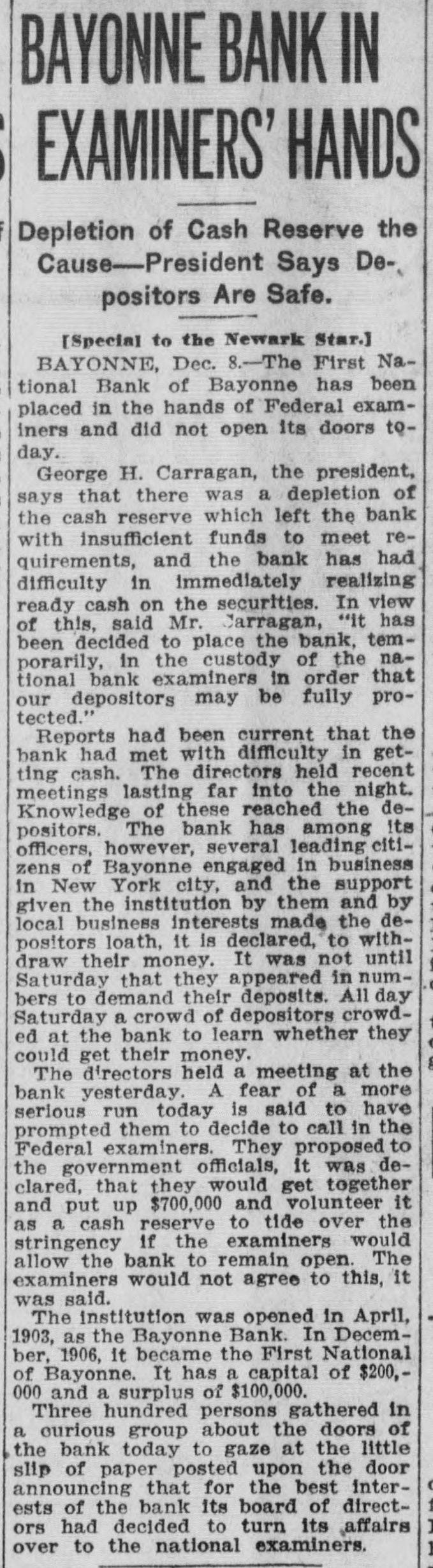
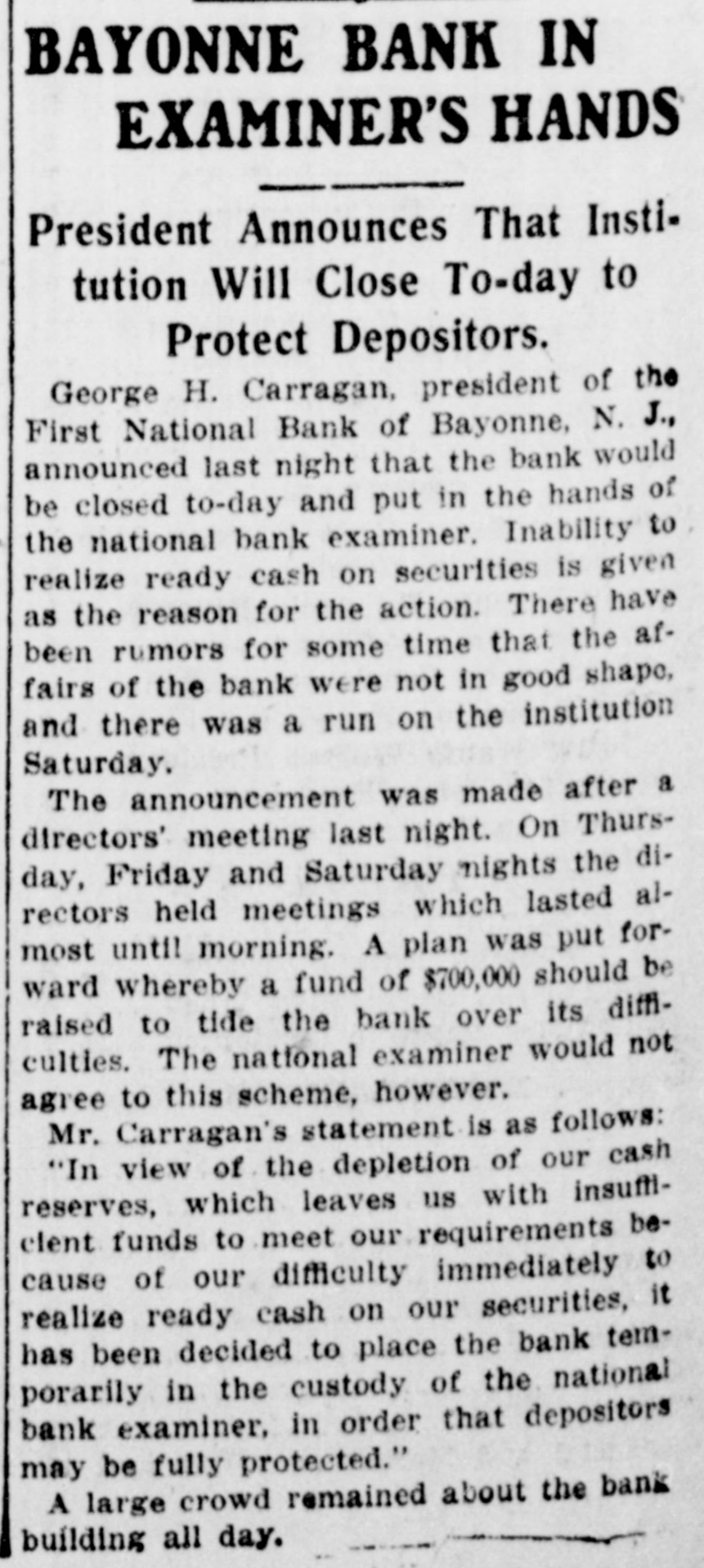
BAYONNE BANK IN EXAMINERS' HANDS Depletion of Cash Reserve the Cause-President Says De-, positors Are Safe. [Special to the Newark Star.] BAYONNE, Dec. 8.-The First National Bank of Bayonne has been placed in the hands of Federal examiners and did not open its doors today. George H. Carragan, the president, says that there was a depletion of the cash reserve which left the bank with insufficient funds to meet requirements, and the bank has had difficulty in immediately realizing ready cash on the securities. In view of this, said Mr. Carragan, "it has been decided to place the bank, temporarily, in the custody of the national bank examiners in order that our depositors may be fully protected." Reports had been current that the bank had met with difficulty in getting cash. The directors held recent meetings lasting far into the night. Knowledge of these reached the depositors. The bank has among its officers, however, several leading citizens of Bayonne engaged in business in New York city, and the support given the institution by them and by local business interests made the depositors loath, it is declared, to withdraw their money. It was not until Saturday that they appeared in numbers to demand their deposits. All day Saturday a crowd of depositors crowded at the bank to learn whether they could get their money. The directors held a meeting at the bank yesterday. A fear of a more serious run today is said to have prompted them to decide to call in the Federal examiners. They proposed to the government officials, it was declared, that they would get together and put up $700,000 and volunteer it as a cash reserve to tide over the stringency if the examiners would allow the bank to remain open. The examiners would not agree to this, it was said. The institution was opened in April, 1903, as the Bayonne Bank. In December, 1906, it became the First National of Bayonne. It has a capital of $200,000 and a surplus of $100,000. Three hundred persons gathered in a curious group about the doors of the bank today to gaze at the little slip of paper posted upon the door ( announcing that for the best inter1 ests of the bank its board of direct] ors had decided to turn its affairs over to the national examiners. 1


Article from The Bridgeport Evening Farmer, December 8, 1913

Click image to open full size in new tab

Article Text

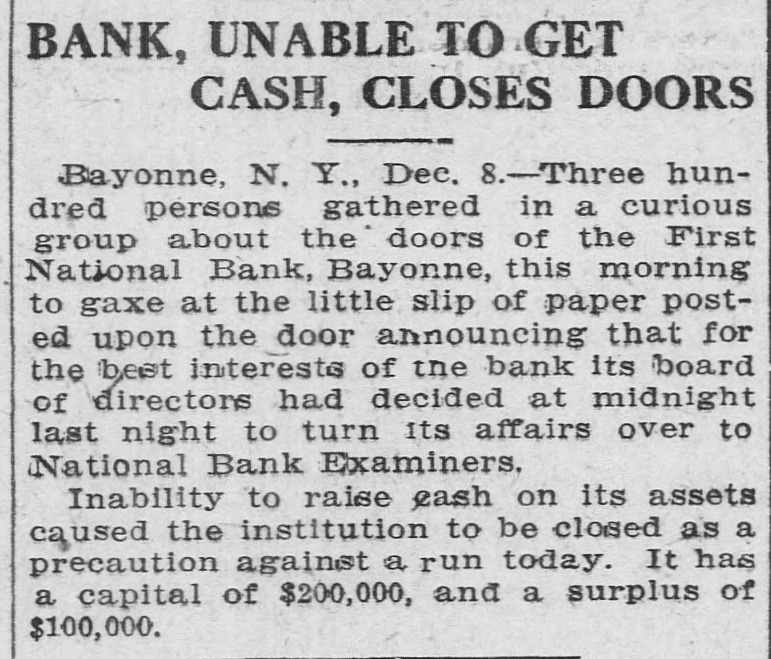
BANK, UNABLE TO GET CASH, CLOSES DOORS Bayonne, N. Y., Dec. 8.-Three hundred persons gathered in a curious group about the doors of the First National Bank, Bayonne, this morning to gaxe at the little slip of paper posted upon the door announcing that for the best interests of the bank its board of directors had decided at midnight last night to turn its affairs over to National Bank Examiners. Inability to raise eash on its assets caused the institution to be closed as a precaution against a run today. It has a capital of $200,000, and a surplus of $100,000.


Article from The Evening World, December 8, 1913

Click image to open full size in new tab

Article Text

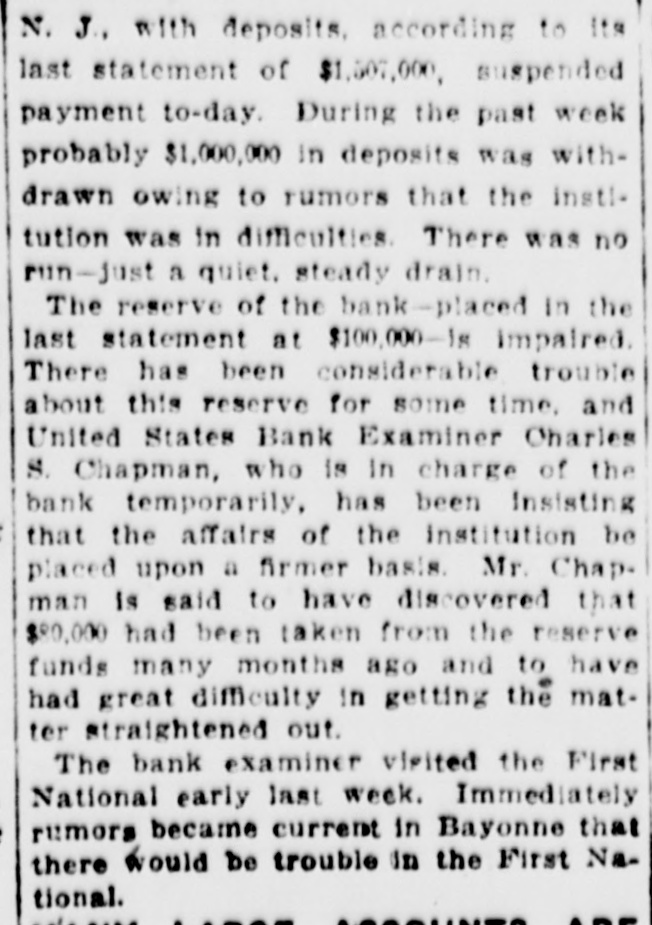
N. J., with deposits, according to Its last statement of $1,507,000, suspended payment to-day. During the past week probably $1,000,000 in deposits was withdrawn owing to rumors that the institution was in difficulties. There was no run-just a quiet. steady drain. The reserve of the bank-placed in the last statement at $100,000-18 impaired. There has been considerable trouble about this reserve for some time. and United States Bank Examiner Charles S. Chapman, who is In charge of the bank temporarily, has been Insisting that the affairs of the institution be placed upon a firmer basis. Mr. Chapman is said to have discovered that $80,000 had been taken from the reserve funds many months ago and to have had great difficulty in getting the matter straightened out. The bank examiner visited the First National early last week. Immediately rumors became current in Bayonne that there would be trouble in the First National. .- APE


Article from The Fairmont West Virginian, December 8, 1913

Click image to open full size in new tab

Article Text

N.J. BANK CLOSES ITS DOORS TO AVOID RUN. BAYONNE, New Jersey, Dec. 8.โ€” Three hundred persons gathered in a curious group about the door of the First National bank at Bayonne this morning to gaze at the little slip of paper posted upon the door announcing that for the best interest of the bank; its board of directors had decided at midnight last night to turn its affairs over to National bank examiners. Inability to raise cash on its assets caused the institution to be closed as a precaution egainst a run today. It has a capital of $200,000 and a surplus of $100,000.


Article from Evening Star, December 9, 1913

Click image to open full size in new tab

Article Text

C. H. Chatman Temporary Receiver. National Bank Examiner C. H. Chatman has been designated temporary receiver for the First National Bank of Bayonne, N. J., by Acting Controller of the Currency Kane. The bank was closed oy its directors.


Article from Newark Evening Star and Newark Advertiser, December 9, 1913

Click image to open full size in new tab

Article Text

BAYONNE BANK TO REOPEN IN A WEEK Pres. Carragan Says That Depositors Will Not Lose a Dollar. [Special to the Newark Star.] BAYONNE, Dec. 9.-Announcements of the most reassuring nature in regard to the financial condition of the First National Bank of this city, which closed its doors yesterday, were made by President George Carragan, of the bank, last night. Mr. Cariagan insisted that depositors would not lose a dollar of their deposits and that the bank would reopen in a week or ten days. Mr. Carragan stated that the bank needed $350,000 to restore it to its feet and that one member of the Board of Directors had promised to deposit $269,000 worth of collateral, while another promised to extend the remainder. The closing of the bank, it was asserted, was a measure of precaution against the heavy runs which would only have made matters worse. Although throngs of depositors gathered about the doors of the bank yesterday, there was not only no disorder, but some even offered to prove their faith in the bank by making further depos'ts. This, however, was refused by Charles C. Chapman, a nat onal bank examiner, who is temporary receiver. The closing of the bank, it was found yesterday. was caused by a shortage in the cash reserve. The bank had fallen about $30,000 short of the 15 per cent. reserve requ red by the federal law. It appeared that Mr. Chapman had been working on the books of the bank for the past two weeks. The reason generally given for the financial embarrassment of the bank is that the bank examiner had disapproved of many of the bonds which had been given as security for loans. The bank is the creditor of many of the mercantile houses of this place. as well as other cities. and Mr. Chapman is said to regard the assets notes as of little or no value. The examiner also objected to the liberal policy maintained in the past in extending loans. Mr. Chapman found that the deposits of the bank amounted to $1,449.676.61. There were 1,600 depositors. of whom many were savings depositors. The bank had loaned out about $700,000, of which only about $115,000 were demand loans. The average daily e outpayments were from $50,000 to $80,000. The questionable paper amounted to $389,000, and the examiner has demanded that the directors replace d most of this amount with ready cash. The latter insists that the loans are 1 good, but that it may take some S time to collect. The reorganization of the bank, It was said, would necessitate the election of a new staff of officers, it being the contention of Mr. Chapman that the present officials were lax in their methods of granting loans. "Mr. Chapman questioned the stability of some of our loans extended to out-of-town concerns," said Mr Carragan. "Some of these are well known in the business world. He refused. however. to grant the request of the directors to be allowed to put up cash of their own and take over the criticised loans. I have no doubt that the bank will reopen within a week or ten days." The officials of the bank, besides Mr. Carragan. are William H. Vreeland and John C. Rver. vice-presidents, and Louis B. Bragden. cashier.


Article from Daily Kennebec Journal, December 9, 1913

Click image to open full size in new tab

Article Text

Three hundred persons gathered in a curious group about the doors of the First National Bank of Bayonne, N. J., Monday morning, to gaze at the little slip of paper posted upon the door announcing that for the best interests of the bank its board of directors had decided, at midnight, Sunday night, to turn its affairs over to national bank examiners. Inability to raise cash on its posets caused the institution to be closed as a precaution against a run Monday. It has a capital of $200,000 and a surplus of $100,000.


Article from The Evening World, December 9, 1913

Click image to open full size in new tab

Article Text

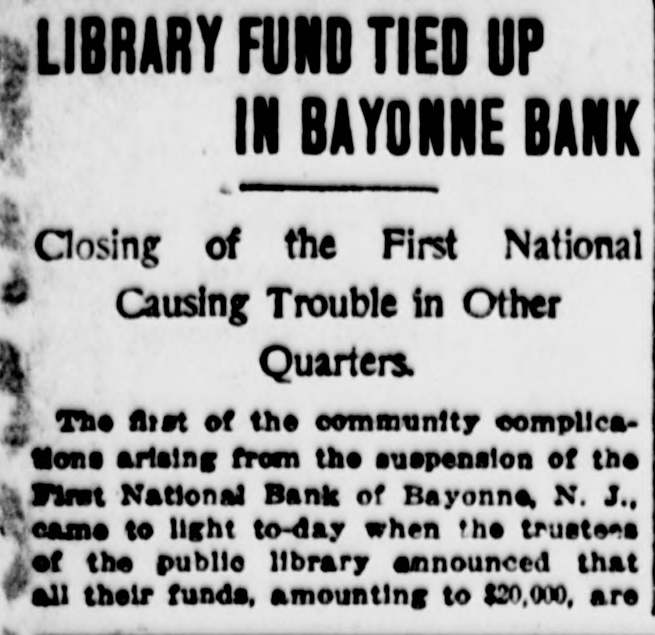
LIBRARY FUND TIED UP IN BAYONNE BANK Closing of the First National Causing Trouble in Other Quarters. The first of the community complicaMons arising from the suspension of the First National Bank of Bayonne, N. J., came to light to-day when the trustees of the public library ennounced that all their funds, amounting to $20,000, are


Article from The Citizen-Republican, December 11, 1913

Click image to open full size in new tab

Article Text

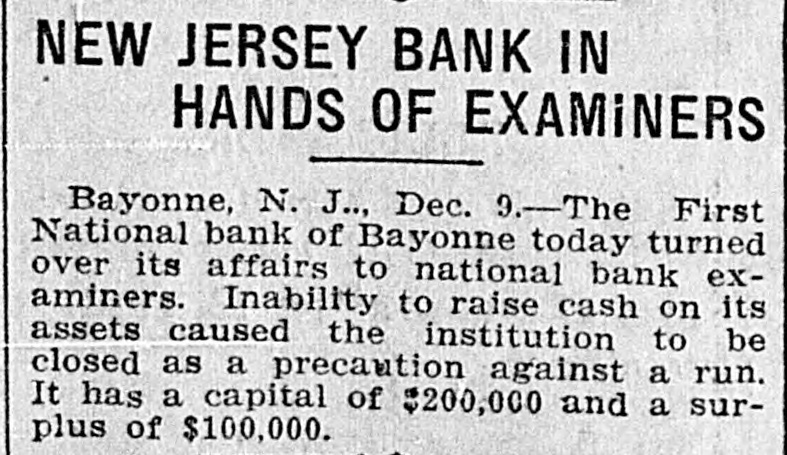
NEW JERSEY BANK IN HANDS OF EXAMINERS Bayonne, N. J.., Dec. 9.-The First National bank of Bayonne today turned over its affairs to national bank examiners. Inability to raise cash on its assets caused the institution to be closed as a precaution against a run. It has a capital of $200,000 and a surplus of $100,000.


Article from Newark Evening Star and Newark Advertiser, February 6, 1914

Click image to open full size in new tab

Article Text

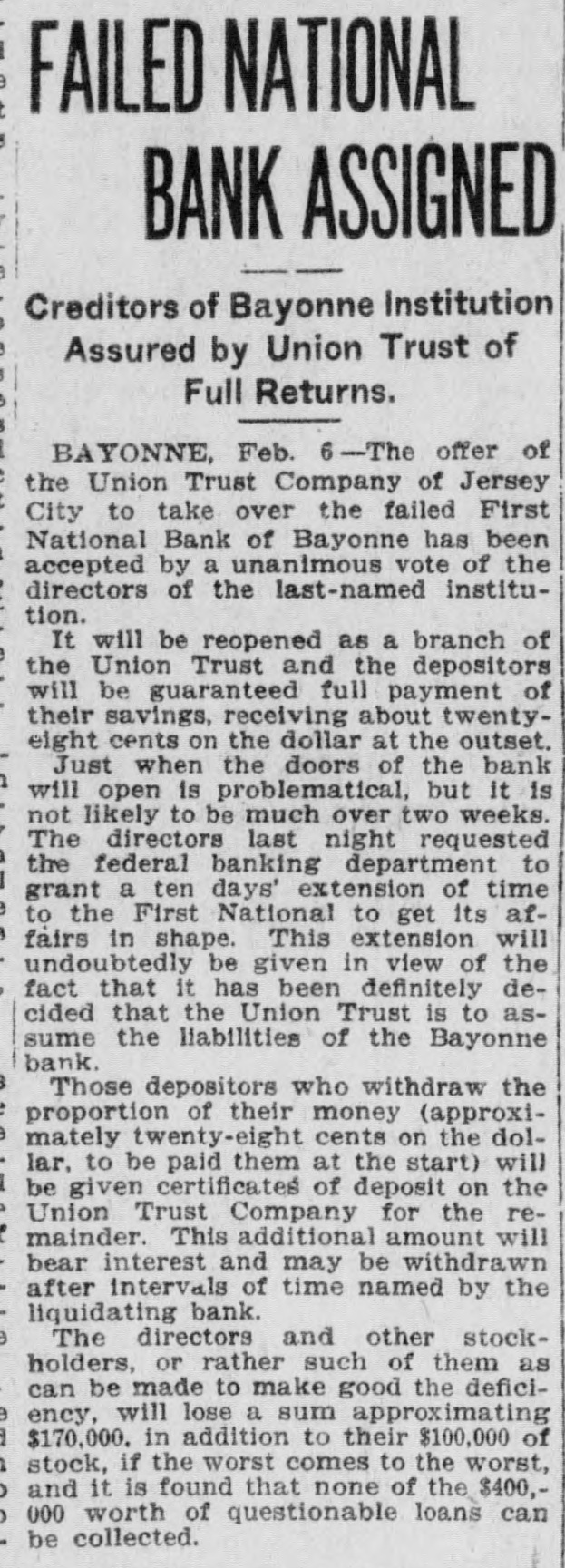
FAILED NATIONAL BANK ASSIGNED Creditors of Bayonne Institution Assured by Union Trust of Full Returns. BAYONNE, Feb. 6-The offer of the Union Trust Company of Jersey City to take over the failed First National Bank of Bayonne has been accepted by a unanimous vote of the directors of the last-named institution. It will be reopened as a branch of the Union Trust and the depositors will be guaranteed full payment of their savings, receiving about twentyeight cents on the dollar at the outset. Just when the doors of the bank will open is problematical, but it is not likely to be much over two weeks. The directors last night requested the federal banking department to grant a ten days' extension of time to the First National to get its affairs in shape. This extension will undoubtedly be given in view of the fact that it has been definitely decided that the Union Trust is to assume the liabilities of the Bayonne bank. Those depositors who withdraw the proportion of their money (approximately twenty-eight cents on the dollar, to be paid them at the start) will be given certificates of deposit on the Union Trust Company for the remainder. This additional amount will bear interest and may be withdrawn after intervals of time named by the liquidating bank. The directors and other stockholders, or rather such of them as can be made to make good the deficiency, will lose a sum approximating $170,000. in addition to their $100,000 of stock, if the worst comes to the worst, and it is found that none of the $400,000 worth of questionable loans can be collected.


Article from New-York Tribune, May 16, 1914

Click image to open full size in new tab

Article Text

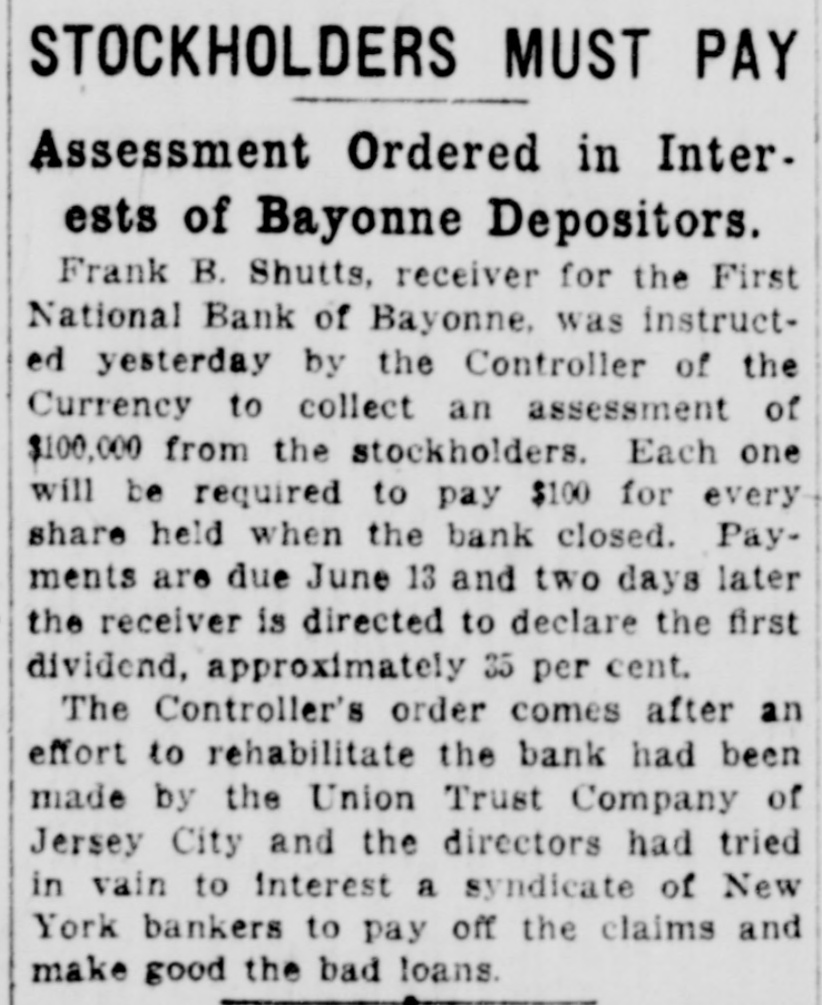
STOCKHOLDERS MUST PAY Assessment Ordered in Interests of Bayonne Depositors. Frank B. Shutts, receiver for the First National Bank of Bayonne, was instructed yesterday by the Controller of the Currency to collect an assessment of $100,000 from the stockholders. Each one will be required to pay $100 for every share held when the bank closed. Payments are due June 13 and two days later the receiver is directed to declare the first dividend, approximately 35 per cent. The Controller's order comes after an effort to rehabilitate the bank had been made by the Union Trust Company of Jersey City and the directors had tried in vain to interest a syndicate of New York bankers to pay off the claims and make good the bad loans.


Article from Newark Evening Star and Newark Advertiser, June 27, 1914

Click image to open full size in new tab

Article Text

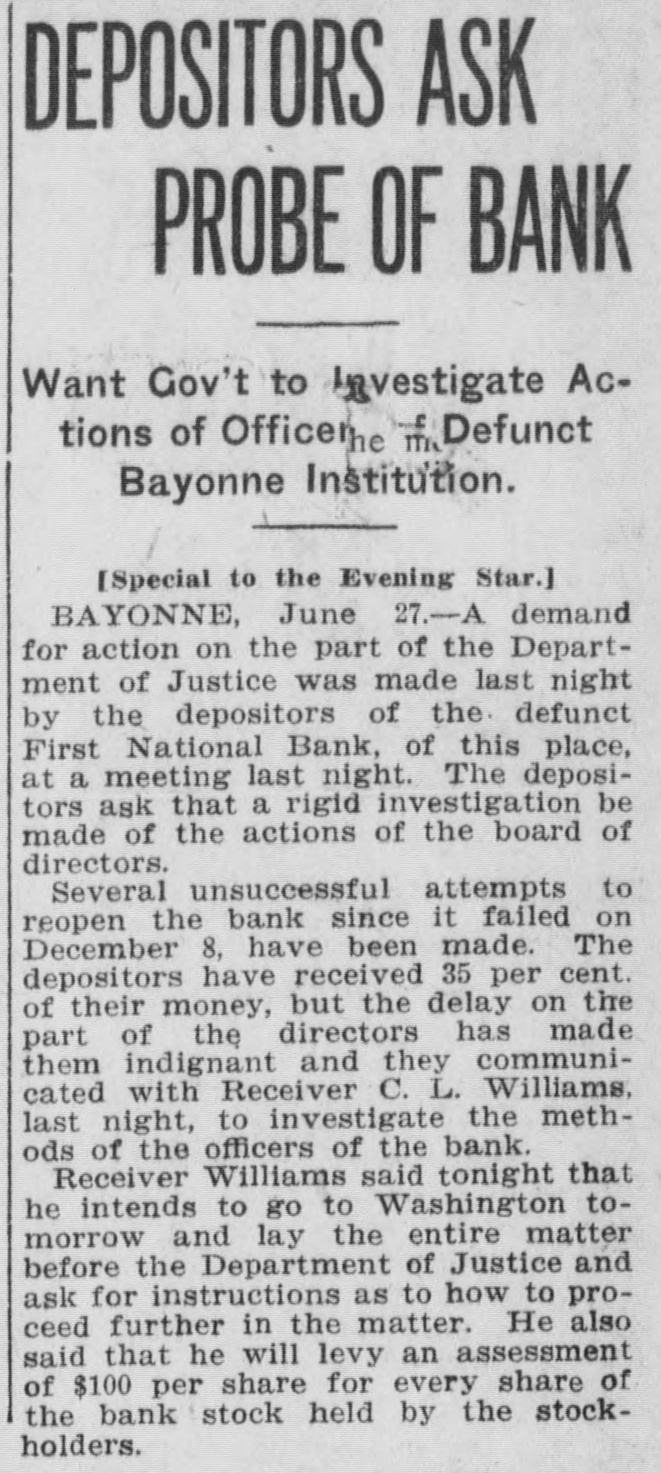
DEPOSITORS ASK PROBE OF BANK Want Gov't to Investigate Actions of Officer he m Defunct Bayonne Institution. [Special to the Evening Star.] BAYONNE, June 27.-A demand for action on the part of the Department of Justice was made last night by the depositors of the. defunct First National Bank, of this place, at a meeting last night. The depositors ask that a rigid investigation be made of the actions of the board of directors. Several unsuccessful attempts to reopen the bank since it failed on December 8, have been made. The depositors have received 35 per cent. of their money, but the delay on the part of the directors has made them indignant and they communicated with Receiver C. L. Williams, last night, to investigate the methods of the officers of the bank. Receiver Williams said tonight that he intends to go to Washington tomorrow and lay the entire matter before the Department of Justice and ask for instructions as to how to proceed further in the matter. He also said that he will levy an assessment of $100 per share for every share of the bank stock held by the stockholders.


Article from Newark Evening Star and Newark Advertiser, July 9, 1914

Click image to open full size in new tab

Article Text

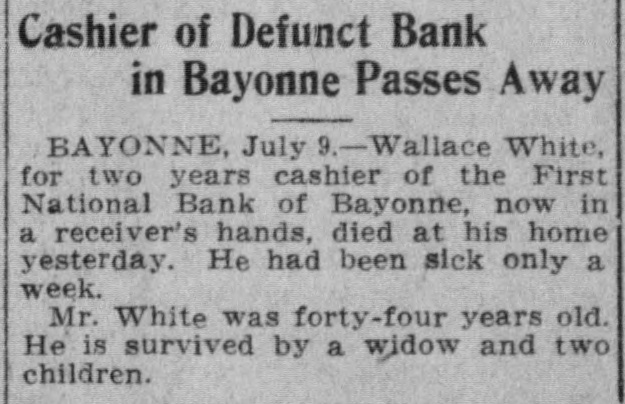
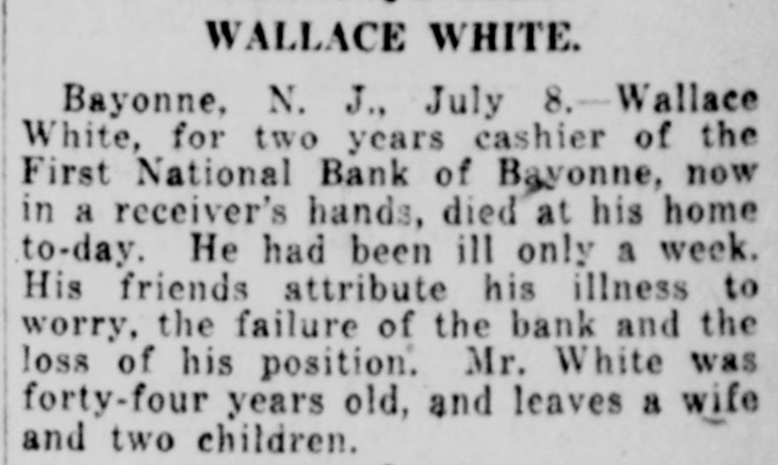
Cashier of Defunct Bank in Bayonne Passes Away BAYONNE, July 9.-Wallace White, for two years cashier of the First National Bank of Bayonne, now in a receiver's hands, died at his home yesterday. He had been sick only a week. Mr. White was forty-four years old. He is survived by a widow and two children.


Article from New-York Tribune, July 9, 1914

Click image to open full size in new tab

Article Text

WALLACE WHITE. Bayonne, N. J., July 8. Wallace White, for two years cashier of the First National Bank of Bayonne, now in a receiver's hands, died at his home to-day. He had been ill only a week. His friends attribute his illness to worry, the failure of the bank and the loss of his position. Mr. White was forty-four years old, and leaves a wife and two children.


Article from New-York Tribune, November 8, 1914

Click image to open full size in new tab

Article Text

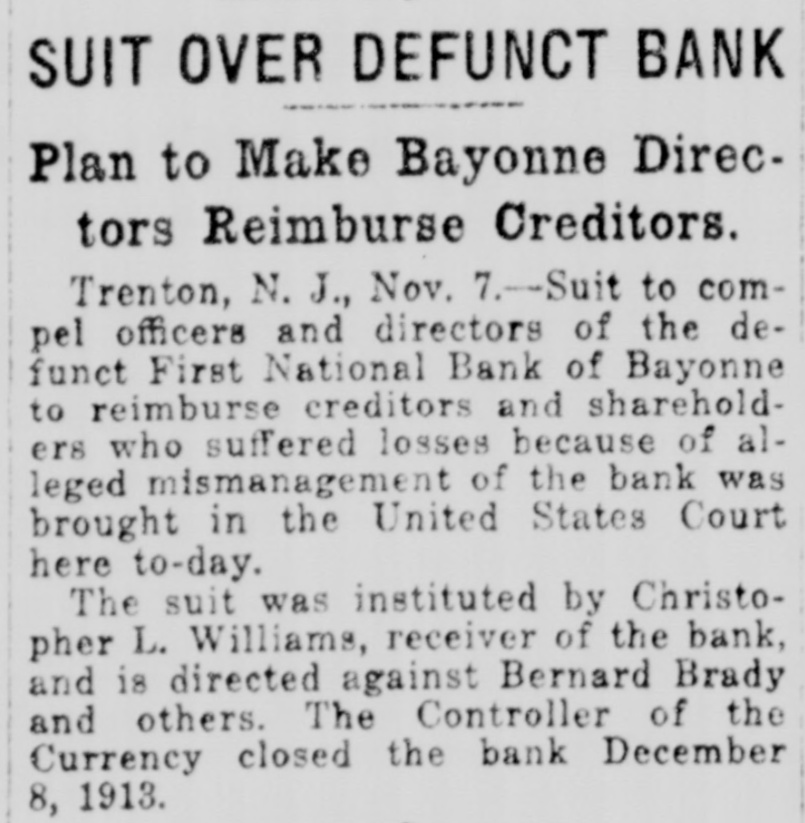
SUIT OVER DEFUNCT BANK Plan to Make Bayonne Directors Reimburse Creditors. Trenton, N. J., Nov. 7.-Suit to compel officers and directors of the defunct First National Bank of Bayonne to reimburse creditors and shareholders who suffered losses because of alleged mismanagement of the bank was brought in the United States Court here to-day. The suit was instituted by Christopher L. Williams, receiver of the bank, and is directed against Bernard Brady and others. The Controller of the Currency closed the bank December 8, 1913.


Article from The Times Dispatch, November 9, 1914

Click image to open full size in new tab

Article Text

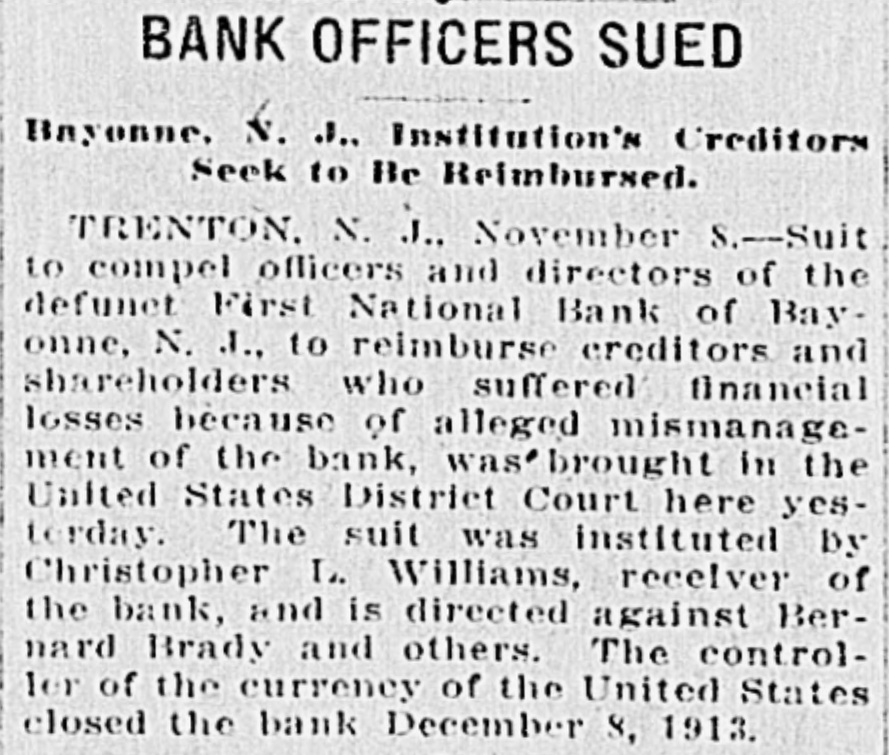
BANK OFFICERS SUED Bayonne, v. .... Institution's Creditors Seek to Be Reimbursed. TRENTON N. J.. November S.-Suit to compel officers and directors of the defunet First National Bank of Bayonne, N. .1., to reimburse creditors and shareholders who suffered financial losses because of alleged mismanagement of the bank, was'brought in the United States District Court here yesLorday. The suit was instituted by Christopher I. Williams, receiver of the bank, and is directed against Bernard Brady and others. The control1er of the currency of the United States closed the bank December 8, 1913.


Article from New-York Tribune, November 22, 1914

Click image to open full size in new tab

Article Text

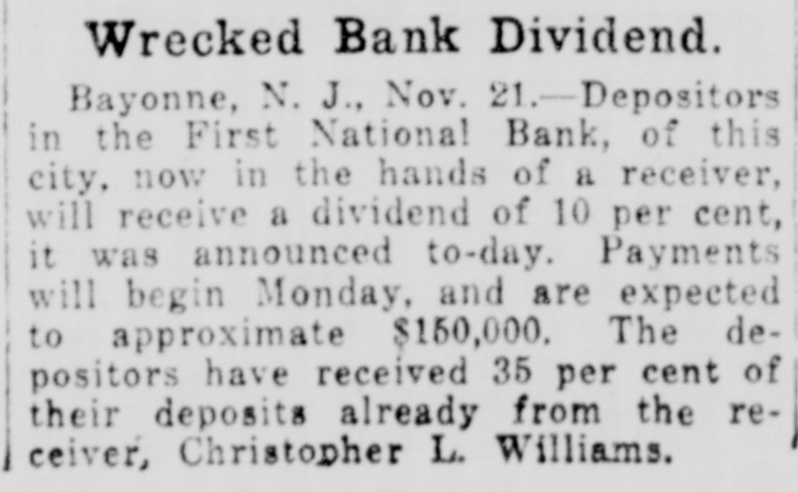
Wrecked Bank Dividend. Bayonne, N. J., Nov. 21. -Depositors in the First National Bank, of this city, now in the hands of a receiver, will receive a dividend of 10 per cent, it was announced to-day. Payments will begin Monday, and are expected to approximate $150,000. The depositors have received 35 per cent of their deposits already from the receiver, Christopher L. Williams.


Article from Newark Evening Star and Newark Advertiser, November 23, 1914

Click image to open full size in new tab

Article Text

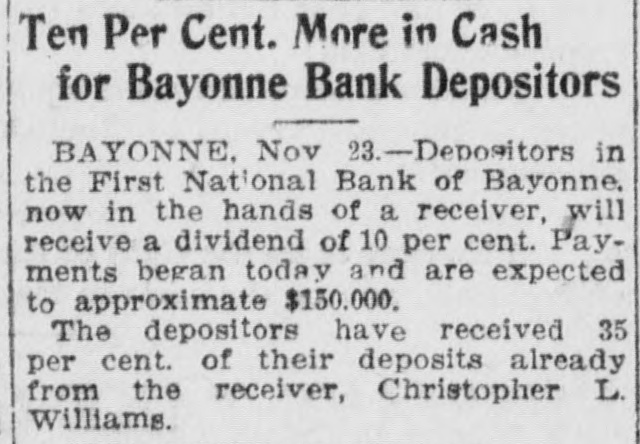
Ten Per Cent. More in Cash for Bayonne Bank Depositors BAYONNE. Nov 23.-Depositors in the First National Bank of Bayonne. now in the hands of a receiver, will receive a dividend of 10 per cent. Payments began today and are expected to approximate $150.000. The depositors have received 35 per cent. of their deposits already from the receiver, Christopher L. Williams.


Article from The Pleasantville Press, February 26, 1916

Click image to open full size in new tab

Article Text

Receiver C. L. Williams of the defunct First National bank of Bayonne is preparing to pay the depositors another 5 per cent dividend. This will make 58 per cent that the depositors have received.


Article from The Washington Herald, March 14, 1917

Click image to open full size in new tab

Article Text

OWES $857,630; HAS $15. New York, March 13.-Julius C. Hocke, who was a director of the First National Bank of Bayonne when it closed its doors in December, 1913, has filed a petition in bankruptcy, scheduling $15 assets and $857,630 liabilities. He is now an official of the General Contracting and Engineering Company. Mr. Hocke is one of the defendants in a suit for $750,000 brought by Christopher L. Williams, receiver of the bank, who charged negligence against the directors.


Article from The New York Herald, April 29, 1922

Click image to open full size in new tab

Article Text

Y WIND UP BANK'S AFFAIRS. NEWARK, N. J., April 28. Christopher Williams, receiver for the First Nanal Bank of Bayonne, which was ed by the Federal authorities on ember 8, 1913, has been authorized Federal Judge Lynch to wind up affairs of the institution. Judge ch signed to-day an order to disa of the bank's remaining assets. application was made by the atey for the receiver.