Real Estate Bank of the State of Arkansas (Little Rock, AR)

Episode Information

Episode UID
8586283190479
Episode Type
Suspension β†’ Closure
Bank Type
state
Bank ID
858628319 hash
Start Date
November 1, 1839
Location
Little Rock, Arkansas (34.746, -92.290)

Metadata

Model
gpt-5-mini (chosen from majority vote of a three-model LLM ensemble)
Short Digest
65cb914f0f0dde0f

Response Measures

None

Events (2)

1. November 1, 1839 Suspension
Cause
Macro News
Cause Details
Ceased to redeem notes and stopped payments statewide on Nov 1, 1839; suspension described as on 'plea of expediency' amid broader banking distress.
Newspaper Excerpt
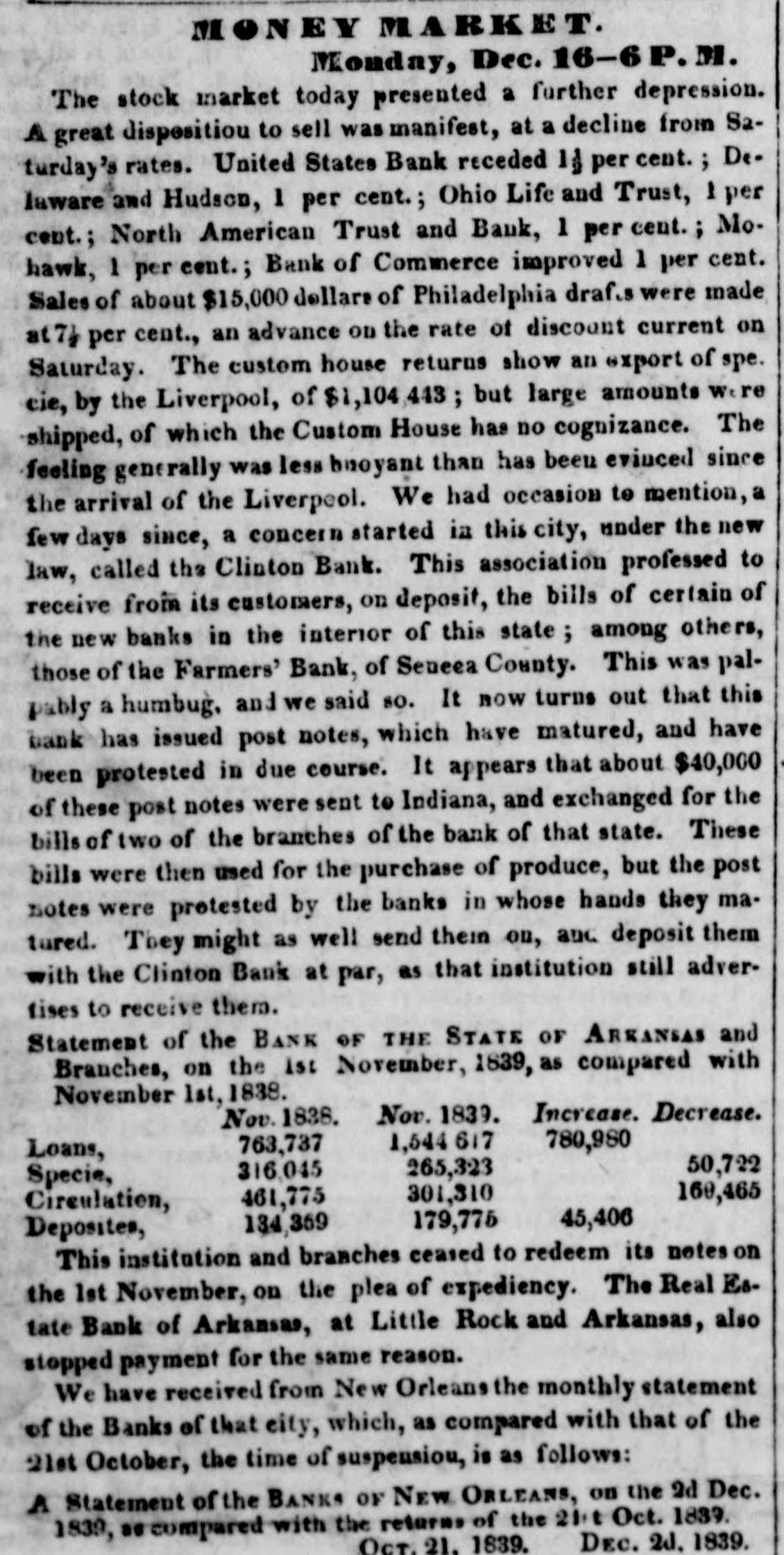
This institution and branches ceased to redeem its notes on the 1st November, on the plea of expediency. The Real Estate Bank of Arkansas, at Little Rock and Arkansas, also stopped payment for the same reason.
Source
newspapers
2. April 20, 1855 Receivership
Newspaper Excerpt
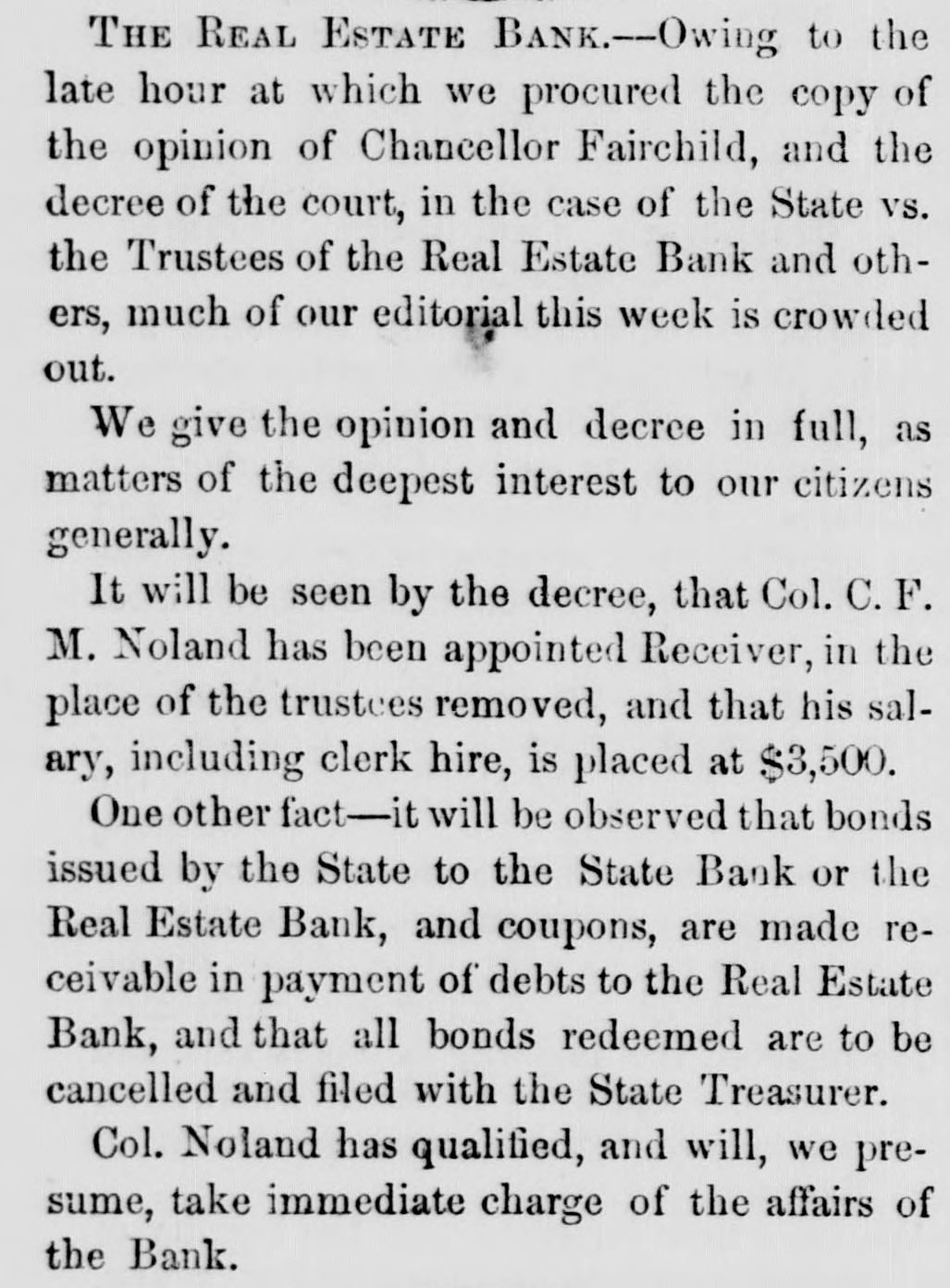
a decree divesting the trustees and officers of the assets of that institution; and the court also appointed a receiver and passed orders ... Col. C. F. M. Noland has been appointed Receiver, in the place of the trustees removed, and that his salary ... Col. Noland has qualified, and will, we presume, take immediate charge of the affairs of the Bank.
Source
newspapers

Newspaper Articles (15)

Article from Morning Herald, December 17, 1839

Click image to open full size in new tab

Article Text

MONEY MARKE T. Monday, Dec. 16-6 P.M. The stock market today presented a further depression. A great disposition to sell was manifest, at a decline from S2turday's rates. United States Bank receded 1 per cent. Delaware and Hudson, 1 per cent.; Ohio Life and Trust, 1 per cent.; North American Trust and Bauk, 1 per cent.; Mohawk, 1 per cent.; Bank of Commerce improved 1 per cent. Sales of about $15,000 dollars of Philadelphia drafis were made at7) per cent., an advance OD the rate of discount current on Saturday. The custom house returns show an export of spe. cie, by the Liverpool, of $1,104,443; but large amounts We re shipped, of which the Custom House has no cognizance. The feeling generally was less bnoyant than has been evinced since the arrival of the Liverpeol. We had occasion to mention, a few days since, a concern started in this city, under the new law, called the Clinton Bank. This association professed to receive from its customers, on deposit, the bills of certain of the new banks in the interior of this state; among others, those of the Farmers' Bank, of Seneea County. This was palpably a humbug, and we said so. It now turns out that this bank has issued post notes, which have matured, and have been protested in due course. It appears that about $40,000 of these post notes were sent to Indiana, and exchanged for the bills of two of the branches of the bank of that state. These bills were then used for the purchase of produce, but the post notes were protested by the banks in whose hands they matured. They might as well send their on, auc deposit them with the Clinton Bank at par, as that institution still adverfises to receive them. Statement of the BANK OF THE STATE OF ARKANSAS and Branches, on the 1st November, 1839, as compared with November 1st, 1838. Increase. Decrease. Nov. 1839. Nov. 1838. 780,980 1,544 617 763,737 Loans, 50,722 265,323 316.045 Specie, 160,465 301,310 461,775 Circulation, 45,406 179,775 134,369 Deposites, This institution and branches ceased to redeem its notes on the 1st November, on the plea of expediency. The Real Estate Bank of Arkansas, at Little Rock and Arkansas, also stopped payment for the same reason. We have received from New Orleans the monthly statement of the Banks of that city, which, as compared with that of the 21st October, the time of suspension, is as follows: A Statement of the BANK OF NEW ORLEANS, on the 2d Dec. 1839, as compared with the returns of the 21.1 Oct. 1839. DEC. 2d. 1839. Oct.21. 1839.


Article from The True Democrat, April 24, 1855

Click image to open full size in new tab

Article Text

THE REAL ESTATE BANK.--Owing to the late hour at which we procured the copy of the opinion of Chancellor Fairchild, and the decree of the court, in the case of the State vs. the Trustees of the Real Estate Bank and others, much of our editorial this week is crowded out. We give the opinion and decree in full, as matters of the deepest interest to our citizens generally. It will be seen by the decree, that Col. C. F. M. Noland has been appointed Receiver, in the place of the trustees removed, and that his salary, including clerk hire, is placed at $3,500. One other fact-it will be observed that bonds issued by the State to the State Bank or the Real Estate Bank, and coupons, are made receivable in payment of debts to the Real Estate Bank, and that all bonds redeemed are to be cancelled and filed with the State Treasurer. Col. Noland has qualified, and will, we presume, take immediate charge of the affairs of the Bank.


Article from The True Democrat, July 10, 1855

Click image to open full size in new tab

Article Text

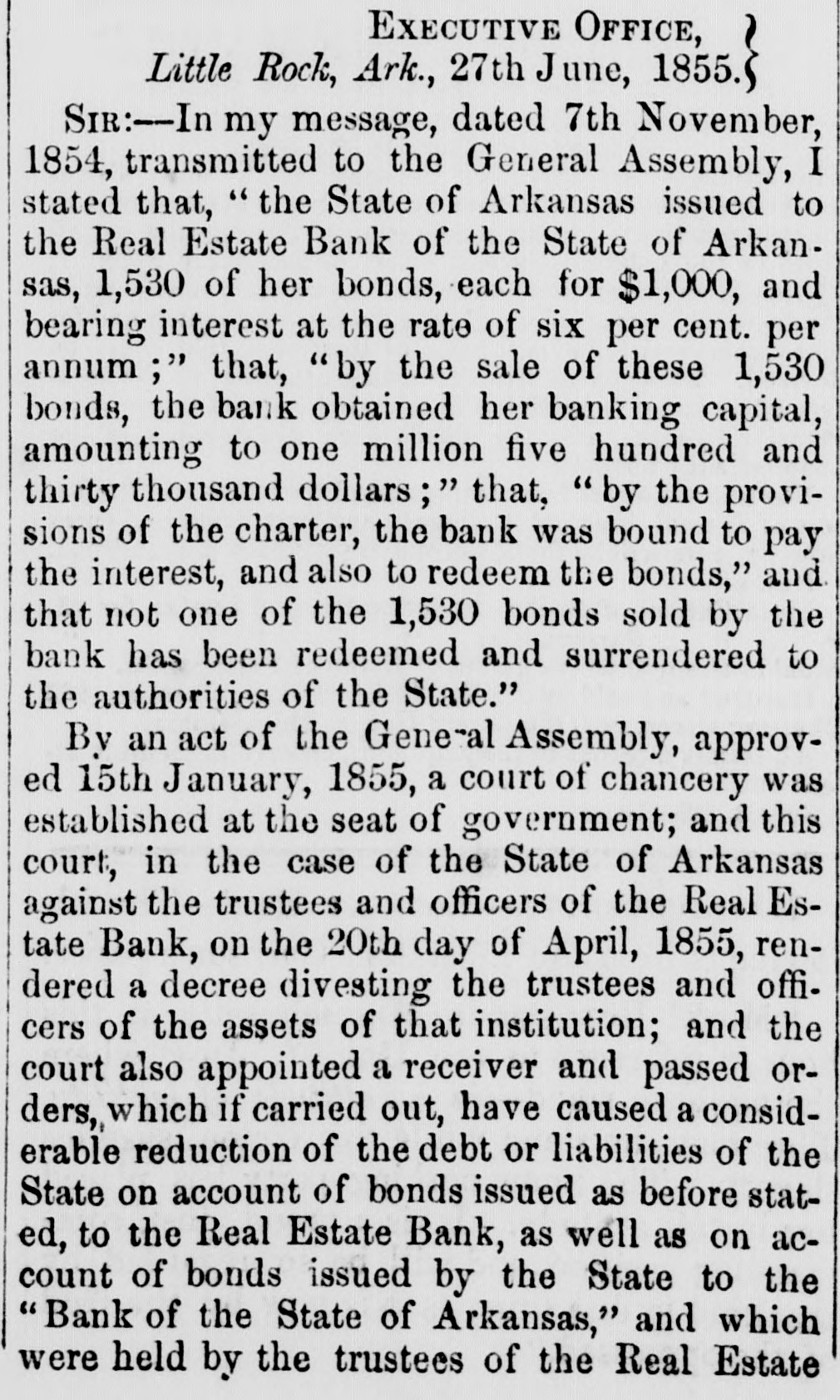
EXECUTIVE OFFICE, Little Rock, Ark., 27th June, 1855. SIR:-In my message, dated 7th November, 1854, transmitted to the General Assembly, I stated that, "the State of Arkansas issued to the Real Estate Bank of the State of Arkansas, 1,530 of her bonds, each for $1,000, and bearing interest at the rate of six per cent. per annum;" that, "by the sale of these 1,530 bonds, the bank obtained her banking capital, amounting to one million five hundred and thirty thousand dollars;" that, "by the provisions of the charter, the bank was bound to pay the interest, and also to redeem the bonds," and that not one of the 1,530 bonds sold by the bank has been redeemed and surrendered to the authorities of the State." Bv an act of the General Assembly, approved 15th January, 1855, a court of chancery was established at the seat of government; and this court, in the case of the State of Arkansas against the trustees and officers of the Real Estate Bank, on the 20th day of April, 1855, rendered a decree divesting the trustees and officers of the assets of that institution; and the court also appointed a receiver and passed orders, which if carried out, have caused a considerable reduction of the debt or liabilities of the State on account of bonds issued as before stated, to the Real Estate Bank, as well as on account of bonds issued by the State to the "Bank of the State of Arkansas," and which were held by the trustees of the Real Estate


Article from The True Democrat, November 20, 1855

Click image to open full size in new tab

Article Text

Gov. Conway's letter to Col. Noland in response, stating the reasons why his letter of 25th October may not be withdrawn. (LETTER NO. v.) EXECUTIVE OFFICE, Little Rock, Ark., 10th Nov., 1855. n SIR: I have received your letter of the 9th instant, asking that you may be allowed to withdraw' from the records of this office, the official communication made to me as Governor of this State, by you as Receiver in Chancery of the assets of the Real Estate Bank, on the 25th October, 1855. On the 7th Nov., 1855, I addressed an official letter to Hon. H. F. Fairchild, Chancellor, enclosing to him a certified copy of the document which you wish to withdraw. For your information, I herewith transmit to you a copy of my letter to the Chancellor. Your communication having been filed as an official paper, and executive action having been based upon it, constitutes one of the public records of this office, which may not be withdrawn. As verbally requested by you, Ihave furnished the Chancellor with acopy of your letter of the 9th instant; and I have also furnished him with a copy of this letter. Very respectfully, your ob't serv't, ELIAS N. CONWAY. Col. C. F. M. Noland, Receiver in Chancery of Real Estate Bank, Little Rock, Arkansas. Gov. Conway's letter to the Chancellor enclosing the above two last official communications. (LETTER NO. VI.) EXECUTIVE OFFICE, Little Rock, Ark., 10th Nov., 1855. } SIR: I transmit to you herewith a copy of a letter from Col. C. F. M. Noland, Receiver of the Real Estate Bank, dated Nov. 9, 1855, and also a copy of my reply thereto, dated 10th Nov., 1855. Very rerpectfully, your ob't serv't, ELIAS N. CONWAY. Hon. H. F. FAIRCHILD, Chancellor, Little Rock, Arkansas.


Article from The True Democrat, November 20, 1855

Click image to open full size in new tab

Article Text

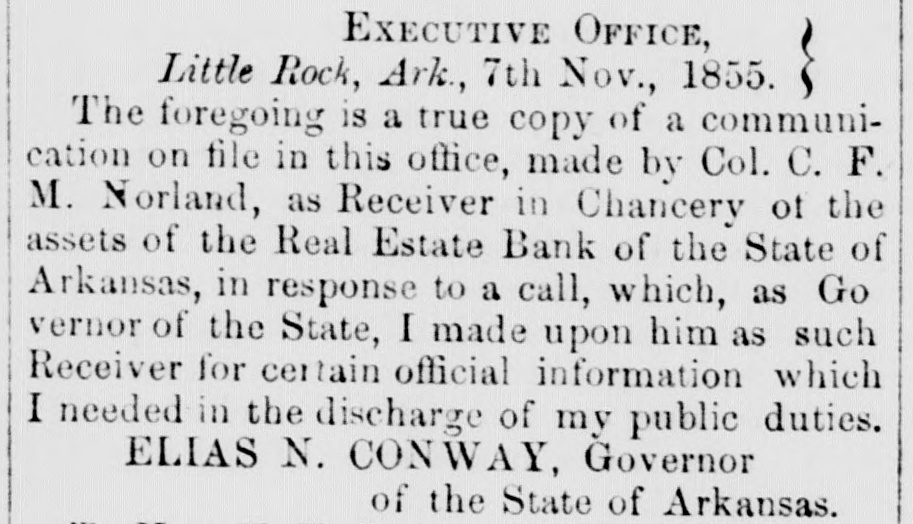
EXECUTIVE OFFICE, Little Rock, Ark., 7th Nov., 1855. } The foregoing is a true copy of a communication on file in this office, made by Col. C. F. M. Norland, as Receiver in Chancery of the assets of the Real Estate Bank of the State of Arkansas, in response to a call, which, as Go vernor of the State, I made upon him as such Receiver for certain official information which I needed in the discharge of my public duties. ELIAS N. CONWAY, Governor of the State of Arkansas.


Article from The True Democrat, November 20, 1855

Click image to open full size in new tab

Article Text

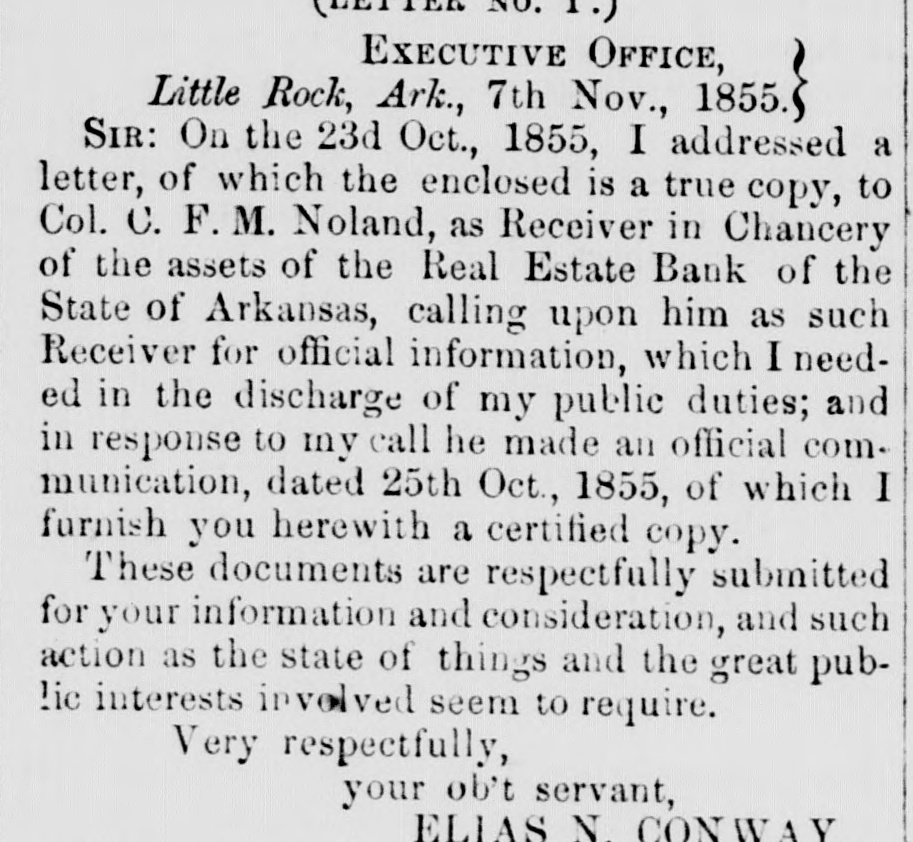
EXECUTIVE OFFICE, Little Rock, Ark., 7th Nov., 1855. an SIR: On the 23d Oct., 1855, I addressed a letter, of which the enclosed is a true copy, to Col. C. F.M. Noland, as Receiver in Chancery of the assets of the Real Estate Bank of the State of Arkansas, calling upon him as such Receiver for official information, which I needed in the discharge of my public duties; and in response to my call he made an official communication, dated 25th Oct., 1855, of which I furnish you herewith a certified copy. These documents are respectfully submitted for your information and consideration, and such action as the state of things and the great pub!ic interests involved seem to require. Very respectfully, your ob't servant, ELIAS N. CONWAY


Article from Southern Shield, February 23, 1856

Click image to open full size in new tab

Article Text

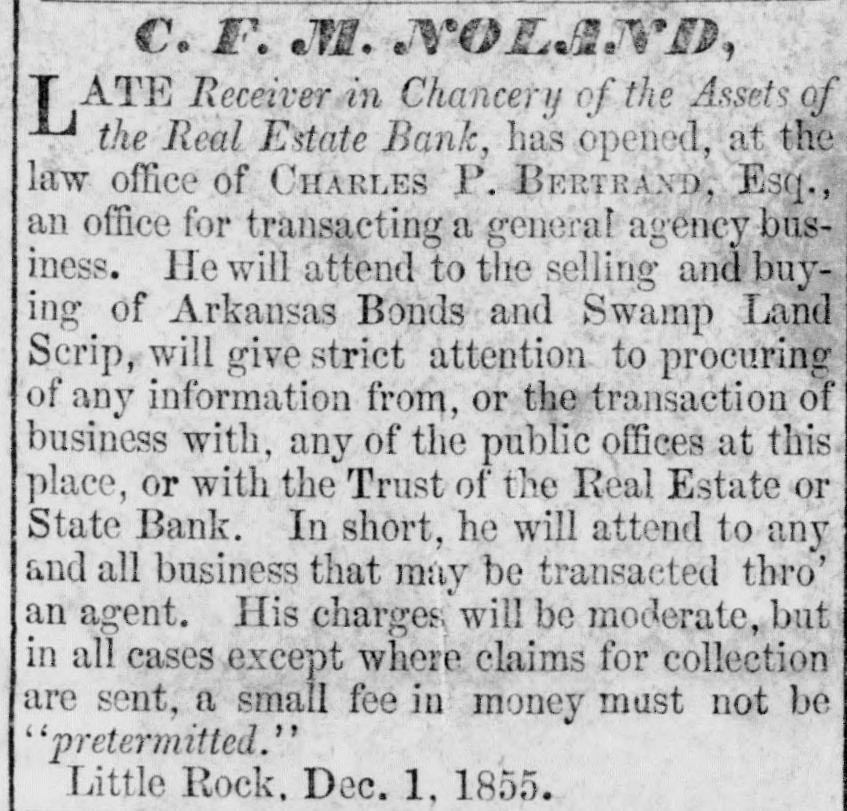
C.F.M. NOLAND, L ATE Receiver in Chancery of the Assets of the Real Estate Bank, has opened, at the law office of CHARLES P. Bertrand, Esq., an office for transacting a general agency business. He will attend to the selling and buying of Arkansas Bonds and Swamp Land Scrip, will give strict attention to procuring of any information from, or the transaction of business with, any of the public offices at this place, or with the Trust of the Real Estate or State Bank. In short, he will attend to any and all business that may be transacted thro' an agent. His charges will be moderate, but in all cases except where claims for collection are sent, a small fee in money must not be "pretermitted." Little Rock, Dec. 1, 1855.


Article from The True Democrat, May 5, 1857

Click image to open full size in new tab

Article Text

to said bank, in a large amount, one hundred and fifty thou-and dollars, no by same can least that provision is recollected, made in the deed in trustees cannot sue trustees to Rock to assets bringing case as hands well which Little The themselves." settled by the principle sought chancellor surrender the be law compel before that of the Pulaski the Judge it local being in ground circuit board Clen- their a he to on of denin, court;but want sitting jurisdiction. declined interfere the the then brought the case before suand Lacy that the assignment was preme decided They court, Judges Ringo Dickenson dissented both and from valid and expedient. Judge this oninion. "Governor Yell had a motion made that the should be reconsidered. But this producbut a flurish from Judge Dickenson, to virtue of the (himself a debtor and independence nothing the bank) judiciary. about made the an debfor own conIn this way was themselves, assignment their benefit, by the State the deeply in its good madeprived the parties mo pagement, tors firmed, to most and interested of and all the share bondholders, in trust. When the legislature met on the 7th of No. 1842, Governor Yell, in his message desounced sys the State as but vember, to them, of productive the whole of banking nothing and as the been of wilful its propriety tem evil; chariered guilty privileges, and Real he palpable Estate suggested bank violations the had of its charter, of revoking if that could be constitutionally effected. The effect upon the State under the assignment, is," he said, " to place the assets and management of the bank, beyond her control, throw the whole responsibility upon and to pay interest the bonds the State to the on now due." To the same legislature the trustees presented a memorial in which they stated that they were willing to surrender their charter, SO far as related to banking privileges, and proposed that board of commissioners should be appointed by the legislature with all the powers neces sarv to be exercised by a board of visitation Also, that the powers of a to up and corporation inspection. of should the bank. be given them wind the affairs The Assembly passed, and the Governor approved, January 31st, 1843, " An act to settle ad bank of act a liquidate Arkansas." the affairs This of the gave Real sanction Estate wall the of trustees additional it assignment, powers important and they granted provisions had the asked of for. the all deed the But provided that instead of fifteen self-appointed trustees, there should be ten elected by the stockholders, and five by the General AssemIt does not appear from the minutes that the trustees even SO much as took the act into consideration. Rather than give p their self-constituted trust, they chose to forfeit the charter bank, which was accordingly done by a decree of the supreme court, July 29th, 1844. It was further provided that if the stock holders should not accept of the liquidation act, the circuit court of Pulaski county should appoint ten trustees who, with five elected by the General Assembly, should wind up the affairs of the bank. And, also, that the Goverpor should cause the several prosecuting attorThey's for the State to sue every stockholder on bis stock bond and mortgage. The General Assembly elected five trustees, but, through some unexplained reason, the other provisions of the law were never carried inco effect; and the self-appointed trustees conissued to act as if no such law had been used. In April, 1844, they chose five of their own number for resid lary trustees, and committed them the whole management of the trust. At each successive session, from 1842 onwards, the attention of thelegislature was called the Real Estate bank, by the Governor, and immittees were, from time to time, appointed inquire into its affairs; but there was no furlegislative action on the subject till 12th of January, 1853, when an act was passed, diecting the attorney general to file a bill in chandivest the trustees of the Real Estate bank of the assets of that institution." This followed by an act, passed January 15th, 1855, to aid in bringing to light the true concition of the Real Estate bank of the State of Arkansas;" and, again, by another passed on same day " to establish a separate court of chancery, at the seat of government, so that causes of the State, including that against metrustees and officers of the Real Estate bank, !those of individuals may be determined as early as practicable." Under proceedings instituted under these a decree was rendered in the court of chanon the 20th of April, 1855, by which the trustees were divested of all the assets of Real Estate bank, and the same were on 25th day of the said month and year transto the receiver appointed by the court of hancery.


Article from The True Democrat, May 12, 1857

Click image to open full size in new tab

Article Text

of the Real Estate Bank. (TO THE SENATE.) Mr. President: The joint committee on banks respectfully beg leave to submit the following report on the affairs of the Real Estate Bank: On the 12th of September, 1836, the first General Assembly of the State of Arkansas began its session at Little Rock, and the first act it passed, being that to establish the Real Es late Bank, was approved by the Governor on the 26th of October, following This bank was to be of a peculiar constitu tion. It was to lend money; but the stockhold ers were not to pay in money. Instead there then of ha which of, they were to give mortgages on been lands, brought bu small into cultivation, portions and on this security the State was to issue bonds to the amount of two mil lions dollars. These bonds were to sold and thus the necessary money was to be procured Each stockholder was to be entitled to loan equal to one half the appraised value of his lands, which loan was to be repayable in twen tv years in instalments of five per cent a year There were to be no annual dividends but to stead thereof the profits of each year were be added to the capital of the bank. When the charter expired prorata dividend was to be made among the stockholders of all the accumulated profits. The benefits of the bank were not to be restricted to stockholders Non-stockholder: were to be allowed loans on mortgage repayable a in ten years in instalments of ten per cent. year. The State also was to share in the advantages of the institution. The bank was to pay it an annual bonus of five thousand dollars a year for ten years, in all fifty thousand dollars, and besides this, to lend it at five per cent. per annum, fifty thousand dollars year for te: years in succession, in all five hundred thou sand dollars. This bank was to quicken industry in all its departments, especially agricultural industry, supply capital to every body, to furnish the people with sound circulating medium, to raise the value of land, and cause the desert to bud and blossom as the rose. All this be done by coining the wild lands of Arkansas into money, which miracle was to be wrought in the manner above described, by private indi- the viduals mortgaging their estates and by State issuing its bends. A million of dollars of actual capital borrowed from abroad, was be made to perform the function of four mil- is lions through the banking privilege of suing three for one." In this way were the dwellers in Arkansas to be enriched much rapidly than they could be by the old-fashion ed process of industry and economy (See port of Mr. Ringgold from banking committee Senate journal, October 4th, 1845. See report of Mr. Wilson, first president of the R E-tate Bank, House journal, Nov. 30th, 1837 and report of Mr. Davies, the second preside for of the bank Appendix to House journal 1838, pages 1.5.) For fear foreigners" should share in the inestimable blessings the bank was to bestow, bers was express provided that none but the to of Arkansas after the though four years make transfers of the stock to owner of Arkansas lands, even though he might not be resident of the State managed Matters have been so that but few of even the the benefits The about favoritcomplaints from the bank. Mr. sm distribution of the stock Izard day, strong, d resolution, the pream act which declared incorporating bank proved to be and was unfair just, equal, at the few its the nature pense from of the many. (See Senate Nov. 13th, 1837.) Whatever the cause have been though there were, according to the without including 1838 of Miller and 11,567 white men the years State and 11,420 white women of the wards, sixteen and upwards, vet only 282 of these men, and of women became ers to stock of the bank. For the the of these labor, and capital of 22,703, and not only their labor capital, but the labor and capital of all who have since become citi r residents of the State, for State bond itv. ortgage the wealth of the whole commuWhat difficulties contrivers of this scheme had in selling the bonds, how they ally posed of them, how less than one year the bank suspended payment, how in less than afterwards it made an assign and under how ment, managed of period thirteen The not stated. the details sufficient of in their G the by to There we which all the difficulty attention, existed in ascertaini he bank. After operation, irst Nov. 20th. 1840. and he 3d of December following, Mr Little to nitted the House That resolution, legislature deem report of the president bank the most illigable (See House journal, Dec. This was not 1840.) adopted, the judiciary committhat of ee, the charter the Real had they Estate come to that the had not the but or its branches, simply at the of each session, require the officers of said institution to the Assembly full and correct tatement of condition. (See House jour al. Dec. 10. 1840.) That there were reasons sufficient for Mr Little's resolution, afterward became fully nauifest. At the next sessio: of the General Assembly, overnor Yell, in his message them used the following language: We are in the midst of a great revolution n the subject of banking. The developments laring and startling, of the demoralizing and uinous consequences of the present system demand at your hand a radical reform. l'he examination of the branches of the State bank and the elopments in relation to the hypothecation' by the Real Estate Bank of a million of bonds, have fully demonstrate d that all the exhibitions of figures setting forth the condition of banks by their reports, give o reliable information of their true circum stances, but are too often calculated to mislead and deceive. The condition of the Favette ille branch fully confirms this im And the report of the Real Estate Bank to the ast legislature is conclusive, when they report hat the tive hundred State bonds are on hand and unsold," hereas subsequent facts have demonstrated that they had Teen by pothecated with the N. A. Trust and Banking Company fear three months previous, for the nomina by um of about $125,000 without sanction aw, and in express violation of charter. (Ser age of appendix to House journal for 1842 and 43) The bonds were pothecated September 1840, but the fact did not leak out
Article from Arkansas True Democrat, April 7, 1860

Click image to open full size in new tab

Article Text

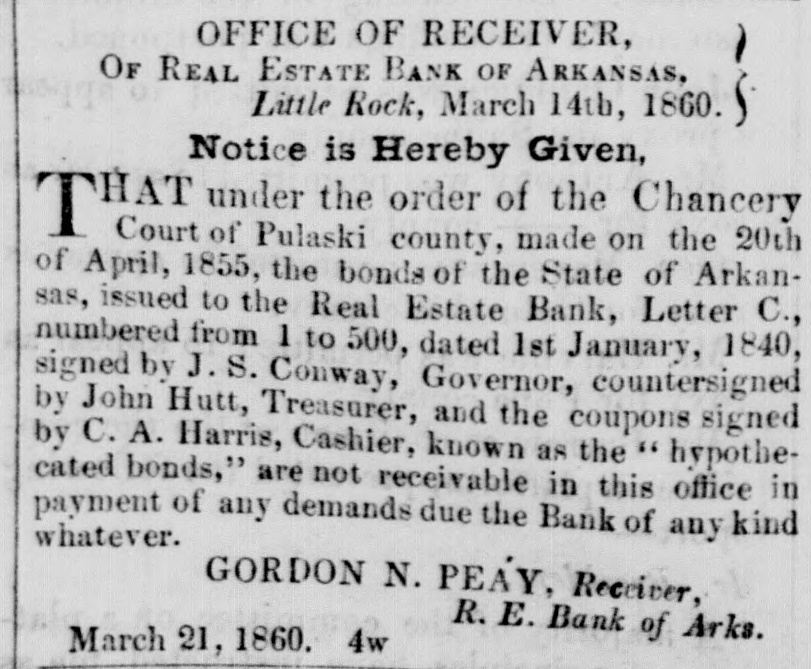
OFFICE OF RECEIVER, OF REAL ESTATE BANK OF ARKANSAS, Little Rock, March 14th, 1860. Notice is Hereby Given, T HAT under the order of the Chancery Court of Pulaski county, made on the 20th of April, 1855, the bonds of the State of Arkansas, issued to the Real Estate Bank, Letter C., numbered from 1 to 500, dated 1st January, 1840, signed by J. S. Conway, Governor, countersigned by John Hutt, Treasurer, and the coupons signed by C. A. Harris, Cashier, known as the " hypothecated bonds," are not receivable in this office in payment of any demands due the Bank of any kind whatever. GORDON N. PEAY, Receiver, R. E. Bank of Arks. March 21, 1860. 4w


Article from Arkansas True Democrat, April 14, 1860

Click image to open full size in new tab

Article Text

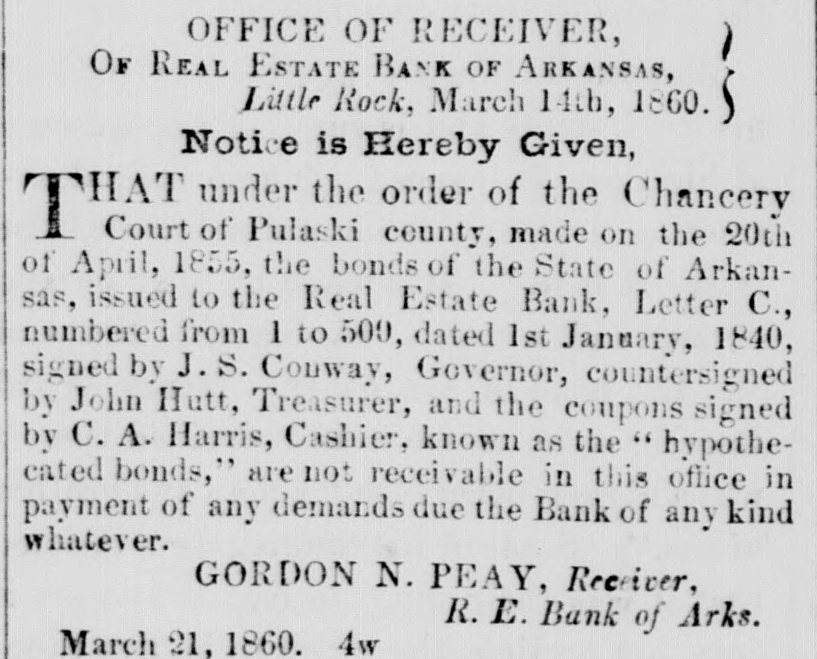
OFFICE OF RECEIVER, / OF REAL ESTATE BANK OF ARKANSAS, Little Rock, March 14th, 1860. S Notice is Hereby Given, THAT under the order of the Chancery of Pulaski county, made on the 20th of April, 1855, the bonds of the State of Arkansas, issued to the Real Estate Bank, Letter C., numbered from 1 to 500, dated 1st January, 1840, signed by J.S. Conway, Governor, countersigned by John Hutt, Treasurer, and the coupons signed by C. A. Harris, Cashier, known as the " hypothecated bonds," are not receivable in this office in payment of any demands due the Bank of any kind whatever. GORDON N. PEAY, Receiver, R. E. Bank of Arks. March 21, 1860. 4w


Article from True Democrat, December 24, 1862

Click image to open full size in new tab

Article Text

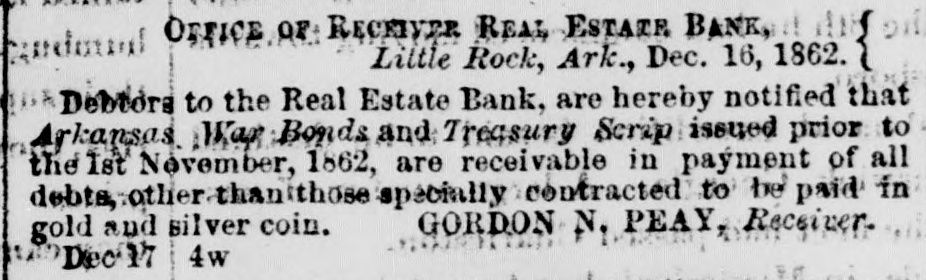
OFFICE OF RECEIVER REAL ESTATE BANK, Little Rock, Ark., Dec. 16, 1862. Debtors to the Real Estate Bank, are hereby notified that Arkansas War Bonds and Treasury Scrip issued prior to the 1st November, 1862, are receivable in paΓ½ment of all debts, other thanithose specially contracted to be paid in GORDON N, PEAY, Receiver. gold and silver coin. Dec 17 4w


Article from True Democrat, January 7, 1863

Click image to open full size in new tab

Article Text

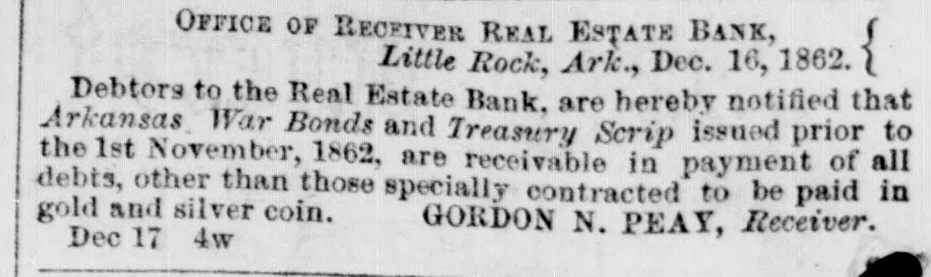
OFFICE OF RECEIVER REAL ESTATE BANK, Little Rock, Ark., Dec. 16, 1862. { Debtors to the Real Estate Bank, are hereby notified that Arkansas War Bonds and Treasury Scrip issued prior to the 1st November, 1862, are receivable in payment of all debts, other than those specially contracted to be paid in gold and silver coin. GORDON N. PEAY, Receiver. Dec 17 4w


Article from The Russellville Democrat, March 23, 1876

Click image to open full size in new tab

Article Text

first The the REAL ESTATE session of was the after state lature the was tea held into Union It of the the fall 1836. convened of 12th this When September the whole assembled of legislature less debt than it Before $9000. adjourned, the acts State involve passed in of the debt 3,000, in 000 which capital be to for the estabof On the banks. of the 26th legislature and (Jaines Octoberrovernor an act for Conway, the the of Es Real of tate with Bank Arkansas, of The princapital $2,000,000. to was bank office with Rock, Little established at Washington, in county, Columbia, Hempstead in at and Chicot Helena, in The capital county. Phillips to be was divided between the four banks. agreed to issue thousand one dollar bonds, thousand six and interest, bearing to to the loan bank commence In of business in the the this, bank to real estate secare mortgaged the by loss, state valued against of sum $2,603. appraisers 000. There acres 127,500 at was land which valued about a $48 per good price. On of the 1838, February, the act an suppasssd to the legislature creating the above banks, of authorizing another tablishment of Van and the Buren, issuance in its for bonds capital. or The this branch of $500,Stockholders land acres at were whieh valued to the state. In the main 1838, at Rock bank Little succeeded of at 1530 bonds to 500 of the States, United Treasur burchased of for and held them in them Smithsonian are bonds Institute. the with by held to paid interest the with time, present exception of been such have amounts the due by tained on of the five state the sale fund from cent. arising of the One thous public and by were bonds D. of New Beers, purchased Joseph M. by and JohnRichard thirty of The Real Bank Estate at Little on of the Rock December, in less and than 1838, month to and loans made discounts of The Helamount was ena office opened February the March 15th, 1829, Columbia the 5th and Washingfollowing, of 1st on the By their ton, April. the and loans action combined of the bank by were, discounts of to 29th the made May, amount the by 31st and bank at of to October 1839, to the principal specie payments, the by tated therein Little Rock and suspended was quickly branches. imithe Wm. Hon. Miller, presM. ent and Wm. Gouge, who were by Governor auditor pointed in to 1855, Conway, investigate at the the that bank affairs to the gov comment time, in 111 of specie


Article from The Sedalia Weekly Bazoo, January 27, 1891

Click image to open full size in new tab

Article Text

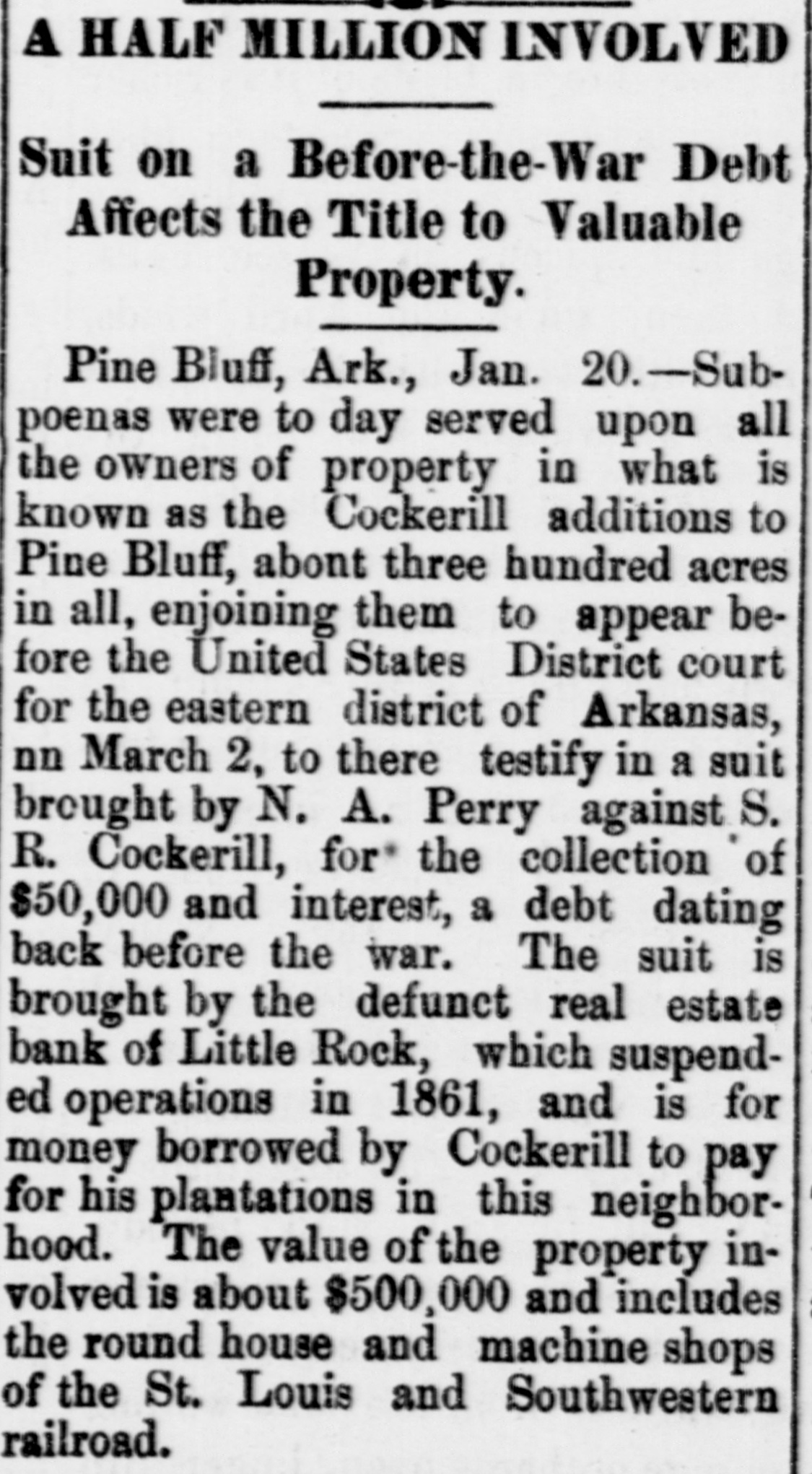
A HALF MILLION INVOLVED Suit on a Before-the-War Debt Affects the Title to Valuable Property. Pine Bluff, Ark., Jan. 20.-Subpoenas were to day served upon all the owners of property in what is known as the Cockerill additions to Pine Bluff, abont three hundred acres in all, enjoining them to appear before the United States District court for the eastern district of Arkansas, nn March 2, to there testify in a suit brought by N. A. Perry against S. R. Cockerill, for* the collection of $50,000 and interest, a debt dating back before the war. The suit is brought by the defunct real estate bank of Little Rock, which suspended operations in 1861, and is for money borrowed by Cockerill to pay for his plantations in this neighborhood. The value of the property involved is about $500,000 and includes the round house and machine shops of the St. Louis and Southwestern railroad.