Article Text
would be a crime to rob those depositors of 25,000, the fee Vandeventer was claiming.
"I refused to co-operate with the governor by disapproving his reprieve of the notorious cashier of the Farmers' bank at Coweta, convicted of grand larceny and sentenced to the penitentiary for two years. I wrote the governor a letter, vigorously protesting, and calling his attention to the Shawnee platform, and his speeches in which it was demanded that the criminal behind the counter should be prosecuted the same as the criminal in front. The governor paid no attention to my protest.
"I don't know what he means by co-operating with the attorney general's office as the recent legislature passed a bill taking the bank commissioner's office from under the control of the attorney general's office and giving the commissioner his own attorneys, with all the powers of the attorney general's office, thus functioning independently with no excuse for co-operating with the attorney general's office.
"Doc. E. T. Bynum, who never had a day's experience in banking is appointed in open violation of the law which requires five years' actual experience as a banker; a same law for the necessary knowledge to run a bank can only be obtained by actual experience. Yet the peoples' funds are to be entrusted to this member of the attorney general's force, for 'Doc' is an appointee of Short."
Bynum owed a note to the Wilkin-Hale bank, Strain alleged.
"The hard-hearted bank commissioner, Joe Strain, believing with 'Doc' drawing $4,000 per year in a soft job created for him by the governor, should pay his honest debts, ordered the liquidating agent to sue," the statement goes on. "Perhaps this was another instance of not co-operating with the executive office and was cause for removal.
"I spent more than $1,000 of my hard earned money traveling over northeast Oklahoma speaking night and day to elect Jack Walton governor, having faith in him as a friend of the people. When I was asked by members of the legislature to come to Oklahoma City they wanted me to be bank commissioner in the Walton administration.
"I accepted the position, making a sacrifice, moving here in midwinter, purchasing a home, and taking charge of the banking department, my friends telling me, 'Joe, we feel sorry for you, for you have the biggest job in the state if you can get banks out of the condition they are in, but if there is a man in the state that can do it, its is you.' I realized the gigantic undertaking, but went to work with a determination to win, and not one minute have I been off the job, not one cent of expense have I made. I have succeeded in stopping failures, there being none for the last three months among the state banks, thus restoring confidence and making the peoples' money in the banks safe.
"I am unceremoniously pitched on the dump heap in mid-summer without any regard for the unfairness to me; with no excuse on earth but that George Short refuses to co-operate with the governor as long as I am bank commissioner. The people of Oklahoma know I have honestly administered my office, fighting the plunderbund day and night in their behalf."
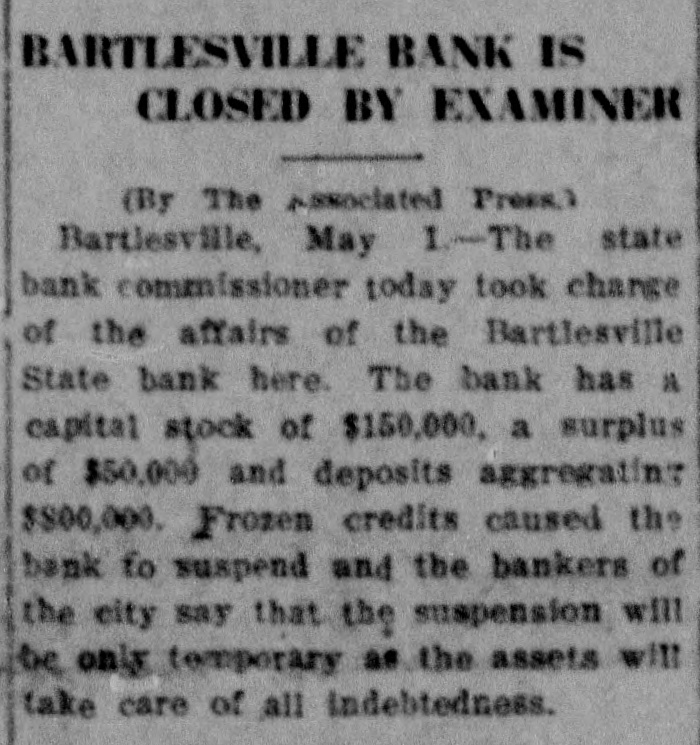
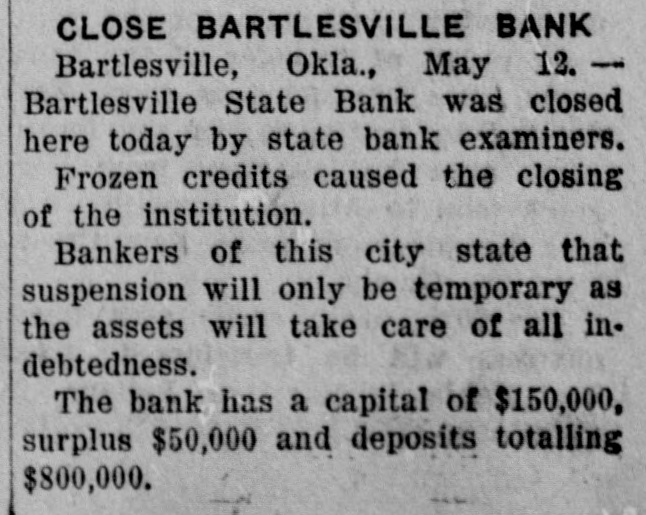
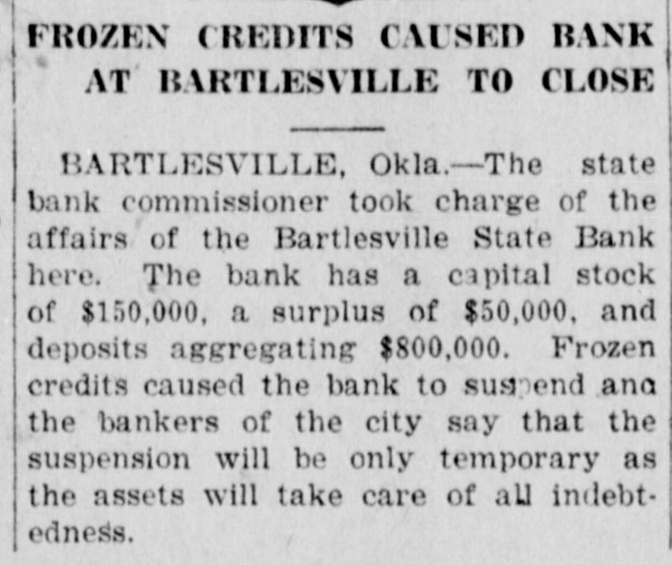
Strain Saturday morning exhibited the bill of A. F. Vandeventer, J. T. Shipman and Norman Barker, valuing the services of the three in the defunct Bartlesville State Bank case at $45,315.
The bill shows an offer of compromise was made by which Strain could have settled for $26,905.
have multiplied and extended until there is no human activity in any corner of this broad continent that they do not reach, touch and regulate.
How much government is enough? We do not know. Lord Haldane, we think it was, said he did not know how many grains of sand made a pile, but he knew a pile of sand when he saw it. We know too much government when we see it. So does every American and every American is seeing it in his country today, and unless he is himself willing to be a grain of sand and shoveled into a pile for the government to hatch its eggs in, he is asking himself what the result is going to be for himself and his country if this huge industry of government continues to expand itself.
Shall a part become greater than the whole? It is becoming so. The government of the United States, the delegated authority of the people, is becoming greater than the people who created it. It has escaped from their control and instead of being their servant is becoming their master. Instead of promoting the general welfare of the people, government now chiefly exists to promote its own welfare.
Look at the facts and see. Congress itself in which is vested all the legislative powers of the government, can do only eighteen specified things. Only eighteen. Today, outside of Congress, there are eighteen times eighteen commissions and boards unknown to the Constitution, doing more things, or pretending to, and spending more money doing them, than Congress itself can do under the organic law of the land.
There is nothing that these commissions and boards can do that Congress could not do if they could properly be done at all or were worth doing. Why, then, the commissions? Because it is the nature of government to duplicate itself. It makes for business for government. It makes for jobs, it makes for power, it makes for spending.
Jobs, power, spending; that has come to be government's business. It has no other except to collect enough revenue to keep it going and growing. The average commission set up by Congress starts with three members and an appropriation of $25,000. It gets a committee room in the basement of the Capitol, hires a stenographer, and is forgotten. The next that is heard from it it has a staff of three hundred office and field workers, occupies an entire floor in a rented building and wants a million dollars.
Business of government. Business of two or more agencies doing the same thing. Business of creating artificial wants and then pretending to supply them. Business of making government's own needs appear to be the needs of the American people.
Example—There are thirty-six distinct bureaus and commissions administering the government of Alaska in which there are only twenty-four thousand white people.
A member of the House committee on territories was asked why Alaska was not given a territorial government. "There are not people enough there to support it," he answered frankly.
Mark it. Government has become so expensive in America that only rich and populous communities can afford it. Alaska is being brought up on a nursing bottle by thirty-six bureaus. If it survives maybe it will be hard enough to stand full fledged government.
If America survives, maybe it can stand it, too. Will it survive? Are even Americans rich enough and numerous enough to carry this increasing load that is being piled on their backs? Every nineteen Americans carry the twentieth on their backs. The twentieth represents federal, state, county and city government.
See what has come about in America. Government was instituted for government. The pyramid that once stood on its base now stands on its apex.
Can it so stand?