Central Exchange Bank (Woodward, OK)

Episode Information

Episode UID
86019471477
Episode Type
Run → Suspension → Closure
Bank Type
state
Bank ID
8601947 routing
Routing Number
86-0194
Start Date
January 1, 1923*
Location
Woodward, Oklahoma (36.434, -99.390)

Metadata

Model
gpt-5-mini (chosen from majority vote of a three-model LLM ensemble)
Short Digest
fb1e185626d22c8a

Response Measures

None

Description

A successor, the Bank of Woodward, opened March 10 and took over assets; Central Exchange remained defunct.

Events (4)

1. January 1, 1923* Run
Cause
Bank Specific Adverse Info
Cause Details
Knowledge of cashier Charles H. Martin's heavy personal ranching losses prompted depositors to withdraw funds.
Measures
None reported besides continued operation attempts; later closure by state commissioner.
Newspaper Excerpt
When this fact became known a run on the bank started and continued until it was necessary to close the doors of the institution.
Source
newspapers
2. January 16, 1923 Suspension
Cause
Bank Specific Adverse Info
Cause Details
State bank commissioner closed the bank after a run driven by knowledge of the cashier's reverses and insolvency concerns; examiners found bank insolvent with large indebtedness estimated at $350,000 and deposits reduced substantially from September call estimates to about $400,000 or less by January call time.
Newspaper Excerpt
Central Exchange Bank at Woodward closed its doors (January 16) ... was closed Wednesday by Roy Walcott, state bank commissioner.
Source
newspapers
3. March 10, 1923 Other
Newspaper Excerpt
The Bank of Woodward ... has just been opened as a successor to the failed institution. The new bank took over the assets of the Central Exchange and announced that depositors would be paid 50 cents on the dollar.
Source
newspapers
4. March 15, 1923 Receivership
Newspaper Excerpt
Charles H. Martin, cashier of the defunct Central Exchange bank of Woodward, surrendered to Attorney General George Short today. Martin will return to Woodward to face charges and turn over his property to the bank receivers.
Source
newspapers

Newspaper Articles (16)

Article from The American Guardian, January 17, 1923

Click image to open full size in new tab

Article Text

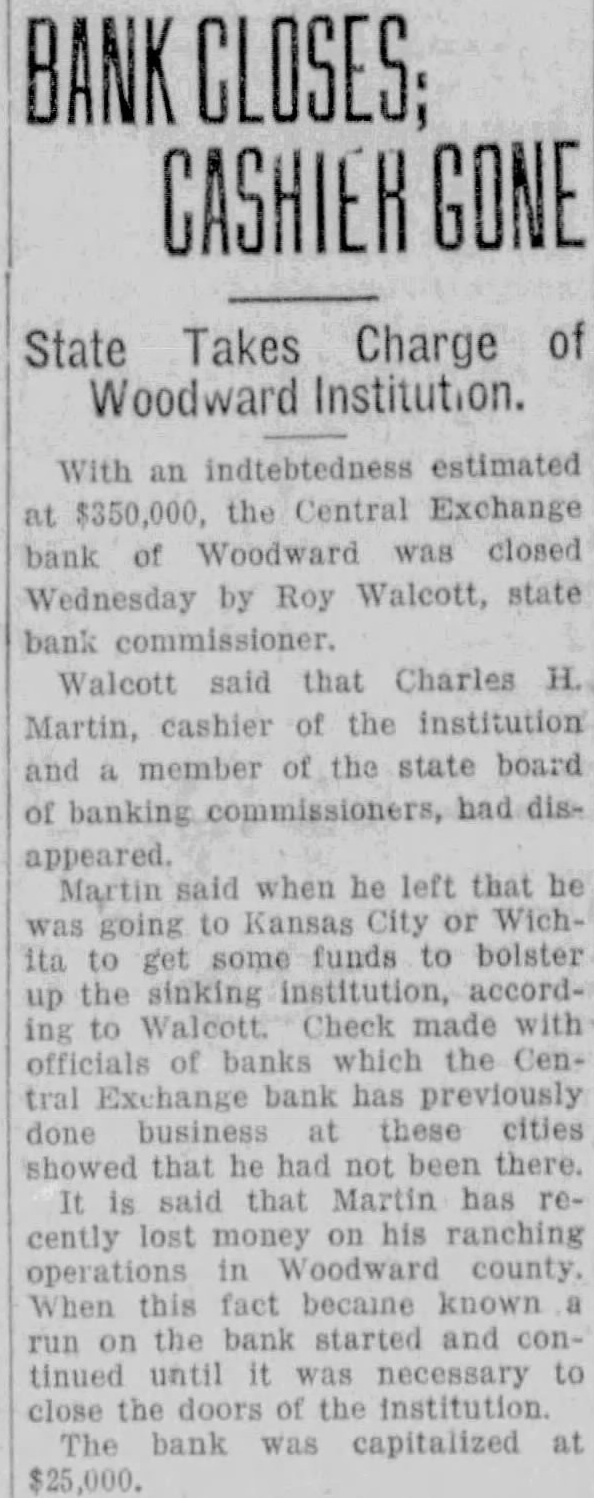
BANK CLOSES; CASHIER GONE State Takes Charge of Woodward Institution. With an indebtedness estimated at $350,000, the Central Exchange bank of Woodward was closed Wednesday by Roy Walcott, state bank commissioner. Walcott said that Charles H. Martin, cashier of the institution and a member of the state board of banking commissioners, had disappeared. Martin said when he left that he was going to Kansas City or Wichita to get some funds to bolster up the sinking institution, according to Walcott. Check made with officials of banks which the Central Exchange bank has previously done business at these cities showed that he had not been there. It is said that Martin has recently lost money on his ranching operations in Woodward county. When this fact became known a run on the bank started and continued until it was necessary to close the doors of the institution. The bank was capitalized at $25,000.


Article from Bartlesville Examiner-Enterprise, January 17, 1923

Click image to open full size in new tab

Article Text

WOODWARD BANK CLOSED AND THE CASHIER IS GONE Personal Reverses of the Cashier Caused Run on Bank Oklahoma City, Jan. 17. — The Central Exchange Bank at Woodward has been closed by Roy Walcott, state bank commissioner, according to his announcement today. Charles T. Martin, cashier, has disappeared, Walcott said. Martin is a member of the state board of banking commissioners. Walcott said Martin disappeared Monday night leaving Woodward ostensibly for Wichita or Kansas City where he intended to make an effort to borrow funds to keep the bank in operation. L. C. Kelly, president of the Fourth National Bank at Wichita, from which Martin had previously obtained loans when his bank was short was quoted by Walcott as saying he had not seen the Woodward cashier. Urban Shellhart, a state bank examiner, is in Woodward. When Shellhart telephoned Kelly to learn if Martin had conferred with him, Kelly asked that the bank be kept open one day to enable him to put in more money in an effort to avoid insolvency and save the loans he had already made, Walcott said. His request was granted and Kelly and Shellhart went over the books yesterday deciding last night that it would be impossible to keep the bank in operation. The hope was expressed, however that the closing would be only temporary. Walcott said that Martin has extensive ranching interests in Woodward county with several thousand head of cattle on which he has recently lost heavily. Knowledge of his personal reverses, the commissioner said, had caused farmers to withdraw deposits. This gradual run has been in progress about a month, he added. The bank is capitalized at $25,000. The September 15 bank call indicated the deposits were approximately $600,000. Walcott said no reply was received to the January call, but that it was estimated the deposits now are about $400,000. Walcott said the bank is between $300,000 and $400,000 in debt. Observe Thrift Week. The opening of "Thrift Week" was celebrated by the members of the Kiwanis club at their meeting Wednesday noon at the Maire hotel. Howard Cannon, chairman for the thrift week, outlined some of the purposes, features and plans of the week. Reverend Carnett spoke on some of the life lessons learned from the life of Benjamin Franklin. A special musical program was part of the affair. About all some girls know about a needle is that one has to change it after each record.


Article from The Curtis Courier, February 1, 1923

Click image to open full size in new tab

Article Text

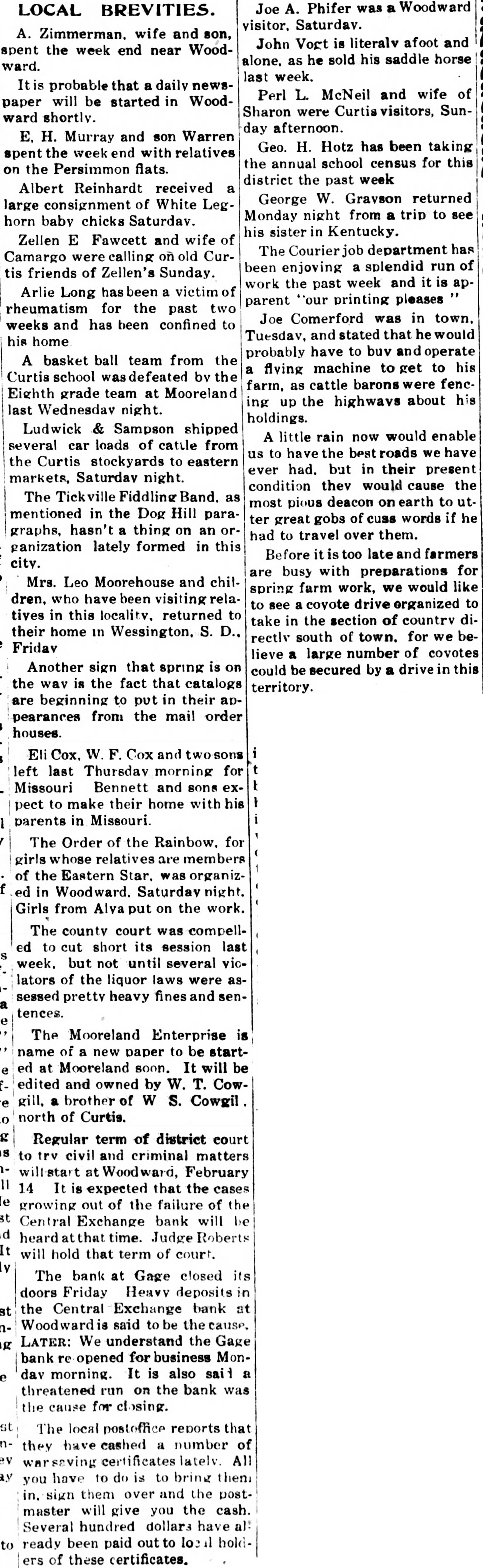
LOCAL BREVITIES. A. Zimmerman, wife and son, spent the week end near Woodward. It is probable that a daily newspaper will be started in Woodward shortly. E, H. Murray and son Warren spent the week end with relatives on the Persimmon flats. Albert Reinhardt received a large consignment of White Leghorn baby chicks Saturday. Zellen E Fawcett and wife of Camargo were calling on old Curtis friends of Zellen's Sunday. Arlie Long has been a victim of rheumatism for the past two weeks and has been confined to his home. A basket ball team from the Curtis school was defeated by the Eighth grade team at Mooreland last Wednesday night. Ludwick & Sampson shipped several car loads of cattle from the Curtis stockyards to eastern markets, Saturday night. The Tickville Fiddling Band, as mentioned in the Dog Hill paragraphs, hasn't a thing on an organization lately formed in this city. Mrs. Leo Moorehouse and children, who have been visiting relatives in this locality, returned to their home in Wessington, S. D., Friday. Another sign that spring is on the way is the fact that catalogs are beginning to put in their appearances from the mail order houses. Eli Cox, W. F. Cox and two sons left last Thursday morning for Missouri. Bennett and sons expect to make their home with his parents in Missouri. The Order of the Rainbow, for girls whose relatives are members of the Eastern Star, was organized in Woodward, Saturday night. Girls from Alva put on the work. The county court was compelled to cut short its session last week, but not until several violators of the liquor laws were assessed pretty heavy fines and sentences. The Mooreland Enterprise is name of a new paper to be started at Mooreland soon. It will be edited and owned by W. T. Cowgill, a brother of W. S. Cowgill, north of Curtis. Regular term of district court to try civil and criminal matters will start at Woodward, February 14. It is expected that the cases growing out of the failure of the Central Exchange bank will be heard at that time. Judge Roberts will hold that term of court. The bank at Gage closed its doors Friday. Heavy deposits in the Central Exchange bank at Woodward is said to be the cause. LATER: We understand the Gage bank reopened for business Monday morning. It is also said a threatened run on the bank was the cause for closing. The local postoffice reports that they have cashed a number of war saving certificates lately. All you have to do is to bring them in, sign them over and the postmaster will give you the cash. Several hundred dollars have already been paid out to local holders of these certificates. Joe A. Phifer was a Woodward visitor, Saturday. John Vogt is literally afoot and alone, as he sold his saddle horse last week. Perl L. McNeil and wife of Sharon were Curtis visitors, Sunday afternoon. Geo. H. Hotz has been taking the annual school census for this district the past week. George W. Grayson returned Monday night from a trip to see his sister in Kentucky. The Courier job department has been enjoying a splendid run of work the past week and it is apparent "our printing pleases." Joe Comerford was in town, Tuesday, and stated that he would probably have to buy and operate a flying machine to get to his farm, as cattle barons were fencing up the highways about his holdings. A little rain now would enable us to have the best roads we have ever had, but in their present condition they would cause the most pious deacon on earth to utter great gobs of cuss words if he had to travel over them. Before it is too late and farmers are busy with preparations for spring farm work, we would like to see a coyote drive organized to take in the section of country directly south of town, for we believe a large number of coyotes could be secured by a drive in this territory.


Article from The Norman Transcript, March 15, 1923

Click image to open full size in new tab

Article Text

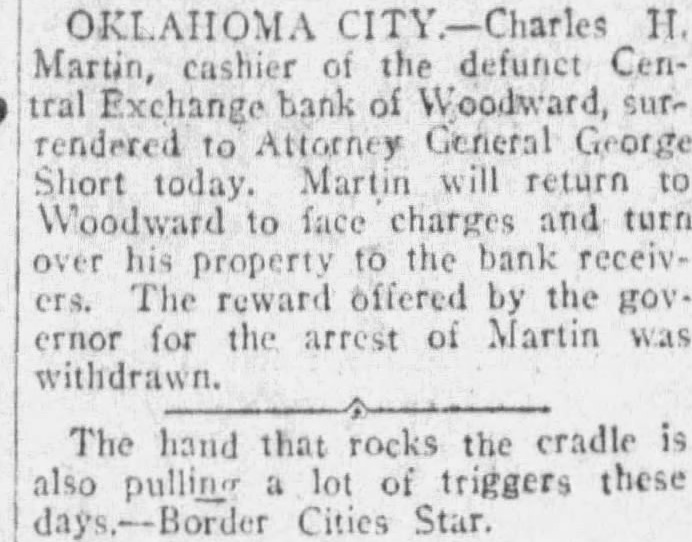
OKLAHOMA CITY.—Charles H. Martin, cashier of the defunct Central Exchange bank of Woodward, surrendered to Attorney General George Short today. Martin will return to Woodward to face charges and turn over his property to the bank receivers. The reward offered by the governor for the arrest of Martin was withdrawn. The hand that rocks the cradle is also pulling a lot of triggers these days.—Border Cities Star.


Article from Okmulgee Daily Democrat, March 15, 1923

Click image to open full size in new tab

Article Text

CHARLES H. MARTIN GIVES SELF UP TO ATTORNEY GENERAL Wife Conducted Negotiations With Mr. Short. RETURN TO WOODWARD Martin Offers to Place All His Property Consisting of "Several Thousand" Acres Of Oklahoma Land at Disposal of Depositors of Failed Bank. (By the Associated Press) OKLAHOMA CITY, Okla., March 15.—Charles H. Martin, cashier of the defunct Central Exchange bank of Woodward, surrendered today to Attorney General Short at the capital here and will return in a few hours to Woodward where the sheriff holds a warrant for his arrest on a charge of accepting deposits in an insolvent bank. Martin surrendered following negotiations made with Mr. Short by his wife about two weeks ago. In a statement issued by Short, the banker declared he will place all his property consisting of "several thousand" acres of Oklahoma land at the disposal of the depositors in the failed bank in an effort to reimburse them. The arrangements for Martin's surrender were perfected when the attorney general agreed to Mrs. Martin's request that the rewards which the state had offered for his capture be cancelled. The Central Exchange bank was closed after state bank examiners conducted an investigation. Martin was charged with accepting deposits in a bank known to be insolvent and search for him was instituted. Martin Was Indicted. On instructions from Governor Walton, Attorney General Short sent John Berry, an Alva attorney, to gather evidence to be presented to a grand jury. This grand jury has since convened and returned two indictments against Martin and one against Urban Shellhart, vice president of the bank. A state reward of $1,000 for Martin's capture and conviction was offered February 3 by Governor Walton. A few days previously the state bankers association had offered $500 reward for the arrest and conviction of any person who contributed to the bank's failure. Roy Walcott, who was state bank commissioner when the bank failed, said that a slow run on the bank had been in progress several weeks before the collapse. This, he said, resulted from a general knowledge of personal losses sustained by Martin in the cattle business, depositors fearing that these reverses might affect the bank. Mrs. Martin, following her husband's departure, met his double liability obligation as a stockholder. The Bank of Woodward, supported by citizens of Woodward county and Wichita, Kan., has just been opened as a successor to the failed institution. The new bank took over the assets of the Central Exchange and announced that depositors would be paid 50 cents on the dollar. The attorney general quoted Martin as saying that he disappeared from Woodward when he saw the impending collapse of the bank, not with the intention of defrauding anyone, but to protect certain personal business interests which he felt (CONTINUED ON PAGE FOUR)


Article from Bartlesville Examiner-Enterprise, March 15, 1923

Click image to open full size in new tab

Article Text

Official of Defunct Bank Surrenders (Continued from Page One) saw the impending collapse of the bank, not with the intention of defrauding any one, but to protect certain personal business interests which he felt must be shielded He said Martin declared he intended to return as soon as conditions permitted. The Central Exchange bank was closed after state bank examiners conducted an investigation. Martin was charged with accepting deposits in a bank that was known to be insolvent and search for him was instituted. On instructions from Governor Walton, Attorney General Short sent John Berry, an Alva attorney, to gather evidence to be presented to a grand jury. This grand jury has since returned an indictment against Urban Shellhart, vice president of the bank. A state reward of $1,000 for Martin's capture and conviction was offered February 3 by Gov. Walton. A few days previously the state bankers association had offered $500 reward for the arrest and conviction of any person who contributed to the bank's failure. Roy Walcott, who was state bank commissioner when the bank failed, said that a slow run on the bank had been in progress several weeks before the collapse. This he said, resulted from a general knowledge of personal losses sustained by Martin in the cattle business, depositors fearing that these reverses might affect the bank. Mrs. Martin, following her husband's departure, met his double liability obligation as a stockholder. The bank of Woodward, supported by citizens of Woodward county and Wichita, Kans., has just been opened as a successor to the failed institution. The new bank took over the assets of the Central Exchange and announced that depositors would be paid fifty cents on the dollar. Oklahoma City, March 15.—The statement issued by the attorney general follows. "Charles H. Martin has reported to me telling me that he desired to report his presence to the governor and asking that the governor withdraw any offer of a reward for his discovery. He was accompanied by Mrs. Martin. "Mrs. Martin came to me for the purpose of arranging to turn over his property in order that the depositors of the Central Exchange bank may receive additional distribution from the proceeds of the same. He is the owner of several thousand acres of Oklahoma land and this property will be sold as soon as advantageous sales can be made. He expects to protect the depositors of the Central Exchange bank with his private funds and says he will do his utmost to see that no depositors suffer any loss. Mr. Martin has reported his presence to the governor telling the governor that it is his intention and desire to devote all of his property and the remainder of his life to seeing that the depositors of the Central Exchange bank do not lose a dollar by reason of the bank's closing "Mr. Martin will go to Woodward, where in connection with the bank examiner and this department he will liquidate his property for the benefit and protection of the depositors of the bank. The sheriff of Woodward county has a warrant for Mr. Martin. He will, of course, report to the sheriff and make his bond. Martin's action will mean that the depositors of the Central Exchange bank will receive thousands of dollars which, but for his action, they would not have received. "Mrs. Martin reported to me several days ago Mr. Martin's intention to report and she has been in communication with me daily for the past two weeks." Martin came here from Memphis, Tenn., Attorney General Short declining to say whether he had been there during the entire time of his absence from Woodward. When he appeared at Short's office he was wearing an old corduroy suit and had a heavy growth of beard. After reporting to the attorney general he changed his attire and was shaved. Martin will go to Woodward alone, according to the attorney general. "I believe the man means well and we will give him every opportunity to prove that he does," Governor Walton declared, following a conference with Martin in his office. The attorney general said the state would probably take no part in Martin's prosecution, leaving the case entirely in the hands of L. A. Foster, county attorney at Woodward.


Article from The Tulsa Tribune, March 15, 1923

Click image to open full size in new tab

Article Text

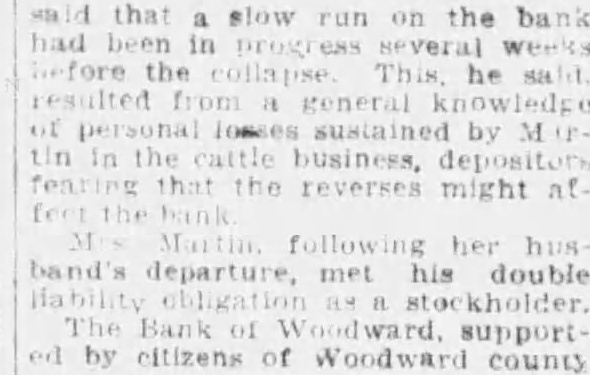
said that a slow run on the bank had been in progress several weeks before the collapse. This, he said, resulted from a general knowledge of personal losses sustained by Martin in the cattle business, depositors fearing that the reverses might affect the bank. Mrs. Martin, following her husband's departure, met his double liability obligation as a stockholder. The Bank of Woodward, supported by citizens of Woodward county


Article from The M'Alester News-Capital, March 15, 1923

Click image to open full size in new tab

Article Text

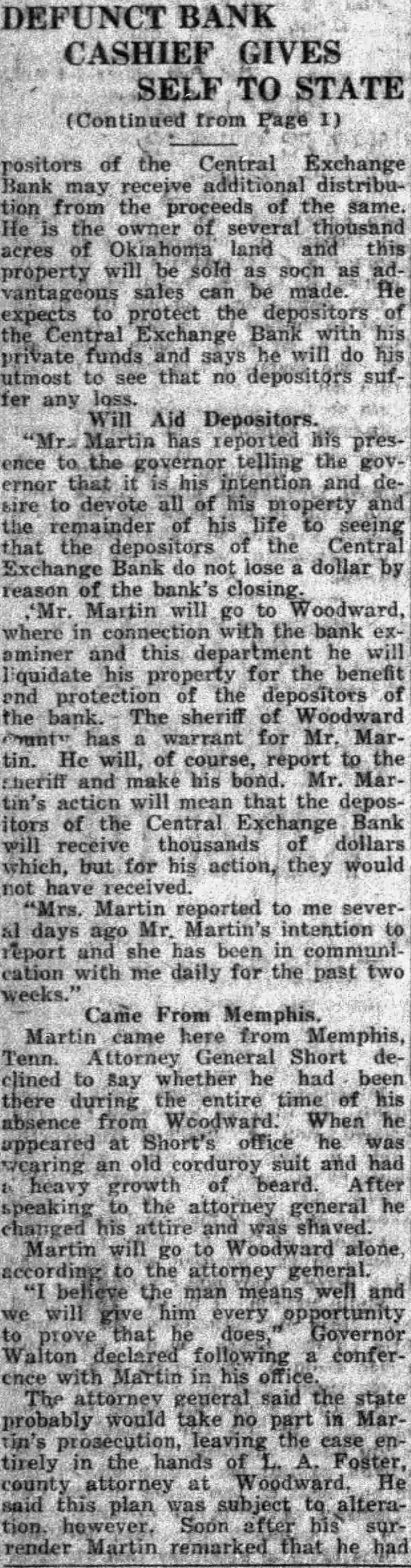
DEFUNCT BANK CASHIER GIVES SELF TO STATE (Continued from Page 1) positors of the Central Exchange Bank may receive additional distribution from the proceeds of the same. He is the owner of several thousand acres of Oklahoma land and this property will be sold as soon as advantageous sales can be made. He expects to protect the depositors of the Central Exchange Bank with his private funds and says he will do his utmost to see that no depositors suffer any loss. Will Aid Depositors. "Mr. Martin has reported his presence to the governor telling the governor that it is his intention and desire to devote all of his property and the remainder of his life to seeing that the depositors of the Central Exchange Bank do not lose a dollar by reason of the bank's closing. "Mr. Martin will go to Woodward, where in connection with the bank examiner and this department he will liquidate his property for the benefit and protection of the depositors of the bank. The sheriff of Woodward county has a warrant for Mr. Martin. He will, of course, report to the sheriff and make his bond. Mr. Martin's action will mean that the depositors of the Central Exchange Bank will receive thousands of dollars which, but for his action, they would not have received. "Mrs. Martin reported to me several days ago Mr. Martin's intention to report and she has been in communication with me daily for the past two weeks." Came From Memphis. Martin came here from Memphis, Tenn. Attorney General Short declined to say whether he had been there during the entire time of his absence from Woodward. When he appeared at Short's office he was wearing an old corduroy suit and had a heavy growth of beard. After speaking to the attorney general he changed his attire and was shaved. Martin will go to Woodward alone, according to the attorney general. "I believe the man means well and we will give him every opportunity to prove that he does," Governor Walton declared following a conference with Martin in his office. The attorney general said the state probably would take no part in Martin's prosecution, leaving the case entirely in the hands of L. A. Foster, county attorney at Woodward. He said this plan was subject to alteration, however. Soon after his surrender Martin remarked that he had


Article from The M'Alester News-Capital, March 15, 1923

Click image to open full size in new tab

Article Text

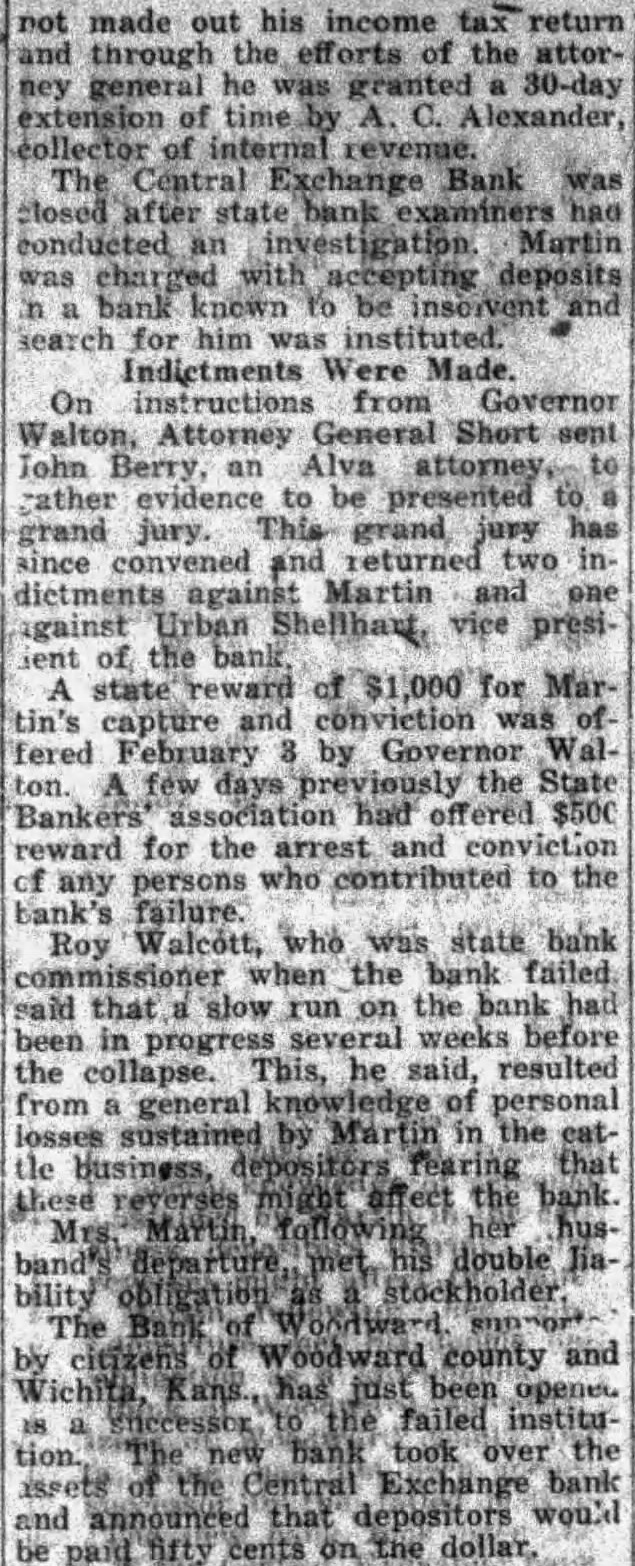
not made out his income tax return and through the efforts of the attorney general he was granted a 30-day extension of time by A. C. Alexander, collector of internal revenue. The Central Exchange Bank was closed after state bank examiners had conducted an investigation. Martin was charged with accepting deposits in a bank known to be insolvent and search for him was instituted. Indictments Were Made. On instructions from Governor Walton, Attorney General Short sent John Berry, an Alva attorney, to gather evidence to be presented to a grand jury. This grand jury has since convened and returned two indictments against Martin and one against Urban Shellhart, vice president of the bank. A state reward of $1,000 for Martin's capture and conviction was offered February 3 by Governor Walton. A few days previously the State Bankers' association had offered $500 reward for the arrest and conviction of any persons who contributed to the bank's failure. Roy Walcott, who was state bank commissioner when the bank failed, said that a slow run on the bank had been in progress several weeks before the collapse. This, he said, resulted from a general knowledge of personal losses sustained by Martin in the cattle business, depositors fearing that these reverses might affect the bank. Mrs. Martin, following her husband's departure, met his double liability obligation as a stockholder. The Bank of Woodward, support by citizens of Woodward county and Wichita, Kans., has just been opened as a successor to the failed institution. The new bank took over the assets of the Central Exchange bank and announced that depositors would be paid fifty cents on the dollar.


Article from The Enid Daily Eagle, March 15, 1923

Click image to open full size in new tab

Article Text

MARTIN READY TO RETURN TO FACE CHARGES (Continued From Page 1.) son of the bank's closing. "Mr. Martin will go to Woodward, where, in connection with the bank examiner and this department, he will liquidate his property for the benefit and satisfaction of the depositors of the bank. The sheriff of Woodward county has a warrant for Mr. Martin. He will, of course, report to the sheriff and make his bond. Mr. Martin's action will mean that the depositors of the Central Exchange bank will receive thousands of dollars, which, but for his action, they would not have received. "Mrs. Martin reported to me several days ago Mr. Martin's intention to report and she has been in communication with me daily for the past two weeks." Martin came here from Memphis Tenn. Attorney General Short declined to say whether he had been there during the entire time of his absence from Woodward. When he appeared at Short's office he was wearing an old corduroy suit and had a heavy growth of beard. After reporting to the attorney general he changed his attire and was shaved. Martin will go to Woodward alone, according to the attorney general. "I believe the man means well and we will give him every opportunity to prove that he does," Governor Walton declared following a conference with Martin in his office. The attorney general said the state would probably take no part in Martin's prosecution, leaving the case entirely in the hands of L. A. Foster, county attorney at Woodward. He said this plan was subject to alteration, however. Soon after his surrender, Martin remarked that he had not made out his income tax return and through the efforts of the attorney general he was granted a thirty day extension of time by A. C. Alexander, collector of internal revenue. The Central Exchange bank was closed after state bank examiners conducted an investigation. Martin was charged with accepting deposits in a bank known to be insolvent and search for him was instituted. On instructions from Governor Walton, Attorney General Short sent John Berry, an Alva attorney, to gather evidence to be presented to a grand jury. This grand jury has since returned two indictments against Martin, and one against Urban Shellhart, vice president of the bank. A state reward of $1,000 for Martin's capture and conviction was offered February 3 by Governor Walton. A few days previously the state bankers' association had offered $500 reward for the arrest and conviction of any person who contributed to the bank's failure. Roy Walcott, who was state bank commissioner when the bank failed, said that a slow run on the bank had been in progress several weeks before the collapse. This, he said, resulted from a general knowledge of personal losses sustained by Martin in the cattle business, depositors fearing that these reverses might affect the bank. Mrs. Martin, following her husband's departure, met his double liability obligation as a stockholder. The Bank of Woodward, supported by citizens of Woodward county and Wichita, Kans., has just been opened as a successor to the failed institution. The new bank took over the assets of the Central Exchange and announced that depositors would be paid fifty cents on the dollar.


Article from San Antonio Light, March 16, 1923

Click image to open full size in new tab

Article Text

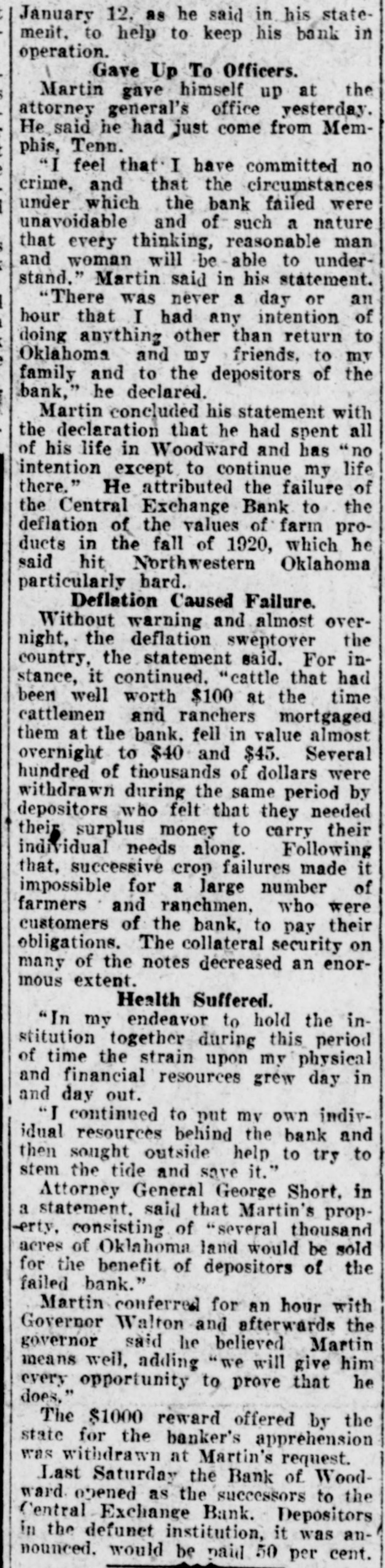
January 12. as he said in his statement, to help to keep his bank in operation. Gave Up To Officers. Martin gave himself up at the attorney general's office yesterday. He said he had just come from Memphis, Tenn. "I feel that I have committed no crime, and that the circumstances under which the bank failed were unavoidable and of such a nature that every thinking, reasonable man and woman will be able to understand." Martin said in his statement. "There was never a day or an hour that I had any intention of doing anything other than return to Oklahoma and my friends, to my family and to the depositors of the bank," he declared. Martin concluded his statement with the declaration that he had spent all of his life in Woodward and has "no intention except to continue my life there." He attributed the failure of the Central Exchange Bank to the deflation of the values of farm products in the fall of 1920, which he said hit Northwestern Oklahoma particularly hard. Deflation Caused Failure. Without warning and almost overnight, the deflation sweptover the country, the statement said. For instance, it continued. "cattle that had been well worth $100 at the time cattlemen and ranchers mortgaged them at the bank. fell in value almost overnight to $40 and $45. Several hundred of thousands of dollars were withdrawn during the same period by depositors who felt that they needed their surplus money to carry their individual needs along. Following that, successive crop failures made it impossible for a large number of farmers and ranchmen, who were customers of the bank, to pay their obligations. The collateral security on many of the notes decreased an enormous extent. Health Suffered. "In my endeavor to hold the institution together during this period of time the strain upon my physical and financial resources grew day in and day out. "I continued to put my own individual resources behind the bank and then sought outside help to try to stem the tide and save it." Attorney General George Short. in a statement. said that Martin's prop-erty, consisting of "several thousand acres of Oklahoma land would be sold for the benefit of depositors of the failed bank." Martin conferred for an hour with Governor Walton and afterwards the governor said he believed Martin means weil, adding "we will give him every opportunity to prove that he does." The $1000 reward offered by the state for the banker's appréhension was withdrawn at Martin's request. Last Saturday the Bank of Woodward opened as the successors to the Central Exchange Bank. Depositors in the defunet institution, it was announced. would be paid 50 per cent.


Article from Blackwell Journal-Tribune, March 16, 1923

Click image to open full size in new tab

Article Text

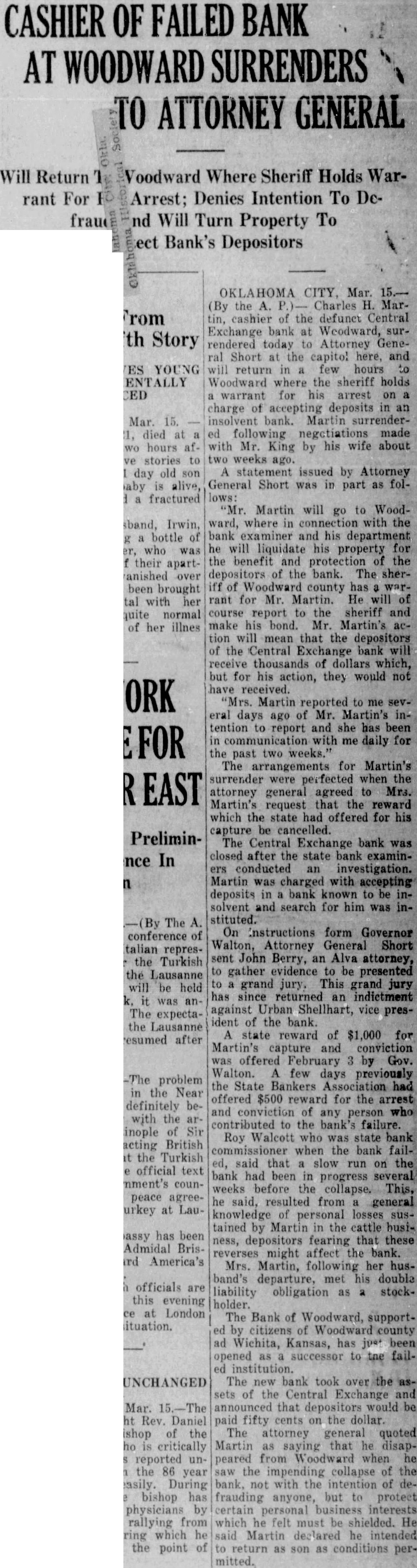
CASHIER OF FAILED BANK AT WOODWARD SURRENDERS TO ATTORNEY GENERAL Will Return To Woodward Where Sheriff Holds Warrant For His Arrest; Denies Intention To Defraud and Will Turn Property To Protect Bank's Depositors OKLAHOMA CITY, Mar. 15.—(By the A. P.)— Charles H. Martin, cashier of the defunct Central Exchange bank at Woodward, surrendered today to Attorney General Short at the capitol here, and will return in a few hours to Woodward where the sheriff holds a warrant for his arrest on a charge of accepting deposits in an insolvent bank. Martin surrendered following negotiations made with Mr. King by his wife about two weeks ago. A statement issued by Attorney General Short was in part as follows: "Mr. Martin will go to Woodward, where in connection with the bank examiner and his department, he will liquidate his property for the benefit and protection of the depositors of the bank. The sheriff of Woodward county has a warrant for Mr. Martin. He will of course report to the sheriff and make his bond. Mr. Martin's action will mean that the depositors of the Central Exchange bank will receive thousands of dollars which, but for his action, they would not have received. "Mrs. Martin reported to me several days ago of Mr. Martin's intention to report and she has been in communication with me daily for the past two weeks." The arrangements for Martin's surrender were perfected when the attorney general agreed to Mrs. Martin's request that the reward which the state had offered for his capture be cancelled. The Central Exchange bank was closed after the state bank examiners conducted an investigation. Martin was charged with accepting deposits in a bank known to be insolvent and search for him was instituted. On instructions from Governor Walton, Attorney General Short sent John Berry, an Alva attorney, to gather evidence to be presented to a grand jury. This grand jury has since returned an indictment against Urban Shellhart, vice president of the bank. A state reward of $1,000 for Martin's capture and conviction was offered February 3 by Gov. Walton. A few days previously the State Bankers Association had offered $500 reward for the arrest and conviction of any person who contributed to the bank's failure. Roy Walcott who was state bank commissioner when the bank failed, said that a slow run on the bank had been in progress several weeks before the collapse. This, he said, resulted from a general knowledge of personal losses sustained by Martin in the cattle business, depositors fearing that these reverses might affect the bank. Mrs. Martin, following her husband's departure, met his double liability obligation as a stockholder. The Bank of Woodward, supported by citizens of Woodward county and Wichita, Kansas, has just been opened as a successor to the failed institution. The new bank took over the assets of the Central Exchange and announced that depositors would be paid fifty cents on the dollar. The attorney general quoted Martin as saying that he disappeared from Woodward when he saw the impending collapse of the bank, not with the intention of defrauding anyone, but to protect certain personal business interests which he felt must be shielded. He said Martin declared he intended to return as soon as conditions permitted.


Article from Woodward Democrat, March 16, 1923

Click image to open full size in new tab

Article Text

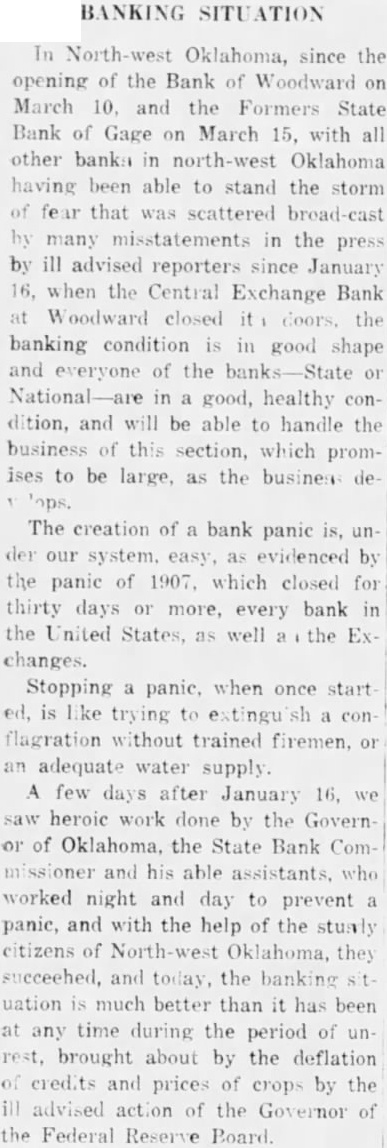
BANKING SITUATION In North-west Oklahoma, since the opening of the Bank of Woodward on March 10, and the Farmers State Bank of Gage on March 15, with all other banks in north-west Oklahoma having been able to stand the storm of fear that was scattered broad-cast by many misstatements in the press by ill advised reporters since January 16, when the Central Exchange Bank at Woodward closed its doors, the banking condition is in good shape and everyone of the banks—State or National—are in a good, healthy condition, and will be able to handle the business of this section, which promises to be large, as the business develops. The creation of a bank panic is, under our system, easy, as evidenced by the panic of 1907, which closed for thirty days or more, every bank in the United States, as well as the Exchanges. Stopping a panic, when once started, is like trying to extinguish a conflagration without trained firemen, or an adequate water supply. A few days after January 16, we saw heroic work done by the Governor of Oklahoma, the State Bank Commissioner and his able assistants, who worked night and day to prevent a panic, and with the help of the sturdy citizens of North-west Oklahoma, they succeeded, and today, the banking situation is much better than it has been at any time during the period of unrest, brought about by the deflation of credits and prices of crops by the ill advised action of the Governor of the Federal Reserve Board.


Article from The Lawton Constitution, May 15, 1923

Click image to open full size in new tab

Article Text

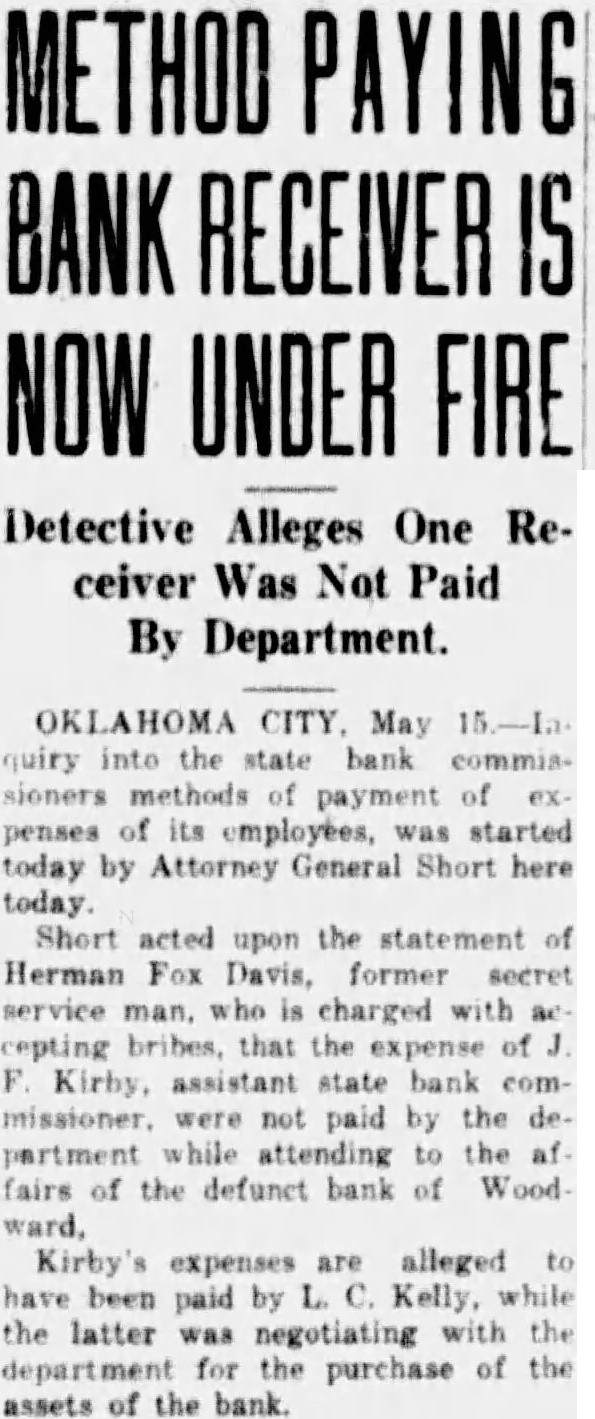
METHOD PAYING BANK RECEIVER IS NOW UNDER FIRE Detective Alleges One Receiver Was Not Paid By Department. OKLAHOMA CITY, May 15.—Inquiry into the state bank commissioners methods of payment of expenses of its employees, was started today by Attorney General Short here today. Short acted upon the statement of Herman Fox Davis, former secret service man, who is charged with accepting bribes, that the expense of J. F. Kirby, assistant state bank commissioner, were not paid by the department while attending to the affairs of the defunct bank of Woodward. Kirby's expenses are alleged to have been paid by L. C. Kelly, while the latter was negotiating with the department for the purchase of the assets of the bank.


Article from Tulsa World, July 15, 1923

Click image to open full size in new tab

Article Text

STRAIN BEHEADED TO PLEASE SHORT, WHOM HE DEFIED CONTINUED FROM PAGE ONE and some were not so good. The question was not altogether how much of these assets could be collected, but how much of the amount collected would ever reach the depositors. When Strain was appointed, the waiting depositors felt relieved. A system had been established of appointing liquidating agents, through banks. Big fees were allowed out of the collections. Supplemental to this, an excrescence on the system made its appearance, by which private attorneys were designated by the attorney-general to "assist" in the collections. This proved to be a fertile idea, and it grew accordingly. Two particular friends of the attorney-general, George Rittenhouse and J. D. Lydick, who also happened to be friends of Governor Robertson, were paid some luscious fees. Lydick became Robertson's attorney in the Okmulgee indictment case, and so did Rittenhouse. It was a fruity program, apparently. They got $20,000 in one bank liquidation. Down at Comanche a little bank failed. One J. L. Duncan was named as liquidating agent. Of the $94,740 collected, other banks collected on about $58,000 securities which they held; yet the liquidating agent was paid on the entire amount, and dragged down $14,520 as commission. The total expense of collecting was $25,520, which was taken out of the depositors' money. Strain Got Some Action. Such was the system established by the attorney-general's office prior to the entrance of Joe Strain upon the scene as bank commissioner. After taking a hasty survey of the situation, Strain decided that he wanted to become divorced from Short, and instituted proceedings in the legislature, which was then in session. He asked for an attorney for the banking department, with full authority to enforce the banking laws of the state. The bill dragged, for some unaccountable reason, and showed signs of paresis. Concerned lest it should expire in some corridor of the capitol and cause trouble for the health department, Strain decided to take a bold step. He gave out an interview, claiming that exorbitant fees had been allowed in liquidation of banks, and proceeded to cite a few instances. This brought results from the legislature, but it also brought other things, among which was a reprimand from Governor Walton, and the bitter enmity of George Short. In March, about the 19th, to be more exact, the governor addressed a letter to Strain, requesting him to give out no more interviews without consulting the executive office. But the legislature, stimulated by the Strain interviews, passed a banking law which gave the department an attorney of its own, and the divorce from Short was granted. Also the house authorized the speaker to appoint a committee to investigate the conditions relative to liquidating failed banks, on motion of Representative Otjen, a republican from Enid. When the speaker finally appointed the committee, on the last night of the session, he named one that was considered to be the most innocuous that could have been selected from the entire membership. Nevertheless, at the few hearings that were held, two of the members forced open sessions and an attempt at a genuine inquiry. This was proceeding fairly well when one member of the committee, Guy Sigler, decided that he wanted his pay and jumped into the supreme court. Proceedings were halted, and finally abandoned after the court held that the committee had no authority at act after close of the session. So it "blew up" with no report. But some of the testimony taken had proved to be interesting, and convinced a large section of the public that not only one but an entire family of bugs were domiciled under the chip. Some Things Strain Did. Meanwhile, Strain went on his way. He had appointed J. T. McIntosh, former senator from Durant, as his attorney, and McIntosh proved to be a self-starter of some general dimensions. He started after the bank officials of a number of failed banks, and began to involve some politicians of more or less repute. He and Strain got after Charles H. Martin, cashier of the failed Central Exchange bank of Woodward, who ran away and later came back and


Article from Tulsa World, July 15, 1923

Click image to open full size in new tab

Article Text

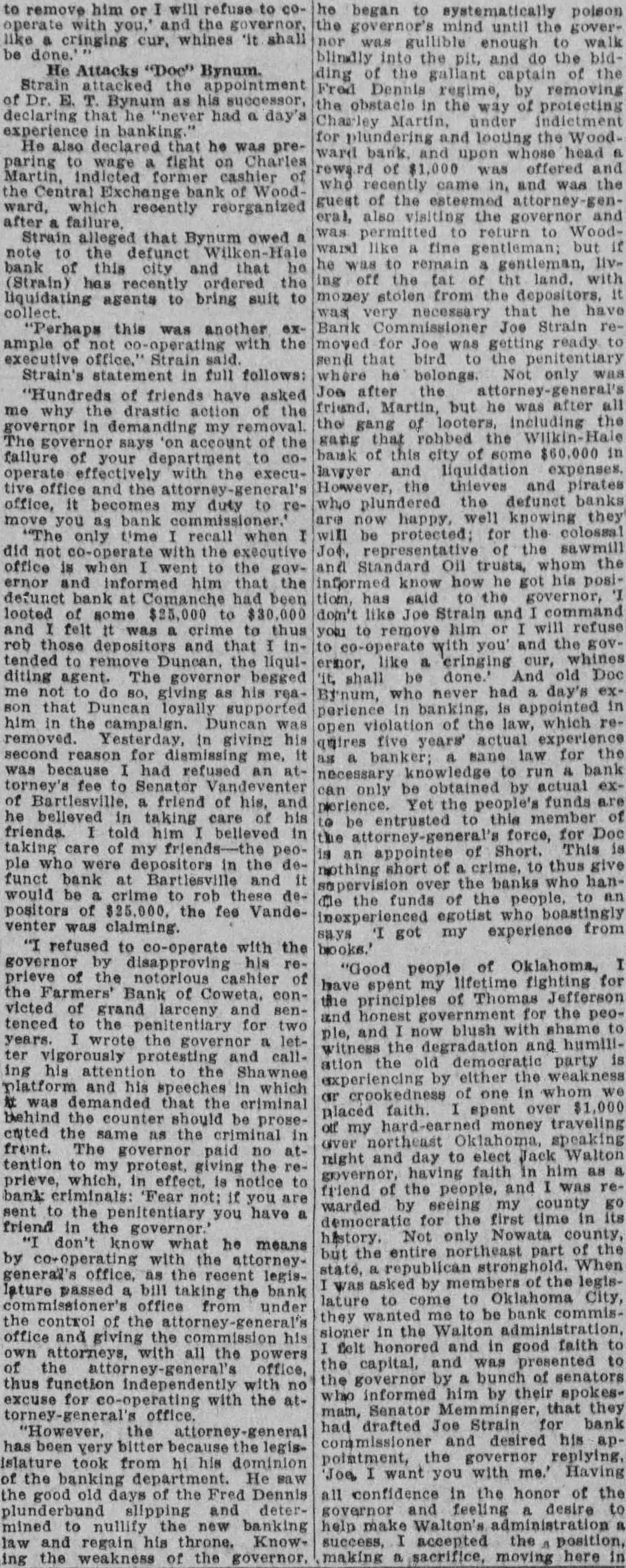
to remove him or I will refuse to co-operate with you,' and the governor, like a cringing cur, whines 'it shall be done.'" He Attacks "Doc" Bynum. Strain attacked the appointment of Dr. E. T. Bynum as his successor, declaring that he "never had a day's experience in banking." He also declared that he was preparing to wage a fight on Charles Martin, indicted former cashier of the Central Exchange bank of Woodward, which recently reorganized after a failure. Strain alleged that Bynum owed a note to the defunct Wilkin-Hale bank of this city and that he (Strain) has recently ordered the liquidating agents to bring suit to collect. "Perhaps this was another example of not co-operating with the executive office," Strain said. Strain's statement in full follows: "Hundreds of friends have asked me why the drastic action of the governor in demanding my removal. The governor says 'on account of the failure of your department to co-operate effectively with the executive office and the attorney-general's office, it becomes my duty to remove you as bank commissioner.' "The only time I recall when I did not co-operate with the executive office is when I went to the governor and informed him that the defunct bank at Comanche had been looted of some $25,000 to $30,000 and I felt it was a crime to thus rob those depositors and that I intended to remove Duncan, the liquidating agent. The governor begged me not to do so, giving as his reason that Duncan loyally supported him in the campaign. Duncan was removed. Yesterday, in giving his second reason for dismissing me, it was because I had refused an attorney's fee to Senator Vandeventer of Bartlesville, a friend of his, and he believed in taking care of his friends. I told him I believed in taking care of my friends—the people who were depositors in the defunct bank at Bartlesville and it would be a crime to rob these depositors of $25,000, the fee Vandeventer was claiming. "I refused to co-operate with the governor by disapproving his reprieve of the notorious cashier of the Farmers' Bank of Coweta, convicted of grand larceny and sentenced to the penitentiary for two years. I wrote the governor a letter vigorously protesting and calling his attention to the Shawnee platform and his speeches in which it was demanded that the criminal behind the counter should be prosecuted the same as the criminal in front. The governor paid no attention to my protest, giving the reprieve, which, in effect, is notice to bank criminals: 'Fear not; if you are sent to the penitentiary you have a friend in the governor.' "I don't know what he means by co-operating with the attorney-general's office, as the recent legislature passed a bill taking the bank commissioner's office from under the control of the attorney-general's office and giving the commission his own attorneys, with all the powers of the attorney-general's office, thus function independently with no excuse for co-operating with the attorney-general's office. "However, the attorney-general has been very bitter because the legislature took from his dominion of the banking department. He saw the good old days of the Fred Dennis plunderbund slipping and determined to nullify the new banking law and regain his throne. Knowing the weakness of the governor, he began to systematically poison the governor's mind until the governor was gullible enough to walk blindly into the pit, and do the bidding of the gallant captain of the Fred Dennis regime, by removing the obstacle in the way of protecting Charley Martin, under indictment for plundering and looting the Woodward bank, and upon whose head a reward of $1,000 was offered and who recently came in, and was the guest of the esteemed attorney-general, also visiting the governor and was permitted to return to Woodward like a fine gentleman; but if he was to remain a gentleman, living off the fat of the land, with money stolen from the depositors, it was very necessary that he have Bank Commissioner Joe Strain removed for Joe was getting ready to send that bird to the penitentiary where he belongs. Not only was Joe after the attorney-general's friend, Martin, but he was after all the gang of looters, including the gang that robbed the Wilkin-Hale bank of this city of some $60,000 in lawyer and liquidation expenses. However, the thieves and pirates who plundered the defunct banks are now happy, well knowing they will be protected; for the colossal Joe, representative of the sawmill and Standard Oil trusts, whom the informed know how he got his position, has said to the governor, 'I don't like Joe Strain and I command you to remove him or I will refuse to co-operate with you' and the governor, like a cringing cur, whines 'it shall be done.' And old Doc Bynum, who never had a day's experience in banking, is appointed in open violation of the law, which requires five years' actual experience as a banker; a sane law for the necessary knowledge to run a bank can only be obtained by actual experience. Yet the people's funds are to be entrusted to this member of the attorney-general's force, for Doc is an appointee of Short. This is nothing short of a crime, to thus give supervision over the banks who handle the funds of the people, to an inexperienced egotist who boastingly says 'I got my experience from books.' "Good people of Oklahoma, I have spent my lifetime fighting for the principles of Thomas Jefferson and honest government for the people, and I now blush with shame to witness the degradation and humiliation the old democratic party is experiencing by either the weakness or crookedness of one in whom we placed faith. I spent over $1,000 of my hard-earned money traveling over northeast Oklahoma, speaking night and day to elect Jack Walton governor, having faith in him as a friend of the people, and I was rewarded by seeing my county go democratic for the first time in its history. Not only Nowata county, but the entire northeast part of the state, a republican stronghold. When I was asked by members of the legislature to come to Oklahoma City, they wanted me to be bank commissioner in the Walton administration, I felt honored and in good faith to the capital, and was presented to the governor by a bunch of senators who informed him by their spokesman, Senator Memminger, that they had drafted Joe Strain for bank commissioner and desired his appointment, the governor replying, 'Joe, I want you with me.' Having all confidence in the honor of the governor and feeling a desire to help make Walton's administration a success, I accepted the position, making a sacrifice, moving here in"}