Article Text
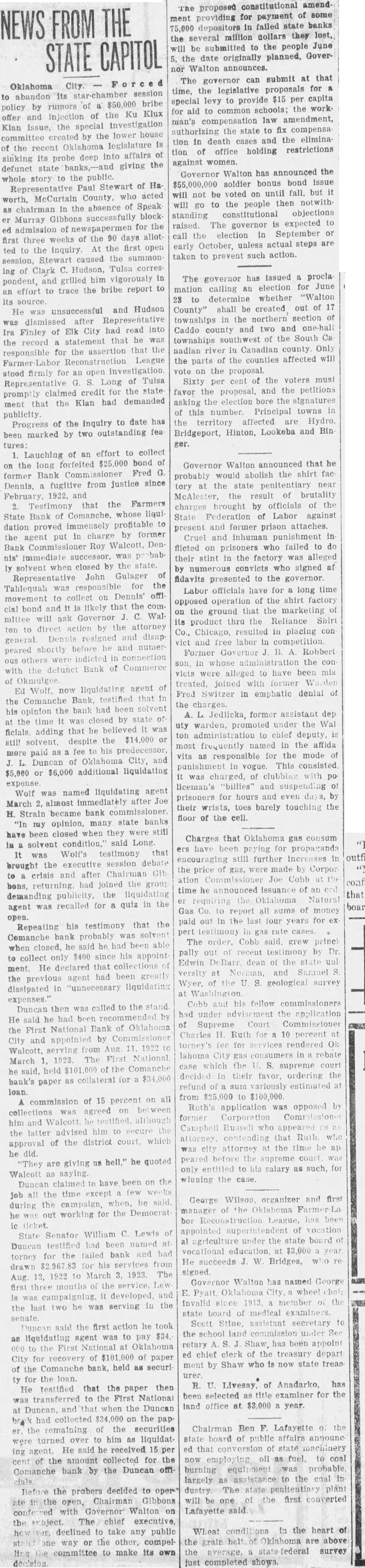
NEWS FROM THE STATE CAPITOL
Oklahoma City. — Forced to abandon its star-chamber session policy by rumors of a $50,000 bribe offer and injection of the Ku Klux Klan issue, the special investigation committee created by the lower house of the recent Oklahoma legislature is sinking its probe deep into affairs of defunct state banks, — and giving the whole story to the public.
Representative Paul Stewart of Haworth, McCurtain County, who acted as chairman in the absence of Speaker Murray Gibbons successfully blocked admission of newspapermen for the first three weeks of the 90 days allotted to the inquiry. At the first open session, Stewart caused the summoning of Clark C. Hudson, Tulsa correspondent, and grilled him vigorously in an effort to trace the bribe report to its source.
He was unsuccessful and Hudson was dismissed after Representative Ira Finley of Elk City had read into the record a statement that he was responsible for the assertion that the Farmer-Labor Reconstruction League stood firmly for an open investigation. Representative G. S. Long of Tulsa promptly claimed credit for the statement that the Klan had demanded publicity.
Progress of the inquiry to date has been marked by two outstanding features:
1. Launching of an effort to collect on the long forfeited $25,000 bond of former Bank Commissioner Fred G. Dennis, a fugitive from justice since February, 1922, and
2. Testimony that the Farmers State Bank of Comanche, whose liquidation proved immensely profitable to the agent put in charge by former Bank Commissioner Roy Walcott, Dennis' immediate successor, was probably solvent when closed by the state.
Representative John Gulager of Tahlequah was responsible for the movement to collect on Dennis' official bond and it is likely that the committee will ask Governor J. C. Walton to direct action by the attorney general. Dennis resigned and disappeared shortly before he and numerous others were indicted in connection with the defunct Bank of Commerce of Okmulgee.
Ed Wolf, now liquidating agent of the Comanche Bank, testified that in his opinion the bank had been solvent at the time it was closed by state officials, adding that he believed it was still solvent, despite the $14,000 or more paid as a fee to his predecessor, J. L. Duncan of Oklahoma City, and $5,000 or $6,000 additional liquidating expense.
Wolf was named liquidating agent March 2, almost immediately after Joe H. Strain became bank commissioner.
"In my opinion, many state banks have been closed when they were still in a solvent condition," said Long.
It was Wolf's testimony that brought the executive session debate to a crisis and after Chairman Gibbons, returning, had joined the group demanding publicity, the liquidating agent was recalled for a quiz in the open.
Repeating his testimony that the Comanche bank probably was solvent when closed, he said he had been able to collect only $400 since his appointment. He declared that collections of the previous agent had been greatly dissipated in "unnecessary liquidating expenses."
Duncan then was called to the stand. He said he had been recommended by the First National Bank of Oklahoma City and appointed by Commissioner Walcott, serving from Aug. 11, 1922 to March 1, 1923. The First National, he said, held $101,000 of the Comanche bank's paper as collateral for a $34,000 loan.
A commission of 15 percent on all collections was agreed on between him and Walcott, he testified, although the latter advised him to secure the approval of the district court, which he did.
"They are giving us hell," he quoted Walcott as saying.
Duncan claimed to have been on the job all the time except a few weeks during the campaign, when, he said, he was out working for the Democratic ticket.
State Senator William C. Lewis of Duncan testified had been named attorney for the failed bank and had drawn $2,967.83 for his services from Aug. 12, 1922 to March 3, 1923. The first three months of the service, Lewis was campaigning, it developed, and the last two he was serving in the senate.
Duncan said the first action he took as liquidating agent was to pay $34,000 to the First National at Oklahoma City for recovery of $101,000 of paper of the Comanche bank, held as security for the loan.
He testified that the paper then was transferred to the First National at Duncan, and that when the Duncan bank had collected $34,000 on the paper, the remaining of the securities were turned over to him as liquidating agent. He said he received 15 per cent of the amount collected for the Comanche bank by the Duncan officials.
Before the probers decided to operate in the open, Chairman Gibbons conferred with Governor Walton on the subject. The chief executive, however, declined to take any public stand one way or the other, compelling the committee to make its own decision.
The proposed constitutional amendment providing for payment of some 75,000 depositors in failed state banks the several million dollars they lost, will be submitted to the people June 5, the date originally planned, Governor Walton announces.
The governor can submit at that time, the legislative proposals for a special levy to provide $15 per capita for aid to common schools; the workman's compensation law amendment, authorizing the state to fix compensation in death cases and the elimination of office holding restrictions against women.
Governor Walton has announced the $55,000,000 soldier bonus bond issue will not be voted on until fall, but it will go to the people then notwithstanding constitutional objections raised. The governor is expected to call the election in September or early October, unless actual steps are taken to prevent such action.
The governor has issued a proclamation calling an election for June 23 to determine whether "Walton County" shall be created, out of 17 townships in the northern section of Caddo county and two and one-half townships southwest of the South Canadian river in Canadian county. Only the parts of the counties affected will vote on the proposal.
Sixty per cent of the voters must favor the proposal, and the petitions asking the election bore the signatures of this number. Principal towns in the territory affected are Hydro, Bridgeport, Hinton, Lookeba and Binger.
Governor Walton announced that he probably would abolish the shirt factory at the state penitentiary near McAlester, the result of brutality charges brought by officials of the State Federation of Labor against present and former prison attaches.
Cruel and inhuman punishment inflicted on prisoners who failed to do their stint in the factory was alleged by numerous convicts who signed affidavits presented to the governor.
Labor officials have for a long time opposed operation of the shirt factory on the ground that the marketing of its product thru the Reliance Shirt Co., Chicago, resulted in placing convict and free labor in competition.
Former Governor J. B. A. Robertson, in whose administration the convicts were alleged to have been mistreated, joined with former Warden Fred Switzer in emphatic denial of the charges.
A. L. Jedlicka, former assistant deputy warden, promoted under the Walton administration to chief deputy, is most frequently named in the affidavits as responsible for the mode of punishment in vogue. This consisted, it was charged, of clubbing with policeman's "billies" and suspending of prisoners for hours and even days, by their wrists, toes barely touching the floor of the cell.
Charges that Oklahoma gas consumers have been paying for propaganda encouraging still further increases in the price of gas, were made by Corporation Commissioner Joe Cobb at the time he announced issuance of an order requiring the Oklahoma Natural Gas Co. to report all sums of money paid out in the last four years for expert testimony in gas rate cases.
The order, Cobb said, grew principally out of recent testimony by Dr. Edwin DeBarr, dean of the state university at Norman, and Samuel S. Wyer, of the U. S. geological survey at Washington.
Cobb and his fellow commissioners had under advisement the application of Supreme Court Commissioner Charles H. Ruth for a 10 percent attorney's fee for services rendered Oklahoma City gas consumers in a rebate case which the U. S. supreme court decided in their favor, ordering the refund of a sum variously estimated at from $25,000 to $100,000.
Ruth's application was opposed by former Corporation Commissioner Campbell Russell who appeared as an attorney, contending that Ruth, who was city attorney at the time he appeared before the supreme court, was only entitled to his salary as such, for winning the case.
George Wilson, organizer and first manager of the Oklahoma Farmer-Labor Reconstruction League, has been appointed superintendent of vocational agriculture under the state board of vocational education, at $3,000 a year. He succeeds J. W. Bridges, who resigned.
Governor Walton has named George E. Pyatt, Oklahoma City, a wheel chair invalid since 1913, a member of the state board of medical examiners.
Scott Stine, assistant secretary to the school land commission under Secretary A. S. J. Shaw, has been appointed chief clerk of the treasury department by Shaw who is now state treasurer.
R. U. Livesay, of Anadarko, has been selected as title examiner for the land office at $3,000 a year.
Chairman Ben F. Lafayette of the state board of public affairs announced that conversion of state machinery now employing oil as fuel, to coal burning equipment was probable, largely as assistance to the coal industry. The state penitentiary plant will be one of the first converted Lafayette said.
Wheat conditions in the heart of the grain belt of Oklahoma are above the average, a state-federal survey just completed shows.