Security Savings Bank (New York, NY)

Episode Information

Episode UID
8622230590911
Episode Type
Run β†’ Suspension β†’ Closure
Bank Type
savings
Bank ID
862223059 hash
Start Date
November 26, 1875
Location
New York, New York (40.714, -74.006)

Metadata

Model
gpt-5-mini (chosen from majority vote of a three-model LLM ensemble)
Short Digest
721a327cf81a82eb

Response Measures

None

Description

Embezzlement by a teller was discovered during receivership, reducing recoveries to depositors.

Events (4)

1. November 26, 1875 Run
Cause
Local Banks
Cause Details
Panic and runs centered on Third Avenue and nearby suspended banks triggered a slight run on Security Savings Bank.
Measures
Officers/ trustees declined to receive deposits and invoked the sixty days' notice (practical closure to avoid withdrawals).
Newspaper Excerpt
There was also a slight run to-day on the Security Savings Bank
Source
newspapers
2. November 27, 1875 Suspension
Cause
Local Banks
Cause Details
Trustees suspended operations and adopted the sixty-day rule following runs and nearby bank failures/panic.
Newspaper Excerpt
This Bank will decline to receive deposits or pay drafts until an examination ... practical suspension
Source
newspapers
3. December 9, 1875 Receivership
Newspaper Excerpt
The receivers of broken savings banks were busy yesterday... The Security Savings Bank nominally resumed business yesterdav. The bank paid ten per cent. to those having large deposits who desired their bank ... Mr. William M. Banks, receiver of the Security Savings Bank, yesterday filed ... statement of the assets and liabilities of that institution (Feb 1876).
Source
newspapers
4. April 11, 1876 Other
Newspaper Excerpt
While the receiver ... was engaged ... he discovered that the bookkeeper and teller, John Seal, ... had embezzled funds to the extent of $70,000, and has fled to escape arrest. This will result in a further loss to the depositors of fifteen per cent.
Source
newspapers

Newspaper Articles (23)

Article from Evening Star, November 26, 1875

Click image to open full size in new tab

Article Text

Run on a New York Bank. NEW YORK, Nov. 26.-There was a run ON the People's Savings Bank this morning, but the officers closed their doors and took advantage of the sixty days notice. Officials say that the bank which was affected by a run on 3d avenue Savings Bank a short time ago will be able to pay now 75 cents on the dollar. There was also a slight run to-day on the Security Savings Bank, but not NO large as in the case of the People's bank.


Article from Public Ledger, November 26, 1875

Click image to open full size in new tab

Article Text

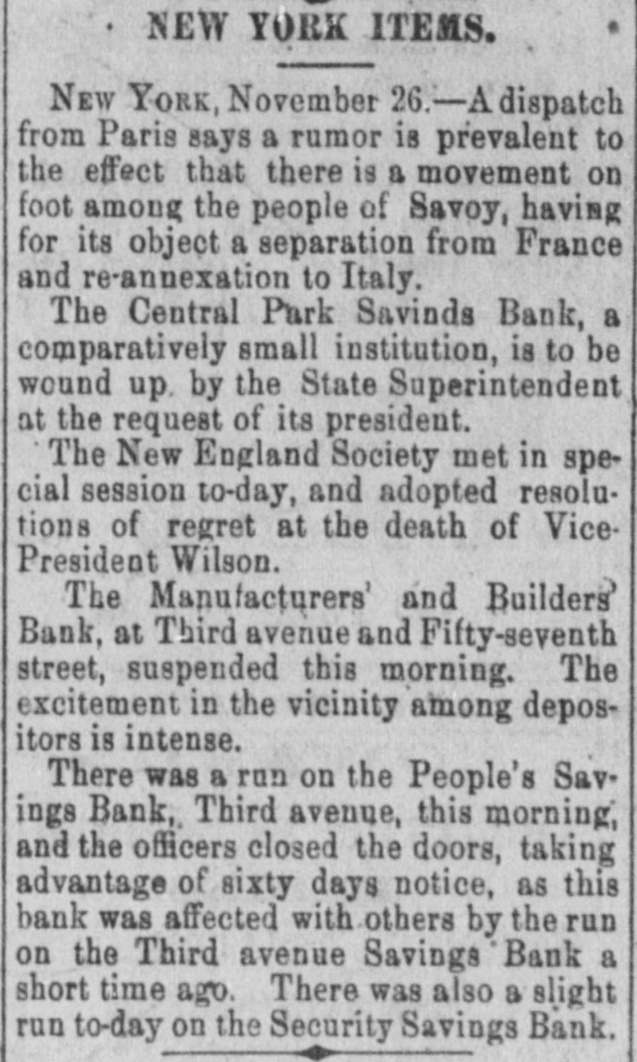
NEW YORK ITEMS. NEW YORK, November 26.-A dispatch from Paris says a rumor is prevalent to the effect that there is a movement on foot among the people of Savoy, having for its object a separation from France and re-annexation to Italy. The Central Park Savinds Bank, a comparatively small institution, is to be wound up, by the State Superintendent at the request of its president. The New England Society met in special session to-day, and adopted resolutions of regret at the death of VicePresident Wilson. The Manufacturers' and Builders Bank, at Third avenue and Fifty-seventh street, suspended this morning. The excitement in the vicinity among depositors is intense. There was a run on the People's Savings Bank, Third avenue, this morning, and the officers closed the doors, taking advantage of sixty days notice, as this bank was affected with others by the run on the Third avenue Savings Bank a short time ago. There was also a slight run to-day on the Security Savings Bank.


Article from New Orleans Republican, November 27, 1875

Click image to open full size in new tab

Article Text

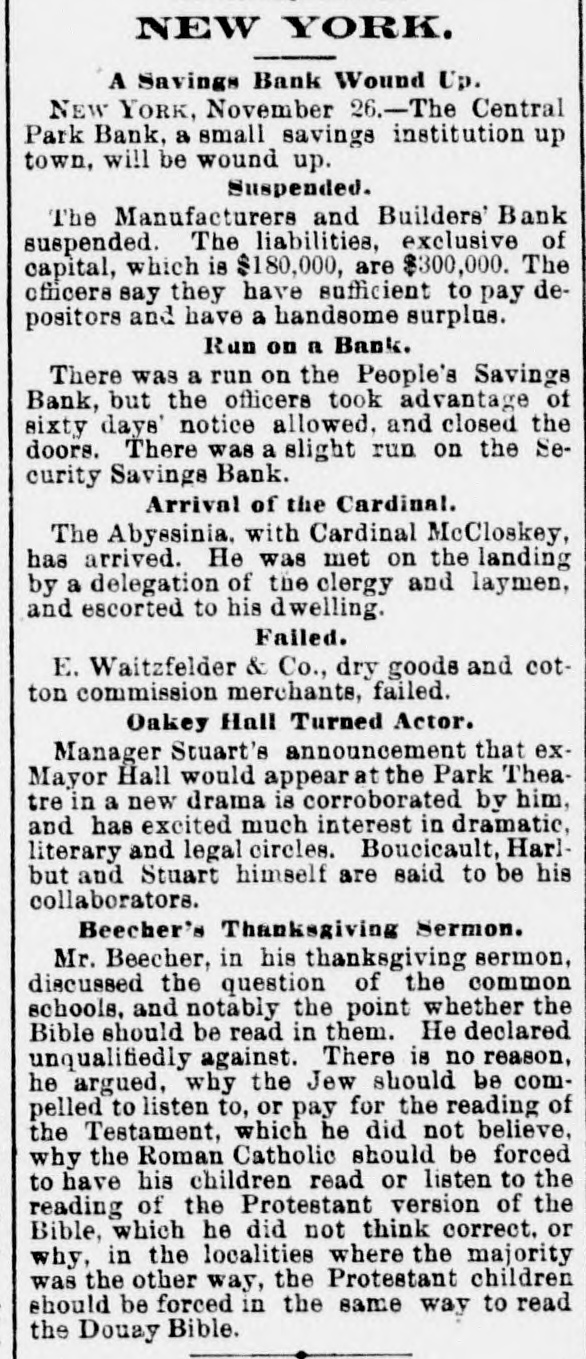
NEW YORK. A Savings Bank Wound Up. NEW YORK, November 26.-The Central Park Bank, a small savings institution up town, will be wound up. Suspended. The Manufacturers and Builders' Bank suspended. The liabilities, exclusive of capital, which is $180,000, are $300,000. The officers say they have sufficient to pay depositors and have a handsome surplus. Run on a Bank. There was a run on the People's Savings Bank, but the officers took advantage of sixty days' notice allowed. and closed the doors. There was a slight run on the Security Savings Bank. Arrival of the Cardinal. The Abyssinia. with Cardinal McCloskey, has arrived. He was met on the landing by a delegation of the clergy and laymen, and escorted to his dwelling. Failed. E. Waitzfelder & Co., dry goods and cotton commission merchants, failed. Oakey Hall Turned Actor. Manager Stuart's announcement that exMayor Hall would appear at the Park Theatre in a new drama is corroborated by him, and has excited much interest in dramatic, literary and legal circles. Boucicault, Harlbut and Stuart himself are said to be his collaborators. Beecher's Thanksgiving Sermon. Mr. Beecher, in his thanksgiving sermon, discussed the question of the common schools. and notably the point whether the Bible should be read in them. He declared unqualifiedly against. There is no reason, he argued, why the Jew should be compelled to listen to, or pay for the reading of the Testament, which he did not believe, why the Roman Catholic should be forced to have his children read or listen to the reading of the Protestant version of the Bible, which he did not think correct. or why, in the localities where the majority was the other way, the Protestant children should be forced in the same way to read the Douay Bible.


Article from Wilmington Daily Commercial, November 27, 1875

Click image to open full size in new tab

Article Text

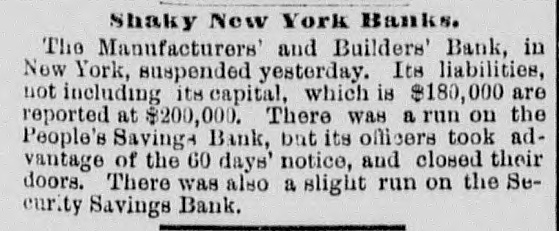
Shaky New York Banks. The Manufacturers' and Builders' Bank, in New York, suspended yesterday. Its liabilities, not including its capital, which is $180,000 are reported at $200,000. There was a run on the People's Saving4 Bank, but its officers took advantage of the 60 days' notice, and closed their doors. There was also a slight run on the Security Savings Bank.


Article from The New York Herald, November 27, 1875

Click image to open full size in new tab

Article Text

Total $92,778 Since the above report was made the complexion of affairs materially changed, and it appears that at the time the new building was occupied the whole of exthe depositors' money had, with the ception, perhaps, of $5,000 or $6,000 in cash, been sunk in the building. With regard to the building and the manner in which the bank was run, the story is better told in the words of the Bank Superintendent, Mr. Ellis, who, in conversation with a HERALD reporter last night, said substantially as follows:"it was by my order that the Central Park Bank closed. I have known for some time that they were not in a condition to go on with their business, and I applied for the appointment of a receiver. This not being done, I perempThe torily ordered the bank to be closed up. way in which my attention to the condition of affairs was called is as follows: When the new building was completed I was applied to by the president for permission to allow the bank to move to its present location. Knowing that the business usually done was but small I did not see what they wanted to change their offices for. I came on to New York and began an investigation, when I found that the bank had purchased the lot at the corner of Forty-eighth This street and built the present edifice. was the first intimation I had that they had begun building. The property had been bought and the building erected with THE DEPOSITORS' MONEY, which amounted to somewhere about $40,000 or I $45,000. The total cost of the building and lot was, believe, about $76,000. On this sum was paid $40,000 and a second mortgage given for the balance to Mr. Gearty, the President of the bank, who built the house. The first mortgage was, of course, held as security for the depositors, I found that there was existing, even looking upon this security as good, a deficiency of between $5,000 and $6,000, and until that was made good refused to sanction any removal, while at the same time I The had almost determined to close the institution. President finally said he would make up the deficiency himself by writing off from his second mortgage the sum of $5,000, and giving one to the bank for the same amount, which he did. This made the bank apparently straight on paper, that is to It say, the depositors had security for their money. was then said that it would be a saving of the $2,000 a year rent which the bank was then paying if the removal was made, as they had on their hands the new building and might as well occupy it. at last gave my consent, and after this removal was effected. some two or three weeks since, I continued to frequently look after the bank. Finding that the depositors were gradually withdrawing deposits, the money for which was furnished by the $5,000 or $6,000 held back when the $40,000 was paid, 1 determined to close the matter." A SINGUEAR FACT will be noticed in the above statement, which is that Mr. Gearty should not only act as President of the bank, but be the builder of the premises, while at the same time he is the second mortgagee, and paid himself the $40,000 out of the moneys entrusted to him for safe keeping by the depositors. Mr. J. W. Carey, the Vice President, has, it is understood, been busily engaged in doing the painton the building, inside and out No doubt these model ing officers thought it but right that the money spent the should be retained and divided for the benefit of brotherhood. The only wonder among banking people generally is that the Central Park Bank was not closed long since, for it has long been talked of What portion of their a deposits the unlucky depositors will ever get back is problem difficult to solve. The dividend will in all proba- be bility be not more than thirty per cent, and it may even very much less. THE SECURITY BANK. The practical stoppage of the Security Savings Bank took every one by surprise yesterday morning, for it was looked upon with great favor and confidence. inPeople at first refused to credit the fact, but when quiry was made at the office no further doubt existed. There they found posted on the glass partition enclos ing the clerks' desks the following cards:NNNNO This Bank will decline to receive deposits or 2 2 pay drafts until an examination which has been re {quested shall have been made by the State Superin tendent. Mr. Ellis, the Bank Superintendent, was present 2 at the bank this morning and states that he has every confidence in the solvency of the bank, and that any statements purporting to have been made by him regarding the appointment of a receiver are without the slightest foundation. He will ex amine the bank on Monday. ONNAMI Mr. Commissioner D. D. T. Marshall was on hand throughout the day, and, in answer to all inquiries, stated in the most emphatic terms that there exists no ground for any apprehension of loss to the depositors. Every claim would be paid in full. The trustees, he said, had simply determined, In order to avoid a run on the bank, to not receive any more deposits and to avail themselves of the sixty days' notice required by law to be given e by the depositors before withdrawing their money. , This course will be followed until the Bank Superin tendent has made an examination into the bank's affairs. "This is, of course, a practical suspension, but leaves us in a position," " said Mr. Marshall, "to go on or wind up, according as the official examination shall determine our exact condition. The securities are all first class, and will fully realize all they are set down for on was the books." This fact, it may here be mentioned, afterward verified by the reporter by inquiries made that in other quarters Indeed, it is the general belief mapk is Able to DAY every one, There, however.
Article from The New York Herald, November 27, 1875

Click image to open full size in new tab

Article Text

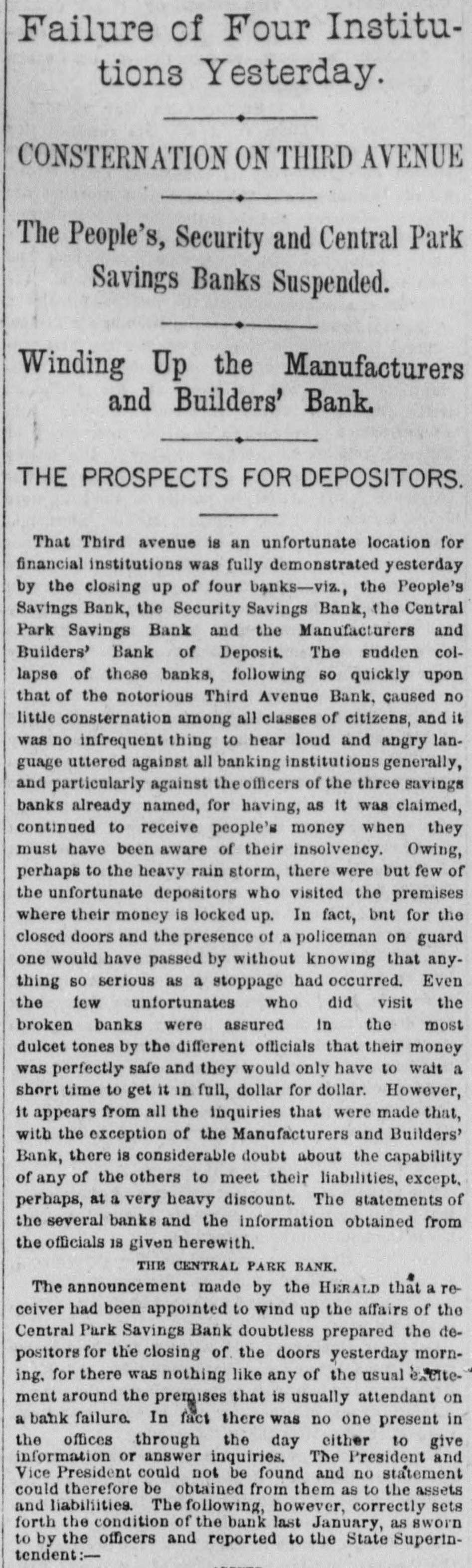
Failure of Four Institutions Yesterday. CONSTERNATION ON THIRD AVENUE The People's, Security and Central Park Savings Banks Suspended. Winding Up the Manufacturers and Builders' Bank. THE PROSPECTS FOR DEPOSITORS. That Third avenue is an unfortunate location for financial institutions was fully demonstrated yesterday by the closing up of four banks-viz., the People's Savings Bank, the Security Savings Bank, the Central Park Savings Bank and the Manufacturers and Builders' Bank of Deposit. The sudden collapse of these banks, following 60 quickly upon that of the notorious Third Avenue Bank, caused no little consternation among all classes of citizens, and it was no infrequent thing to hear loud and angry language uttered against all banking institutions generally, and particularly against the officers of the three savings banks already named, for having, as it was claimed, continued to receive people's money when they must have been aware of their insolvency. Owing, perhaps to the heavy rain storm, there were but few of the unfortunate depositors who visited the premises where their money is locked up. In fact, bnt for the closed doors and the presence of a policeman on guard one would have passed by without knowing that anything so serious as a stoppage had occurred. Even the few unfortunates who did visit the broken banks were assured in the most dulcet tones by the different officials that their money was perfectly safe and they would only have to wait a short time to get it in full, dollar for dollar. However, it appears from all the inquiries that were made that, with the exception of the Manufacturers and Builders' Bank, there is considerable doubt about the capability of any of the others to meet their liabilities, except, perhaps, at a very heavy discount. The statements of the several banks and the information obtained from the officials 18 given herewith. THE CENTRAL PARK BANK. The announcement made by the HERALD that a receiver had been appointed to wind up the affairs of the Central Park Savings Bank doubtless prepared the depositors for the closing of the doors yesterday morning, for there was nothing like any of the usual entitement around the premises that is usually attendant on a bank failure. In fact there was no one present in the offices through the day either to give information or answer inquiries. The President and Vice President could not be found and no statement could therefore be obtained from them as to the assets and liabilities. The following, however, correctly sets forth the condition of the bank last January, as sworn to by the officers and reported to the State Superintendent:-


Article from Chicago Daily Tribune, November 27, 1875

Click image to open full size in new tab

Article Text

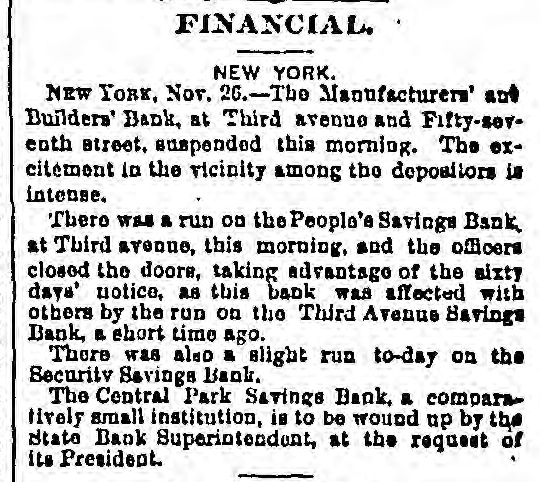
FINANCIAL. NEW YORK. NEW YORK, Nov. 26.-The Manufacturers' and Builders' Bank, at Third avenue and Fifty-seventh street, suspended this morning. The excitement in the vicinity among the depositors is intense. There was a run on the People's Savings Bank, at Third avenue, this morning, and the officers closed the doors, taking advantage of the sixty days' notice, as this bank was affected with others by the run on the Third Avenue Savings Bank, a short time ago. There was also & slight run to-day on the Security Savings Bank. The Central Park Savings Bank, a comparatively small institution, is to be wound up by the State Bank Superintendent, at the request of its President.


Article from The Cincinnati Daily Star, November 30, 1875

Click image to open full size in new tab

Article Text

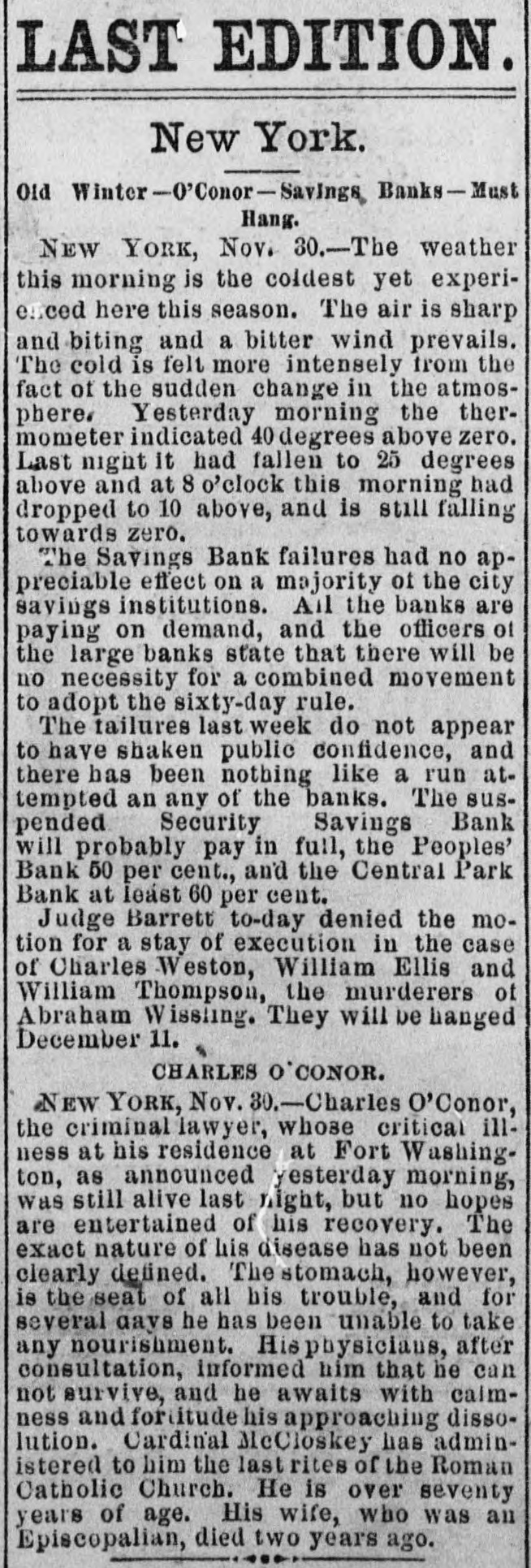
LAST EDITION. New York. Old Winter-0'Conor-Savings - Banks-Must Hang. NEW YORK, Nov. 30.-The weather this morning is the coldest yet experien ced here this season. The air is sharp and biting and a bitter wind prevails. The cold is felt more intensely from the fact of the sudden change in the atmosphere. Yesterday morning the thermometer indicated 40 degrees above zero. Last night it had fallen to 25 degrees above and at 8 o'clock this morning had dropped to 10 above, and is still falling towards zero. The Savings Bank failures had no appreciable effect on a majority of the city savings institutions. All the banks are paying on demand, and the officers of the large banks state that there will be no necessity for a combined movement to adopt the sixty-day rule. The tailures last week do not appear to have shaken public confidence, and there has been nothing like a run attempted an any of the banks. The suspended Security Savings Bank will probably pay in full, the Peoples' Bank 50 per cent., and the Central Park Bank at least 60 per cent. Judge Barrett to-day denied the motion for a stay of execution in the case of Charles Weston, William Ellis and William Thompson, the murderers of Abraham Wissing. They will be hanged December 11. CHARLES O'CONOR. NEW YORK, Nov. 30.-Charles O'Conor, the criminal lawyer, whose critical illness at his residence at Fort Washington, as announced yesterday morning, was still alive last night, but no hopes are entertained of his recovery. The exact nature of his disease has not been clearly defined. The stomach, however, is the seat of all his trouble, and for several days he has been unable to take any nourishment. His physiciaus, after consultation, informed him that he can not survive, and he awaits with calmness and fortitude his approaching dissolution. Cardinal McCloskey has administered to him the last rites of the Roman Catholic Church. He is over seventy years of age. His wife, who was an Episcopalian, died two years ago.


Article from Los Angeles Daily Herald, November 30, 1875

Click image to open full size in new tab

Article Text

EASTERN NEWS. New York News. NEW YORK, November 29th.-Information from Fort Washington received late this afternoon states that Charles O'Connor is alive, but very low, and his physicians say he cannot live over night. The Savings Bank failure has had no effect on the majority of the city savings institutions. To-day all the banks are paying on demand, and the officers of the large banks state that there will be no necessity for a combined movement to adopt the sixty days rule. The failures last week do not appear to have shaken public confidence, and there was nothing like a run attempted on any of the banks today. The suspended Security Savings Bank will probably pay in full, the People's Bank fifty per cent., and the Central Park Bank at least sixty per cent. Judge Barrett to-day denied the motion for a stay of execution in the case of Chas. Weston, Wm. Ellis and Wm. Thompson, the negro murderers of Abraham Weisberg, and they will be hanged December 18th.


Article from New-York Tribune, November 30, 1875

Click image to open full size in new tab

Article Text

THE SAVINGS BANKS. FEELING OF SECURITY IN THE LARGER INSTITUTIONS -EFFORTS TOWARD RESUMPTION AT THE SECURITY BANK-RUN ON THE NORTH RIVER BANK-EXAMINATION OF THE OFFICERS OF THE THIRD AVENUE BANK. The savings banks "funerally are paying all depositors applying for money. Depositors as a rule do not draw heavily in December, in order to save the interest due at the beginning of the year. The officers of the large institutions have no fear of trouble. There is much distrust as to some of the smaller banks, but it is believed that the excitement is calming down, and that the alarm is local, confined to the Third-ave., between Twenty-third and Fifty-seventh-sts., in the immediate vicinity of the suspended Third Avenue Savings Bank. The President of the People's Savings Bank stated yesterday that there had been no meeting of the trustees or officers of the institution. Nothing could be done by them, and they were awaiting the action of the Attorney-General. They had been given notice to show cause to-day why a receiver should not be appointed. They were not going to show cause, but would allow the appointment of a receiver by default. Several depositors called at the bank during the day for information. No statement has yet been prepared. Mr. Benedict, Secretary of the Mutual Benefit Bank, said yesterday that the trustees were endeavoring to put the affairs of the bank on a sound basis, which would satisfy the Superintendent and depositors, with the view of soon resuming business. Hedeclined to state whether the trustees intended to make up the deficiency as they did in 1873, or what the amount of the deficiency was. No receiver, he said, had been appointed, and he did not think that there would be one. No notice had been received from Mr. Ellis as to what action he would take. By to-day or to-morrow the action of the trustees would probably be made known. A large number of depositors at this bank yesterday gave the required 60 days' notice of withdrawal. Henry Clausen, President of the German Up-town Savings Bank, said yesterday that his bank was in a perfectly sound condition. Two months ago, before be became President, a committee investigated the affairs of the bank thoroughly, and reported its surplus to be over $25,000. No examiner had investigated it since. The eause of the adoption of the 60 days' rule had been the alarm arising from the failure of two or three banks in the vicinity. This bank was located between the Manufacturers' and Builders' and the Central Park Banks, both of which had suspended, and on that account its depositors had shown considerable unnecessary alarm. Sums of $20 were paid without notice. Several depositOTS gave notice of withdrawal yesterday, but Mr. Clausen said there had been fewer withdrawals than he had anticipated. Ane trustees of the Security Savings Bank held a meeting last evening, at the bank, and decided to call a meeting of the largest depositors this week, and ask their cooperation in preventing a run. D. D. T. Marshall, the President, stated to a reporter of THE TRIBUNE, after the adjournment, that several of the largest depositors would be added to the Board of Trustees. The law allowed 30 trustees, and the present Board would avail themselves of this provision, and increase the number. Mr. Marshall also said that the bank had paid to depositors during the past five years $156,000 in interest, and had not lost a dollar by bad investments. There was a surplus over liabilities, and the Bank Examiner's statement showed that the bank wassound. Many of the depositors had called at the bank and expressed their confidence in the management. Mr. Marshall thought tuat the bank would go on again by next Monday. A run was made on the North River Savings Bank yesterday, but the officers are satisfied that it will not continue. The bank has a surplus of $60,000. It is no 11cumbered, the officers state, with any real estate or depreciated securities, all its stocks and bonds are first class, and its assets have a known market value far in excess of the amount due depositors. The total deposits in this bank are about $840,000. At the Yorkville Police Court yesterday, the examination into the charge of perjury against the officers of the Third Avenue Savings Bank was begun, Justice Duffy presiding. The complainant was Georgiana F. Levien. The prisoners in court were John H. Lyon. Toompson W. Decker. David Morgan, Daniel Bates, and William S. Carman. The first witness was Charles W. Hassler of No. 7 Wall-st., editor of Hassler's Weekly Financial Reporter: The testimony of Mr. Hassler, who is regarded as an expert, was mainly occupied in quoting the actual marketable value of Southern securities held by the bank during The of the witness WILA


Article from New-York Tribune, December 2, 1875

Click image to open full size in new tab

Article Text

THE SAVINGS BANKS. sOLVENCY OF THE MECHANICS AND TRADERS' SAVINGS INSTITUTION - CLEAR SURPLUS OF $50,000-OTHER BANKS. A number of the depositors of the Mechantes and Traders' Savings Institution, at No. 283 Bowery, applied for their money yesterday. The banking rooms were crowded and the payments were made slowly, and after a careful examination and comparison of the pass-books with the ledger accounts of the bank. Some of the trustees were present endeavoring to reason with the frightened depositors, and to convince them of the solvency of the institution. To & reporter of THE TRIBUNE were shown the books and accounts of the bank, with a statement of the market value of the assets. A. T. Conklin, the President, and Henry C. Fisher, the Secretary, declared that the bank was perfectly safe, and could pay dollar for dollar of liabilities without any difficulty. Mr. Conklin stated that the bank wasexamined on April 1, 1874, by theState bank examiners, who reported a surplus of $82,333 18* The bank property was appraised by appraisers em. ployed by the Bank Department, and was put down to its lowest market value. The market value of the stocks, bonds, and other securities was obtained by the examiners after consultation with leading brokers in Wall-st. The annual report, Jan. 1,1875, said Mr. Conklin, was an honest and true statement of the bank's condition. It showed a large surplus over liabilities, and was in every particular corroot. A8 to the item of suspense account, bankruptcy claim, worth $20,000," that claim was well known by the trustees to be good beyond all question, and would yield, principal and interest, at least $25,000 in a few months. The lawsuit pending in relation to it was merely to determine which of two very rich men was liable to the bank for the full amount. The total market value of the stocks and bonds owned by the bank at the present time was largely in excess of the figures reported by the bank examiners. A profit of $20,000 had been made last year on the sale of Government securities a few days before the examination, which did not appear in the figures of the examiners. This sum alone met all the charges of salaries, taxes, and incidental expenses. Salaries had been reduced $5,000 last year, and a considerable reduction made in advertising, stationery, &c. In every way, Mr. Conklin continued. the bank had economized and sought to merit the confidence of its customers and the public. After deducting this suspense account of $20,000, and making due allowance for any unexpected shrinkage, the bank had a clear surplus of at least $50,000. The trustees had decided to enforce the 60 days' rule in extreme cases, but would pay small amounts and pressing claims without delay. This action had been taken in order to protect depositors in the payment of interest due them at the end of this month. Mr. Conklin said, in conclusion that there had been a want of harmony in the Board of Direction some time ago, and the attack on the bank might have originated from that cause. The Mutual Benefit and the Security Savings Banks continued open yesterday, without transacting any business. The Security, it is understood, will resume in two or three days. A receiver for the People's Savings Bank had not arrived at the bank yesterday afternoon, but it is not doubted that an appointment was made yesterday.


Article from The Stark County Democrat, December 2, 1875

Click image to open full size in new tab

Article Text

ONE BANK SUSPENDS AND ANOTHER CLOSES ITS DOORS TO SAVE ITSELF. New York, Nov. 26.-The Manufacturers and Builders' Bank, at Third avenue and Fifty-seventh street, suspended this morning. The excitement among the depositers is intense. There was a run on the People's Savings Bank. Third avenue, this morning and the officers closed the doors, taking advantage of the sixty days' notice. This bank was affected, with others, by the run on the Third Avenue Savings Bank a short time ago. There was also a slight run to-day on the Security Savings Bank. The Central Park Savings Bank, a comparatively small institution, is to be wound up by the State Superintendent, at the request of its President.


Article from The Eaton Democrat, December 9, 1875

Click image to open full size in new tab

Article Text

TOO MUCH MONEY! COVINGTON, Kr., Nov. 27.-It falls to our lot to record another big brewery failure. A deed of assignment from Henry Niemeyer, jun., to H. P. Whitaker was lodged for record in the County Clerk's office yesterday. NEW YORK, Nov. 26.-The Manufacturers' and Builders' Bank, at Third avenue and Fifty-seventh St., suspended this morning. The excitement among the depositors is in tense. There was a run on the People's Savings Bank, Third avenue, this morning and the officers closed the doors, taking advantage of the sixty days' notice. This bank was affected, with others, by the 1un on the Third Avenue Savings Bank a short time ago. There W?S also a slight run to-day on the Security Savings Bank. The Central Park Savings Bank, a comparatively small institution, is to be wound up by the State Superintendent, at the request of its President. NEW YORK, Dec. 1.-R. & P. Lawrence, heavy stationers in Maiden Lane, announce to their creditors their inability to continue their payments. They promise a prompt state ment of their affairs when a meeting of creditors will be called. NEW ORLEANS, Dec. 1.-The Bank e of America has suspended. The Board of Directors resolved to cease operations and put the bank into liquidation at once. NEW YORK, Dec. 1.-The failure of John Thompson & Co., No. 441 Broadway, and No. 15 Mercer street, hair and fancy goods, is announced. u MT. VERNON, Nov. 29.-Several business men and farmers hereabouts e have made assignments recently. n NEW YORK, Dec. 2.-The failure of B. & P. Lawrence, stationers, Maiden Lane, is likely to be a heavy one, though much of the indebtedness is n to foreign houses. The liabilities of e Abrahan Bogardus, photographer, whose failure is announced, are esti0 mated at $35,000. He claims if his n creditors will allow him time he will y pay in full.


Article from The Sun, December 9, 1875

Click image to open full size in new tab

Article Text

GUARDING WHAT IS LEFT. MORE RECEIVERS APPOINTED FOR THE CRIPPLED BANKS. A Little ΠŸΠΎΡ€Π΅ for the Third Avenue Bank Depositors-The People's, Central Park, Mutual. and German Up-Town Banks. The receivers of broken savings banks were busy yesterday. Mr. Hurd. of the Third Avenue, said to a SUN reporter: My business will be to get all the money I can for the deposHors. The criminal prosecutions are affairs of the District Attorney. I shall take no part in them except as required by law and duty as a citizen. I will institute civil proceedings against any trustee who may have rendered himself liable for the losses of the bank. I will pay the depositors as soon as I can realize on the assets. I have no alliances, and am bound only oy the orders of the Court which appointed me." One depositor, a moulder, who works at night. and who has about $2,000 in the bank, has been in the habit of walking up and down in front of the building every afternoon since the failure. When ne heard that Mr. Hurd was receiver he expressed biseatisfaction, and was absent from his post vesterday. Mr. Isase M. French vesterday took charge of the People's and the Central Park Savings' Banks, of which he has been sppointed receiver. Ho transferred the assets of the People's Bank to A Tr at Company, in accordance with the order of the Court at Albany. There are no BMS. in the Central P rk Ba: K to transfer. and the movement of trustees to pay the depositors and take the bank building was not instured. Unless 8 mething be done. the mortgages on the building will be foreclosed, and the depositors whitget little or no things .r. Herman Uni, one of the editors of the Staats Zeitung, and step-son of Mr. Oswaid Ottendorfer. was yesterday appointed receiver of the German Uptown Savings B nk. The complainant Was John Martin Mant. n depositor of $2,300. and the complainant set forth that the amount due to depositorsis $838,000, and the assets not more than $800,000, all of which was admitted in the answer. The receiver gave a bond for $150.000. The order requires him to deposit all the assets coming into his possession, except $25,000. with the New York Life Insurance and Trust Company: to make an inventory at once, and to make a report of the property within forty days, and ithin each succeeding forty days. or show cause. The appointment of Mr. Uhl is said to have the hearty approval of Mr. Claussan, the late President, who exposed the condition of the bank. and gives satisfaction to the depositors. On complaint of Edgar A. Simmons. a deposttor in the Mutual Benefit. W. F. Aidrich, law yer. of 84 Broadway, has be D appointed receiver of the concern. His bond is fixed at $75,000. The compt Int represented the deposits to be $450.000, and the deficiency $22,500. So far as the SUN reporter could learn, Mr. Aldrich is unknown to the depositors in general, and many of them think that they should have been consulted. The appointment is at the instance of the trustees. The Security Savings Bank nominally resumed business yesterdav. The bank paid ten per cent. to these having tarze deposits who desired their bank


Article from The New York Herald, February 12, 1876

Click image to open full size in new tab

Article Text

THE SECURITY SAVINGS BANK. Mr. William M. Banks, receiver of the Security Savings Bank, yesterday filed in the County Clerk's office a statement of the assets and liabilities of that institution. It appears that by realizing on the securities held as assets, those assets, as now stated, amount to $329,594 65. The liabilities will reach $326,636 69. The accrued interest on rent and deposits does not appear in the figures. The following are the principal figures of the statement:-


Article from Evening Star, April 11, 1876

Click image to open full size in new tab

Article Text

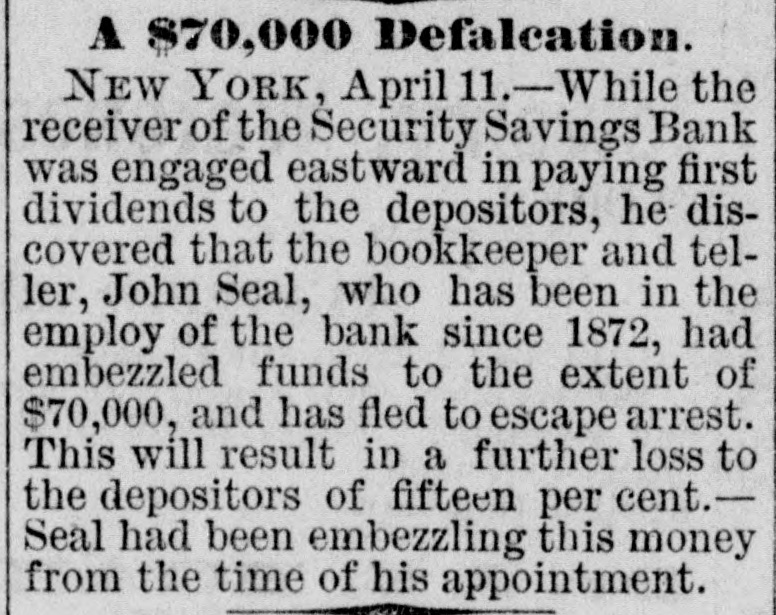
A 870,000 Dafalcation. NEW YORK, A pril 11.- While the receiver of the Security Savings Bank was engaged eastward in paying first dividends to the depositors, be discovered that the bookkeeper and teller, John Seal, who has been in the employ of the bank since 1872, had embezzled funds to the extent of $70,000, and has fied to escape arrest. This will result in a further loss to the depositors of fifteen per cent. Seal bad been embezzling this money from the time of his appointment.


Article from The New York Herald, April 11, 1876

Click image to open full size in new tab

Article Text

ANOTHER DEFAULTER. DISCOVERY OF A DEFALCATION OF SEVENTY THOUSAND DOLLARS BY ONE OF THE TELLERS OF THE SECURITY BANK. Mr. W. M. Banks, receiver of the Security Savings Bank, while engaged last week in paying the first dividend to the unfortunate depositors in that defunct institution, made a discovery which will result in a further loss to them of about fifteen percent. It appears that the bookkeeper and teller, John Seal, who has been in the employ of the bank since June, 1872, has embezzled funds to the extent of $69,600, and has fied to escape arrest. The manner in which this robbery was discovered was as follows:-On Monday of last week Mr. Banks commenced the payment of the first instalment to the depositors, giving checks for all sums of over $200, and paying lesser amounts than this in cash. Toward evening he called for the receipt book, and on making a comparison between the stubs of the checks already paid and the receipts made out in the receipt book which were awaiting the signatures of the depositors yet to call for their money, he found there was apparently some mistake either in the making out of the receipts or in the calculations he had made as to the amount required to pay the dividend. Seal was called and a consultation was held. He was asked to go over the accounts and books, with a view to finding where the discrepancy was. it being time to close the bank, he promised to do so in the evening and have everything straight for opening time on Tuesday morning. Mr. Banks then left the building, without suspicion that anything was wrong. Next day, on arriving at the offices ol the bank, he inquired for Seal, but was told that he had not appeared. This some. what aroused his suspicions, and be began himself to make a personal examination of the books, when, discovering some trilling errors, no sent for two export accountants. These gentlemen at once commenced operations, and very soon found that since August, 1872, two months after Seal had first been employed, he had been in the habit of embezzling money and continued his thievery until the bank suspended. It was also discovered that on Monday night, after his conversation with the receiver, he had DUR. Joined $500, with which to make good his escape. He also borrowed $25 from a tradesman in the neighborhood, and carried away with him, in addition, $700, which he had collected as rent due to the Coulant estate, of which Excise Commissioner Marshall is ad ministrator. The latter had employed Seal as agent. The way in which Seal rohbed the bank was most ingenious, although had the officers exercised proper supervision over the affairs it would have been impossible for him to have extended his operations over tour years without detection. It will also be remembered that the State Examiner, when the bank suspended last fall, made, as he then stated, a tull and thorough EXAMINATION OF THE BOOKS and assets, and asserted that there then existea a sur plus. How thorough this examination was this reve lation proves, for had the ledgers and cash books been then compared the fraud must have been at once dis. covered. It appears that when a depositor would pay in certain sum of money Seal would credit the amount on the depositor's ledger. In the cash book he would make an entry of the amount to the credit of "John Seal. Agent," thus mak. ing the books balance. Shortly afterward, probably the same day, be would draw out the money. It was not until the depositors' passbooks were examined and the entries therein compared with those in the cash book that the fraud was discovered. In some instances he would omit the entries altogether in the cash book, which would show, if the depositors' ledger and the general ledger had been compared, a differ. ence, and when the balance sheet came to be drawn off the robbery must have been seen at a glance. 'It would seem, however, that when the time came for the preparing of the balance sheet Seal would call off the amounts to another clerk, and remem. bering the sums he had embezzled, would also call them. although they were not on the book. He then made false totals in order to cover up his tracks, so that when the final balance sheet was struck the main sums would appear all straight, unless a most thorough examination was made. Had the officers once tooted up the columns of the general ledger all would have been known. Seal was formerly at eller in the Third Avenue Savings Bank, where he bore an excellent character. He resigned his position there to go to the Security Bank. He is said to be mas unostentatious in his habits and mode of living, and is married. Lately he has been living at Whitestone, J. 1., but has frequently changed his residence during the past two years. This is the second defalcation on the part of the em. ployΓ©s of the bank, the first being one of $4,000, committeed eighteen months ago by a teller named Tuttle. The last balance sheet showed that the liabilities of the bank were $324,000 as against assets $298,000. These latter will now be reduced by $70,000, making a deficiency of $96,000, even supposing the bank build. ing realizes $50,000, at which price it is estimated in the schedule.


Article from The New York Herald, April 13, 1876

Click image to open full size in new tab

Article Text

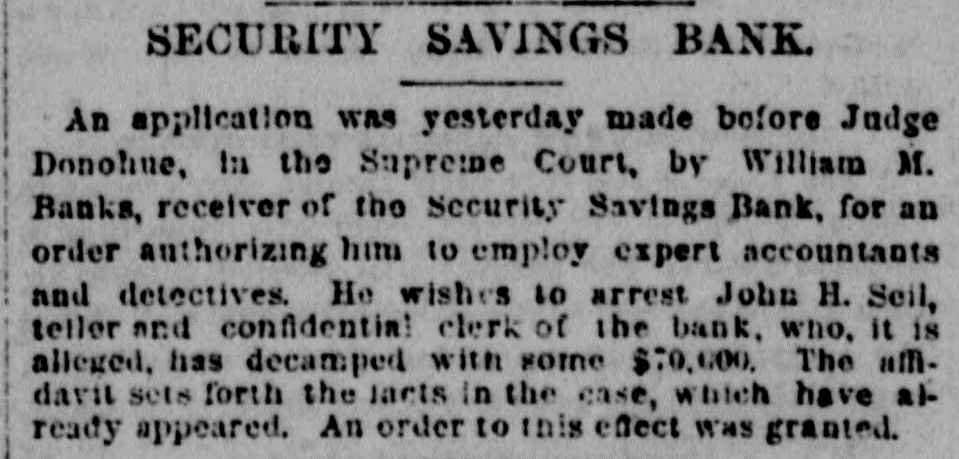
SECURITY SAVINGS BANK. An application was yesterday made before Judge Donohue, In the Supreine Court, by William M. Banks, receiver of the Security Savings Bank, for an order authorizing him to employ expert accountants and detectives. He wishes 10 arrest John H. Seil, teller and confidential clerk of the bank. who, it is alleged. has decamped with some $:0,000. The am. davit sets forth the lacts in the case, which have already appeared. An order to this effect was granted.


Article from Martinsburg Independent, April 15, 1876

Click image to open full size in new tab

Article Text

A $70,000 Defalcation. NEW YORK, April 11.-While the receiver of the Security Savings Bank was engaged eastward in paying first dividends to the depositors, he discovered that the bookkeeper and teller, John Seal, who has been in the employ of the bank since 1872, had embezzled funds to the extent of $70,000, and has fled to escape arrest. This will result in a further loss to the depositors of fifteen per cent.Seal had been embezzling this money from the time of his appointment.


Article from The New York Herald, April 28, 1877

Click image to open full size in new tab

Article Text

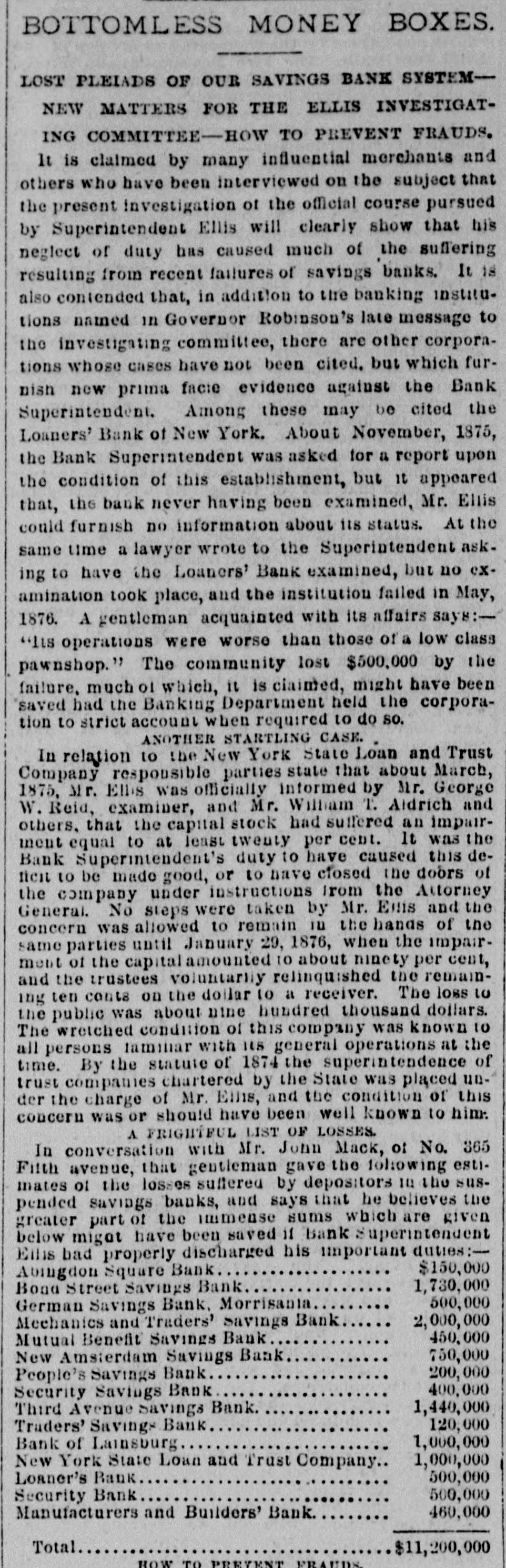
BOTTOMLESS MONEY BOXES. LOST PLEIADS OF OUR SAVINGS BANK SYSTEMNEW MATTERS FOR THE ELLIS INVESTIGATING COMMITTEE-HOW TO PREVENT FRAUDS. It is claimed by many influential merchants and others who have been interviewed on the subject that the present investigation of the official course pursued by Superintendent Ellis will clearly show that his neglect of duty has caused much of the suffering resulting from recent failures of savings banks. It is also contended that, in addition to the banking institu. tions named in Governor Robinson's late message to the investigating committee, there are other corporations whose cases have not been cited. but which furnish new prima facie evidence against the Bank Superintendent. Among these may be cited the Loaners' Bank of New York. About November, 1875, the Bank Superintendent was asked for a report upon the condition of this establishment, but it appeared that, the bank never having been examined, Mr. Eltis could furnish no information about its status. At the same time a lawyer wrote to the Superintendent asking to have the Loaners' Bank examined, but no examination took place, and the institution failed in May, 1876. A gentleman acquainted with its affairs says:"Its operations were worse than those of a low class pawnshop." The community lost $500,000 by the failure, much 01 which, it is claimed, might have been saved had the Banking Department held the corporation to strict account when required to do so. ANOTHER STARTLING CASE. In relation to the New York State Loan and Trust Company responsible parties state that about March, 1875, Mr. Ell's was officially informed by Mr. George W. Reid, examiner, and Mr. William T. Aidrich and others, that the capital stock had suffered an impairment equal to at least twenty per cent. It was the Bank Superintendent's duty to have caused this deneit to be made good, or to have closed the doors of the company under instructions from the Attorney General. No steps were taken by Mr. Exis and the concern was allowed to remain in the hands of the same parties until January 29, 1876, when the impairment of the capital amounted 10 about ninety per cent, and the trustees voluntarily relinquished the remaining ten conts on the dollar to a receiver. The loss 10 the public was about nine hundred thousand dollars. The wretched condition of this company was known to all persons familiar with us general operations at the time. By the statute of 1874 the superintendence of trust companies chartered by the State was placed under the charge of Mr. Ellis, and the condition of this concern was or should have been well known to him. A FRIGHTFUL LIST OF LOSSES. In conversation with Mr. John Mack, of No. 365 Fifth avenue, that gentleman gave the following estimates of the losses suffered by depositors 10 the suspended savings banks, and says that he believes the greater part of the immense sums which are given below migot have been saved if Bank Superintendent Eths bad properly discharged his important duties:$150,000 Abingdon Square Bank 1,730,000 Bona Street Savings Bank 500,000 German Savings Bank, Morrisanta 2,000,000 Mechanics and Traders' Savings Bank 450,000 Mutual Benefit Savings Bank 750,000 New Amsterdam Savings Bank 200,000 People's Savings Bank 400,000 Security Savings Bank 1,440,000 Third Avenue Savings Bank. 120,000 Traders' Savings Bank 1,000,000 Bank of Lainsburg 1,000,000 New York State Loan and Trust Company Loaner's Rauk 500,000 500,000 Security Bank Manufacturers and Builders' Bank. 460,000 Total $11,200,000 HOW TO PREVENT FRAUDS


Article from The New York Herald, November 2, 1877

Click image to open full size in new tab

Article Text

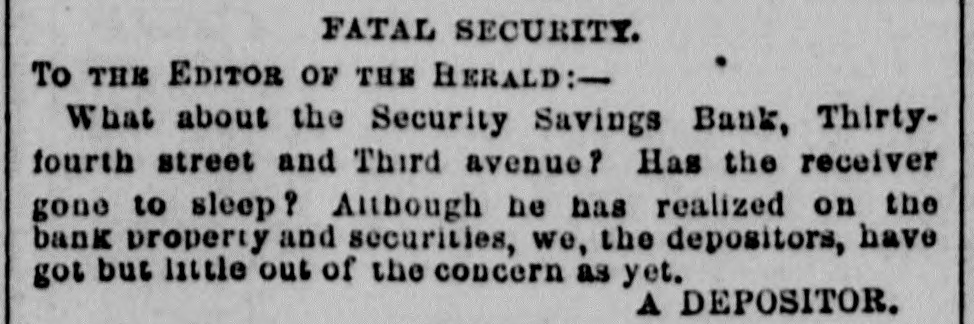
FATAL SECURITY. To THE EDITOR OF THE HERALD:What about the Security Savings Bank, Thirtyfourth street and Third avenue? Has the receiver gone to sleep? Altbough he has realized on the bank property and securities, we, the depositors, have got but little out of the concern as yet. A DEPOSITOR.


Article from The New York Herald, January 28, 1878

Click image to open full size in new tab

Article Text

THE SECURITY SAVINGS BANK. To THE EDITOR OF THE HERALD:Can you inform me why Receiver Bangs, of the Security Savings Bank, has not tried to recover from the trustees part of that $70,000? The charter of the bank requires each clerk to give bonds to the amount of $20,000. If the trustees failed to require the receiving teller to give such bond did they not make themselves liable? A DEPOSITOR.


Article from The New York Herald, February 17, 1879

Click image to open full size in new tab

Article Text

WHEN WILL HE PAY? To THE EDITOR OF THE HERALD:Why does not the receiver of the Security Savings Bank pay the depositors? CONSTANT READER.