Second Bank of the United States (Philadelphia, PA)

Episode Information

Episode UID
8641175990229
Episode Type
Run Only
Bank Type
federal
Bank ID
864117599 hash
Start Date
January 1, 1819*
Location
Philadelphia, Pennsylvania (39.333, -82.982)

Metadata

Model
gpt-5-mini (chosen from majority vote of a three-model LLM ensemble)
Short Digest
19a0249e5d49713c

Response Measures

None

Description

Multiple articles explicitly describe a severe run in winter 1818–1819; the bank was saved and did not permanently close.

Events (1)

1. January 1, 1819* Run
Cause
Macro News
Cause Details
Widespread contraction and banking panic in 1818–1819 (contraction of currency by the Bank and state banks produced severe pressure and runs).
Measures
Leadership change (Langdon Cheves became president March 1819) and internal measures to restore confidence; contraction of discounts reversed and specie operations adjusted.
Newspaper Excerpt
The Bank of the United States sustained a fearful run in the winter of 1818-'19, and was saved
Source
newspapers

Newspaper Articles (8)

Article from Richmond Enquirer, December 29, 1818

Click image to open full size in new tab

Article Text

of the bank the monte yet visible in places. of The of the east funds cities Philadelphi the of sale front their derived imported to had been suffered modifies, in accumulate the late the during until war, and, ostablishin of the ities Phichiefly aall immense the ment of the and bank. Baltimore, of that to consequent event. and immount, adelphia in anticipation of the The e public middle reve. and western of amount many millions, prospects in accumulated the States. to the the of Bank Baltimore. of provement hue bad also sections of the particularly. in the of the District Philadelphiand those banks Columbia to to were the those greatly indebted espectively. will Shortly recolsir the banks and Virginia Nine of eastward laces of after them this period, of New as York, you agreed Philadel- to reFebruary of special in which abia, ect Baltimore, on the 2011 order the Bank to event, bring ensable banks, under he United a desirable States, and indisper protecting these engaged bont this its credit and and in liquidation remittances the to only possible he debtor balances. by and actual bills at par. what had ee been so happily of public those banks, deposites he eastward mmense means in specie of maintaining time. places the which had of the to been Bank he United in y chiefly collected espendthe same, id in the the of east These Susquehange main so in a circumstances ained the great astern that been have cities, to the at unable the extend offices discounts New and York have Boston, as they earnestly to to do. the debt into desired retting without banks and the f'those imme places, incurring of in to liate spe liability demand ie ; payment by of the whic large of the of the a Bank United great States, expence, ot one has or dollar west been south f by Philadelphia he of all banks. opera of by those other viciuty wise, those parsimowill the HOUR, become re or the the most liberal he ions must banks in which their are Creditors of or those conse. who of is which emence respon The of bitity. Bank and States United do to its not this offices rule, and a of facts that have bank all demonstrated by mavari resources. its to not means, but he tr very Limited and applying accommon odation the bills of drawing daily, ious the purpose policy, tiic in of specie, public by out collecting the specie may for sale, sub ect contribu It is ion. other banks, the operation incessant been said conceived, will prove. thattine satisfactorily and the repeating capital that what Bank of the not and could remit liquidate of lebis and middle 10. the sections. eastern a loan ime, large capital United States the southern. cities, western and at the the same late readditional er; and that, latter if the participatd the in in of the 10 loans ecortion bank, propo at and their great they have commerce as east the from derived benefits substantial of the of as any bank other section operations he Union. In on the by bills regard secured discount he of it is stocks, pledge publican corporate that toans origi these observed. espectfully the of 000 rated sudden $13,000 redemption f the of of the part the funded debt. capital the with had bank, which been funds public to in the the repre bank manuer ransferred ented. This took few event after the months place had ank few when commenced operations. and the while operation, the precluded its of possibility to f circumstances its offices of were all of equitable the institution distribution object desirable which capital: it. therefore, this rapital became for and a benefit the only of the question insti- was, the col. whether loans employ without delay, to involve. the of and public security corperate r ation, the case ought to be made on atestocks, of mere security precarious of personal species accommodation on the sponsibility, more appear where that to Hdmit determined of so The board to dis hills an extension. and proceeded stock, without place. to y the great ipon the former on the pludge and of indiscri iminate- and of offered, the Fourse loans greates! of stock amount count geard 10 persons extent which or it was been Thewhole where the of on stock every pledged by reached, reatest mount of the loans not at any time. funded debt re" description. have the amonat of although the of ori- the wo millions. by the funded debt part have been leemed amount of the was intended these 10 fands in capital rinal of the To bank, have loaned would have required the of $28,000.000 York and conversion Boston, into specie. the or convee to their New previous those cities, which, extraordinary from demind have demanded the in the banks by of funds exchange, and impractica the payment and, of specie of District and the Columbia for specie, the was immediate Philadelphia, Baltimore, country, to would have been require impossibilities.. The fuids were, where they Joaned therefore. were and in current, produced he by due the gradual debts 10 of ank the the those Bank Unit places d the had not they to which States, ability on The discharge demand. reason hesperie, of hy in no of the part the coin, possession is in the 2. of No. ank exhibited statement of lie the in bank, capital existing assigned to he note that the but annexer statement; in of whole the and its amount bank specie at as offices. that was ex' time. 96, $2,815,208 in the 10 general rendered statement The the Bank if the States United t and The peculiar libited he department.lich crisis in the directors acted. has of been policy one delicacy difficulty. and of effect be their cannot by an any single abstract appreciated in it be taken with must measure: connection which ear have They involves. everyother to the of nestly interests promote endeavore he of the but disthey publican institution, the claim wonld exempt presumption them from error. with remain. resgreat pect, 1 have sir, the your honor ohedient to WM. spreadt JONES, President. of the secretary The hon. Wm. U. Crawjord, Treasury, is ashington City.

Article from Richmond Enquirer, May 28, 1819

Click image to open full size in new tab

Article Text

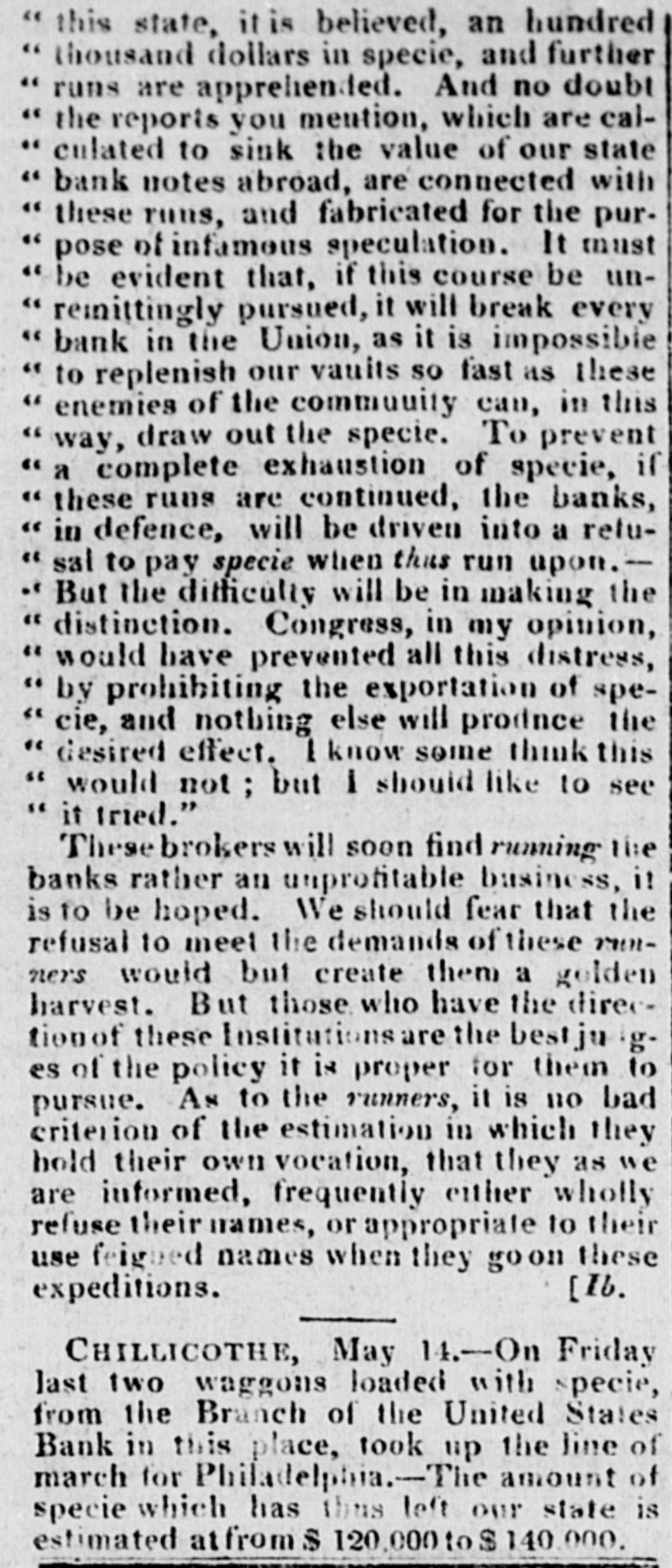
this state, it is believed, an hundred "thousand dollars in specie, and further runs are apprehended. And no doubt the reports you mention, which are caiculated to sink the value of our state bank notes abroad, are connected with these runs, and fabricated for the purpose of infamous speculation. It must be evident that, if this course be unremittingly pursued, it will break every bank in the Union, as it is impossible to replenish our vauits so fast as these 'enemies of the community can, in this way, draw out the specie. To prevent a complete exhaustion of specie, if these runs are continued, the banks, in defence, will be driven into a relusal to pay specie when thus run upon.But the difficulty will be in making the distinction. Congress, in my opinion, would have prevented all this distress, by prohibiting the exportation of specie, and nothing else will prodnce the desired effect. 1 know some think this would not ; but i should like to see it tried." These brokers will soon find running the banks rather an unprofitable business, it is to be hoped. We should fear that the refusal to meet the demands of these mmners would but create them a golden harvest. But those who have the direction of these Institutions are the best ju ges of the policy it is proper for them to pursue. As to the runners, it is no bad criterion of the estimation in which they hold their own vocation, that they as we are informed, frequently either wholly refuse their names, or appropriate to their use feigued names when they goon these [Ib. expeditions. CHILLICOTHE, May 14.-On Friday last two waggons loaded with specie, from the Branch of the United States Bank in this place, took up the line of march for Philadelphia.-The amount of specie which has thus left our state is estimated at from $ 120,000 to $ 140 000.


Article from Richmond Enquirer, September 7, 1819

Click image to open full size in new tab

Article Text

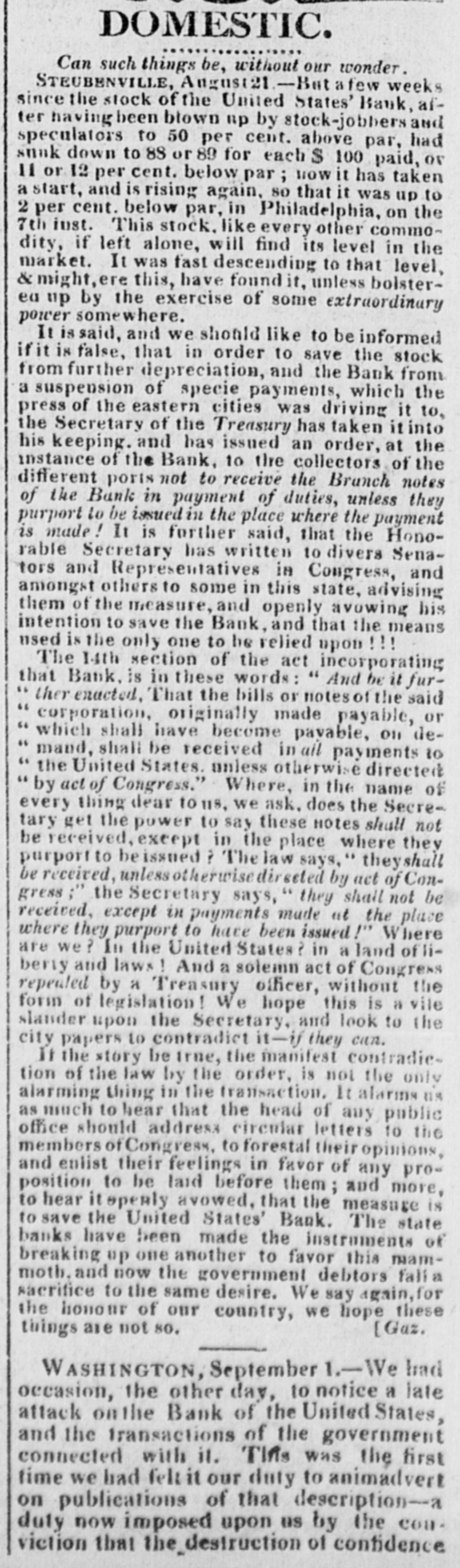
DOMESTIC. Can such things be, without our wonder. STEUBENVILLE, August21-Bat a few weeks since the stock of the United States' Bank, alter having! been blown up by stock-jobbers and speculators to 50 per cent. above par, had sunk down to 88 or 89 for each $ 100 paid, or or 12 cent. below par; HOW it has taken a and is so was up to 11 start, per rising again, in Philadelphia, that it the 2 per cent. below par, on 7th just. This stock. like every other commodity, if left alone, will find its level in the market. It was fast descending to that level, might, ere this, have found it, unless bolsterea up by the exercise of some extraordinary power somewhere. It is said, and we should like to be informed if it is false, that in order to save the stock from further depreciation, and the Bank from a suspension of specie payments, which the of the eastern cities was driving it to, the of the his and has an at to instance press keeping. Secretary of the Bank, Treasury issued the collectors has order, taken it of into the the different ports not to receive the Brunch notes of the Bank in payment of duties, unless they purport to be issued in the place where the payment is made! It is further said, that the Honohas written to divers Senaand tors rable Secretary Representatives in Congress, and amongst others to some in this state, advising them of the measure, and openly avowing his intention to save the Bank, and that the means used is the only one to he relied upon !!! The 14th section of the act incorporating that Bank, is in these words: And be it further enacted, That the bills or notes of the said " corporation, originally made payable, or " which shall have become payable, on de" mand, shall be received in all payments to " the United States. unless otherwise directed " by act of Congress." Where, in the name of every thing dear to 118, we ask. does the Secretary get the power to say these Hotes shull not be received, except in the place where they purport to be issued ? The law says," theyshall be received, unless otherwise directed by act of Congress;" the Secretary says, they shall not be received, except in payments made at the place where they purport to have been issued!" Where are we? In the United States? in a land of liberty and laws ! And a solemn act of Congress repeated by a Treasury officer, without the form of legislation! We hope this is a vile slander upon the Secretary, and look to the city papers to contradict it-if they can. It the story be true, the manifest contradietion of the law by the order, is not the only alarming thing in the transaction. It alarins us as much to hear that the head of any public office should address circular letters to the members of Congress. to forestal their opinions, and enlist their feelings in favor of any proposition to be laid before them; and more, to hear it openly avowed, that the measure is to save the United States' Bank. The state banks have been made the instruments of breaking up one another to favor this mammoth. and now the government debtors fall a sacrifice to the same desire. We say again, for the honour of our country, we hope these (Gaz. things are not 80. WASHINGTON, September 1.-We had occasion, the other day, to notice a late attack on the Bank of the United States, and the transactions of the government connected with it. This was the first time we had feltit our duty to animadvert on publications of that description-a duty now imposed upon us by the con. viction that the destruction of confidence


Article from Richmond Enquirer, October 8, 1819

Click image to open full size in new tab

Article Text

had the information the tax: be would at and the that, it be would fature, urobably the that 17th inst. however, appears, of the behalf acting the personstate, Auditor branch at bank took foreible Chillicother there counter; of possession the the to payments and car take ried two away hundred and dollars, Specie is thousawhich understood The States. perty and, tax, proceeded between in Notes to be the pro. branch of its end was, course, suspen In its of operationsview thus funds, part of of the United obliged 10 of Branch being was to obliged operations, except this It is first that the the claimed enforce authority of the Bank United so striking pretended attempt state over 10 have the furnished of the of the by should of the interests that drafts of States, illushawer, nation power, It is by the the Treasurer for the govern of pay- the of the is U. States, and paid had States. been on given that Branch, mediately these, Pension- it pro for mear ment in that not quarter be U. States have litmust bable, may and the of whom their support, the now go, was want of funds, state, many upon for because has tle ers else in that to depend for provided time, unpaid, to pay them to be extremely the On every hat 10 been money thus which taken ground, away. it state is authorivident this of at right, should egretted, have 10 enforce which the has Su- JeOhio, node of doubtful, United but States state: and that best, but of 10 a injunction of Court having is preme Court not belong of the the affair. Understil unstances but 10 have least cided too, does in detiance-inance cognization of would seem until prudent! the of an have Pgislature might the revise measure. is opportunity io the be more This Step regretted, the of the motives state imputations due to are very as it will to known States, the debts in Ohio large, believed that is the Bank unable the of part being authorities the Bank of the and United as generally 10 collect any amount. Georgeton Messenger. Pre4.-The sident WASHINGTONNELL October to his farm, after preweek's visit has the to the President's City. Loudoun farm miles. and county, about to the city sent distant ride over at Virginia. Oatlands, residence, is in thirty perform business but a money may public is is moment's which the notice, between there city require require bis presence. communica and the of a daily regular his residence founted place he is to the overnment the that of continuabilic the governmental concerns, so what is important of materially delayed cannot and be in affected any case by visits his to the the country. are generally other in or otherwise the operations His consultime sojourn made on ument with scat ocof government which Departments, call for and or are there. of the duration. that of of no of Congress the officers the fore rasions Heads long of Devernment, It is only usable, seat the du- rering of the absolutely near at sidence the Sessions is President so at indispen Governor hand. government his seat General, is city, from when The Postmaster returned to the is the period the visit to for where conwhich in each and our at family Meigs, has the contracts Ohio. This year, carrying city tracts are crowded has called for Pittsmails are usual, made, about expiring: with strangers, hither. the Miller to take of Aris, whom General as that business way has departed territory upon himself Int. vs. burg, government on his of the [Nat." THE UNITED kansaw. OF OHIO COURTS. of the The report, the Branch the STATE STATES of by private letters, and Bank of tak- up- the forcible at of law, IS United States entry under Chilicothe, colour thousand dollars, statetherefrom, hundred following We wards fully ing confirmed of one from by the Ohio papers. commenced ments, copied which has tragical end. authors wish as a farce, this drama, may and not abettors have of a it have much The to answer for. i-ib. of Sept.22 Supporter, States Bank. [Flom' the Chilicothe Okio vs. United issued by the The State virtue of of a warrant agreeably to the proBy the legislaof an act of levy Auditor visions of of the state, state passed Ohio, All by act at to their and last tax and and collect a companies, transact tere session, and entitled from that all may banks, association with of within this 80 by the being Mr. John banking Harper, individuals dividuals. ations business authorized to L. do state, (to laws warrant was and Mr. J. Collister, the T. Orr, Bank out whom thereof," by Mr. directed) Branch accom- Fri- M'- of the United on the 10 the panied and entered States, levied the at institution, this place, specie on and day last, in that thousand dol-


Article from The Rhode-Island Republican, May 17, 1837

Click image to open full size in new tab

Article Text

the New Post. From York Evening AND BANK THE STATES UNITED OF EEN HUNTHE EIGHTEEN was DRED PANIC AND NINETEEN that never It is very visited generally with said such pecuniary Not altogeth disthe the country it now experiences. lapse of time calamities. makes tress er, perhaps as the but extent of past the embarrass- we us forget desires to compare those which the Whoever we now suffer with seasons of pressure, Gouge's and may ments have suffered means in other of doing so gain in instruction will find of Banking, the comparison The operStates United On 1817. History from making Bank went the 27th of were discounts February, of dollars. ation in January, in that year, its In July five follow- miltwentyThe three millions had increased to thirty-three equally ing they in October to was almost its 1818, subsequent lions, and increase March and April, to forty-three and issues following of Joans millions. of rapid, the bank and In in had July reached had swelled the amount and the rapid discounts fifty- ex- we itnessed one millions. result of this vast similar to what years of was pansion The of credit for was the pressure. two or three Specula- credthe value, of dise every have preceding encourage the present by the facility price of stocks kind tion it, lands rose in foreign merchand sale at high the and prices, ury had advanced, commanded.mest an instant prodigality and luxitself reigned. July, 1318, the steps, bank to found contract At the But in to retrace 115 its discounts. were compelled and cut short 1818, its discounts than in instead it loans, end of the year ten millions less of nine, reforty-one and millions, its circulation, llions. It went circulation on July, had become seven discounts m and the year 1820, dacing both year its 1819 and reduced to thirty- three millions, and of through until the the discounts and were the circulation to the seven half. of these operations Calamitous in Mr. the The effect Bank was them from the United States We quote recommend them who to are and the were for National trying a Bank. Gouge's extreme. serious attention book, second and of all time our the readers experiment ruined of people the Philadelthe In many 11 The Bank as saved, question in not Market who had broken parts Phila country it others For was. time, every morning, who yet was a stood. great deploral as in ble. phia previous day, the but distress was still more says Mr Niles business delphia the and all in parts of our pressure country on large men reduction in rapidly we From hear of wevere of trade, Real property it is rents general price of stagnation staple in its articles. nominal value, and Many and highl it the depreciating exceedingly become the Banks conti are their profits are traders others have must 'go: dations is merchants the discount agreed respectable that many customary. shaken. and of three promis pe consie widered any cant, dence refusing per among month is offered is little while for whose ago makers were notes have less no Four sory good notes. as which old gold," losses and to render their estimated 20,000 streets as valuable since wiffered months than heretofore." Ofterwards, persons he 10,000 daily says, seeking able-bod It is lied work looking men in that Philadelphia there are in wandering New York about the the women who than desire 20, said to be add to them cannot be 10,000 less persons for are it and if to we do. the there amount may be actually about suffering know sev be000: something in Baltimore employment business. or We who now subunsteady get into good livers." they would cause in they cannot men, lately two years ago, kitchen citiHist rat decent on such victuals their as servant+ by in a the meeting of to the inquire not have committee Childdelphia, given appointed on manufacture the 21st of August. October, of the city that and of in zens the of situation of the on manufacturing the 2d of branches empty into vicimonical reported and enumerated. which and gave eighty hundred -eight persons in and thirty trade. which they thousand and one hundred and thousand six two thouseventy-two. and hundred saud one ment to nine in 1814, and 1816. to nine there were persons but employ ed in 1319. of the who citizens Pittsburgh, that stated made their unfacturing employed nine A committee report on of the 24th and of mechanical December trades one thousand in employe certain and its vicinity sixty which persons in in 1815, 1819. Slaves city hundred and and Gazette, quoted by which Niles the most only writer six handred in the Kentucky immand A 9th of October. and could inadequate value. annum on the sometime ago. fallen to 100 an dollars house per and lot offered ready sold which money hires for for 80 300 or or 400- 15,000 had ham- been may be purchased straet, for which under the which, officer' I am ina on Limesto: some time past, house sold and lot 6.000. mortgage had been mer for was $1,800. bought for @10,000; was sold purchaser under (hexides of sales formed by the purchaser. the original À number and pity of local paid for $1,500. le leaving $3,500 in debt. time natanishment suffering is less Lexington of which have his advance*) occurred excited should at in the not this same be afflicted town. indalged Comparison than in, almost but any am told othfrequent of the that er part of the ptcies State for large is made, amounts among little others. town of affair occurrence. hankruptcy Bankruptci of Ivania, Mention merchant who failed for in the the sum in of a eighty- town but York, Peansy dollars. important inhabita insignificant cities. four This was, thousand indeed, three an or four when compared So exten- with cities but containing it sunk the into failures in the the large merchants to be of disreputable reputable the the Raine were of these among that it seemed 100,000 dollars: dollars give of Baltimore for less than 2 to 300,000 whose faraeast stop 'navment was from support of a year, fashionable tip-top amount quality. from the 8 to 12,000 of debt dollars exceeding of and ities the had cost them with an amount as much a million of these dollars. 500,000 were honored dollars, The prodigality and belief; nearly and we waste have of heard some (we that cannot the dollars. almost beyond single parlor possessed cost 40 000 dashwere farnititure of a to one of them, cities -dash, dash, into perzens any it belonging) was in all the and great hobbins transformed of respectable spec- citiand the nation facilities So venders of tape blood. and the sons of rank-- "-through sons of converted high into knaves of the abominable paper sys-


Article from The National Era, November 12, 1857

Click image to open full size in new tab

Article Text

BRIEF NOTICES OF BANKS AND BANKING. The first institution to which the name of bank has been applied, was the Bank of Venice, in the twelfth century. It was a Chamber of Loans. This was followed by the Table of Exchange at Barcelona, and the Chamber of St. George at Genoa, about the beginning of the fifteenth century. These were banks of deposit, and supported by buying and selling exchange. The necessities of trade compelled the creation of the Bank of Amsterdam, in the beginning of the seventeenth century. Its profits were made by the sale of bullion, coin, and certificates of deposit, called bank money. In 1694, the Bank of England was chartered, and is the grand exemplar of all modern banks. The capital was £1,200,000 sterling. This capital was made up of Government stock, issued to stockholders, for a loan of this sum at eight per cent. interest, besides an annuity of £4,000, and the privilege of acting as a banking company for twelve years. As there was no coin in the vaults, the Bank issued its own notes, payable on demand at the Bank; and this was the origin of bank notes. In 1796, the amount of circulation was about equal to the capital of the Bank, to redeem which a large amount of coin was left on hand. The difference between the circulation and the coin, was the profit of the Bank. The last increase of the capital took place on the renewal of the charter, in 1781, when it was raised to £11,642,000, or fifty-six millions of dollars. The whole of this capital is lent to the Government, and so its capital has been ever since the Bank commenced business. In 1781, the first bank in the United States, established in Philadelphia, was formed upon the principle of the Bank of England. Robert Morris was its chief manager. There was then, as now, an anti-bank party; but such was the prudence and integrity of the management of the "Bank of North America," as it was called, that its charter was renewed by the State of Pennsylvania for fourteen years, on the 17th of march, 1780. The success of the bank led to the formation of the "Massachusetts Bank," in Boston, in 1784, with a capital of $1,600,000, and in the same year of the "Bank of New York," in New York, with a capital of $950,000. The first "Bank of the United States" was projected by Alexander Hamliton, and was chartered by Congress in 1791. It had a capital of ten millions of dollars, one-fifth of which was owned by the United States. Its notes were received in payment of all public dues, and it had the keeping of the public treasure. It was opposed by Mr. Jefferson and his party, though when rechartered or recreated, in 1816, the bill was voted for by his friends, and approved by Mr. Madison. Then it was regarded as a State necessity, as it may be once again, and at no distant day; for then, as now, there was a suspension of specie payments. The suspension of 1815 was followed by a saturnalia of non-specie paying banks, and has been called the jubilee of swindlers. All banks out of New England, except the "Bank of Nashville," went in for making money plenty. We may see a like result when the panic now upon the banks has passed away, and they come to understand one another. In those days of depreciation, all sorts of speculations were brisk, prices rose, and all went on cheerily as marriage bells. It was easy to make money in those days, and banks made enormous dividends to their rich stockholders, at the cost of the working classes. The depreciation of paper on an average amounted to twenty-five per cent., and a return to specie values was the breaking of all the bubbles of a specious prosperity. A general bankruptcy was over all the land, except New England, where the differences of condition was that of Goshen in the days of Egyptian darkness. The Bank of the United States sustained a fearful run in the winter of 1818-'19, and was saved, just as the New York banks have lately hoped to save themselves, by ruining their customers. Mr. Secretary Crawford, in his report to Congress for 1819-'20, says: "Few instances are on record of sufferings so deep and so extensive as those which have overspread the United States." Then the miserable shaving shops of banks in the West uttered cries of distress, that they were broken down by the Colossus bank of Philadelphia. They were then, as now, managed by men who as bank directors traded on the cupidity of the public, and had no other capital than the brass of their own foreheads; but the hue and cry they raised helped them to throw dust in the eyes of the few people who found it hard to believe that country squires and rich merchants were the cause of all the public calamities. One thing was certain—the notes issued to represent dollars at this time represented no sort of a dollar, and were purchased at a heavy discount, so far as needed by these capitalists to take up their own notes to the Bank; and as for the rest, they were good for nothing. As New England had not gone into the witchery of the dance, so they had not now to pay the fiddler. In Kentucky, they had all manner of contrivances to stave off the demands of the people upon the banks—such as stop laws, relief laws, and tender laws—laws anything but tender to the claims of the honest men swindled by "promises to pay on demand," issued by these banks. The stock of the Bank of the United States, with all other bank stock, and its circulation, in 1823, did not exceed four millions and a half. The harmony existing between the bank and the Government was perfect till towards the end of its charter, when certain great capitalists in New York, who wanted the bank to be seated there, and not in Philadelphia, aided by General Jackson, made war upon the bank; and this ended in the entire loss of the capital of the bank, (which was squandered to pay a


Article from The Great West, October 6, 1893

Click image to open full size in new tab

Article Text

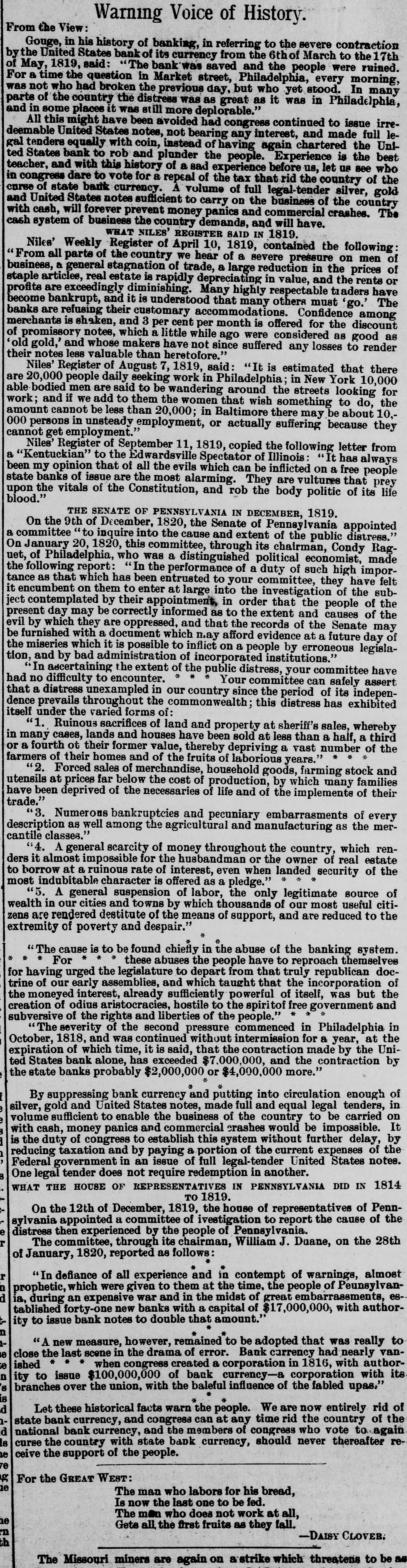
Warning Voice of History. From the View: Gouge, in his history of banking, in referring to the severe contraction by the United States bank of its currency from the 6th of March to the 17th of May, 1819, said: "The bank was saved and the people were ruined. For a time the question in Market street, Philadelphia, every morning, was not who had broken the previous day, but who yet stood. In many parts of the country the distress was as great as it was in Philadelphia, and in some places it was still more deplorable." All this might have been avoided had congress continued to issue irredeemable United States notes, not bearing any interest, and made full legal tenders equally with coin, instead of having again chartered the United States bank to rob and plunder the people. Experience is the best teacher, and with this history of a sad experience before us, let us see who in congress dare to vote for a repeal of the tax that rid the country of the curse of state bank currency. A volume of full legal-tender silver, gold and United States notes sufficient to carry on the business of the country with cash, will forever prevent money panics and commercial crashes. The cash system of business the country demands, and will have. WHAT NILES' REGISTER SAID IN 1819. Niles' Weekly Register of April 10, 1819, contained the following: " From all parte of the country we hear of a severe pressure on men of business, a general stagnation of trade, a large reduction in the prices of staple articles, real estate is rapidly depreciating in value, and the rents or profits are exceedingly diminishing. Many highly respectable tiaders have become bankrupt, and it is understood that many others must 'go.' The banks are refusing their customary accommodations. Confidence among merchants is shaken, and 3 per cent per month is offered for the discount of promissory notes, which a little while ago were considered as good as 'old gold,' and whose makers have not since suffered any losses to render their notes less valuable than heretofore.' Niles' Register of August 7, 1819, said: "It is estimated that there are 20,000 people daily seeking work in Philadelphia; in New York 10,000 able bodied men are said to be wandering around the streets looking for work; and if we add to them the women that wish something to do, the amount cannot be less than 20,000; in Baltimore there may be about 10,000 persons in unsteady employment, or actually suffering because they cannot get employment.' Niles' Register of September 11, 1819, copied the following letter from a "Kentuckian" to the Edwardsville Spectator of Illinois It has always been my opinion that of all the evils which can be inflicted on a free people state banks of issue are the most alarming. They are vultures that prey blood." upon the vitals of the Constitution, and rob the body politic of its life THE SENATE OF PENNSYLVANIA IN DECEMBER, 1819. On the 9th of December, 1820, the Senate of Pennsylvania appointed a committee to inquire into the cause and extent of the public distress.' On January 20, 1820, this committee, through its chairman, Condy Raguet, of Philadelphia, who was a distinguished political economist, made the following report: In the performance of a duty of such high importance as that which has been entrusted to your committee, they have felt it encumbent on them to enter at large into the investigation of the subject contemplated by their appointment, in order that the people of the present day may be correctly informed as to the extent and causes of the evil by which they are oppressed, and that the records of the Senate may be furnished with a document which n.ay afford evidence at a future day of the miseries which it is possible to inflict on a people by erroneous legislation, and by bad administration of incorporated institutions." In ascertaining the extent of the public distress, your committee have had no difficulty to encounter. Your committee can safely assert that a distress unexampled in our country since the period of its independence prevails throughout the commonwealth; this distress has exhibited itself under the varied forms of: "1. Ruinous sacrifices of land and property at sheriff's sales, whereby in many cases, lands and houses have been sold at less than a half, a third or a fourth ot their former value, thereby depriving a vast number of the farmers of their homes and of the fruits of laborious years." "2. Forced sales of merchandise, household goods, farming stock and utensils at prices far below the cost of production, by which many families have been deprived of the necessaries of life and of the implements of their trade." "3. Numerous bankruptcies and pecuniary embarrasments of every description as well among the agricultural and manufacturing as the mercantile classes." "4. A general scarcity of money throughout the country, which renders it almost impossible for the husbandman or the owner of real estate to borrow at a ruinous rate of interest, even when landed security of the most indubitable character is offered as a pledge. "5. A general suspension of labor, the only legitimate source of wealth in our cities and towns by which thousands of our most useful citizens are rendered destitute of the means of support, and are reduced to the extremity of poverty and despair." The cause is to be found chiefly in the abuse of the banking system. For these abuses the people have to reproach themselves for having urged the legislature to depart from that truly republican doctrine of our early assemblies, and which taught that the incorporation of the moneyed interest, already sufficiently powerful of itself, was but the creation of odius aristocracies, hostile to the spiritof free government and subversive of the rights and liberties of the people." The severity of the second pressure commenced in Philadelphia in October, 1818, and was continued without intermission for a year, at the expiration of which time, it is said, that the contraction made by the United States bank alone, has exceeded $7,000,000, and the contraction by the state banks probably $2,000,000 or $4,000,000 more." By suppressing bank currency and putting into circulation enough of silver, gold and United States notes, made full and equal legal tenders, in volume sufficient to enable the business of the country to be carried on with cash, money panics and commercial crashes would be impossible. It is the duty of congress to establish this system without further delay, by reducing taxation and by paying a portion of the current expenses of the Federal government in an issue of full legal-tender United States notes. One legal tender does not require redemption in another. WHAT THE HOUSE OF REPRESENTATIVES IN PENNSYLVANIA DID IN 1814 TO 1819. On the 12th of December, 1819, the house of representatives of Pennsylvania appointed a committee of ivestigation to report the cause of the distress then experienced by the people of Pennsylvania. The committee, through its chairman, William J. Duane, on the 28th of January, 1820, reported as follows: In defiance of all experience and in contempt of warnings, almost prophetic, which were given to them at the time, the people of Peunsylvania, during an expensive war and in the midst of great embarrassments, established forty-one new banks with a capital of $17,000,000, with authority to issue bank notes to double that amount." A new measure, however, remained to be adopted that was really to close the last scene in the drama of error. Bank currency had nearly vanished * when congress created a corporation in 1816, with authority to issue $100,000,000 of back currency-a corporation with its 8 branches over the union, with the baleful influence of the fabled upas." d Let these historical facts warn the people. We are now entirely rid of state bank currency, and congress can at any time rid the country of the d national bank currency, and the members of congress who vote to again curse the country with state bank currency, should never thereafter reae ceive the support of the people. For the GREAT WEST: The man who labors for his bread, Is now the last one to be fed. The men who does not work at all, Gets all the first fruits as they fall. -DAISY CLOVER. The Missouri miners are again on a strike which threatens to be as


Article from The Watchman and Southron, October 14, 1903

Click image to open full size in new tab

Article Text

As the loans to shareholders could be renewed at the discretion of the president and cashier there was no reason why the unpaid shares should ever be paid or why the money should not be returned on those that had been paid.' Thus is made apparent the unsoun ness of the bank at its beginning, and the lesson which taught what is now the national bank law, that no bank should lend money on its own stock. In two years the bank under Mr. Jones had run its course and reached the end of its rope." "The bank at this time," January, 1819, says Mr. White, was really insolvent. It was held up only by the Government deposits, which amounted to $8,000,000. It was saved from impending bankruptcy by Mr. Langdon Cheves, of South Carolina, who became its president in March, 1819. Prof. Sumner, of Yale College, in his life of Andrew Jackson, p. 233-4, says: "In the first two years of its existence the great bank was carried to the verge of bankruptcy by as bad banking as ever was heard of. Instead of checking the other banks in their improper proceedings it led and surpassed them all. A clique inside the bank was jobbing in its shares and robbing it to provide the margins. Instead of rectifying the currency it made the currency worse. Instead of helping the country out of the distress produced by the war it plunged the country into the commercial crisis of 1819, which caused a general liquidation lasting four or five years. * Langdon Cheves was elected president of the bank on March 6, 1819. He set about restoring it. In three years be had succeeded, although the losses had been over 000,000--accurately about $3,700,000." Gouge on Banking, p. 94-5, thus described the bank under Mr. Jones, 1817-1819 "To sustain its operations the bank exchanged part of its funded debt for specie in Europe and purchased a large amount of coin in the West Indies and other places. Between July, 1817, and July 1818, upwards of $7,000,000 of specie were imported by the bank at a cost of $500,000. But the original cause of the specie leaving the country, viz, the excess of paper issues, still continuing to operate, the money was exported by individuals fsater than it was imported by the bank. Over $5,000,000 were exported in twelve months from Boston and Salem alone, and it was estimated that the aggregate was over $12,000,000. Notwithstanding the importation of specie made by the bank, the amount at any one time in the vaults did not rise to $3,000,000-an amount which if divided between the mother bank and eighteen branches was quite insufficinet to sustain its operations. On November 30, 1818, a committee of Congress was appointed to investigate the affairs of the bank, and on January 16, 1819, made its report. On receipt in Philadelphia of the report of the committee the stock fell, says Mr. Gouge, p. 102, "to 93, and Dr. William Jones, the president, soon after fied in affright from the institution. Mr. Cheves, of South Carolina, was invited to take his place.' The situation to its full extent was not then even imagined, but was nevertheless regarded as desperate. In March, 1819, Mr. W. H. Crawford, Secretary of the Treasury writing to Mr. Cheves, says: "The task" of restoring a sound currency will be executed with difficulty and loss if, * indeed, it be practicable. * * The stoppage of specie payments by the bank and by the State institutions is inevitable. * * * I greatly fear that no efforts which it is in the power of the directors to make will be successful.' John Quincy Adams, in his diary on April 5, 1819, soon after Cheves had gone in, writes: The bank is so drained of its specie that it is hardlly conceivable that it can go till June without stopping payments. * * * The state of our currency is perilous in the highest degree and threatens to terminate in a national convulsion." And again, on 18th of April, writing of a visit of Mr. Cheves to Washington, he says: It's the visit's real cause is the tottering situation of the bank, which will very shortly be reduced tc the alternative of calling in all its notes and trading on those of other banks, or stopping payment." But like many others, says the young historian, before the Historical Association. Mr. Adams had failed to appreciate the remarkable ability and energy of the new president. Three weeks after the last quoted entry in the diary the bank was safe and sound again and in position to aid other solvent but needy concerns." The above is sufficient evidence to show that in less than twenty-four months from the day it opened the bank had lost over $3,500,000, its credit and its good name, and that in less than two months after Cheves took charge both credit and good name had been restored. The records further show that in three years the loss of $3,700,000 had been wiped out and replaced by an item on the creditsideentitled Con-