gpt-5-mini (chosen from majority vote of a three-model LLM ensemble)
Short Digest
29ea1bac057ebeaf
Response Measures
None
Description
Suspension in February 1841 followed heavy specie demands after resumption; bank was later assigned to trustees (June 1841).
Events (3)
1.February 9, 1841Run
Cause
Bank Specific Adverse Info
Cause Details
Large specie drafts/presentments and loss of confidence after resumption produced heavy withdrawals and refusals to meet very large demands.
Measures
Paid out specie until inability to meet a large draft; directors met to consider proceedings.
Newspaper Excerpt
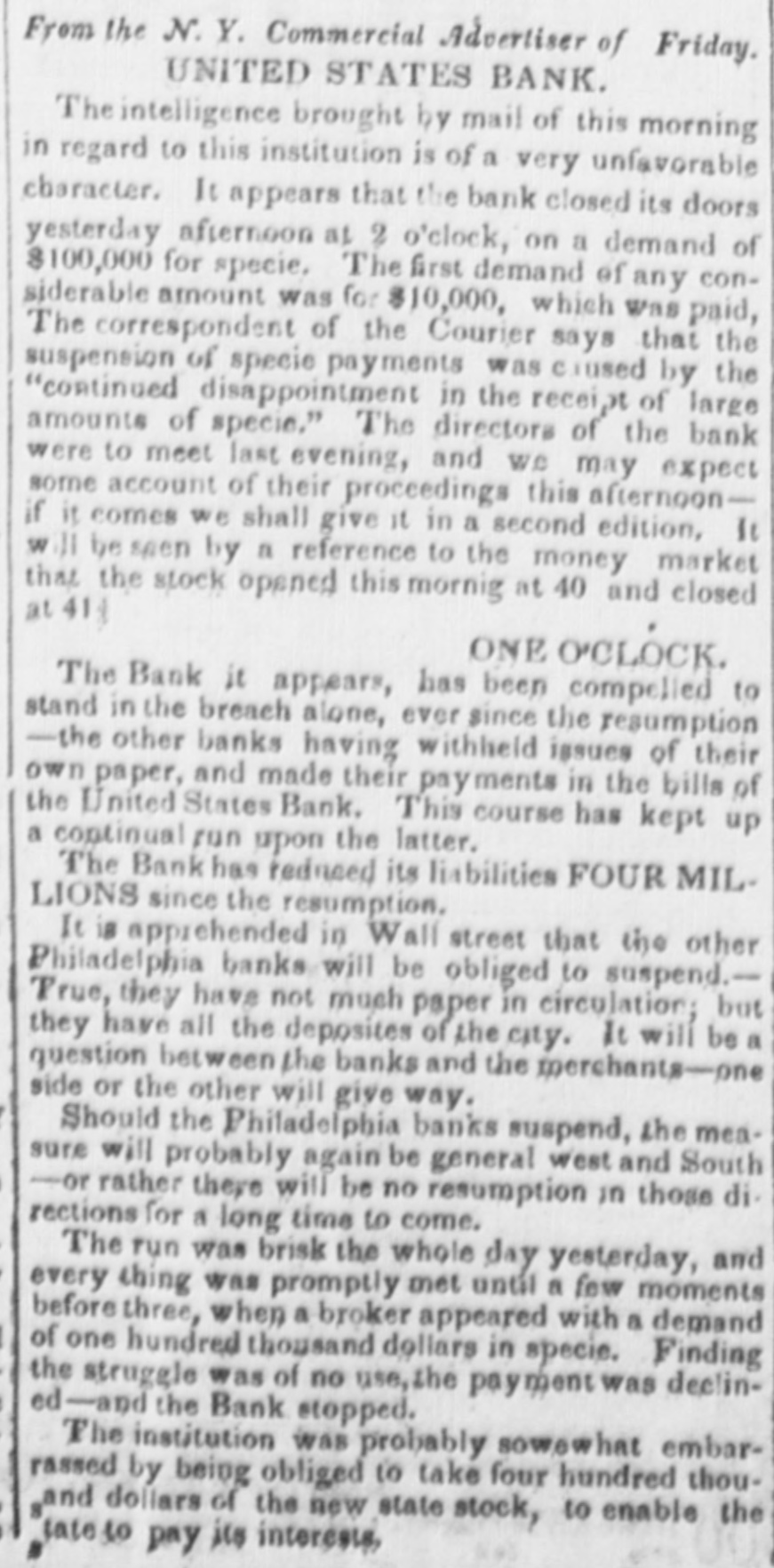
the run was brisk the whole day yesterday, and every thing was promptly met until a few moments before three, when a broker appeared with a demand of one hundred thousand dollars in specie...the payment was declined-and the Bank stopped.
Source
newspapers
2.February 10, 1841Suspension
Cause
Bank Specific Adverse Info
Cause Details
Inability to meet large specie demands and continued heavy withdrawals forced the bank to suspend specie payments.
Newspaper Excerpt
The correspondent ... says that the suspension of specie payments was caused by the 'continued disappointment in the receipt of large amounts of specie.' ... the Bank stopped.
Source
newspapers
3.June 7, 1841Receivership
Newspaper Excerpt
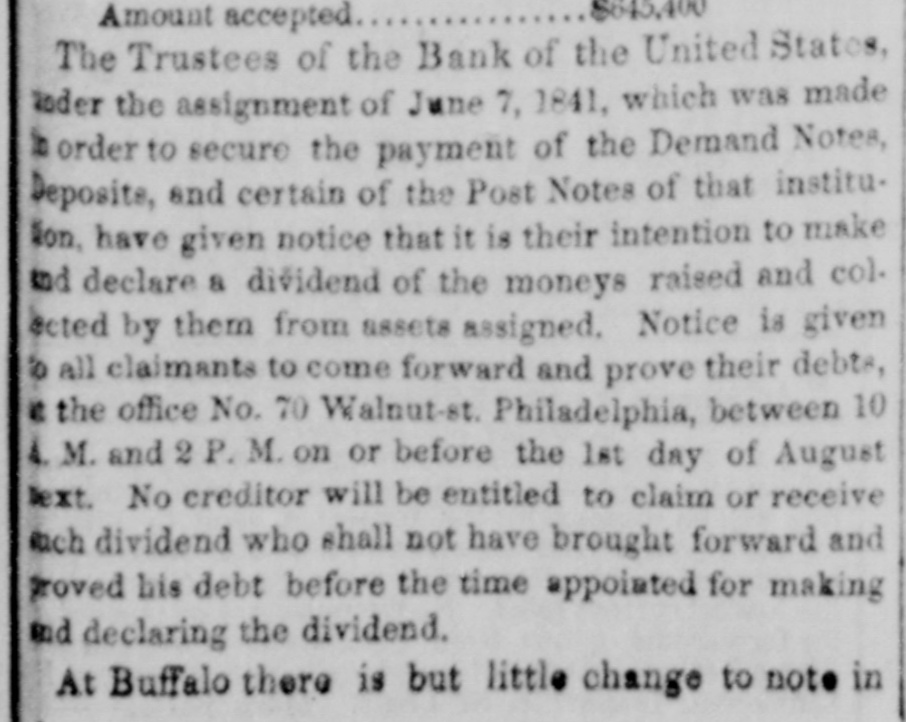
assignment of June 7, 1841 ... Trustees of the Bank of the United States, under the assignment of June 7, 1841 ... intend to make and declare a dividend of the moneys raised and collected by them from assets assigned.
Source
newspapers
Newspaper Articles (25)
1.July 13, 1837Staunton Spectator, and General AdvertiserStaunton, VA
Click image to open full size in new tab
Article Text
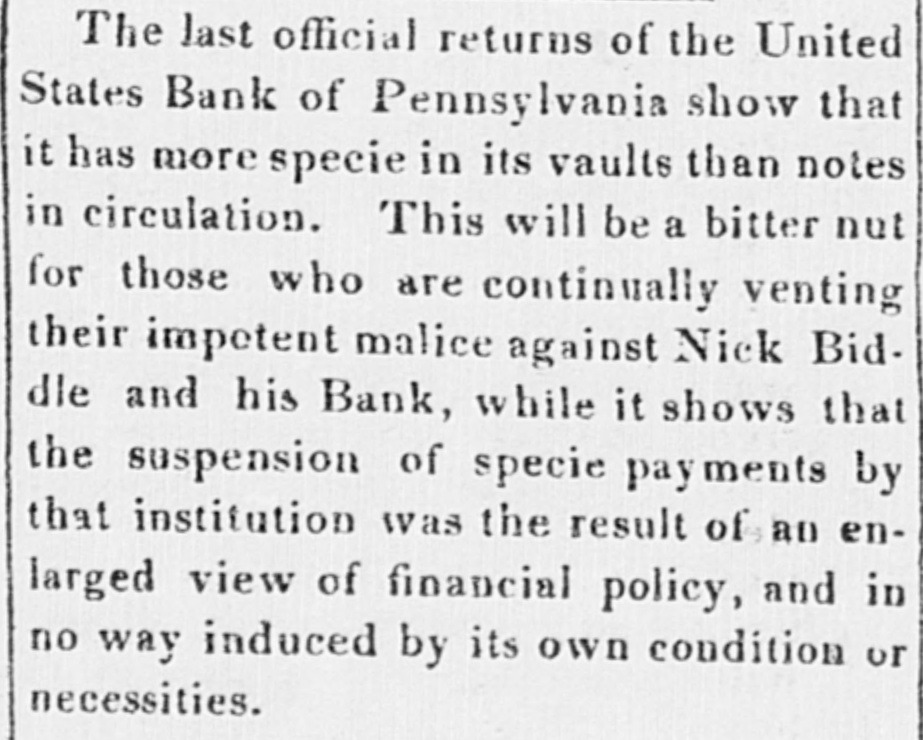
The last official returns of the United States Bank of Pennsylvania show that it has more specie in its vaults than notes in circulation. This will be a bitter nut for those who are continually venting their impotent malice against Nick Biddle and his Bank, while it shows that the suspension of specie payments by that institution was the result of an enlarged view of financial policy, and in no way induced by its own condition or necessities.
2.April 11, 1838The Rhode-Island RepublicanNewport, RI
Click image to open full size in new tab
Article Text
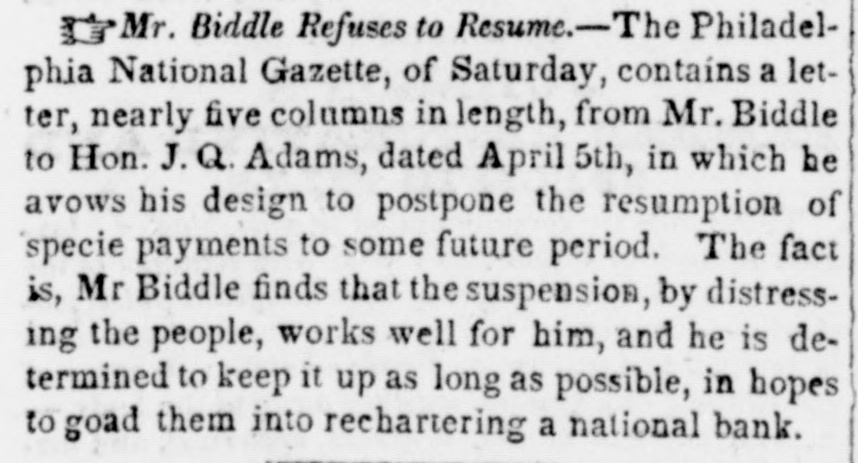
Mr. Biddle Refuses to Resume.- The Philadelphia National Gazette, of Saturday, contains a letter, nearly five columns in length, from Mr. Biddle to Hon. J. Q. Adams, dated April 5th, in which be avows his design to postpone the resumption of specie payments to some future period. The fact is, Mr Biddle finds that the suspension, by distressing the people, works well for him, and he is determined to keep it up as long as possible, in hopes to goad them into rechartering a national bank.
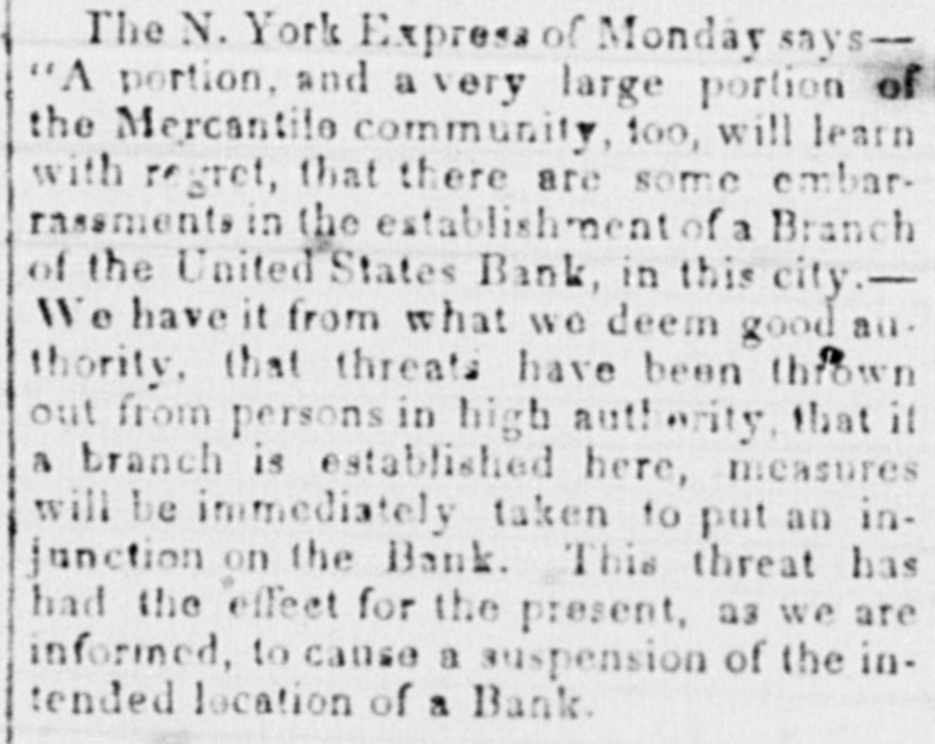
The N. York Express of Monday says"A portion. and a very large portion of the Mercantile community, 100, will learn with regret, that there are some embarrassments in the establishmentofa Branch of the United States Bank, in this city.We have it from what we deem good all. thority, that threats have been thrown out from persons in high authority that it a branch is established here, measures will be immediately taken to put an injunction on the Bank. This threat has had the effect for the present, as we are informed, to cause a suspension of the intended location of a Bank
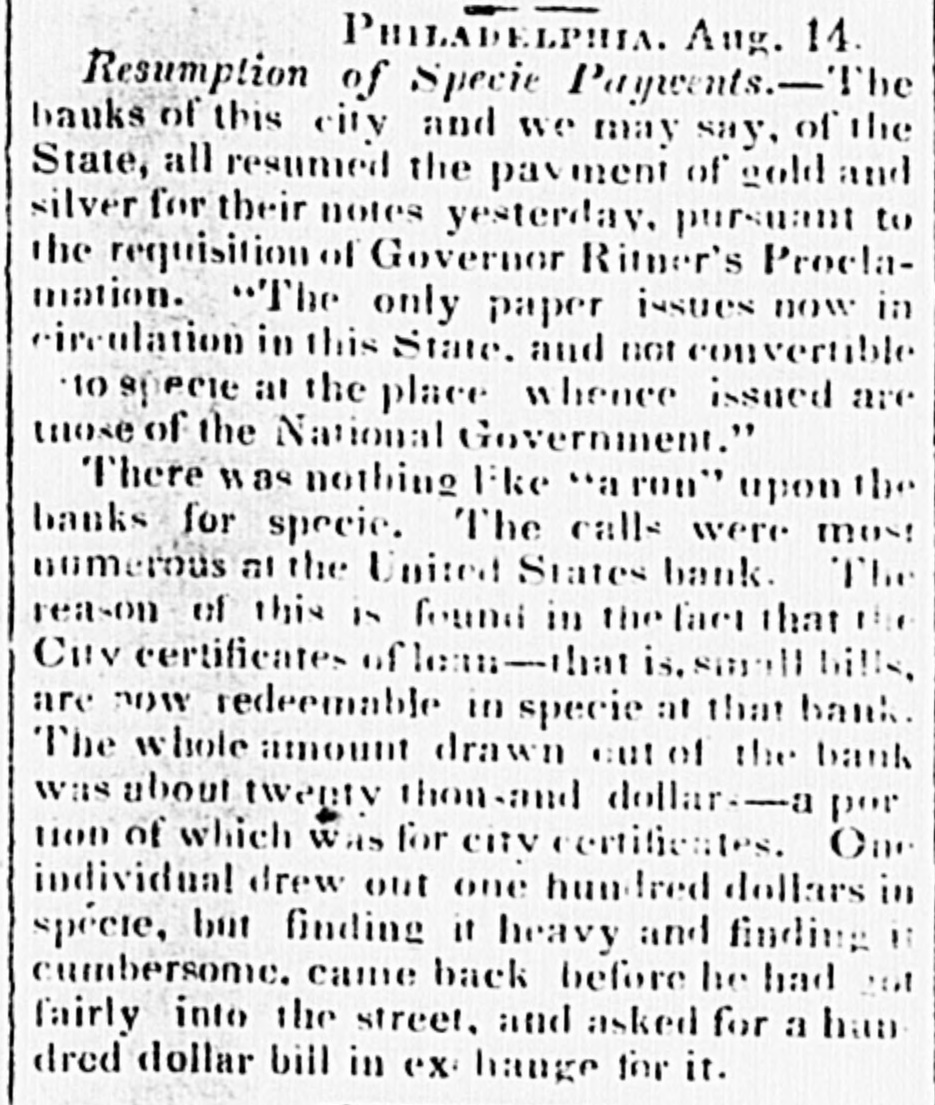
PHILADELPHIA. Aug. 14 Resumption of Specie Paycents - 'he banks of this city and we may say, of the State, all resumed the payment of gold and silver for their notes yesterday. pursuant to the requisition of Governor Rimer's Procla mation. The only paper issues now in ein ulation in this State. and not convertible to specie at the place whence issued are those of the National Government." There was nothing like "aron" upon the banks for specie. The calls were most numerous at the United States bank. reason of this IS found in the fact that the City certificates oflean-that is. small bills are now redeemable in specie at that bank The whole amount drawn out of the bank was about twenty thousand dollar.-a por 1100 of which was for CITV certificates. O individual drew out one hundred dollars in specie, but finding it heavy and finding cumbersome. came back before he had fairly into the street, and asked for a han dred dollar bill in ex hange for it.
5.August 25, 1838Maumee City ExpressMaumee City, Maumee, OH
Click image to open full size in new tab
Article Text
Correspondence of the N. Y. Cour. & Enq. Philadelphia, Aug. 13--5, P. M. This is Resumption Day,' and the Whigs are celebrating it with becoming spirit on the banks of the Wissibiccan. The demand for speci upon the banks of the city has, 80 far as could learn, been very limited. Several of the Banks said that they had not seen any presentation of their own notes for silver beyond what was common for change, before the resumption. It was believed by some persons that a run would be made upon the Bank of the United States but no such error was committed. That Bank had made arrangements to redeem with specie the notes issued by the corporation of the city-which were otherwise irredeemable for nearly ten months. These had been as common in the markets as are the fruits of the season. The Bank, at closing, had paid out between: sixteen and eighteen thousand dollars, of which sum about nine thousand dollars were for the Corporation shin plasters, so that the remainder is even less than would be expected, for the ordinary retail and market transactions, on a day when the shin plasters ceased to be current. The demands for specie have in all cases been for small sums: in on instance, three hundred dollars were asked for, but in nearly all the other cases the sums were from one dollar to ten dollars. Sundry drafts from your city in several of our city Banks, the U. S Bank included, amounting in all to four hundred thousand dollars, were presented -day, and as the United States Bank had balances, to settle, it accepted these drafts, and gave the bearer a check for the whole amount in the New York Banks. so that the specie changed hands. This looks like the good old fashioned way of doing business-a way which it is thought has been bro't about by the management of those who have e S taunted her for delaying the measure.
6.October 22, 1839True AmericanNew Orleans, LA
Click image to open full size in new tab
Article Text
P. YORK, Friday, The stock of the United Stays Bank run down at the Board this morning to $75, and some shares were offered af erwards as low as 71, but there were no bayers at hat pr : ! The impression is pretty general in Wall street, that the monster," and, indeed, several othern of the Philadelphia Banks have not only S sp nded, but that they are actual y broken and misolvent. There is one thing certain-the notes of the United States Bank are no longer received in preference to those of any other of your Banks, but are more shunned than they were ever sought after, even by it warmest advocates. For my own P rt. 1 cannot believe that this institution, under the management of such able and experienced financiers)as it is, should so far overreach its vast resources as to be unable speedily to meet all demands against it. The bro ers of Wall street, however, have lost all confidence in its soundness; and will be long. very long, before the Bank of the United States can again take its for. mer elevated stand among the banking institutions of the country. Our banks are firm and unti inching ; and there is no doubt of their perfect ability to perform their duty to the public. Checks on Philadelphia are not very readily ob. tained at 10 per cent dis. Operations, of all kinds in southern funds have ceased for the present. In cotton ther 18 nothing doing. Flour looks better northern $0.00 southern $6.25 southern corn 73. and northern 62, wight. Rye 87 a 78c. Some light sales of wheat neve been made at rather better Ices.
7.October 25, 1839Cheraw Gazette and Pee Dee FarmerCheraw, SC
Click image to open full size in new tab
Article Text
The stock of the United States Bank, has fluctuated, since the suspension, from 70 to 90. It fell suddenly to 70, then rose rapidly to 90, in Philadelphia, and 80 in New York. Efforts have been made in certain quarters to produce an impression that it is insolvent, it may be
8.November 29, 1839Richmond EnquirerRichmond, VA
Click image to open full size in new tab
Article Text
Making a loss of $4,287,557 51
specie, in 8 months terminating with Mr. Biddle's resignation.
The returns also show from the first of August, 1833, to the first of October, 1839, a certain regular monthly decrease of specie, with a momentary rally in September, and no man can read them without being convinced of two facts:
1. That the final suspension of the Bank at an earlier or later period was inevitable, from the moment of her resumption in August, 1838.
2 That Mr. Biddle, on the 29th of March, was clearly aware of this fact, and that his "Hegira," was the result of this conviction.
We ask all our readers to examine these abstracts carefully, and then to mark, what we now declare as our solemn and deliberate sentiment, that this bank is utterly insolvent; that her bona fide resumption is utterly impracticable; and that the remaining banks in Philadelphia, and throughout the States must prepare for resumption and resume, without the Bank of the United States entering into their calculation.
The solvent Banks must resume by the 1st of January -they have had indulgence enough-let them no longer hoard their gold and silver, and depreciate their own paper. There is no foreign demand for gold and silver. Exchange is below par. New York and the East stand firm. The Banks of Cincinnati have resumed. The Banks of Pennsylvania must and shall resume.
Bank of the United States.-In the District Court for the city and county of Philadelphia, at the July term, judgments were obtained against this institution on its protested bills and post notes, to the amount of one million, eight hundred and fifty seven thousand. one hundred dollars. The court decided that the Bank was bound to pay twelve per cent interest, according to its charter. and not six per ccut, according to the legalizing the suspension upon these judgements, it is said the bank has taken out writs of error; and given security to double the amount.--Camden Journal.
10.October 31, 1840Lexington UnionLexington, MS
Click image to open full size in new tab
Article Text
Extraordinary Law Case.-Some 26 years ago, an Irishman married a young woman, his junior by 25 years in Liver pool, England, and set up a tavern onga large scale. A fine looking, brawny fel. low, fresh from the Green Isle, became a lodger, and in a short time, made love to the hostess, and prevailed upon her to elope to America. The lady, being the factotem of the hotel, converted every thing she could conveniently into cash, and with her lover and all the tangibles that were portable, set sail for America, leaving her husband with the empty house, and as she says "to take care of its contents." The elopement was so well planned and executed, that her whereabouts was unknown for nearly 18 years when her forsaken lord obtained news of her arrival and marriage in this country to her lover. A few days ago he arrived here, and in a short time sought and found his long-lost wife. She immediately dropped on her knees and renewed her allegiance, and swore that she would be his again. Accordingly she packed up his goods, took several hundred dollars which her late husband had in the house, and eloped with ber first husband. When the last husband found out his position, he commenced a suit in the Superior Court last Saturday, and had the first husband arrested for crim. con. and seduction The defendant was thrown into jail, and yesterday morning the parties had a friendly conference, quietly compared notes, balanced accounts, discontinued the suit, released the true husband, and went into a tippling hole and made merry-it being mutually agreed that the first husband should have precedence.--N. Y. Sun / United States Bank.-In the District Court lately for the City and County of Philadelphia, fourteen judgments were entered against the United States on the bills and post notes protested for nonpayment in specie to the amount of one million eight hundred and Alty-seven thousand dollars. The court on that OCcasion decided that the bank was bound to pay 12 per cent. interest on its dishonored bills, according to its charter, and not 6 per cent. according to the act legalizing suspensions.-Phil. Times. Mobile.-One hundred and nine new buildings, exclusive of out-houses, have been erected in Mobile within the last twelve months. Without the fire limits, there has probably been an equal number of buildings erector during the same period; these are, however, generally frame dwelling houses-Pic. A man died recently in the prison at Ghent, who had been confined there 42 years, having been condemned in 1798, for highway robbery. It is an excellent rule for a man, when
11.January 13, 1841The Camden JournalCamden, SC
Click image to open full size in new tab
Article Text
The New York Herald of Friday, speaking of exchange on the South and the indications of a general resumption, has the following remarks: The rates of premium on specie indicate the degree of depreciation of the local currencies throughout the South, and the different degrees of indebtedness to the commercial centre of the Union. It will be observed that the rate of bills on England, being in deprecriated currencies, are generally lower than at this port, and are in every instance below par for specie. Whether the proposed resumption will extend to all these points or not, is yet problematical. Letters from New Orleans are confident that it cannot be effected there. The resumption by the United States Bank is a juggle, and will in all probability not last three months. New Orleans is a commanding point, and the branch of the United States Bauk there and the Merchants Bank, exert as great an influence as the mother bank does in Philadelphia. Popular opinion does not set so strongly in favor of resumption in the former, as in the latter city. It is therefore feared that non-resumption in New Orleans will be made the cloak for another suspension at an early day, unless the deposites of the federal government are restored the United States Bank. If this cannot be effected, a new suspension and derangement of affairs, will make it the instrument of new political intrigues.
12.January 21, 1841The Charlotte JournalCharlotte, NC
Click image to open full size in new tab
Article Text
MONEY CONCERNS. The Philadelphia Enquirer of Saturday says We understand that the United States Bank has now in her vaults more than $4,000,000 in specie. All doubts as to a general resumption have disappeared, and we begin to indulge a hope that out community will glide so gradually from suspension into resumption that the affair will not create a momentary sensation.The truth is, very little difficulty is expe. rienced even now with regard to small change."
13.January 26, 1841Rutland HeraldRutland, VT
Click image to open full size in new tab
Article Text
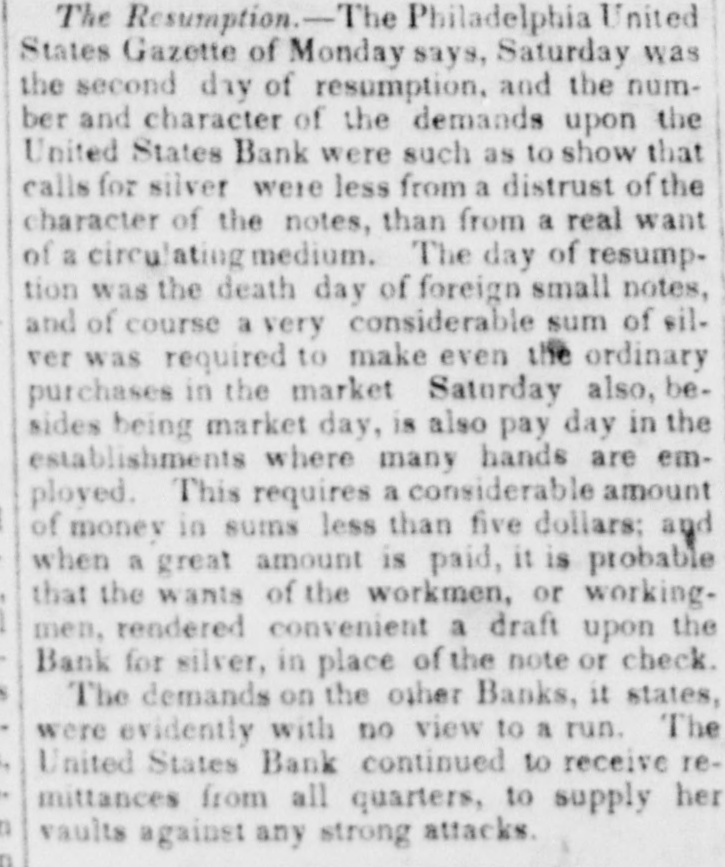
The Resumption. - The Philadelphia United States Gazette of Monday says, Saturday was the second day of resumption. and the number and character of the demands upon the United States Bank were such as to show that calls for silver were less from a distrust of the character of the notes, than from a real want of a circulating medium. The day of resumption was the death day of foreign small notes, and of course a very considerable sum of silver was required to make even the ordinary purchases in the market Saturday also, besides being market day, is also pay day in the establishments where many hands are employed. This requires a considerable amount of money in sums less than five dollars: and when a great amount is paid, it is probable that the wants of the workmen, or workingmen, rendered convenient a draft upon the Bank for silver, in place of the note or check. The demands on the other Banks, it states, were evidently with no view to a run. The United States Bank continued to receive remittances from all quarters, to supply her a vaults against any strong attacks.
14.February 10, 1841Daily Richmond WhigRichmond, VA
Click image to open full size in new tab
Article Text
From the N. Y. Commercial Advertiser of Friday. UNITED STATES BANK. The intelligence brought by mail of this morning in regard to this institution is of a very unfavorable character. It appears that the bank closed its doors yesterday afternoon at 2 o'clock, on a demand of $100,000 for specie, The first demand of any considerable amount was for $10,000, which was paid, The correspondent of the Courier says that the suspension of specie payments was clused by the "continued disappointment in the receipt of large amounts of specie." The directors of the bank were to meet last evening, and we may expect some account of their proceedings this afternoonif it comes we shall give it in a second edition, It will be spen by a reference to the money market that the stock opened this mornig at 40 and closed at 41 ONE O'CLOCK. The Bank it appears, has been compelled to stand in the breach alone, ever since the resumption the other banks having withheld issues of their own paper, and made their pay ments in the bills of the United States Bank. This course has kept up a continual run upon the latter. The Bank has redneed its liabilities FOUR MILLIONS since the resumption. It is apprehended in Wall street that the other Philadelphia banks will be obliged to suspend.True, they have not much paper in circulation but they have all the deposites of the city. It will be a question between the banks and the merchants-one side or the other will give way. Should the Philadelphia banks suspend, the measure will probably again be general west and South rather theye will be no resumption in those directions for a long time to come. The run was brisk the whole day yesterday, and every thing was promptly met until a few moments before three, when a broker appeared with a demand of one hundred thousand dollars in specie. Finding the struggle was of no use, the payment was declined-and the Bank stopped. The institution was probably sowewhat embarrassed by being obliged to take four hundred thouand dollars of the new state stock, to enable the late to pay its interests,
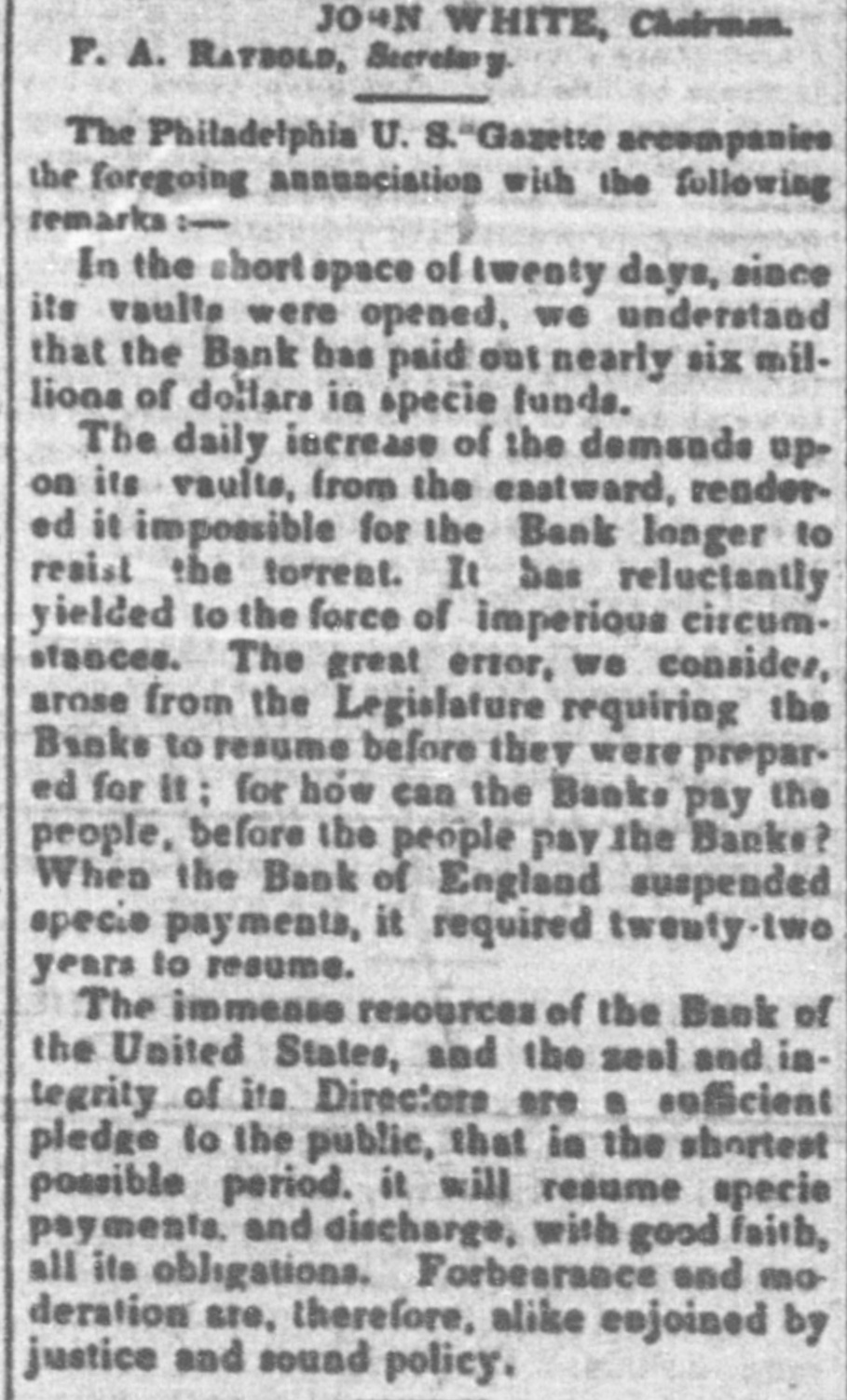
JOHN WHITE, Chairman F. A. RATBOLD, Secretary. The Philadelphia U. S."Gazette accompanies the foregoing annunciation with the following remarks:In the short space of twenty days, since its vaults were opened, we understand that the Bank has paid out nearly six millions of dollars ia specie funds. The daily increase of the demands up. on its vaulte, from the eastward, render. ed it im possible for the Bank longer to resist the torrent. It Sas reluciantly yielded to the force of imperious circum. stances. The great error, we consider, arose from the Legislature requiring the Banks to resume before they were prepared for it : for how can the Banks pay the people, before the people pay the Banks? hen the Bank of England suspended specie payments, it required twenty-two years to resume. The immense resources of the Bank of the United States, and the zeal and integrity of its Directors are a sofficient pledge to the public, that is the shortest possible period. it will resume specie payments. and discharge, with good faith, all its obligations. Forbeerance and moderation are, therefore, alike enjoined by justice and sound policy.
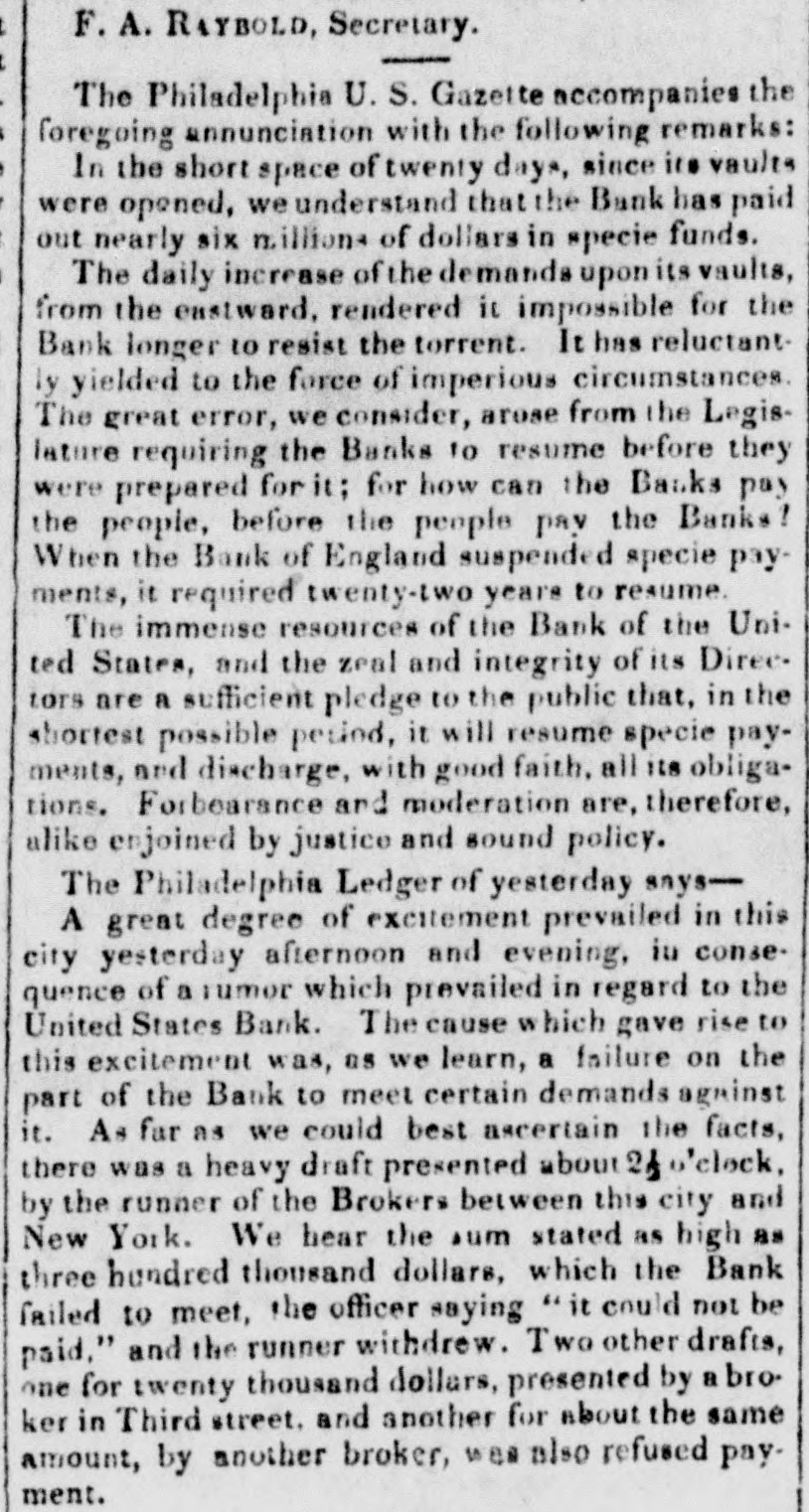
F. A. RAYBOLD, Secretary. The Philadelphia U. S. Gazette accompanies the foregoing annunciation with the following remarks: In the short space of twenty days, since its vaults were opened, we understand that the Bank has paid out nearly six millions of dollars in specie funds. The daily increase of the demands upon its vaults, from the eastward, rendered it impossible for the Bank longer to resist the torrent. It has reluctantly yielded to the force of imperious circumstances. The great error, we consider, arose from the Legislature requiring the Banks to resume before they were prepared for it; for how can the Basks pay the people, before the people pay the Banks When the Bank of England suspended specie payments, it required twenty-two years to resume. The immense resources of the Bank of the United States, and the zeal and integrity of its Direc. tors are a sufficient pledge to the public that, in the shortest possible period, it will resume specie payments, and discharge, with good faith. all its obligations. Forbearance and moderation are, therefore, alike enjoined by justice and sound policy. The Philadelphia Ledger of yesterday saysA great degree of excitement prevailed in this city yesterday afternoon and evening, in consequence of a rumor which prevailed in regard to the United States Bank. The cause which gave rise to this excitement was, as we learn, a failure on the part of the Bank to meet certain demands against it. As far as we could best ascertain the facts, there was a heavy draft presented about 24 'clock, by the runner of the Brokers between this city and New York. We hear the sum stated as high as three hundred thousand dollars, which the Bank failed to meet, the officer saying "it could not be paid," and the runner withdrew. Two other drafts, one for twenty thousand dollars, presented by a broker in Third street. and another for about the same amount, by another broker, was also refused payment.
17.August 11, 1841Indiana State SentinelIndianapolis, IN
Click image to open full size in new tab
Article Text
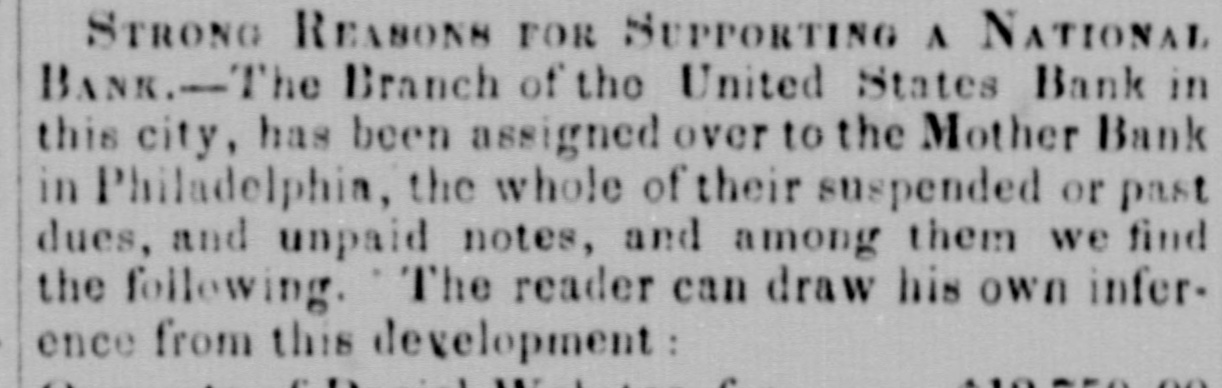
STRONG REASONS FOR SUPPORTING A NATIONAL BANK.-The Branch of the United States Bank in this city, has been assigned over to the Mother Bank in Philadelphia, the whole of their suspended or past dues, and unpaid notes, and among them we find the following. The reader can draw his own inference from this development oeA no
18.November 22, 1841Daily Richmond WhigRichmond, VA
Click image to open full size in new tab
Article Text
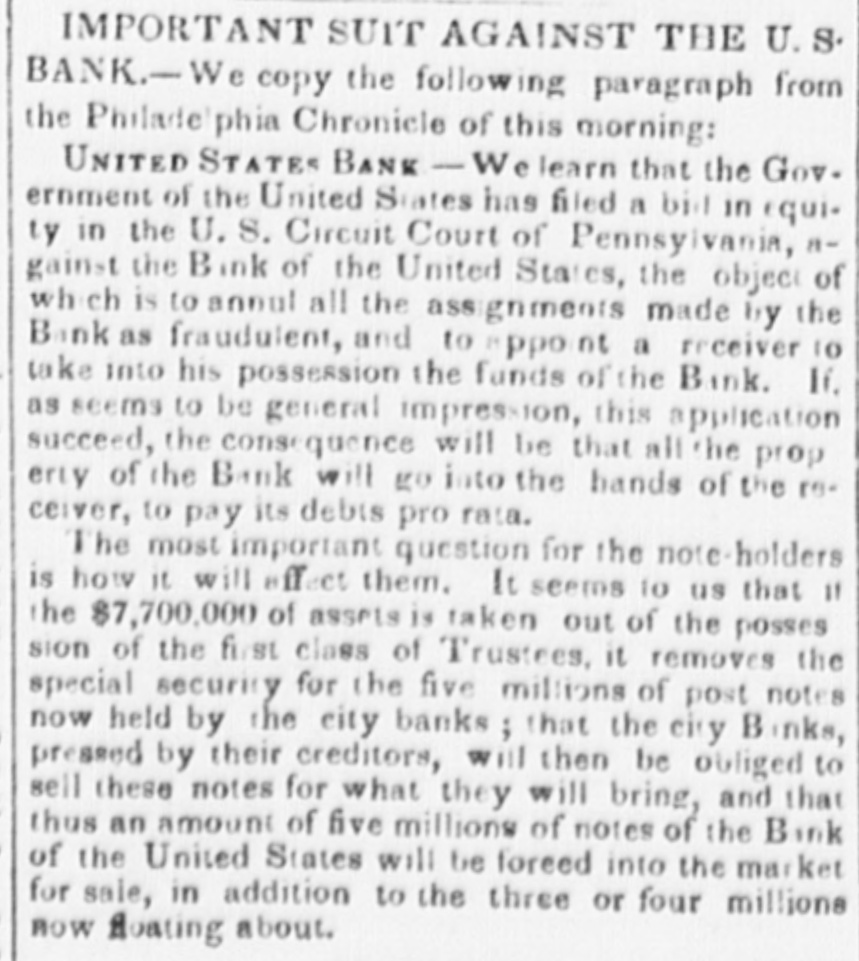
IMPORTANT SUIT AGAINST THE U.S. BANK.-We copy the following paragraph from the Philadel phia Chronicle of this morning: UNITED STATES BANK -We learn that the Gov. ernment of the United States has filed a bid in equity in the U. S. Circuit Court of Pennsylvania, Against the Bink of the United States, the object of which is to annul all the ass griments made by the Bank as fraudulent, and to "ppo nt a receiver 10 take into his possession the funds of the Bank. If. as seems to be general impression, this application succeed, the consequence will be that all the prop erty of the Bank will go into the hands of the receiver, to pay its debts pro rata. The most important question for the note-holders is how it will effect them. It seems to us that If the $7,700,000 of assets is taken out of the posses sion of the first class of Trustees. it removes the special security for the five millions of post notes now held by the city banks ; that the city nks, pressed by their creditors, will then be obliged to seil these notes for what they will bring, and that thus an amount of five millions of notes of the Bank of the United States will be foreed into the market for sale, in addition to the three or four millions ROW floating about.
19.June 23, 1848New-York Daily TribuneNew York, NY
Click image to open full size in new tab
Article Text
Amount accepted The Trustees of the B ank of the United States, inder the assignment of June 7, 1841, which was made b order to secure the payment of the Demand Notes, Deposits, and certain of the Post Notes of that instituNon, have given notice that it is their intention to make and declare a dividend of the moneys raised and col. ected by them from assets assigned. Notice is given to all claimants to come forward and prove their debte, it the office No. 70 Walnut-st. Philadelphia, between 10 4. M. and 2 P. M. on or before the 1st day of August text. No creditor will be entitled to claim or receive each dividend who shall not have brought forward and proved his debt before the time appointed for making and declaring the dividend. At Buffalo there is but little change to note in
20.March 2, 1852The Daily DispatchRichmond, VA
Click image to open full size in new tab
Article Text
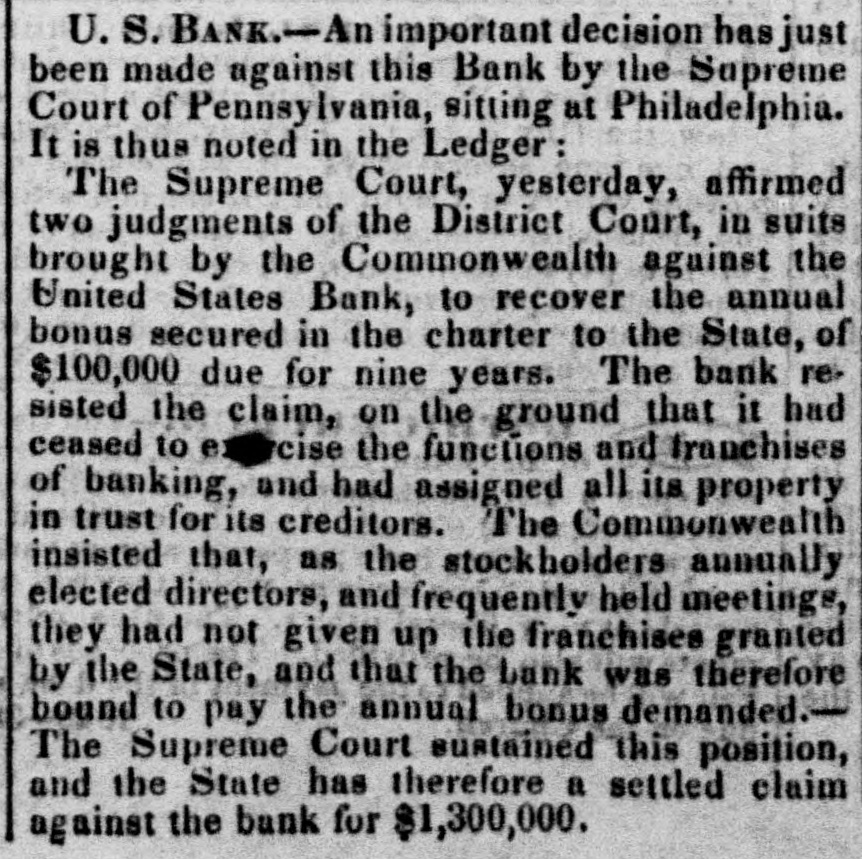
U. S. BANK.- An important decision has just been made against this Bank by the Supreme Court of Pennsylvania, sitting at Philadelphia. It is thus noted in the Ledger: The Supreme Court, yesterday, affirmed two judgments of the District Court, in suits brought by the Commonwealth against the United States Bank, to recover the annual bonus secured in the charter to the State, of $100,000 due for nine years. The bank resisted the claim, on the ground that it had ceased to er cise the functions and franchises of banking, and had assigned all its property in trust for its creditors. The Commonwealth insisted that, as the stockholders annually elected directors, and frequently held meetings, they had not given up the franchises granted by the State, and that the bank was therefore bound to pay the annual bonus demanded.The Supreme Court sustained this position, and the State has therefore a settled claim against the bank for $1,300,000.
21.March 2, 1852The RepublicWashington, DC
Click image to open full size in new tab
Article Text
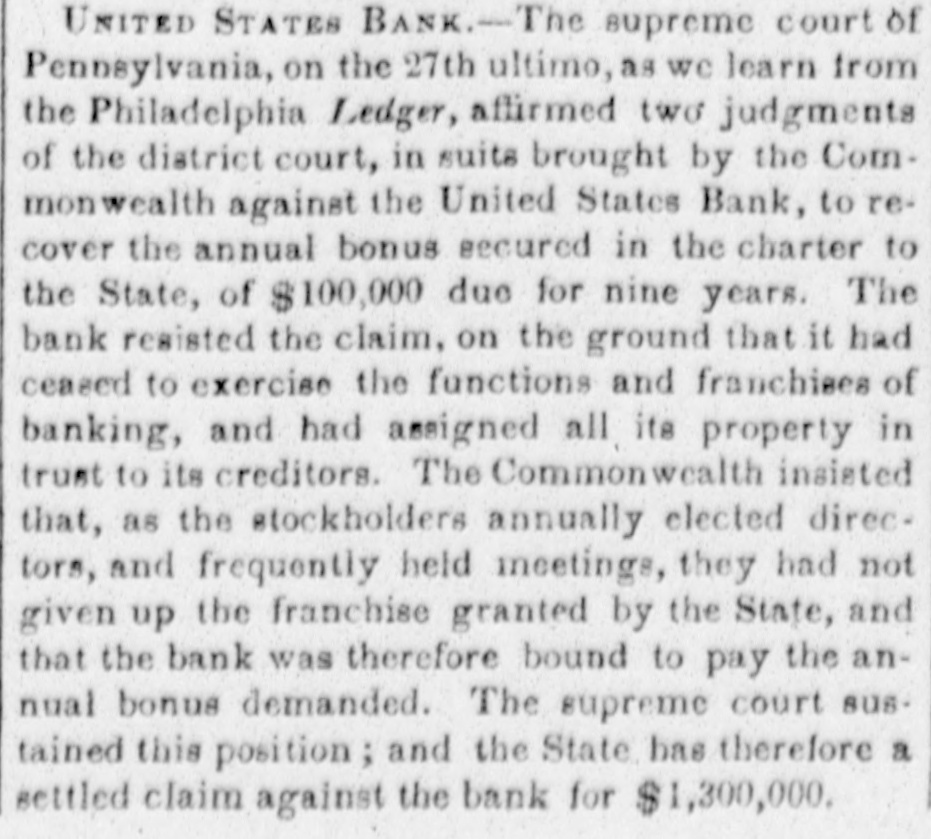
UNITED STATES BANK. The supreme court of Pennsylvania, on the 27th ultimo, as we learn from the Philadelphia Ledger, affirmed two judgments of the district court, in suits brought by the Commonwealth against the United States Bank, to recover the annual bonus secured in the charter to the State, of $100,000 due for nine years. The bank resisted the claim, on the ground that it had ceased to exercise the functions and franchises of banking, and had assigned all its property in trust to its creditors. The Commonwealth insisted that, as the stockholders annually elected direc. tors, and frequently held meetings, they had not given up the franchise granted by the State, and that the bank was therefore bound to pay the annual bonus demanded. The supreme court sus. tained this position ; and the State has therefore a settled claim against the bank for $1,300,000.
22.September 9, 1906The Montgomery AdvertiserMontgomery, AL
Click image to open full size in new tab
Article Text
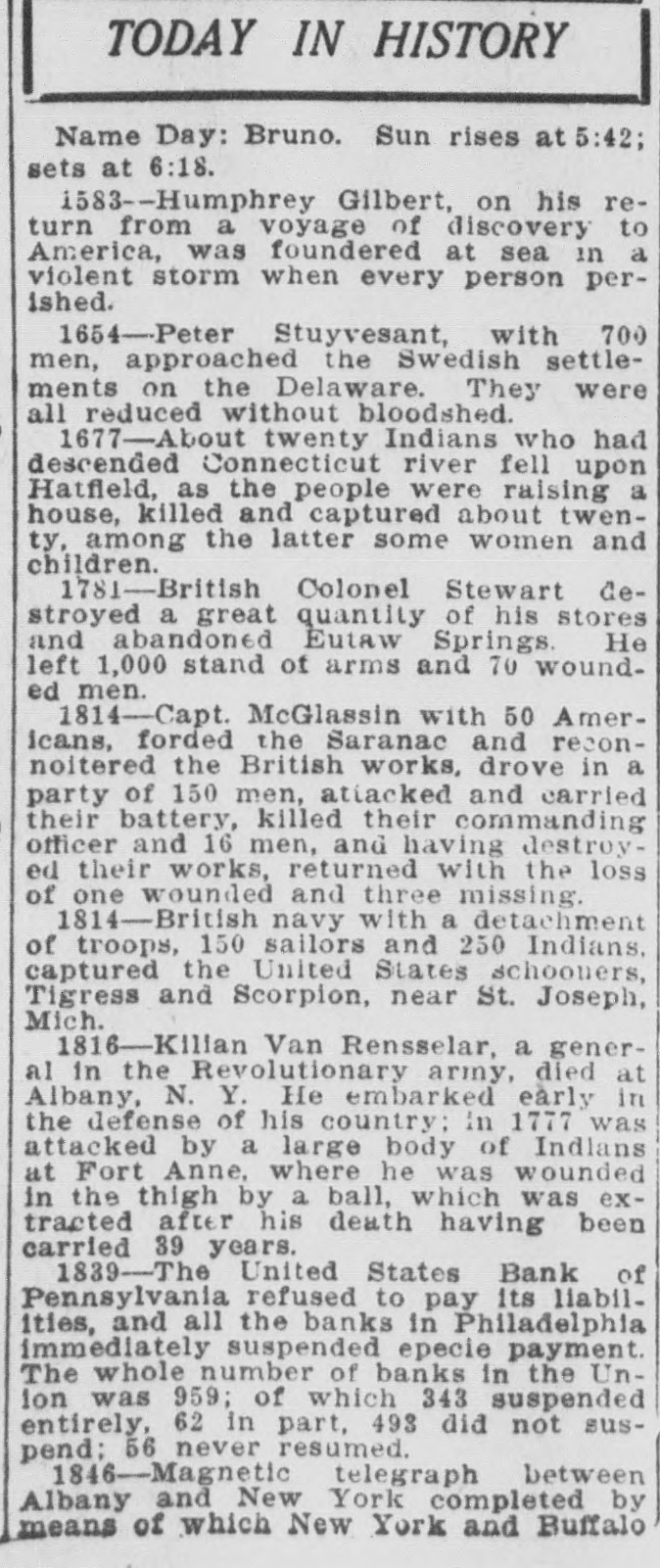
TODAY IN HISTORY Name Day: Bruno. Sun rises at 5:42; sets at 6:18. 1583--Humphrey Gilbert, on his return from a voyage of discovery to America, was foundered at sea in a violent storm when every person perished. 1654-Peter Stuyvesant, with 700 men, approached the Swedish settlements on the Delaware. They were all reduced without bloodshed. 1677-About twenty Indians who had descended Connecticut river fell upon Hatfield, as the people were raising a house, killed and captured about twenty, among the latter some women and children. 1781-British Colonel Stewart destroyed a great quantity of his stores and abandoned Eutaw Springs. He left 1,000 stand of arms and 70 wounded men. 1814-Capt. McGlassin with 50 Americans, forded the Saranac and reconnoitered the British works, drove in a party of 150 men, attacked and carried their battery, killed their commanding officer and 16 men, and having destroyed their works, returned with the loss of one wounded and three missing. 1814- - British navy with a detachment of troops, 150 sailors and 250 Indians, captured the United States schoouers, Tigress and Scorpion, near St. Joseph, Mich. 1816-Killan Van Rensselar, a general in the Revolutionary army, died at Albany, N. Y. He embarked early in the defense of his country: in 1777 was attacked by a large body of Indians at Fort Anne, where he was wounded in the thigh by a ball, which was extracted after his death having been carried 39 years. 1839-The United States Bank of Pennsylvania refused to pay its liabilities, and all the banks in Philadelphia immediately suspended epecie payment. The whole number of banks in the UnIon was 959; of which 343 suspended entirely, 62 in part, 493 did not suspend; 56 never resumed. 1846-Magnetic telegraph between Albany and New York completed by means of which New York and Buffalo
23.October 5, 1909The Marion Daily MirrorMarion, OH
Click image to open full size in new tab
Article Text
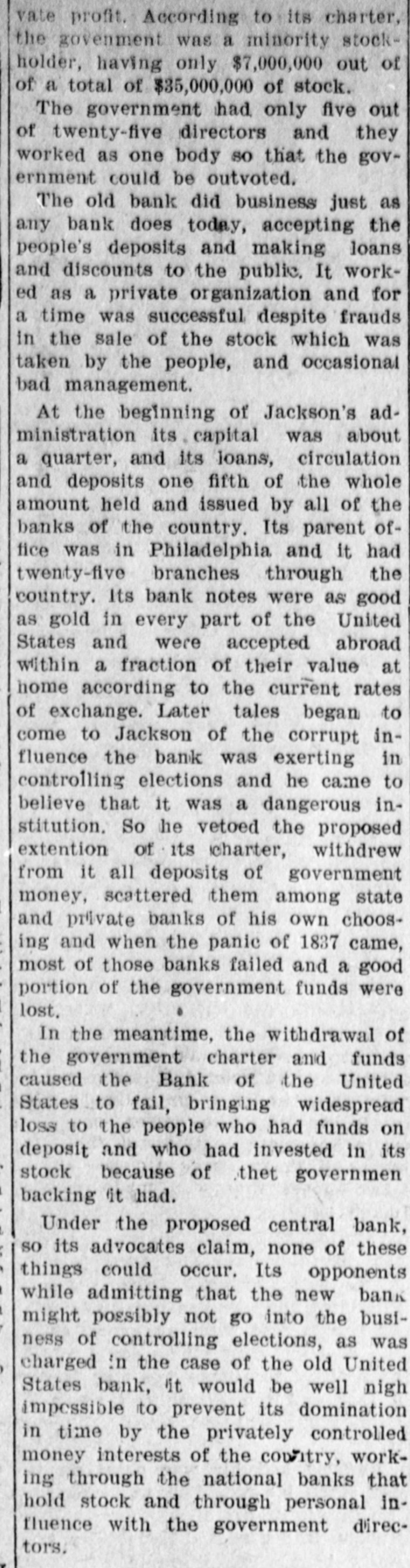
vate profit. According to its charter, the govenment was a minority stockholder, having only $7,000,000 out of of a total of $35,000,000 of stock. The government had only five out of twenty-five directors and they worked as one body so that the government could be outvoted. The old bank did business just as any bank does today, accepting the people's deposits and making loans and discounts to the public. It worked as a private organization and for a time was successful despite frauds in the sale of the stock which was taken by the people, and occasional bad management. At the beginning of Jackson's administration its capital was about a quarter, and its loans, circulation and deposits one fifth of the whole amount held and issued by all of the banks of the country. Its parent office was in Philadelphia and it had twenty-five branches through the country. Its bank notes were as good as gold in every part of the United States and were accepted abroad within a fraction of their value at home according to the current rates of exchange. Later tales began to come to Jackson of the corrupt influence the bank was exerting in controlling elections and he came to believe that it was a dangerous institution. So he vetoed the proposed extention of its charter, withdrew from it all deposits of government money, scattered them among state and private banks of his own choosing and when the panic of 1837 came, most of those banks failed and a good portion of the government funds were lost. In the meantime, the withdrawal of the government charter and funds caused the Bank of the United States to fail, bringing widespread loss to the people who had funds on deposit and who had invested in its stock because of thet governmen backing it had. Under the proposed central bank, so its advocates claim, none of these things could occur. Its opponents while admitting that the new bank might possibly not go into the business of controlling elections, as was charged in the case of the old United States bank, it would be well nigh impossible to prevent its domination in time by the privately controlled money interests of the country, working through the nationa] banks that hold stock and through personal influence with the government directors.
24.August 26, 1915The Detroit TimesDetroit, MI
Click image to open full size in new tab
Article Text
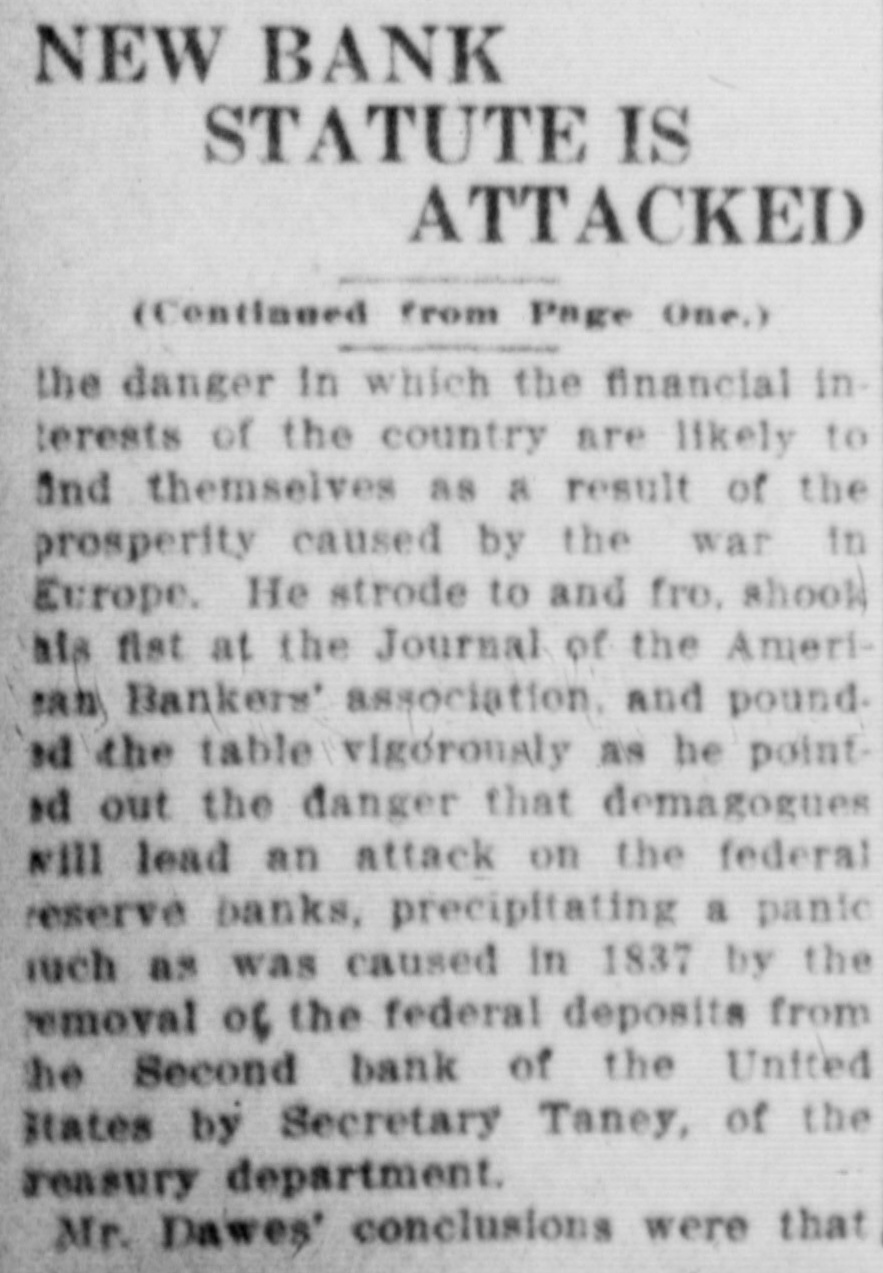
NEW BANK STATUTE IS ATTACKED (Continued from Page One.) the danger In which the financial interests of the country are likely to find themselves as a result of the prosperity caused by the war in Europe. He strode to and fro, shook his fist at the Journal of the Ameritan Bankers' association. and pound. rd the table vigorously as he pointsd out the danger that demagogues will lead an attack on the federal reserve banks, precipitating a panic such as was caused in 1837 by the removal of the federal deposits from the Second bank of the United States by Secretary Taney, of the reasury department. Mr. Dawes' conclusions were that
25.May 8, 1930The RepublicanOakland, MD
Click image to open full size in new tab
Article Text
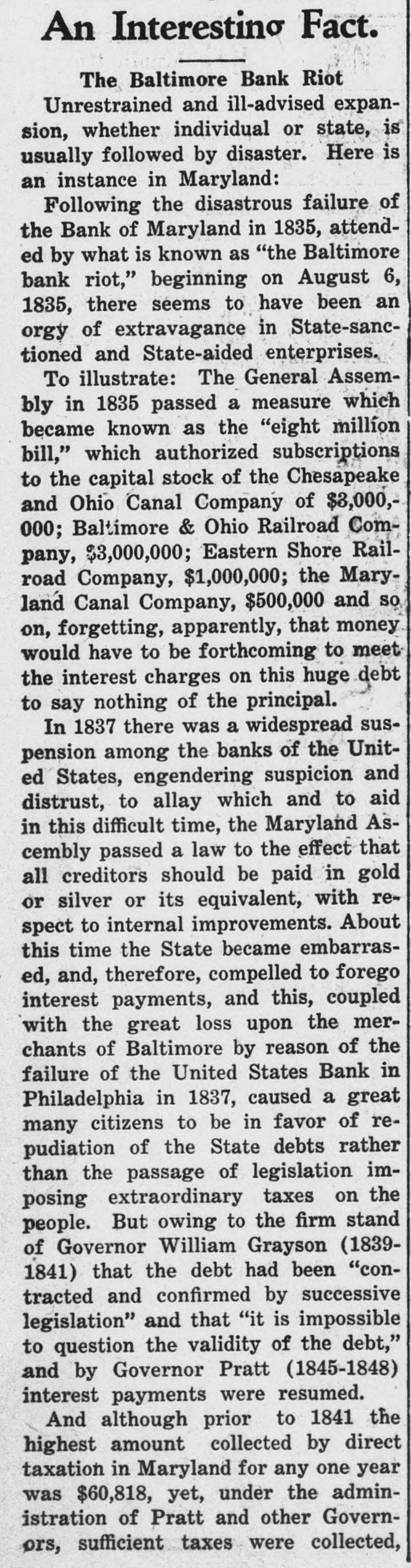
An Interesting Fact. The Baltimore Bank Riot Unrestrained and ill-advised expansion, whether individual or state, is usually followed by disaster. Here is an instance in Maryland: Following the disastrous failure of the Bank of Maryland in 1835, attended by what is known as "the Baltimore bank riot," beginning on August 6, 1835, there seems to have been an orgy of extravagance in State-sanctioned and State-aided enterprises. To illustrate: The General Assembly in 1835 passed a measure which became known as the "eight millíon bill," which authorized subscriptions to the capital stock of the Chesapeake and Ohio Canal Company of $3,000,000; Baltimore & Ohio Railroad Company, $3,000,000; Eastern Shore Railroad Company, $1,000,000; the Maryland Canal Company, $500,000 and so on, forgetting, apparently, that money would have to be forthcoming to meet the interest charges on this huge debt to say nothing of the principal. In 1837 there was a widespread suspension among the banks of the United States, engendering suspicion and distrust, to allay which and to aid in this difficult time, the Maryland Ascembly passed a law to the effect that all creditors should be paid in gold or silver or its equivalent, with respect to internal improvements. About this time the State became embarrased, and, therefore, compelled to forego interest payments, and this, coupled with the great loss upon the merchants of Baltimore by reason of the failure of the United States Bank in Philadelphia in 1837, caused a great many citizens to be in favor of repudiation of the State debts rather than the passage of legislation imposing extraordinary taxes on the people. But owing to the firm stand of Governor William Grayson (18391841) that the debt had been "contracted and confirmed by successive legislation" and that "it is impossible to question the validity of the debt," and by Governor Pratt (1845-1848) interest payments were resumed. And although prior to 1841 the highest amount collected by direct taxation in Maryland for any one year was $60,818, yet, under the administration of Pratt and other Governors, sufficient taxes were collected,
Bank runs are almost always and everywhere a deterioration of bank fundamentals.
But not for you.
You are the measure-zero exception: great fundamentals, solid bank, and yet the Diamond Dybvig fairy spread its rumor. Depositors woke up. Your collateral was not prepositioned. The Clearinghouse had it for you.
Do not pass Go. Do not collect $200. Go directly to jail… or worse.
Flag Article for Review
Flag Episode for Review
Second Bank of the United States · UID 8641175990494