Third National Bank (New York, NY)

Episode Information

Episode UID
8701169
Episode Type
Suspension β†’ Closure
Bank Type
national
Bank ID
870 national
Charter Number
87
Start Date
May 21, 1897
Location
New York, New York (40.714, -74.006)

Metadata

Model
gpt-5-mini (chosen from majority vote of a three-model LLM ensemble)
Short Digest
c8ff46666982097f

Response Measures

None

Description

Contemporary reports state the bank 'goes into liquidation' and will turn affairs over to City Bank.

Events (3)

1. September 21, 1863 Chartered
Source
historical_nic
2. May 20, 1897 Voluntary Liquidation
Source
historical_nic
3. May 21, 1897 Suspension
Cause
Voluntary Liquidation
Cause Details
Bank announced decision to retire from business and go into liquidation; affairs to be turned over to City Bank.
Newspaper Excerpt
The Third National bank of this city announced, this morning, that it will go into liquidation.
Source
newspapers

Newspaper Articles (12)

Article from The Houston Daily Post, November 3, 1896

Click image to open full size in new tab

Article Text

HANNA'S HAND. Shuts Money Up or Lets It Loose At Will. A Panic Was Planned. New York, October -(Special to the Post-Dispatch.)-Developments of the past few days in the money market here are full of significance to the American people. The unscrupulous methods of Wall street were never better illustrated. It can be stated that the pegs were all set for a panic and the preliminary steps were taken Thursday when money was run up to 100 per cent on call without any apparent reason. The fact that the panic did not develop was due to Mark Hanna, who had political sagacity enough to see ruin ahead, and he issued orders to the bankers here which were promptly obeyed and the rate easily put down to 40 per cent. After the close of business Thursday, telegrams were sent to Chairman Hanna and other members of the republican National committee, informing them of the situation. A spirited interchange of telegrams and messages over the long-distance telephone was kept up until late in the evening. when Mr. Hanna sent word that the panic-breeders were making votes for Bryan by raising the rates for money and that they would have to be put down. Henry W. Cannon, president of the Chase National bank and chairman of the clearing house committee, undertook to clear the atmosphere. He called a meeting of half a dozen bank presidents at the Union League club and suggested that it would be a brilliant idea for the banks to offer their money in more liberal quantities for use on the Stock Exchange. James T. Woodward of the Hanover National bank, A. B. Hepburn, president of the Third National bank: Frederick D. Tappen of the Gallatin National bank. and J. Edward Simmons of the Fourth National are some of the gentlemen with whim Mr. Cannon discussed the situation. It was decided to send an agent on the stock exchange Friday to offer money down. In the meantime reassuring cables were sent to London. together with buying orders. and the bankers went home to await the opening here. The result was as might have been anticipated. The rate went down and the panic vanished. Conservative business men of all parties are now standing aghast at the enormous power here shown to be held by one man. What is to become of the business of the country. they ask, if a itical magnate can issue an order from Chicago to the Wall street financiers, and put the money rate either up or down and precipitate a panic or shut one off as may seem best to his judgment for the interests of his party? If it had suited Hanna's purposes, does anyone doubt that the scheme would have gone through. and that the country would have been plunged into utter dismay and ruin. and this without any other cause than the determination of a coterie of wealthy men here to dominate the finances of the United States without regard to results to the people? The danger has temporarily passed. but an object lesson has been given the American people which it will well behoove them to remember on election day.
Article from Santa Fe Daily New Mexican, November 9, 1896

Click image to open full size in new tab

Article Text

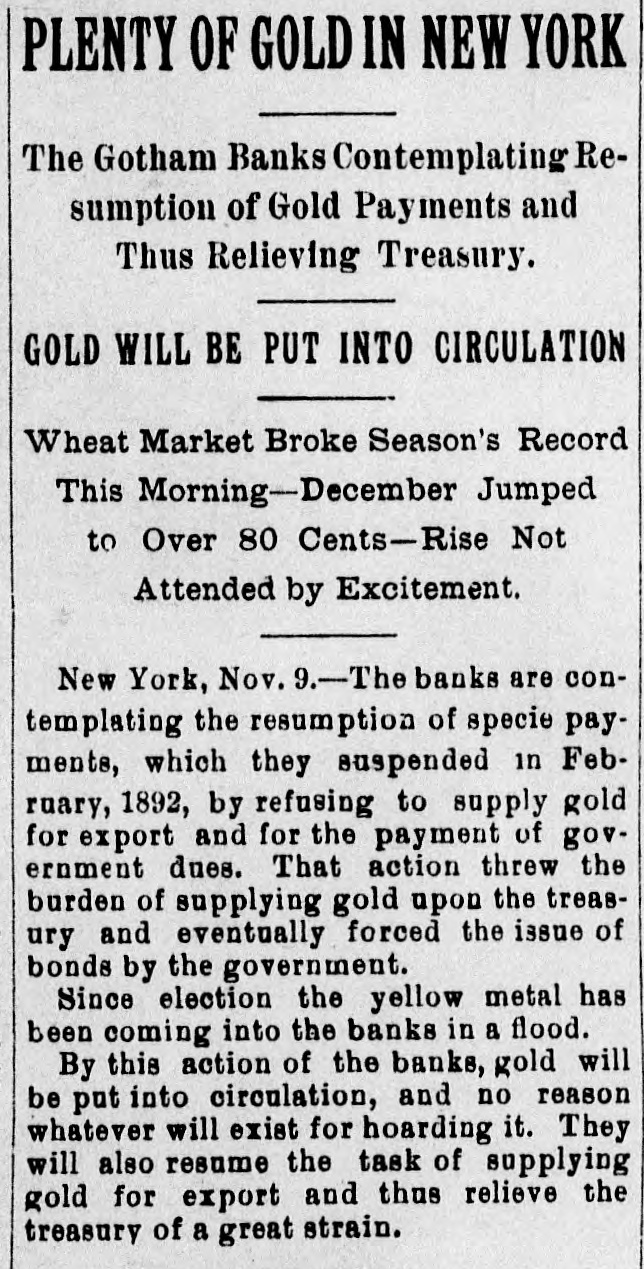
PLENTY OF GOLD IN NEW YORK The Gotham Banks Contemplating Resumption of Gold Payments and Thus Relieving Treasury. GOLD WILL BE PUT INTO CIRCULATION Wheat Market Broke Season's Record This Morning-December Jumped to Over 80 Cents-Rise Not Attended by Excitement. New York, Nov. 9. -The banks are contemplating the resumption of specie payments, which they suspended in February, 1892, by refusing to supply gold for export and for the payment of government dues. That action threw the burden of supplying gold upon the treasury and eventually forced the issue of bonds by the government. Since election the yellow metal has been coming into the banks in a flood. By this action of the banks, gold will be put into circulation, and no reason whatever will exist for hoarding it. They will also resume the task of supplying gold for export and thus relieve the treasury of a great strain.


Article from Deseret Evening News, November 9, 1896

Click image to open full size in new tab

Article Text

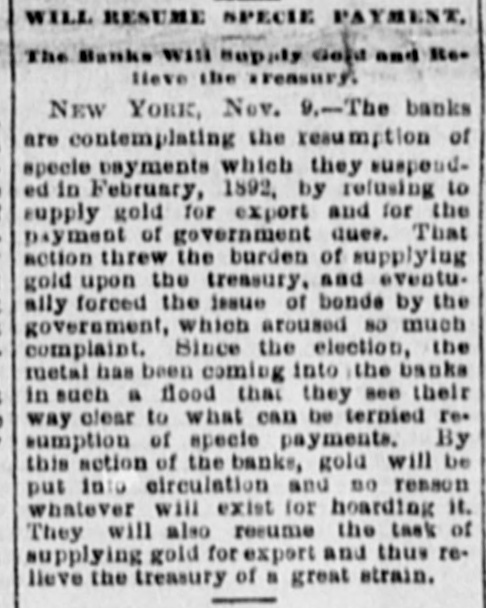
WILL RESUME SPECIE PAYMENT, The Banks will Supaly Gold and ReHeve the areasury, NEW YORK, Nov. 9,-The banks are contemplating the resumption of specie payments which they suspended in February, 1892, by refusing to supply gold for export and for the payment of government dues. That action threw the burden of supplying gold upon the treasury, and eventually forced the issue of bonds by the government, which aroused so much complaint. Since the election, the metal has been coming into the banks in such a flood that they see their way clear to what can be ternied re. sumption of specie payments. By this action of the banks, gold will be put into circulation and no reason whatever will exist for hoarding it. They will also resume the task of supplying gold for export and thus relieve the treasury of a great strain.


Article from The Topeka State Journal, November 9, 1896

Click image to open full size in new tab

Article Text

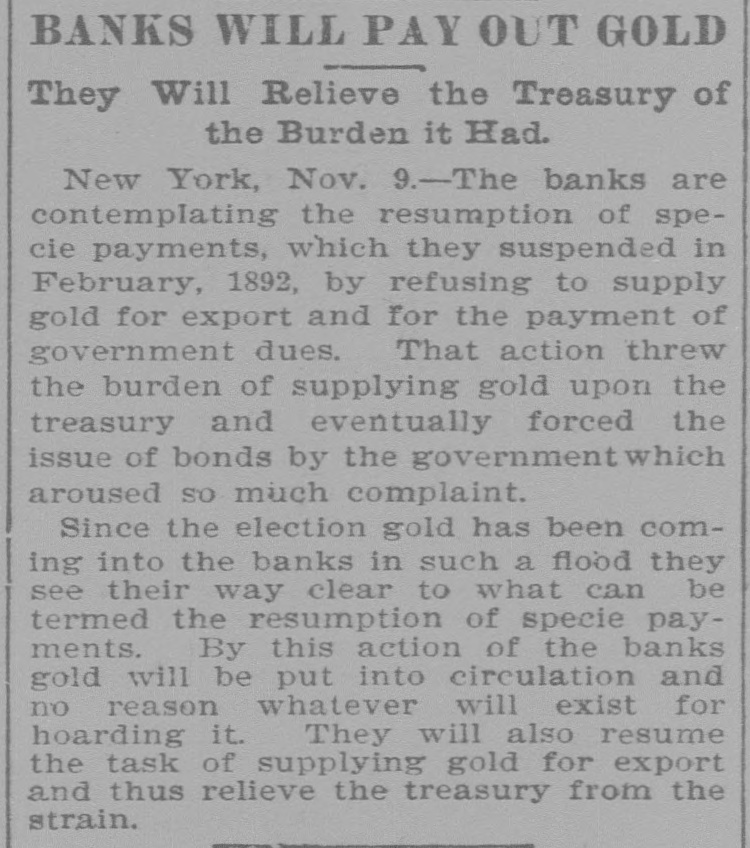
BANKS WILL PAY OUT GOLD They Will Relieve the Treasury of the Burden it Had. New York, Nov. 9.-The banks are contemplating the resumption of specie payments, which they suspended in February, 1892, by refusing to supply gold for export and for the payment of government dues. That action threw the burden of supplying gold upon the treasury and eventually forced the issue of bonds by the government which aroused SO much complaint. Since the election gold has been coming into the banks in such a flood they see their way clear to what can be termed the resumption of specie payments. By this action of the banks gold will be put into circulation and no reason whatever will exist for hoarding it. They will also resume the task of supplying gold for export and thus relieve the treasury from the strain.


Article from The Dalles Daily Chronicle, November 10, 1896

Click image to open full size in new tab

Article Text

Banks Feel the Effect of Restored Confidence. NEW YORK, Nov. 9.-The banks are contemplating the resumption of specie payments which they suspended in February, 1892, by refusing to supply gold for export and for payment of government dues. That action threw the burden of supplying gold upon the treasury, and eventually forced the issue of bonds by the government, which aroused so much complaint. Since the election the metal has been coming into the banks in such a flood that they see their way clear to what can be termed a resumption of specie payments. By this action of the banks gold will be put into circulation, and no occasion whatever will exist for hoarding it. They will also resume the task of supplying gold for export and thus relieve the treasury of a great strain.


Article from Pine Bluff Daily Graphic, November 10, 1896

Click image to open full size in new tab

Article Text

THEIR WAY CLEAR Coming Into the Banks In a Flood. PTION OF SPECIE PAYMENT York Banks Are Contemplating Move-They - Suspended Such stent In February, 1892, by Reto Supply Gold For Export-Facnd Shops Running Full Time. YORK, Nov. 10.-The banks are W implating the resumption of specie ents, which they suspended in arry, 1892, by refusing to supply for export and for the payment of mment dues. That action threw borden of supplying gold upon the Sary and eventually forced the issue bonds by the government, which red SO much complaint. Since the metal has been coming into the firs in such a flood that they see their clear to what can be termed the reotion of specie payments. By this of the banks gold will be put on circulation and no reasons whatwill exist for hoarding it. They also resume the task of supplying for export and thus relieve the stray from the strain.


Article from Las Vegas Daily Optic, May 21, 1897

Click image to open full size in new tab

Article Text

STILL FAILING. Prosperity Seems to Have no Effect on HardPressed Banks. NEW YORK, N. Y., May, 21. The Third national bank of this city announced, this morning, that it will go into liquidation. It has $12,000.00 of deposits and claims solitiney. It will turn over its affairs Horow City bank, which will pay deposi our The City bank has $43,000,000 in assets. LAWRENCE, N. H., May 21.-The Lake village bank follows the Belknap savings bank and suspends. WASHINGTON, D. C., May 21.The failure of the State national bank of Logansport, Indiana, yesterday, was due to the management's loaning heavily to its president. BOSTON, Mass., May 21. -The Han. cock national bank goes into lΓ­quidation, to-day, and the Mercantile trust company takes charge of its affairs. WASHINGTON, D. C.,May 21.-Act. ing comptroller of the treasury, Coffin, was notified, this morning, that the First national bank of Orleans, Nebraska, had failed.


Article from El Paso Daily Herald, May 21, 1897

Click image to open full size in new tab

Article Text

Bank Failures. NEW YORK, May 21.-The Third National bank of this city announces this morning that it goes into liquidation. It has twelve million dollars on deposit. and claims solvency. It will turn over to the City bank which will pay the depositors. The City bank has forty-three million in assets. LAWRENCE, N. H., May 21.- The Lake Village bank follows the Belknap Savings bank and has suspended. WASHINGTON, May 21.-The failure of the State National bank of Logansport, Indiana, was due to bad management and heavy loaning to the president. BOSTON, May 21.-The Hancock National bank goes into liquidation. The Mercantile Trust company takes charge of its affairs. WASHINGTON, May 21.-Acting Comptroller of the Treasury Coffin was notified this morning that the First National bank of Orleans, Neb., had failed.


Article from The Ely Miner, May 26, 1897

Click image to open full size in new tab

Article Text

Failure is announced of the Miners' state bank of Cripple Creek, Col. Gov. Black, of New York, signed the bill providing the death penalty for train wreckers who cause death. The Belknap savings bank at Laconia, N. H., closed its doors with about $1,000,000 due depositors. A fire in Jersey City, N. J., caused a loss of $100,000 and made 60 families homeless. The rapid fall of the Mississippi river at all points from Memphis to the gulf gives notice that the flood of 1897 is over. The total area overflowed was: Arkansas, 3,200 square miles; Mississippi, 6,520 square miles; Louisiana, 975 square miles, and the total damage amounts to $14,520,000. The first public test of the acrograph, an instrument by which photographs may be instantaneously transmitted by wire, was successfully made in Cleveland, O. Albert W. King, a 19-year-old messenger of the Boylston national bank in Boston, was missing with about $20,000 in cash. Two children of Augustus Muetze, residing 12 miles from Redfield, S. D., were killed by lightning. Tramps fired the home of Thomas Biddle, a farmer at White Oak Creek, Tenn., and he and his wife and three children were cremated. The sixty-fifth annual meeting of the American Baptist Home Missionary society convened in Pittsburgh, Pa. The fourth annual banquet of the Associated Press was given in Chicago, 140 members being present. The State bank of Monticello, Ind., suspended payment. It had $135,000 in deposits. At Oakland, Cal., Lucretia Borgia, a four-year-old filly, broke the world's record for four miles, making the distance in 7:11. Terrific wind and rainstorms in Indiana did great damage at Indianapolis, Kokomo and Wabash. Fire at Hoboken, N. J., caused a loss of $650,000 and 150 families were rendered homeless. The National Good Citizens' convention at Nashville, Tenn., adopted a platform which seeks to unite all friends of good government, to promote the duty of good citizens, to contend for purity in politics and to make known to all the truth about the principles of American institutions. The State national bank of Logansport, Ind., closed its doors with liabilities of $300,000. The Randolph county courthouse at Beverly, W. Va., was destroyed by fire with all the official records for 100 years. The Third national bank of New York has decided to retire from business. The one hundred and ninth General Assembly of the Presbyterian church met at Eagle Lake, Ind. President McKinley will visit the Nashville exposition on June 12. Michigan will have no state fair this year. The treasury is bankrupt. A statue of Stephen Girard, the philanthropist and founder of Girard college, was unveiled in Philadelphia. Col. E. B. Gray, of Madison, was elected state commander of the G. A. R. at the annual encampment in Eau Claire, Wis. A statue of the late Cornelius Vanderbilt, "the commodore," was unveiled on the campus of Vanderbilt university at Nashville, Tenn.


Article from Warren Sheaf, May 27, 1897

Click image to open full size in new tab

Article Text

Failure is announced of the Miners' state bank of Cripple Creek, Col. Gov. Black, of New York, signed the bill providing the death penalty for train wreckers who cause death. The Belknap savings bank at Laconia, N. H., closed its doors with about $1,000,000 due depositors. A fire in Jersey City, N. J., caused a loss of $100,000 and made 60 families homeless. The rapid fall of the Mississippi river at all points from Memphis to the gulf gives notice that the flood of 1897 is over. The total area overflowed was: Arkansas, 3,200 square miles; Mississippi, 6,520 square miles; Louisiana, 975 square miles, and the total damage amounts to $14,520,000. The first public test of the acrograph, an instrument by which photographs may be instantaneously transmitted by wire, was successfully made in Cleveland, O. Albert W. King, a 19-year-old messenger of the Boylston national bank in Boston, was missing with about $20,000 in cash. Two children of Augustus Muetze, residing 12 miles from Redfield, S. D., were killed by lightning. Tramps fired the home of Thomas Biddle, a farmer at White Oak Creek, Tenn., and he and his wife and three children were cremated. The sixty-fifth annual meeting of the American Baptist Home Missionary society convened in Pittsburgh, Pa. The fourth annual banquet of the Associated Press was given in Chicago, 140 members being present. The State bank of Monticello, Ind., suspended payment. It had $135,000 in deposits. At Oakland, Cal., Lucretia Borgia, a four-year-old filly, broke the world's record for four miles, making the distance in 7:11. Terrific wind and rainstorms in Indiana did great damage at Indianapolis, Kokomo and Wabash. Fire at Hoboken, N. J., caused a loss of $650,000 and 150 families were rendered homeless. The National Good Citizens' convention at Nashville, Tenn., adopted a platform which seeks to unite all friends of good government, to promote the duty of good citizens, to contend for purity in politics and to make known to all the truth about the principles of American institutions. The State national bank of Logansport, Ind., closed its doors with liabilities of $300,000. The Randolph county courthouse at Beverly, W. Va., was destroyed by fire with all the official records for 100 years. The Third national bank of New York has decided to retire from business. The one hundred and ninth General Assembly of the Presbyterian church met at Eagle Lake, Ind. President McKinley will visit the Nashville exposition on June 12. Michigan will have no state fair this year. The treasury is bankrupt. A statue of Stephen Girard, the philanthropist and founder of Girard college, was unveiled in Philadelphia. Col. E. B. Gray, of Madison, was elected state commander of the G. A. R. at the annual encampment in Eau Claire, Wis. A statue of the late Cornelius Vanderbilt, "the commodore," was unveiled on the campus of Vanderbilt university at Nashville, Tenn.


Article from New-York Tribune, June 12, 1897

Click image to open full size in new tab

Article Text

WALL STREET AND EXCHANGES. A cable dispatch from London yesterday said the announcement of a committee headed by ex-Secretary Charles S. Fairchild, representing Central Pacific Railroad bonds and shares, had created surprise in view of the existence of the so-called Banbury shareholders' committee and the recent notice that Speyer Brothers would soon call for a deposit of bonds. It was added that "in business circles the new committee is scarcely taken seriously." At the office of the New-York Security and Trust Co., of which Mr. Fairchild is president, It was said he had not yet received a copy of the London Committee's agreement, and did not know who the other members of the committee were. It was stated yesterday that President Diaz, of Mexico, had declared forfeited a number of concesions for railroads granted to the Mexican National Construction Company, of New-York. John Pratt, the secretary of the company, which has an office at No. 11 Broadway, said the concessions had simply lapsed. The construction company was formed to build the Mexican National Railway. Subsequently it built a line from Colima to Manzanello and another line in the State of Zacataca. Concessions for the extension of these lines were the ones that were allowed to lapse. The Sugar Trust (American Sugar Refining Company) has advanced all grades of sugar a quarter of a cent a pound in the last week, and it reports all grades oversold except cubes and granulated. The wholesale price of granulated is now 43/4 cents. The belief in the sugar trade is that the present Senate sugar schedule will pass and go into effect about July 1. The law permitting. the consolidation of the Chicago gas companies becomes operative on July 1, and the formal merging of the companies will take place soon after that date. Counsel for the companies are now at work on the details of the arrangement. With only one set of officers and only one general office, there will be a great saving in administration. The annual economy by the consolidation, it is estimated, will be equal to from 1 to 1Β½ per cent on the stock. The new company will be called the People's Consolidated Gaslight and Coke Company. A story was printed yesterday that the Long Island Railroad proposed to make arrangements to run its trains over the Brooklyn Bridge. William H. Baldwin, jr., the president of the Long Island road, said the company had no such scheme under consideration. The company is going ahead with the tunnel under the East River. Standard Oil Trust certificates sold yesterday at the highest price yet attained. Fifteen certificates were sold at 3213/4 which made the certificates carrying the recently declared dividend worth 3313/4. The sum of $10,254.95 was realized from the auction sale on Tuesday, Wednesday and Thursday at the Barge Office of seized, unclaimed and abandoned goods. The champagne which was sold brought $1,800. The shipment of gold to-day by Ladenburg, Thalmann & Co. will be $260,000. The gold, which is destined for Austria, will be forwarded by La Bretagne, of the French Line. It was taken in coin from the Sub-Treasury yesterday afternoon. Samuel Sloan, president of the Delaware, Lackawanna and Western Railroad, and A. B. Hepburn, president of the Third National Bank, which is now In liquidation, have been elected vice-presidents of the National City Bank.


Article from The Birmingham Age-Herald, September 22, 1916

Click image to open full size in new tab

Article Text

Will Soon Have Vanderlip Branch Banks All Over the World EVERY MAN IN BANK UP FROM THE RANKS This Successful Institutions Principle- Are Now Co- Conducted operation on Dominating Note at National City 21 By HOLLAND (Special.) September Frank New two York, or three years of the National Within president have es Vanderlip as will in all probability all parts of or bank banks in those parts tablished City branch at least in for buildpoint the where world, there are trade. opportunities From national this and ing up American institution is in New York at of view merely the large bank veral years accumu ago, not London, to the rapid of this tention city In was deposits called and reported resources that bank- Sir ing lation institution of and it one was of the great said to his associates United Felix uthorities Schuster of after London he had States returned that the years from business visit to of three the or was four persuaded, take rank world. in National the course City bank among he the 10 greatest reflects would banks of the of this institution modern American a flourishing The high growth degree early the nineties. large, it was bank behind with spirit in a In the but not very one or two respect other to esta maintained and stood in New far York city Its stablished manageme by who banks deposits and the traditions in his day authorities was one of Moses Taylor, leading banking and was often said chiefly of the United States banker who was upon broad the been the organizing association instrumental have the in clearing house the secprinciples York city just before as of New came time Grover Cleveland advisable to There uguration of seemed that some ond ina when directors the bank be President stockholder in the and order ethods to of secure man these of changes established James In G occupied Stillma with any the pro cot with changes wealth, all his not life professing bank ng princi would ton business. asked if he dis found methods. was At first he there was was take ples the decline presidence the offer. which but decided father him posed to imental reason His of the proposition propost in this bank- The favor been inter terested known banker, had long welfare and its wever was not wide repuas senior its Stillman but how had merchant nation He in New was tation as as cotton known in Texas was an authori Europe almost well and his cotton name ma rkets of tion that this bank tative York city, one was in the his father's influenced Mr Stillresidency. with man LIQUIDATING to accept the AN OLD Stillman BANK took Mr there came few months of the bank, shrewdly per bank the opportunity presidency which he The Third Na dry accept cepted had become perfectly ceived an and of New York sound. The new putting tional rotted although the hope of of Barton stockholders it. made in choice Mr epburn had life into president retired as comptroller The Henburn a as earlier Washington few weeks currency at Hepburn's career was of of the successes of Mr. it clear that it Third latest banker made his that the into quickened due to no fault could not be he proposed to vigorous liquida City National bank life Therefore Mr Stillman bank put in the National opened by this Na president of opportu unity the Third bank grasped the liquidation of liquidate the proposed offered to City and did so it was tional He National ctorily Although all through the very sa proposition. never- of almost opened accounts quickly not and part of the of the depositor with of National for the theless Third National City and nearly the deposits doubled by a this the institution Mr were Hep! became National City that action president of the the Chase Na tional. the time vice went thence to have been among phenomenal bank and where his triumphs successes of New at the time York bankers. grew so that preparing to long when The business the government occupie was custom custom house house at vacate Wall its street, of the the new city having proposit been on the lower Mr end Stillman made take over the were old firished, the government Some to thought this there proposicustom to house. reasons behind of hastard sentimenta The tal building which was was sometimes London tion Egyptian architecture resemble the Bank of reasons thought to no sentime imental behind this there were ones. Stillman the but But purely business HOW far ahead custom Mr. house transaction when he purchased is now made nearly clear 1200 bank saw for statement the city bank that there in are the building was employes the of the this old custom house of this inand, large as with the necessar growth in few nevertheless may be additional property years stitution to acquire NDEFFICIENCY associa ORGANIZATION Banking in New When the America years ago, met asked to some 10 Stillman was bankers. York tion, city, Mr of welcome accepted to the the invifive He spoke make He speech reluctantly man of few minutes words, was thought and tion, that tation for for he not more than the modern nespirit by His cessity central of co-opera to be espe Co-operation ially needed with organizahe believed American meant banks also high The remark the Stillman efficiency truly national so, tion Mr and nization great of this now Mr. Stillman's counsel has made able organization institution flects also, does its it effi- posestablish policy and organization institution merica, to in Censible ciency for the in South and speedity in branch banks in Europe already been observ these tral Russia. America and it has establishment Internation of tional that with institutions the our Efficiency the fact is branch has demonstrated increased by average in the course commerce strikingly each day and these are an without perfected as that also transaction of year $40,000,000 error of so much one cent of policy co-operation of time the Sal was Mr illustrated Stillman at the and fire. reported With Francisco earthquake after the telegraph Simonson. one acfew hours William A. bank in a disaster, esidents of the Stillman to of this the vice the counsels of with Mr. $5,000,000 the of started cord with for San be Francisco made so ailable that to they which was San Francisco busing prevented its banks could carry of their this kind also that city and in Co-opera tion timore when placed great panic in Ba institutions were of the fire. a banking on account emergency