Citizens Bank (Mound City, KS)

Episode Information

Episode UID
8702777891122
Episode Type
Suspension β†’ Closure
Bank Type
state
Bank ID
870277789 hash
Start Date
June 19, 1893
Location
Mound City, Kansas (38.143, -94.814)

Metadata

Model
gpt-5-mini (chosen from majority vote of a three-model LLM ensemble)
Short Digest
d17a0e42ee21c42c

Response Measures

None

Description

Bank failed/closed in 1893 and was placed in receivership; later receiver removed for mismanagement in 1897.

Events (5)

1. June 19, 1893 Receivership
Newspaper Excerpt
in the hands of receivers; the defunct Citizens' bank of Mound City ... is in the hands of receivers.
Source
newspapers
2. June 19, 1893 Suspension
Cause
Bank Specific Adverse Info
Cause Details
Insolvency: liabilities far exceeded assets, heavy insider loans/notes and depleted cash position revealed by examiner
Newspaper Excerpt
The bank failed on June 19, 1893, with $120,000 of individual deposits ... when the bank examiner ... found only $1,579.62 in cash
Source
newspapers
3. February 6, 1895 Other
Newspaper Excerpt
Suit Between Receivers of Failed Banks for Possession of Assets ... resulting from the failure of the Citizens' bank of Mound City ... in the hands of receivers.
Source
newspapers
4. June 22, 1897 Other
Newspaper Excerpt
Judge Simons ... removed G. A. Seaman as receiver of the defunct Citizens' bank of Mound City, and appointed James Ashbaugh to succeed him.
Source
newspapers
5. June 23, 1897 Other
Newspaper Excerpt
Receiver A. G. Seaman ... refused to comply with the demand of the bank commissioner for a statement showing the condition of the institution; Seaman charged $8,864 for collecting and paying a dividend of $5,000.
Source
newspapers

Newspaper Articles (15)

Article from Western Kansas World, August 26, 1893

Click image to open full size in new tab

Article Text

STATE NEWS. McPherson county spent $38,220.16 on the public schools last year. The works of the Western coal company at Fleming are burned. Three hundred miners were thrown out of employment. Washburn college of Topeka has 13 instructors, a membership of over 300 scholars and a library containing over 6,000 volumes. The University of Kansas has fortyfour instructors and last year 739 scholars were entered. The library contains 17,288 volumes. Fort Scott will be given the next state meeting of the Y. M. C. A. of Kansas, which will convene October 19, 20, 21 and 22. This will bring together about 500 delegatesa means a big thing for Fort Scott. On account of recent agitation, the clubs of Lawrence have decided to close up and quit business. All were notified that if they did not, prosecution would be begun by the county attorney under the nuisance clause of the prohibitory law. The Atchison electric street railway is an assured fact. The city council has passed the necessary ordinances, and a site for the power house has been purchased. Work will be commenced at once, and the line will be in operation December 1. Prof. C. A. Boyle, of Ottawa university has been chosen to the chair of music at the Normal school at Emporia. He will be assisted by his wife who has a national reputation as a pianist, having for years been accompanist at Chautauquan assemblies. Olathe Patron: About twenty-five of our young ladies, chaperoned by Mrs. R. E. Stevenson, went into camp at Holliday Tuesday. The camp will be kept open for about ten days and during that time it is expected that about forty will enjoy the pleasure of camp life. Fred Tufts, receiver of the Kansas Trust and Banking company of Atchison, sold a quarter section of land in Phillips county last week for $1,800 cash. The claim of the company was $1,200. A quarter section in Smith county was sold for $2,250. The company's claim against the land was $1,000. Robert Kincaid, president of the defunct Citizen's bank of Mound City, and partner in five other banks, has fled the country. In addition to the money the people will lose through the bank failures, the people of Linn county held his personal notes for about $200,000, all of which it is thought will prove a tΓ³tal loss. Thieves entered the home of Rev. W. B. Poinsett, ex-chaplain of the state penitentiary, at Kansas City, Kan., and secured a gold watch and some small change. The watch was the property of Mrs. Lizzie Gamble, the daughter of Rev. Poinsett, presented to her by the prison officials and convicts when she conduced a convict choir. Topeka Capital: City Assessor Oscar Bishoff is making a thorough search of the records in the various courts and elsewhere to discover all the judgments, mortgages, etc., subject to taxation. A list will be compiled and submitted to the board of county commissioners who will see that those not returned by the owners are properly taxed. Thomas H. Cavanaugh, formerly of Topeka, who it has been known has been conducting experiments in raising sunken vessels by means of placing large canvas sacks in the hold and pumping air into them, has made a great success. He raised the Glenola near New York within one hour after the sacks were adjusted. The New York papers contain long accounts of it. From Winona: A tornado destroyed considerable property and killed two children in the northwestern part of Logan county. The tornado formed about fifteen miles northwest of here and first struck the farm house of William Jackson, completely demolishing it and killing his two children, aged 5 and 10 years, respectively. Farm machinery and wagons were carried for a quarter of a mile and twisted out of shape. The storm traveled in a northeasterly direction for about five miles, striking the house of G. B. Yeoman, totally destroying it, together with the stable and other outbuildings, killing a horse, several pigs and chickens. The prairie for a mile and a half wide was covered with debris from the demolished buildings. Jack rabbits were killed by the score. From Goodland: This section has been visited by a most terrible hail storm, covering an area of three miles square. The stones averaged the size of base balls, many of them weighing nineteen ounces and measuring sixteen inches in circumference. The roof of part of the R. W. Finley mill building is covered with corrugated iron, through which the hail tore its way. At over fifty places roofs of shingles and inch boards were crushed and sidewalks were broken in many parts of town. One thousand roof lights of glass, five-eighths

Article from The Advocate, September 26, 1894

Click image to open full size in new tab

Article Text

MORRILL AND BLUE OUGHT TO FORM A PARTNERSHIP AND HANG OUT A SIGN: Redeemers and Dealers in Fraudulent Titles and Mortgages-Conduct a General Skinning Business-Oustomers Robbed on Short Notice. In this the most important political campaign of Kansas' history the People's party papers have made no attempt at sensations, and no attempt to injure personal character without cause. The republican state convention, in order to keep up its reputation of standing by the interests of the money power nominated nine state candidates, seven of which are either bankers or corporation lawyers or both. The most notorious of these are R. W. Blue for Congressman at large and E. N. Morrill for Governor. These two men have business records so foul that they are even denounced by members of their own party while their leaders undertake to berate the official character of Populist officials. Most of our readers have some knowledge of the swindling operations of E. N. Morrill and they will find something in this artiele to add to their knowledge. We wish first to say a word about that other combination of fraud an egotiem, R. W. Blue. This R. W. Blue is a stockholder in the Citizens Bank of Mound City, Kansas, an institution which recently failed with liabilities far exceeding its assets. The bank was 8 swindle from start to finish. Blue paid $800 for stock in this bank and thereby, it seems, established a credit of twelve times that amount, something he never had in his life before. But this credit was used to the dire detriment of the depositors of the concern, for Blue drew out over $9,000 of the bank's funds and the receiver now holds his worthleas notes for that amount. The depositors will receive little or nothing for their hard earned money. This accounts for all this "standing up for the credit of Kansas," which fellows of the Blue stripe talk SO much about. They believe in credit and confidence, for it may enable them to repeat their confidence games in the future. There is still more to Blue's record. He was vice-president of the Kansas Land, Loan and Trust Co., organized in Mound City in 1885, and here is a sample of their manner of doing business, as :published by the Mound City Torch of Liberty: They had a mortgage given by Rv. C. Casida for $700, which they sold to an eastern party named Louisa Miller. Casida paid the amount of this mort-


Article from The Advocate, September 26, 1894

Click image to open full size in new tab

Article Text

large, and his connection as director with the Citizen's bank of Mound City, Linn county, wherein he took out nearly $10,000 of the people's money, and the bank holds his note for the amount. Tell me how much said note is worth on the dollar. Ask the president of the Creditor's Protective association, an organization of the creditors of said defunct bank. Tell me about your notorious, drunken republican judge, Botkin, whose impeachment trial by $the senate cost the state $38,837.58. Tell me about your republican dynamite plot at Coffeyville, which almost resulted in serious loss of life. Then explain why your republican courts say that it is all right and legal for the Topeka club to run, but that all other smaller clubs, composed of poor men, and less influential, shall be closed, although operated on exactly the same system. It appears"to me that you and your prohibition friends should look into this matter. Tell me about the bribery and corruption in the senatorial elections of 1867 and 1871 as shown by the report of your republican investigating committee, which reported February 24, 1872, in which Pomeroy and other prominent republicans figured. Tell me about the useless expenditure of state money by Governor Humphrey when he was a candidate for congress in the Third district, referred to by the Topeka Capital of April 27, 1892, as follows: "For six months he has had a playedout politician, a lazy, political loafer, acting as his? personal roustabout. This barnacle is borne on the rolls of the adjutant general as Lewis Hanback, at $100 per month, and has not in the past six months done an hour's work in the adjutant general's office. He has been kept traveling about looking after the governor's political fences, for which services the governor has drawn orders on the contingent fund, which is under his personal control, for $280. These orders given by the governor may be examined by any tax-payer in the state auditor's office, as they are among the public records open to all citizens. From December 15, to April 25, 1892, Mr. Hanback drew on five vouchers of the governor, $280 for 'special services,' 'extra $ services," etc., to each of which vouchers I was attached the following certificate s signed by Governor Humphrey: | "I do certify that the within was I contracted by me for the state under 1 authority of law, and that the amount ) therein claimed is correct according to ) such contract, and is unpaid.' ) "When Governor Humphrey signed 1 those vouchers he know Low Hanback i was receiving $100.00 per month from : the state, not one dollar of which he 3 earned. He knew also that the private l political work Lew Hanback was doing , and 18 doing to-day for him on the $50 he drew on Monday, April 25th, was not an expenditure of the money of the state 7 warranted by exigencies of the public service or contemplated by law." 1 Then tell me about the overlasting I diagrace on Kansas, at the Osawatomie Income canlum in 1877 an account of


Article from Barbour County Index, October 3, 1894

Click image to open full size in new tab

Article Text

contractors, and persons interested? By the way, did not the legislative investigation in 1891 show a shortage on statehouse contracts of $80,000? What became of it? Then tell me about the $14,576.77 of worthless school bonds purporting to be from Norton and Rice counties purchased by the republican board of school fund commissioners, a history of which is found in the republican attorney general's report for 1876, to the governor. Then tell me about the Comanche county school bond fraud of 1872 and 1873, the buffalo hunt, Mr. Mowry, the forged tally sheets of imaginary school district bond elections said to have been held, location of imaginary school district No. 1, and the $2,500 in bonds voted to build the school house (see House Journal, page 450 of 1876) the mapping out of other fraudulent school districts, and in repiy to the question, where the fictitious bonds could be disposed of, the answer came: "There is just as good market for fraudulent school bonds in Topeka as there is for legal bonds. There is only a difference in price." Then tell me about the many thousands of dollars due the state from N. Y. Firse Insurance companies on account of insurance written by them in Kansas cities and towns having paid fire departments. This matter has been running for years, and until the records of insurance written are lost, so that now it is impossible to determine the exact amount due the state from this source. This outstanding indebtedness is about to be compromised by the payment of a large sum of money into the state treasury, but in the future every eent of this tax will be collected, especially it we have a populist state superintendent of insurance. Then tell me about R. W. Blue, your candidate for congress man-at-large, and his connection as director, with the Citizen's bank of Mound City, Linn county, wherein he took out nearly $10,000 of the people's money, and the bank holds his note for the amount. Tell me how much said note is worth on the dollar. Ask the president of the creditors Protective Association, an organization of the creditors of said defunct bank. Tell me about your notorious, drunken republican judge, Botkin, whose impeachment trial by the senate cost the state $38,857.58. Tell me about your republican dynamite plot at Coffeyville, which almost resulted in serious loss of life. Then explain why your republican courts say that it is all right and legal for the Topeka Club to run, but that all other smaller clubs, composed of poor men, and less influential, shall be closed although operated on exactly the same system. It appears to me that you and your prohibition friends should look into this matter. Tell me about the bribery and corruption in the senatorial elections of 1876 and 1871 as shown by the reports of your republican investigation committee, which reported February 24, 1872, in which Pomeroy and other prominent republicans figured. [Concluded next week.]


Article from Barbour County Index, October 3, 1894

Click image to open full size in new tab

Article Text

R. W. BLUE is a stockholder in the Citizens' bank of Mound City, Kansas, an institution which recently failed with liabilities far exceeding its assets. The bank was a swindle from start to finish. Blue paid $800 for stock in this bank and thereby, it seems, established a credit of twelve times that amount, something he never had in his life before. But this credit was used to the dire detriment of the depositors of the concern, for Blue drew outover $9,000 of the bank's funds and the receiver now holds his worthless notes for that amount. The depositors will receive little or nothing for their hard earned money. This accounts for all this "standing up for the credit of Kansas," which fellows of the Blue strip talk so much about. They believe in credit and confidence, for-it may enable them to repeat their confidence games in the future.


Article from The Advocate, October 10, 1894

Click image to open full size in new tab

Article Text

THIS IS WHAT HELPED BRING KANSAS TO DISGRACE. A Loud-Mouthed Redeemer Whose Business Is Swindling the Public, and Who Ought to Be In Prison. It is now time to acquaint the people of Kansas with the bank and mortgage record of R. W. Blue, candidate for conreasman-at-large upon the republican ticket. Being one of the victims of the alleged "failure" of the Citizens bank of Mound City, Linn county, Kas., I am financially interested in the affairs of that bank, which was claimed to be the very best bank in Linn county, in fact, a particularly bright star in the consteliation of fin ncial institutions which have been persistently pointed to with pride by our republican leaders and press as being "the best banking system on earth." We now find that, notwithstanding the alleged "safe and conservative" character of the institution with which we will show how closely Mr. Blue was connected, it had some peculiar characteristics not get forth in its glittering prospectus. The bank was organized in May, 1887, and failed in July,1893, Mr. Blue being "in on the ground floor" in the start, and safely "over the fence and out" when the failare occurred. I was one of a committee of three appointed to examine the books. and as each of the committee WAS a victim of the crash, we had fairly paid for the information we might obtain, al though we were not aware what the de velopments might be. The bank failed on June 19, 1893, with $120,000 of individual deposits as one item of their liability, in addition to $49,400 paid-up stock, which had also been swallowed up. Now, when the bank examiner walked into this safe and conservative institution on the above date, and put his hand on the money drawer and safe, he found, as a basis for this liability of $169,400, only $1,579.62 in cash, and about $149,000 in notes. We, as depositors, were assured by the president, cashier, and R. W. Blue, director, up to the very day of the failure, that the bank was perfectly safe; and, as one evidence of the confidence we had in their assurances, based, of course, on our belief in their honesty and integrity, we call attention to the fact that there was no run made or the bank by depositors, as the statement of its condition made to the bank commissioner on June 20, 1893, one month previous to the failure, shows $119,000 individual deposits. As evidence of the worse than rotten character of the paper (in general, which is turned over to us as assets by this gang of genteel freebooters and legalized Dal tons, we call attention to the fact that the names of the stockholders of the institution are attached to $103,000 out of the $149,000 in notes, and, as evidence of the share that Mr. Blue had in the transaction, I call attention to the fact that his name as principal is attached to $8,657.64. He had $2,000 in stock, upon which he had paid but $800, leaving him liable as stockholder, for $3,200, making him debtor in the total sum of $12,057.64. Now, no one would imagine for a moment that one of the foremost "redeemers" of Kansas,one of the brightest apostles of "honest dollars," would obligate himself in this manner to the citizens of his own county, his neighbors and friends-some of whom are widow withont dapositing collat-


Article from The Advocate, October 24, 1894

Click image to open full size in new tab

Article Text

BLUE'S CONFIDENCE GAMES. A Victim of the Great Redeemer Tells His Experience. [The following article was published in our issue of October 10, but as the present issue will reach many thousands of new readers, and as this article gives facts which are almost identical with the experience of many other victims, it is reprinted.] It is now time to acquaint the people of Kansas with the bank and mortgage record of R. W. Blue, candidate for congreaman-at-large upon the republican ticket. Being one of the viotims of the alleged "failure" of the Citizens bank of Mound City, Linn county, Kas., I am financially interested in the affairs of that bank, which was claimed to be the very best bank in Linn county, in fact, s particularly bright star in the consteliation of fin recial institutions which have been persistently pointed to with pride by our republican leaders and press as being "the best banking system on earth." We now find that, notwithstanding the alleged "safe and conservative" character of the institution with which we will show how closely Mr. Blue was connected, it had some peouliar characteristics not set forth in its glittering prospectus. The bank was organized in May, 1887, and failed in July, 1893, Mr. Blue being "in on the ground floor" in the start, and safely "over the fence and out" when the failure occurred. I was one of a committee of three appointed to examine the books. and as each of the committee was a victim of the crash, we had fairly paid for the information we might obtain, although we were not aware what the de velopments might be. The bank failed on June 19, 1893, with $120,000 of individual deposits as one item of their liability, in addition to $49,400 paid-up stock, which had also been swallowed up. Now, when the bank examiner walked into this safe and conservative institution on the above date, and put his hand on the money drawer and safe, he found, as a basis for this liability of $169,400, only $1,579.62 in cash, and about $149,000 in notes. We, as depositors, were assured by the president, cashier, and R. W. Blue, director, up to the very day of the failure, that the bank was perfectly safe; and, as one evidence of the confidence we had in their assurances, based, of course, on our belief in their honesty and integrity, we call attention to the fact that there was no run made or the bank by depositors, as the statement of its condition made to the bank commissioner on June 20, 1893, one month previous to the failure, shows $119,000 individual deposits. As evidence of the worse than rotten character of the paper in general, which is turned over to us as assets by this gang of genteel freebooters and legalized Dal tone, we call attention to the fact that the names of the stockholders of the institution are attached to $103,000 out of the $149,000 in notee, and, as evidence of the share that Mr. Blue had in the transaction, I call attention to the fact that his name as principal is attached to $8,657.64. He had $2,000 in stock, upon which he had paid but $800, leaving him liable as stockholder, for $3,200, making him debtor in the total sum of $12,057.64. Now, no one would imagine for a moment that one of the foremost


Article from Abilene Weekly Reflector, February 7, 1895

Click image to open full size in new tab

Article Text

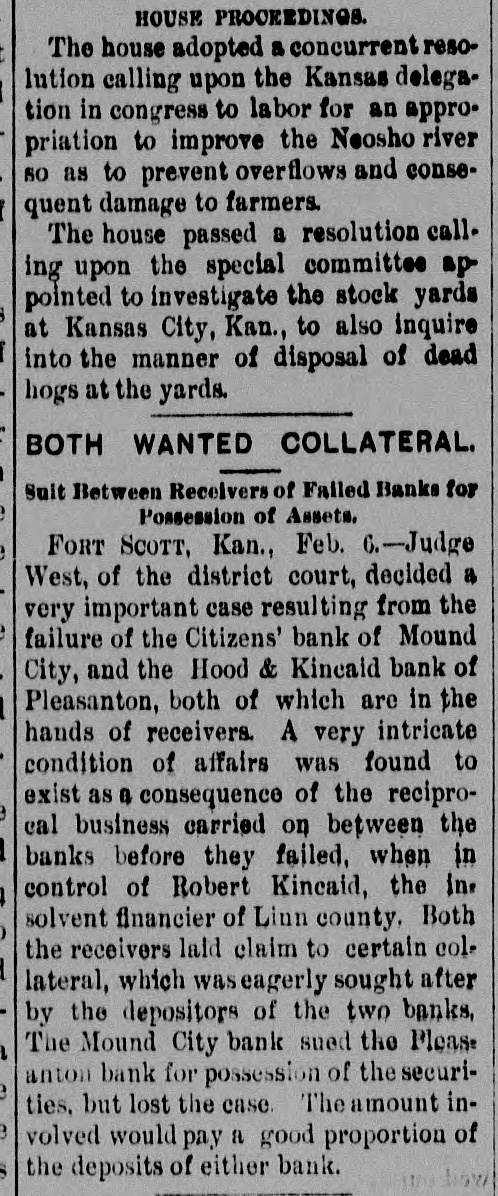
HOUSE PROCEEDINGS. The house adopted a concurrent resolution calling upon the Kansas delegation in congress to labor for an appropriation to improve the Neosho river so as to prevent overflows and consequent damage to farmers. The house passed a resolution calling upon the special committee appointed to investigate the stock yards at Kansas City, Kan., to also inquire into the manner of disposal of dead hogs at the yards. BOTH WANTED COLLATERAL. Suit Between Receivers of Failed Banks for Possession of Assets. FORT SCOTT, Kan., Feb. 6.-Judge West, of the district court, decided a very important case resulting from the failure of the Citizens' bank of Mound City, and the Hood & Kincaid bank of Pleasanton, both of which are in the hands of receivers. A very intricate condition of affairs was found to exist as a consequence of the reciprocal business carried on between the banks before they failed, when in control of Robert Kincaid, the in. solvent financier of Linn county. Both the receivers laid claim to certain collateral, which was eagerly sought after by the depositors of the two banks, The Mound City bank sued the Please anton bank for possession of the securities, but lost the case. The amount involved would pay a good proportion of the deposits of either bank. how


Article from The Mena Weekly Star, June 23, 1897

Click image to open full size in new tab

Article Text

Deflex the Banking Law. TOPEKA, Kan., June 32. - -Receiver A. G. Seaman, of the defunct Citizens' bank, of Mound City, is the first receiver to defy the new banking law of Kansas, and he will likely lose his job as a result of it. Mr. Seaman refused to comply with the demand of the bank commissioner for a statement showing the condition of the institution.


Article from Kansas City Journal, June 23, 1897

Click image to open full size in new tab

Article Text

RECEIVER SEAMAN OUSTED. His Management of Affairs of Defanct Citizens' Bank Not Satisfactory. Topeka, Kas., June 22.-(Special.) Judge Simons, of the Bourbon-Linn county district court, to-day removed G. A. Seaman as receiver of the defunct Citizens' bank of Mound City, and appointed James Ashbaugh to succeed him. James Snoddy was also removed as attorney, and the court appointed J. W. Poor to the vacancy. The removal of Seaman and Snoddy was due to an examination of Seaman's accounts by Examiner Waterman, of the state banking department.


Article from The Wichita Daily Eagle, June 24, 1897

Click image to open full size in new tab

Article Text

Judge Simons, of the Bourbon-Linn county district court, today removed G. A. Seaman as receiver of the defunct Citizens' bank of Mound City, and appointed James Ashbaugh to succeed him. James Snoddy was also removed as attorney, and the court appointed J. W. Poor to the vacancy. The removal of Seaman and Snoddy was due to an examination of Seaman's accounts by Examiner Waterman, of the state banking department.


Article from The Guthrie Daily Leader, June 24, 1897

Click image to open full size in new tab

Article Text

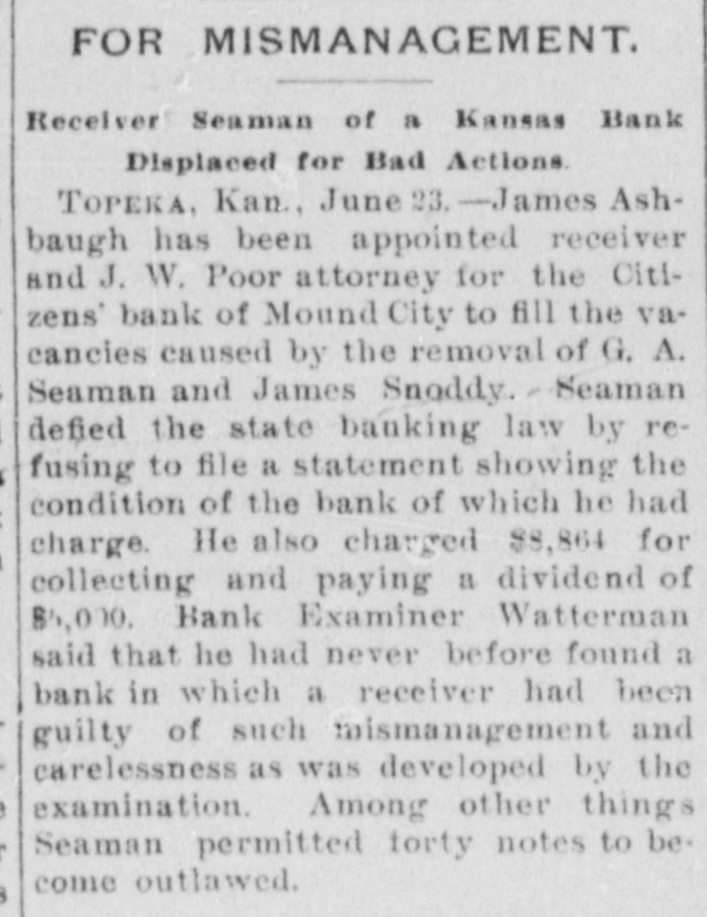
FOR MISMANAGEMENT. Receiver Seaman of a Kansas Bank Displaced for Bad Actions. TOPERA, Kan., June 23. -James Ashbaugh has been appointed receiver and J. W. Poor attorney for the Citizens' bank of Mound City to fill the vacancies caused by the removal of G. A. Seaman and James Snoddy. - Seaman defied the state banking law by refusing to file a statement showing the condition of the bank of which he had charge. He also charged $8,864 for collecting and paying a dividend of $5,000. Bank Examiner Watterman said that he had never before found a bank in which a receiver had been guilty of such mismanagement and carelessness as was developed by the examination. Among other things Seaman permitted torty notes to become outlawed.


Article from Abilene Weekly Reflector, June 24, 1897

Click image to open full size in new tab

Article Text

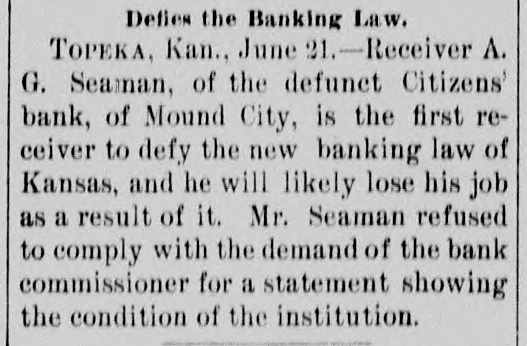
Defies the Banking Law. TOPEKA, Kan., June 21.-Receiver A. G. Seaman, of the defunct Citizens' bank, of Mound City, is the first receiver to defy the new banking law of Kansas, and he will likely lose his job as a result of it. Mr. Seaman refused to comply with the demand of the bank commissioner for a statement showing the condition of the institution.


Article from Abilene Weekly Reflector, June 24, 1897

Click image to open full size in new tab

Article Text

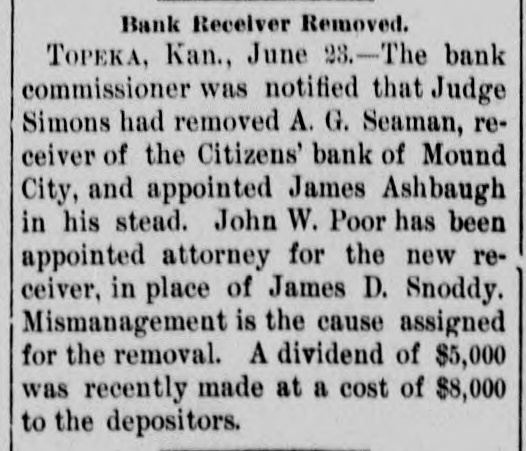
Bank Receiver Removed. TOPEKA, Kan., June 28.-The bank commissioner was notified that Judge Simons had removed A. G. Seaman, receiver of the Citizens' bank of Mound City, and appointed James Ashbaugh in his stead. John W. Poor has been appointed attorney for the new receiver, in place of James D. Snoddy. Mismanagement is the cause assigned for the removal. A dividend of $5,000 was recently made at a cost of $8,000 to the depositors.


Article from The Topeka State Journal, July 8, 1897

Click image to open full size in new tab

Article Text

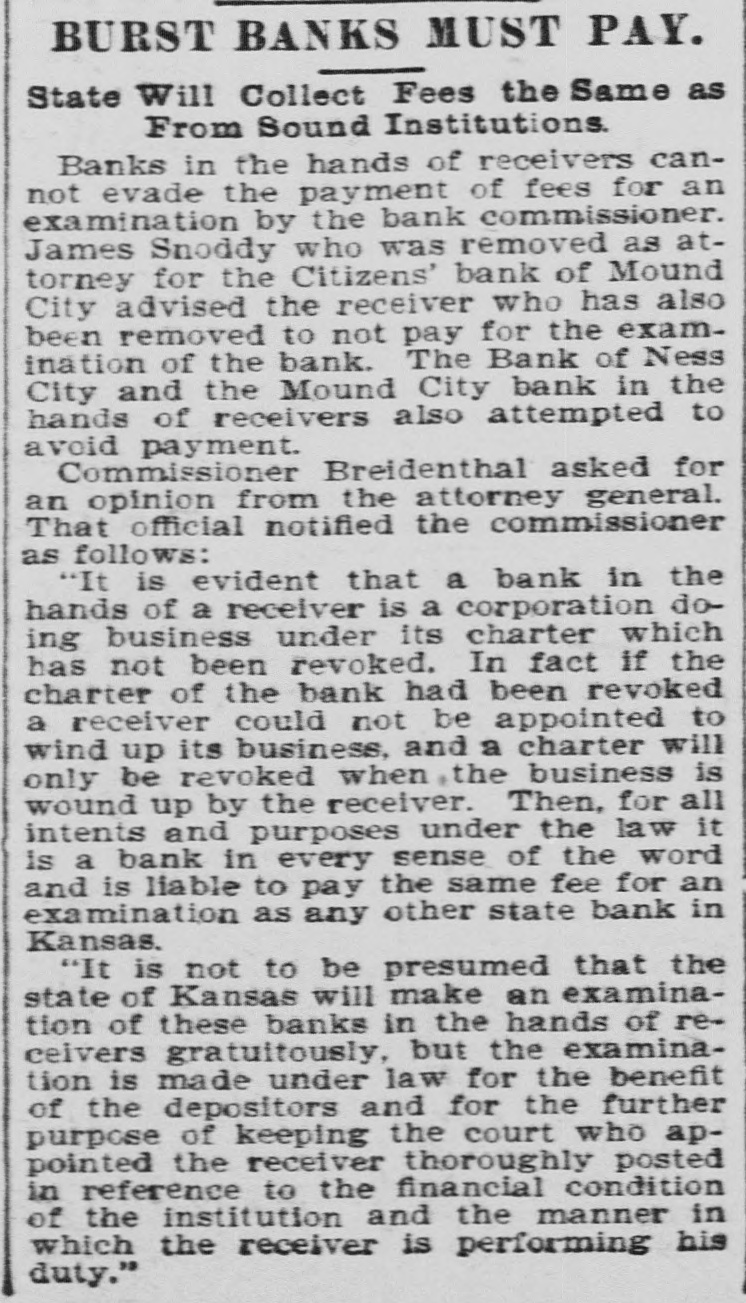
BURST BANKS MUST PAY. State Will Collect Fees the Same as From Sound Institutions. Banks in the hands of receivers cannot evade the payment of fees for an examination by the bank commissioner. James Snoddy who was removed as attorney for the Citizens' bank of Mound City advised the receiver who has also been removed to not pay for the examination of the bank. The Bank of Ness City and the Mound City bank in the hands of receivers also attempted to avoid payment. Commissioner Breidenthal asked for an opinion from the attorney general. That official notified the commissioner as follows: "It is evident that a bank in the hands of a receiver is a corporation doing business under its charter which has not been revoked. In fact if the charter of the bank had been revoked a receiver could not be appointed to wind up its business, and a charter will only be revoked when the business is wound up by the receiver. Then, for all intents and purposes under the law it is a bank in every sense of the word and is liable to pay the same fee for an examination as any other state bank in Kansas. "It is not to be presumed that the state of Kansas will make an examination of these banks in the hands of receivers gratuitously, but the examination is made under law for the benefit of the depositors and for the further purpose of keeping the court who appointed the receiver thoroughly posted in reference to the financial condition of the institution and the manner in which the receiver is performing his duty."