Northern Bank (New York, NY)

Episode Information

Episode UID
8731221691294
Episode Type
Run โ†’ Suspension โ†’ Closure
Bank Type
state
Bank ID
873122169 hash
Start Date
October 28, 1907
Location
New York, New York (40.714, -74.006)

Metadata

Model
gpt-5-mini (chosen from majority vote of a three-model LLM ensemble)
Short Digest
ddf460124386434c

Response Measures

None

Description

A minor run occurred during the 1907 panic but the 1910 suspension was by the state superintendent for irregularities; suspension led to permanent closure and receivership.

Events (4)

1. October 28, 1907 Run
Cause
Macro News
Cause Details
Run occurred during the wider 1907 banking panic and general loss of confidence in banks.
Measures
Paid waiting depositors promptly; cited lack of small bills caused some delay.
Newspaper Excerpt
At the Northern Bank of New York, at Broadway and Fourth street, about seventy-five people were constantly in line. The bank officials ... they were paid off as rapidly as possible.
Source
newspapers
2. December 27, 1910 Suspension
Cause
Government Action
Cause Details
State Superintendent of Banks took possession and closed the bank after an examination revealed irregular transactions.
Newspaper Excerpt
The Northern Bank of New York ... was taken possession of today by Superintendent of Banks Chesney. ... an examination of the institution had disclosed certain irregular transactions.
Source
newspapers
3. January 24, 1911 Other
Newspaper Excerpt
Joseph Robin ... caused a big sensation today when he appeared before Federal Commissioner Alexander in connection with the appointment of a receiver in bankruptcy. Robin ... declared ... he was the alleged wrecker of the Northern bank, the appointment of a receiver in bankruptcy was in process and legal actions continued.
Source
newspapers
4. April 18, 1911 Other
Newspaper Excerpt
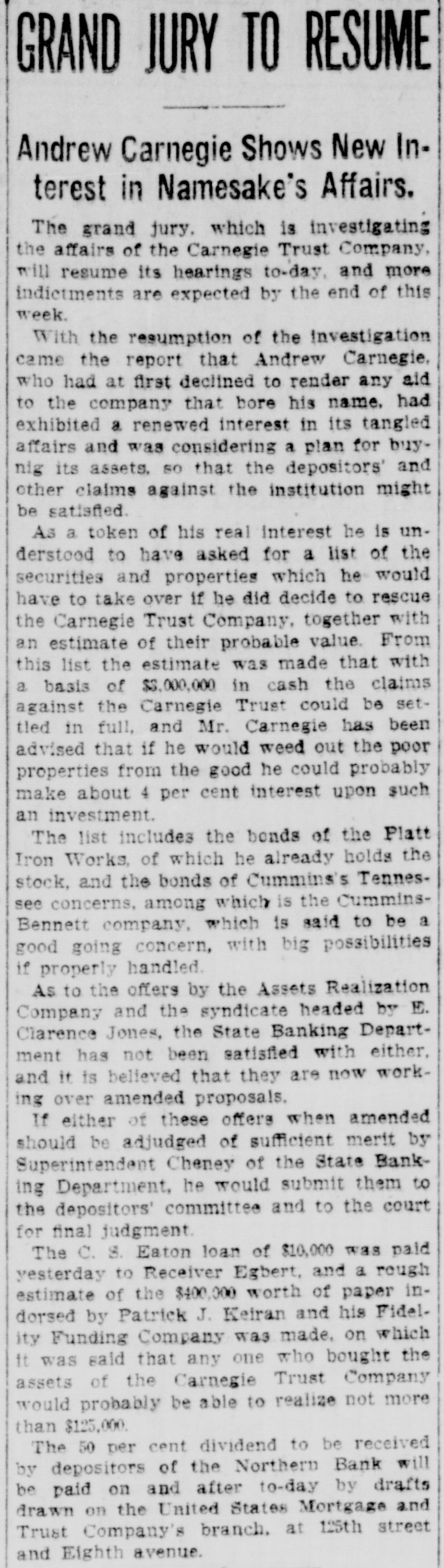
The 50 per cent dividend to be received by depositors of the Northern Bank will be paid on and after to-day by drafts drawn on the United States Mortgage and Trust Company's branch at 125th street and Eighth avenue.
Source
newspapers

Newspaper Articles (23)

Article from The Washington Times, October 28, 1907

Click image to open full size in new tab

Article Text

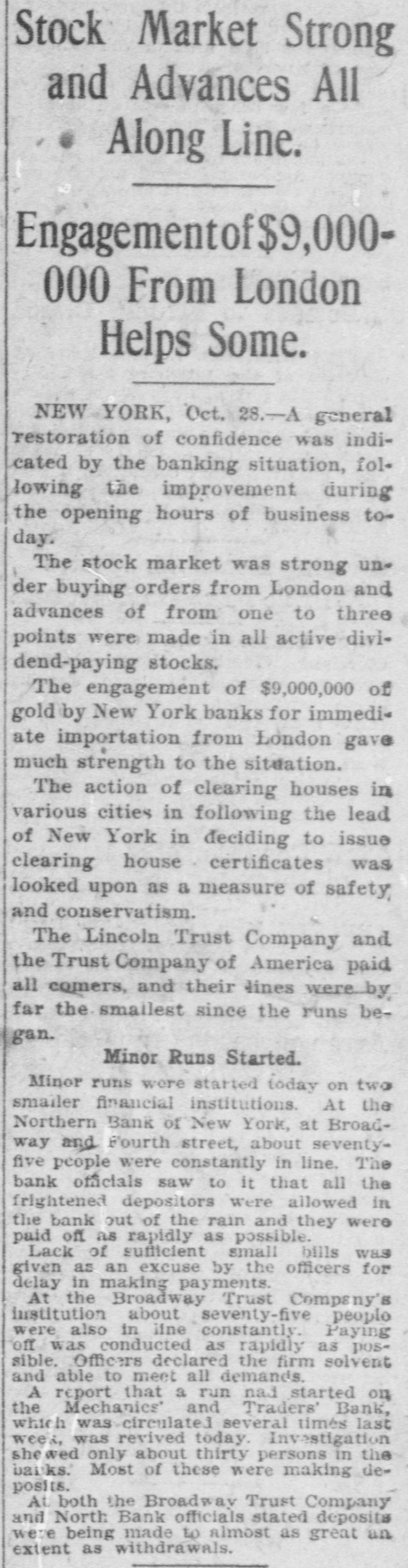
Stock Market Strong and Advances All Along Line. Engagementof$9,000000 From London Helps Some. NEW YORK, Oct. 28.-A general restoration of confidence was indicated by the banking situation, following the improvement during the opening hours of business today. The stock market was strong under buying orders from London and advances of from one to three points were made in all active dividend-paying stocks. The engagement of $9,000,000 of gold by New York banks for immedi< ate importation from London gave much strength to the situation. The action of clearing houses in various cities in following the lead of New York in deciding to issue clearing house certificates was looked upon as a measure of safety and conservatism. The Lincoln Trust Company and the Trust Company of America paid all comers, and their lines were by far the smailest since the runs began. Minor Runs Started. Minor runs were started today on two smailer financial institutions. At the Northern Bank of New York, at Broadway and Fourth street, about seventyfive people were constantly in line. The bank officials saw to it that all the frightened depositors Were allowed in the bank out of the rain and they were paid off as rapidly as possible. Lack of sufficient small bills was given as an excuse by the officers for delay in making payments. At the Broadway Trust Company's institution about seventy-five people were also in line constantly. Paying off was conducted as rapidly as pos= sible. Officers declared the firm solvent and able to meet all demands. A report that a run nad started on the Mechanics' and Traders' Bank, which was circulated several times last week, was revived today. Investigation shewed only about thirty persons in the banks. Most of these were making deposits. At both the Broadway Trust Company and North Bank officials stated deposits were being made to almost as great an extent as withdrawals.


Article from The Washington Times, October 28, 1907

Click image to open full size in new tab

Article Text

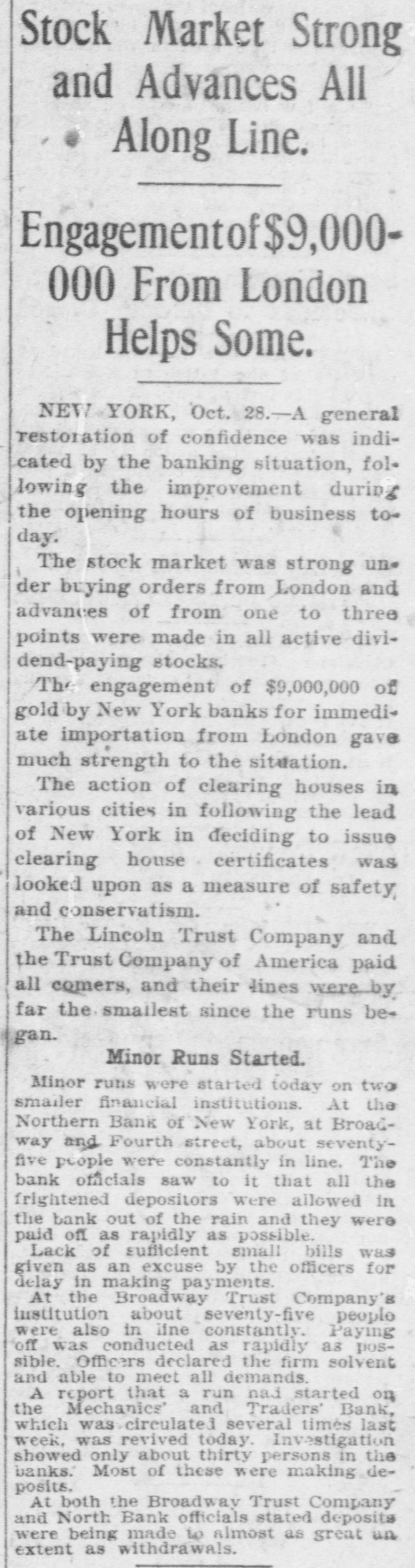
Stock Market Strong and Advances All Along Line. Engagementof$9,000000 From London Helps Some. NEW YORK, Oct. 28.-A general restoration of confidence was indicated by the banking situation, following the improvement during the opening hours of business today. The stock market was strong under buying orders from London and advances of from one to three points were made in all active dividend-paying stocks. The engagement of $9,000,000 of gold by New York banks for immediate importation from London gave much strength to the situation. The action of clearing houses in various cities in following the lead of New York in deciding to issue clearing house certificates was looked upon as a measure of safety and conservatism. The Lincoln Trust Company and the Trust Company of America paid all comers, and their lines were by far the smallest since the runs began. Minor Runs Started. Minor runs were started today on two smailer financial institutions. At the Northern Bank of New York, at Broadway and Fourth street, about seventyfive people were constantly in line. The bank officials saw to it that all the frightened depositors were allowed in the bank out of the rain and they were paid off as rapidly as possible. Lack of sufficient small bills was given as an excuse by the officers for delay in making payments. At the Broadway Trust Company's institution about seventy-five people were also in line constantly. Paying off was conducted as rapidly as possible. Officers declared the firm solvent and able to meet all demands. A report that a run nad started on the Mechanics' and Traders' Bank, which was circulated several times last week, was revived today. Investigation showed only about thirty persons in the banks. Most of these were making deposits. At both the Broadway Trust Company and North Bank officials stated deposits were being made to almost as great an extent as withdrawals.


Article from New-York Tribune, October 29, 1907

Click image to open full size in new tab

Article Text

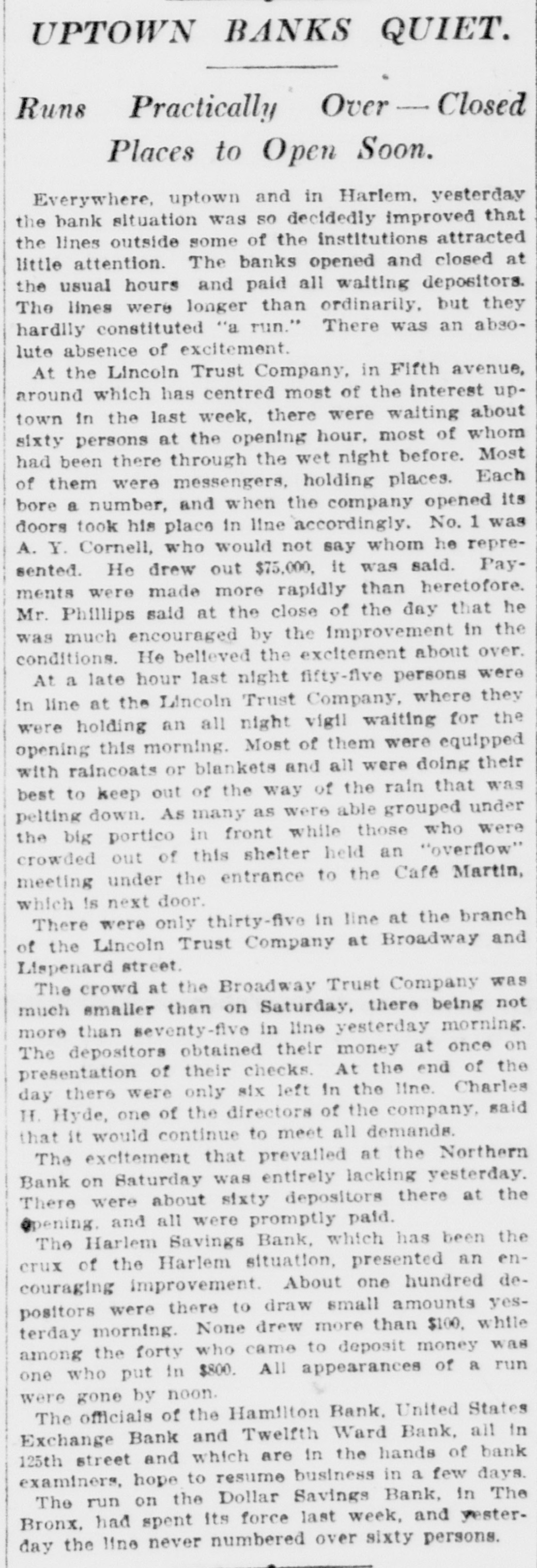
UPTOWN BANKS QUIET. Runs Practically Over - Closed Places to Open Soon. Everywhere, uptown and in Harlem. yesterday the bank situation was so decidedly improved that the lines outside some of the institutions attracted little attention. The banks opened and closed at the usual hours and paid all waiting depositors. The lines were longer than ordinarily, but they hardlly constituted "a run." There was an absolute absence of excitement. At the Lincoln Trust Company, in Fifth avenue, around which has centred most of the interest uptown in the last week, there were waiting about sixty persons at the opening hour, most of whom had been there through the wet night before. Most of them were messengers, holding places. Each bore a number, and when the company opened its doors took his place in line accordingly. No. 1 was A. Y. Cornell, who would not say whom he represented. He drew out $75,000. it was said. Payments were made more rapidly than heretofore. Mr. Phillips said at the close of the day that he was much encouraged by the improvement in the conditions. He believed the excitement about over. At a late hour last night fifty-flve persons were in line at the Lincoln Trust Company, where they were holding an all night vigil waiting for the opening this morning. Most of them were equipped with raincoats or blankets and all were doing their best to keep out of the way of the rain that was pelting down. As many as were able grouped under the big portico in front while those who were crowded out of this shelter held an "overflow" meeting under the entrance to the Cafe Martin, which is next door. There were only thirty-five in line at the branch of the Lincoln Trust Company at Broadway and Lispenard street. The crowd at the Broadway Trust Company was much emailer than on Saturday, there being not more than seventy-five in line yesterday morning. The depositors obtained their money at once on presentation of their checks. At the end of the day there were only six left In the line. Charles H. Hyde, one of the directors of the company, said that it would continue to meet all demands. The excitement that prevailed at the Northern Bank on Saturday was entirely lacking yesterday. There were about sixty depositors there at the pening. and all were promptly paid. The Harlem Savings Bank, which has been the crux of the Harlem situation, presented an encouraging improvement. About one hundred depositors were there to draw small amounts yesterday morning. None drew more than $100. while among the forty who came to deposit money was one who put in $800. All appearances of a run were gone by noon. The officials of the Hamilton Bank. United States Exchange Bank and Twelfth Ward Bank, all in 125th street and which are in the hands of bank examiners, hope to resume business in a few days. The run on the Dollar Savings Bank, in The Bronx. had spent its force last week, and yesterday the line never numbered over sixty persons.


Article from New-York Tribune, May 4, 1909

Click image to open full size in new tab

Article Text

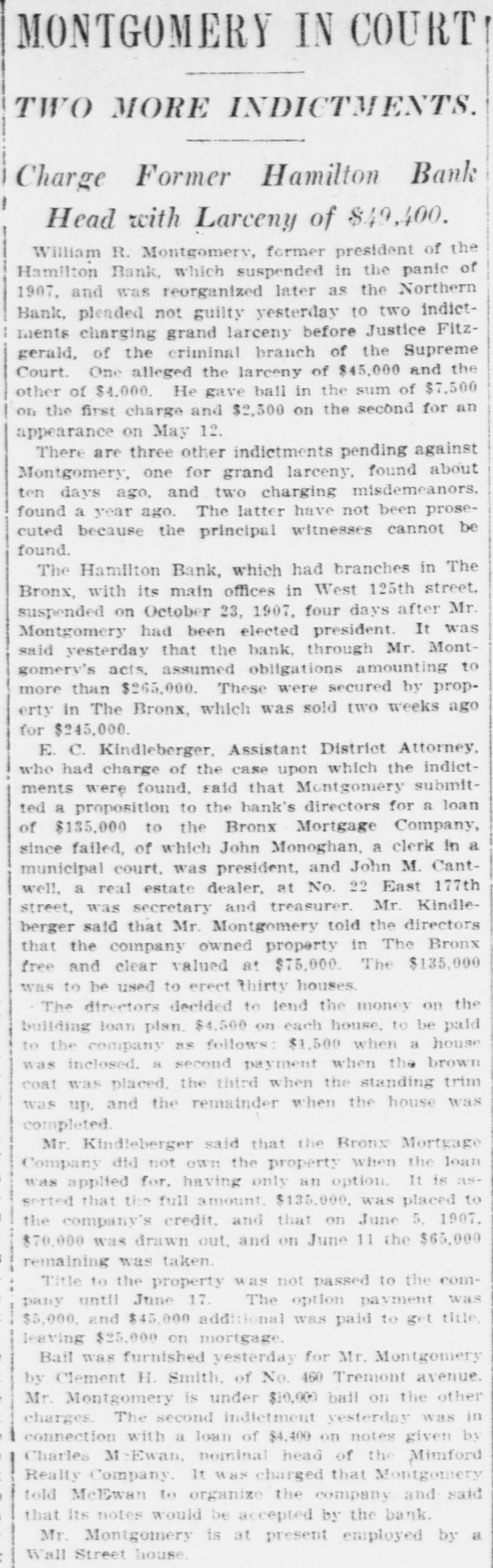
MONTGOMERY IN COURT TWO MORE INDICTMENTS. Charge Former Hamilton Bank Head with Larceny of $49,400. William R. Montgomery, former president of the Hamilton Bank, which suspended in the panic of 1907, and was reorganized later as the Northern Bank, pleaded not guilty yesterday to two indictments charging grand larceny before Justice Fitzgerald, of the criminal branch of the Supreme Court. One alleged the larceny of $45,000 and the other of $4.000. He gave ball in the sum of $7,500 on the first charge and $2,500 on the second for an appearance on May 12. There are three other indictments pending against Montgomery, one for grand larceny, found about ten days ago, and two charging misdemeanors. found a year ago. The latter have not been prosecuted because the principal witnesses cannot be found. The Hamilton Bank, which had branches in The Bronx, with its main offices in West 125th street. suspended on October 23, 1907, four days after Mr. Montgomery had been elected president. It was said yesterday that the bank. through Mr. Montgomery's acts, assumed obligations amounting to more than $265,000. These were secured by property in The Bronx, which was sold two weeks ago for $245,000. E. C. Kindleberger, Assistant District Attorney, who had charge of the case upon which the indictments were found, said that Montgomery submitted a proposition to the bank's directors for a loan of $135,000 to the Bronx Mortgage Company, since failed, of which John Monoghan, a clerk in a municipal court, was president, and John M. Cantwell, a real estate dealer, at No. 22 East 177th street, was secretary and treasurer. Mr. Kindleberger said that Mr. Montgomery told the directors that the company owned property in The Bronx free and clear valued at $75,000. The $135,000 was to be used to erect thirty houses. The directors decided to lend the money on the building loan plan. $4.500 on each house. to be paid to the company as follows: $1,500 when a house was inclosed. a second payment when the brown coat was placed. the third when the standing trim was up. and the remainder when the house was completed Mr. Kindleberger said that the Bronx Mortgage Company did not own the property when the loan was applied for. having only an option. It is asserted that the full amount $135,000. was placed to the company's credit. and that on June 5. 1907. $70,000 was drawn out, and on June 11 the $65,000 remaining was taken Title to the property was not passed to the company until June 17. The option payment was $5,000. and $45,000 additional was paid to get title leaving $25,000 on mortgage. Bail was furnished yesterday for Mr. Montgomery by Clement H. Smith. of No. 460 Tremont avenue. Mr. Montgomery is under $10,000 bail on the other charges. The second indictment yesterday was in connection with a loan of $4,400 on notes given by Charles MeEwan, nominal head of the Mimford Realty Company. It was charged that Montgomery told McEwan to organize the company and said that its notes would be accepted by the bank. Mr. Montgomery is at present employed by a Wall Street house.


Article from The Topeka State Journal, December 27, 1910

Click image to open full size in new tab

Article Text

BANK IS SEIZED. Institution With Deposits of $6.000,000 Is Shaky. New York, Dec. 27.-The Northern bank of New York at 215 West One Hundred and Twenty-fifth street, which has several branches in Harlem and the Bronx, was taken possession of today by Superintendent of Banks Chesney. The institution has deposit. aggregating over $6,000,000. The Northern bank was formerly known as the Hamilton bank, which had difficulties during. the panic of 1907. Today's closing of the doors was no surprise to those who had known of the bank's condition. The suspension is regarded as unimportant. In a statement regarding the bank's suspension, Superintendent of Banks Cheney said that an examination of the institution had disclosed certain irregular transactions that have taken place during the time the examination has been in progress. The institution has a capital of $700,000 and a book surplus at the time of its last published statement, November 10, 1910, of $185,965.11. Its deposits at that time were $6,912,582.62.


Article from The Washington Times, December 27, 1910

Click image to open full size in new tab

Article Text

BANK IN NEW YORK CLOSES ITS DOORS Police Called Out to Prevent Rioting by Depositors. NEW YORK, Dec. 27.-The Northern Bank of New York, at 217 West 125th street, capitalized at $700,000, and having nins branches in various parts of the city, was closed today by State Superintendent of Banks Cheney. No reason was given for the closing. A perfunctory notice was posted on the doors of the bank this morning, and soon afterward crowds began gathering in iront of the place. A- number of depositors were in the crowds, and the police were called to the scene to prevent disorder. The Northern Bank of New York sprang into existence after the failure of the Hamilton Bank, which is said to have made heavy loans to the Heinzes. The officers are: President, Frank L. Grast, formerly at the head of the Hamilton Bank; vice presidents, Henderson M. Wolf, Martin McHale, Frederick D. Ives, and H. H. Bizallion; cashier, William L. Brewer. The failure was the most sensational since the days of the 1907 panic. Rioting broke out about the Port Morris branch in 138th street this evening and the police reserves had to charge the mob of men and women who were surging about the bank clamoring for their money. But the Port Morris branch was not the only one which saw lively scenes and police action. By noon practically all the branch institutions were under police guard to hold back the excited and angry depositors. The bulk of business had been done with small traders, many of whom deposited all their Christmas receipts last week.


Article from Deseret Evening News, December 27, 1910

Click image to open full size in new tab

Article Text

NORTHERN BANK OF NEW YORK State Superintendent of Banks Takes Possession of It. New York, Dec. 27.+-The Northern Bank of New York at 315 west One Hundred and Twenty-fifth street. which has several branches in Harlem and the Bronx, was taken possession of today by Supt. of Banks Chency. The Institution has deposits aggregating over $6,000,000. The Northern bank was formerly known as the Hamilton bank which had difficulties during the panic of 1907. Today's closing of the doors was no surprise to those who had known of the bank's condition. The suspension is regarded as unimportant. In a statement regarding the bank's suspension Supt. of Banks Cheney said that an examination of the institution had disclosed certain irregular transactions, that have taken place during the time the examination has been in progress The Institution has a capital of $700,000 and a book surplus at the time of its last published statement Nov. 10, 1910, of $185,965.11. Its deposits nt the time were $6,912,582.62.


Article from The Pensacola Journal, December 28, 1910

Click image to open full size in new tab

Article Text

Northern Bank and Nine Branches in Hands of Supt. of Banks. It Has Deposits Totaling Nearly Seven Million Dollars-"For the Benefit of Depositors" and Because of "Certain Irregularities" the Reasons Assigned for Action. By Associated Press. New York, Dec. 27.--The Northern Bank of New York, with deposits at its nine branches of $6,912,582 at the time of the last published statement, was closed today by State Superintendent of Banks Cheney "for the benefit of depositors," because of "certain conditions," and also "certain irregular transactions." An inventory of the assets and liabilities are under way. No further statement by Cheney will be available until this is completed. The facts will probably be presented to the grand jury tomorrow. Joseph Robin, chairman of the executive committee of the institution and a shareholder and director in many other corporations, is in a private sanitarium, where he was committed Saturday at the request of his sister. James Gifford, one of the directors, said tonight that the physicians diagnosed the case as acute paranoia. It is said that Robin tried to suicide Saturday night, but was restrained by a nurse. State Superintendent of Insurance Hotchkiss said tonight that the capital Aetna Indemnity Company, with which Robin has been connected, IS seriously impaired by his manipulations. Officers of the company say that now Robin has been eliminated from the stock and the control and progress of the company will continue undisturbed.


Article from The Barre Daily Times, December 28, 1910

Click image to open full size in new tab

Article Text

The Northern bank in New York City, which has been closed, is the same bank under the name of Hamilton bank, which was closed during the panic of 1907. Apparently, it was rebuilt on none too secure a foundation.


Article from The Salt Lake Tribune, January 3, 1911

Click image to open full size in new tab

Article Text

Robin Is Better. NEW YORK, Jan. 2.-The condition of Joseph Robin. director of the suspended Northern bank who took poison in the office of the district attorney last Friday while awaiting arralgnment for grand larceny. was reported good today. He sat up and read today. Physicians report that he would be able to appear for arralgnment by Wednesday without danger to his health.


Article from The Birmingham Age-Herald, January 3, 1911

Click image to open full size in new tab

Article Text

Robin's Condition Improved New York, January 2.-The condition of Joseph G. Robin, director of the suspended Northern bank, who took poison in the office of the district attorney last Friday while awaiting arraignment for grand larceny, was reported improved today. Robin is confined in the prison ward of Bellevue hospital.


Article from The Pensacola Journal, January 3, 1911

Click image to open full size in new tab

Article Text

ROBIN IS IMPROVING. New York, Jan. 2.-The condition of Joseph G. Robin, director of the suspended Northern Bank, who took poison in the office of the district attorney last Friday while awaiting arraignment for grand larceny, was reported improved today. Robin is confined in the prison ward of Bellevue hospital.


Article from The Ocala Evening Star, January 3, 1911

Click image to open full size in new tab

Article Text

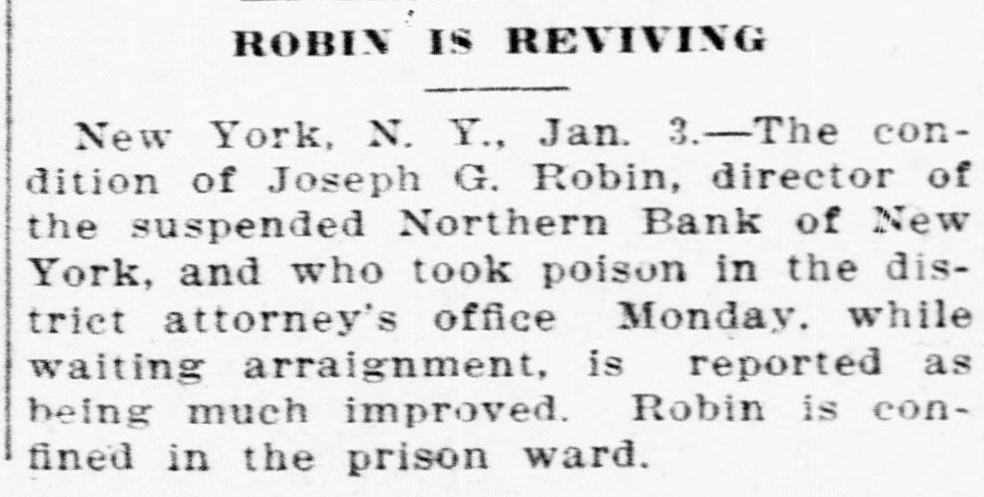
ROBIN IS REVIVING New York, N. Y., Jan. 3.-The condition of Joseph G. Robin, director of the suspended Northern Bank of New York, and who took poison in the district attorney's office Monday. while waiting arraignment, is reported as being much improved. Robin is confined in the prison ward.


Article from Omaha Daily Bee, January 8, 1911

Click image to open full size in new tab

Article Text

with the Corn Products Refining company, a subsidiary of the Standard Oil and the National Starch company, of which he was president, made him a desirable asset, succeeded Mr. Dickinson for ten months. He did as much house cleaning as he could and resigned in favor of Mr. Howeli. So many changes in management has not strengthened the bank in public favor. It is evident from its report to the state superintendent on November 1 that its business had greatly declined in recent months. Deposits as of that date were given at $5,705,100, as against $9,278,700 as shown in the bankers' directory of the preceding July. Then the shadow of Robin again feil across its doors. Dickinson and Robin had been friends. Robin was on the first directorate, but resigned. When the Northern bank was closed and Superintendent Hotchkiss of the State Department of Insurance made public his investigation into its affairs, a draft drawn by Robin on the Carnegie, with which he had no account, cropped up. From that time there began a steady, but continuous withdrawal of funds by depositors who had lost confidence. It could scarcely be called a run, but in its culmination today it proved quite as effective. With the incoming of the new city administration the Northern Bank of New York and the Carnegie Trust company both became city depositories. Comptroller Prendergast became doubtful ofthe Carnegie and in one of City Chamberlain Hyde's vacations, insisted that the directors put up their personal bond, # LESLIE M. SHAW IS SURPRISED. PHILADELPHIA, Pa., Jan. - Leslie M. Shaw, former president of the Carnegie Trust company, who is now a resident of this city, was surprised to learn that the company had closed its doors. He said he had no knowledge that the institution was in a bad condition. Mr. Shaw said the trust company's paper was all good when he retired as president and that he has inside information that there has not been more than $2,000 loss on the paper held by the bank at the time he retired.


Article from Newark Evening Star and Newark Advertiser, January 10, 1911

Click image to open full size in new tab

Article Text

RECEIVER FOR AETNA INDEMNITY co. HARTFORD, Conn., Jan. 10.-Colonel Theodore H. MacDonald, insurance commissioner for Connecticut, has been appointed receiver for the Aetna Indemnity Company, of this city, which was involved in the recent closing of the Northern Bank, of New York. )


Article from East Oregonian : E.O, January 24, 1911

Click image to open full size in new tab

Article Text

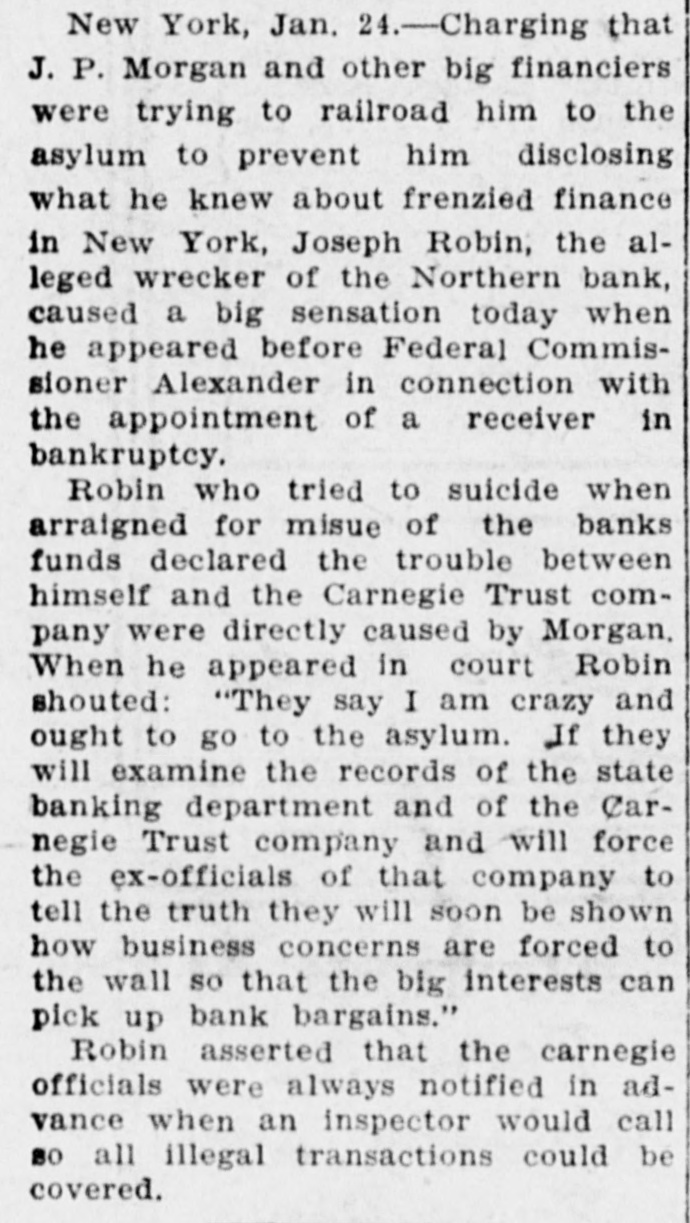
New York, Jan. 24.-Charging that J. P. Morgan and other big financiers were trying to railroad him to the asylum to prevent him disclosing what he knew about frenzied finance in New York, Joseph Robin, the alleged wrecker of the Northern bank, caused a big sensation today when he appeared before Federal Commissioner Alexander in connection with the appointment of a receiver in bankruptcy. Robin who tried to suicide when arraigned for misue of the banks funds declared the trouble between himself and the Carnegie Trust company were directly caused by Morgan, When he appeared in court Robin shouted: "They say I am crazy and ought to go to the asylum. If they will examine the records of the state banking department and of the Carnegie Trust company and will force the ex-officials of that company to tell the truth they will soon be shown how business concerns are forced to the wall so that the big interests can pick up bank bargains." Robin asserted that the carnegie officials were always notified in advance when an inspector would call so all illegal transactions could be covered.


Article from The Rathdrum Tribune, April 7, 1911

Click image to open full size in new tab

Article Text

FORMING MONEY TRUST Wall Street Sees Big Combine Impending. DRIVE OUT SMALL BANKS Prompt Action By Government Said to be Necessary. Wall street is buzzing with the report that the Morgan-Rockefeller and the Kuhn-Loeb interests are planning to force all the small banks and trust companies in the country out of business. Their purchase of the Bank of Commerce, the Equitable Trust and other companies is taken as the first blow in the campaign. The ostensible purpose of the combination's move, Wall street believes, will be to prevent scandals in the banking world, but the real purpose, it is said, is the formation of a money trust to dominate the country and to gobble up the proposed central bank. Financiers say that only prompt action by the government can prevent the scheme going through. Morgan, Kuhn, Loeb and Rockefeller are known to have formed a "gentlemen's agreement" after the panic of 1907. As a result Morgan gobbled four banks when the Northern Bank of New York went to the wall. Since then he and his allies have gained control of the Bank of Commerce, notwithstanding denials, financiers assert there is no doubt that the huge funds of the Equitable are also in the power of the clique. The probable reason given for the secrecy of the big money interests regarding the Equitable deal is that the Democratic congress may attempt to curb the money trust.


Article from Newark Evening Star and Newark Advertiser, April 12, 1911

Click image to open full size in new tab

Article Text

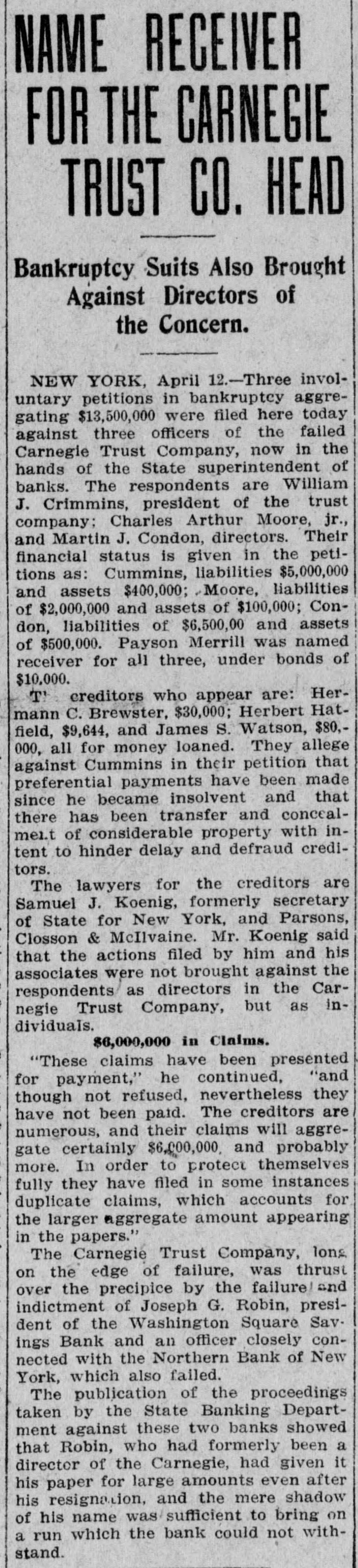
NAME RECEIVER FOR THE CARNEGIE TRUST CO. HEAD Bankruptcy Suits Also Brought Against Directors of the Concern. NEW YORK, April 12.-Three involuntary petitions in bankruptcy aggregating $13,500,000 were filed here today against three officers of the failed Carnegie Trust Company, now in the hands of the State superintendent of banks. The respondents are William J. Crimmins, president of the trust company: Charles Arthur Moore, jr., and Martin J. Condon, directors. Their financial status is given in the petitions as: Cummins, liabilities $5,000,000 and assets $400,000; Moore, liabilities of $2,000,000 and assets of $100,000; Condon, liabilities of $6,500,00 and assets of $500,000. Payson Merrill was named receiver for all three, under bonds of $10,000. T' creditors who appear are: Hermann C. Brewster, $30,000; Herbert Hatfield, $9,644, and James S. Watson, $80,000, all for money loaned. They allege against Cummins in their petition that preferential payments have been made since he became insolvent and that there has been transfer and concealmeit of considerable property with intent to hinder delay and defraud creditors. The lawyers for the creditors are Samuel J. Koenig, formerly secretary of State for New York, and Parsons, Closson & McIlvaine. Mr. Koenig said that the actions filed by him and his associates were not brought against the respondents as directors in the Carnegie Trust Company, but as individuals. $6,000,000 in Claims. "These claims have been presented for payment," he continued, "and though not refused, nevertheless they have not been paid. The creditors are numerous, and their claims will aggregate certainly $6,000,000, and probably more. In order to protect themselves fully they have filed in some instances duplicate claims, which accounts for the larger aggregate amount appearing in the papers." The Carnegie Trust Company, long on the edge of failure, was thrust over the precipice by the failure and indictment of Joseph G. Robin, president of the Washington Square Savings Bank and an officer closely connected with the Northern Bank of New York, which also failed. The publication of the proceedings taken by the State Banking Department against these two banks showed that Robin, who had formerly been a director of the Carnegie, had given it his paper for large amounts even after his resignation, and the mere shadow of his name was sufficient to bring on a run which the bank could not withstand.


Article from Pine Bluff Daily Graphic, April 13, 1911

Click image to open full size in new tab

Article Text

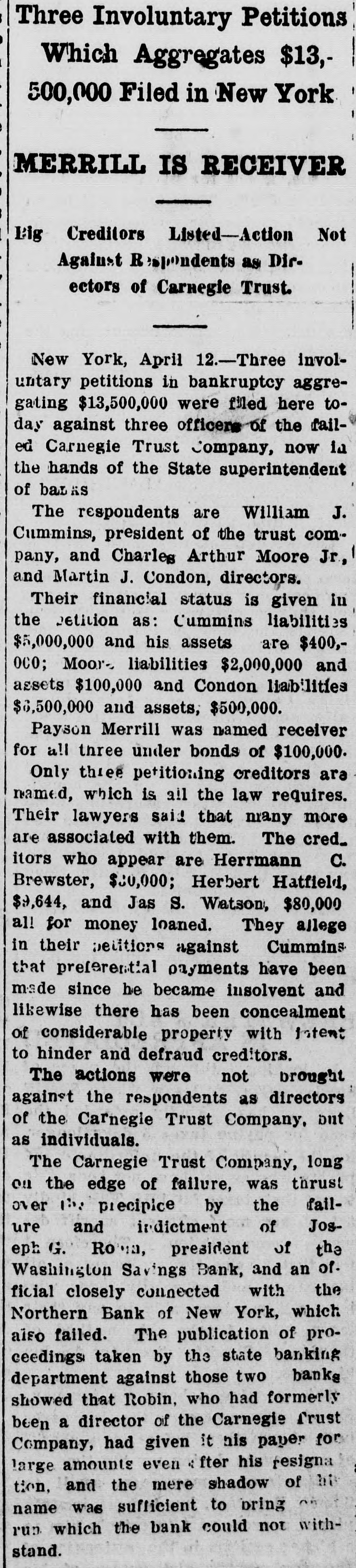
Three Involuntary Petitions Which Aggregates $13,500,000 Filed in New York MERRILL IS RECEIVER Big Creditors Listed-Action Not Against Respondents as Directors of Carnegie Trust. New York, April 12.-Three involuntary petitions in bankruptcy aggregating $13,500,000 were filed here today against three officers of the failed Carnegie Trust Company, now la the hands of the State superintendent of basks The respondents are William J. Cummins, president of the trust company, and Charles Arthur Moore Jr, and Martin J. Condon, directors. Their financial status is given in the petition as: Cummins liabilities $5,000,000 and his assets are $400,oco; Moore liabilities $2,000,000 and assets $100,000 and Condon liabilities $6,500,000 and assets, $500,000. Payson Merrill was named receiver for all three under bonds of $100,000. Only three petitioning creditors ara named, which is all the law requires. Their lawyers said that nrany more are associated with them. The cred_ itors who appear are Herrmann C. Brewster, $30,000; Herbert Hatfield, $9,644, and Jas S. Watson, $80,000 all for money loaned. They allege in their petitions against Cummins that preferential payments have been made since he became insolvent and likewise there has been concealment of considerable property with intent to hinder and defraud creditors. The actions were not brought against the respondents as directors of the Carnegie Trust Company, but as individuals. The Carnegie Trust Company, long on the edge of failure, was thrust over I've precipice by the failure and indictment of Joseph G. Ro pan, president of the Washington Savings Bank, and an of. ficial closely connected with the Northern Bank of New York, which also failed. The publication of proceedings taken by the state banking department against those two banks showed that Robin, who had formerly been a director of the Carnegie Trust Company, had given it his paper for large amounts even fter his resigna tion, and the mere shadow of at and name was sufficient to oring run which the bank could not withstand.


Article from New-York Tribune, April 18, 1911

Click image to open full size in new tab

Article Text

GRAND JURY TO RESUME Andrew Carnegie Shows New Interest in Namesake's Affairs. The grand jury. which is investigating the affairs of the Carnegie Trust Company, will resume its hearings to-day. and more indictments are expected by the end of this week. With the resumption of the Investigation came the report that Andrew Carnegie, who had at first declined to render any aid to the company that bore his name. had exhibited a renewed interest in its tangled affairs and was considering a plan for buynig its assets. so that the depositors' and other claims against the institution might be satisfied. As a token of his real interest he is understood to have asked for a list of the securities and properties which he would have to take over if he did decide to rescue the Carnegie Trust Company, together with an estimate of their probable value. From this list the estimate was made that with a basis of $3,000,000 in cash the claims against the Carnegie Trust could be settled in full, and Mr. Carnegie has been advised that if he would weed out the poor properties from the good he could probably make about 4 per cent interest upon such an investment. The list includes the bonds of the Platt Iron Works, of which he already holds the stock, and the bonds of Cummins's Tennessee concerns, among which is the CumminsBennett company. which is said to be a good going concern, with big possibilities if properly handled As to the offers by the Assets Realization Company and the syndicate headed by E. Clarence Jones, the State Banking Department has not been satisfied with either, and it is believed that they are now working over amended proposals. If either of these offers when amended should be adjudged of sufficient merit by Superintendent Cheney of the State Banking Department, he would submit them to the depositors' committee and to the court for final judgment. The C. S. Eaton loan of $10,000 was paid yesterday to Receiver Egbert, and a rough estimate of the $400,000 worth of paper indorsed by Patrick J. Keiran and his Fidelity Funding Company was made. on which It was said that any one who bought the assets of the Carnegie Trust Company would probably be able to realize not more than $125,000. The 50 per cent dividend to be received by depositors of the Northern Bank will be paid on and after to-day by drafts drawn on the United States Mortgage and Trust Company's branch. at 125th street and Eighth avenue.


Article from Newark Evening Star and Newark Advertiser, November 20, 1912

Click image to open full size in new tab

Article Text

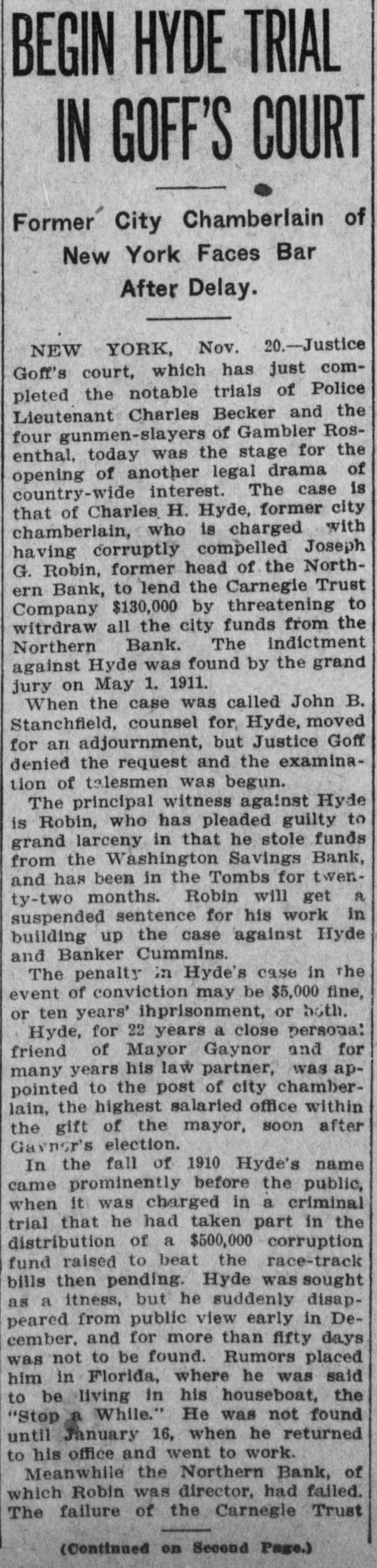
BEGIN HYDE TRIAL IN GOFF'S COURT Former City Chamberlain of New York Faces Bar After Delay. NEW YORK, Nov. 20.-Justice Goff's court, which has just completed the notable trials of Police Lieutenant Charles Becker and the four gunmen-slayers of Gambler Rosenthal, today was the stage for the opening of another legal drama of country-wide interest. The case is that of Charles H. Hyde, former city chamberlain, who is charged with having corruptly compelled Joseph G. Robin, former head of the Northern Bank, to lend the Carnegie Trust Company $130,000 by threatening to witrdraw all the city funds from the Northern Bank. The indictment against Hyde was found by the grand jury on May 1. 1911. When the case was called John B. Stanchfield, counsel for, Hyde, moved for an adjournment, but Justice Goff denied the request and the examination of telesmen was begun. The principal witness against Hyde is Robin, who has pleaded guilty to grand larceny in that he stole funds from the Washington Savings Bank, and has been in the Tombs for twenty-two months. Robin will get a suspended sentence for his work in building up the case against Hyde and Banker Cummins. The penalty in Hyde's case in the event of conviction may be $5,000 fine, or ten years' ihprisonment, or 56th. Hyde, for 22 years a close personal friend of Mayor Gaynor and for many years his law partner, was appointed to the post of city chamberlain, the highest salaried office within the gift of the mayor, soon after Gayner's election. In the fall of 1910 Hyde's name came prominently before the public, when it was charged in a criminal trial that he had taken part in the distribution of a $500,000 corruption fund raised to beat the race-track bills then pending. Hyde was sought as a itness, but he suddenly disappeared from public view early in December. and for more than fifty days was not to be found. Rumors placed him in Florida, where he was said to be living in his houseboat, the "Stop a While." He was not found until January 16, when he returned to his office and went to work. Meanwhile the Northern Bank, of which Robin was director, had failed. The failure of the Carnegie Trust (Continued on Second Page.)


Article from The Richmond Virginian, November 30, 1912

Click image to open full size in new tab

Article Text

CHARLES H. HYDE IS FOUND GUILTY IN BRIBERY CASE Jury Returns Verdict After Forty-four Minutes' Deliberation FACES LONG TERM, BIG FINE ON BOTH Convicted Man Is Friend of Mayor Gaynor and Former City Chamberlain of New York NEW YORK, Nov. 29.-Charies H. Hyde, former city chamberlain, and protege of Mayor Gaynor, was tonight convicted of bribery, the punishment, for which is ten years' imprisonment or $10,000 fine, or both, at the discretion of the court. The verdict of the jury was rendered at 11:39 P. M., after the jury had been in actual deliberation fortyfour minutes. Hyde, until a year ago, chief political adviser of Mayor Gaynor, and one of the leading spirits of his administration, received the verdict of the jury sitting, the usual rule of forcing defendant and jurors to stand having been ignored in his case. He turned deathly pale, but evidenced no other sign of emotion. Crime of Hyde. The crime for which Hyde was convicted consisted of forcing President Robin. of the defunct Northern Bank, to make a large loan to the tottering Carnegie Trust company. on a threat that if the loan was not forthcoming the city deposits in the Northern bank, over which deposits Hyde had control, would bรฉ withdrawn. Exposure of the crime came a litthe less than two years ago, when, with the failure of the Carnegie Trust company. a. number of smaller institutions, including the Robin banks, also went to the wall. Immediately after the verdict had been recorded. and the formal motions for setting aside the verdict and the wranting of a new trial had been made, Hyde was hurried across the bridge of sighs to the Tombs. For the first time since his arrest, eighteen months ago, Hyde, ex-high city official. habitue of the Hotel Knickerbocker. friend and companion of the fast racing set of New York, was locked in a cell. He spent the night there. Tries to Avoid Trial. Following his indictment, Hyde made a most determined effort to avoid trial. More than two score motions of various kinds have been made in half a dozen different courts, all tending toward a delay of the proceedings. Not until fifteen days ago was the last resort of skillful lawyers exhausted, and then a date for the trial was fixed. He was called to trial on November 20th. a jury was secured the first day, and it has taken just eight actual court days to establish his guilt. Tonight's verdict was a complete surprise to Hyde, as well as his attorneys, all of whom had been looking forward confidently to an acquittal.


Article from The Sun, November 10, 1914

Click image to open full size in new tab

Article Text

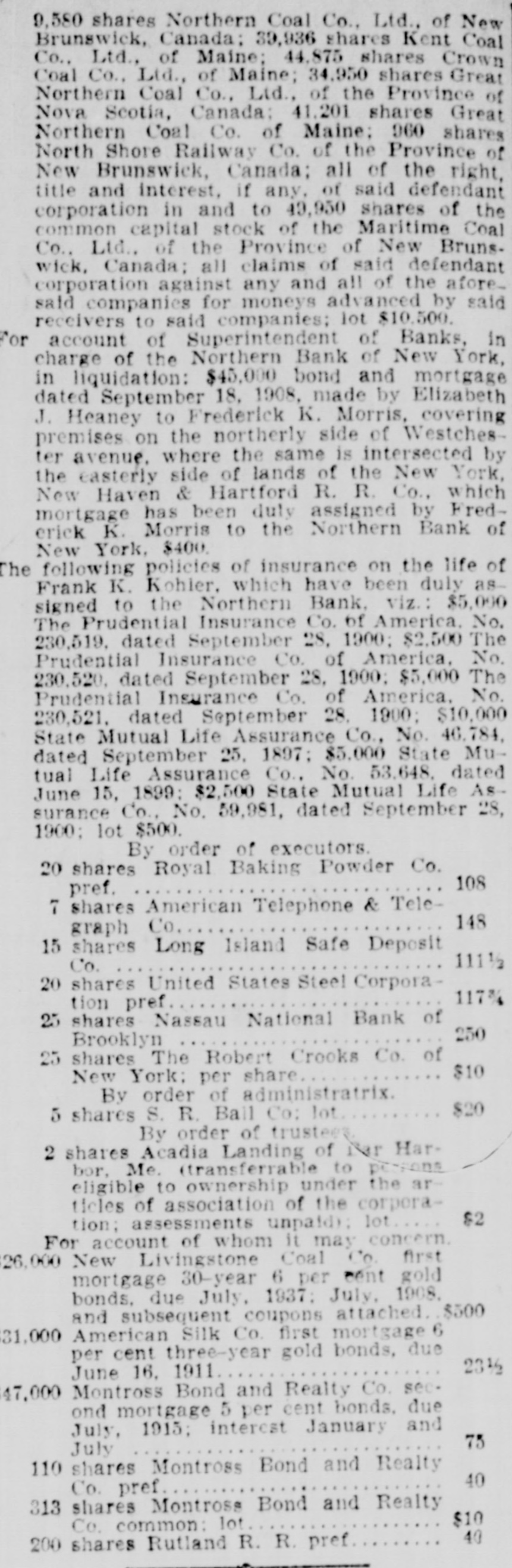
176TH ST, 506 W. a 8, May 4. 1912-Same to Wertheim Realty Co: atty, same. $4,000 42D ST. 358 W. 8 8, 82 e 9th av. 17x98.9, Oct 24. 1911-Emille Du Mond to T G & T $7,000 Co. 176 Bway SAME PROPERTY. Nov 1, 1913-Same to $5,000 same 10TH ST, 66 W, S S. 103.4 e 6th av, 25.1x92.3, May 3. 1910-Isidore Tannenbaum to Wilson Marshall et al, exrs, &c; attys, Dutton $33,000 & Kilsheimer, 203 Bway 10TH ST, 68 W. S S. 78.1 e 6th av, runs 8 46.1% e 0.5x 8 46.1x e 24.10x n 92.3 to H S st X W 25.3 to beg. May 3. 1910-Same to same: attys, same 93D ST. n 8, 137 W Bway, 19%100.8. Jan 7. 1910-Ellen J Erickson to H Mortimer Brooks. Newport, R I; attys. Duer, Strong $2,000 & W. 48 Exchange pl JAMES ST, W 8, 50 8 Madison st. 23.7x99.10% 23.7x100, Nov 7. 1912-Paul and WIIhelmina Maniscalco to Mary Dumas; attys. Whaley, Walker & Day, 27 William st $4,000 BRISTOW ST. F - cor 170th st, 105.6*57.6* 105.7x52.6; 170th st, M 8, 52.6 W Bristow st. Funs S 105.7x e 0.7x S 24.8x W 67.1x n 27.11x e 50% n 100 to 8 8 170th st X e 22.8 to beg. Mar 28, 1910 Frank Miller to Northern Bank of New York. in liquidation; attys, Breed, Abbott & M. 32 Liberty st $3,500 MINFORD PL, 1533. W 8, 100 n 172d st. 33.3x100, Nov 1, 1911-Andreas and Margt Fuchs to Sandow Realty Co. 198 Bway: $2,500 atty. A Knox, 198 Bway HULL AV, S w cor 209th (Ozark) st, 100x 100. Aug 1, 1913-Frederick Realty Co to Pauline Tynberg. 1329 Madison av; atty. $3,500 Jos Kohler, 100 William at