Article Text
The Financial Situation in Washington
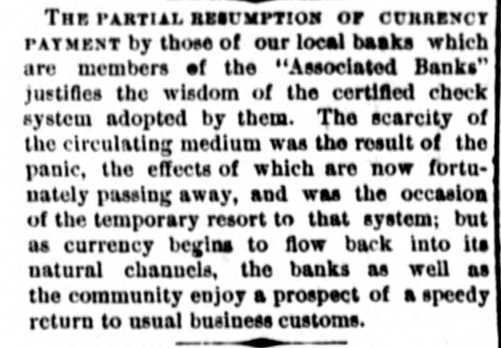
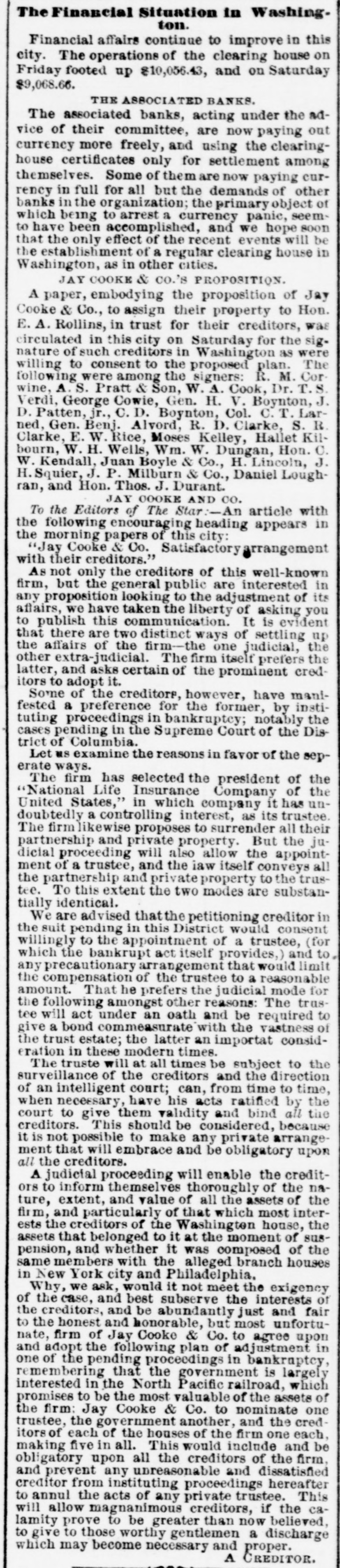
Financial affairs continue to improve in this city. The operations of the clearing house on Friday footed up $10,056.43, and on Saturday $9,068.66. THE ASSOCIATED BANKS. The associated banks, acting under the advice of their committee, are now paying out currency more freely, and using the clearinghouse certificates only for settlement among themselves. Some of them are now paying currency in full for all but the demands of other banks in the organization; the primary object of which being to arrest a currency panic, seemto have been accomplished, and we hope soon that the only effect of the recent events will be the establishment of a regular clearing house in Washington, as in other cities. JAY COOKE & co.'s PROPOSITION. A paper, embodying the proposition of Jay Cooke & Co., to assign their property to Hon. E. A. Rollins, in trust for their creditors, was circulated in this city on Saturday for the signature of such creditors in Washington as were willing to consent to the proposed plan. The following were among the signers: R. M. Cor wine, A. S. Pratt & Son, W. A. Cook, Dr. T.S. Verdi, George Cowie, Gen. H. V. Boynton, D. Patten, jr., C. D. Boynton, Col. C. T. Larned, Gen. Benj. Alvord, R. D. Clarke, S. R Clarke, E. W. Rice, Moses Kelley, Hallet Kilbourn, W. H. Wells, Wm. W. Dungan, Hon. C. W. Kendall, Juan Boyle & Co., H. Lincoln, J. H. Squier, J. P. Milburn & Co., Daniel Loughran, and Hon. Thos. J. Durant. JAY COOKE AND co. To the Editors of The Star An article with the following encouraging heading appears in the morning papers of this city: "Jay Cooke & Co. Satisfactory arrangement with their creditors." As not only the creditors of this well-known firm, but the general public are interested in any proposition looking to the adjustment of its affairs, we have taken the liberty of asking you to publish this communication. It is evident that there are two distinct ways of settling up the affairs of the firm--the one judicial, the other extra-judicial. The firm itself prefers the latter, and asks certain of the prominent creditors to adopt it. Some of the creditore, however, have manifested a preference for the former, by instituting proceedings in bankruptcy; notably the cases pending in the Supreme Court of the Dis trict of Columbia. Let NS examine the reasons in favor of the seperate ways. The firm has selected the president of the National Life Insurance Company of the United States," in which company it has undoubtedly a controlling interest, as its trustee. The firmlikewise proposes to surrender all their partnership and private property. But the judicial proceeding will also allow the appointment of a trustee, and the law itself conveys all the partnership and private property to the trustee. To this extent the two modes are substantially identical. We are advised that the petitioning creditor in the suit pending in this District would consent willingly to the appointment of a trustee, (for which the bankrupt act itself provides,) and to any precautionary arrangement that would limit the compensation of the trustee to a reasonable amount. That he prefers the judicial mode for the following amongst other reasons: The trustee will act under an oath and be required to give a bond commeasurate with the vastness of the trust estate; the latter an importati consideration in these modern times. The truste will at all times be subject to the surveillance of the creditors and the direction of an intelligent court; can, from time to time, when necessary, have his acts ratified by the court to give them validity and bind all the creditors. This should be considered, because it is not possible to make any private arrangement that will embrace and be obligatory upon all the creditors. A judicial proceeding will enable the creditors to inform themselves thoroughly of the nature, extent, and value of all the assets of the firm, and particularly of that which most interests the creditors of the Washingten house, the assets that belonged to it at the moment of suspension, and whether it was composed of the same members with the alleged branch houses in New York city and Philadelphia. Why, we ask, would it not meet the exigency of the case, and best subserve the interests of the creditors, and be abundantly just and fair to the honest and honorable, but most unfortunate, firm of Jay Cooke & Co. to agree upon and adopt the following plan of adjustment in one of the pending proceedings in bankraptcy, remembering that the government is largely interested in the North Pacific railroad, which promises to be the most valuable of the assets of the firm: Jay Cooke & Co. to nominate one trustee, the government another, and the cred itors of each of the houses of the firm one each. making five in all. This would include and be obligatory upon all the creditors of the firm. and prevent any unreasonable and dissatisfied creditor from instituting proceedings hereafter to annul the acts of any private trustee. This will allow magnanimous creditors, if the calamity prove to be greater than now believed, to give to those worthy gentlemen a discharge which may become necessary and proper. A CREDITOR.