Article Text
The Brooklyn Trust Company
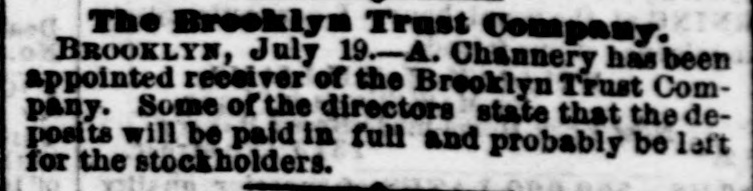
BROOKLYN, July 19.-A. Channery has been appointed receiver of the Breoklyn Trust Company. Some of the directors state that the deposits will be paid in full and probably be left for the stock holders.
Click image to open full size in new tab
BROOKLYN, July 19.-A. Channery has been appointed receiver of the Breoklyn Trust Company. Some of the directors state that the deposits will be paid in full and probably be left for the stock holders.
Click image to open full size in new tab
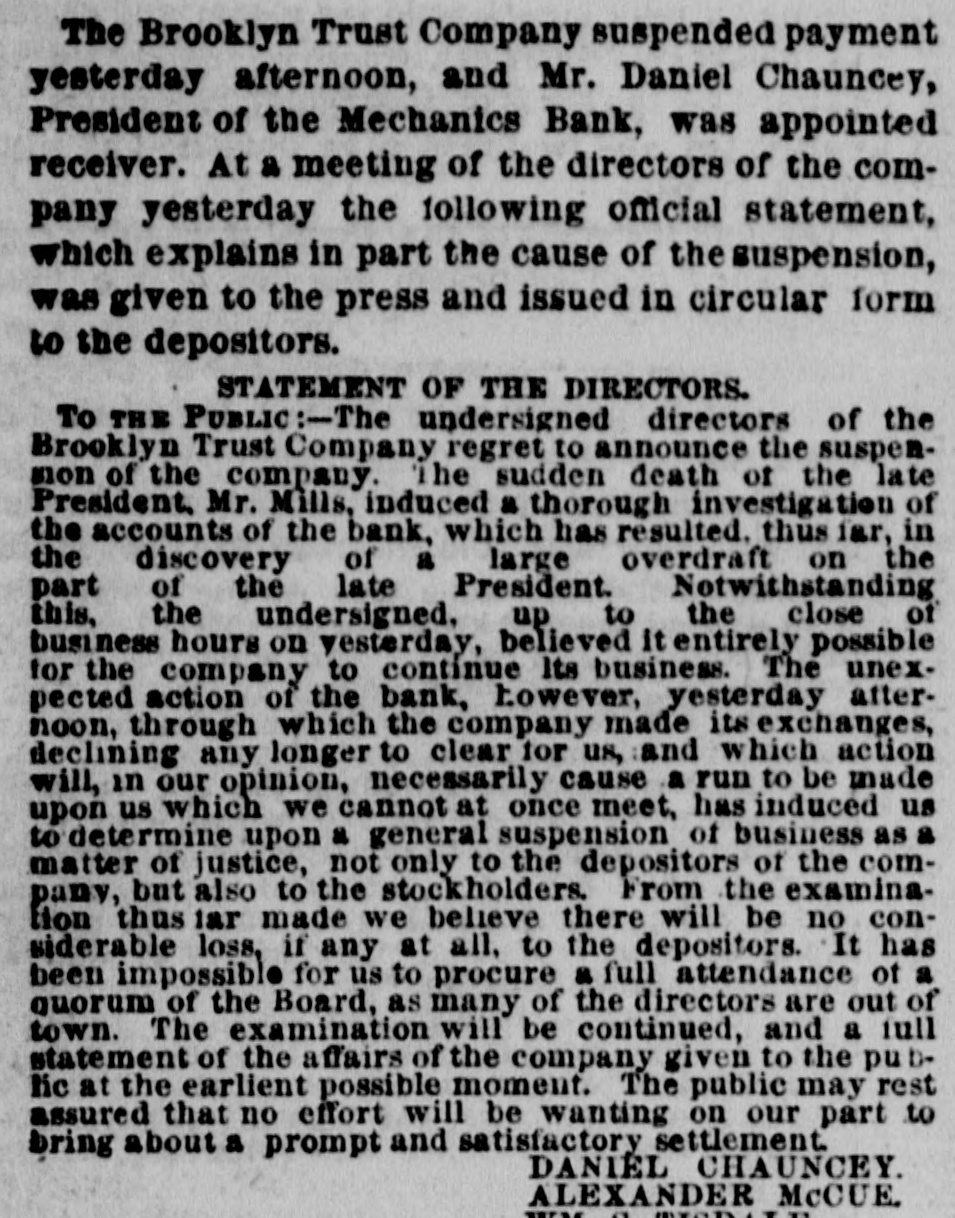
The Brooklyn Trust Company suspended payment yesterday afternoon, and Mr. Daniel Chauncey, President of the Mechanics Bank, was appointed receiver. At a meeting of the directors of the company yesterday the following official statement, which explains in part the cause of the suspension, was given to the press and issued in circular form to the depositors. STATEMENT OF THE DIRECTORS. To THE PUBLIC:-The undersigned directors of the Brooklyn Trust Company regret to announce the suspennon of the company. The sudden death of the late President. Mr. Mills, induced u thorough investigation of the accounts of the bank, which has resulted. thus far, in the discovery of a large overdraft on the part of the late President. Notwithstanding this, the undersigned, up to the close of business hours on yesterday, believed it entirely possible for the company to continue Its business. The unexpected action of the bank, however, yesterday afternoon, through which the company made its exchanges, declining any longer to clear for us, and which action will, in our opinion, necessarily cause a run to be made upon us which we cannot at once meet, has induced us to determine upon a general suspension of business as a matter of justice, not only to the depositors of the company, but also to the stockholders. From the examinalion thus lar made we believe there will be no considerable loss, if any at all, to the depositors. It has been impossible for us to procure u full attendance ot a quorum of the Board, as many of the directors are out of town. The examination will be continued, and a full statement of the affairs of the company given to the public at the earlient possible moment. The public may rest assured that no effort will be wanting on our part to bring about a prompt and satisfactory settlement DANIEL CHAUNCEY. ALEXANDER McCUE.
Click image to open full size in new tab
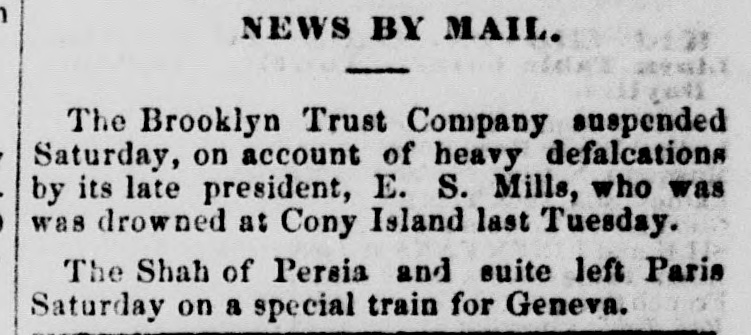
1,125 The Brooklyn Trust Company suspended Saturday, on account of heavy defalcations by its late president, E. S. Mills, who was was drowned at Cony Island last Tuesday. The Shah of Persia and suite left Paris Saturday on a special train for Geneva.
Click image to open full size in new tab
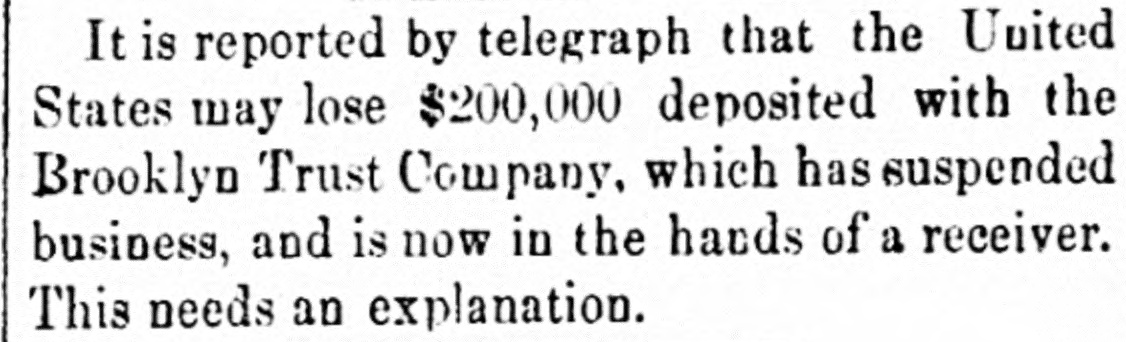
It is reported by telegraph that the United States may lose $200,000 deposited with the Brooklyn Trust Company, which has suspended business, and is now in the hands of a receiver. This needs an explanation.

Click image to open full size in new tab
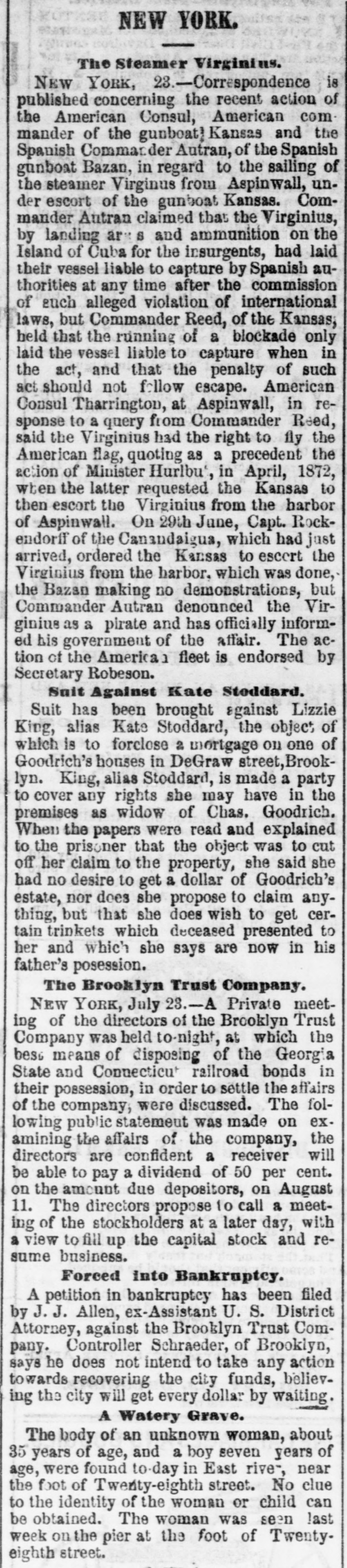
[SPECIAL TO THE GOLD HILL DAILY NEWS.] DOMESTIC INTELLICENCE The Breeklyn Trust Company. NEW YORK. July 21.-The statement that the condition of the Brooklyn Trust Company has long been known to certain members of the ring, and that they availed themselves of this knowledge to draw out funds belonging to them is reiterated. and with particulars, names and dates. It is alleged that scarcely one of the ring has a large amount now remaining with the Trust Company. Not long ago the treasurer of a political club was informed of the condition of the company. and withdrew all the funds of the club. Regi-ter McLaughlin withdrew the city funds under his charge on the Monday preceding the suspension, and was induced to return them because of the bad effect it would have on others. The loans of the company. amounting to $1,975,000, are being called in. Pacific Mail Matters. A fresh batch of rumors are circulated in reference to the Pacific Mail. one being that negotiations for a loan of $700,000 on the company's real estate In San Francisco were off, at least for the time being. The lawyer to whom has been referred the matter of the general mortgage bonds on the company's entire property, will give his opinion to-day, when the board of directors will meet and take action. The Case of Carl Vegs. Counsel who seek the extradition of Carl Vogt, the alleged Belgian murderer, intend, it is said, to obtain a mandamus from the U.S. Court to test the question whether the Attorney General has the power to release A prisoner after a Judge's commitment. If this does not hold they will procure another civil order of arrest from State courts, so that he shall not escape. The Murderer Sharkey. Notwithstanding every effort made by counsel for William J. Sharkey. sentenced to be hanged on the 15th of August, there is doubt that he will obtain a stay of proceedings. No Judge of the Supreme Court has been found who would listed to an argument. Governor Dix has been ap. pealed to for executive clemency, but every effort in that direction has failed to elicit a response. Walworth in Sing Sing-His Treat. ment. Etc. The Warden of Sing Sing prison gives a complete denial to the sensational stories recently published of special favors being granted to convict Walworth. He says Walworth is treated just the same as the other prisoners. When it was known that he was coming. application was made by those having charge of the shoe shop, as they wanted a man in their office who was not a common thief, and I sent Walworth. As to his refusing food. he has been suffering for a few days from sickness brought about by confluement and change of mode of life. He has seen his mother and no one else, and her but three times. His cell is furnished the same as others, and he receives no better treatment or attention than any of the other prisoners.
Click image to open full size in new tab
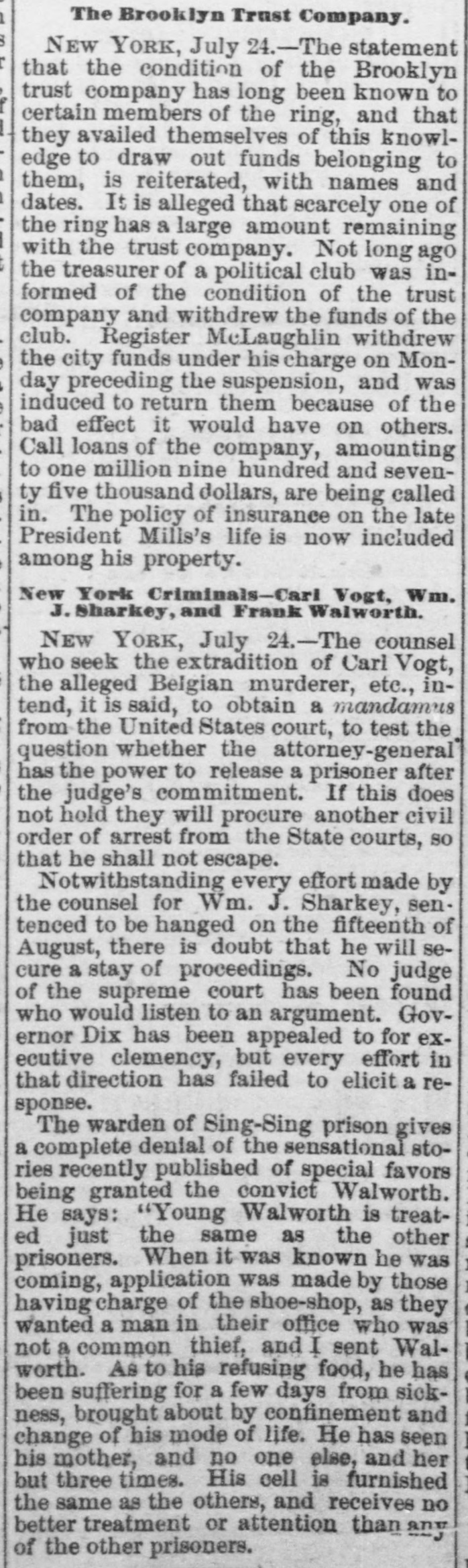
The Steamer Virginius. NEW YORK, 23.-Correspondence is published concerning the recent action of the American Consul, American commander of the gunboat} Kansas and the Spanish Commander Autran, of the Spanish gunboat Bazan, in regard to the sailing of the steamer Virginus from Aspinwall, under escort of the gunboat Kansas. Commander Autran claimed that the Virginius, by landing ar S and ammunition on the Island of Cuba for the insurgents, had laid their vessel liable to capture by Spanish authorities at any time after the commission of euch alleged violation of international laws, but Commander Reed, of the Kansas, held that the running of a blockade only laid the vessel liable to capture when in the act, and that the penalty of such act should not fellow escape. American Consul Tharrington, at Aspinwall, in response to a query from Commander Reed, said the Virginius had the right to fly the American flag, quoting as a precedent the action of Minister Hurlbu', in April, 1872, when the latter requested the Kansas to then escort the Virginius from the harbor of Aspinwall. On 29th June, Capt. Rockendorff of the Canandaigua, which had just arrived, ordered the Kansas to escert the Virginius from the harbor, which was done, the Bazan making no demonstrations, but Commander Autran denounced the Virginius as a pirate and has officially informed his government of the affair. The action of the America fleet is endorsed by Secretary Robeson. Suit Against Kate Steddard. Suit has been brought against Lizzie King, alias Kate Stoddard, the object of which is to forclose 2 wortgage on one of Goodrich's houses in DeGraw street,Brooklyn. King, alias Stoddard, is made a party to cover any rights she may have in the premises as widow of Chas. Goodrich. When the papers were read and explained to the prisoner that the object was to cut off her claim to the property, she said she had no desire to get a dollar of Goodrich's estate, nor does she propose to claim anything, but that she does wish to get certain trinkets which deceased presented to her and which she says are now in his father's posession. The Brooklyn Trust Company. NEW YORK, July 23.-A Private meeting of the directors of the Brooklyn Trust Company was held to-night, at which the bess means of disposing of the Georgia State and Connecticut railroad bonds in their possession, in order to settle the affairs of the company, were discussed. The following public statement was made on examining the affairs of the company, the directors are confident a receiver will be able to pay a dividend of 50 per cent. on the amount due depositors, on August 11. The directors propose to call a meeting of the stockholders at a later day, with a view to fill up the capital stock and resume business. Forced into Bankruptcy. A petition in bankruptcy has been filed by J. J. Allen, ex-Assistant U. S. District Attorney, against the Brooklyn Trust Company. Controller Schraeder, of Brooklyn, says he does not intend to take any action towards recovering the city funds, believing the city will get every dollar by waiting. A Watery Grave. The body of an unknown woman, about 35 years of age, and a boy seven years of age, were found to day in East rive-, near the foot of Twenty-eighth street. No clue to the identity of the woman or child can be obtained. The woman was seen last week on the pier at the foot of Twentyeighth street.
Click image to open full size in new tab
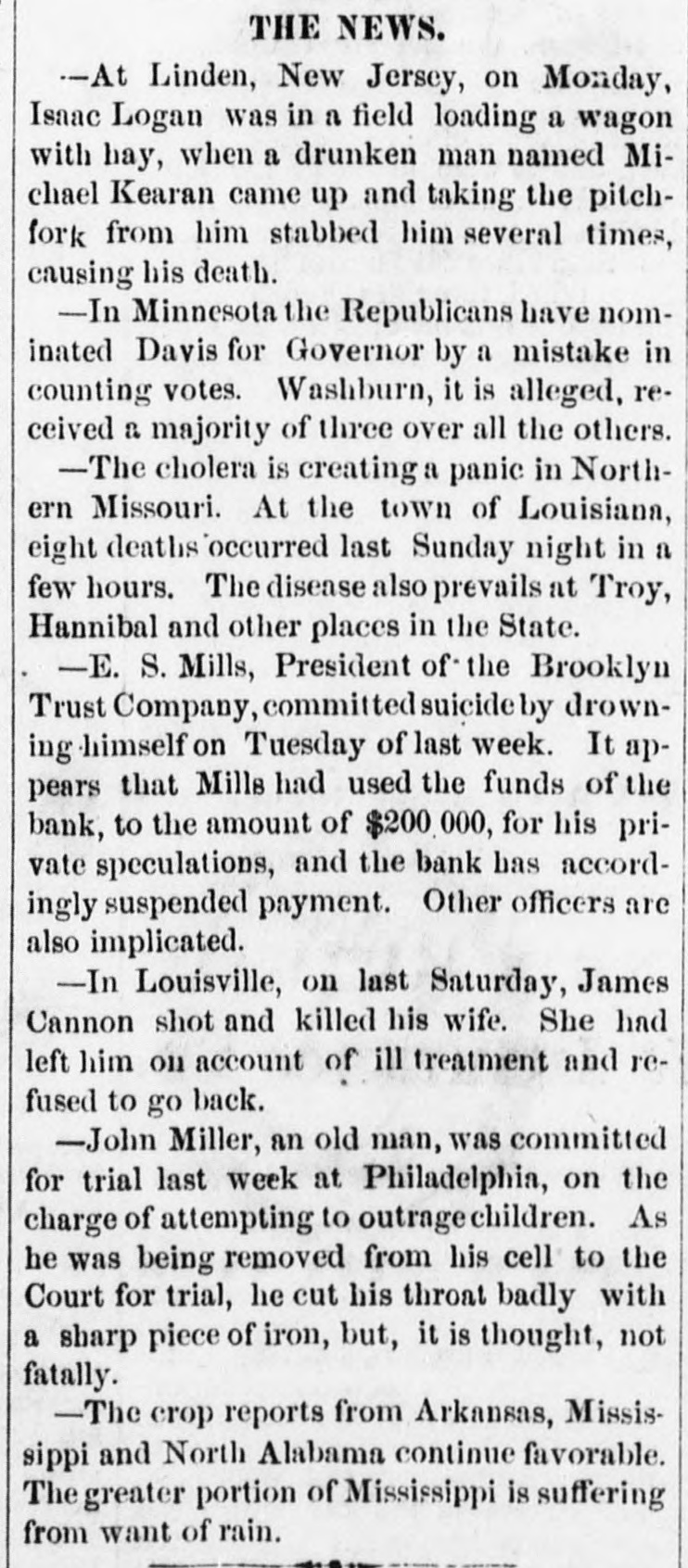
NEW YORK, July 24.-The statement that the condition of the Brooklyn trust company has long been known to certain members of the ring, and that they availed themselves of this knowledge to draw out funds belonging to them, is reiterated, with names and dates. It is alleged that scarcely one of the ring has a large amount remaining with the trust company. Not long ago the treasurer of a political club was informed of the condition of the trust company and withdrew the funds of the club. Register McLaughlin withdrew the city funds under his charge on Monday preceding the suspension, and was induced to return them because of the bad effect it would have on others. Call loans of the company, amounting to one million nine hundred and seventy five thousand dollars, are being called in. The policy of insurance on the late President Mills's life is now included among his property. New York Criminals-Cari Vogt, Wm. J. Sharkey, and Frank Walworth. NEW YORK, July 24.-The counsel who seek the extradition of Carl Vogt, it is to a tend, the alleged said, Belgian obtain murderer, mandamus etc., infrom the United States court, to test the question whether the attorney-general has the power to release a prisoner after the judge's commitment. If this does not hold they will procure another civil order of arrest from the State courts, so that he shall not escape. Notwithstanding every effort made by the counsel for Wm. J. Sharkey, sentenced to be hanged on the fifteenth of August, there is doubt that he will secure a stay of proceedings. No judge of the supreme court has been found who would listen to an argument. Governor Dix has been appealed to for executive clemency, but every effort in that direction has failed to elicit a response. The warden of Sing-Sing prison gives a complete denial of the sensational stories recently published of special favors the He being says: granted "Young convict Walworth Walworth. the is treat- other the same as When was was was prisoners. coming, ed just application it known made by he those having charge of the shoe-shop, as they wanted a man in their office who was not a common thief, and I sent Walworth. As to his refusing food, he has been suffering for a few days from sickness, brought about by confinement and of his seen and no one his change mother, mode of life. else, He has and her but three times. His cell is furnished the same as the others, and receives no better treatment or attention than any inj of the other prisoners.
Click image to open full size in new tab
-At Linden, New Jersey, on Monday, Isaac Logan was in a field loading a wagon with hay, when a drunken man named Michael Kearan came up and taking the pitchfork from him stabbed him several times, causing his death.
-In Minnesota the Republicans have nominated Davis for Governor by a mistake in counting votes. Washburn, it is alleged, received a majority of three over all the others.
-The cholera is creating a panic in Northern Missouri. At the town of Louisiana, eight deaths occurred last Sunday night in a few hours. The disease also prevails at Troy, Hannibal and other places in the State.
-E. S. Mills, President of the Brooklyn Trust Company, committed suicide by drowning himself on Tuesday of last week. It appears that Mills had used the funds of the bank, to the amount of $200,000, for his private speculations, and the bank has accordingly suspended payment. Other officers are also implicated.
-In Louisville, on last Saturday, James Cannon shot and killed his wife. She had left him on account of ill treatment and refused to go back.
-John Miller, an old man, was committed for trial last week at Philadelphia, on the charge of attempting to outrage children. As he was being removed from his cell to the Court for trial, he cut his throat badly with a sharp piece of iron, but, it is thought, not fatally.
-The crop reports from Arkansas, Mississippi and North Alabama continue favorable. The greater portion of Mississippi is suffering from want of rain.
Click image to open full size in new tab
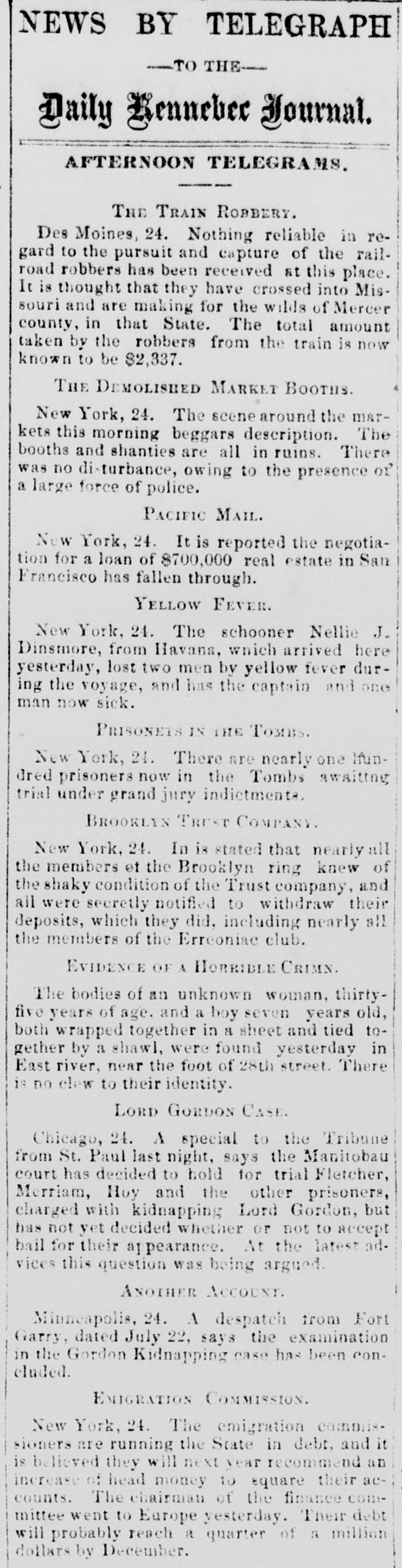
NEWS BY TELEGRAPH -TO THE-Daily Bennebec Journal. AFTERNOON TELEGRAMS. -THE TRAIN ROBBERY. Des Moines, 24. Nothing reliable in regard to the pursuit and capture of the railroad robbers has been received at this place. It is thought that they have crossed into Missouri and are making for the wilds of Mercer county, in that State. The total amount taken by the robbers from the train is now known to be $2,337. THE DEMOLISHED MARKET BOOTHS. New York, 24. The scene around the markets this morning beggars description. The booths and shanties are all in ruins. There was no di-turbance, owing to the presence of a large force of police. PACIFIC MAIL. New York, 24. It is reported the negotiation for a loan of $700,000 real estate in San Francisco has fallen through. YELLOW FEVER. New York, 24. The schooner Nellie J. Dinsmore, from Havana, which arrived here yesterday, lost two men by yellow fever during the voyage, and has the captain and one man now sick. PRISONETS IN THE Tomms. New York, 24. There are nearly one Ifundred prisoners now in the Tombs awaiting trial under grand jury indictments. BROOKLYN TRUST COMPANY. New York, 24. In is stated that nearly all the members et the Brooklyn ring knew of the shaky condition of the Trust company, and all were secretly notified to withdraw their deposits, which they did, including nearly all the members of the Erreoniac club. EVIDENCE OF A HORRIBLE CRIMN. The bodies of an unknown woman, thirtyfive years of age. and a boy seven years old, both wrapped together in a sheet and tied together by a shawl, were found yesterday in East river, near the foot of 28th street. There is no clew to their identity. LORD GORDON CASE. Chicago, 24. A special to the Tribune from St. Paul last night, says the Manitobau court has decided to hold for trial Fletcher, Merriam, Hoy and the other prisoners, charged with kidnapping Lord Gordon, but has not yet decided whether or not to accept bail for their pearance. At the latest ad. vices this question was being argued. ANOTHER ACCOUNT. Minneapolis, 24. A despatch from Fort Garry, dated July 22, says the examination in the Gordon Kidnapping case has been concluded. ENIGRATION COMMISSION. New York, 24. The emigration commiss sioners are running the State in debt, and it is believed they will next year recommend an increase of head money to equare their accounts. The chairman of the finance committee went to Europe yesterday. Their debt will probably reach a quarter of a million dollars by December.
Click image to open full size in new tab
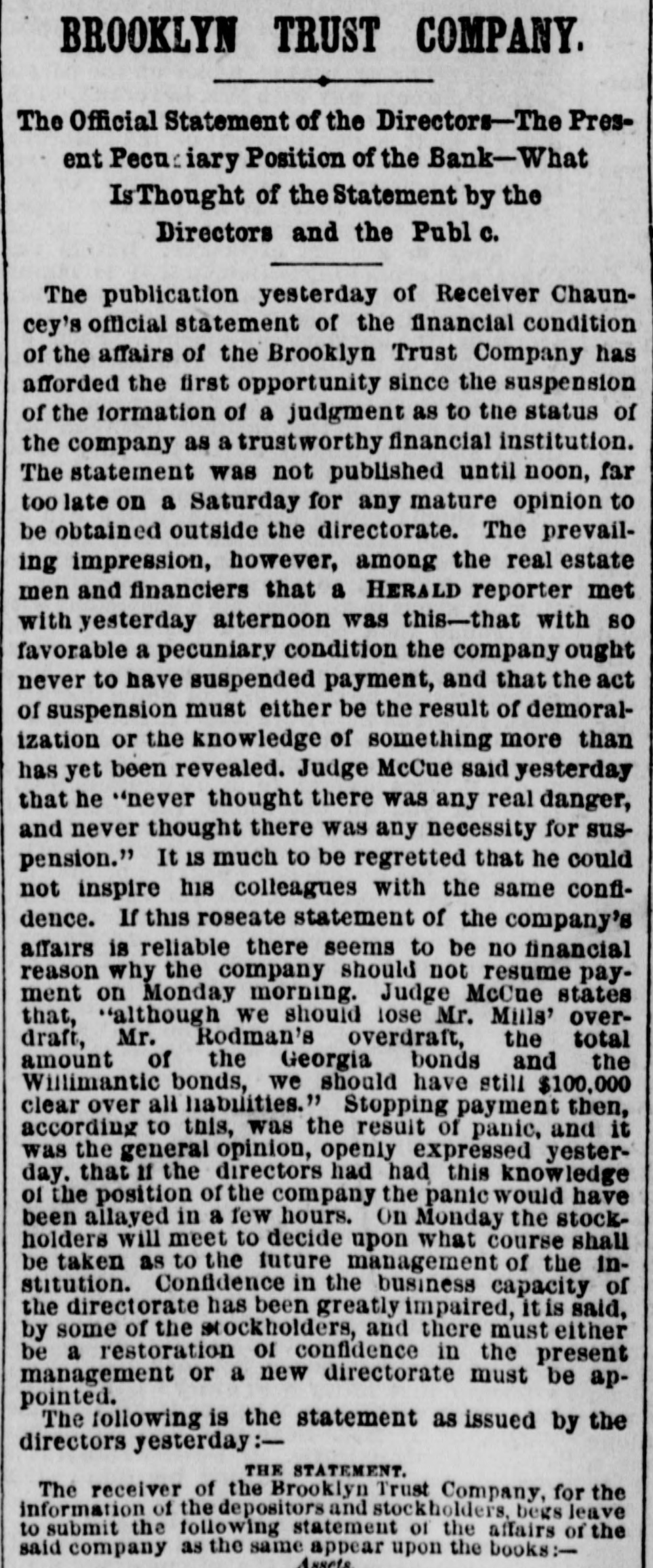
The Official Statement of the Directors-The Present Pecuriary Position of the Bank-What IsThought of the Statement by the Directors and the Publ c. The publication yesterday of Receiver Chauncey's official statement of the financial condition of the affairs of the Brooklyn Trust Company has afforded the first opportunity since the suspension of the formation of a judgment as to the status of the company as a trustworthy financial institution. The statement was not published until noon, far too late on a Saturday for any mature opinion to be obtained outside the directorate. The prevailing impression, however, among the real estate men and financiers that a HERALD reporter met with yesterday atternoon was this-that with so favorable a pecuniary condition the company ought never to have suspended payment, and that the act of suspension must either be the result of demoralization or the knowledge of something more than has yet been revealed. Judge McCue said yesterday that he "never thought there was any real danger, and never thought there was any necessity for suspension." It is much to be regretted that he could not inspire his colleagues with the same confidence. If this roseate statement of the company's affairs is reliable there seems to be no financial reason why the company should not resume payment on Monday morning. Judge McCue states that, "although we should lose Mr. Mills' overdraft, Mr. Rodman's overdraft, the total amount of the Georgia bonds and the Willimantic bonds, we should have still $100,000 clear over all habities." Stopping payment then, according to this, was the result of panic, and it was the general opinion, openly expressed yesterday. that If the directors had had this knowledge of the position of the company the panic would have been allayed in a few hours. on Monday the stockholders will meet to decide upon what course shall be taken as to the future management of the institution. Confidence in the business capacity of the directorate has been greatly impaired, it is said, by some of the stockholders, and there must either be a restoration of confidence in the present management or a new directorate must be appointed. The following is the statement as issued by the directors yesterday:THE STATEMENT. The receiver of the Brooklyn Trust Company, for the information of the depositors and stockholders, begs leave to submit the following statement of the affairs of the said company as the same appear upon the books:Assets
Click image to open full size in new tab
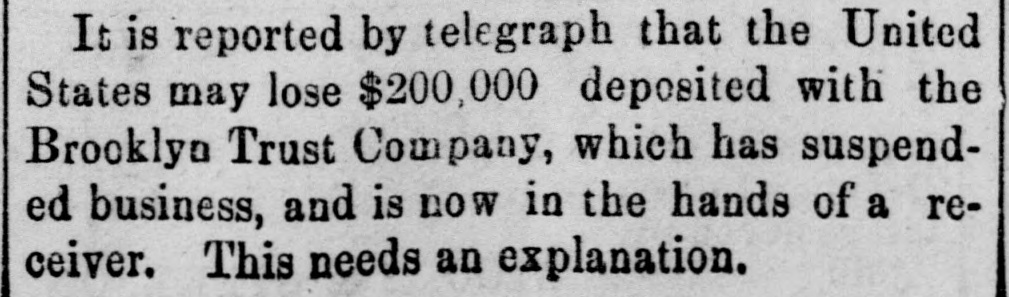
It is reported by telegraph that the United States may lose $200,000 deposited with the Brooklyn Trust Company, which has suspended business, and is now in the hands of a receiver. This needs an explanation.
Click image to open full size in new tab
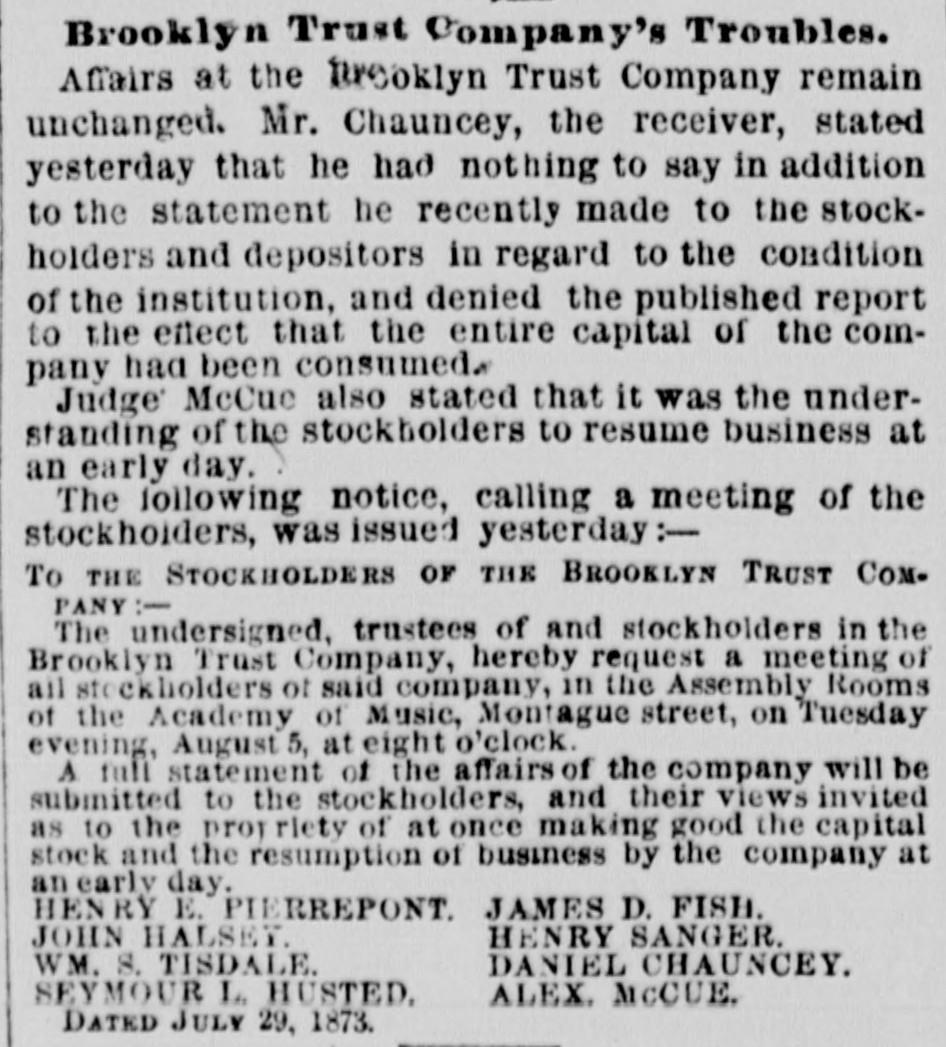
Affairs at the Brooklyn Trust Company remain unchanged. Mr. Chauncey, the receiver, stated yesterday that he had nothing to say in addition to the statement he recently made to the stockholders and depositors in regard to the condition of the institution, and denied the published report to the effect that the entire capital of the company had been consumed. Judge McCue also stated that it was the understanding of the stockholders to resume business at an early day. The following notice, calling a meeting of the stockholders, was issued yesterday:To THE STOCKHOLDERS OF THE BROOKLYN TRUST COM. PANY:The undersigned, trustees of and stockholders in the Brooklyn Trust Company, hereby request a meeting of all stockholders of said company, in the Assembly Rooms of the Academy of Music, Montague street, on Tuesday evening, August 5, at eight o'clock. A full statement of the affairs of the company will be submitted to the stockholders, and their views invited as to the projriety of at once making good the capital stock and the resumption of business by the company at an early day. HENRY E. PIERREPONT. JAMES D. FISH. JOHN HALSET HENRY SANGER. WM. S. TISDALE. DANIEL CHAUNCEY. SEYMOUR L. HUSTED. ALEX. MCCUE. DATED JULY 29, 1873.
Click image to open full size in new tab
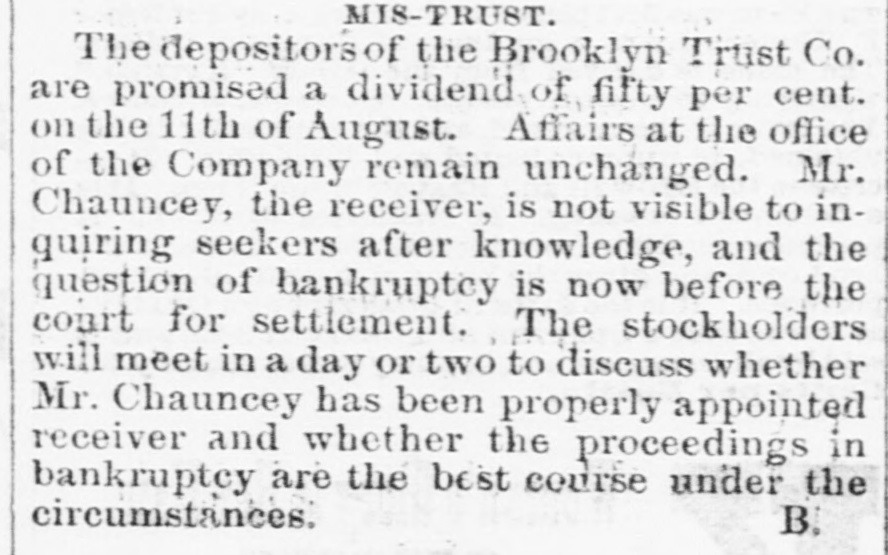
The depositors of the Brooklyn Trust Co. are promised a dividend of fifty per cent. on the 11th of August. Affairs at the office of the Company remain unchanged. Mr. Chauncey, the receiver, is not visible to inquiring seekers after knowledge, and the question of bankruptcy is now before the court for settlement. The stockholders will meet in a day or two to discuss whether Mr. Chauncey has been properly appointed receiver and whether the proceedings in bankruptcy are the best course under the circumstances.
B
Click image to open full size in new tab
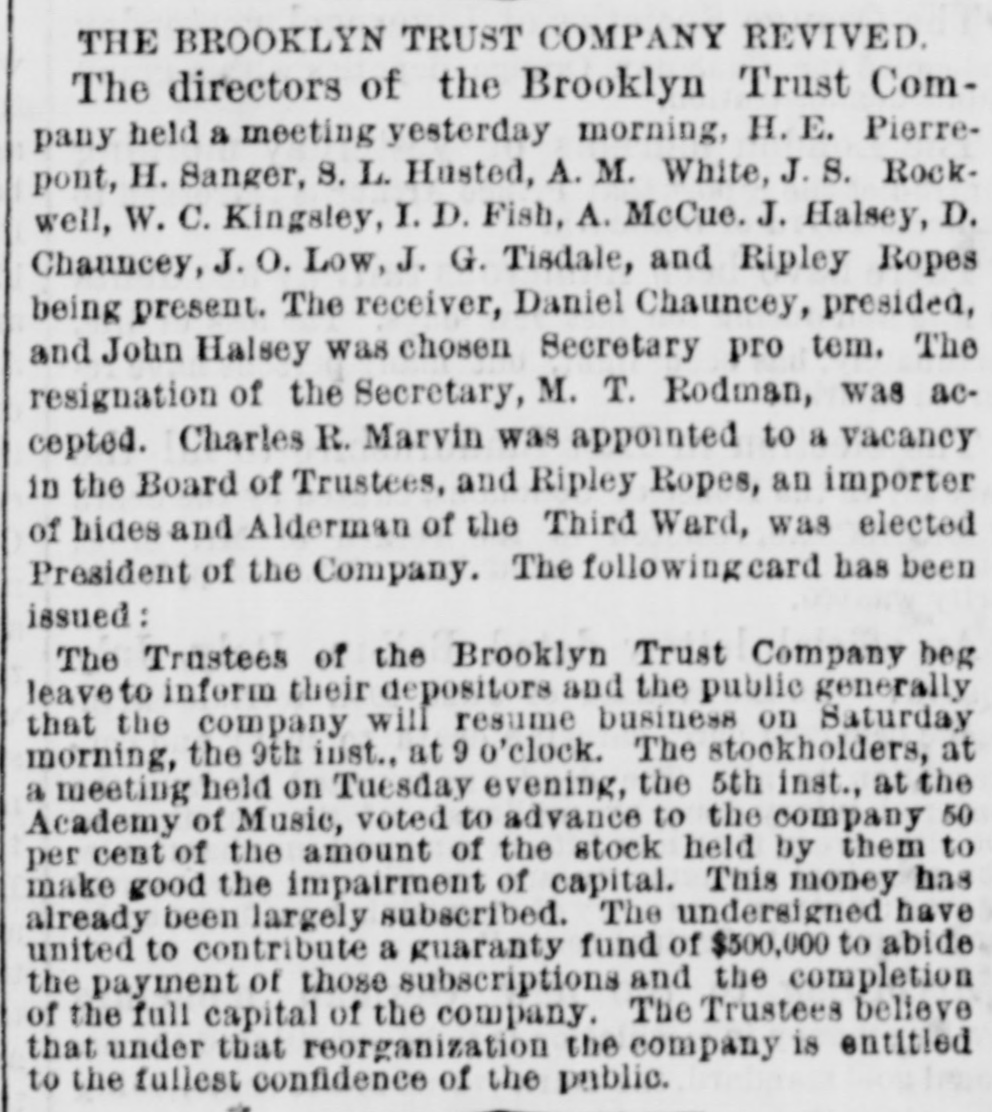
The directors of the Brooklyn Trust Company held a meeting yesterday morning, H. E. Pierrepont, H. Sanger, S. L. Husted, A. M. White, J. S. Rockwell, W. C. Kingsley, I. D. Fish, A. McCue. J. Halsey, D. Chauncey, J. O. Low, J. G. Tisdale, and Ripley Ropes being present. The receiver, Daniel Chauncey, presided, and John Halsey was chosen Secretary pro tem. The resignation of the Secretary, M. T. Rodman, was accepted. Charles R. Marvin was appointed to a vacancy in the Board of Trustees, and Ripley Ropes, an importer of hides and Alderman of the Third Ward, was elected President of the Company. The following card has been issued: The Trustees of the Brooklyn Trust Company beg leave to inform their depositors and the public generally that the company will resume business on Saturday morning, the 9th inst., at 9 o'clock. The stockholders, at a meeting held on Tuesday evening, the 5th inst., at the Academy of Music, voted to advance to the company 50 per cent of the amount of the stock held by them to make good the impairment of capital. This money has already been largely subscribed. The undersigned have united to contribute a guaranty fund of $500,000 to abide the payment of those subscriptions and the completion of the full capital of the company. The Trustees believe that under that reorganization the company is entitled to the fullest confidence of the public.
Click image to open full size in new tab
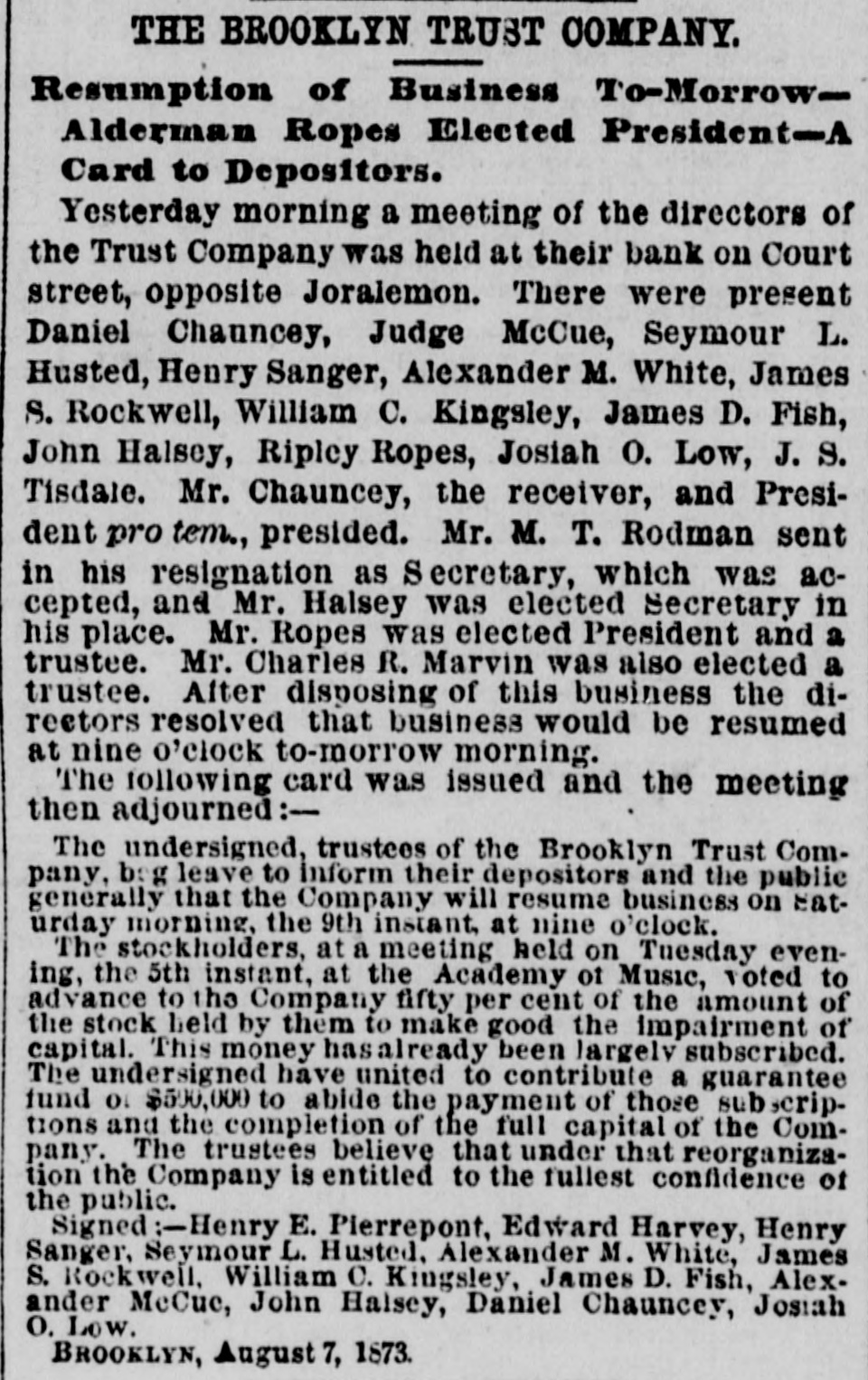
Resumption of Business To-MorrowAlderman Ropes Elected President-A Card to Depositors. Yesterday morning a meeting of the directors of the Trust Company was held at their bank on Court street, opposite Joralemon. There were present Daniel Chauncey, Judge McCue, Seymour L. Husted, Henry Sanger, Alexander M. White, James S. Rockwell, William C. Kingsley, James D. Fish, John Halsey, Ripley Ropes, Josiah O. Low, J. S. Tisdale. Mr. Chauncey, the receiver, and President pro tem., presided. Mr. M. T. Rodman sent in his resignation as Secretary, which was accepted, and Mr. Halsey was elected Secretary in his place. Mr. Ropes was elected President and a trustee. Mr. Charles R. Marvin was also elected a trustee. After disposing of this business the directors resolved that business would be resumed at nine o'clock to-morrow morning. The following card was issued and the meeting then adjourned:The undersigned, trustees of the Brooklyn Trust Company, beg leave to inform their depositors and the public generally that the Company will resume business on Eatürday morning, the 9th instant, at nine o'clock. The stockholders, at a meeting held on Tuesday evening, the 5th instant, at the Academy of Music, voted to advance to the Company fifty per cent of the amount of the stock held by them to make good the impairment of capital. This money hasalready been largely subscribed. The undersigned have united to contribute a guarantee fund o. $590,000 to abide the payment of those subscriptions and the completion of the full capital of the Company. The trustees believe that under that reorganization the Company is entitled to the fullest confidence of the public. Signed -Henry E. Pierrepont, Edward Harvey, Henry Sanger, Seymour L. Husted. Alexander M. White, James S. Rockwell, William C. Kingsley, James D. Fish, Alexander McCuc, John Halsey, Daniel Chauncey, Josiah O. Low. BROOKLYN, August 7, 1673.
Click image to open full size in new tab
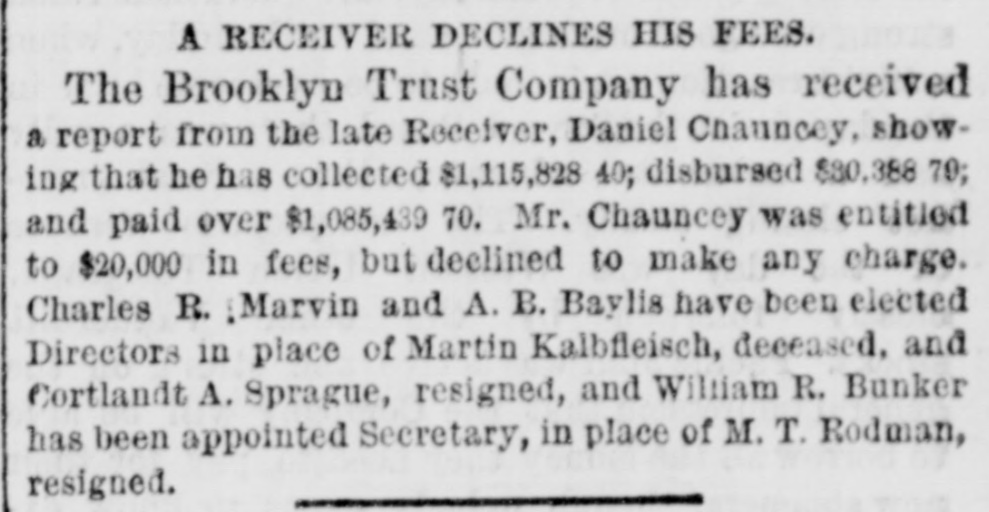
The Brooklyn Trust Company has received a report from the late Receiver, Daniel Chauncey, showing that he has collected $1,115,828 40; disbursed $20,388 70; and paid over $1,085,439 70. Mr. Chauncey was entitled to $20,000 in fees, but declined to make any charge. Charles R. Marvin and A. B. Baylis have been elected Directors in place of Martin Kalbfleisch, deceased, and Cortlandt A. Sprague, resigned, and William R. Bunker has been appointed Secretary, in place of M. T. Rodman, resigned.
Click image to open full size in new tab
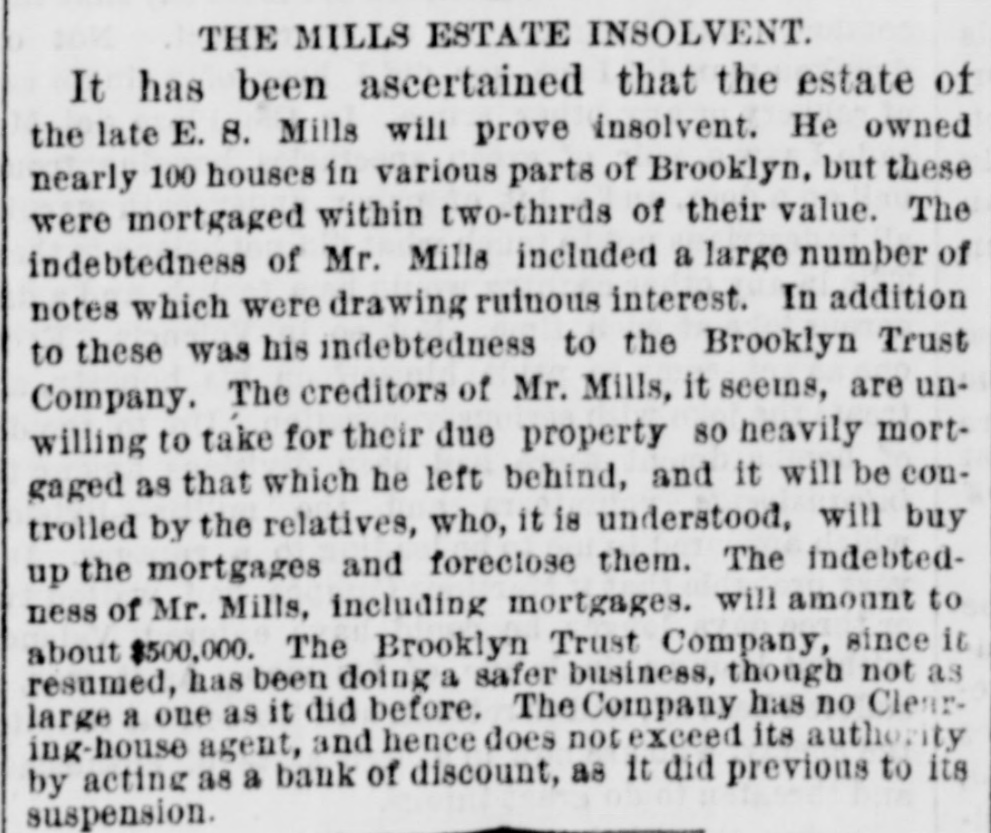
It has been ascertained that the estate of the late E. 8. Mills will prove insolvent. He owned nearly 100 houses in various parts of Brooklyn. but these were mortgaged within two-thirds of their value. The indebtedness of Mr. Milla included a large number of notes which were drawing ruinous interest. In addition to these was his indebtedness to the Brooklyn Trust Company. The creditors of Mr. Mills, it seems, are unwilling to take for their due property so heavily mortgaged as that which he left behind, and it will be controlled by the relatives, who, it is understood, will buy up the mortgages and foreclose them. The indebtedness of Mr. Mills, including mortgages. will amount to about $500,000. The Brooklyn Trust Company, since it resumed, has been doing a safer business, though not as large a one as it did before. The Company has no Clearing-house agent, and hence does notexceed its authority by acting as a bank of discount, as it did previous to its suspension.
Click image to open full size in new tab
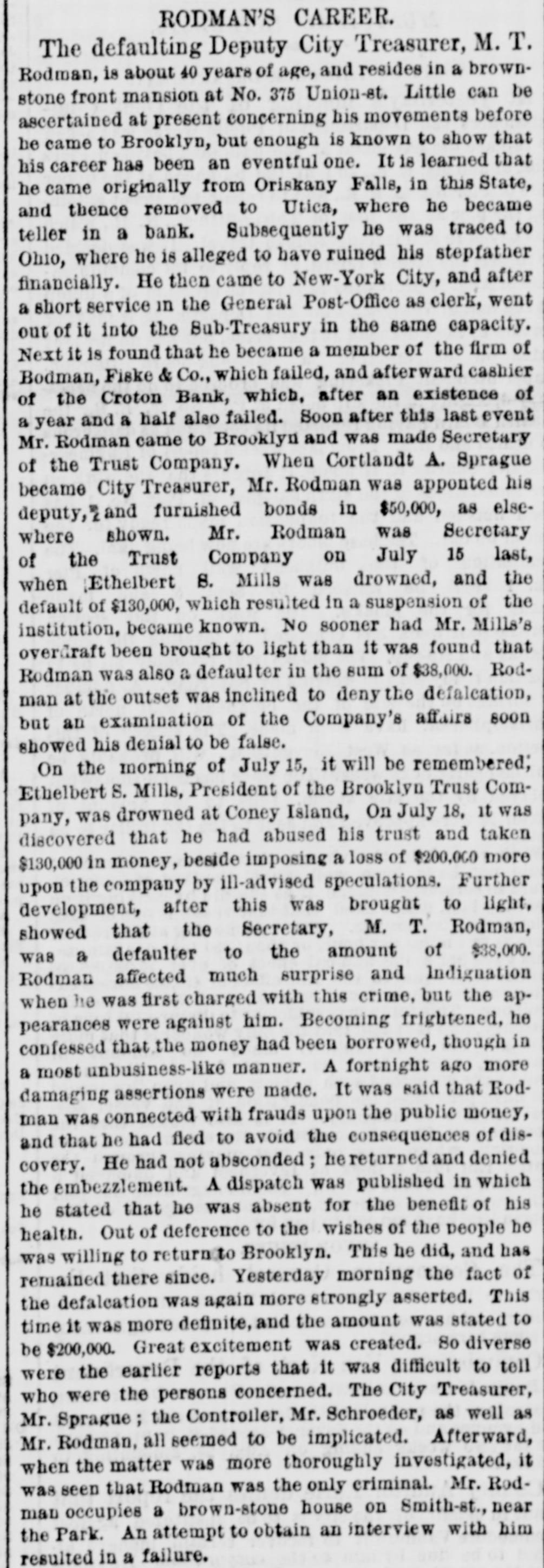
The defaulting Deputy City Treasurer, M. T. Rodman, is about 40 years of age, and resides in a brown-stone front mansion at No. 375 Union-st. Little can be ascertained at present concerning his movements before he came to Brooklyn, but enough is known to show that his career has been an eventful one. It is learned that he came originally from Oriskany Falls, in this State, and thence removed to Utica, where he became teller in a bank. Subsequently he was traced to Ohio, where he is alleged to have ruined his stepfather financially. He then came to New-York City, and after a short service in the General Post-Office as clerk, went out of it into the Sub-Treasury in the same capacity. Next it is found that he became a member of the firm of Bodman, Fiske & Co., which failed, and afterward cashier of the Croton Bank, which, after an existence of a year and a half also failed. Soon after this last event Mr. Rodman came to Brooklyn and was made Secretary of the Trust Company. When Cortlandt A. Sprague became City Treasurer, Mr. Rodman was apponted his deputy, and furnished bonds in $50,000, as elsewhere shown. Mr. Rodman was Secretary of the Trust Company on July 15 last, when Ethelbert S. Mills was drowned, and the default of $130,000, which resulted in a suspension of the institution, became known. No sooner had Mr. Mills's overdraft been brought to light than it was found that Rodman was also a defaulter in the sum of $38,000. Rodman at the outset was inclined to deny the defalcation, but an examination of the Company's affairs soon showed his denial to be false.
On the morning of July 15, it will be remembered; Ethelbert S. Mills, President of the Brooklyn Trust Company, was drowned at Coney Island, On July 18, it was discovered that he had abused his trust and taken $130,000 in money, beside imposing a loss of $200,000 more upon the company by ill-advised speculations. Further development, after this was brought to light, showed that the Secretary, M. T. Rodman, was a defaulter to the amount of $38,000. Rodman affected much surprise and indignation when he was first charged with this crime, but the appearances were against him. Becoming frightened, he confessed that the money had been borrowed, though in a most unbusiness-like manner. A fortnight ago more damaging assertions were made. It was said that Rodman was connected with frauds upon the public money, and that he had fled to avoid the consequences of discovery. He had not absconded; he returned and denied the embezzlement. A dispatch was published in which he stated that he was absent for the benefit of his health. Out of deference to the wishes of the people he was willing to return to Brooklyn. This he did, and has remained there since. Yesterday morning the fact of the defalcation was again more strongly asserted. This time it was more definite, and the amount was stated to be $200,000. Great excitement was created. So diverse were the earlier reports that it was difficult to tell who were the persons concerned. The City Treasurer, Mr. Sprague; the Controller, Mr. Schroeder, as well as Mr. Rodman, all seemed to be implicated. Afterward, when the matter was more thoroughly investigated, it was seen that Rodman was the only criminal. Mr. Rodman occupies a brown-stone house on Smith-st., near the Park. An attempt to obtain an interview with him resulted in a failure.
Click image to open full size in new tab
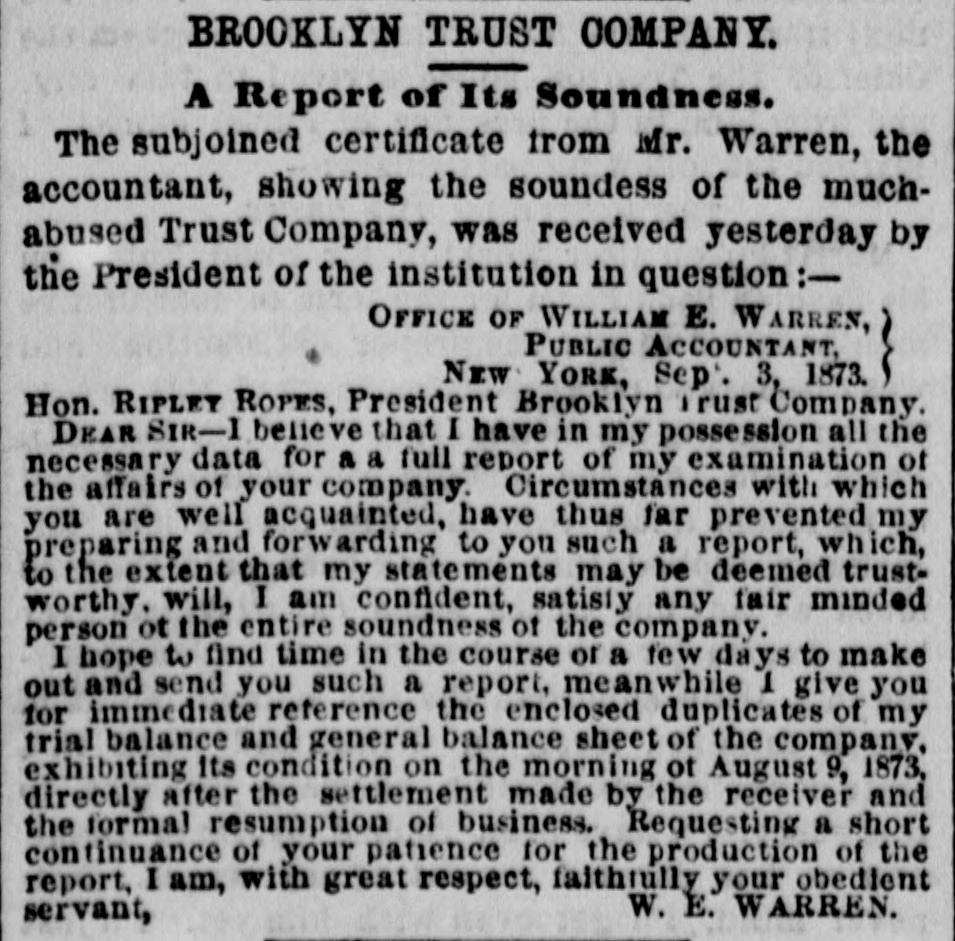
A Report of Its Soundness. The subjoined certificate from Mr. Warren, the accountant, showing the soundess of the muchabused Trust Company, was received yesterday by the President of the institution in question:OFFICE OF WILLIAM E. WARREN, PUBLIC ACCOUNTANT. NEW YORK, Sep: 3, 1873. Hon. RIPLEY ROPES, President Brooklyn I rust Company. DEAR SIR-1 believe that I have in my possession all the necessary data for a a full report of my examination of the affairs of your company. Circumstances with which you are well acquainted, have thus far prevented my preparing and forwarding to you such a report, which, to the extent that my statements may be deemed trustworthy. will, I am confident, satisly any fair minded person ot the entire soundness of the company. I hope to find time in the course or a few days to make out and send you such a report, meanwhile 1 give you for immediate reference the enclosed duplicates of my trial balance and general balance sheet of the company, exhibiting its condition on the morning ot August 9, 1873, directly after the settlement made by the receiver and the formal resumption of business. Requesting a short continuance of your patience for the production of the report, I am, with great respect, faithfully your obedient W. E. WARREN. servant,
Click image to open full size in new tab
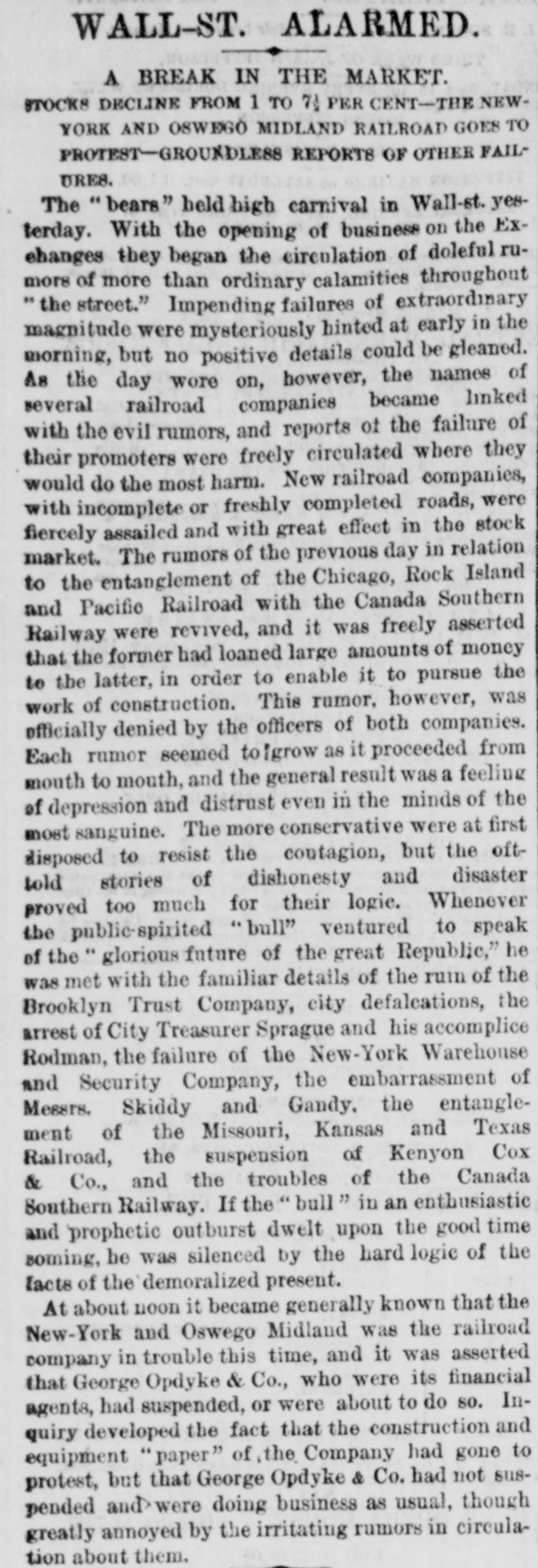
ALARMED. A BREAK IN THE MARKET. STOCKS DECLINE FROM 1 TO 71 PER CENT-THE NEWYORK AND OSWEGO MIDLAND RAILROAD GOES TO PROTEST-GROUNDLESS REPORTS OF OTHER FAILURE8. The "bears" held high carnival in Wall-st. yesterday. With the opening of business on the Exchanges they began the circulation of doleful rumors of more than ordinary calamities throughout "the street." Impending failures of extraordinary magnitude were mysteriously hinted at early in the morning, but no positive details could be gleaned. As the day wore on, however, the names of several railroad companies became linked with the evil rumors, and reports of the failure of their promoters were freely circulated where they would do the most harm. New railroad companies, with incomplete or freshly completed roads, were fiercely assailed and with great effect in the stock market. The rumors of the previous day in relation to the entanglement of the Chicago, Rock Island and Pacific Railroad with the Canada Southern Railway were revived, and it was freely asserted that the former had loaned large amounts of money to the latter, in order to enable it to pursue the work of construction. This rumor, however, was officially denied by the officers of both companies. Each rumor seemed tolgrow as it proceeded from mouth to mouth, and the general result was a feeling of depression and distrust even in the minds of the most sanguine. The more conservative were at first disposed to resist the coutagion, but the ofttold stories of dishonesty and disaster proved too much for their logic. Whenever the public-spirited "bull" ventured to speak of the ** glorious future of the great Republic," he was met with the familiar details of the ruin of the Brooklyn Trust Company, city defalcations, the arrest of City Treasurer Sprague and his accomplice Rodman, the failure of the New-York Warehouse and Security Company, the embarrassment of Messrs. Skiddy and Gandy. the entanglement of the Missouri, Kansas and Texas Railroad, the suspension of Kenyon Cox & Co., and the troubles of the Canada Southern Railway. If the " bull " in an enthusiastic and prophetic outburst dwelt upon the good time soming, he was silenced by the hard logic of the facts of the demoralized present. At about noon it became generally known that the New-York and Oswego Midland was the railroad company in trouble this time, and it was asserted that George Opdyke & Co., who were its financial agents, had suspended, or were about to do so. Inquiry developed the fact that the construction and equipment "paper" of the Company had gone to protest, but that George Opdyke & Co. had not suspended and were doing business as usual, though greatly annoyed by the irritating rumors in circulation about them.
Click image to open full size in new tab
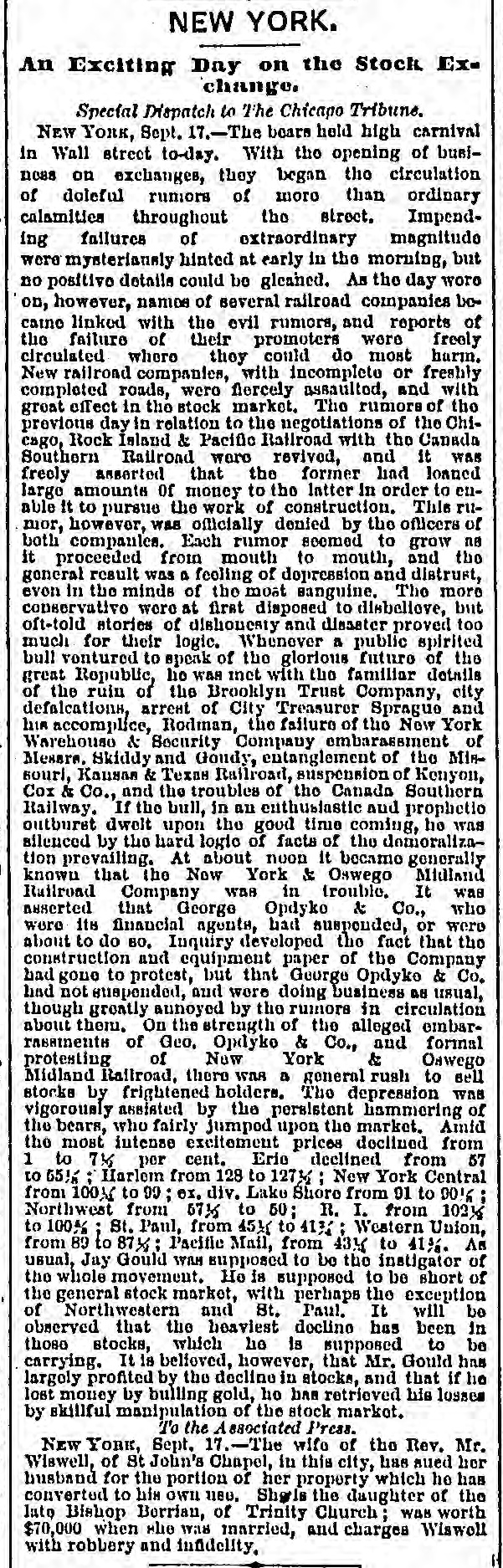
An Exciting Day on the Stock Exchange. Special Dispatch to The Chicago Tribune, NEW YORK, Sept. 17.-The bears held high carnival in Wall street to-day. With the opening of business on exchanges, they began the circulation of doleful runiors of more than ordinary calamities throughout the street. Impending failures of extraordinary magnitude were mysteriansly hinted at early in the morning, but no positivo details could be gleaned. As the day wore on, however, names of several railroad companies becaine linked with the evil runors, and reports of the failure of their promoters were freely circulated where they could do most harm. New railroad companies, with incomplete or freshly completed roads, were fiercely assaulted, and with great effect in the stock market. The rumors of the previous day in relation to the negotiations of the Chicago, Rock Island & Pacific Railroad with the Canada Southern Railroad were revived, and it was freely asserted that the former had loaned large amounts of money to the latter In order to enable It to pursue the work of construction. This rumor, however, was officially denied by the officers of both companics. Each rumor seemed to grow na it proceeded from mouth to mouth, and the general result was a feeling of depression and distrust, evon in the minds of the most Banguine. The more conservativo were at first disposed to disbellove, but oft-told stories of dishonesty and disaster proved too much for their logic. Whenever a public spirited bull vontured to speak of the glorious future of the great Ropublic, he was met with the familiar details of the ruin of the Brooklyn Trust Company, city defalcations, arrent of City Treasurer Sprague and his accomplice, Rodman, the failure of the New York Warehouse & Security Company embarassment of Mesare. Skiddy and Goudy, entanglement of the Minsourl, Kausan & Texas Railroad, suspension of Kenyon, Cox & Co., and the troubles of the Canada Southern Railway. If the bull, in an enthusiastic and prophetio outburst dwelt upon the good tiruo coming, he was silenced by the hard logic of facts of the domoralization prevailing. At about noon it becamo generally known that the Now York & Oswego Milland Railroad Company was in trouble, It was asserted that George Opdyko & Co., who were its financial agents, had suspended, or were about to do 80. Inquiry developed the fact that the construction and equipment paper of the Company had gone to protest, but that George Opdyko & Co. had not suspended, and were doing business as usual, though greatly annoyed by the rumors in circulation about them. On the strength of the alleged embarrassments of Geo, Opdyko & Co., and formal protesting of New York & Oawego Midland Railroad, there was a general rush to sell stocks by frightened holders. The depression was vigorously assisted by the persistent hammering of the bears, who fairly jumpod upon the market. Amid the most intense excitement prices declined from 1 to 7% per cent. Erio declined from 57 5516 ; Harlem from 128 to 127% New York Central from 1001 to 99 61. div. Lake Shore from 01 to 0016 Northwest from 571/5 to 50; R. I. from 102% to 100% St. Paul, from 451/ to 4132 ; Western Union, from 89 to 87 % Pacific Mail, from 43M to 41% As usual, Jay Gould WAH supposed to be the instigator of the whole movement. He is supposed to be short of the general stock market, with perhaps the exception of Northwestern and St. Paul. It will be observed that the heaviest doclino has been in those stocks, which he is supposed to be carrying. It is believed, however, that Mr. Gould hns largoly profited by the decline in stocks, and that if he lost money by bulling gold, ho has retrieved his losses by skillful manipulation of the stock market. To the Associated Press. NEW YORK, Sept. 17.-The wifo of the Rev. Mr. Wiswell, of St John's Chapel, in this city, has aued her husband for the portion of her property which he has converted to his own use. Sheris the daughter of the late Bishop Borrian, of Trinity Church; was worth $70,000 when alio was married, and charges Wiswell with robbery and infidelity,
Click image to open full size in new tab
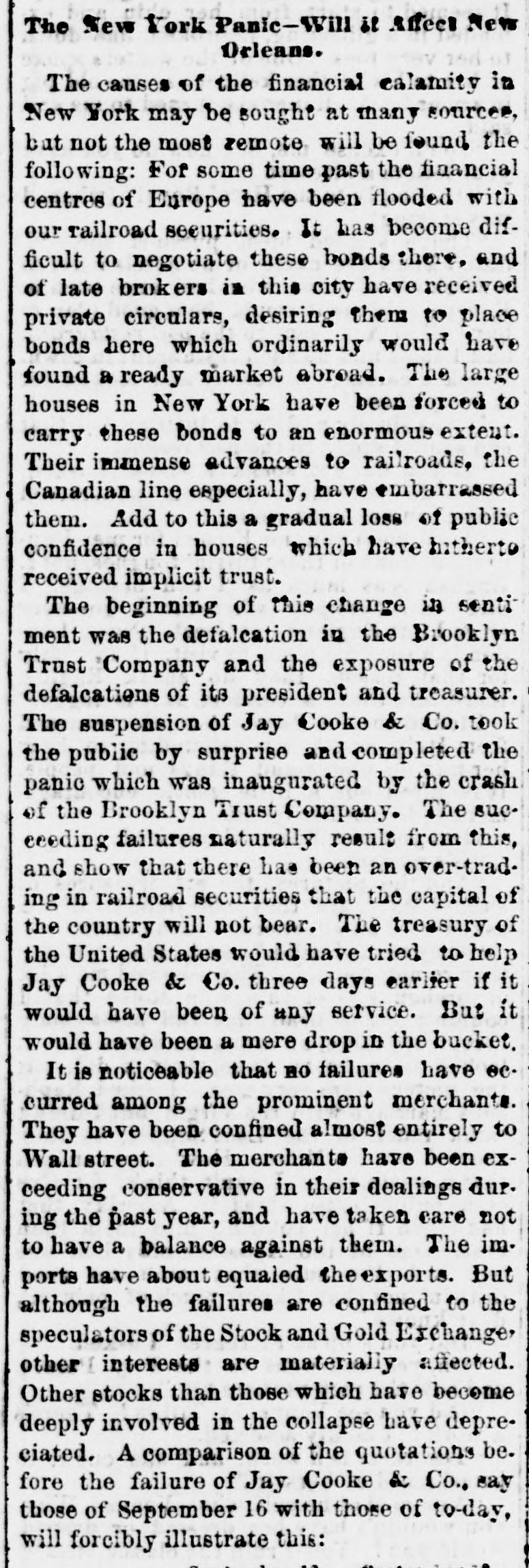
The New York Panic-Will il Affect New Orleans. The causes of the financial calamity in New York may be sought at many sources, but not the most remote will be found the following: For some time past the financial centree of Europe have been flooded with our railroad securities. It has become difficult to negotiate these bonds there, and of late brokers in this city have received private circulars, desiring them to place bonds here which ordinarily would have found a ready market abroad. The large houses in New York have been forced to carry these bonds to an enormous extent. Their immense advances to railroads, the Canadian line especially, have embarrassed them. Add to this a gradual loss of public confidence in houses which have hitherto received implicit trust. The beginning of this change in senti ment was the defalcation in the Brooklyn Trust Company and the exposure of the defalcations of its president and treasurer. The suspension of Jay Cooke & Co. took the public by surprise and completed the panic which was inaugurated by the crash of the Brooklyn Trust Company. The succeeding failures naturally result from this, and show that there has been an over-trading in railroad securities that the capital of the country will not bear. The treasury of the United States would have tried to help Jay Cooke & Co. three days earlier if it would have been of any service. But it would have been a mere drop in the bucket. It is noticeable that no failures have ec. curred among the prominent merchants. They have been confined almost entirely to Wall street. The merchants have been exceeding conservative in their dealings dur. ing the past year, and have taken care not to have a balance against them. The im. ports have about equaled theexports. But although the failures are confined to the speculators of the Stock and Gold Exchange, other H interests are materially affected. Other stocks than those which have become deeply involved in the collapse have depreciated. A comparison of the quotations be. fore the failure of Jay Cooke & Co., say those of September 16 with those of to-day, will forcibly illustrate this:
Click image to open full size in new tab
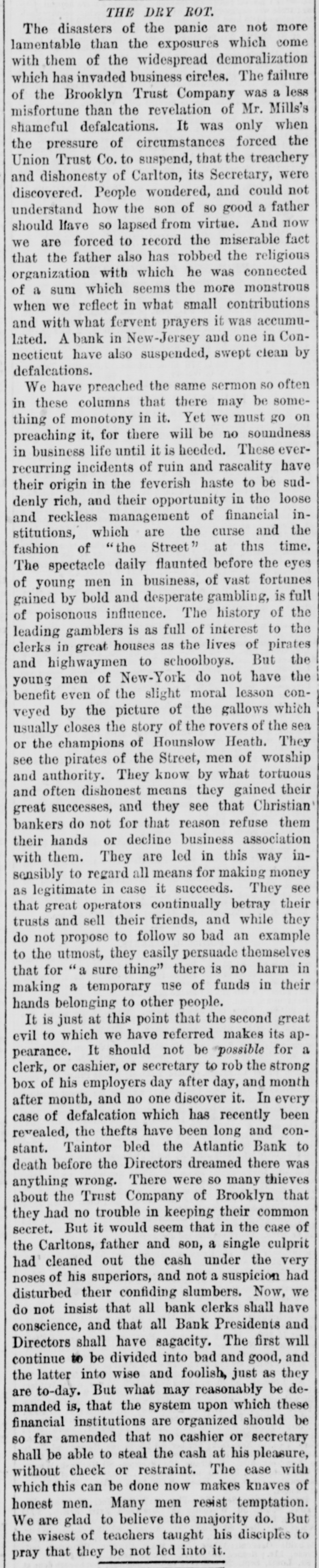
The disasters of the panic are not more lamentable than the exposures which come with them of the widespread demoralization which has invaded business circles. The failure of the Brooklyn Trust Company was a less misfortune than the revelation of Mr. Mills's shameful defalcations. It was only when the pressure of circumstances forced the Union Trust Co. to suspend, that the treachery and dishonesty of Carlton, its Secretary, were discovered. People wondered, and could not understand how the son of so good a father should have so lapsed from virtue. And now we are forced to record the miserable fact that the father also has robbed the religious organization with which he was connected of a sum which seems the more monstrous when we reflect in what small contributions and with what fervent prayers it was accumulated. A bank in New-Jersey and one in Connecticut have also suspended, swept clean by defalcations.
We have preached the same sermon so often in these columns that there may be something of monotony in it. Yet we must go on preaching it, for there will be no soundness in business life until it is heeded. These ever-recurring incidents of ruin and rascality have their origin in the feverish haste to be suddenly rich, and their opportunity in the loose and reckless management of financial institutions, which are the curse and the fashion of "the Street" at this time. The spectacle daily flaunted before the eyes of young men in business, of vast fortunes gained by bold and desperate gambling, is full of poisonous influence. The history of the leading gamblers is as full of interest to the clerks in great houses as the lives of pirates and highwaymen to schoolboys. But the young men of New-York do not have the benefit even of the slight moral lesson conveyed by the picture of the gallows which usually closes the story of the rovers of the sea or the champions of Hounslow Heath. They see the pirates of the Street, men of worship and authority. They know by what tortuous and often dishonest means they gained their great successes, and they see that Christian bankers do not for that reason refuse them their hands or decline business association with them. They are led in this way insensibly to regard all means for making money as legitimate in case it succeeds. They see that great operators continually betray their trusts and sell their friends, and while they do not propose to follow so bad an example to the utmost, they easily persuade themselves that for "a sure thing" there is no harm in making a temporary use of funds in their hands belonging to other people.
It is just at this point that the second great evil to which we have referred makes its appearance. It should not be possible for a clerk, or cashier, or secretary to rob the strong box of his employers day after day, and month after month, and no one discover it. In every case of defalcation which has recently been revealed, the thefts have been long and constant. Taintor bled the Atlantic Bank to death before the Directors dreamed there was anything wrong. There were so many thieves about the Trust Company of Brooklyn that they had no trouble in keeping their common secret. But it would seem that in the case of the Carltons, father and son, a single culprit had cleaned out the cash under the very noses of his superiors, and not a suspicion had disturbed their confiding slumbers. Now, we do not insist that all bank clerks shall have conscience, and that all Bank Presidents and Directors shall have sagacity. The first will continue to be divided into bad and good, and the latter into wise and foolish, just as they are to-day. But what may reasonably be demanded is, that the system upon which these financial institutions are organized should be so far amended that no cashier or secretary shall be able to steal the cash at his pleasure, without check or restraint. The ease with which this can be done now makes knaves of honest men. Many men resist temptation. We are glad to believe the majority do. But the wisest of teachers taught his disciples to pray that they be not led into it.