Lebanon Miami Banking Company (Lebanon, OH)

Episode Information

Episode UID
8836056890489
Episode Type
Suspension โ†’ Closure
Bank Type
state
Bank ID
883605689 hash
Start Date
September 30, 1840
Location
Lebanon, Ohio (39.423, -84.220)

Metadata

Model
gpt-5-mini (chosen from majority vote of a three-model LLM ensemble)
Short Digest
cdee2b3c9302f919

Response Measures

None

Description

Article (1840) explicitly states it was chartered by the State; 1842 article reports assignment of assets for creditors.

Events (3)

1. September 30, 1840 Other
Newspaper Excerpt
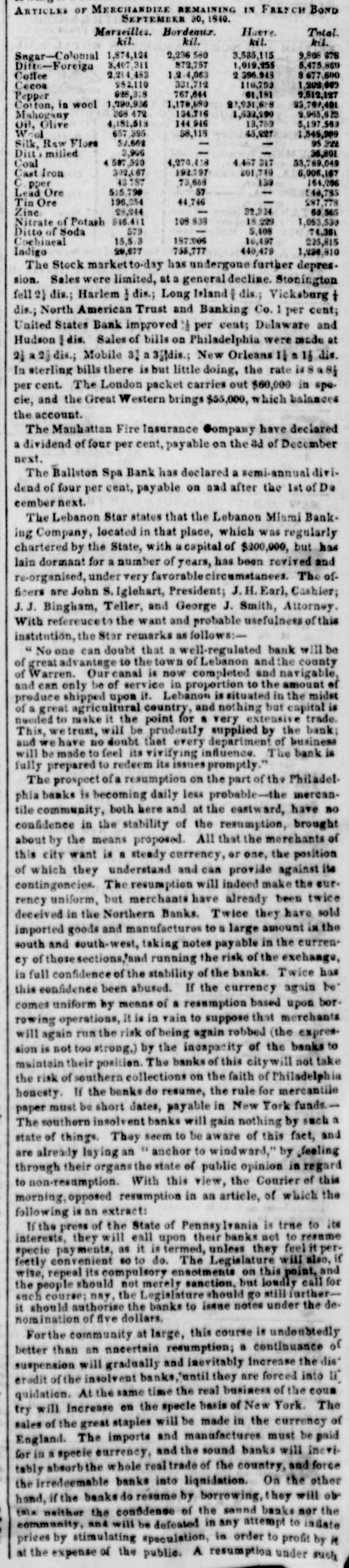
The Lebanon Star states that the Lebanon Miami Bank ing Company, located in that place, which was regularly chartered by the State, ... has been ... revived
Source
newspapers
2. January 17, 1842 Receivership
Newspaper Excerpt
has made an assignment of all its assets to E. W. M'Guire, of Lebanon, for the benefit of the creditors.
Source
newspapers
3. January 17, 1842 Suspension
Cause
Bank Specific Adverse Info
Cause Details
Bank stopped operations and assigned assets to an assignee for benefit of creditors, indicating insolvency/closure.
Newspaper Excerpt
The Lebanon Miami|Bank, which stopped lately, has made an assignment of all its assets to E. W. M'Guire, of Lebanon, for the benefit of the creditors.
Source
newspapers

Newspaper Articles (3)

Article from Morning Herald, November 25, 1840

Click image to open full size in new tab

Article Text

SEPTEMBER 30, 1840. ARTICLES OF MERCHANDIZE REMAINING IN FRENCH BOND Haere. Total Marseilles. Bordeaux. kil. kil. kil. kib. 2,236 580 9,806 678 3,535,115 Sagar-Colonal 1,874,124 872,757 3,407,311 1,019,255 5,475,869 Difto-Foreign 2,214,483 1,24,063 8 677,600 2 396.943 Coffee 331,712 252,110 1,209,669 110,793 Cecoa 2,512,127 61,181 628,318 767,644 1,170,080 27,931,688 25,761,401 Pepper Cotton, is wool 1,290,936 134.716 868 472 2,965,623 1,632,190 Mahogany 144 946 13,759 4,181,513 5,197,569 Oil, Olive 657,395 Wool 1,545,989 38,118 45,821 52.66% 95.322 Silk, Rsw Flore 3,906 36,801 Ditt milled 4.467 317 4,270,438 4507,390 53,769,049 Coal 192.197 302,467 201,749 Cast Iron 6,006,167 43787 139 73,668 164,206 C pper 57 515,790 148,795 Lead Ore 196,854 44,746 287,778 Tin Ore 32,324 60 565 28,244 Zine 18.229 108 838 1,053,530 Nitrate of Potash 846.411 579 5,408 74.36 Ditto of Soda 197:005 10,497 15,5.3 Cochineal 225,815 29,677 440,479 756,777 1,220,810 Indigo The Stock marketto-day has un Mergone further depression. Sales were limited, at a general decline. Stonington fell 2) dis.; Harlem dis.; Long Island dis.; Vicksburg dis.; North American Trust and Banking Co. 1 per cent; United States Bank improved : per cent; Delaware and Hudson dis. Sales of bills on Philadelphia were made at 2ja2jdis.; Mobile 31 a 3 dis.; New Orleans 11 In sterling bills there is but little doing, the rate issa8h percent. The London packet carries out $60,000 in specie, and the Great Western brings $55,000, which balances the account. The Manhattan Fire Insurance Company have declared a dividend of four per cent, payable on the ad of December next. The Ballston Spa Bank has declared a semi-annual dividend of four per cent, payable on and after the 1st of De cember next. The Lebanon Star states that the Lebanon Miami Bank ing Company, located in that place, which was regularly chartered by the State, with acapital of $200,000, but has for a number of years, has been under very lain re-organised, dormant favorablecircumstances. revived The and of ficers are John S. Iglehart, President; J.H. Earl, Cashier; J.J. Bingham, Teller, and George J. Smith, Attorney. With refereuceto the want and probable usefulness of this institution, the Star remarks as follows:" No one can doubt that a well-regulated bank will be advantage to the town of Lebanon and the county of of Warren. great Our canal is now completed and navigable, of can only be of service in proportion to the amount midst and shipped upon it. Lebanon is situated in the is produce of agricultural country, and nothing but capital trade. a great to make it the point for a very extensive bank needed wetrust, will be prudently supplied by the business and This, we have no doubt that every department of is will be made to feel its vivifying influence. The bank fully prepared to redeem its issues promptly." The prospect of a resumption on the part of the Philadelphia banks is becoming daily less probable-the mercanboth here and at the in the stability of the tile confidence community, resumption, eastward, have brought no of about by the means proposed. All that the merehants this city want is a steady currency, or one, the position understand and can provide The resumption will indeed of contingencies. which they make been against the twice our its uniform. but merchants have already sold deceived rency in the Northern Banks. Twice they have goods and manufactures to a large amount in the and south-west, taking notes payable those sections,and running the risk south cy imported of of the in the exchange, curren- has in full confidence of the stability of the banks. Twice be this confidence been abused. If the currency again uniform by means of a resamption upon it is in rain to suppose rowing comes operations, robbed based that (the merchants expres- bor will again run the risk of being again to sion is not too strong,) by the incapacity of the banks maintain their position. The banks of this citywill not take the risk of southern collections on the faith of Philadelphia honesty. If the banks do resume, the rule for mercantile paper must be short dates, payable in New York funds.- such The southern insolvent banks will gain nothing by a state of things. They seem to be aware of this fact, and are already laying an " anchor to windward," by feeling through their organs state of public opinion in regard this to non-resumption With this view, the Courier of the morning, opposed resumption in an article, of which following is an extract: If the press of the State of Pennsylvania is true resume to its they will eall upon their banks not to it interests, as it is termed, unless they feel per- if convenient so to do. The Legislature and its compulsory enactments on feetly wise, specie repeal payments, this loudly will point, call for also, should not merely sanction, but furtherthe people course; nay, the Legislature should go still under the deit such should authorise the banks to issue notes nomination of five dollars. Forthe community at large, this course is undoubtedly of than an nncertain resumption; a continuance dis suspension better will gradually and inevitably increase the into li" eradit of the insolvent banks, until they are forced the Althe same time the real business of cous The quidation. will increase on the specie basis of New York. of try of the great stapies will be made in the currency sales The imports and manufactures must be paid for England. in specie currency, and the sound banks will ineviabsorbthe whole realtrade of the country, and force tably the irredeemable banks into liquidation. On the other the banks resume by borrowing, they will ob the confidence of the nor and will be defeated in any hand, talk community, neither if sound attempt banks to indate the prices by stimulating speculation, in order to profit by it at the expense of the public. A resumption under such


Article from The New York Herald, January 17, 1842

Click image to open full size in new tab

Article Text

190.000 3,560 Notes of Banks, 11,014 Due Banks, Due from 18.068 5295 Deposites, 131.381 7,734 Other resources, Other liabilities, $376 $376,699 The Lebanon Miami|Bank, which stopped lately, has made an assignment of all its assets to E. W. M'Guire, of Lebanon, for the benefit of the ereditors. Three other banks have passed resolutions to wind up their affairs, viz: the Bank of Zanesville, the Commercial Bank of Lake Erie, and the Bank of Chillicothe. This last is one from which the State obtained a loan of $591,000 during the past year, and the institution is to make an offer by which the State will be able to pay the bank in the cur rency receivable by the State. The debt is now payable in New York. The ship ashore reported to be the Morrison, turns out to be the Frankfort, from New Orleans. The Treasury note bill authorising the issue of $5,000, 00 of Treasury notes in lieu of so much of the $12,000,000 loan of the extra session. has passed the House of Repre sentatives. Of all the means proposed to borrow money now that the mismanagement of the government finan cesrenders borrowing necessary, this is, perhaps, in the present state of the market, the least objectionable mode in which it can be done. The necessity for bor rowing at all at such a juncture as this, is greatly to be deplored, and the more so, that the government should have impaired its own credit by divesting itself of the proceeds of the public lands, which should have been appropriated to the discharge of the debt. The increase of the amount outstanding will no doubt cause a fall in the value of those upon the market, more particularly as there is no means of judging of the issue of the pre sent financial difficulties of the government. There is yet no way pointed out to remedy the deficient revenue and the prespect is that of yearly adding to the present debt. which is embracing thenew issue of $18,000,000 Under the new tariff, the customs may yield $15,000,000, and if the distribution act remains in force, this is all the revenue to meet $30,000,000 of annual expenditure. With this prospect ahead, nothing can save the government credit, or enable it to obtain money on any terms, but to recall the proceeds of the public lands, appropriate it to meet the interest and principal of the debts contracted, and then levy imposts promptly to meet fully an economical expenditure. The state of the markets and of American credit at home and abroad, make rigorous measures imperative. The government is already on the same tack that has destroyed State credit, and blast. ed American reputation abroad. The excitement in relation to the Bankrupt Law is increasing. Movements are making in favor of repeal in all sections of the country. A resolution is before the Lesgislature of Indiana to instruct the Senate and House of Representatives to vote for a repeal of the Law. In the debate upon the subject the following strong language was used by a member :As the law stands, it is worse than nothing. If its provisions extended to Banks and Corporations- that when they suspend specie pay otherw verted themselves into engines for swindling the community-he could rejoice to see it go into open ation But, while these insinuations are not embraced in are the compulsory provisions of the Bankrupt Law, and suffered to practice the most stupendous fraud upon the with impunity- while their favorites, the great country who have been furnished with the credit speculators, fraudulent necessary to enable them to carry on their operations by those institutions, are alone to be benefit al its operations, and by a summary process are lowed baby to absolve themselves from all obligations to pay their honest debts-he felt that he could not too strongly advocate its repeal. Sir, theonly effects of the law proposed to be repealare 1st. Any scoundrel who may have been en gaged ed in exclusive speculations, and ho has been enabled to live in splendor for years upon the hard earnings of the honest working portions of the community, and whose dubts have moltiplied and wollen than ex tentas su' joi himto ergent and repeated solicitations the demands against him, which so such gentlepay is always an intolerable grievance- may volunta man rily go before court, and by giving up what little he had not squandered of the property of others then in his opehands, swear is all he has, and by this one grant ration. pay all his debts at once, and that without money or other valuable consideration. As a matter of interest to the holders of Indiana bonds, we annex from the report of Milton Stapp, late Fund Commissioner, the numbers of the bonds in dispute. Those issued to Sherwood :410 BONDS DUE FROM SHERWOOD. Dollar Bonds. Sterling Bonds. Bank loan dollar boads, numbers from 1 23 to 23, Internal improvement dollar bonds, from 5 4.452 to 456, 4,457. 4,458. 4,459, 4 460, 18-from 4,519 35 to 4,347. 4 549, 4,550. 4,552, 4,553, 4,534, 4,557, to 4,562, 11 4,564, 7 4,566. 4,567 4,668, 4,575. 4,579, 4,579, 4,580, 6 4,682, 4,597, 4,698, 4,599. 4,600, 87 Sterling internal improvement bonds, num20 bers from 1,771 to 1,790, 1,901. to 1,906, 1.910, 1,911, 1,919, 1,926, 24 to 1.940. 1951, to 1,950, 1,970, to 1,979, 2,001, 2,003, 34 to 2015, 29 2018,102.021. 2.073, 2.080. 178, to 200. 87 2,276 te 2,300 2,302 to 309 601 to 2,654, 13 2.656.2667 658 2,665 2674. 20 2.684 to 2700, 806 to 2,807 2,808, 16 2,826 to 2,839, 2,841, 2,877, 243 Bank loan sterling bonds, number's from 363 to 390. 28 52 Numbers from 849 to 900, SO Bonds, 410 The following are the bonds sold the Circleville Bank, as numbered Wabash and E. Canal bonds, (which had been returned in the pace of Internal Improvement bonds hv pothecated. numbers 2,389. 2,990,2403 2,422, 2 437 439. 2471. 2.472. 2,473 4 474.2475 2,476. 247722,188, 2,489, 2,490, 2,491, 492, 2,493, 21 2.494, and 2,495 improvement bonds numbers 2,422 2.435 Internal 2,437, 2,438,2,471, 2,472. 2,473. 2,474. 2,475 5.2,476 2,477, 2,498, 2.489, 2490. 2,491. 2 492. 2,493, 2494, 495. 3 433, 3,435. 3,435, 3,437 3,816, 29 3,820, 3,821, and 3,822, 50 The followin are the bonds retained by Danforth Internal Improvement bonds. numbers 2 993, 3,419, 3 420, 3,793, 3.796, 3 808. 3 810, 3811, 3,815, 3.823. 3.824, 3 825, 3,826 3527, 3,812. 3,829. 3.830, 3.831. 3 632, 3,833, 3 834, 3,828, 3.835. 3837, 3 938. 3.839. 3 840, 3 841, 3,843, 35 3,844, 3 845, 4,299. 4264. 4,576, 4,577. Madison Railroad bonds, numbers 143, 145, 146, 147. 148, and 150, 4 Others numbers not known, 45 The following are the bonds issued to th Morri Canal :Internal Improvement bonds, Nes. 4345 to 4,352 4,421 4,440 4.461 477 4,479 to 4.500, 4,563. 82 4.569 4,874 4,583 to 4,583. 4,595 to 4 596, Madison Railroad bonds, Nos. 149. 164,165 166. 167. 169, 170.171.179. 212,213. 214, 308, 409, 416,417, 418, 421, 422, 423, 424, 426, 431. 435, 446, 29 453 and 456, 11] Died. Sunday, 16th inst. WILLIAM H. HUDSON agel 32


Article from The Spirit of Democracy, January 24, 1846

Click image to open full size in new tab

Article Text

# FOR GOVERNOR OF OHIO, DAVID TOD, of Trumbull. # THE CONSTITUTIONAL CURRENCY. In our paper of last week, we published the proceedings of the Democratic 8th of January Convention, which put in nomination, as the Democratic candidate for Governor of Ohio, the able advocate of equal rights-DAVID TOD. On the first page of to-day's paper will be found the proceedings of the Democratic Editorial State Convention, for which we bespeak an attentive perusal. The democracy of this county are well aware, that, when the democratic party of Ohio raised the "bank reform" banner, in 1838, they were triumphantly victorious at the ensuing elections. The people were well satisfied, from past experience, that the old villanous banking system needed much reformation, in order to secure them from the almost daily loss of thousands of dollars; a loss resulting as well from the total failure of these rascally shaving shops, as from a partial depreciation in the nominal value of their "promises to pay." In accordance with the views and doctrines, at that time advocated, the democratic members of the General Assembly, at subsequent sessions of the Ohio legislature, passed laws which, it was supposed, would have the effect to make bankers honest men; or, in other words, to prevent the old system of bank swindling of "contractions to-day, and expansions to-morrow"- from ever being again fastened upon the people of this State. Laws were enacted making stockholders liable in their individual capacity for the debts of a bank, in case of failure, as well as other laws equally salutary. When these laws were passed, it was thought that the people would, thereafter, be secured from losses by bank failures, and bank suspensions; and that all banks thereafter chartered would have engrafted in their charters these salutary provisions. But how have the people been disappointed in their hopes and expectations? Would bankers accept of charters with the individual liability clause? No. The determination of the moneyed aristocracy of this State was to grind down the people by enormous taxes, by bank failures, and bank suspensions, until they should be brought to tamely submit to any banking proposition that might be brought forward. The result has been, that by "deception, corruption, and accident," the bank power of the State has once more gained the ascendency in our legislative halls. Immediately, all the salutary measures, demanded by the people, were repealed; and a system of banking enforced upon the people only equalled by the old defunct banks of Gallipolis, West Union, and a host of others. Who does not recollect, and, not only recollect, but, by experience, know the thousands, and we might safely say millions, lost to the people of Ohio, by the explosion of such dens of iniquity as the Bank of Cincinnati, German Bank of Wooster, Bank of Steubenville, Bank of Granville, Bank of Urbana, Bank of Gallipolis, Bank of West Union, Miami Exporting Company, new Bank of Circleville, Lebanon Miami Bank, Bank of Cleveland, Commercial Bank of Lake Erie, Commercial Bank of Scioto, and a long list of others in this State, together with the losses sustained by the failure of the banks of the States of Illinois, Michigan, and others; and we might particularly mention as "last though not least," the Bank of St. Clair, familiarly known as the *Red-dog* bank? Have the people, we ask, forgotten all their losses occasioned by the failure of these institutions? No. They feel that forbearance will soon cease to be a virtue; and will, ere long, speak in tones of thunder to those nabobs of the bank-paper-mills, whose only rule of action seems