Suspension triggered by the clearing agent's refusal to clear checks; receivers later appointed and bank did not resume as an operating bank.
Events (3)
1.August 9, 1893Run
Cause
Correspondent
Cause Details
Refusal of the St. Nicholas Bank (clearing agent) to clear the Madison Square Bank's checks, triggering depositor panic and crowd at doors.
Measures
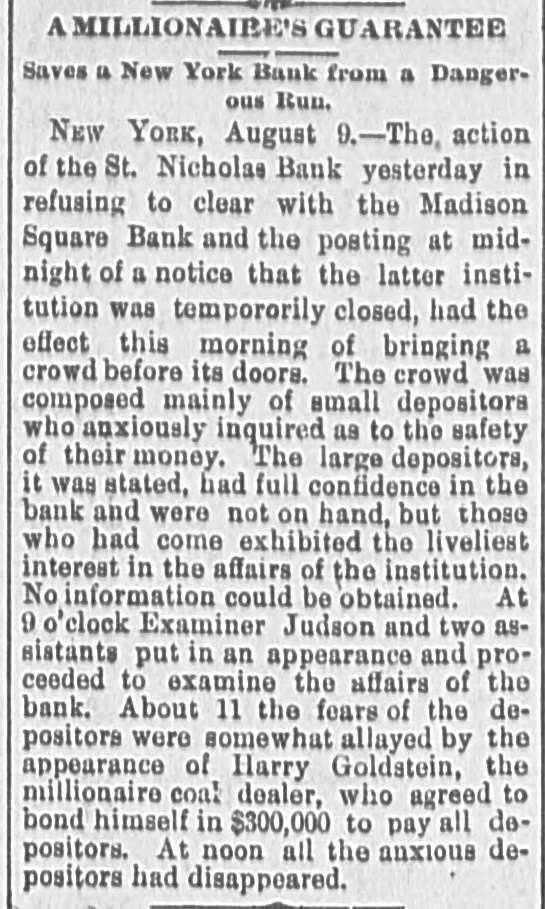
Harry Goldstein agreed to bond himself in $300,000 to pay depositors; examiners examined the bank.
Newspaper Excerpt
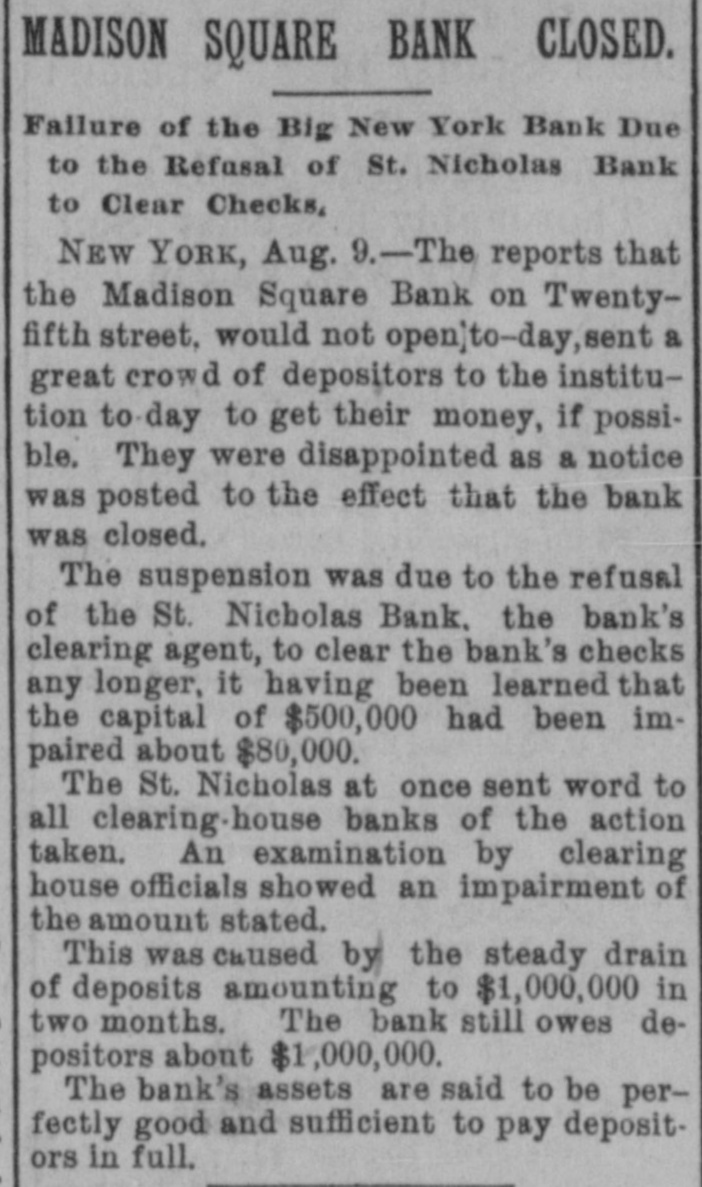
The reports that the Madison Square Bank ... sent a great crowd of depositors to the institution to day to get their money
Source
newspapers
same day
2.August 9, 1893Suspension
Cause
Correspondent
Cause Details
St. Nicholas Bank refused to clear checks after learning capital was impaired (~$80,000), leading Madison Square to close its doors.
Newspaper Excerpt
a notice was posted to the effect that the bank was closed. The suspension was due to the refusal of the St. Nicholas Bank to clear the bank's checks
Source
newspapers
+18 days
3.August 27, 1893Receivership
Newspaper Excerpt
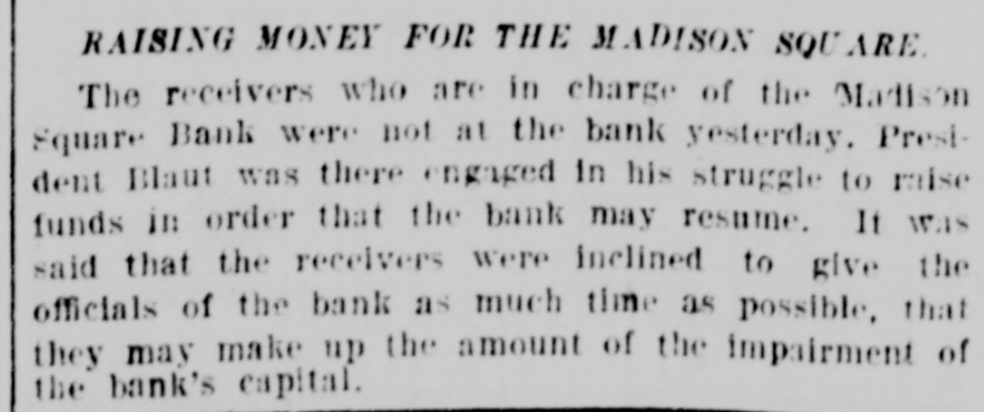
The receivers who are in charge of the Madison Square Bank were not at the bank yesterday. President Blaut was there engaged In his struggle to raise funds in order that the bank may resume.
Source
newspapers
Newspaper Articles (25)
1.August 9, 1893Evening JournalWilmington, DE
Click image to open full size in new tab
Article Text
CLOSED
BANK MADISON SQUARE Failure of the Big New York Bank Due to the Refusal of St. Nicholas Bank to Clear Checks, NEW YORK, Aug. -The reports that the Madison Square Bank on Twentyfifth street, would not openjto-day, sent a great crowd of depositors to the institution to day to get their money, if possible. They were disappointed as a notice was posted to the effect that the bank was closed. The suspension was due to the refusal of the St. Nicholas Bank, the bank's clearing agent, to clear the bank's checks any longer, it having been learned that the capital of $500,000 had been impaired about $80,000. The St. Nicholas at once sent word to all clearing-house banks of the action taken. An examination by clearing house officials showed an impairment of the amount stated. This was caused by the steady drain of deposits amounting to $1,000,000 in two months. The bank still owes depositors about $1,000,000. The bank's assets are said to be perfectly good and sufficient to pay depositors in full.
2.August 10, 1893Pawtucket TribunePawtucket, RI
Click image to open full size in new tab
Article Text
Lucky Danforth
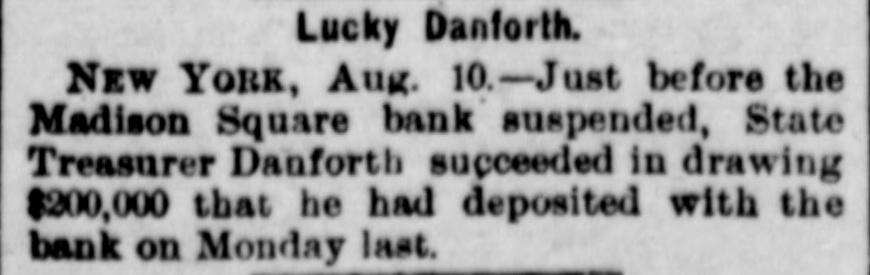
NEW YORK, Aug. 10.-Just before the Madison Square bank suspended, State Treasurer Danforth succeeded in drawing $200,000 that he had deposited with the bank on Monday last.
A MILLIONAIRE'S GUARANTEE Saves a New York Bank from a Dangerous Run. NEW YORK, August 9.-The, action of the St. Nicholas Bank yesterday in refusing to clear with the Madison Square Bank and the posting at midnight of a notice that the latter institution was tempororily closed, had the effect this morning of bringing a crowd before its doors. The crowd was composed mainly of small depositors who anxiously inquired as to the safety of their money. The large depositors, it was stated, had full confidence in the bank and were not on hand, but those who had come exhibited the liveliest interest in the affairs of the institution. No information could be obtained. At 9 o'clock Examiner Judson and two assistants put in an appearance and proceeded to examine the affairs of the bank. About 11 the fears of the depositors were somewhat allayed by the appearance of Harry Goldstein, the millionaire coal dealer, who agreed to bond himself in $300,000 to pay all depositors. At noon all the anxious depositors had disappeared.
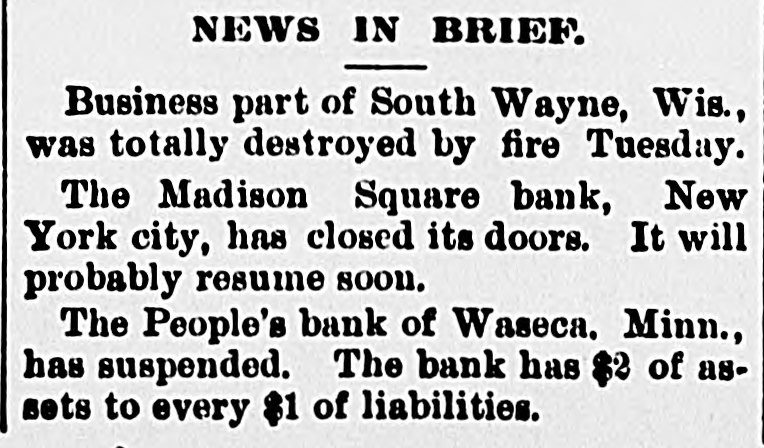
Business part of South Wayne, Wis., was totally destroyed by fire Tuesday. The Madison Square bank, New York city, has closed its doors. It will probably resume soon. The People's bank of Waseca. Minn., has suspended. The bank has $2 of assets to every $1 of liabilities.
5.August 19, 1893Mineral Point TribuneMineral Point, WI
Click image to open full size in new tab
Article Text
metal coming in contact with inflicted terrible injuries on workmen were killed by an exof 1,500 kegs of powder at the of the Phoenix company, near III. Lewelling, of Kansas, has four commissioners to visit in the interest of his gulf ortation project. the National Tailors' convention Paul, aid was voted to the ington, III., union, and M. Bantz lected president. -silver men have made a canvass house and claim unconditional of the Sherman law will have majority. ommittee was selected at the of silver men to draw up a roviding for free coinage at an ratio as a substitute for the law. Burke, with several aliases, arrest at Leadville for robG. Pollock of a package of on a train between Omaha City. of Cooprider, who killed in Indiana, assert the murder result of Kress' interference affair. has been begun against John betting, the missing cashier of filwaukee South Side Savings for $109,582. Wayne, a little station eighsouthwest of Darlington, was swept by fire WednesLinden Steel company, Pittsburg, financially embarrassed. The has large government confor armor plate. definitely learned that two of issengers of the steamer Karafrom Naples, now quarantined York city, have Asiatic choPhoenix powder mills near BelleIII., were blown up. Luther Bishop Heckman, John Elliott harles Mullaye were killed. C. Dunn, the Rockford physiho was to superintend the burial resurrection of Seymour, has out, fearing that he will be liable should the burial fatal. McCormick shot Janette Neil Mich. McCormick is dead girl is dying. She had reto marry him. Wright & Co., bankers at AlIll., have suspended and the Levi Butler, has disappeared, a letter saying that he has $41,000 of the firm's cash. for the arrest of the Conout and Marshal Hodson, of Ind., will attempt to serve The Conrads are intrenched in of a brother-in-law. weekly crop report issued by eather bureau at Washnigton hat all crops throughout the need rain. The weather has avorable only in New England. E. D. Morris, of the Lane semiCincinnati, has selected the for the college, which will open The selection of Professor is regarded as anti-Briggs. Madison Square bank, 0 Twènstreet, New York city, did not doors Thursday. A milion of deposits had been withdrawn the last month. Rippe has secured an injuneprevent the erection of a state at Duluth, on the ground state has no righ to build an from the fees collected from private elevators. rument officials are making no
6.August 27, 1893New-York TribuneNew York, NY
Click image to open full size in new tab
Article Text
RAISING MONEY FOR THE MADISON SQUARE
The receivers who are in charge of the Madison Square Bank were not at the bank yesterday. President Blaut was there engaged In his struggle to raise funds in order that the bank may resume. It was said that the receivers were inclined to give the officials of the bank as much time as possible, that they may make up the amount of the impairment of the bank's capital.
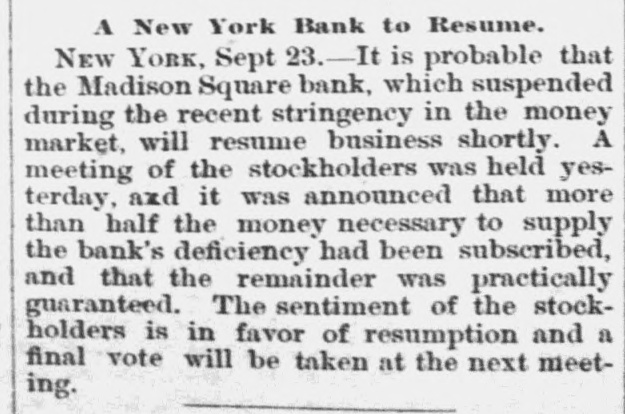
A New York Bank to Resume. NEW YORK, Sept 23.-It is probable that the Madison Square bank, which suspended during the recent stringency in the money market, will resume business shortly. A meeting of the stockholders was held yesterday, and it was announced that more than half the money necessary to supply the bank's deficiency had been subscribed, and that the remainder was practically guaranteed. The sentiment of the stockholders is in favor of resumption and a final vote will be taken at the next meeting.
8.October 11, 1893Morris TribuneMorris, MN
Click image to open full size in new tab
Article Text
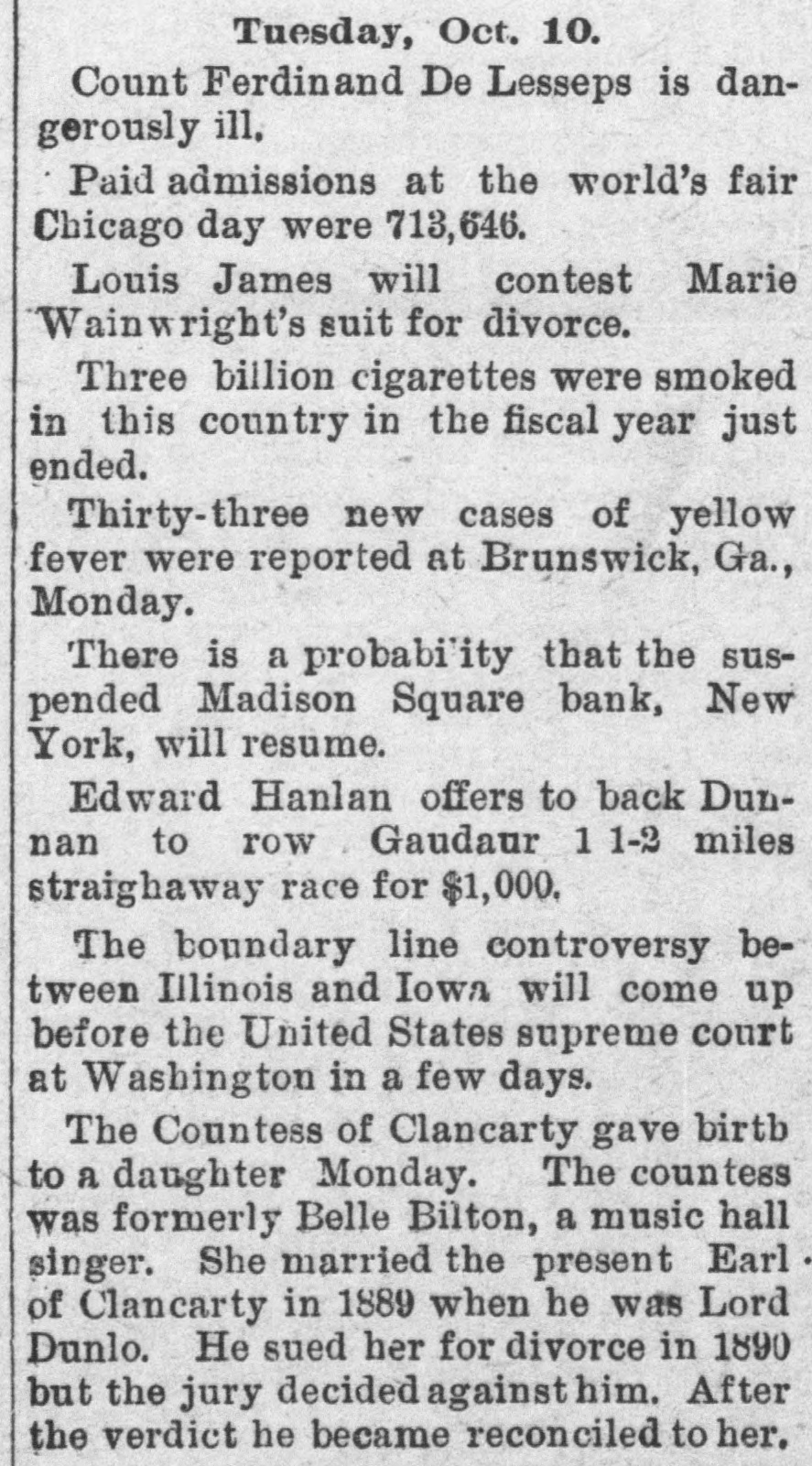
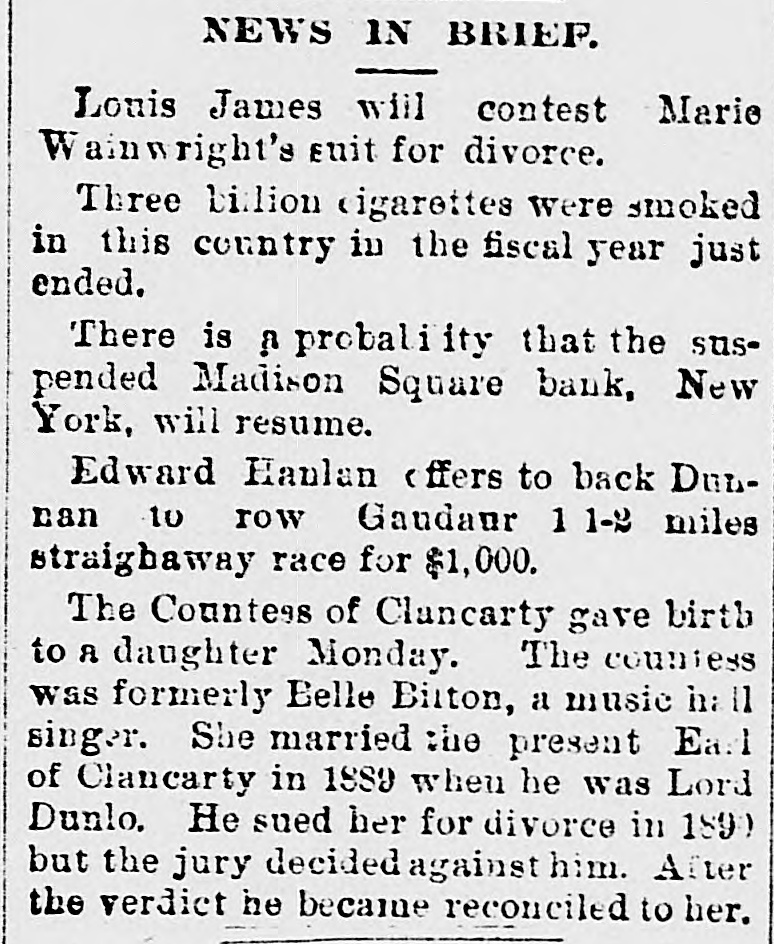
Tuesday, Oct. 10. Count Ferdinand De Lesseps is dangerously ill. Paid admissions at the world's fair Chicago day were 713,646. Louis James will contest Marie Wainwright's suit for divorce. Three billion cigarettes were smoked in this country in the fiscal year just ended. Thirty-three new cases of yellow fever were reported at Brunswick, Ga., Monday. There is a probability that the suspended Madison Square bank, New York, will resume. Edward Hanlan offers to back Dunnan to row Gaudaur 1 1-2 miles straighaway race for $1,000. The boundary line controversy between Illinois and Iowa will come up before the United States supreme court at Washington in a few days. The Countess of Clancarty gave birth to a daughter Monday. The countess was formerly Belle Bilton, a music hall singer. She married the present Earl of Clancarty in 1889 when he was Lord Dunlo. He sued her for divorce in 1890 but the jury decided against him. After the verdict he became reconciled to her.
9.October 11, 1893New Ulm ReviewNew Ulm, MN
Click image to open full size in new tab
Article Text
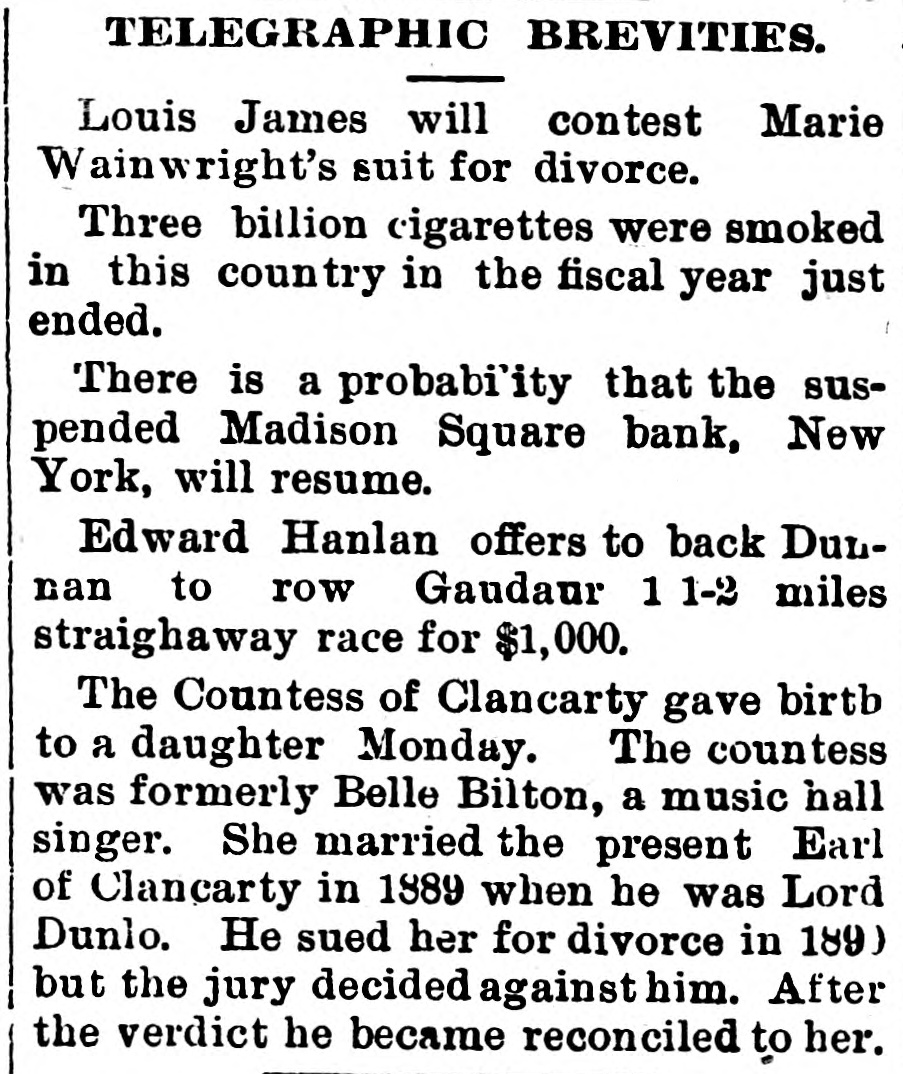
TELEGRAPHIC BREVITIES
I Louis James will contest Marie Wainwright's suit for divorce. Three billion cigarettes were smoked in this country in the fiscal year just ended. There is a probability that the suspended Madison Square bank, New York, will resume. Edward Hanlan offers to back Dunnan to row Gaudaur 1 1-2 miles straighaway race for $1,000. The Countess of Clancarty gave birtb to a daughter Monday. The countess was formerly Belle Bilton, a music hall singer. She married the present Earl of Clancarty in 1889 when he was Lord Dunlo. He sued her for divorce in 189) but the jury decided against him. After the verdict he became reconciled to her.
10.October 14, 1893Red Lodge PicketRed Lodge, MT
Click image to open full size in new tab
Article Text
NEWS IN BRIEF
Louis James will contest Marie Wainwright's suit for divorce. Three billion cigarettes were smoked in this country in the fiscal year just ended. There is a probali ity that the suspended Madison Square bank, New York, will resume. Edward Hanlan offers to back Dunnan to row Gaudaur 1 1-2 miles straigbaway race for $1,000. The Countess of Clancarty gave birth to a daughter Monday. The countess was formerly Belle Bitton, a music hail singer. She married the present Ea.1 of Clancarty in 1889 when he was Lord Dunlo. He sued her for divorce in 1890 but the jury decided against him. After the verdict he became reconciled to her.
11.October 24, 1893Richmond DispatchRichmond, VA
Click image to open full size in new tab
Article Text
up the stone stairs
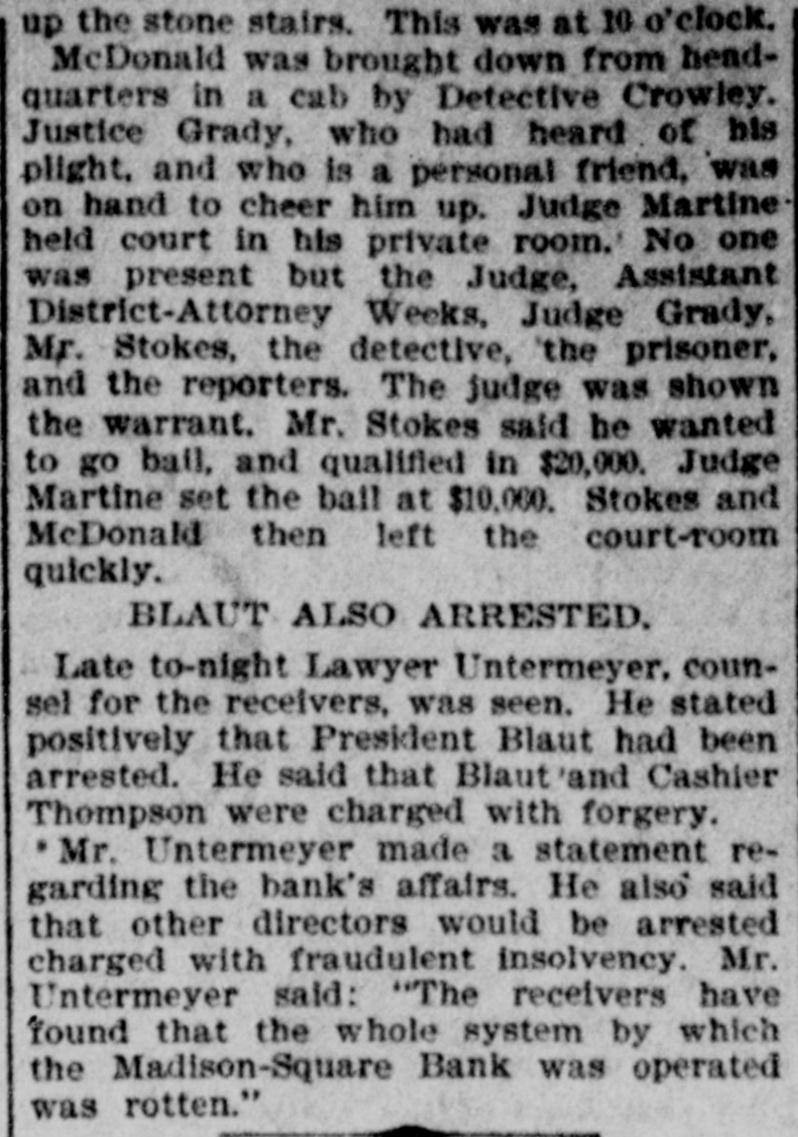
This was at 10 o'clock. McDonald was brought down from headquarters in a cab by Detective Crowley. Justice Grady, who had heard of his plight. and who is a personal friend, was on hand to cheer him up. Judge Martine held court in his private room. No one was present but the Judge, Assistant District-Attorney Weeks, Judge Grady, Mr. Stokes, the detective, 'the prisoner, and the reporters. The judge was shown the warrant. Mr. Stokes said he wanted to go ball, and qualified in $20,000. Judge Martine set the ball at $10,060. Stokes and McDonald then left the court-room quickly. BLAUT ALSO ARRESTED. Late to-night Lawyer Untermeyer. counsel for the receivers, was seen. He stated positively that President Blaut had been arrested. He said that Blaut'and Cashier Thompson were charged with forgery. Mr. Untermeyer made a statement regarding the bank's affairs. He also said that other directors would be arrested charged with fraudulent insolvency. Mr. Untermeyer said: "The receivers have found that the whole system by which the Madison-Square Bank was operated was rotten."
12.November 2, 1893New-York TribuneNew York, NY
Click image to open full size in new tab
Article Text
FOUR PER CENT REALIZED.
MADISON SQUARE BANK SECURITIES SELL FOR A SONG.
PRESIDENT BLAUT LOOKS ON IN DISMAY-LEWIS THOMPSON, THE CASHIER, WILL PROBABLY TURN STATE'S EVIDENCE-HIS IMPORTANT TESTIMONY.
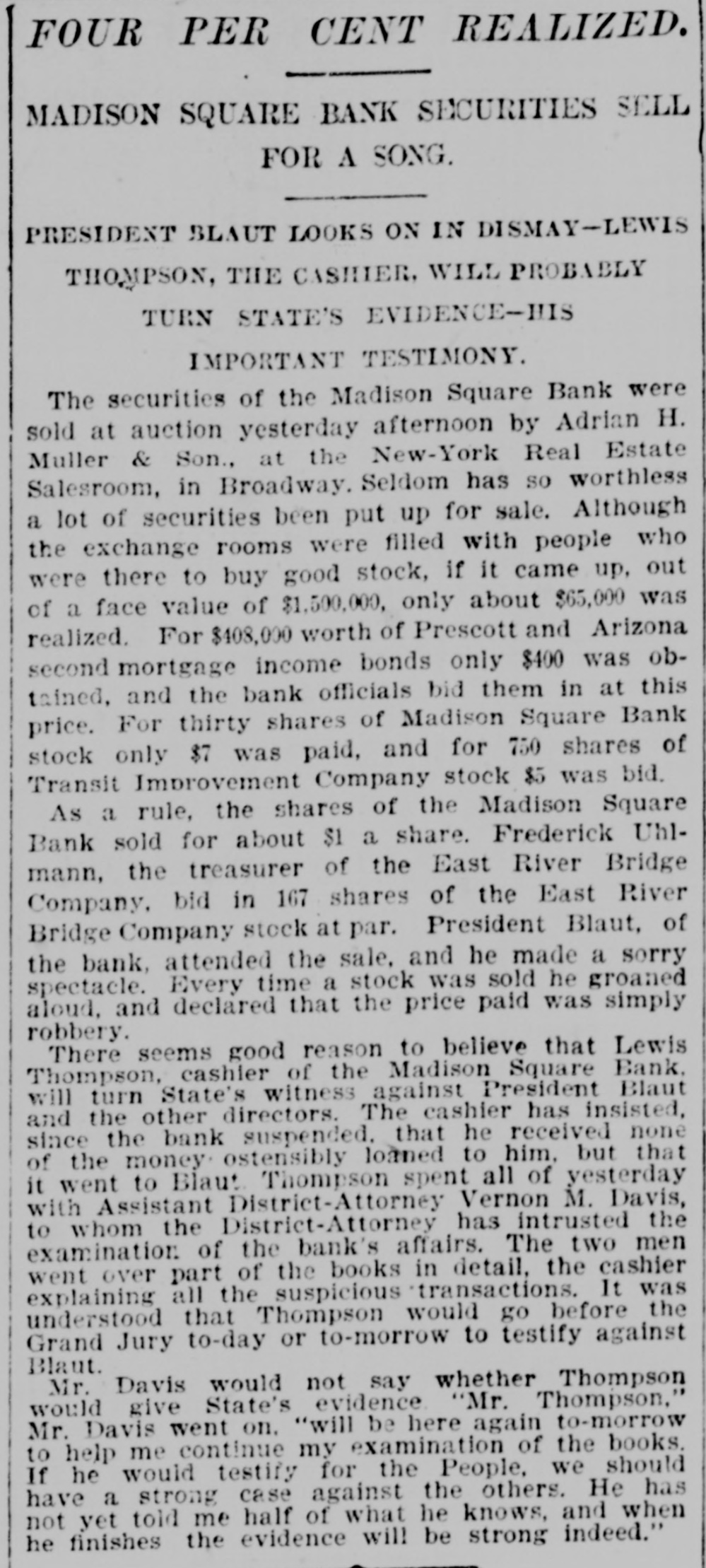
The securities of the Madison Square Bank were sold at auction yesterday afternoon by Adrian H. Muller & Son., at the New-York Real Estate Salesroom, in Broadway. Seldom has so worthless a lot of securities been put up for sale. Although the exchange rooms were filled with people who were there to buy good stock, if it came up, out of a face value of $1,500,000, only about $65,000 was realized. For $408,000 worth of Prescott and Arizona second mortgage income bonds only $400 was obtained, and the bank officials bid them in at this price. For thirty shares of Madison Square Bank stock only $7 was paid, and for 750 shares of Transit Improvement Company stock $5 was bid. As a rule, the shares of the Madison Square Bank sold for about $1 a share. Frederick Uhlmann, the treasurer of the East River Bridge Company, bid in 167 shares of the East River Bridge Company stock at par. President Blaut, of the bank, attended the sale, and he made a sorry spectacle. Every time a stock was sold he groaned aloud, and declared that the price paid was simply robbery.
There seems good reason to believe that Lewis Thompson, cashier of the Madison Square Bank, will turn State's witness against President Blaut and the other directors. The cashier has insisted, since the bank suspended, that he received none of the money ostensibly loaned to him, but that it went to Blaut. Thompson spent all of yesterday with Assistant District-Attorney Vernon M. Davis, to whom the District-Attorney has intrusted the examination of the bank's affairs. The two men went over part of the books in detail, the cashier explaining all the suspicious transactions. It was understood that Thompson would go before the Grand Jury to-day or to-morrow to testify against Blaut.
Mr. Davis would not say whether Thompson would give State's evidence. "Mr. Thompson," Mr. Davis went on, "will be here again to-morrow to help me continue my examination of the books. If he would testify for the People, we should have a strong case against the others. He has not yet told me half of what he knows, and when he finishes the evidence will be strong indeed."
13.May 5, 1894New-York TribuneNew York, NY
Click image to open full size in new tab
Article Text
DIRECTORS' DEMURRERS OVERRULED.
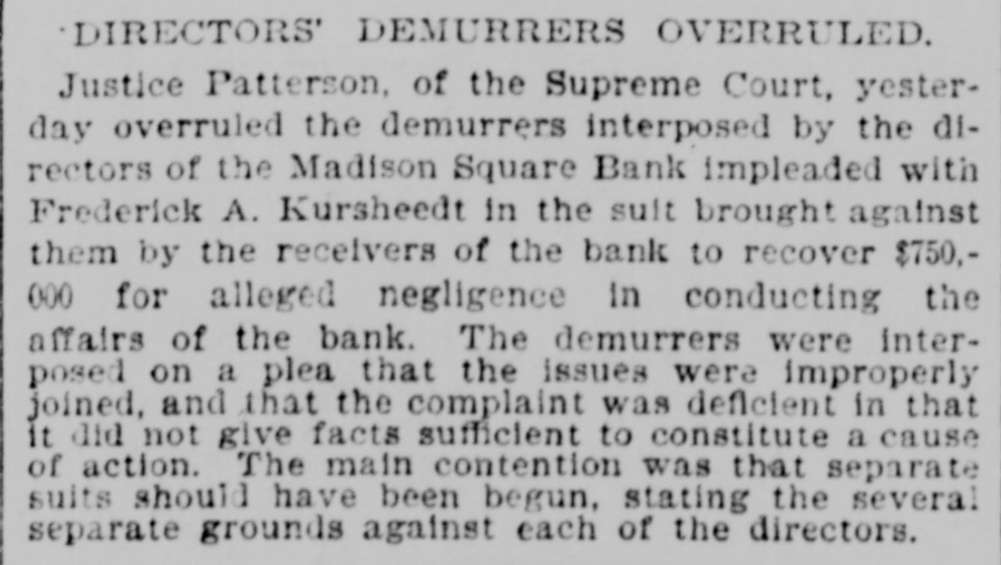
Justice Patterson, of the Supreme Court, yesterday overruled the demurrers interposed by the directors of the Madison Square Bank impleaded with Frederick A. Kursheedt in the suit brought against them by the receivers of the bank to recover $750,000 for alleged negligence in conducting the affairs of the bank. The demurrers were interposed on a plea that the issues were improperly joined, and that the complaint was deficient in that it did not give facts sufficient to constitute a cause of action. The main contention was that separate suits should have been begun, stating the several separate grounds against each of the directors.
14.June 23, 1894New-York TribuneNew York, NY
Click image to open full size in new tab
Article Text
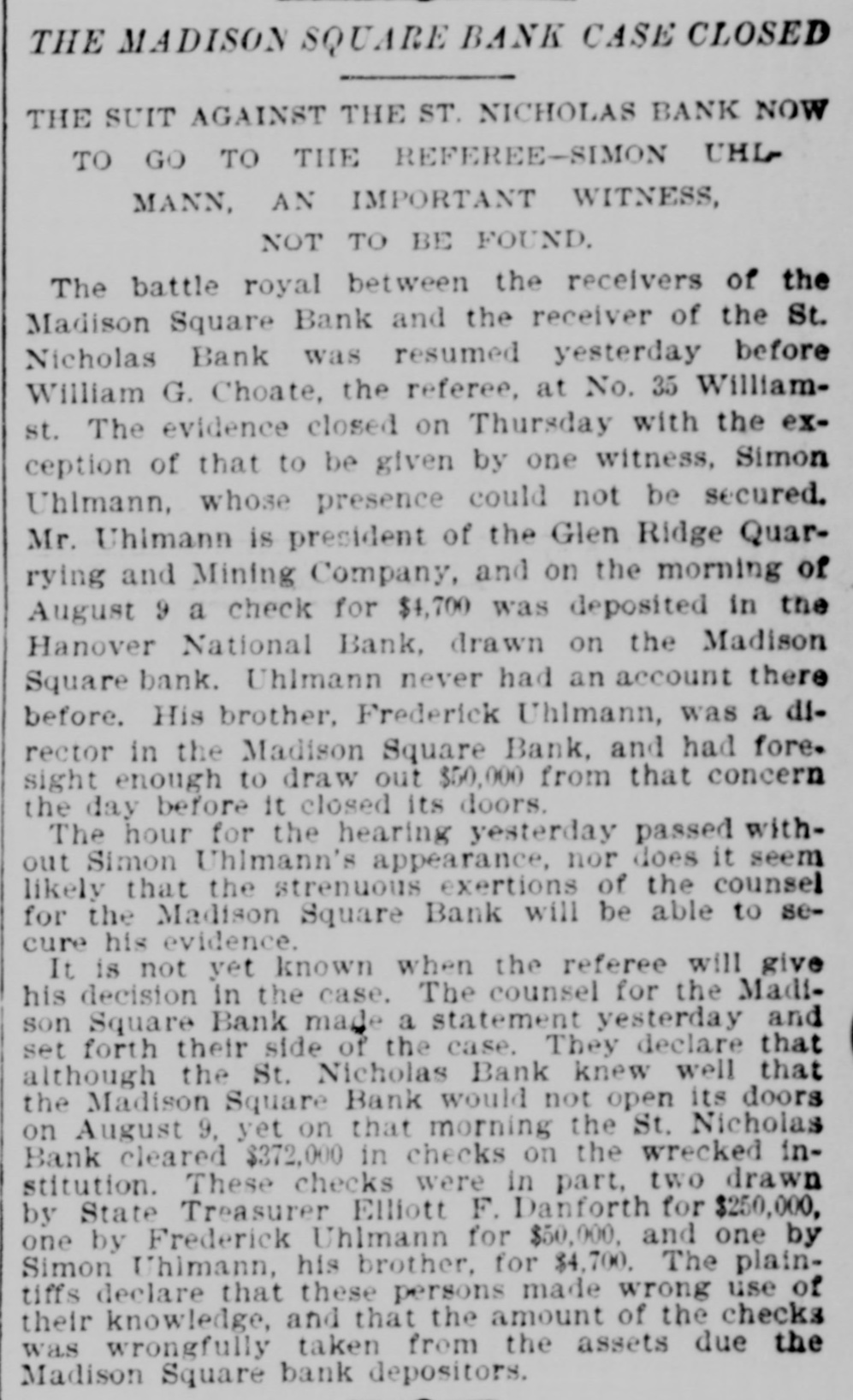
THE MADISON SQUARE BANK CASE CLOSED THE SUIT AGAINST THE ST. NICHOLAS BANK NOW TO GO TO THE REFEREE-SIMON UHLMANN, AN IMPORTANT WITNESS, NOT TO BE FOUND. The battle royal between the receivers of the Madison Square Bank and the receiver of the St. Nicholas Bank was resumed yesterday before William G. Choate, the referee, at No. 35 Williamst. The evidence closed on Thursday with the exception of that to be given by one witness, Simon Uhlmann, whose presence could not be secured. Mr. Uhimann is president of the Glen Ridge Quarrying and Mining Company, and on the morning of August 9 a check for $4,700 was deposited in the Hanover National Bank, drawn on the Madison Square bank. Uhlmann never had an account there before. His brother, Frederick Uhlmann, was a director in the Madison Square Bank, and had fore. sight enough to draw out $50,000 from that concern the day before it closed its doors. The hour for the hearing yesterday passed without Simon Uhlmann's appearance, nor does it seem likely that the strenuous exertions of the counsel for the Madison Square Bank will be able to secure his evidence. It is not yet known when the referee will give his decision in the case. The counsel for the Madison Square Bank made a statement yesterday and set forth their side of the case. They declare that although the St. Nicholas Bank knew well that the Madison Square Bank would not open its doors on August 9, yet on that morning the St. Nicholas Bank cleared $372,000 in checks on the wrecked institution. These checks were in part, two drawn by State Treasurer Elliott F. Danforth for $250,000, one by Frederick Uhlmann for $50,000, and one by Simon Uhimann, his brother, for $4,700. The plaintiffs declare that these persons made wrong use of their knowledge, and that the amount of the checks was wrongfully taken from the assets due the Madison Square bank depositors.
15.June 26, 1894The Evening WorldNew York, NY
Click image to open full size in new tab
Article Text
UHLMANN WON'T TELL MUCH
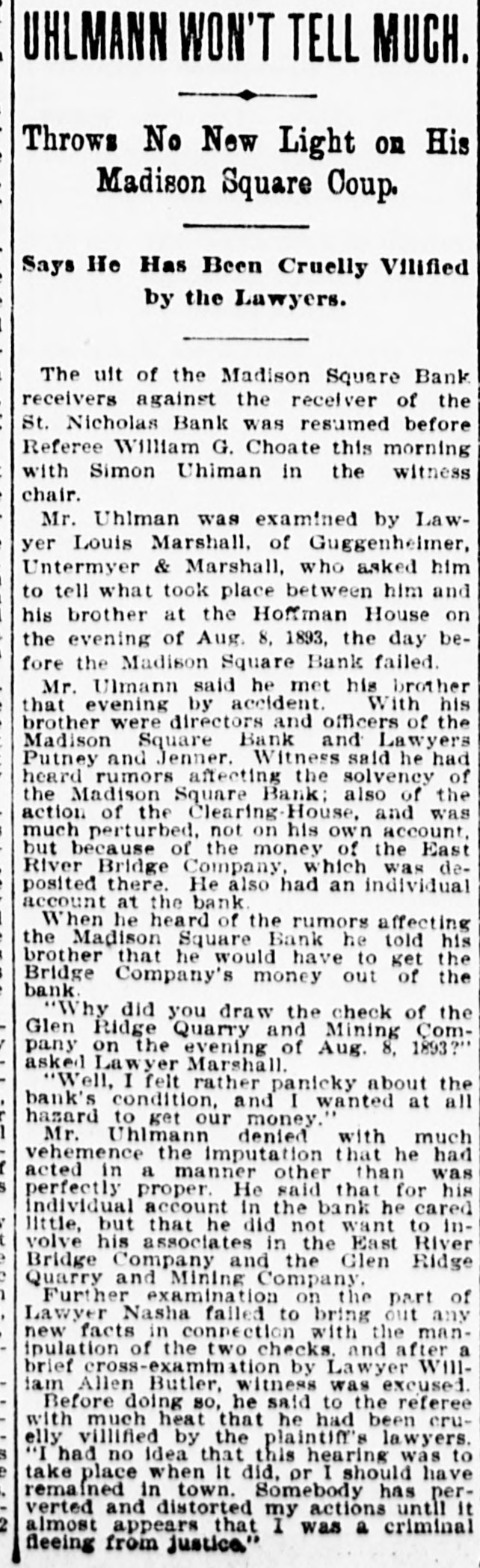
Throws No New Light on His Madison Square Coup. Says He Has Been Cruelly Vilified by the Lawyers. The ult of the Madison Square Bank receivers against the receiver of the St. Nicholas Bank was resumed before Referee William G. Choate this morning with Simon Uhiman in the witness chair. Mr. Uhlman was examined by Lawyer Louis Marshall, of Guggenhelmer, Untermyer & Marshall, who asked him to tell what took place between him and his brother at the Hoffman House on the evening of Aug. 8, 1893, the day before the Madison Square Bank failed. Mr. Ulmann said he met his brother that evening by accident. With his brother were directors and officers of the Madison Square Bank and Lawyers Putney and Jenner. Witness said he had heard rumors affecting the solvency of the Madison Square Bank; also of the action of the Clearing-House, and was much perturbed, not on his own account, but because of the money of the East River Bridge Company, which was deposited there. He also had an individual account at the bank. When he heard of the rumors affecting the Madison Square Bank he told his brother that he would have to get the Bridge Company's money out of the bank. "Why did you draw the check of the Glen Ridge Quarry and Mining Company on the evening of Aug. 8, 1893?" asked Lawyer Marshall. "Well, I felt rather panicky about the bank's condition, and I wanted at all hazard to get our money." Mr. Uhlmann denied with much vehemence the imputation that he had acted in a manner other than was perfectly proper. He said that for his individual account in the bank he cared little, but that he did not want to involve his associates in the East River Bridge Company and the Glen Ridge Quarry and Mining Company. Further examination on the part of Lawyer Nasha failed to bring out any new facts in connection with the manipulation of the two checks. and after a brief cross-examination by Lawyer William Allen Butler, witness was excused. Before doing so, he said to the referee with much heat that he had been cruelly villified by the plaintiff's lawyers. "I had no idea that this hearing was to take place when It did, or I should have remained in town. Somebody has perverted and distorted my actions until it almost appears that I was a criminal fleeing from justice"
16.July 14, 1894The Evening WorldNew York, NY
Click image to open full size in new tab
Article Text
DECIDES IN KING'S FAVOR
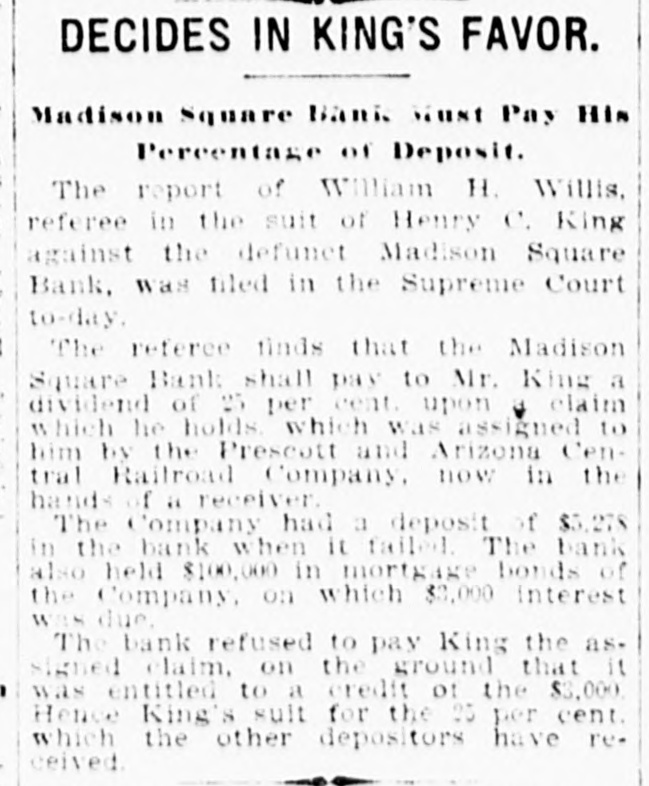
Madison Square Bank Must Pay His Percentage of Deposit. The report of William H. Willis, referee in the suit of Henry C. King against the defunct Madison Square Bank, was filed in the Supreme Court to-day. The referee finds that the Madison Square Bank shall pay to Mr. King a dividend of 25 per cent. upon # claim which he holds. which was assigned to him by the Prescott and Arizona Central Railroad Company, now in the hands of .. receiver. The Company had a deposit if $5,278 in the bank when it failed. The bank also held $100,000 in mortgage bonds of the Company, on which $3,000 interest was due. The bank refused to pay King the assigned claim, on the ground that it was entitled to a credit of the $3,000. Hence King's sult for the 25 per cent. which the other depositors have received.
17.July 14, 1894The Evening WorldNew York, NY
Click image to open full size in new tab
Article Text
DECIDES IN KING'S FAVOR.
Madison Square Bank Must Pay His Percentage of Deposit.
The report of William H. Willis, referee in the suit of Henry C. King against the defunct Madison Square Bank, was filed in the Supreme Court to-day.
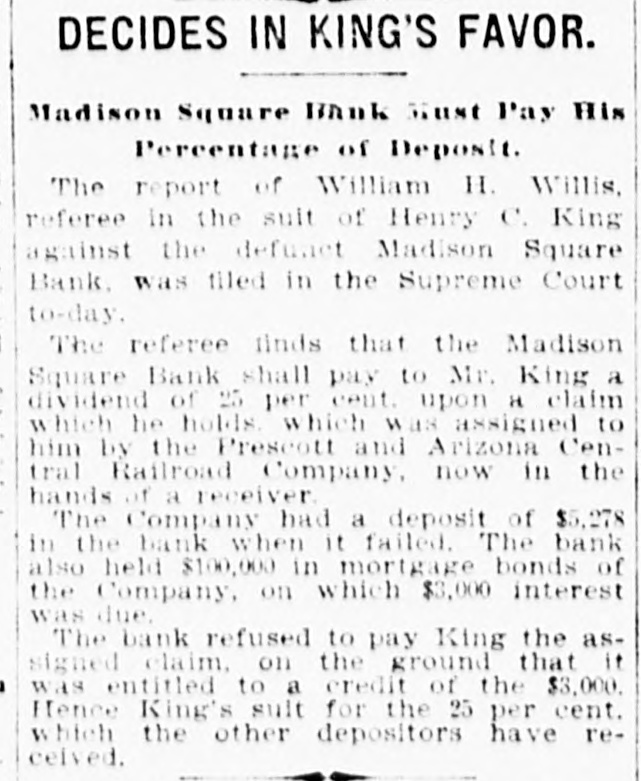
The referee finds that the Madison Square Bank shall pay to Mr. King a dividend of 25 per cent, upon a claim which he holds, which was assigned to him by the Prescott and Arizona Central Railroad Company, now in the hands of a receiver.
The Company had a deposit of $5,278 in the bank when it failed. The bank also held $100,000 in mortgage bonds of the Company, on which $3,000 interest was due.
The bank refused to pay King the assigned claim, on the ground that it was entitled to a credit of the $3,000. Hence King's suit for the 25 per cent. which the other depositors have received.
18.July 15, 1894New-York TribuneNew York, NY
Click image to open full size in new tab
Article Text
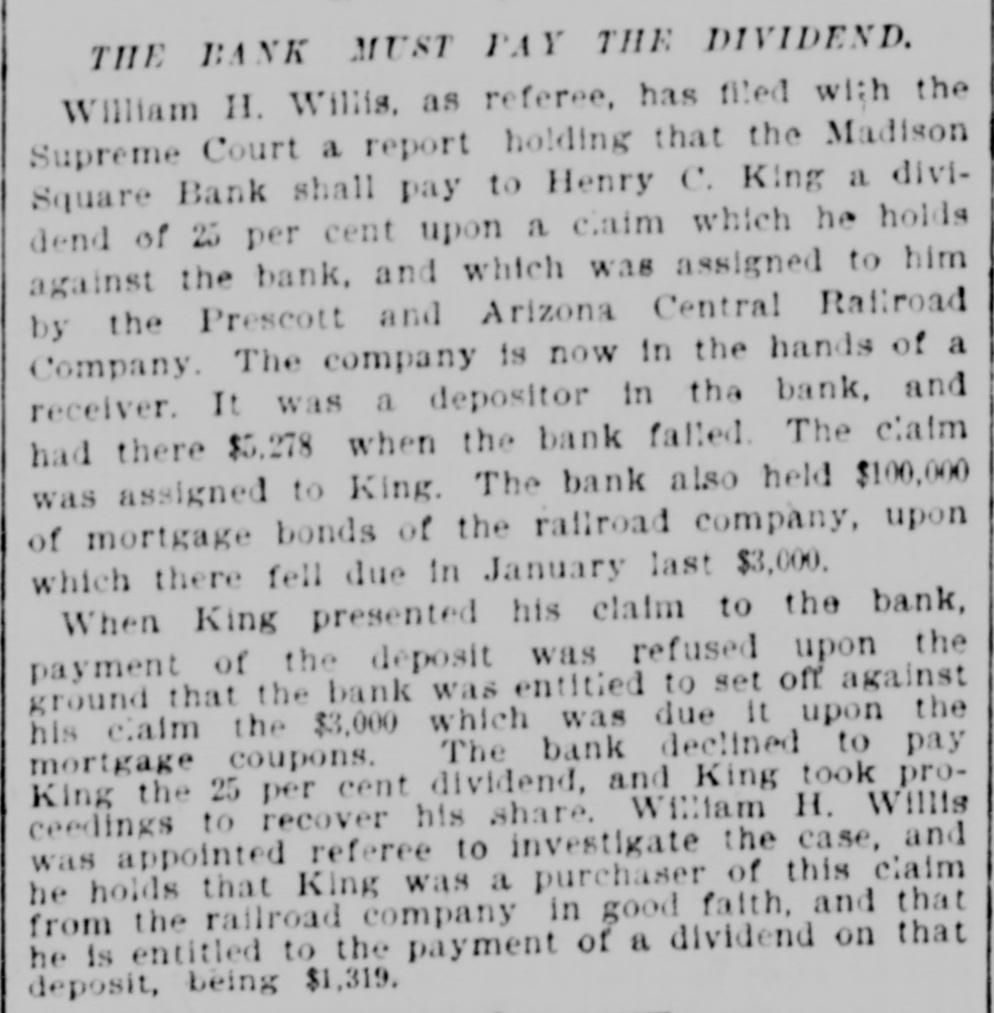
THE BANK MUST PAY THE DIVIDEND.
William H. Willis, as referee, has filed with the Supreme Court a report holding that the Madison Square Bank shall pay to Henry C. King a dividend of 25 per cent upon a claim which he holds against the bank, and which was assigned to him by the Prescott and Arizona Central Railroad Company. The company is now in the hands of a receiver. It was a depositor in the bank, and had there $5.278 when the bank failed. The claim was assigned to King. The bank also held $100,000 of mortgage bonds of the railroad company, upon which there fell due in January last $3,000.
When King presented his claim to the bank, payment of the deposit was refused upon the ground that the bank was entitled to set off against his claim the $3,000 which was due it upon the mortgage coupons. The bank declined to pay King the 25 per cent dividend, and King took proceedings to recover his share. William H. Willis was appointed referee to investigate the case, and he holds that King was a purchaser of this claim from the railroad company in good faith, and that he is entitled to the payment of a dividend on that deposit, being $1,319.
19.October 30, 1894New-York TribuneNew York, NY
Click image to open full size in new tab
Article Text
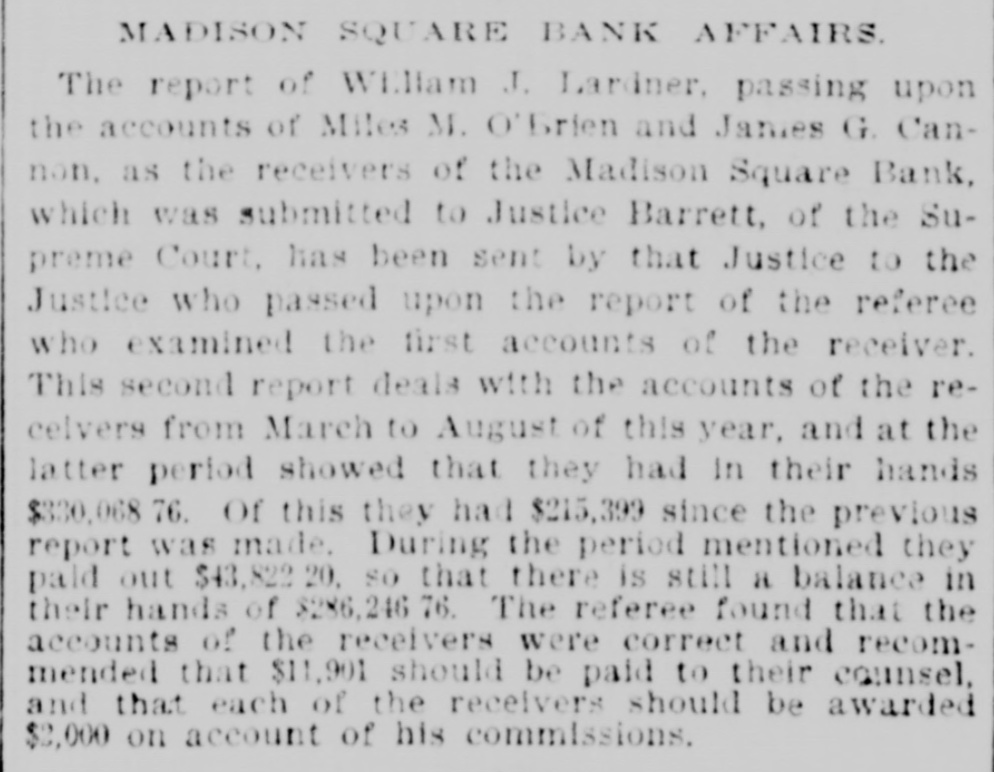
MADISON SQUARE BANK AFFAIRS
The report of WEllam J. Lardner, passing upon the accounts of Miles M. O' Srien and Jamies G. Cannon, as the receivers of the Madison Square Bank, which was submitted to Justice Barrett, of the Supreme Court, has been sent by that Justice to the Justice who passed upon the report of the referee who examined the first accounts of the receiver. This second report deals with the accounts of the recelvers from March to August of this year. and at the latter period showed that they had In their hands $320,068.76 Of this they had $215,399 since the previous report was made. During the period mentioned they paid out $43,822.20. so that there is still a balance in their hands of $286,246.76 The referee found that the accounts of the receivers were correct and recommended that $11,901 should be paid to their counsel, and that each of the receivers should be awarded $2,000 on account of his commissions.
20.September 4, 1895The Evening WorldNew York, NY
Click image to open full size in new tab
Article Text
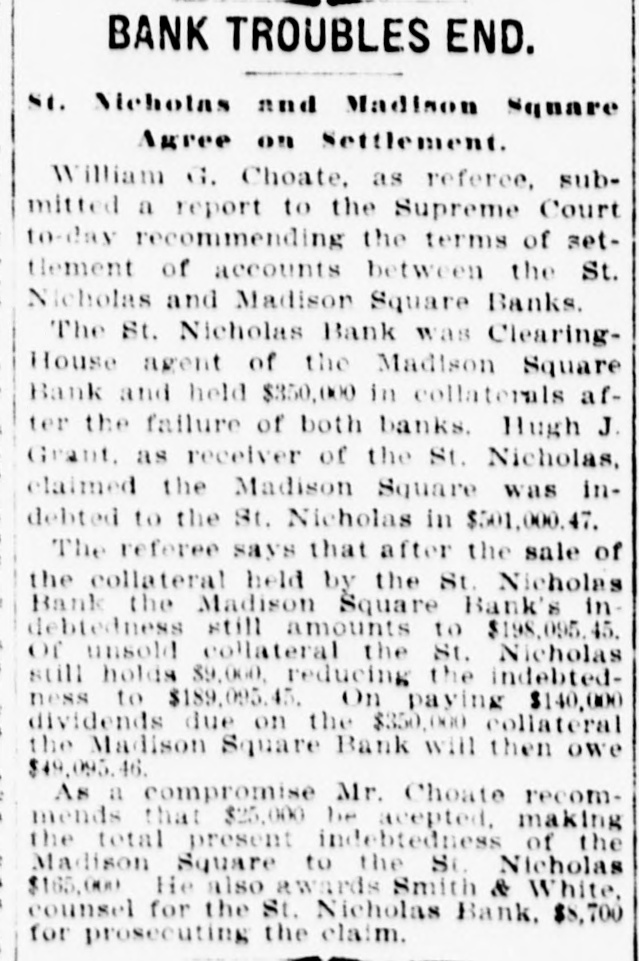
BANK TROUBLES END
St. Nicholas and Madison Square Agree on Settlement. William G. Choate, as referee, submitted a report to the Supreme Court to-day recommending the terms of settlement of accounts between the St. Nicholas and Madison Square Banks. The St. Nicholas Bank was ClearingHouse agent of the Madison Square Bank and held $350,000 in collaterals after the failure of both banks. Hugh J. Grant. as receiver of the St. Nicholas, claimed the Madison Square was indebted to the St. Nicholas in $501,000.47. The referee says that after the sale of the collateral held by the St. Nicholas Bank the Madison Square Bank's indebtedness still amounts to $198,095.45. or unsold collateral the St. Nicholas still holds $9,000, reducing the indebtedness to $189,095.45. On paying $140,000 dividends due on the $350,000 collateral the Madison Square Bank will then owe $49,095.46. As a compromise Mr. Choate recommends that $25,000 be acepted, making the total present indebtedness of the Madison Square to the St. Nicholas $165,000 He also awards Smith & White, counsel for the St. Nicholas Bank, $8,700 for prosecuting the claim.
21.August 15, 1896New-York TribuneNew York, NY
Click image to open full size in new tab
Article Text
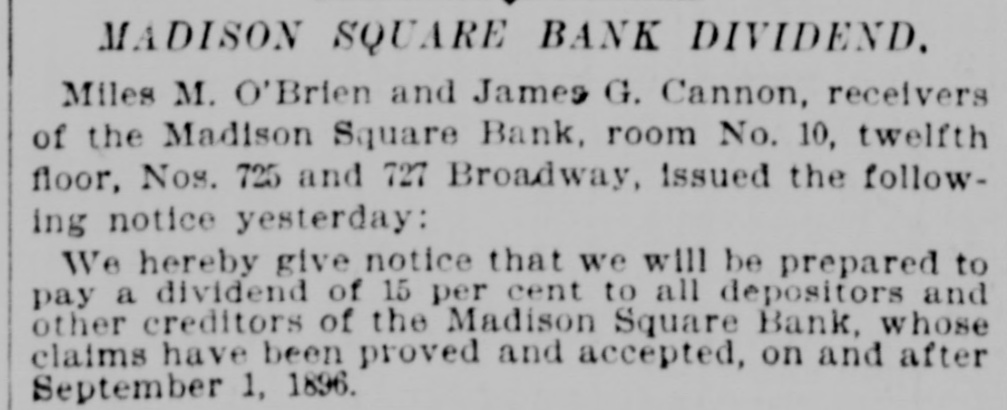
MADISON SQUARE BANK DIVIDEND.
Miles M. O'Brien and James G. Cannon, receivers of the Madison Square Bank, room No. 10, twelfth floor, Nos. 725 and 727 Broadway, issued the following notice yesterday:
We hereby give notice that we will be prepared to pay a dividend of 15 per cent to all depositors and other creditors of the Madison Square Bank, whose claims have been proved and accepted, on and after September 1, 1896.
22.May 15, 1897Custer Weekly ChronicleCuster, SD
Click image to open full size in new tab
Article Text
Empty Talk of the "Great American Course "MO "IH 10 Parts Noticetion "I een Months of Inaction. Cleveland's Tale of Woe. Special Washington correspondence: No event of the past few days has created more comment in the political world than the attack of ex-President Cleveland upon the Republican party for the promptness with which it has taken up the chief pledges of its platform, the tariff and international bimetallism. and proceeded with legislation upon them. This attack, in which he describes the party as "re. turning in hot haste" to its principles of protection to American industries, has suggested a review of Mr. Cleveland's up ALIND s1q JO 18q1 pus blotory UMO this same line. The recollection of the events which transpired between his inauguration as President, March 4, 1893, and the enactment, eighteen 01 108 Mail MOI om JO [2019] squard which his party was equally pledged, would seem to have suggested silence rather than criticism regarding party activity in carrying out pledges. It was more than seven months from his inauguration as President in 1893 before his Congress met to consider any of the propositions to which his party was pledged and within a few days of eighteen months before the leading promise of its platform was ful filled in the enactment of a new tariff law. The business uncertainties, the long months of suspense in which manufacturers and dealers of all classes were unable to proceed intelligently with business enterprises, and the stoppage of business and loss of employment consequent thereon, make the eighteen months of masterly inactivity in which President Cleveland and his party neglected to fulfill with "hot haste" their promises of legislation, the most disastrous in the history of the business of the country. A brief review of these eighteen months of deup ABUI Party siq sq up 181 dicate whether the Republicans of today ought to be deterred by his complaint of their "hot haste" in carrying out their promises. The latest number of the statistical abstract shows the number of failures of commercial and business concerns in the United States in the first year of President Cleveland's administration (1893) to be 15,242, with total liabiliSTU.L 01 Supunome sep covers only about one-half of the period between the inauguration of President Cleveland and the enactment of the legislation which his party promised. The record of 1893, however, is the most disastrous the country has ever experienced, the number of failures being 50 per cent. greater than in OSIB sesso[ am pus 1878 JO change the 50 per cent. greater. In addition to these failures no less than 613 banks failed during that year. This great number of failures threw out of employment such large numbers of perAUBUI os u1 peonper pus suos cases as to cause an unusual number of strikes and lockouts, resulting in great losses of wages of workingmen and losses to employers. Over 250,000 employes were involved in the strikes occurring between March 4, 1893, and August 28, 1894, the date of the enact ment of the Wilson law. The loss in wages to the persons thrown out of employment by the strikes and lockSU months these up sino shown by the report of the United States Commissioner of Labor, is over $45,000,000, while the business loss to employers aggregated about half that sum. Reports of the Interstate Com merce covering this period also afford interesting comment upon the effect of the business troubles which existed during the pendency of the promised legislation during the year 1893. Many of the most important railroads of the country were placed in the hands of receivers. The mileage of thirty railroads SO treated in the first half of the period between President Clevland's inauguration and the completion of the siq up position was 25,375 miles, or nearly one-seventh of all the railroad lines of the United States. Their indebtedness SEM The following record of prominent events during the eighteen months in which President Cleveland and his party held the country in suspense prior to the enactment of the legislation promised by them will indicate to some extent whether he was justified in complaining of the "hot haste" with which the Republican party is carrying out its own pledges on this occasion. March, 1893. General strike began among the clothing cutters in New York: strike of employes on Toledo and Ann Arbor road. April, 1893. Strike of 4,000 workers on Chicago 18 spunoss JJ83 May, 1893. Strike of 20,000 coal miners in Ohio: failure of a large number of Western banks following the failure of the Columbia National Bank at Chicago. June, 1893. Runs on savings banks in Chicago and failures of numerous banks in various parts of the country. July, 1893. Announcement of suspension of work in 300 silver mines in the United States: numerous bank failures: -410 uo suns Denner: up Jailures quaq anoz er financial institutions; numerous business failures; many bank failures in the West and all other sections of the counAugust, 1893. Failure of numerous commission houses in Chicago: failure of Madison Square Bank in New York; riots in New York and encounters between anarchists and socialists only prevented Information pus Buot JO close dollect &q, coal miners' strike in Kansas. September, 1893. Strike of "Big Four" employes. October, 1893. Troops called out in Alabama to suppress riots of railroad strikers. November, 1893. Riots in Pennsylvania request Sujujus January, 1894. Strike of many thou-91 Jessey MON up potters puse duction of wages; Secretary Carnele offers a $50,000,000 loan for public subscription; striking miners in Pennsylvania destrey property at Brantville
23.May 28, 1897The Corvallis GazetteCorvallis, OR
Click image to open full size in new tab
Article Text
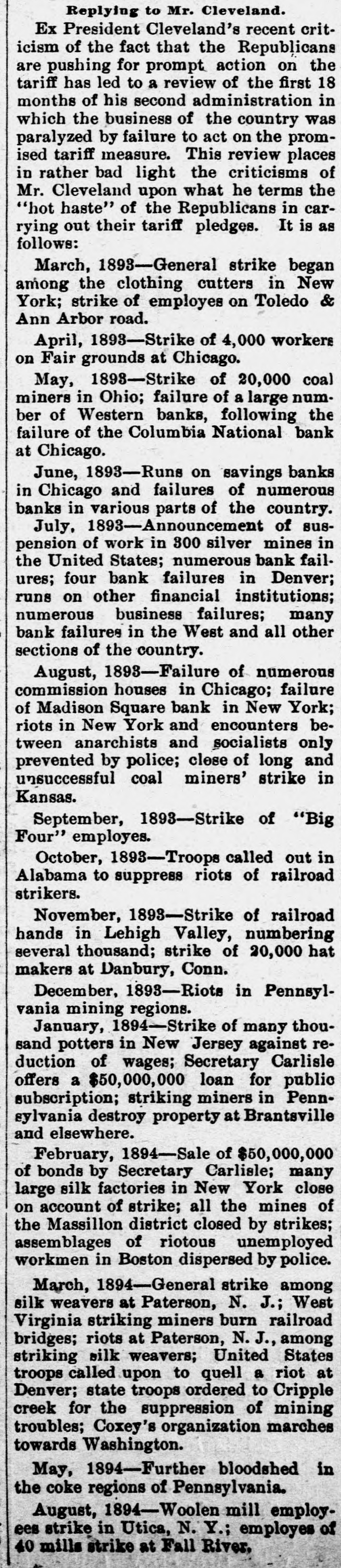
Replying to Mr
Cleveland. Ex President Cleveland's recent criticism of the fact that the Republicans are pushing for prompt action on the tariff has led to a review of the first 18 months of his second administration in which the business of the country was paralyzed by failure to act on the promised tariff measure. This review places in rather bad light the criticisms of Mr. Cleveland upon what he terms the "hot haste" of the Republicans in carrying out their tariff pledges. It is as follows: March, 1893-General strike began among the clothing cutters in New York; strike of employes on Toledo & Ann Arbor road. April, 1893-Strike of 4,000 workers on Fair grounds at Chicago. May, 1893-Strike of 20,000 coal miners in Ohio; failure of a large number of Western banks, following the failure of the Columbia National bank at Chicago. June, 1893-Runs on savings banks in Chicago and failures of numerous banks in various parts of the country. July, 1893-Announcement of suspension of work in 300 silver mines in the United States; numerous bank failures; four bank failures in Denver; runs on other financial institutions; numerous business failures; many bank failures in the West and all other sections of the country. August, 1893-Failure of numerous commission houses in Chicago; failure of Madison Square bank in New York; riots in New York and encounters between anarchists and socialists only prevented by police; close of long and unsuccessful coal miners' strike in Kansas. September, 1893-Strike of "Big Four" employes. October, 1893-Troops called out in Alabama to suppress riots of railroad strikers. November, 1893-Strike of railroad hands in Lehigh Valley, numbering several thousand; strike of 20,000 hat makers at Danbury, Conn. December, 1893-Riots in Pennsylvania mining regions. January, 1894-Strike of many thousand potters in New Jersey against reduction of wages; Secretary Carlisle offers a $50,000,000 loan for public subscription; striking miners in Penneylvania destroy property at Brantsville and elsewhere. February, 1894-Sale of $50,000,000 of bonds by Secretary Carlisle; many large silk factories in New York close on account of strike; all the mines of the Massillon district closed by strikes; assemblages of riotous unemployed workmen in Boston dispersed by police. March, 1894-General strike among silk weavers at Paterson, N. J.; West Virginia striking miners burn railroad bridges; riots at Paterson, N. J., among striking silk weavers; United States troops called upon to quell a riot at Denver; state troops ordered to Cripple creek for the suppression of mining troubles; Coxey's organization marches towards Washington. May, 1894-Further bloodshed in the coke regions of Pennsylvania. August, 1894-Woolen mill employees strike in Utica, N. Y.; employes of 40 mills strike at Fall River,
24.June 3, 1897The IslanderFriday Harbor, WA
Click image to open full size in new tab
Article Text
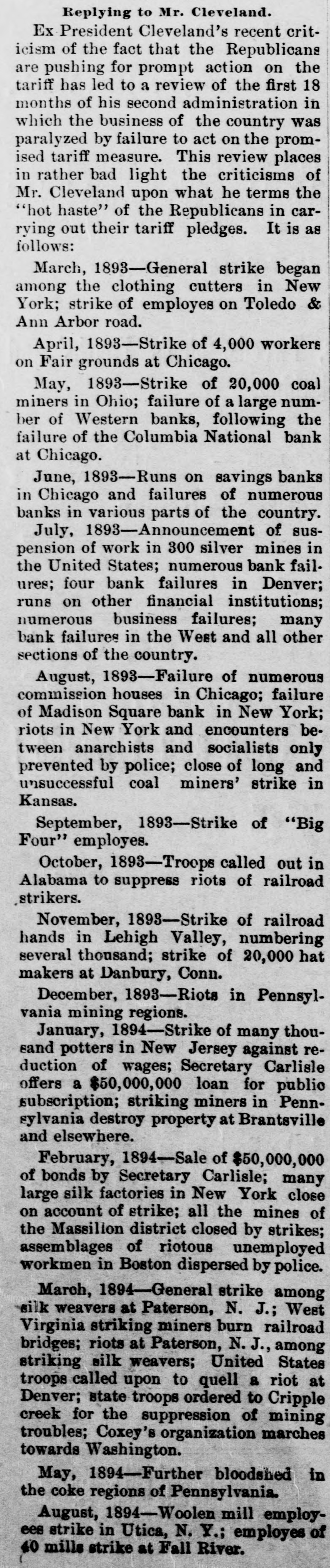
Replying to Mr
Cleveland. Ex President Cleveland's recent criticism of the fact that the Republicans are pushing for prompt action on the tariff has led to a review of the first 18 months of his second administration in which the business of the country was paralyzed by failure to act on the promised tariff measure. This review places in rather bad light the criticisms of Mr. Cleveland upon what he terms the "hot haste" of the Republicans in carrying out their tariff pledges. It is as follows: March, 1893-General strike began among the clothing cutters in New York; strike of employes on Toledo & Ann Arbor road. April, 1893-Strike of 4,000 workers on Fair grounds at Chicago. May, 1893-Strike of 20,000 coal miners in Ohio; failure of a large number of Western banks, following the failure of the Columbia National bank at Chicago. June, 1893-Runs on savings banks in Chicago and failures of numerous banks in various parts of the country. July, 1893-Announcement of suspension of work in 300 silver mines in the United States; numerous bank failures; four bank failures in Denver; runs on other financial institutions; numerous business failures; many bank failures in the West and all other sections of the country. August, 1893-Failure of numerous commission houses in Chicago; failure of Madison Square bank in New York; riots in New York and encounters between anarchists and socialists only prevented by police; close of long and unsuccessful coal miners' strike in Kansas. September, 1893-Strike of "Big Four" employes. October, 1893-Troops called out in Alabama to suppress riots of railroad strikers. November, 1893-Strike of railroad hands in Lehigh Valley, numbering several thousand; strike of 20,000 hat makers at Danbury, Conn. December, 1893-Riots in Pennsylvania mining regions. January, 1894-Strike of many thousand potters in New Jersey against reduction of wages; Secretary Carlisle offers a $50,000,000 loan for public subscription; striking miners in Pennsylvania destroy property at Brantsville and elsewhere. February, 1894-Sale of $50,000,000 of bonds by Secretary Carlisle; many large silk factories in New York close on account of strike; all the mines of the Massillon district closed by strikes; assemblages of riotous unemployed workmen in Boston dispersed by police. March, 1894-General strike among silk weavers at Paterson, N. J.; West Virginia striking miners burn railroad bridges; riots at Paterson, N. J., among striking silk weavers; United States troops called upon to quell a riot at Denver; state troops ordered to Cripple creek for the suppression of mining troubles; Coxey's organization marches towards Washington. May, 1894-Further bloodshed in the coke regions of Pennsylvania. August, 1894-Woolen mill employees strike in Utica, N. Y.; employes of 40 mills strike at Fall River.
25.June 2, 1899New-York TribuneNew York, NY
Click image to open full size in new tab
Article Text
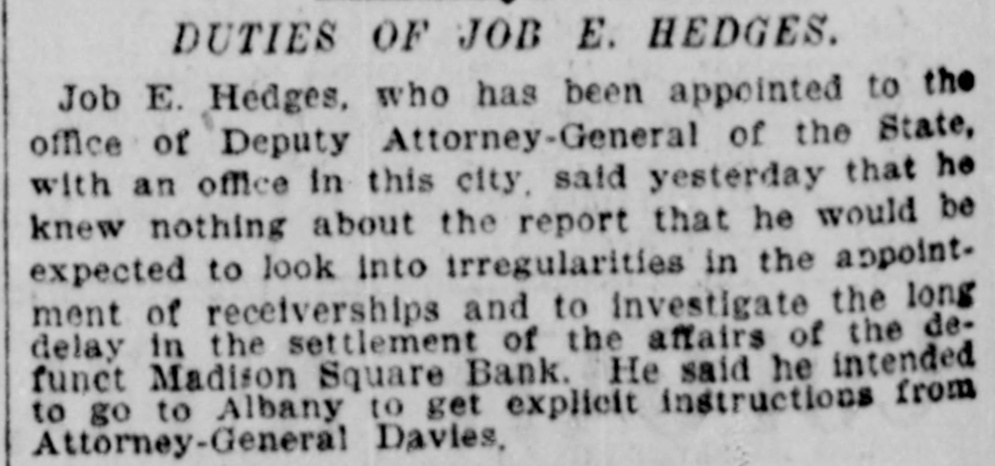
DUTIES OF JOB E. HEDGES.
Job E. Hedges, who has been appointed to the office of Deputy Attorney-General of the State, with an office in this city, said yesterday that he knew nothing about the report that he would be expected to look into irregularities in the appoint-ment of receiverships and to investigate the long delay in the settlement of the affairs of the defunct Madison Square Bank. He said he intended to go to Albany to get explicit instructions from Attorney-General Davies.
Bank runs are almost always and everywhere a deterioration of bank fundamentals.
But not for you.
You are the measure-zero exception: great fundamentals, solid bank, and yet the Diamond Dybvig fairy spread its rumor. Depositors woke up. Your collateral was not prepositioned. The Clearinghouse had it for you.
Do not pass Go. Do not collect $200. Go directly to jail… or worse.