Bank of Tennessee (Nashville, TN)

Episode Information

Episode UID
8966463790853
Episode Type
Suspension β†’ Closure
Bank Type
state
Bank ID
896646379 hash
Start Date
January 20, 1871
Location
Nashville, Tennessee (36.166, -86.784)

Metadata

Model
gpt-5-mini (chosen from majority vote of a three-model LLM ensemble)
Short Digest
96a36055688fec84

Response Measures

None

Description

Bank suspended and placed in chancery receivership; assets and plates destroyed and sold under court orders.

Events (7)

1. January 20, 1871 Other
Newspaper Excerpt
To authorize the Governor to sell the real estate belonging to the State. Passed. To wind up the Bank of Tennessee, Passed.
Source
newspapers
2. December 11, 1871 Suspension
Cause
Government Action
Cause Details
Bank was suspended and subject to chancery court actions and winding up by state authorities/Chancery Court.
Newspaper Excerpt
I am led to believe from investigation that there has not been any notes struck off these plates since the Bank of Tennessee has suspended.
Source
newspapers
3. May 9, 1877 Receivership
Newspaper Excerpt
An important decree was rendered ... in the case R. Ewing, receiver, etc., vs. S. R. Anderson ... the new issue of the Bank of Tennessee was lawfully issued ... in the receiver's hands.
Source
newspapers
4. November 11, 1881 Receivership
Newspaper Excerpt
The sale of $1,500,000 in Confederate bonds, part of the assets of the Bank of Tennessee, for $5,000. The sale was effected by Robert Ewing, Clerk and Master, as Receiver for the bank.
Source
newspapers
5. January 17, 1882 Receivership
Newspaper Excerpt
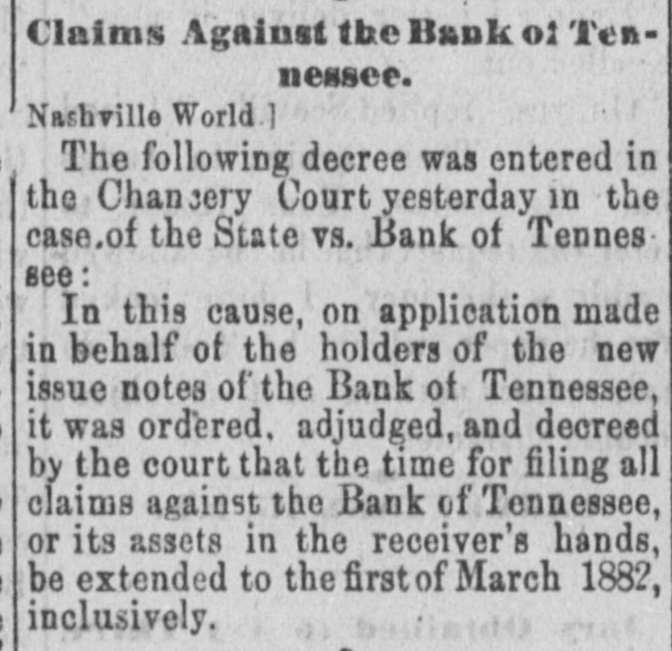
it was ordered ... that the time for filing all claims against the Bank of Tennessee, or its assets in the receiver's hands, be extended to the first of March 1882, inclusively.
Source
newspapers
6. January 7, 1883 Receivership
Newspaper Excerpt
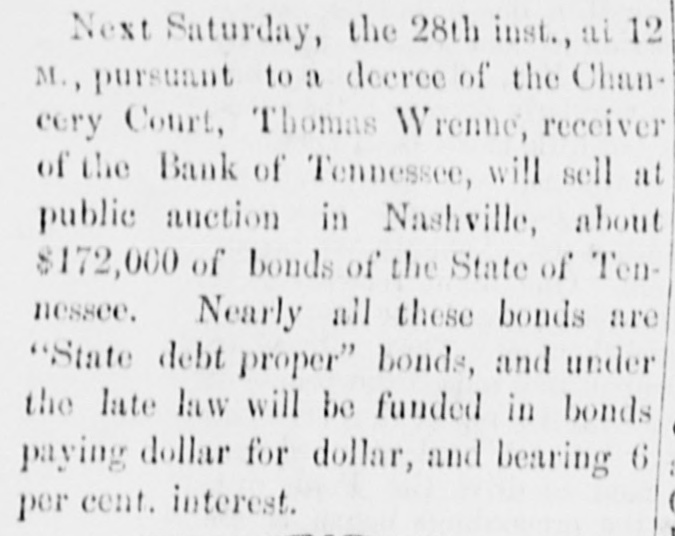
pursuant to an order of the Chancery Court ... Thomas W. Wrenne, receiver of the Bank of Tennessee, will sell at public auction ... a large mass of the Old Assets of the Bank of Tennessee.
Source
newspapers
7. March 7, 1883 Other
Newspaper Excerpt
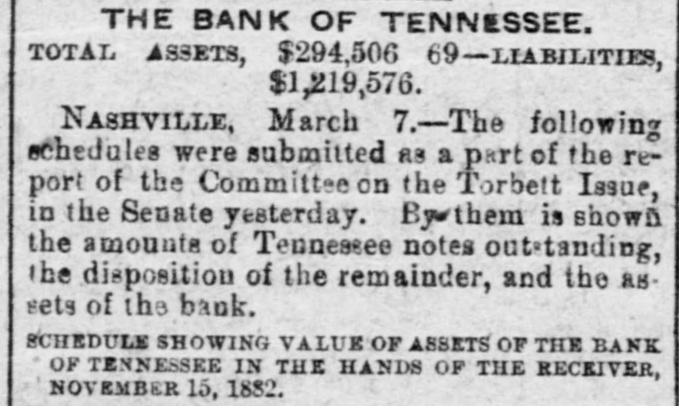
SCHEDULE SHOWING VALUE OF ASSETS OF THE BANK OF TENNESSEE IN THE HANDS OF THE RECEIVER, NOVEMBER 15, 1882.
Source
newspapers

Newspaper Articles (14)

Article from Brownlow's Knoxville Whig, and Rebel Ventilator, June 7, 1865

Click image to open full size in new tab

Article Text

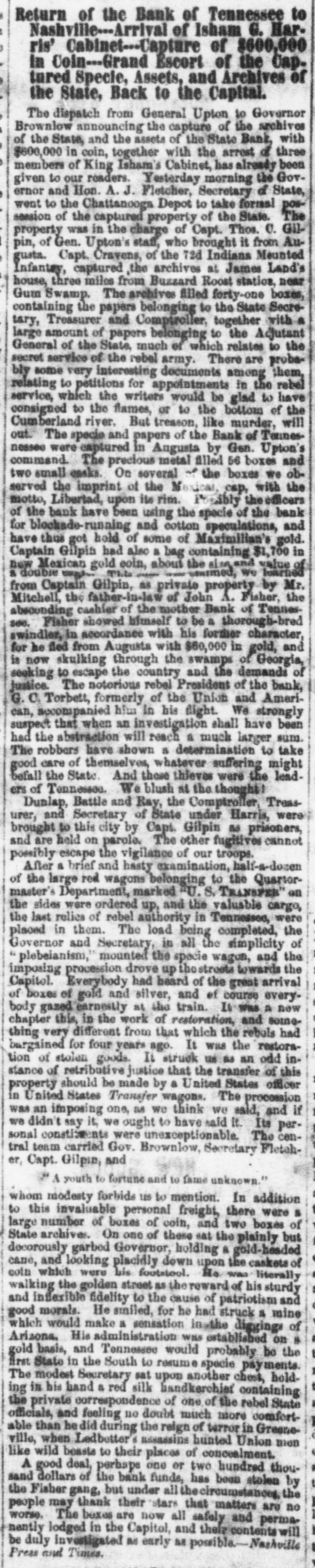
Return of the Bank of Tennessee to Nashville--Arrival of Isham G. Harris' Cabinet--Capture of $600,000 in Coin--Grand Escort of the Cap. tured Specie, Assets, and Archives of the State, Back to the Capital. The dispatch from General Upton to Governor Brownlow announcing the capture of the archives of the State, and the assets of State Bank, with $600,000 in coin, together with the arrest of three members of King Isham's Cabinet, has already been given to our readers. Yesterday morning the Governor and Hon. A. J. Fletcher, Secretary of State, went to the Chattanooga Depot to take formal possession of the captured property of the State. The property was in the charge of Capt. Thos. C. Gilpin, of Gen. Upton's staff, who brought it from Augusta. Capt. Cravens, of the 72d Indiana Meunted Infantry, captured the archives at James Land's house, three miles from Buzzard Roost station, near Gum Swamp. The archives filled forty-one boxes, containing the papers belonging to the State Secretary, Treasurer and Comptroller, together with & large amount of papers belonging to the Adjutant General of the State, much of which relates to the secret service of the rebel army. There are probably some very interesting documents among them, relating to petitions for appointments in the rebel service, which the writers would be glad to have consigned to the flames, or to the bottom of the Cumberland river. But treason, like murder, will out." The specio and papers of the Bank of Tennesnessee were exptured in Augusta by Gen. Upton's command. The precious metal filled 56 boxes and two small-easks. On several - the boxes we observed the imprint of the Mexical, cap, with the motto, Libertad, upon its rim. Posibly the efficers of the bank have been using the specie of the bank for blockade running and cotton speculations, and have thus got hold of some of Maximilian's gold. Captain Gilpin had also a bag containing $1,700 in new Mexican gold coin, about the size, value of & double english. This - - wasimed, We loarned from Captain Gilpin, as private property by Mr. Mitchell, the father-in-law of John A. Fisher, the absconding cashier of the mother Bank of Tennessee. Fisher showed hitnself to be a thorough-bred swindler, in accordance with his forther character, for he fled from Augusta with $60,000 in gold, and is now skulking through the swamps of Georgia, seeking to escape the country and the demands of justice. The notorious rebel President of the bank, G. 0, Torbett, formerly of the Union and American, accompanied him In his flight. We strongly suspect that when an investigation shall have been had the abstraction will reach a much larger sum. The robbers have shown & determination to take good care of themselves, whatever suffering might befall the State. And these thleves were the lenders of Tennessee. We blush at the thought! Dunlap, Battle and Ray, the Comptroller, Treasurer, and Secretary of State under Harris, were brought to this city by Capt. Gilpin M prisoners, and are held on parole. The other fugitives cannot possibly escape the vigilance of our troops. After a brief and hasty examination, half-a-dozen of the large red wagons belonging to the Quartormaster's Department, marked "U. S. TRANSFER" on the sides were ordered up, and the valuable cargo, the last relies of rebel authority in Tennessee, were placed in them. The load being completed, the Governor and Secretary, in all the simplicity of plebelanism," mounted the specie wagon, and the imposing procession drove up thostreets towards the Capitol. Everybody had heard of the great arrival of boxes of gold and silver, and of course everybody gazed earnestly at the train. It was a new chapter this, in the work of restoration, and soinething very different from that which the rebuls had burgained for four years ago. It was the restoration of stolen goods. It struck us as an odd instance of retributive justice that the transfer of this property should be made by a United States officer in United States Transfer wagons. The procession was an imposing one, as we think we said, and if we didn't say it, we ought to have said It. Its personal constituents were unexceptionable. The central team carried Gov. Brownlow, Secretary Fletcher, Capt. Gilpin, and , A youth to fortune and to fame unknown." whom modesty forbids us to mention. In addition to this invaluable personal freight, there were a large number of boxes of coin, and two boxes of State archives. On one of these eat the plainly but decorously garbed Governor, holding a gold-headed cane, and looking placidly down upon the caskets of coin which were his footstool. Ho was literally walking the golden street as the reward of his sturdy and inflexible fidelity to the cause of patriotism and good morals. He smiled, for he had struck a mine which would make a sensation in-the diggings of Arizona. His administration was established on # gold basis, and Tennessee would probably be the first State in the South to resume specie payments. The modest Secretary sat upon another chest, holding in his hand a red silk handkerchief containing the private correspondence of one of the rebel State officials, and feeling no doubt much more comfortable than he did during the reign of terror in Greeneville, when Ledbetter's assassins hunted Union men like wild boasts to their places of concealment. A good deal, perhaps one or two hundred thousand dollars of the bank funds, has been stolen by the Fisher gang, but under all the circumstances, the people may thank their stars that matters are no worse. The boxes are now all safuly and permanently lodged in the Capitol, and their contents will be duly investigated M early M possible.-Nashville Eness 1


Article from Public Ledger, February 27, 1867

Click image to open full size in new tab

Article Text

THE NOON DISPATCHES LOUISVILLE, February 27.-John Ma. son Brown, was nominated by the Une e ionists at Frankfort, yesterday, for At torney-General instead of LieutenantGovernor. R. T. Baker is the nominee for the latter office. a WASHINGTON, February 27. - The House Fortification bill has passed. The Committee of the Whole has dis posed of only 20 of the 275 amendments to the Tax bill reported by the Committee on Ways and Means. NASHVILLE, February 27.-A decision has been rendered in the Supreme Court that notes of the Bank of Tennessee cannot be received for taxes due the State. It has caused a decline of the notes to 20 cents. The Legislature has adopted a resolution to pay the members in gold standard. SAN FRANCISCO, February 27.-Over seven feet of snow has fallen in the mountains. WASHINGTON, February 27.-General Griffin, of the Freedmen's Bureau in Texas, says that outrages on freedmen will be punished, if need be, with a military force. The Secretary of the Treasury ordered the suspension of the sales of illicit whiskey. In the Senate, Trumbull's amendment to the Army Appropriation bill was adopted, directing the officers of the Freedmen's Bureau to prohibit maiming and whipping in the late rebellious States. The Committee on the New Orleans Riots say they confined their action to the start of the resolution regarding appointments. It does not appear that Mr. Kellogg made appointments of persons he had reason to believe had been connected with rebellious service, nor deemed it his duty to inquire as to the antecedents of applicants, Some officers had been removed when it appeared that they had aided the rebellion. The Committee say that great care should be taken to appoint officers who will prevent frauds on revenue; that such care has been uniformly taken in all departments of the Custom House, Mr. Boyer dissenting from this last proposition that it is not expedient to recommend to the House of Representatives any action concerning the appointments of the New Orleans Custom House. The Committee says of two hundred and fifty-two employes, seventy-seven have served in the United States army, seventeen in the navy, and twenty-eigh as clerks in the army. Some late rebels obtained appointments under cover of the test oath, but were dismissed when the Collector ascertained it. A Washington special says that General Grant yesterday expressed his intention of visiting the President for the purpose of advising him to sign the Milk itary Reconstruction bill. The Tax bill contains a severe penalty against selling cigar boxes with canceled stamps on them. A special says a man pretending to be Surratt's brother attempted to obtain an interview yesterday, but the guards were not satisfied with his indentity and re fused to admit him. Professor Benj. Pierce was appointed Superintendent of the Coast Survey, vice Bache deceased. A Baltimore special says it is understood that Governor Swann will decline the Senatorship and retain the Gubernatorial chair. The Senate Committee on foreign af fairs yeterday voted on the nominations of Dix and Ewing as ministers to France and the Hague. There were three for confirmation and three for rejection, Johnson, of Maryland, being absent, who would have gone for confirmation.


Article from Nashville Union and American, February 21, 1869

Click image to open full size in new tab

Article Text

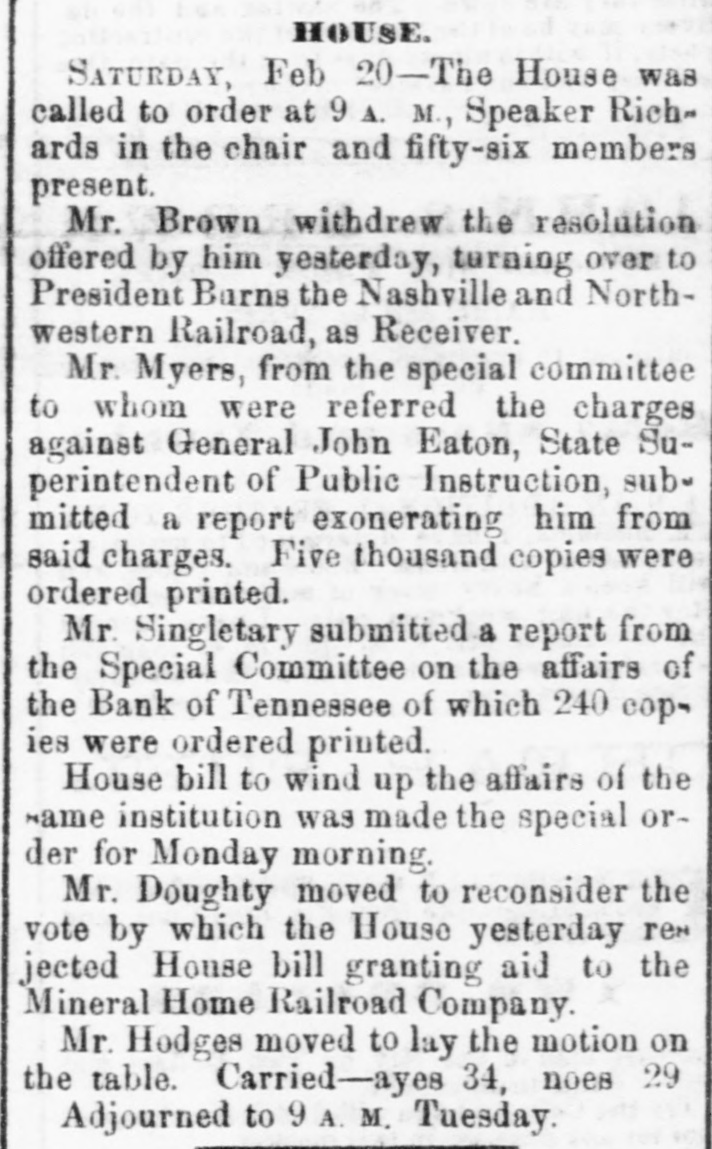
HOUSE. SATURDAY, Feb 20-The House was called to order at 9 A. M., Speaker Richards in the chair and fifty-six members present. Mr. Brown withdrew the resolution offered by him yesterday, turning over to President Burns the Nashville and Northwestern Railroad, as Receiver. Mr. Myers, from the special committee to whom were referred the charges against General John Eaton, State Superintendent of Public Instruction, submitted a report exonerating him from said charges. Five thousand copies were ordered printed. Mr. Singletary submitted a report from the Special Committee on the affairs of the Bank of Tennessee of which 240 copies were ordered printed. House bill to wind up the affairs of the same institution was made the special order for Monday morning. Mr. Doughty moved to reconsider the vote by which the House yesterday ren jected House bill granting aid to the Mineral Home Railroad Company. Mr. Hodges moved to lay the motion on the table. Carried-ayes 34, noes 29 Adjourned to 9 A. M. Tuesday.


Article from Memphis Daily Appeal, January 21, 1871

Click image to open full size in new tab

Article Text

NASHVILLE. Reller of Federal and Confederate Soldlers and of School Teachers-Incorporation of Germantown and Raleigh. The Bank of Tennessee and Penitentiary Branches Run late the Ground-The School Fund Fraud - D. F. Jackson, of Memphis. Delinquent Railroads-Rates of Taxation Special to Memphis APPEAL.] SENATE. NASHVILLE, January 20.-Mr. Lut"rell introduced a bill for the relief of Federal and Confederate soldiers in the late war who have been arrested for acts committed during the war, etc. House bills on third reading: For relief of the Secretary of State, allowing him certain fees, etc. Passed. To amend section 4038 of the Code. Passed. For the relief of school teachers authorized by the county trustees to forward their warrants to the State Treasurer, etc. Passed. To authorize Chancery Courts to grant letters of incorporation, and to authorize County Courts to incorporate towns and villages. Passed. House amendment to Senate bill to provide revenue for State were amended and concurred in. Senate bills on third reading To establish the Fifteenth Judicial Circuit, and change the Third, Fifth and Tenth Circuits of the State. Passed. For improvement and extension of Penitentiary: Bill was amended so as to grant $90,000, in old issue of Bank of Tennessee as collateral security, the same to be returned within two years, and to legalize the stockades at Tracy City, and Battle Creek coal mines as branches of the Penitentiary. Bill then referred to Judiciary Committee. To confer criminal jurisdiction on the County Court of Hamilton county, and for other purposes. Passed. HOUSE. In the House, Mr. White, from a special committee in regard to the connection of B. Lanier in the school fund fraud, presented 2 report of exonoration of Mr. Lanier from all connection with said fraud. Mr. Jones offered a resolution appointing a committee to investigate the claim of D.F. Jackson, former jailer of Shelby county. Adopted, and Jones, Casey and Owen appointed on the committee. Mr. Lackey offered a resolution to appoint a committee to burn all the blank notes and bonds of the Bank of Tennessee. Adopted. The following bills were introduced By Mr. Rhea: To authorize the courts to legitimatize persons and alter names. By Mr. Clark: A bill for the benefit of Clerks of County and Circuit Courts. House bills on third reading: To amend an act to establish a Law Court at Nashville by directing the Judge of said Court to hold the Circuit Court of Summer county. Rejected. To amend the revenue laws in regard to taxing notes. Passed. To amend an act for the formation of Etheridge county. Passed. To authorize the Governor to sell the real estate belonging to the State. Passed. To wind up the Bank of Tennessee, Passed. To amend an act to provide for the sale of delinquent railroads by appropriating $2000 for the payment of each attorney employed in the suits, $3000 each to commissioners, and allowing the Clerk and Master the usual office fees, but no commissions for making sales. Passed. To change qualifications of jurors. Passed. To equalize taxation. Rejected. The House concurred in the Senate amendments to the revenue bill. The revenue bill has finally passed both Houses, and now awaits the approval of the Governor, which no doubt it will receive. The first section fixes the tax at sixty cents on one hundred dollars of taxable property. The second section provides for a license tax, to be paid by the merchants to equal their ad valorem tax. The third section repeals the act fixing the tax at forty cents. section that or local of any every The traveling fourth provides agent in the of pay an annual insurance it, shall company, Stateoro privilege tax of twenty-five dollars to the State and ten dollars to each county. The fifth section provides that railroad companies shall pay a tax of six mills on the dollar on net earnings. The sixth section taxes commercial dollars drummers the State fifty representing per parties annum out for of the State and five dollars for each county. The seventh section provides that the act shall take effect from and after its D8888ge


Article from Knoxville Daily Chronicle, December 15, 1871

Click image to open full size in new tab

Article Text

Our Nashville Letter. NASHVILLE, Dec. 11. The plates from which the notes of the Bank of Tennessee were struck, twentythree in number, were destroyed to-day in the presence of a joint committee of the Legislature and the Clerk and Master of the Nashville Chancery Court. The plates seem to be all in good order and were lately received from Philadelphia, where they have been for ten years. They were destroyed by being cast into the furnace at the penitentiary. Senator Staley was Chairman of the Committee that did the work. I am led to believe from investigation that there has not been any notes struck off these plates since the Bank of Tennessee has suspended. I am informed the plates have all the time been in the hands of highly responsible parties. But how many notes unsigned were in the vaults of the Bank of Tennessee and its branches when the bank left this State, I can not state, but I understand these unsigned notes were very numerous. THE TAX BILL. The tax bill has not yet finally got through the two Houses. The House has refused to concur in the Senate amendments, and a Committee of Conference has been appointed. The ad valorem tax is forty cents. Nothing was done for schools. The Senate voted down to-day a House bill exempting manufacturers from taxation for five years, The objection to the bill was that it was unconstitutional. The Senate would have sustained the bill had it not been for this Constitutional difficulty. Thus does the new Constitution damage the material interest of the State. VETOES. Governor Brown has been rather free in the use of the veto power. He vetoed quite a batch of county line bills on SatΓΌrday, and thus created quite a flutter among the members. The Senate overruled one of the vetoes and sustained the balance. A great many Democrats have rather cooled in their affection for the Govternor, and his course and policy have been severely criticised in and out of the Legislature. Brown is not quite Democratic enough for the rebels. The old Whig still sticks out in him. "Raising will tell." ADJOURNMENT. The Legislature will adjourn about SatSurday. Members swear they will not stay an hour after their pay stops. I expect the world will continue to turn around Yours. after adjournment.


Article from The Morristown Gazette, May 9, 1877

Click image to open full size in new tab

Article Text

An Important Decision. An important decree was rendered in the Chancery Court at Nashville, Wednesday, involving the question whether debts due the Bank of Tennessee can be paid in the "newissue" of that bank. The case is styled R. Ewing, receiver, etc., V3. S.R. An. derson and J. H. Dodd, Chancellor Cooper decided that, in accordance with the decision of the Supreme Court, the new issue of the Bank of Tennessee was lawfully issued and legally binding upon the bank, and that the debtors of the bank, by note or other evidence of debt discounted by the bank, were entitled to pay such indebtedness in new issue notes; that the note given by: the defendants was merely a renewal of the debt due the Bank of Tennessee before the assignment, and was not founded upon any new or other consideration; and that the makers of said note, given in renewal, might make the same defense to this note that they could have made to the original note. The Court was therefore of the opinion that the tender made by the defendant was a good and valid tender, and should have been accepted by the complainant.


Article from The Home Journal, May 10, 1877

Click image to open full size in new tab

Article Text

Chancellor Cooper rendered a decision in the Chancery Court at Nashville, a few days since. in the case of the receiver of the Bank of Tennessee VS. S R Anderson, in which he deci ded that, in accordance with the dect sion of the Supreme Court, the new issue of the Bank of Tennessee was lawfully issued and legally binding upon the bank, and that the debtors of the bank, by note or other evidences of debt discounted by the bank, were entitled to pay such indebtedness in new issue notes


Article from The Magnolia Gazette, November 11, 1881

Click image to open full size in new tab

Article Text

dren are all alive and kicking, and it is presumed that Mr. C. is going through a similar exercise. The contract for that portion of the Pensacola and Atlantic Railroad not heretofore let, consisting of about one hundred miles in the center of the line, has been awarded to A. J. Lane & Co., of Macon, Ga. The contractors will transfer about one thousand men to the Pensacola and Atlantic from the New Orleans and Pacific railroad, where they are just finishing a large contract. Nashville World: Considerable surprise was caused yesterday by the sale of $1,500,000 in Confederate bonds, part of the assets of the Bank of Tennessee, for $5,000. The sale was effected by Robert Ewing, Clerk and Master, as Receiver for the bank, and the buyer was Raphael J. Moses, Jr., of New York. One million dollars more in Confederate bonds is in his possession.


Article from Public Ledger, January 17, 1882

Click image to open full size in new tab

Article Text

Claims Against the Bank of Tennessee. Nashville World The following decree was entered in the Changery Court yesterday in the case, of the State vs. Bank of Tennes see: In this cause, on application made in behalf of the holders of the new issue notes of the Bank of Tennessee, it was ordered. adjudged, and decreed by the court that the time for filing all claims against the Bank of Tennessee, or its assets in the receiver's hands, be extended to the first of March 1882, inclusively.


Article from Memphis Daily Appeal, March 8, 1883

Click image to open full size in new tab

Article Text

THE BANK OF TENNESSEE. TOTAL ASSETS, $294,506 69-LIABILITIES, $1,219,576. NASHVILLE, March 7.-The following schedules were submitted as a part of the report of the Committee on the Torbett Issue, in the Senate yesterday. Bywthem is shown the amounts of Tennessee notes outstanding, the disposition of the remainder, and the assets of the bank. SCHEDULE SHOWING VALUE OF ASSETS OF THE BANK OF TENNESSEE IN THE HANDS OF THE RECEIVER, NOVEMBER 15, 1882.


Article from Memphis Daily Appeal, March 8, 1883

Click image to open full size in new tab

Article Text

THE LEGISLATURE. THE HOUSE DEBT BILL PASSED THE SENATE ON FIRST READING. Special to the Appeal.) NASHVILLE, March 7.-Senate.-At 11 o'clock Mr. Galloway's bill providing for the construction, building and repairing of turnpike, macadamized and graded gravel roads, and providing for the collection of a ten cent tax on each $100 worth of property for the same, was taken up. The act is not compulsory. Passed third reading. The House joint resolution, "that our United States senators be instructed and our representatives in Congress requested to use their influence to have the tariff reduced to a basis for revenue only," was postponed indefinitely, which effectually kills the resolution. The Senate joint resolution to have printed for the use of the General Assembly 10,000 copies of Commissioner Hawkins's report on experimental tests of commercial fertilizers was adopted. The Senate joint resolution directing the treasurer to file a petition with the receiver in the case of State of Tennessee and Samuel Wateon, trustee, vs. the Bank of Tenneesee, in the Chancery Court at Nashville, for the pro rata payment of all the notes of the bank held by him, as treasurer of Tennessee, or which may hereafter be paid into his office, or be received by him in his official capacity, was adopted. The House bill to authorize church officers and their successors in office to convey real estate, passed third reading. The House bill to settle the bonded indebtedness of the State of Tennessee was taken up and passed first reading. It is thought it will pass the third reading within the next two days, as it is in accordance with the action of the Democratic caucue.


Article from The Home Journal, July 25, 1883

Click image to open full size in new tab

Article Text

Next Saturday, the 28th inst., al 12 M., pursuant to a deeree of the Chancery Court, Thomas Wrenne, receiver of the Bank of Tennessee, will sell at public auction in Nashville, about $172,000 of bonds of the State of Tennessee. Nearly all these bonds are "State debt proper" bonds, and under the late law will be funded in bonds paying dollar for dollar, and bearing 6 per cent. interest.


Article from Memphis Daily Appeal, August 15, 1883

Click image to open full size in new tab

Article Text

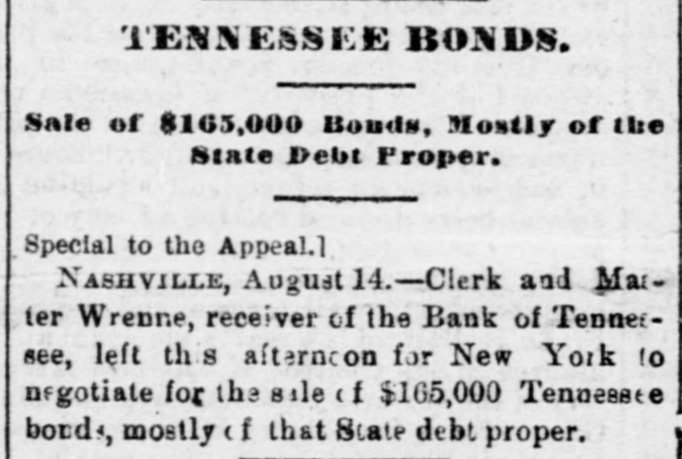
TENNESSEE BONDS. Sale of 8165,000 Bouds, Mostly of the State Debt Proper. Special to the Appeal.] NASHVILLE, August 14.-Clerk and Marter Wrenne, receiver of the Bank of Tennersee, left this afterncon for New York to negotiate for the sale of $165,000 Tennessee bonds, mostly of that State debt proper.


Article from Memphis Daily Appeal, December 20, 1883

Click image to open full size in new tab

Article Text

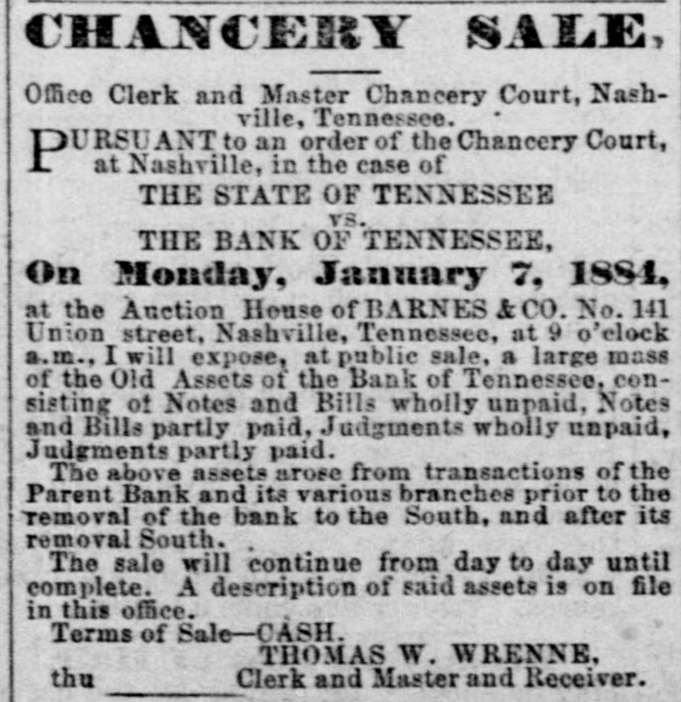
CHANCERY SALE, Office Clerk and Master Chancery Court, Nashville, Tennessee. URSUANT to an order of the Chancery Court, P at Nashville, in the case of THE STATE OF TENNESSEE vs. THE BANK OF TENNESSEE, On Monday, January 7, ISS4, at the Auction House of BARNES &CO. No. 141 Union street, Nashville, Tennessee, at 9 o'elock a.m., I will expose, at public sale, a large mass of the Old Assets of the Bank of Tennessee, consisting of Notes and Bills wholly unpaid, Notes and Bills partly paid, Judgments wholly unpaid, Judgments partly paid. The above assets arose from transactions of the Parent Bank and its various branches prior to the removal of the bank to the South, and after its removal South. The sale will continue from day to day until complete. A description of said assets is on file in this office. Terms of Sale-CASH. THOMAS W. WRENNE, thu Clerk and Master and Receiver.