Mechanics & Traders Bank (New York, NY)

Episode Information

Episode UID
9027559490918
Episode Type
Suspension β†’ Closure
Bank Type
state
Bank ID
902755949 hash
Start Date
June 10, 1876
Location
New York, New York (40.714, -74.006)

Metadata

Model
gpt-5-mini (chosen from majority vote of a three-model LLM ensemble)
Short Digest
1b8ea8430a10fc69

Response Measures

None

Description

Failure driven by real-estate depreciation and alleged mismanagement; receiver appointed and depositors paid partial dividends.

Events (3)

1. June 10, 1876 Suspension
Cause
Bank Specific Adverse Info
Cause Details
Shrinkage in value of securities and culpable mismanagement (depreciated real estate, improper investments) led to failure and suspension of payments.
Newspaper Excerpt
This closed June 10, 1876, having 3,300 depositors, to whom it owed $1,454,000.
Source
newspapers
2. July 13, 1876 Receivership
Newspaper Excerpt
On July 13 Mr. William J. Best was appointed receiver by Judge Osborne.
Source
newspapers
3. December 1, 1877* Other
Newspaper Excerpt
Receiver Best declared last dividend December, 1877; depositors were paid seventy-one cents on the dollar (additional dividends expected).
Source
newspapers

Newspaper Articles (10)

Article from The New York Herald, October 1, 1876

Click image to open full size in new tab

Article Text

THE BOND STREET SAVINGS BANK. The officials of the above savings bank have given to the world, through the columns of the HKRALD, the trustees' statement of the condition of the institution; but it seems that the depositors are not satisfied to have them control the appointment of a receiver, which, it seems, they are desirous of doing. At the meeting on last Wednesday evening some of the heaviest depositors, principally residing on the Bowery, recommended through their counsel, Mr. Samuel Crook, the appointment of the present receiver of the Mechanics' and Traders' Savings Bank, but after a petition to this effect was signed it was said "the bank party" created disorder, and the meeting was adjourned to Friday evening, to take place at No. 291 Bowery, a full report of which was given yesterday. At this meetitg, according to the published statement, "out rageous disorder" prevailed. AMr. Descha was placed in the chair with scarcely the form of fair play, every motion made by depositors outside of the bank party was overruled and the voices of the objectors drowned by groans and shouts. The President was at first invested with power to name a committee who should recommend the receiver to Judge Landon, of Schenectady; but as this too obviously gave him (Descha) the nomination of that official, it was agreed that he should name three of the committee, after which the balance was filled by names equally in the interest of the bank party. One after another of the depositors objected to this management, but the crowd of yellers carried their motions. Upon learning the above facts a HERALD reporter waited on several ot the depositors, and they were in the main corroborated. Mr. John Bowden, a depositor, residing at No. 348 Bowery, stated that almost the unanimous wish of the depositors at the first meeting was the appointment as receiver of the gentleman whose name has already been published, but it was evident from the start that some other name had been agreed on by the bank party. All they wanted, how. ever was an honest man, and if Judge Landon appoints any other the depositors will take measures to turn him out. Mr. Best was waited on, and he told the reporter substantially the following story of the affair:-He bad been approached by n number of gentlemen, among whom were Messrs. Lynn, Campbell, Maguire and others, large depositors, to know 11 he would accept the receivership if recommended by the depositors and appointed by the Court. His reply was that he had no aspirations in that direction. but would accept the position 11 the depositors thought he could best serve their interests. He had nearly finished his arduous duties as receiver of the Mechanics and Traders' Bank and was ready to pay the dividend already announced, 80 that the final closing up of the concern only involved clerical duties. He paid a compliment to the trustees of the Boud Street Bank in saying that is was creditable to them ID having, like the New Amsterdam Bank directors, initiated themselves the proceedings for liquidation. The officers of the Bond Street Bank were subsequently sought, but the bank see:ned hermetically sealed as to the doors but not air-light us to the windows.


Article from New-York Tribune, October 3, 1876

Click image to open full size in new tab

Article Text

LOCAL MISCELLANY. THE BROKEN SAVINGS BANKS. MEETINGS OF DEPOSITORS-DiVIDEND BY THE RECRIVER OF THE MECHANICS' AND TRADERS' BANK. An adjourned meeting of the depositors of the Bond Street Savings Bank was held last evening in the Germania Assembly Rooms. About 150 persons were present. The report of the committee of eleven appointed at the last meeting to recommend a suitable person as receiver was read. It stated that while the committee were in session on Saturday evening. a dispatch was received from Judge J.P. Landon, stating that on Wednesday last he had appointed Willis 8. Paine receiver of the bank. The report suggested the formation of a permanent organization of the depositors and closed with a recommendation to the Legislature to make trustees of savings banks responsible for deficiencics. The committee was then discharged and a permanent organization formed, with the following officers: William C. Marshall, President ; H. F. Lippold, VicePresident; George Rollwagen, Secretary; John Levis, Treasurer. A committee was appointed to confer with the receiver, empowered to act in every way for the depositors, consisting of James Brown, Samuel T. MeKinney, L. E. O'Brien, Henry Dauscha, and M. Corcoran. Mr. Best, the receiver of the Mechanics' and Traders' Bank, in the Bowery, will begin paying the depositors in that bank, to-morrow, a first dividend of fifty cents on the dollar. There are in all 3,202 depositors. The bank will be open from 10 a. 111. until 3 p. m. every day; and for the convenience of those engaged at work during the day, money will be paid on the deposits on Monday, Wednesday, and Thursday evenings, from 6 until 9 o'clock. Mr. Best is of the opinion that he will be able to pay from seventy-five to eigaty cents on the dollar. A claim has been made upon the past officers of the institution to the amount of $54,000, to make good the losses to the depositors resulting from outside speculations. It is thought that as these persons are responsible men, they will pay the amount rather than allow legal procedings to be taken. A meeting of the depositors of the Abingdon Square Savings Bank was held last evening at No. 79 Bank-st. There are 857 depositors on the books of the bank, but only 12 attended the me ting. It was considered advisable to postpone the consideration of any business until a fuller attendance could be o tained. Before adjourning, Francis Thompson the receiver of the bank. stated that $87,997 59 was due to the depositors. The total available assets were 825.316 49, from which could be realized about 25 per cent immediately. There were other assets, unavailable at the present time, which by next Spring would bring from 20 to 23 per cent.


Article from New-York Tribune, April 25, 1877

Click image to open full size in new tab

Article Text

John F. James, a dealer in real estate of No. 326 Scher- merhorn-st., Brooklyn, testified that he was well informed in regard to the real estate owned by the Mechanics' and Trader's Bank. If this property had been disposed of at the proper time the bank would have suffered little or no less. The depreciation of real estate in Brooklyn began in the Spring of 1872. This class of property had been failing in value ever since, and the depreciation would fully amount to 33 per cent. William J. Best, the receiver of the Mechanics' and Traders' Bank, was recalled. Mr. McKeon asked the wit- ness to point out the deficiency in the assets as reported and the actual condition of the same at the present time. Mr. Chapman objected to this on the ground that the committee was not trying Mr. Best. The point at issue, he added, was whether Mr. Ellis reported the condition of the bank soon enough or could be regarded as having neglected to do his duty in this case; whether or not Mr. Ellis exercised the best judgment according to the light that he received. Mr. McKeon contended that the amount of the loss to the depositors ought to determine the importance of the case. If a loss of only a few thousand dollars had fallen upon the depositors the Superintendent ought not to be regarded as nearly so culpable as though the loss had been as in this case, several hundred thousand dollars. The previous question was then read, and Mr. Keon's last question was submitted to the committee under Mr. Chapman's objection. That question was, "What was the deficiency in this bank?" After a short consultation the committee sustained the objection and excluded the question. The witness then continued, stating that he had already paid to the depositors of the Mechanics' and Traders' Bank 65 cents on a dollar. The witness had a consid- erable amount of the assets remaining on hand in the form of bonds and mortgages under the process of fore- closure. The amount of this property he could not state definitely, but believed that its value was between $50,000 and $60,000. The assets of the bank when de- livered to the witness embraced the four pieces of real estate spoken of in the schedule, bonds of North Carolina amounting to $113,600 (one of these bonds for $1,000 had been sold), bonds of South Carolina amounting to $141,000 ($14,000 of this class of bonds had been sold), bonds of Alabama amounting to $166,000, and the fur- niture, fixtures, safes, etc., in the bank. The available cash amounted to only a few thousand dollars. Mr. Chapman facetiously asked here, "When the receiver's fees and my friend McKeon's are paid will there be any cash left?" This inquiry raised a laugh, and seemed to put everybody in good humor. Daniel A. Moran submitted a list showing the relative prices of the stocks reckoned among the assets on July 1, 1874, and September and October, 1874. This list was introduced as evidence. The witness stated that the difference between the buying and the selling price of ordinary stocks was from 1 to 5 per cent. Brokers, he added, buy as cheaply as they can and sell at the highest prices they can get. Mr. McKeon then stated that he proposed to introduce the minutes of the bank, or rather such portions as related to its financial condition, from 1873 to the time of the appointment of the receiver. He said that the law gave to the Superintendent of Banks almost abso- lute power to examine books and papers, and if the minutes showed that the financial condition of the bank was doubtful, these would be evidence of negligence on his part. Mr. Chapman said that he did not consider this fair, for an important paper showing the true condi- tion of the bank might lie undisturbed in an open pigeon-


Article from The Rutland Daily Globe, May 1, 1877

Click image to open full size in new tab

Article Text

From New York. THE ELLIS INVESTIGATION. NEW YORK, April 30. Before the senate committee to investigate the charges against Bank Superintendent Ellis, experts testified to-day that the Mechanics and Traders' bank building was worth $105,000 in 1874. Receiver Best of the broken bank testified that four dividends were declared from June, 1874, to December, 1875, although it was known that the bank was in a broken condition, and a minority of the trustees voted against them. THE CUSTOM HOUSE INQUIRY. Col. Burt testified before the custom house commission to-day that at least a saving of ten per cent. could be effected by the reduction of the force of employes, and giving the offices to competent men, and not for political favor. He thought the office of naval officer was a necessity. INSURANCE MATTERS. The Times Albany special says the insurance superintendent is investigating the Atlantic Mutual company of Albany, the Universal of New York, and thirteen other state companies. It is rumored that Senator Tobey will succeed McCall as deputy superintendent. AN IMMENSE ROBBERY. Thursday last, a driver of the New York transfer company received a trunk for delivery at west Twenty-third street. He drove to the company's stable, leaving the trunk in the wagon while taking dinner. He then delivered the trunk to the owner who discovered it had been tampered with and $53,000 worth of diamonds stolen. BASE BALL. Hartfords 1, Boston 1, after eleven innings were played darkness set in and the game was declared a draw. The Paducah and Memphis railroad, 168 miles long, capital stock $3,000,000, and funded debt $1,541,000, was sold to-day under an agreement with creditors to the trustees for $105,000. Phillipsburg, Penn., formerly a lively manufacturing town, has been almost destroyed by hard times. The people are seeking labor elsewhere. The Hope Methodist chapel, after 12 years' existence, was closed yeaterday for lack of funds. The farewell services were touching and impressive The gold exchange was dissolved to-day and passes under the control of the stock exchange. The room will be opened tomorrow as a branch of that institution for the sale of gold and government bonds. The reported salo of the Stevens battery to Russia is denied.


Article from New-York Tribune, May 1, 1877

Click image to open full size in new tab

Article Text

THE ELLIS CHARGES. RESUMPTION OF THE INVESTIGATION. TESTIMONY CONCERNING THE AFFAIRS OF THE ME CHANICS AND TRADERS' BANK-SUMMARY OF THE CHARGES AGAINST MR. ELLIS. The Senate committee's investigation of the charges against Bank Superintendent De With C. Ellis was.continued vesterday at the St. Nicholas Hotel. The three members of the committee- -Senators Coloman, Wellman, and St. John-were present, as were Mr. Ellia and the counsel on both sides. Leopold Soldener testified that, as a real estate agent at No. 66 Bond-st. he was familiar with the values of real property In that neighborhood; he thought that in September and October, 1874, the Mechan ics and Traders' Bank building, with the land on which it stands, was worth from $105,000 to $110,000. A. A. Gould of No. 196 Prospect place, Brooklyn, a real estate agent, testified that the property at President and Van Brunt-sts. Brookly n. belonging to the Mechanics' and Traders' Bank, was worth in September, 1874. about $30,000; this prop erty consisted of a storehouse and bank: be would now give $15,000 for the two buildings, if he had the money. Later in the session J.S. Carman and J. M. W Tyckoff gav about the same estimates. William Brinkerboff of No 405 East Sixty first-st. for 26 years : real estate broker in New-York, testified that he was acquainted with the value of the Mechanics and Traders' Bank building and land in 1874 and estimated it at $105,000. These wit neases were called at the request of Mr. Ellis William J. Best. receiver of the Mechanics' and Traders' Bank, was recalled. He testifled that a resolution to re duce the salaries of the officers of the bank was intro duced by Mr. Gregory in April, 1874. In July the mat ter was taken up again, but once more deferred until the October meeting of the board, W when the salaries were slightly reduced. At the Japa meeting the semi annual dividend of three percent was de lared over the opposttion of Messrs. Gregory, Sharot. and Floyd. On Dec. 28 1874, asimilar dividend was declared, Measrs. Floyd and Gregory protesting. On June 14, 1875, the same dividond was declared with the same protesting votes, and six months later the same was declared again Mr. Gregory alone protesting This was the last dividend declared by the bank Senator St. John was particular to have recorded the names of the trostees who voted for these dividends, and he read an extract from the law which went into effect in May 1875, make ing trustees voting to declare a dividend jointly and SCV erally liable, if such dividend exceeded the earning during the period for which it was declared. Mr. Best was asked what would have been the effect uton the bank if majority of the trustees had voted against the dividends with Mr Floyd and Mr. Gregory. He replied the failure to declare a resulted resolution the calling said nothing relati consisting was appoint being Tappan, Gregory Floyd, They ported de Mt the value D that of these each he took 110 action MORE


Article from New-York Tribune, August 8, 1877

Click image to open full size in new tab

Article Text

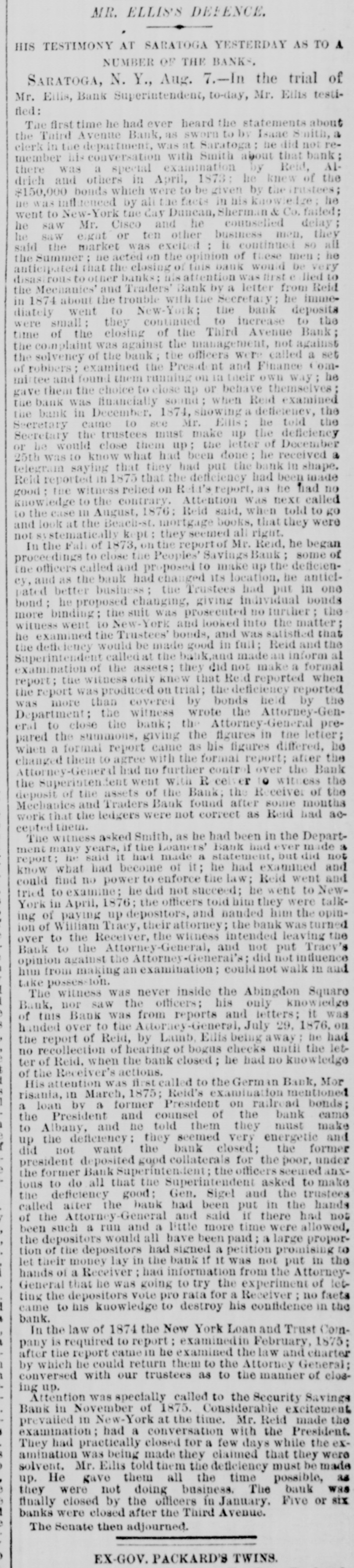
HIS TESTIMONY AT SARATOGA YESTERDAY AS TO A NUMBER OF THE BANKS. SARATOGA, N. Y., Aug. 7.-In the trial of Mr. Ellis, Bank Superintendent, to-day, Mr. Eths testified: The first time he had ever heard the statements about the Taird Avenue Bank, as sworn to by Isaac Smith, a clerk in the department, was at Saratoga: ne did not remember his conversation with Smith about that bank: there was a special examination by Reid, Aldrich and others in April, 1873: he knew of the $150,000 bonds which were to be given by the Trustees: ne was infl teneed by ali the facts in his knowledge he went to New-York the day Duncan, Sherman & Co. failed; he saw Mr. Cisco and he counselled delay he saw eight or ten other business men. they said the market was excited : it continued so all the Summer ne acted on the opinion of these men: he anticipated that the closing of this bank would be very disastrous to other banks: attention first e lied to the Mechanics' and Traders' Bank by a letter from Reid in 1874 about the trouble with the Secretary: he immediately went to New-York: the bank deposits were small: they continued to increase to the time of the closing of the Third Avenue Bank: the plaint was against the management, not against the solvency of the bank; the officers were called a set of robbers: examined the Preside nt and Finance Commistee and found them running on 111 their own way; he gave them the choice close up or behave themselves the bank was financially sound: when Reid examined the bank in December, 1874, showing a defletency, the Secretary came to see Mr. Eills: he told the Secretary the trustees must make up the deficiency or be would close them up; the letter of December 25th was to know what had been done: he received a telegram saying that they had put the bank in shape. Reid reported in 1875 that the deficiency had been made good : the witness relied on R report, as he had no knowledge to the contrary. Attention was next called to the case 111 August, 1876: Reid said, when told to go and look at the Beach-st. mortgage books, that they were not systematically kept they seemed all right. In the Fall of 1873, on the reportof Mr. Reid, he began proceedings to close the Peoples' Savings Bank: some of the officers called and proposed to make up the deficieney, and as the bank had changed its location. be antictpated better business: the Trustees had put in one bond: he proposed changing, giving individual bonds more binding: the suit was prosecuted no further: the witness went to New-York and looked into the matter; he examined the Trustees' bonds, and was satisfied that the deficiency would be made good in full: Reid and the Superintendent called at the balikand made an inform al examination of the assets: they did not make a formal report; the witness only knew that Reld reported when the report produced on trial; the deficiency reported was more than covered by bonds held by the Department: the witness wrote the Attorney-General to close the bank: the Attorney-General prepared the summons, giving the figures in the letter; when a formal report came as his figures differed, he changed them to agree with the formal report: after the Attorney-General had no further contro over the Bank the Superistender went with R cel er Q witness the deposit of the assets of the Bank: the R ceiver of the Mechanics and Traders Bank found after some months work that the ledgers were not correct as Reid had aocepted them. The witness asked Smith, as be had been in the Department many years, if the Loaners' Bank had ever made a report: he said it had made a statement, but did not know what had become of it; he had examined and could find no power to enforce the law; Reid went and tried to examine: he did not succeed; be went to NewYork in April, 1876: the officers told him they were talking of paying depositors, and handed him the opinion of William Tracy, their attorney; the bank sturned over to the Receiver, the witness intended leaving the Bank to the Attorney-General, and not put Tracy's opinion against the Attorney -General's: did not induence him from making an examination; could not walk in and take possession. The witness was never inside the Abingdon Square Bank, nor saw the officers: his only knowledge of this Bank was from reports and letters: it was hunded over to the Attorney-General, July 29. 1876, on the report of Reid, by Lamb Ellis being away; be had no recollection of hearing of bogus checks until the letter of Reid. when the bank closed ; he had no knowledge of the Receiver's actions. His attention was first called to the German Bank, Mor risania, in March, 1875; Reid's examination mentioned a loan by a former President on railroad bonds; the President and counsel of the bank came to Albany, and ne told them they must make up the defferency: they seemed very energetic and did not want the bank closed: the former president deposited good collaterals for the poor, under the former Bank Superintendent; the officers seemed anxlous to do all that the Superintendent asked to make the deficiency good Gen. Sigel and the trustees called after the bank had been put in the hands of the Attorney-General and said if there had not been such a run and a little more time were allowed, the depositors would all have been paid : a large proportion of the depositors had signed a petition promising to let their money lay in the bank if it was not put in the hands of a Receiver : had information from the AttorneyGeneral that he was going to try the experiment of letting the depositors vote pro rata for a Receiver no facts came to his knowledge to destroy his confidence in the bank. In the law of 1874 the New York Loan and Trust Company is required to report: examinedin February, 1875; after the report camelin be examined the law and charter by which be could return them to the Attorney General; conversed with our trustees as to the manner of closing up. Attention was specially called to the Security Savings Bank in November of 1875. Considerable excitement prevailed in New-York at the time. Mr. Reid made the examination; had a conversation with the President. They had practically closed for a few days while the examination was being made they claimed that they were solvent. Mr. Ellis told them the deficiency must be made up. He gave them all the time possible, as they were not doing business. The bank was finally closed by the officers in January. Five or six banks were closed after the Third Avenue. The Senate then adjourned. EX-GOV. PACKARD'S TWINS.


Article from The New York Herald, August 8, 1877

Click image to open full size in new tab

Article Text

SUPERINTENDENT ELLIS' TRIAL. MR. ELLIS TESTIMONY EXPLANATORY OF HIS OFFICIAL ACTION. SARATOGA N. Y., August 7, 1877. In the Ellistrial to-day, at the opening of the Senato, D. C. Ellis, bank superintendent, testified that the first time he ever heard the statement about the Third Avenue Bank, as sworn to by Isake Smith, a clerk in the department, was at Saratoga; don't remember any conversation with Smith about that bank there was a special examination by Reid, Aldrick and others in April, 1873: knew ot the $150,000 bonds which were to be given by the trustees; was influenced by all the lacts in bis knowledge; went to New York the day Duncan, Sberman & Co failed; saw Mr. Cisco, and be counselled delay; saw eight or ten other business men; they said that the market was excited: it continued 80 all the summer: acted on the opinion of these man; anticipated that the closing of this bank would be very disastrous to other banks; at tention was first called to the Mechanics and Traders' Bank by a letter from Roid, in 1874, about the trouble with the Secretary: I immediately went to New York the bank deposits were small; they continued to in. crease to the time of the closing ot the Third Avenue Bank: the complaint was against the management, not against the solvency of the bank; the officers were called set of robbers; examined the President and Finance Committee; found them running on in their own way; gave them the choice to close up or behave themselves; found the bank financially sound; when Reid examined the bank in December, 1874, showing a deficiency, the Secretary came to see me: told the Secretary the trustees must make up the deticiency or 1 would close them up; the letter of Decemi 25 was to know what had been done: received tele. gram saying they had put the bank in shape; Reid re ported in 1876 that the deficiency had been made good: relied on Retd' report, as I had no knowledge to the contrary next had attention called to the bank in August, 1876 Reid said, when told to go and look at the Beach street mortgage books. that they were not systematicali; kept: they seemed all right: was at Rochester when Lamb turned the bank over to the Attorney General, and approved his action instructed Reid to keep a watch on the bauk and others and report;returned the letters sent by Lamb and told him 10 look to the matter in his (Eills' absence. THE CASE OF THE PROPLE'S BANK. In the fall of 1873, on the report Mr. Reid, commenced proceedings to close the People's Savings Bank: some of the officers called and proposed to make up the deficiency, and as the bank had changed its location anticipated bette business; the trustees had put in one bond proposed changing, giving in dividual ones more binding; the suit was prosecu no further then: went to New York and looked Into the matter examined the trustees' bonds and mort gages, and was satisfied the deficiency would be made good in full; Reid and the superintendent called at the bank and made an informal examination of the assets did not make a formal report; only know that Reid reported when the report was produced on trial; the deficiency reported by Reld was more covered by bonds held by the department; thinks be acted under the letter received November 11, and telegraphed Reid to send formal report; wrote the Attorney Gen. eral to close the bank followed the figures of Reid's letter; the Attorney General prepared the summons giving the figueres in the letter: when formal report came, as figures differed, he changed them to agree with the formal report; after the Attorney General had no further control over the bank went with receiver to witness the deposit of the assets the bank the receiver of the Mechanics and Traders Bank found, after some months' work, that the ledgers were not correct as Reid had accepted them. THE LOANERS' BANK. Asked Smith, as he had been in the department many years, if the Loaners' Bank had ever made port; he said " bad made a statement but did not know what had become of it: he had examined and could tind no power to inforce the law Reid went and tried to examine; did not succeed went to New York in April, 1876; the officers told him they were taking of paying up depositors; handed him the opinion of William Tracy, their attorney thought it was before the opinion was put into the hands of the Attorney General the bank was turned over to the receiver: intended leaving the bani to the Attorney General and not put Traoy's opinion against the Attorney General: did not influence him from making un examination: could not walk m and take possession. ABINGDON SQUARE BANK. Never was inside of the Abingdon Square Bank nor saw the officers his only knowledge of this bank from reports and letters it was handed over to the Attorney General July 29, 1876, on the report of Reid by Lamb, Ellis being away has no recollection of hearing of bogus checks until the letter of Reid, when the bank closed; has no knowledge of the Receiver's actions. MORRISANIA GERMAN BANK. His attention was first called to the German Bank, Morrisauia, in March. 1875; Reid's examination men tioned a loan by former president on railroad bonds; the president and counsel of the bank came to Albany and be told them they must make up the deficiency they seemed very cuergetic did not want the bank closed; the former president deposited good collaterals for the oor under the former bank superintendent the officers seemed anxious to do al that the superintendent asked to make the and good General Sigel deficiency the trustees called after the bank had been pue in the hands of the Attorney General and said if there had not been such rnn and a little more time were allowed the depositors would all have been paid: a large proportion of the depositors had signed H petition, prom. ising to let their money lay in the bank it was not put in the hands of a receiver: had information from the Attorney General that be was going to try the ex periment of letting the depositors vote pro rata for a receiver; no lacts came to his knowledge to destroy the confidence in bank. his In the law of 1874 the New York Loan and Trust Company is required to report; examined in February 1875, after the report caine he examined the law and charter by which he could return them to the Attorney General: conversed with the trustees as to the manner of closing up BANK. SECURITY SAVINGS Attention was especially called to the Security Sav ings Bank in November of 1875: considerable excite ment prevailed in New York at the time; Mr. Reid made the examination had a conversation with the President: they had practically closed for a few days while the examination was being made they claimed that they were solveni Mr. Ettis told them the de ficiency must be made up he gave them all the time possible, as they were not doing business the bank was finalty closed by the officers January tive or six banks were closed after the Third Avenue NEW BANKS NURSED WEAK Attension was called to the Mutual Benefit Savings Bauk three or four days before the receiver was pointed Mr. Reid made an examination, found clency and told them they must make it up they asked time to nold meeting of trustees: two day before the time expired they appointed receive without his knowledge the deficiency was small trustees were always allowed to make up deficiency 18. new banks: in fact all new banks have to be propped up by their trustees: If any of banks holding mortgages were put under in the bammer, they would be insolvent time of great de preciation in stocks they might so, but allowed to go on would be right the Superintendent exercised his best discretion regard to these banks; it was that the Security Savings Bank was good and ought to go It not practicable with the force of the department to examine every piece of property the books hold one had 3,200 different mortgages: could only take the papers as they appeared to him they are re ported at face value in the present state of the real estate market; If their mortgages were foreclosed, banks could pay their depos tors; n run would force a foreclosure of mortgages, large proportion of which were taken when real estate was in better condition if let alone they will pull through. The Senate then adjourned.


Article from New-York Tribune, March 4, 1878

Click image to open full size in new tab

Article Text

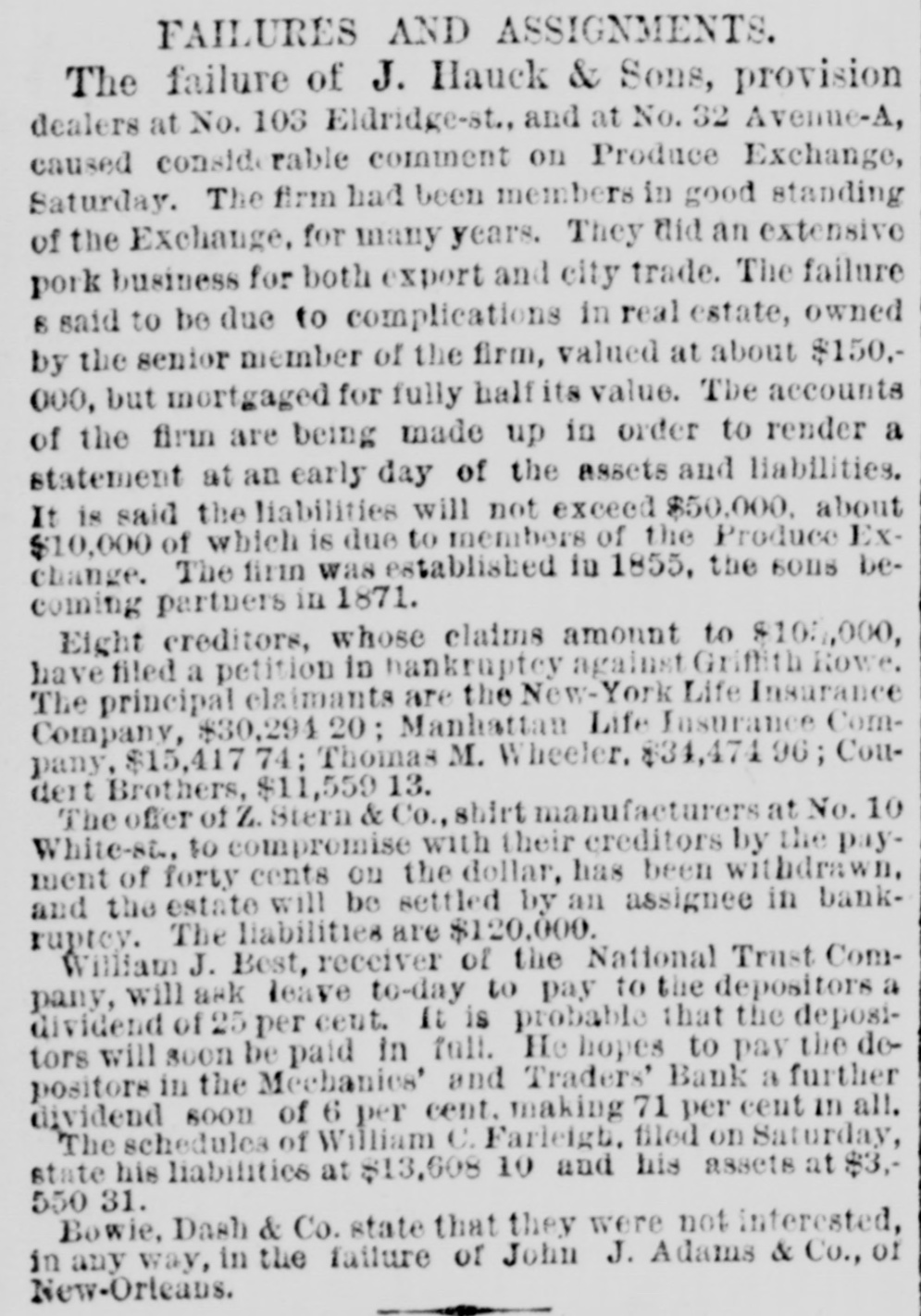
FAILURES AND ASSIGNMENTS. The failure of J. Hauck & Sons, provision dealers at No. 103 Eldridge-st., and at No. 32 Avenue-A, caused conside rable comment on Produce Exchange, Saturday. The firm had been members in good standing of the Exchange, for many years. They did an extensive pork business for both export and city trade. The failure 8 said to be due to complications in real estate, owned by the senior member of the firm, valued at about $150.000, but mortgaged for fully halfits value. The accounts of the firm are being made up in order to render a statement at an early day of the assets and liabilities. It is said the liabilities will not exceed $50,000. about $10,000 of which is due to members of the Produce Exchange. The firm was established in 1855, the sons becoming partners in 1871. Eight creditors, whose claims amount to $105,000, have filed a petition in bankruptcy against Griffith Rowe. The principal claimants are the New-York Life Insurance Company, $30,294 20; Manhattan Life Insurance Company, $15,417 74; Thomas M. Wheeler, $34,474.96; Coudert Brothers, $11,559 13. The offer of Z. Stern & Co., shirt manufacturers at No. 10 White-st. to compromise with their creditors by the payment of forty cents ou the dollar, has been withdrawn, and the estate will be settled by an assignee in bankruptey. The liabilities are $120,000. William J. Best, receiver of the National Trust Company, will ask leave to-day to pay to the depositors a dividend of 25 per cent. It is probable that the depositors will soon be paid in full. He hopes to pay the dopositors in the Mechanics' and Traders' Bank a further dividend soon of 6 per cent. making 71 per cent in all. The schedules of William C. Farleigb. filed on Saturday, state his liabilities at $13,608 10 and his assets at $3, 550 31. Bowie, Dash & Co. state that they were not interested, in any way, in the failure of John J. Adams & Co., of New-Orleaus.


Article from New-York Tribune, March 15, 1878

Click image to open full size in new tab

Article Text

NEW-YORK CITY. Colored embroideries in Persian designs colors are new. Striped batiste ties at O'Neill's have embroidered ends. Square horn buttons beautifully colored carved are novelties. "Drap Kaboul" is a new suit material Arnold, Constable & Co.'s. Blond ties with variegated borders at man's are new and pretty. Antique carved silver clasps fasten the cut-away coats worn by ladies. Carriage parasols at E. A. Morrison's very small, and have extension handles. Old curiosities in odd designs are shown faience de Paris" at Bawo & Dotter's. Purchasers at Stewart's, on Wednesday, ceived some of their change in gold at par. Gilmore's Band, sixty performers, will by the Inman steamer City of Berlin on May 4. Sewing silk damasse grenadines at son's are very handsome, and sell for $1 per yard. W. T. Hantington has resigned a positio in the Custom House which he held for fifty years. Richard Meares is having a special sale colored and white balbriggan hose for 25 cents a pair. White satin evening boots at Lord & Tay lor's are ornamented with narrow lace and tiny flower Francis Rebzold, age four, has mysterious] disappeared from his father's home, No. 659 Second ave. A. T. Stewart & Co. have just opened a line of French bourettes, varying from $1 to $2 50 yard. Notwithstanding the Lenten season, Catholics and Episcopalians are continuing their ceptions. The polished brass ornaments, for which there has been a mania, are now rivalled by those mixed siver and brass. There will be a service every morning, at o'clock, during Lent, in St. Ann's P. E. Church, eenth-st.,Ine Fifth-ave. Novel pocket-books have a small silver on the outside, which, when moved by a spring, display the picture of the owner. The Gramercy flats in West Twentieth-st are almost finished, and the building adds much to appearance of that part of the city. Workmen are engaged in repainting frescoing the music-stand on the Mall. in Central preparatory to the regular Saturday afternoon concerts Tidies, chair and bureau covers, made with macramΓ© lace: are the favorite fancy work at present The lace is not difficult to make, and looks rich colors, 11" ut 81 11 Mayor Ely, yesterday, signed the Aldermen' amendment to the ordinance in regard to arrying tols. permitting non-residents the same privileges 01 ΠΏΠΎΠ»Π΅ are su am Among the mortgages filed, yesterday, one for $15,000 on the Trinity Baptist Church grounds, at No. 141 East Fifty-fifth-st., the Mutual om Sujuroj Suedmo) Insurance William J. Best, the receiver of the Mechan ics' and Traders' Bank, began the payment of a 6 cent dividend to depositors yesterday. This makes total of 71 per cent received by the depositors. Picture galleries, brie-Γ -brae shops, fashionable dress-making establishments are now gregated in Fifth-ave, and the next May moving make very decided change in Broadway shops. A bread plate at Gorham & Co.'s is a terpiece of workmanship: the centre 18 in Japanes decoration in colors, an I around the edge, in large silver letters, are the words, Give US this day our bread. As passengers on the Staten Island boats passed to or fro from this city yesterday, they an opportunity of watching the shad fishermen the poles for the nets, preparatory to the opening of "uoseas Grace before Gruel," a painting by Pittz. representing a charity school of about thirty dren standing and waiting while the dignified matro grace before their trugal meal, is one of the


Article from The New York Herald, April 21, 1878

Click image to open full size in new tab

Article Text

amount of $0 building was so heavily mortgaged that the rent only defrayed the interest on the mortgage. Suits, how. ever, are pending against the president and trustees, and may yet result in yielding something. Clinton Baok collapsed July 5, 1877, with a roll of 1,300 depositors, calling for $88,000. Mr. Edward L. Paris was appointed receiver by Judge Landon July 17. 1877. The panie of 1873 caused such a shrinkage in the securities of this bank that It was reduced to 118 last legs, and was only kept alive by the personal sacrifices of 118 trustees, Who struggled on, making up the deficiency from year 10 year until they grew tired. From the sale of real estate owned by the bank and available assets the depositors may yet realize a dividend of thirty-five per cent, out toey must have patience. Clairmont Bank closed September, 1877, on 1,000 Repositors, representi $100,000. Judge Westbrook appointed General Henry V. Smalley receiver. but though the available assets are rated at sixty cents no dividend bus yet been declared, and the late recelver is enjoying himself in Canada. His successor as receiver is Mr. Clark Brooks, no is expected to do thing possible for the depositors GERMAN UPTOWN BANK. This institution closed on December 6, 1875, with a roll of 4,399 depositors, claiming $229,436. Mr. Herman Uni was appointed receiver by Judge Davis, and the depositors received eighty cents on the dollar, the last dividend being declared September 4, 1876, while another is expected about this time of teu per cent. The trouble with this bank was that its assistant Secretary, Schwartz, who is now in Sing Sing, stole liberally of its lunds, and a consi erable amount of its securities were in depreciat Southern bonds. The German Bank, of Morrisauia, failed March, 1877, having 2,200 depositors, 10 whom 11 owed $230,000. Mr. William J. Best was made receiver by Judge Landon, and he expects when all the available assets are realized and the trustees made to pay on account of illegal investments that the depositors will be reimbursed to the extent of seventy five cents on the dollar, but they have had nething yet. Mr. Best says that when he took possession of the bank last July its cash amounted to only $351 95 and it owed $54 000 to sundry secured creditors. including two of its own trustees The sum named had been borrowed at different times by the officers LO meet current disbursements, its payment being guaranteed by the pledge of 10wn bonds and bonds and mortgages. Mr. Best says he holds railroad bonds and other securities to the amount of $167,000, and this amount he shall endeavor to recover from those trustees who voted in favor of the purchase of the bonds and of making the loan on railroad securities, both acts being in direct violation of the charter of the bank and of the laws in relation to savings banks. If he only succeeds in this it will be a well taught lesson to all trustees in future. GUARDIAN BANK. This bank had 1,000 depositors, to whom it owed $560,000 on the day it closed, November 17, 1871# Among its directors were well known members of the Ring. Its first receiver was Mr. Jeremiah Quinlan, appointed by Judge Barnard November 17, 1871. Mr. Mr. Walter S. Roche, one of the directors, who held himself responsible for the failure of the bank. turned over to Quinlan his entire property, to make good the losses. This property realized enough to pay the depositors in full and leave a surplus of about $150,000; but Roche WMS cheated of his last dollar. Quintan resigned and Peter J. O'Donohue was ap. pointed his successor by Judge Donohue; but no Was removed by Judge Lawrence and Mr. John T. McGowan, a lawyer of good repute, WILL substituted in his place. Suits against Quiolan for the recovery of the moneys were promptly started by Mr. McGowan, but nothing has come of them yet. The depositors, however, ought to be thankful to get so much as ninety live cents OD the dollar, though it Was secured by the beggary of Roche. MECHANICS AND TRADERS' BANK. This closed June 10, 1876, having 3, 300 depositors, to whom it owed $1,454,000. On July 13 Mr. William J. Best was appointed receiver by Judge Osborne. The depositors were paid seventy one cents on the dollar, the last dividend having been declared December, 1877, and one more of ten or filteen per cent 18 expected to be declared within a few months. Snrinkage of values, along with culpable mismanagement, brought about the tate of the Mechanics and Traders'. MUTUAL BENEFIT BANK. This yielded up the ghost November 27. 1875, after being seven years in existence. It bad 4,000 depositors, to whom It owed $450,000. Judge Donohue appointed William F. Addried receiver. The depositors were paid fifty cents on the dollar up to May, 1876. Another dividend of ten per cent, and though a (orther one of ten 18 hoped for there 18 not much faith in its being realized. Fall in real estate and stupid management brought this concern to its inglorious end. MARKET BANK. This institution went under in January, 1872. through the rasculities of ring composed of its officers and one or two outsiders. The number of its depositors was 1,900, to whom $1,000,000 were due. Mr. James Dennis was appointed receiver January 20, 1872, by Judge Barnard, but the appointment, owing to the character of the Judge, excited the suspicion of the depositors, which culminated 12A such action being taken as resulted in the rejection 01 Dennis and the throwing of the bank into bankruptcy. Mr. Francis W. Worth, who died the following year, was elected assignee by the creditors, and about the same time the secretary of the bank, Conklin, departed for Canada with as much of the funds as he could conveniently lay hold OI. On Worth's death, in September, 1873, John S. Platt was appointed his successor by Judge Blatchford, but he succeeded to little more than a legacy of barassing litigation about real estate and squabbles with lawyers about fees. The bank paid thirty-eight cents on the dollar up to March 12. 1873, and another dividend is hoped for some day in the future. NEW AMSTERDAM BANK. This concern expired September 27, 1876, with a roll of 2,100 depositors, representing $510,000. It had been in existence eight years and was lodged in a large and most expensive building, that proved a fatal drag upon its resources. Mr. Richard M. Bent was appointed receiver December, 1876, by Judge Landon, and up to October 1877, bad paid the depositors sixty-five cents our the dollar. with a promised forthcoming dividend of twelve per cent. NATIONAL BANK This was a savings institution of no great consequence, and was more or less identified with the Ring, along with which It collapsed. "Hank" Smith was president. The trustees made up the deficiency and the depositors, to whom $190,000 were due, were paid in falls The receiver was appointed by Judge Barnard, but as be neid the office only ball a day, was offered $6,000 for his services, which he indignantly declined and felt ashamed o: the whole business, his name never transpired. PROPLE'S BANK. This was rather a weak institution and collapsed immediately when the hard times set in November 26, 1875. It had 1,296 depositors, to whom it owed $195,000. Isaac V. French Was appointed receiver by Judge Landon and succeeded in paying 33 1-3 cents on the dollar to the depositors up to April 4, 1876. Within the past SIX months 10 per cent additional has been paid, making 10 all 431-3 cents on the dollar, an amount which the depositors when the crash OCcurred hardly ever expected to get. SECURITY BANK. This bank failed November 26, 1875, after an existonce of seven years, which appears to be about the average longevity of a New York savings bank. It had 2,600 depositors, entitled to the gross sum of $390,000. Mr. William M. Banks was appointed receiver January 28, 1876, by Judge Landon, and up to May 1877, paid the depositors ty-seven and a half cents on the dollar. A delalcation on the part of the secretary, John L. Sen, who was subsequently sent to the Pemtentiary, and also the tall 10 the value of real estate, were the causes of the collepse. Mr. Banks expects within two months more to pay an additional live per cent THIRD AVENUE BANK. This bank closed with a deep. resounding crash September 30, 1875, and produced more w despread distress than hall the other banks put together. It bad the immense roll of 8,000 depositors, to whom was due $1,400,000. Mr. William S. Carman was first appointed receiver by Judge Osborne October, 1875, but was subsequently removed and Mr. Samuel H. Hurd, the present receiver, appointed in bis place by Judge Westbrook. Everybody has heard the history of this bank and its disgraceful and. corrupt management A loop in the law permited the escape of the president and trustees. Fifteen cents on the dollar, what they have got already is nearly all the depositors are ever likely LO see. The management of this concern was illustrated in the matter of the trustees bond suit, ID which " was shown that when the bank ran behind 80 that it could not pay a dividend the trusiees held a meeting and drew up a bond by which they became individually liable to the amount of