Mechanics & Traders Bank (New York, NY)

Episode Information

Episode UID
9027559491294
Episode Type
Run → Suspension → Reopening
Bank Type
state
Bank ID
902755949 hash
Start Date
October 26, 1907
Location
New York, New York (40.714, -74.006)

Metadata

Model
gpt-5-mini (chosen from majority vote of a three-model LLM ensemble)
Short Digest
777fa4b0ffcff5a5

Response Measures

None

Description

Bank later reorganized and reopened as the Union Bank of Brooklyn.

Events (5)

1. October 26, 1907 Run
Cause
Local Banks
Cause Details
Heavy withdrawals following failures/strain in related institutions and clearing house stringency; clearing house reluctance to extend further credit.
Measures
Paid out large sums over prior days; branches delayed openings and directed large withdrawals to main office.
Newspaper Excerpt
the Mechanics and Traders Bank... doors shut at noon to the second in the faces of some 300 excited and protesting depositors
Source
newspapers
2. January 29, 1908 Suspension
Cause
Local Banks
Cause Details
Renewed drain on resources and inability to take up clearing house certificates after other bank failures; clearing house declined further credit.
Newspaper Excerpt
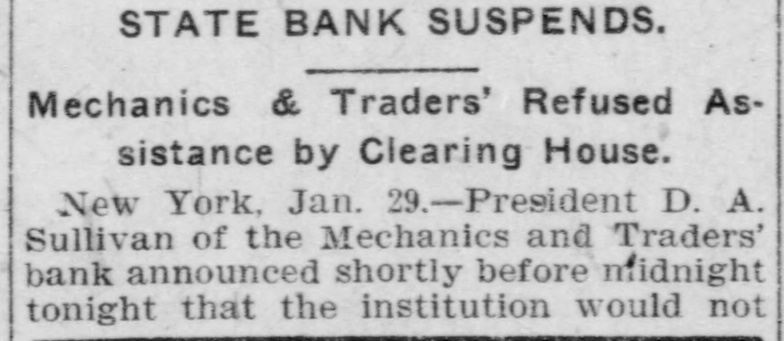
Mechanics & Traders' Refused Assistance by Clearing House. New York, Jan. 29.-President D. A. Sullivan... announced ... the institution would not
Source
newspapers
3. February 29, 1908 Receivership
Newspaper Excerpt
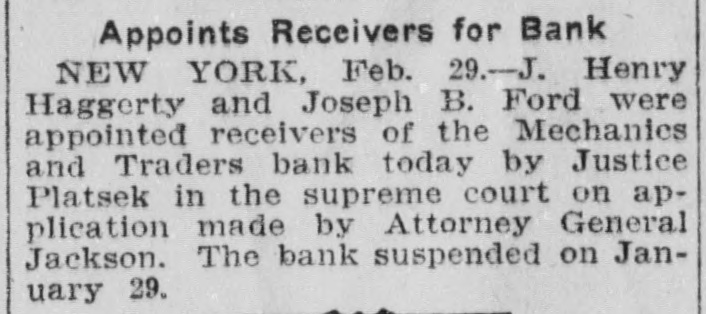
Appoints Receivers for Bank ... J. Henry Haggerty and Joseph B. Ford were appointed receivers of the Mechanics and Traders bank today ... The bank suspended on January 29.
Source
newspapers
4. June 16, 1908 Other
Newspaper Excerpt
Mechanics and Traders Reduces Its Capital and Borrows $1,000,000. ... asked permission to reduce the capital stock of the bank from $2,000,000 to $1,000,000 and to borrow $1,000,000 from the Equitable Trust company.
Source
newspapers
5. August 17, 1908 Reopening
Newspaper Excerpt
The Mechanics' and Traders' bank ... reopened for business today. ... As soon as legal steps can be completed, the name of the bank will be changed to the Union bank of Brooklyn.
Source
newspapers

Newspaper Articles (22)

Article from The Ocala Evening Star, March 2, 1907

Click image to open full size in new tab

Article Text

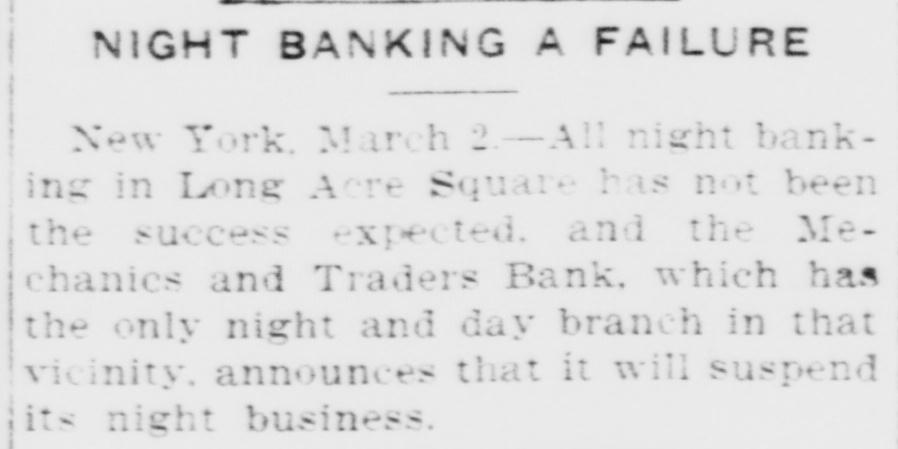
NIGHT BANKING A FAILURE New York. March 2.-All night banking in Long Acre Square has not been the success expected. and the Mechanics and Traders Bank, which has the only night and day branch in that vicinity. announces that it will suspend its night business.


Article from The Evening World, October 26, 1907

Click image to open full size in new tab

Article Text

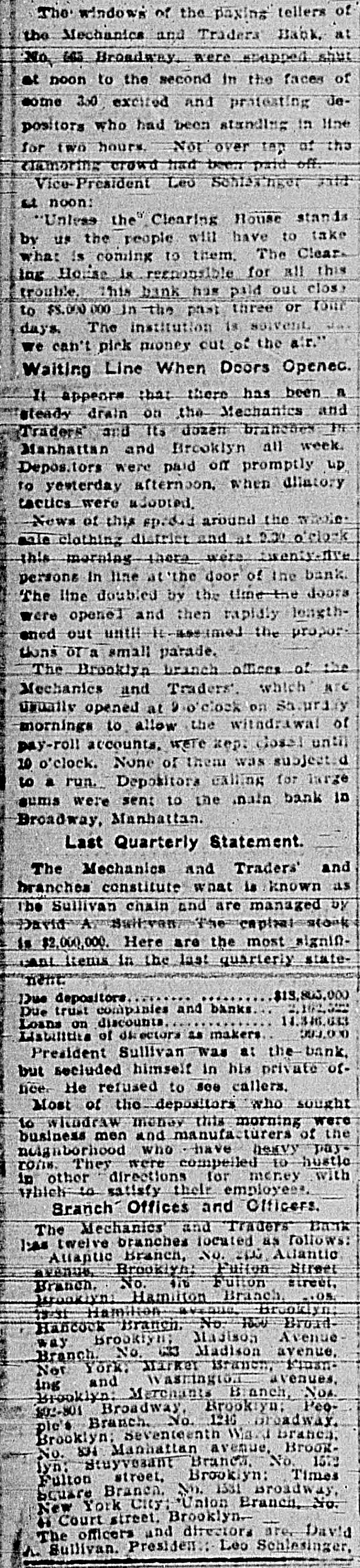
the Mechanics and Traders Bank. at No. 663 Broadway were shapped shut at noon to the second in the faces of some 300 excited and protesting depositors who had been standing in line for two hours. Not over tep of the clamoring crowd had been paid off. Vice-President Leo Schlexhget and at noon: "Unless the Clearing House stands by us the people will have to take what is coming to them. The Clear. Ing House is responsible for all this trouble. This bank has paid out close to $8,000 000 in the past three or four days. The institution is solvent. we can't pick money cut of the air." Waiting Line When Doors Openec. It appears that there has been a steady drain on the Mechanics and Traders' and its dozen branches 15 Manhattan and Brooklyn all week. Depositors were paid on promptly up to yesterday afternoon. when dilatory tactics were adopted. News of this spedid around the whole. sale clothing district and at 2.30 o'clork this morning there were twenty five persons in line at at'the door of the bank. The line doubled by the time the doors are opene] and then rapidly longthened out untH It assumed the propor Lons ora small parade, The Brooklyn branch offices of the Mechanics and Traders'. which are usually opened at 9-o'clock on Shurday mornings to allow the withdrawal of pay-roll accounts, were kep: closs! until 10 o'clock. None of them was subjected to a run. Depositors calling for large eums were sent to the nain bank in Broadway, Manhattan. Last Quarterly Statement. The Mechanics and Traders' and branches constitute what is known as the Sullivan chain and are managed by David A Bullyan The capital stork is $2,000,000. Here are the most signincant Items in the last quarterly statenent. $13,805,000 Due depositors 2,192,322 Due trust compinies and banks. Loans on discounts 14.346.633 393,000 Lisbilities of directors as makers President Sullivan was at the bank, but seciuded himself in his private ofnce. He refused to see callers. Most of the depositors who sought to withdraw meney this morning were business men and manufacturers of the neighborhood who have heavy payTOTAL They were compelled to hustle in other directions for money with which to satisfy their employees. Branch Offices and Officers. The Mechanics' and Traders Bank has twelve branches located as follows: Attantic Branch, No. and Atlantic evenue, Brooklyn: Fulton Street Branch. No. 415 Fulton street, Brooklyn: Hamilton Branch ..05 19-31 Hamilton avenue, Brooklyn Hancock Branch. No. 1550 Broid way Brooklyn; Madison Avenue Branch. No. US3 Madison avenue, Nor York, Mirket Branch, Finsnthat and Washington avenues,


Article from The Salt Lake Herald, January 30, 1908

Click image to open full size in new tab

Article Text

STATE BANK SUSPENDS. Mechanics & Traders' Refused Assistance by Clearing House. New York, Jan. 29.-President D. A. Sullivan of the Mechanics and Traders' bank announced shortly before midnight tonight that the institution would not


Article from The Brandon News, February 6, 1908

Click image to open full size in new tab

Article Text

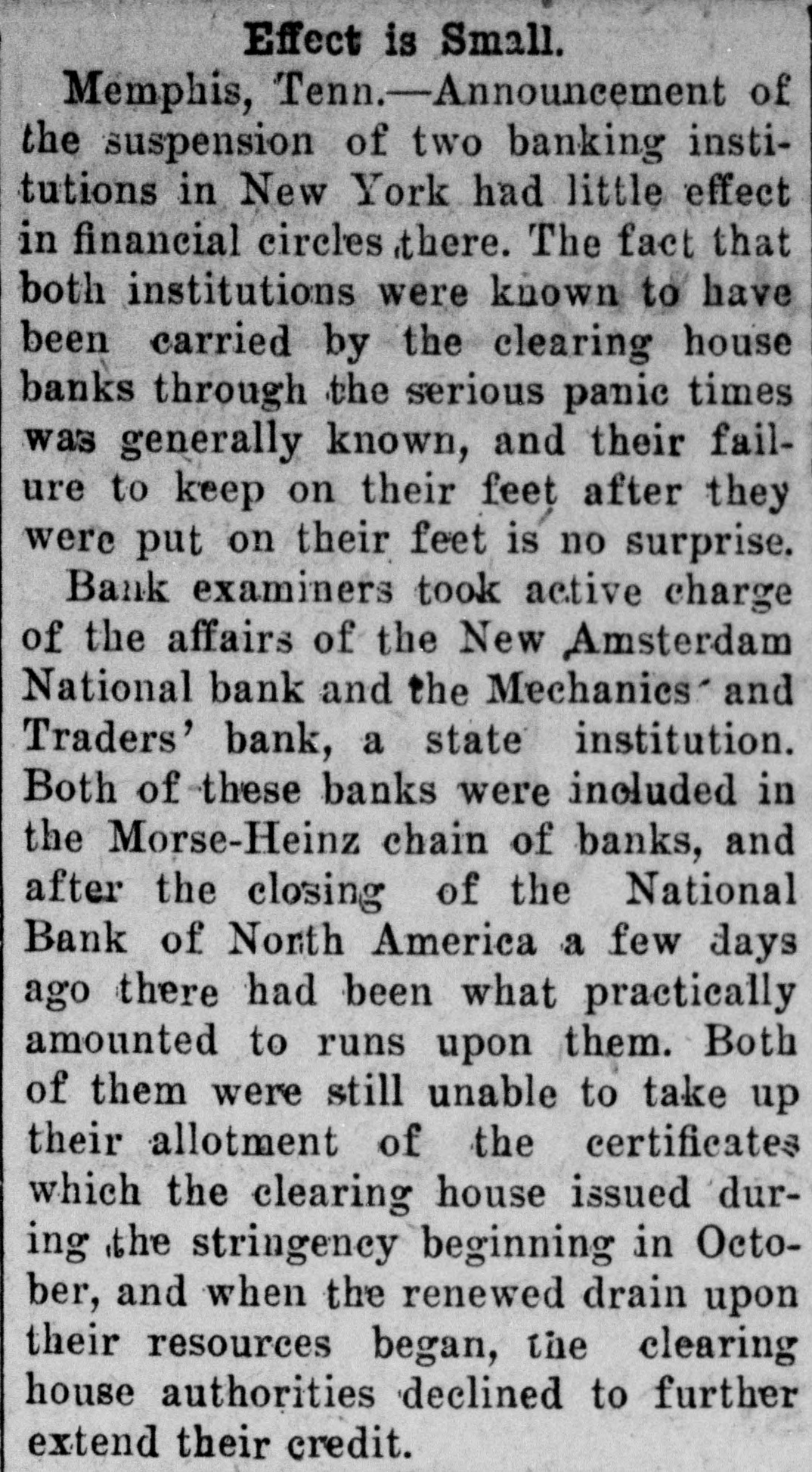
Effect is Small. Memphis, Tenn.-Announcement of the suspension of two banking institutions in New York had little effect in financial circles there. The fact that both institutions were known to have been carried by the clearing house banks through the serious panic times was generally known, and their failure to keep on their feet after they were put on their feet is no surprise. Bank examiners took active charge of the affairs of the New Amsterdam National bank and the Mechanics and Traders' bank, a state institution. Both of these banks were included in the Morse-Heinz chain of banks, and after the closing of the National Bank of North America a few days ago there had been what practically amounted to runs upon them. Both of them were still unable to take up their allotment of the certificates which the clearing house issued during the stringency beginning in October, and when the renewed drain upon their resources began, the clearing house authorities declined to further extend their credit.


Article from East Oregonian : E.O, February 18, 1908

Click image to open full size in new tab

Article Text

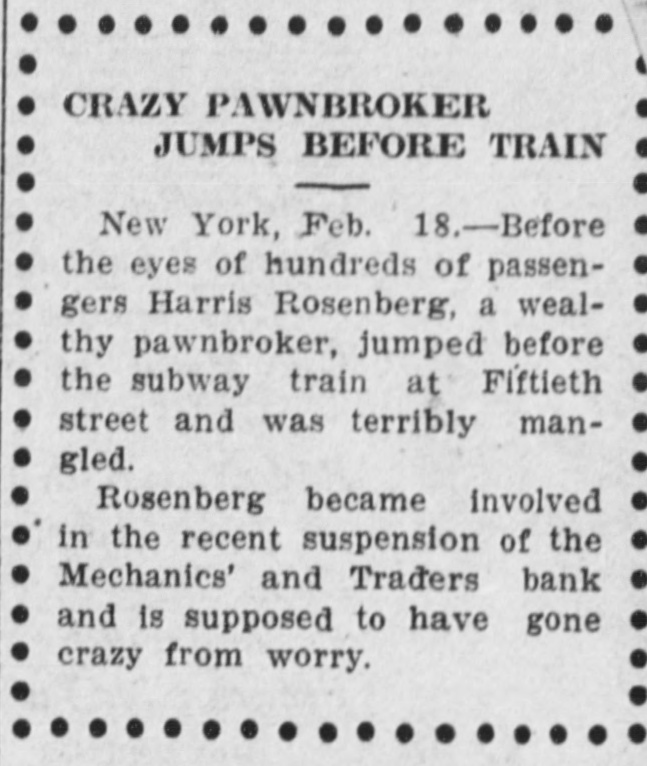
CRAZY PAWNBROKER JUMPS BEFORE TRAIN 1 18.-Before New York, Feb. the eyes of hundreds of passengers Harris Rosenberg, a wealthy pawnbroker, jumped before the subway train at Fiftieth street and was terribly mangled. Rosenberg became involved in the recent suspension of the Mechanics' and Traders bank and is supposed to have gone crazy from worry.


Article from Los Angeles Herald, March 1, 1908

Click image to open full size in new tab

Article Text

Appoints Receivers for Bank NEW YORK, Feb. 29.-J. Henry Haggerty and Joseph B. Ford were appointed receivers of the Mechanics and Traders bank today by Justice Platsek in the supreme court on application made by Attorney General Jackson. The bank suspended on January 29.


Article from The Washington Herald, March 3, 1908

Click image to open full size in new tab

Article Text

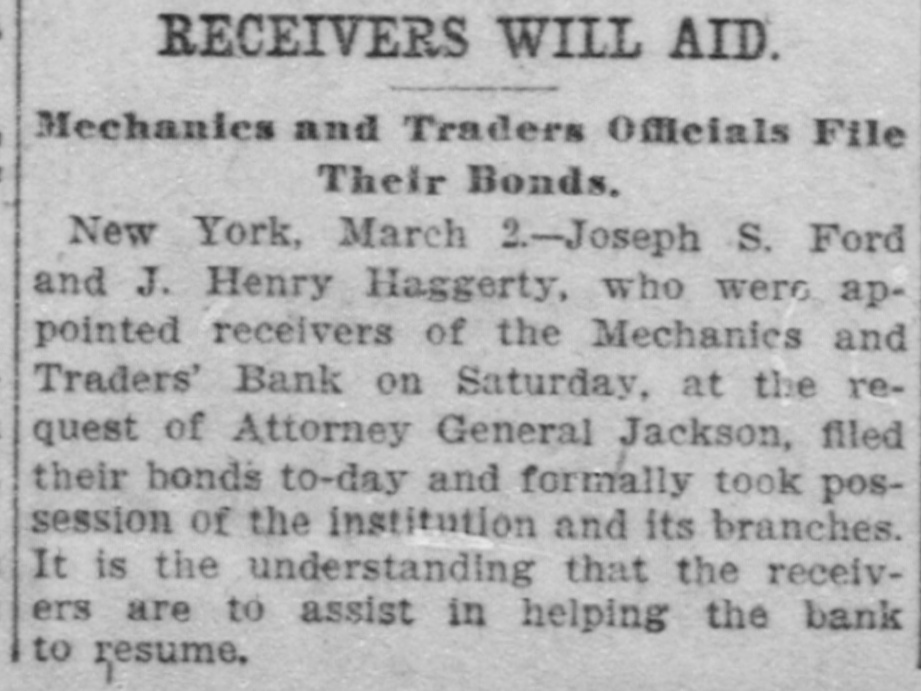
RECEIVERS WILL AID. Mechanics and Traders Officials File Their Bonds. New York, March 2.-Joseph S. Ford and J. Henry Haggerty, who were appointed receivers of the Mechanics and Traders' Bank on Saturday, at the request of Attorney General Jackson, filed their bonds to-day and formally took possession of the institution and its branches. It is the understanding that the receivers are to assist in helping the bank to resume.


Article from Manchester Democrat, March 4, 1908

Click image to open full size in new tab

Article Text

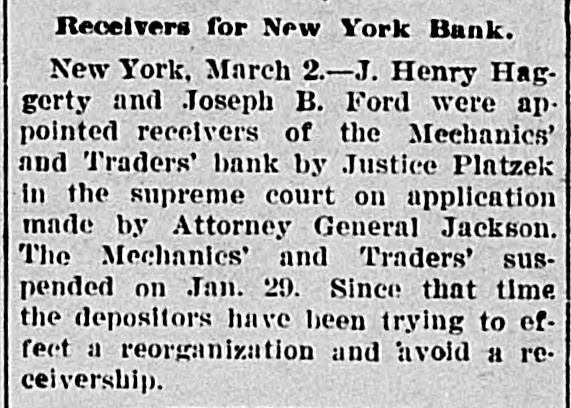
Receivers for New York Bank. New York, March 2.-J. Henry Haggerty and Joseph B. Ford were appointed receivers of the Mechanics' and Traders' bank by Justice Platzek in the supreme court on application made by Attorney General Jackson. The Mechanics' and Traders' suspended on Jan. 29. Since that time the depositors have been trying to effeet a reorganization and avoid a receivership.


Article from The Billings Gazette, March 20, 1908

Click image to open full size in new tab

Article Text

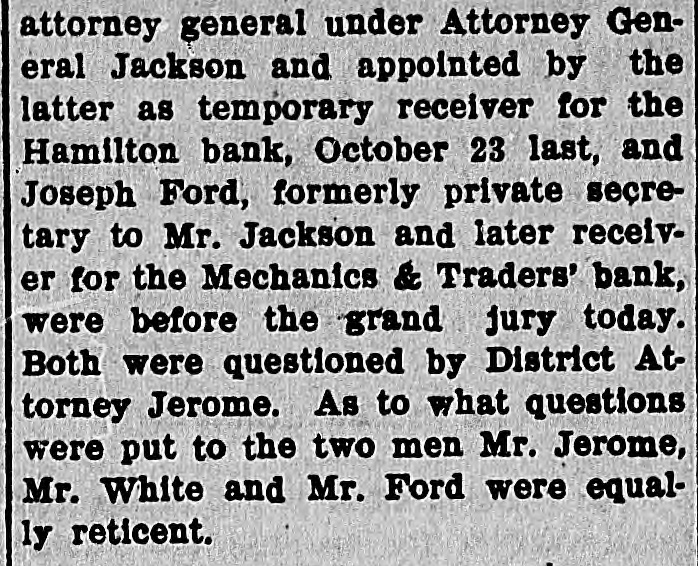
attorney general under Attorney General Jackson and appointed by the latter as temporary receiver for the Hamilton bank, October 23 last, and Joseph Ford, formerly private secretary to Mr. Jackson and later receiver for the Mechanics & Traders' bank, were before the grand jury today. Both were questioned by District Attorney Jerome. As to what questions were put to the two men Mr. Jerome, Mr. White and Mr. Ford were equally reticent.


Article from Goldsboro Weekly Argus, April 23, 1908

Click image to open full size in new tab

Article Text

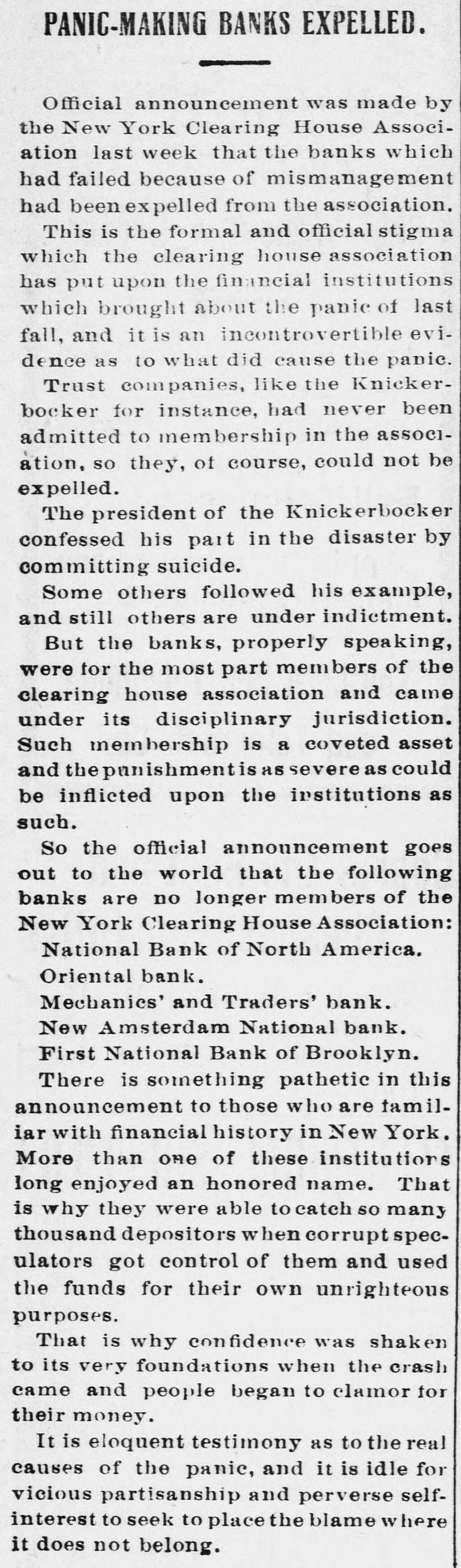
PANIC-MAKING BANKS EXPELLED. Official announcement was made by the New York Clearing House Association last week that the banks which had failed because of mismanagement had been expelled from the association. This is the formal and official stigma which the clearing house association has put upon the financial institutions which brought about the panic of last fall, and it is an incontrovertible evidence as to what did cause the panic. Trust companies, like the Knickerbocker for instance, had never been admitted to membership in the association, so they, of course, could not be expelled. The president of the Knickerbocker confessed his pait in the disaster by committing suicide. Some others followed his example, and still others are under indictment. But the banks, properly speaking, were for the most part members of the clearing house association and came under its disciplinary jurisdiction. Such membership is a coveted asset and thepunishmenti is as severe as could be inflicted upon the institutions as such. So the official announcement goes out to the world that the following banks are no longer members of the New York Clearing House Association: National Bank of North America. Oriental bank. Mechanics' and Traders' bank. New Amsterdam National bank. First National Bank of Brooklyn. There is something pathetic in this announcement to those who are familiar with financial history in New York. More than one of these institutions long enjoyed an honored name. That is why they were able to catch so many thousand depositors when corrupt speculators got control of them and used the funds for their own unrighteous purposes. That is why confidence was shaken to its very foundations when the crash came and people began to clamor for their money. It is eloquent testimony as to the real causes of the panic, and it is idle for vicious partisanship and perverse selfinterest to seek to place the blame where it does not belong.


Article from The Morning Journal-Courier, June 17, 1908

Click image to open full size in new tab

Article Text

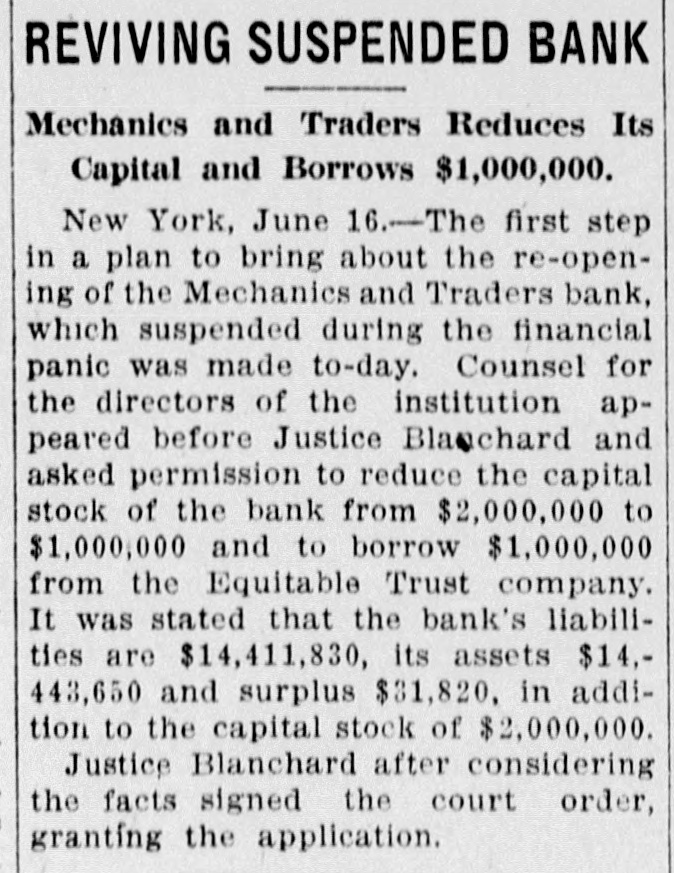
REVIVING SUSPENDED BANK Mechanics and Traders Reduces Its Capital and Borrows $1,000,000. New York, June 16.-The first step in a plan to bring about the re-opening of the Mechanics and Traders bank, which suspended during the financial panic was made to-day. Counsel for the directors of the institution appeared before Justice Blanchard and asked permission to reduce the capital stock of the bank from $2,000,000 to $1,000,000 and to borrow $1,000,000 from the Equitable Trust company. It was stated that the bank's liabilities are $14,411,830, its assets $14,443,650 and surplus $31,820. in addition to the capital stock of $2,000,000. Justice Blanchard after considering the facts signed the court order, granting the application.


Article from The Chanute Times, June 26, 1908

Click image to open full size in new tab

Article Text

To Reopen a New York Bank. New York, June 18.-The first step in a plan to bring about the opening of the Mechanics and Traders' bank, which suspended during the financial panic, was made Tuesday.


Article from New-York Tribune, August 7, 1908

Click image to open full size in new tab

Article Text

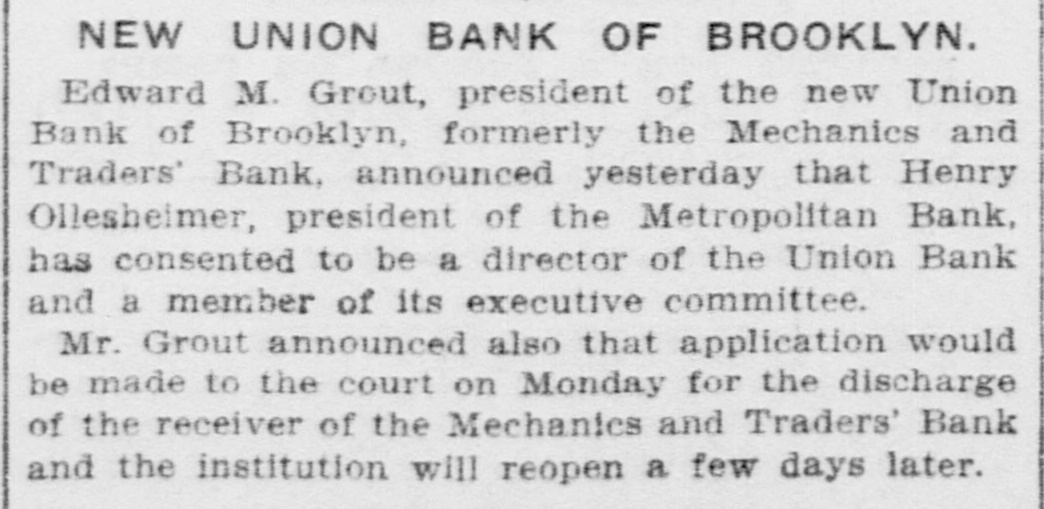
NEW UNION BANK OF BROOKLYN. Edward M. Grout, president of the new Union Bank of Brooklyn, formerly the Mechanics and Traders' Bank, announced yesterday that Henry Ollesheimer, president of the Metropolitan Bank, has consented to be a director of the Union Bank and a member of its executive committee. Mr. Grout announced also that application would be made to the court on Monday for the discharge of the receiver of the Mechanics and Traders' Bank and the institution will reopen a few days later.


Article from The Detroit Times, August 10, 1908

Click image to open full size in new tab

Article Text

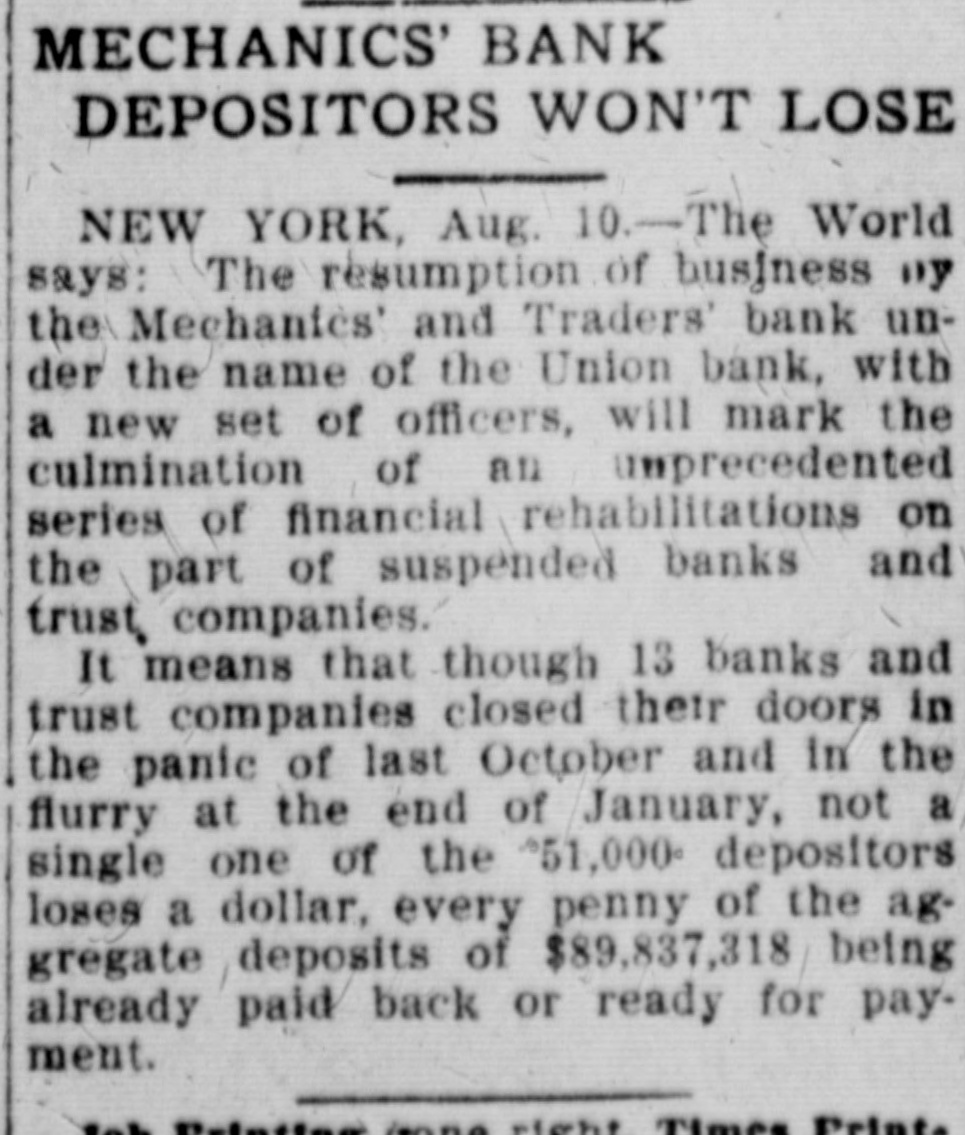
# MECHANICS' BANK # DEPOSITORS WON'T LOSE NEW YORK, Aug. 10. -The World says: The resumption of business by the Mechanics' and Traders' bank under the name of the Union bank, with a new set of officers, will mark the culmination of an unprecedented series of financial rehabilitations on the part of suspended banks and trust companies. It means that though 13 banks and trust companies closed their doors in the panic of last October and in the flurry at the end of January, not a single one of the 51,000 depositors loses a dollar, every penny of the aggregate deposits of $89,837,318 being already paid back or ready for payment.


Article from New-York Tribune, August 18, 1908

Click image to open full size in new tab

Article Text

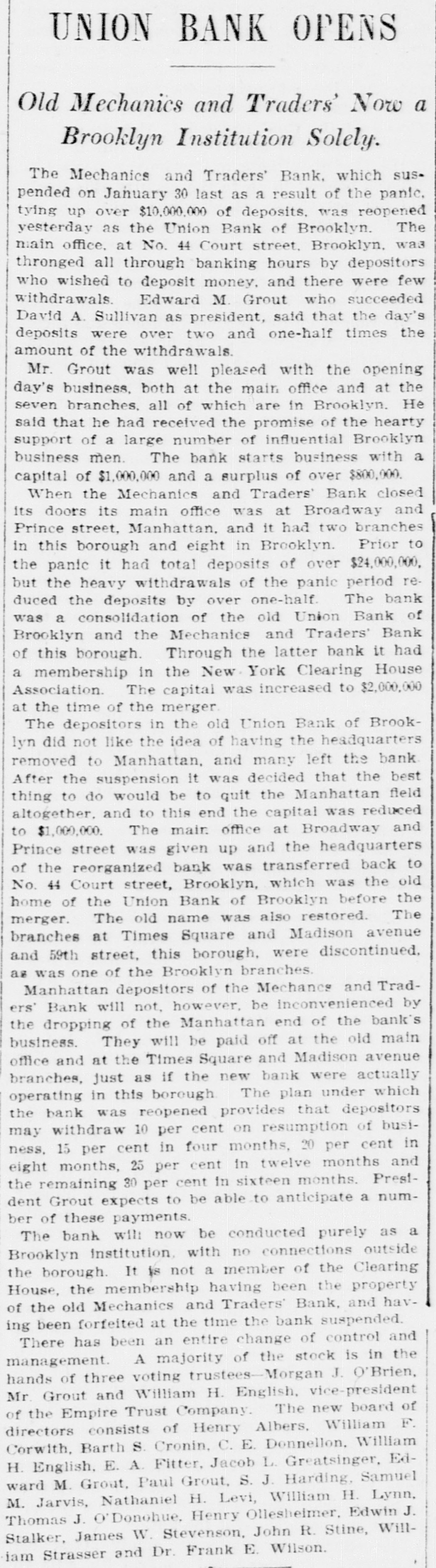
UNION BANK OPENS Old Mechanics and Traders' Now a Brooklyn Institution Solely. The Mechanics and Traders' Bank. which suspended on January 30 last as a result of the panic, tying up over $10,000,000 of deposits, was reopened yesterday as the Union Bank of Brooklyn. The main office. at No. 44 Court street, Brooklyn, was thronged all through banking hours by depositors who wished to deposit money, and there were few withdrawals. Edward M. Grout who succeeded David A. Sullivan as president, said that the day's deposits were over two and one-half times the amount of the withdrawals. Mr. Grout was well pleased with the opening day's business, both at the main office and at the seven branches, all of which are in Brooklyn. He said that he had received the promise of the hearty support of a large number of influential Brooklyn business men. The bank starts business with a capital of $1,000,000 and a surplus of over $800,000. When the Mechanics and Traders' Bank closed its doors its main office was at Broadway and Prince street, Manhattan, and it had two branches in this borough and eight in Brooklyn. Prior to the panic it had total deposits of over $24,000,000. but the heavy withdrawals of the panic period reduced the deposits by over one-half. The bank was a consolidation of the old Union Bank of Brooklyn and the Mechanics and Traders' Bank of this borough. Through the latter bank it had a membership in the New York Clearing House Association. The capital was increased to $2,000,000 at the time of the merger The depositors in the old Union Bank of Brooklyn did not like the idea of having the headquarters removed to Manhattan, and many left the bank After the suspension it was decided that the best thing to do would be to quit the Manhattan field altogether. and to this end the capital was reduced to $1,000,000. The mair. office at Broadway and Prince street was given up and the headquarters of the reorganized bank was transferred back to No. 44 Court street, Brooklyn, which was the old home of the Union Bank of Brooklyn before the merger. The old name was also restored. The branches at Times Square and Madison avenue and 59th street, this borough, were discontinued. as was one of the Brooklyn branches Manhattan depositors of the Mechance and Traders' Bank will not. however, be inconvenienced by the dropping of the Manhattan end of the bank's business. They will be paid off at the old main office and at the Times Square and Madison avenue branches, just as if the new bank were actually operating in this borough The plan under which the bank was reopened provides that depositors may withdraw 10 per cent on resumption of business, 15 per cent in four months, 20 per cent in eight months, 25 per cent in twelve months and the remaining 30 per cent in sixteen months. Prestdent Grout expects to be able to anticipate a number of these payments. The bank will now be conducted purely as a Brooklyn institution with no connections outside the borough. It is not a member of the Clearing House, the membership having been the property of the old Mechanics and Traders' Bank, and having been forfeited at the time the bank suspended. There has been an entire change of control and management. A majority of the stock is in the hands of three voting trustees-Morgan J. Brien, Mr. Grout and William H. English, vice-president of the Empire Trust Company. The new board of directors consists of Henry Albers, William F. Corwith, Barth S. Cronin, C. E. Donnellon, William H. English, E. A. Fitter, Jacob L Greatsinger, Edward M. Grout. Paul Grout, S. J. Harding, Samuel M. Jarvis, Nathaniel H. Levi, William H. Lynn. Thomas J. O'Donohue, Henry Ollesheimer, Edwin J. Stalker, James W. Stevenson, John R. Stine, William Strasser and Dr. Frank E. Wilson.


Article from The Morning Journal-Courier, August 18, 1908

Click image to open full size in new tab

Article Text

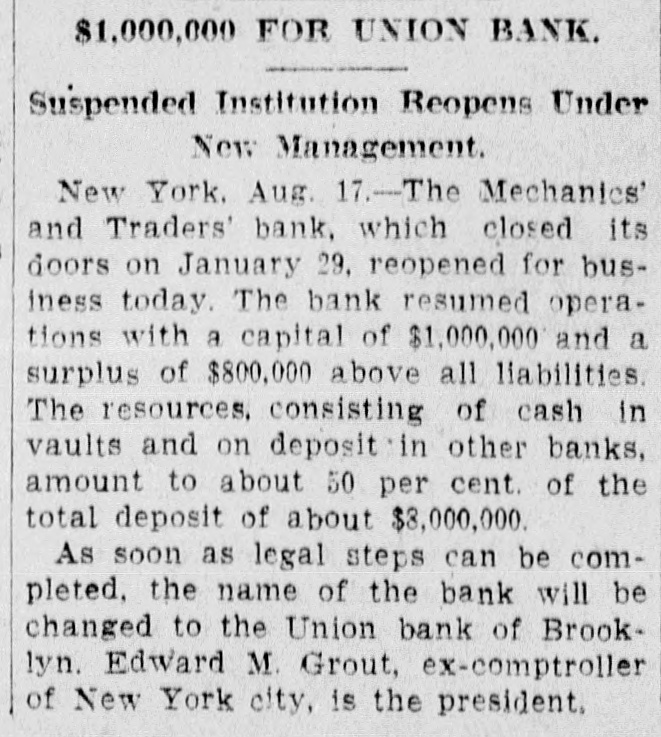
$1,000,000 FOR UNION BANK. Suspended Institution Reopens Under New Management. New York. Aug. 17.-The Mechanics' and Traders' bank, which closed its doors on January 29, reopened for business today. The bank resumed operations with a capital of $1,000,000 and a surplus of $800,000 above all liabilities. The resources, consisting of cash in vaults and on deposit in other banks, amount to about 50 per cent. of the total deposit of about $3,000,000. As soon as legal steps can be completed, the name of the bank will be changed to the Union bank of Brooklyn. Edward M. Grout, ex-comptroller of New York city, is the president.


Article from The Rich Hill Tribune, December 31, 1908

Click image to open full size in new tab

Article Text

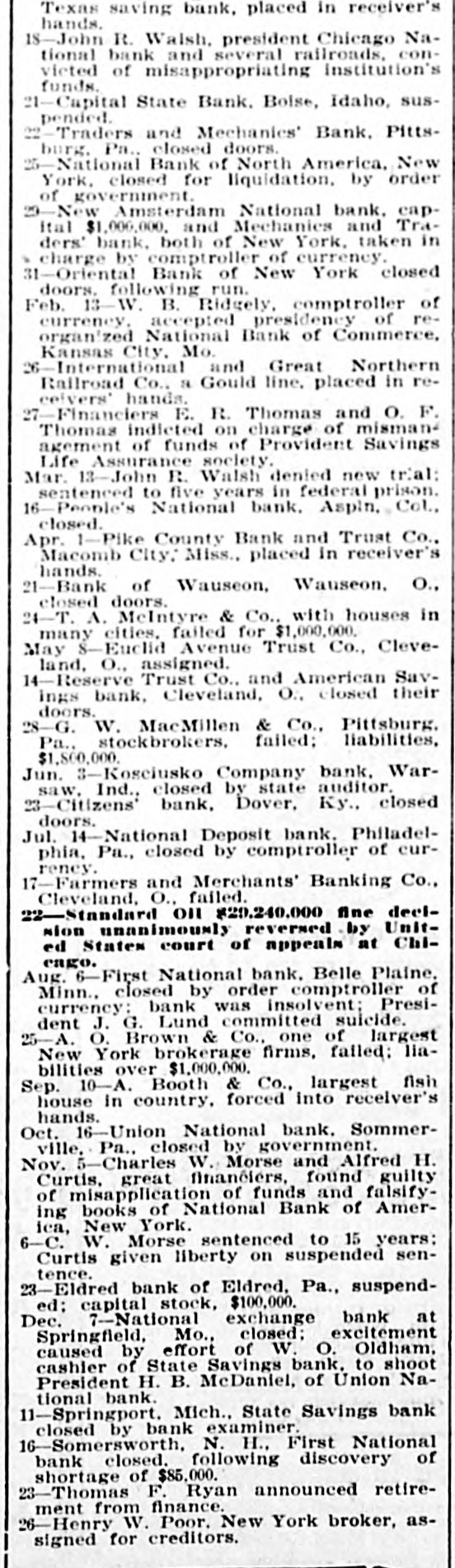
Texas saving bank, placed in receiver's hands. 18—John R. Walsh, president Chicago National bank and several railroads, convicted of misappropriating institution's funds. 21—Capital State Bank, Boise, Idaho, suspended. 22—Traders and Mechanics' Bank, Pittsburg, Pa., closed doors. 25—National Bank of North America, New York, closed for liquidation, by order of government. 29—New Amsterdam National bank, capital $1,000,000, and Mechanics and Traders' bank, both of New York, taken in charge by comptroller of currency. 31—Oriental Bank of New York closed doors, following run. Feb. 13—W. B. Ridgely, comptroller of currency, accepted presidency of reorganized National Bank of Commerce, Kansas City, Mo. 26—International and Great Northern Railroad Co., a Gould line, placed in receivers' hands. 27—Financiers E. R. Thomas and O. F. Thomas indicted on charge of mismanagement of funds of Provident Savings Life Assurance society. Mar. 13—John R. Walsh denied new trial; sentenced to five years in federal prison. 16—People's National bank, Aspin, Col., closed. Apr. 1—Pike County Bank and Trust Co., Macomb City, Miss., placed in receiver's hands. 21—Bank of Wauseon, Wauseon, O., closed doors. 24—T. A. McIntyre & Co., with houses in many cities, failed for $1,000,000. May 8—Euclid Avenue Trust Co., Cleveland, O., assigned. 14—Reserve Trust Co., and American Savings bank, Cleveland, O., closed their doors. 28—G. W. MacMillen & Co., Pittsburg, Pa., stockbrokers, failed; liabilities, $1,800,000. Jun. 2—Kosciusko Company bank, Warsaw, Ind., closed by state auditor. 23—Citizens' bank, Dover, Ky., closed doors. Jul. 14—National Deposit bank, Philadelphia, Pa., closed by comptroller of currency. 17—Farmers and Merchants' Banking Co., Cleveland, O., failed. Aug. 6—First National bank, Belle Plaine, Minn., closed by order comptroller of currency; bank was insolvent; President J. G. Lund committed suicide. 25—A. O. Brown & Co., one of largest New York brokerage firms, failed; liabilities over $1,000,000. Sep. 10—A. Booth & Co., largest fish house in country, forced into receiver's hands. Oct. 16—Union National bank, Sommerville, Pa., closed by government. Nov. 5—Charles W. Morse and Alfred H. Curtis, great financiers, found guilty of misapplication of funds and falsifying books of National Bank of America, New York. 6—C. W. Morse sentenced to 15 years; Curtis given liberty on suspended sentence. 23—Eldred bank of Eldred, Pa., suspended; capital stock, $100,000. Dec. 7—National exchange bank at Springfield, Mo., closed; excitement caused by effort of W. O. Oldham, cashier of State Savings bank, to shoot President H. B. McDaniel, of Union National bank. 11—Springport, Mich., State Savings bank closed by bank examiner.


Article from The Guthrie Daily Leader, January 2, 1909

Click image to open full size in new tab

Article Text

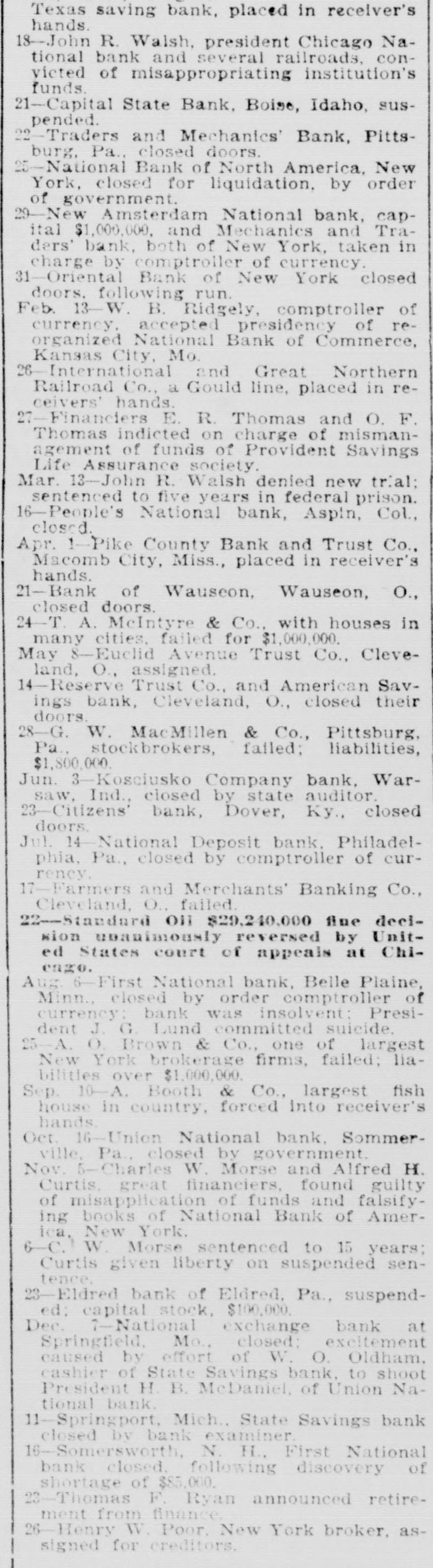
Texas saving bank, placed in receiver's hands. 18—John R. Walsh, president Chicago National bank and several railroads, convicted of misappropriating institution's funds. 21—Capital State Bank, Boise, Idaho, suspended. 22—Traders and Mechanics' Bank, Pittsburg, Pa., closed doors. 25—National Bank of North America, New York, closed for liquidation, by order of government. 29—New Amsterdam National bank, capital $1,000,000, and Mechanics and Traders' bank, both of New York, taken in charge by comptroller of currency. 31—Oriental Bank of New York closed doors, following run. Feb. 13—W. B. Ridgely, comptroller of currency, accepted presidency of reorganized National Bank of Commerce, Kansas City, Mo. 26—International and Great Northern Railroad Co., a Gould line, placed in receivers' hands. 27—Financiers E. R. Thomas and O. F. Thomas indicted on charge of mismanagement of funds of Provident Savings Life Assurance society. Mar. 13—John R. Walsh denied new trial; sentenced to five years in federal prison. 16—People's National bank, Aspin, Col., closed. Apr. 1—Pike County Bank and Trust Co., Macomb City, Miss., placed in receiver's hands. 21—Bank of Wauseon, Wauseon, O., closed doors. 24—T. A. McIntyre & Co., with houses in many cities, failed for $1,000,000. May 8—Euclid Avenue Trust Co., Cleveland, O., assigned. 14—Reserve Trust Co., and American Savings bank, Cleveland, O., closed their doors. 28—G. W. MacMillen & Co., Pittsburg, Pa., stockbrokers, failed; liabilities, $1,800,000. Jun. 3—Kosciusko Company bank, Warsaw, Ind., closed by state auditor. 23—Citizens' bank, Dover, Ky., closed doors. Jul. 14—National Deposit bank, Philadelphia, Pa., closed by comptroller of currency. 17—Farmers and Merchants' Banking Co., Cleveland, O., failed. Aug. 6—First National bank, Belle Plaine, Minn., closed by order comptroller of currency; bank was insolvent; President J. G. Lund committed suicide. 25—A. O. Brown & Co., one of largest New York brokerage firms, failed; liabilities over $1,000,000. Sep. 10—A. Booth & Co., largest fish house in country, forced into receiver's hands. Oct. 16—Union National bank, Sommerville, Pa., closed by government. Nov. 5—Charles W. Morse and Alfred H. Curtis, great financiers, found guilty of misapplication of funds and falsifying books of National Bank of America, New York. 6—C. W. Morse sentenced to 15 years; Curtis given liberty on suspended sentence. 23—Eldred bank of Eldred, Pa., suspended; capital stock, $100,000. Dec. 7—National exchange bank at Springfield, Mo., closed; excitement caused by effort of W. O. Oldham, cashier of State Savings bank, to shoot President H. B. McDaniel, of Union National bank. 11—Springport, Mich., State Savings bank closed by bank examiner.


Article from The Forrest City Times, January 8, 1909

Click image to open full size in new tab

Article Text

Texas saving bank, placed in receiver's hands. 18—John R. Walsh, president Chicago National bank and several railroads, convicted of misappropriating institution's funds. 21—Capital State Bank, Boise, Idaho, suspended. 22—Traders and Mechanics' Bank, Pittsburg, Pa., closed doors. 25—National Bank of North America, New York, closed for liquidation, by order of government. 29—New Amsterdam National bank, capital $1,000,000, and Mechanics and Traders' bank, both of New York, taken in charge by comptroller of currency. 31—Oriental Bank of New York closed doors, following run. Feb. 13—W. B. Ridgely, comptroller of currency, accepted presidency of reorganized National Bank of Commerce, Kansas City, Mo. 26—International and Great Northern Railroad Co., a Gould line, placed in receivers' hands. 27—Financiers E. R. Thomas and O. F. Thomas indicted on charge of mismanagement of funds of Provident Savings Life Assurance society. Mar. 13—John R. Walsh denied new trial; sentenced to five years in federal prison. 16—People's National bank, Aspin, Col., closed. Apr. 1—Pike County Bank and Trust Co., Macomb City, Miss., placed in receiver's hands. 21—Bank of Wauseon, Wauseon, O., closed doors. 24—T. A. McIntyre & Co., with houses in many cities, failed for $1,000,000. May 8—Euclid Avenue Trust Co., Cleveland, O., assigned. 14—Reserve Trust Co., and American Savings bank, Cleveland, O., closed their doors. 28—G. W. MacMillen & Co., Pittsburg, Pa., stockbrokers, failed; liabilities, $1,800,000. Jun. 3—Kosciusko Company bank, Warsaw, Ind., closed by state auditor. 23—Citizens' bank, Dover, Ky., closed doors. Jul. 14—National Deposit bank, Philadelphia, Pa., closed by comptroller of currency. 17—Farmers and Merchants' Banking Co., Cleveland, O., failed. 22—Standard Oil $29,240,000 fine decision unanimously reversed by United States court of appeals at Chicago. Aug. 6—First National bank, Belle Plaine, Minn., closed by order comptroller of currency; bank was insolvent; President J. G. Lund committed suicide. 25—A. O. Brown & Co., one of largest New York brokerage firms, failed; liabilities over $1,000,000. Sep. 10—A. Booth & Co., largest fish house in country, forced into receiver's hands. Oct. 16—Union National bank, Sommerville, Pa., closed by government. Nov. 5—Charles W. Morse and Alfred H. Curtis, great financiers, found guilty of misapplication of funds and falsifying books of National Bank of America, New York. 6—C. W. Morse sentenced to 15 years; Curtis given liberty on suspended sentence. 23—Eldred bank of Eldred, Pa., suspended; capital stock, $100,000. Dec. 7—National exchange bank at Springfield, Mo., closed; excitement caused by effort of W. O. Oldham, cashier of State Savings bank, to shoot President H. B. McDaniel, of Union National bank. 11—Springport, Mich., State Savings bank closed by bank examiner. 16—Somersworth, N. H., First National bank closed, following discovery of shortage of $85,000. 22—Thomas F. Ryan announced retirement from finance. 26—Henry W. Poor, New York broker, assigned for creditors.

Article from The Ordway New Era, January 8, 1909

Click image to open full size in new tab

Article Text

Texas saving bank, placed in receiver's hands. 18—John R. Walsh, president Chicago National bank and several railroads, convicted of misappropriating institution's funds. 21—Capital State Bank, Boise, Idaho, suspended. 22—Traders and Mechanics' Bank, Pittsburg, Pa., closed doors. 25—National Bank of North America, New York, closed for liquidation, by order of government. 29—New Amsterdam National bank, capital $1,000,000, and Mechanics and Traders' bank, both of New York, taken in charge by comptroller of currency. 31—Oriental Bank of New York closed doors, following run. Feb. 13—W. B. Ridgely, comptroller of currency, accepted presidency of reorganized National Bank of Commerce, Kansas City, Mo. 26—International and Great Northern Railroad Co., a Gould line, placed in receivers' hands. 27—Financiers E. R. Thomas and O. F. Thomas indicted on charge of mismanagement of funds of Provident Savings Life Assurance society. Mar. 13—John R. Walsh denied new trial; sentenced to five years in federal prison. 16—People's National bank, Aspin, Col., closed. Apr. 1—Pike County Bank and Trust Co., Macomb City, Miss., placed in receiver's hands. 21—Bank of Wauseon, Wauseon, O., closed doors. 24—T. A. McIntyre & Co., with houses in many cities, failed for $1,000,000. May 8—Euclid Avenue Trust Co., Cleveland, O., assigned. 14—Reserve Trust Co., and American Savings bank, Cleveland, O., closed their doors. 28—G. W. MacMillen & Co., Pittsburg, Pa., stockbrokers, failed; liabilities, $1,800,000. Jun. 3—Kosciusko Company bank, Warsaw, Ind., closed by state auditor. 23—Citizens' bank, Dover, Ky., closed doors. Jul. 14—National Deposit bank, Philadelphia, Pa., closed by comptroller of currency. 17—Farmers and Merchants' Banking Co., Cleveland, O., failed. 22—Standard Oil $29,240,000 fine decision unanimously reversed by United States court of appeals at Chicago. Aug. 6—First National bank, Belle Plaine, Minn., closed by order comptroller of currency; bank was insolvent; President J. G. Lund committed suicide. 25—A. O. Brown & Co., one of largest New York brokerage firms, failed; liabilities over $1,000,000. Sep. 10—A. Booth & Co., largest fish house in country, forced into receiver's hands. Oct. 16—Union National bank, Sommerville, Pa., closed by government. Nov. 5—Charles W. Morse and Alfred H. Curtis, great financiers, found guilty of misapplication of funds and falsifying books of National Bank of America, New York. 6—C. W. Morse sentenced to 15 years; Curtis given liberty on suspended sentence. 23—Eldred bank of Eldred, Pa., suspended; capital stock, $100,000. Dec. 7—National exchange bank at Springfield, Mo., closed; excitement caused by effort of W. O. Oldham, cashier of State Savings bank, to shoot President H. B. McDaniel, of Union National bank. 11—Springport, Mich., State Savings bank closed by bank examiner. 16—Somersworth, N. H., First National bank closed, following discovery of shortage of $85,000. 23—Thomas F. Ryan announced retirement from finance. 26—Henry W. Poor, New York broker, assigned for creditors.

Article from The Sun, May 17, 1911

Click image to open full size in new tab

Article Text

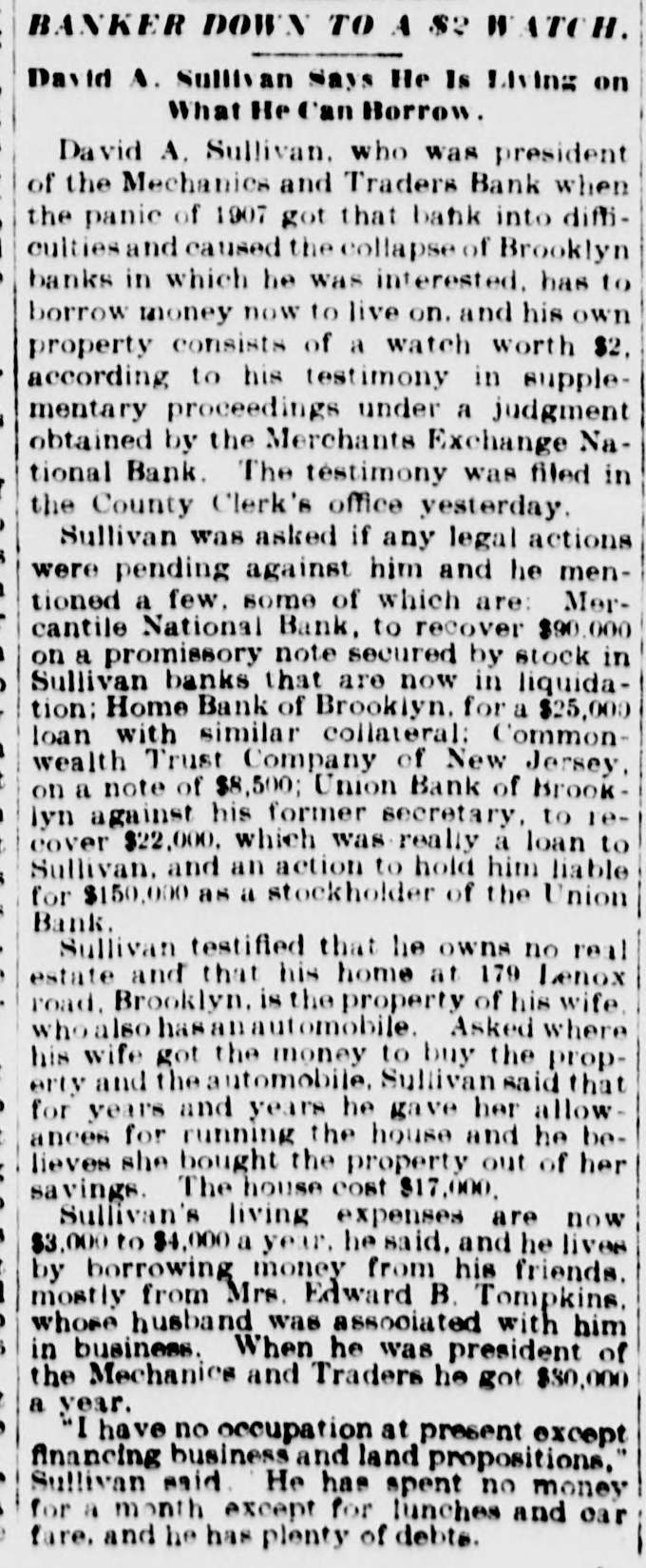
BANKER DOWN TO A $2 " ATCH. David A. Sullivan says He Is Living on What He Can Borrow. David A. Sullivan. who was president of the Mechanics and Traders Bank when the panic of 1907 got that bank into difficuities and caused the collapse of Brooklyn banks in which he was interested, has to borrow money now to live on. and his own property consists of a watch worth $2. according to his testimony in supplementary proceedings under a judgment obtained by the Merchants Exchange National Bank. The testimony was filed in the County Clerk's office yesterday. Sullivan was asked if any legal actions were pending against him and he mentioned a few. some of which are: Mercantile National Bank, to recover $90.000 on a promissory note secured by stock in Sullivan banks that are now in liquidation: Home Bank of Brooklyn. for a $25,000 loan with similar collateral: Commonwealth Trust Company of New Jersey, on a note of $8,500; Union Bank of Brooklyn against his former secretary, to recover $22,000. which was really a loan to Sullivan. and an action to hold him liable for $150,000 as a stockholder of the Union Bank. Sullivan testified that he owns no real estate and that his home at 179 Lenox road. Brooklyn, is the property of his wife. who also hasanautomobile. Asked where his wife got the money to buy the property and the automobile, Sullivan said that for years and years he gave her allowances for running the house and he believes she bought the property out of her savings. The house cost $17,000. Sullivan's living expenses are now $3.000 to $4,000 a year. he said. and he lives by borrowing money from his friends. mostly from Mrs. Edward B. Tompkins. whose husband was associated with him in business. When he was president of the Mechanics and Traders he got $30,000 a year. "I have no occupation at present except financing business and land propositions. Sullivan said. He has spent no money for a month except for lunches and car fare. and he has plenty of debte.


Article from Newark Evening Star and Newark Advertiser, May 17, 1911

Click image to open full size in new tab

Article Text

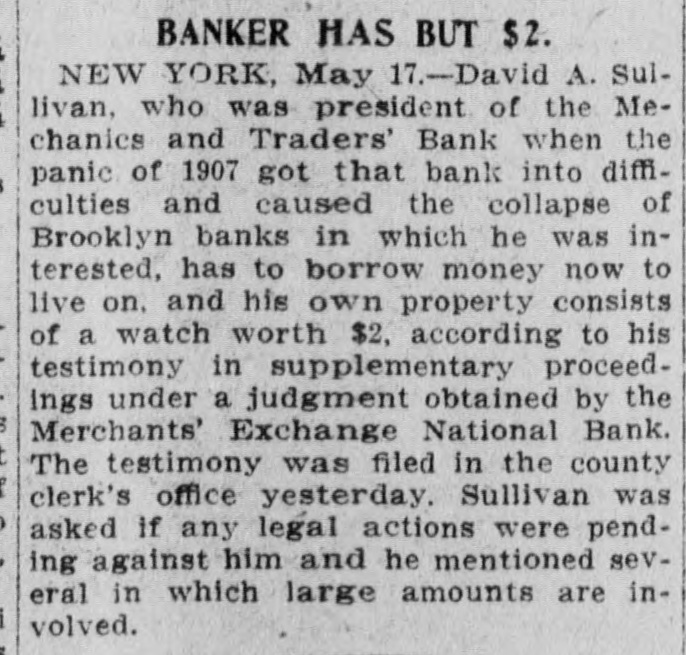
BANKER HAS BUT $2. NEW YORK, May 17.-David A. Sullivan, who was president of the Mechanics and Traders' Bank when the panic of 1907 got that bank into difficulties and caused the collapse of Brooklyn banks in which he was interested, has to borrow money now to live on, and his own property consists of a watch worth $2, according to his testimony in supplementary proceedings under a judgment obtained by the Merchants' Exchange National Bank. The testimony was filed in the county clerk's office yesterday. Sullivan was asked if any legal actions were pending against him and he mentioned several in which large amounts are involved.