Jay Cooke & Company (Philadelphia, PA)

Episode Information

Episode UID
9028931590885
Episode Type
Run โ†’ Suspension โ†’ Closure
Bank Type
private
Bank ID
902893159 hash
Start Date
September 18, 1873
Location
Philadelphia, Pennsylvania (39.952, -75.164)

Metadata

Model
gpt-5-mini (chosen from majority vote of a three-model LLM ensemble)
Short Digest
8328ab3ab35e9d13

Response Measures

None

Events (3)

1. September 18, 1873 Run
Cause
Bank Specific Adverse Info
Cause Details
Losses and heavy exposure in railroad (Northern Pacific) bonds and related speculative engagements led depositors to withdraw funds.
Measures
Clerical force set to prepare statement; posted notice to depositors; attempted to reassure public and requested forbearance from creditors.
Newspaper Excerpt
the run on their house has ceased; the run on Jay Cooke & Co. was the principal object of their attack.
Source
newspapers
2. September 18, 1873 Suspension
Cause
Bank Specific Adverse Info
Cause Details
Unexpected heavy demands driven by the firm's railroad-related exposures forced temporary suspension of payments.
Newspaper Excerpt
SUSPENSION OF THE GREAT BANKING FIRM. ... owing to unexpected demands upon us, our office has been obliged to suspend for a few days.
Source
newspapers
3. November 27, 1873 Receivership
Newspaper Excerpt
A RECEIVER APPOINTED IN THE JAY COOKE & CO. BANKRUPTCY CASE. ... Edwin D. Lewis ... has accepted the position of receiver in Jay Cooke & Co.'s bankruptcy case, offered by the Court.
Source
newspapers

Newspaper Articles (25)

Article from Wilmington Daily Commercial, September 18, 1873

Click image to open full size in new tab

Article Text

SECOND EDITION. Jay Cooke & Co. SUSPENSION OF THE GREAT BANKING FIRM. PHILADELPHIA, Sept. 18.


Article from Evening Star, September 19, 1873

Click image to open full size in new tab

Article Text

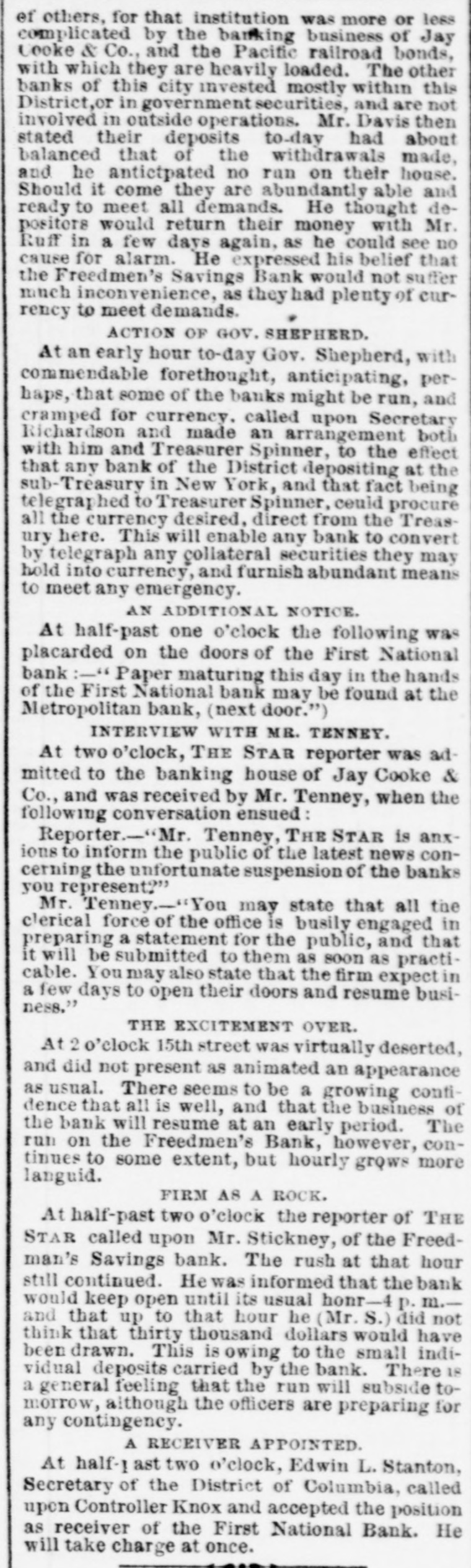
of others, for that institution was more or less complicated by the banking business of Jay Cooke & Co., and the Pacific railroad bonds, with which they are heavily loaded. The other banks of this city invested mostly within this District or in government securities, and are not involved in outside operations. Mr. Davis then stated their deposits to-day had about balanced that of the withdrawals made, and he antictpated no run on their house. Should it come they are abundantly able and ready to meet all demands. He thought depositors would return their money with Mr. Ruff in a few days again, as he could see no cause for alarm. He expressed his belief that the Freedmen's Savings Bank would not suffer much inconvenience, as they had plenty of currency to meet demands. ACTION OF GOV. SHEPHERD. At an early hour to-day Gov. Shepherd, with commendable forethought, anticipating, perhaps, that some of the banks might be run, and cramped for currency. called upon Secretary Richardson and made an arrangement both with him and Treasurer Spinner, to the effect that any bank of the District depositing at the sub-Treasury in New York, and that fact being telegrap hed to Treasurer Spinner, could procure all the currency desired, direct from the Treasury here. This will enable any bank to convert by telegraph any collateral securities they may hold into currency, and furnish abundant means to meet any emergency. AN ADDITIONAL NOTICE. At half-past one o'clock the following was placarded on the doors of the First National bank: Paper maturing this day in the hands of the First National bank may be found at the Metropolitan bank, (next door.") INTERVIEW WITH MR. TENNEY. At two o'clock, THE STAR reporter was admitted to the banking house of Jay Cooke & Co., and was received by Mr. Tenney, when the following conversation ensued: Reporter.-"Mr. Tenney, THE STAR is anxions to inform the public of the latest news concerning the unfortunate suspension of the banks you represent?" Mr. Tenney.-"You may state that all the clerical force of the office is busily engaged in preparing a statement for the public, and that it will be submitted to them as soon as practicable. You may also state that the firm expect in a few days to open their doors and resume business." THE EXCITEMENT OVER. At o'clock 15th street was virtually deserted, and did not present as animated an appearance as usual. There seems to be a growing contidence that all is well, and that the business of the bank will resume at an early period. The run on the Freedmen's Bank, however, continues to some extent, but hourly grows more languid. FIRM AS A ROCK. At half-past two o'clock the reporter of THE STAR called upon Mr. Stickney, of the Freedman's Savings bank. The rush at that hour still continued. He was informed that the bank would keep open until its usual honr-4 p. m.and that up to that hour he (Mr. S.) did not think that thirty thousand dollars would have been drawn. This is owing to the small individual deposits carried by the bank. There 18 a general feeling that the run will subside tomorrow, although the officers are preparing for any contingency. A RECEIVER APPOINTED At half-1 last two o'clock, Edwin L. Stanton, Secretary of the District of Columbia, called upon Controller Knox and accepted the position as receiver of the First National Bank. He will take charge at once.


Article from The Daily State Journal, September 19, 1873

Click image to open full size in new tab

Article Text

FREEDMAN'S BANK.-A telegram from Washington rรฉceived to-day, says that the Freedman's bank loses nothing by the suspension of Jay Cooke & Co.'s banking house or the First National bank of that city.


Article from New-York Tribune, September 20, 1873

Click image to open full size in new tab

Article Text

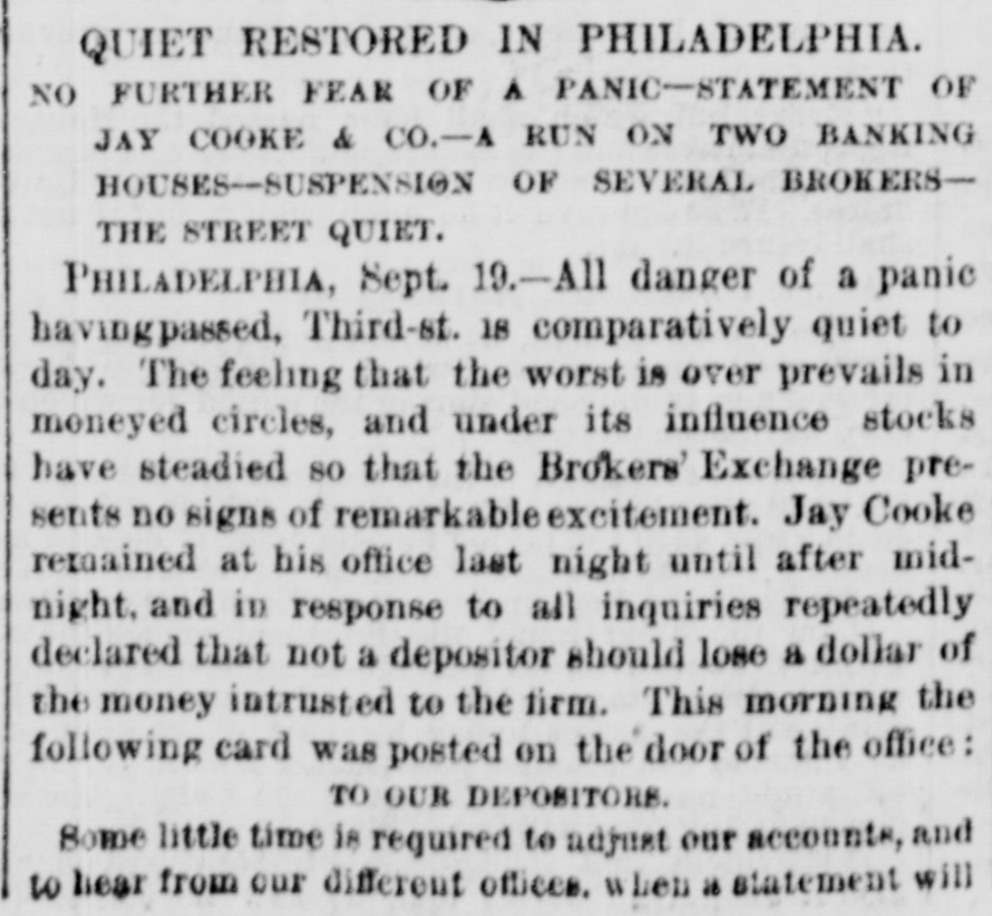
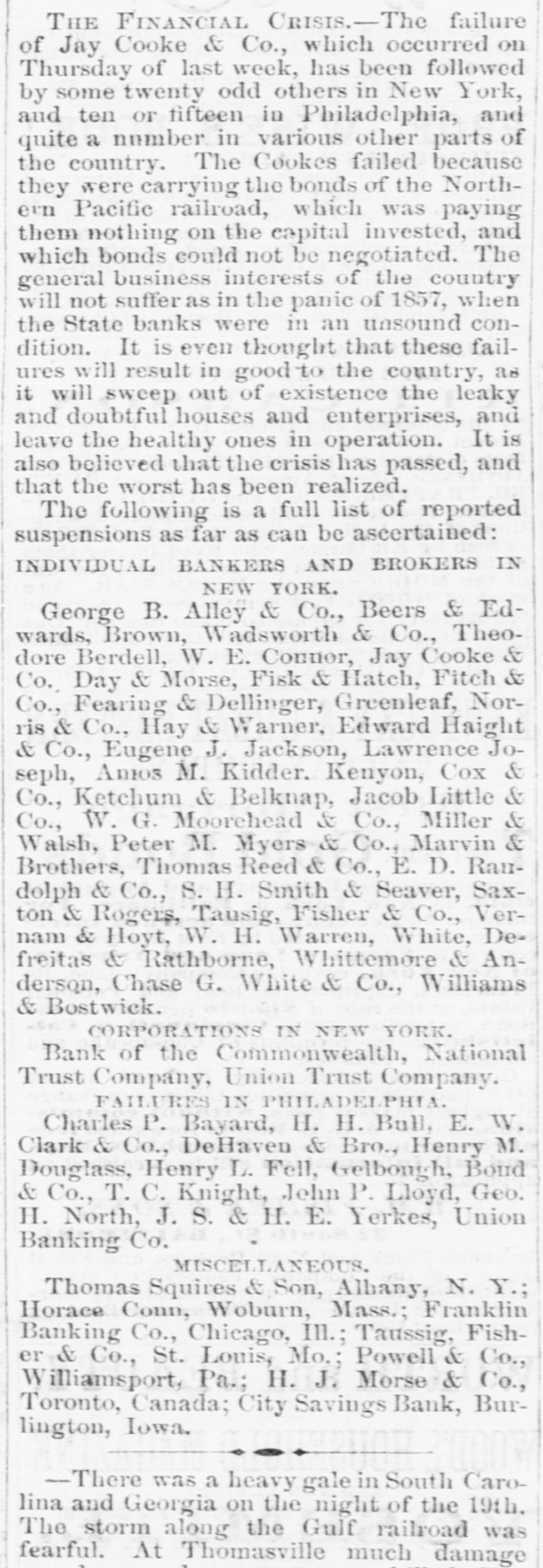
QUIET RESTORED IN PHILADELPHIA. NO FURTHER FEAR OF A PANIC-STATEMENT OF JAY COOKE & CO.-A RUN ON TWO BANKING HOUSES-SUSPENSION OF SEVERAL BROKERSTHE STREET QUIET. PHILADELPHIA, Sept. 19.-All danger of a panic havingpassed, Third-st. 18 comparatively quiet to day. The feeling that the worst is over prevails in moneyed circles, and under its influence stocks have steadied so that the Brokers' Exchange presents no signs of remarkableexcitement Jay Cooke remained at his office last night until after midnight. and in response to all inquiries repeatedly declared that not a depositor should lose a dollar of the money intrusted to the firm. This morning the following card was posted on the door of the office: TO OUR DEPOBITORS. Some little time is required to adjust our accounts, and to hear from our different offices. when a statement will


Article from Evening Star, September 20, 1873

Click image to open full size in new tab

Article Text

THE SYNDICATE ALL RIGHT. All rumors circulated with reference to losses by the syndicate, through the suspensions will be set at rest by the following cipher dispatch received this morning at the Treasury department: LONDON, Sept. 19, 1873, Evening. Hen. W. A. Richardson, Secretary of Treasury. The syndicate accounts are all in perfect order. There is a universal feeling of sympathy towards Jay Cooke, McCulloch & Co.'s house here, which continues transacting business as usual. A. G. CATTELL. THE FREEDMEN'S BANK. The run on the bank was continued this morning, but in comparison with yesterday's rush it was quite light. Much time is necessarily expended on each depositor, as nine out of ten are unable to write, and the checks are prepared by the paying teller, who witnesses the mark made by each. It is expected that by the time of closing the bank this afternoon that all making demands will have been satisfied. The usual droll scenes were to be witnessed to-day. The check-books are sometimes wrapped in bandanas, towels, brown paper, &c. The hat seems to be a favorite receptacle with many; the older dames carry "dat book" in their bosoms; but one old "Aunt Dinah," when her turn arrived to receive her cash, grinned all over with evident satisfaction, and produced the evidence of the bank's indebtedness from within a black stocking, which encased a leg of attenuated dimensions. Upon receiving the "cash money," it was substituted in the place vacated by the check-book, and she skipped out, as light-hearted as a school-girl at recess. Many who fall in at the rear end of the line, drag slowly about half way, take a look ahead, and reason perhaps that the bank is all right, and drop out and go their way. The officers of the bank are in no wise nervous, and are emphatic in their statement that they have abundant available resources on hand to meet any contingency. At half-past 12 o'clock to-day there had been drawn out of the Freedman's Bank sixty-five thousand dollars since the run began. About fifty persons were then in line awaiting payment. The officers continue their emphatic assurances that they are amply fortified for any emergency. ADDITIONAL PRECAUTIONS OF THE GOVERNMENT. A conference of Treasury officials was held late last night, at which it was decided to advertise for the purchase of ten million dollars of bonds to-day, and that in the event of this action failing to allay the excitement, it was further determined to draw on the forty-four million reserve to any extent necessary to restore confidence and stop the panic. A rumor is current at this writing (12 o'clock) that the stock exchange of New York has been closed, and that it will only be re-opened upon the order of its president, and that all who deal in stocks at any other place, or on the street, will be promptly expelled. THE LEGAL TENDER RESERVES. In connection with the drawing on the legal tender reserves to help Wall street, it will be remembered that Secretary Richardson has always claimed the right to issue any part or all of this reserve fund, in which opinion he is sustained by several decisions of the Supreme Court, delivered by the late Chief Justice Chase, who was Secretary of the Treasury at the time the law was passed which Secretary Richardson claims gives him the right to use the fund. JAY COOKE & CO.'S BANK. About double the usual clerical force are engaged in the bank setting accounts and preparing a statement for the public. Assistant Secretary Sawyer was some time in consultation with ex-Governor Cooke this morning. It still seems to be the general impression that the bank will resume business early next week. THE FIRST NATIONAL BANK. E. L. Stanton, designated by Secretary Richardson as receiver of his bank, took formal possession to-day, and began at once an investigation into its accounts. Under the law providing for a receiver, he is entitled to choose his own assistants, but as yet he has made no change in the clerical force of the bank, retaining them for the present as helomates. The bank was visited during the day by Controller Fox and Deputy Controller Langworthy. ANXIETY INCREASING. Towards noon, when the news of the suspensions in New York city and the closing of the New York stock exchange had become well noised throughout the city, callers and loungers around the bank increased in number, anxious to hear the latest intelligence from Wall street. While the feeling among many was unsettled, there seemed to be still evidences of confidence. Dispatches were received every few minutes by both the First National and Jay Cooke & Co.'s banks, and those inclined to be of a speculative turn of mind imagined and circulated many ill-founded rumors. INTERVIEW WITH TREASURER SPINNER. A little before two o'clock the reporter of THE STAR called on Gen. Spinner with reference to a subject which the following short conversation will explain: Reporter.โ€”"General, the New York Tribune of yesterday publishes a statement to the effect that two days before the First National Bank of this city suspended, that Secretary Richardson loaned that bank, without any collateral security, one hundred thousand dollars, which is aโ€”" General.โ€”"Damned lie. The Tribune is getting quite reckless lately. There is not a word of truth in the publication. Had such a loan been made, I certainly would have known of it. A blonde representative of that paper called upon me, but I am sure I gave him no information which would inspire on his part such a groundless dispatch." HOW MANY BONDS WERE OFFERED. In response to the call of the Treasury department for the purchase of ten million of bonds, only two million have been offered in New York for sale. This is caused, it is said, by two reasons: first, the closing of the Stock Exchange in New York, and second from the fact that all the available securities of this nature were 'hypothecated in trust to weather yesterday's storm. It seems now to be the general impression that Secretary Richardson will draw on the forty-four million bank reserves. AN ASSISTANT RECEIVER. It is said that E. M. Nourse, of the firm of Nourse & Middleton, has been appointed by Mr. Stanton assistant receiver of the First National Bank. NEARLY SUBSIDED. At half-past two o'clock there were not over thirty in line at the Freedman's Bank, and but few were coming in. It may be said that the run on this institution is virtually over. Order have been issued by the bank officers to pay every one off, and close the press of the depositors by the time the bank closes, at 4 p. m. Every clerk in the bank has been put at work in the payment of depositors. There is no run anticipated on Monday. THE WASHINGTON CITY SAVINGS BANK. The run on the Washington City Savings bank has dwindled down to a mere nothing; this morning some dozen persons were at the door when the bank opened, and it was observed that the same familiar faces seen in the line yesterday and who failed to reach the counter in season, made up a greater part of the crowd present to-day. A new line has been formed to-day on the other side of the door, where those who desire to make deposits are admitted, and the deposits have been quite heavy to-day. MR. RUFF'S OPINION.

Article from The Cairo Bulletin, September 23, 1873

Click image to open full size in new tab

Article Text

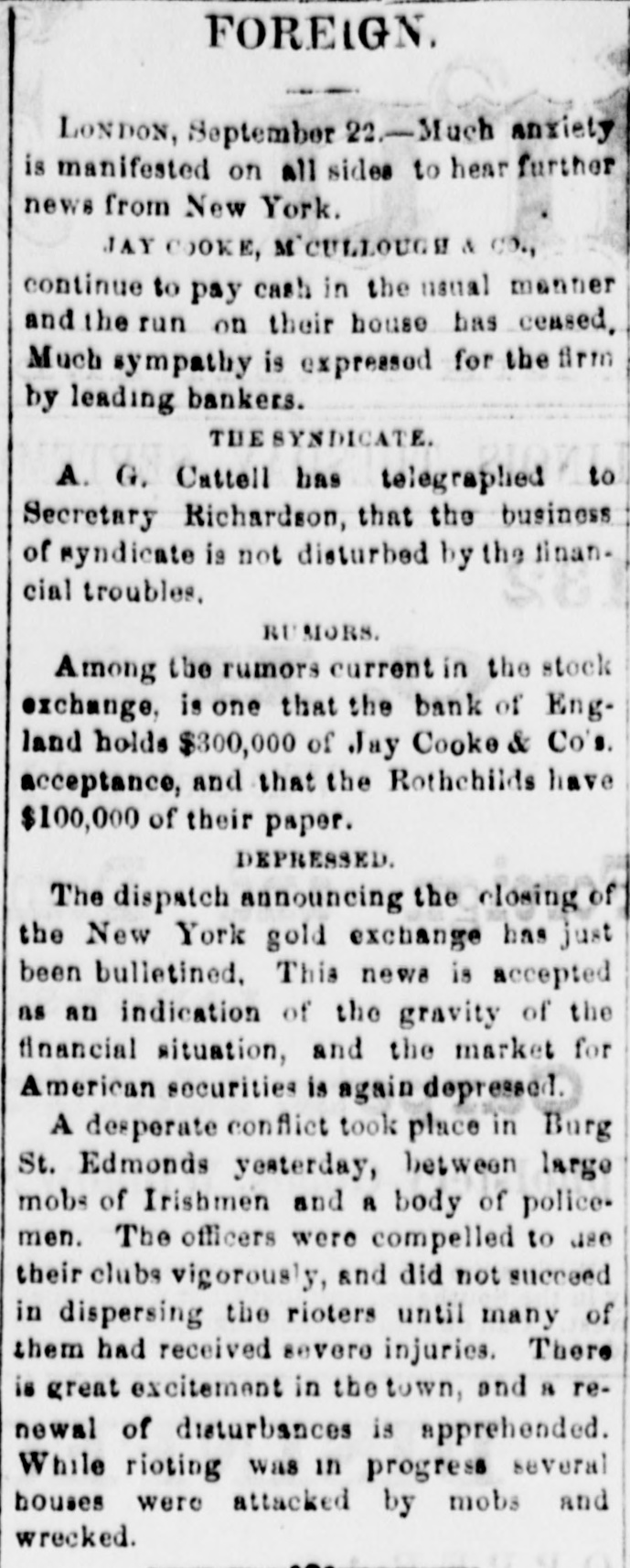
FOREIGN. LONDON, September 22.Much anxiety is manifested on all sides to hear further news from New York. JAY COOKE, M'CULLOUGH & CO., continue to pay cash in the usual manner and the run on their house has ceased, Much sympathy is expressed for the firm by leading bankers. THE SYNDICATE. A. G. Cattell has telegraphed to Secretary Richardson, that the business of syndicate is not disturbed by the finan. cial troubles. RUMORS. Among the rumors current in the stock exchange, is one that the bank of England holds $300,000 of Jay Cooke & Co's. acceptance, and that the Rothchilds have $100,000 of their paper. DEPRESSED. The dispatch announcing the closing of the New York gold exchange has just been bulletined, This news is accepted as an indication of the gravity of the financial situation, and the market for American securities is again depresed A desperate conflict took place in Burg St. Edmonds yeaterday, between large mobs of Irishmen and R body of police. men. The officers were compelled to use their clubs vigorously, and did not succeed in dispersing the rioters until many of them had received severe injuries. There is great excitement in the town, and a renewal of disturbances is apprehended. While rioting was in progress several houses were attacked by mobs and wrecked.


Article from Chicago Daily Tribune, September 23, 1873

Click image to open full size in new tab

Article Text

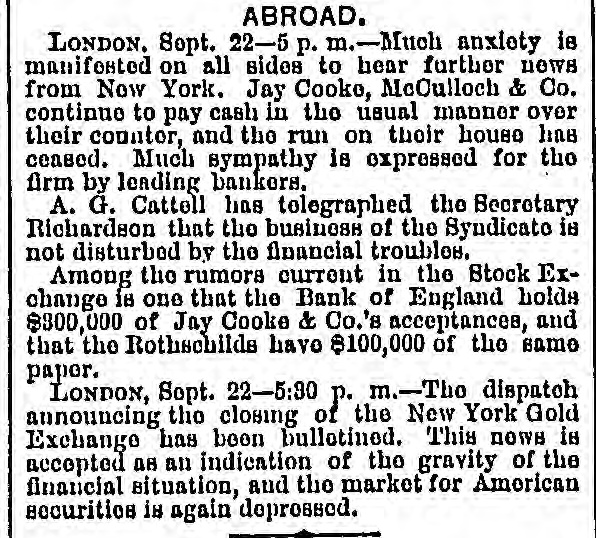
ABROAD. LONDON. Sopt. 22-5 p. m.-Much anxiety is manifested on all sides to hear further news from Now York. Jay Cooke, McCulloch & Co. continue to pay cash in the usual manner over their counter, and the run on their house has ceased. Much sympathy is expressed for the firm by leading bankers. A. G. Cattell has tolegraphed the Secretary Richardson that the business of the Syndicato is not disturbed by the financial troubles, Among the rumors current in the Stock Exchange is one that the Bank of England holds $300,000 of Jay Cooke & Co.'s acceptances, and that the Rothschilde have 8100,000 of the same paper. LONDON, Sopt. 22-5:30 p. m.-The dispatch announcing the closing of the New York Gold Exchange has been bullotined. This nows is accepted as an indication of the gravity of the financial situation, and the market for American securities is again depressed.


Article from The Bismarck Tribune, September 24, 1873

Click image to open full size in new tab

Article Text

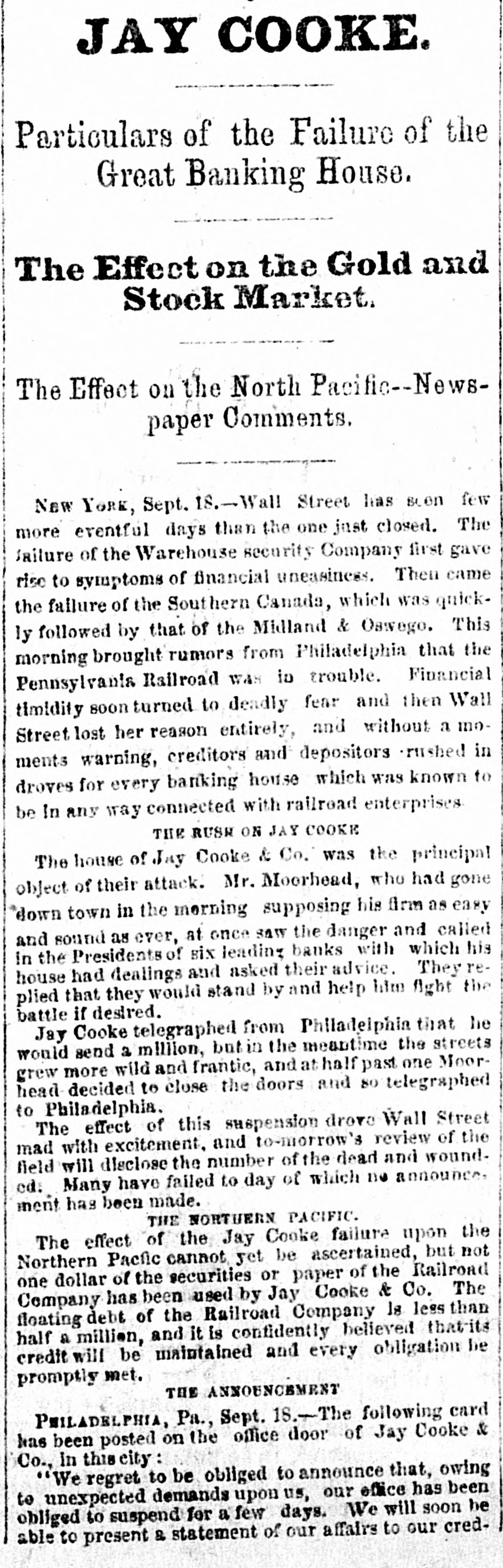
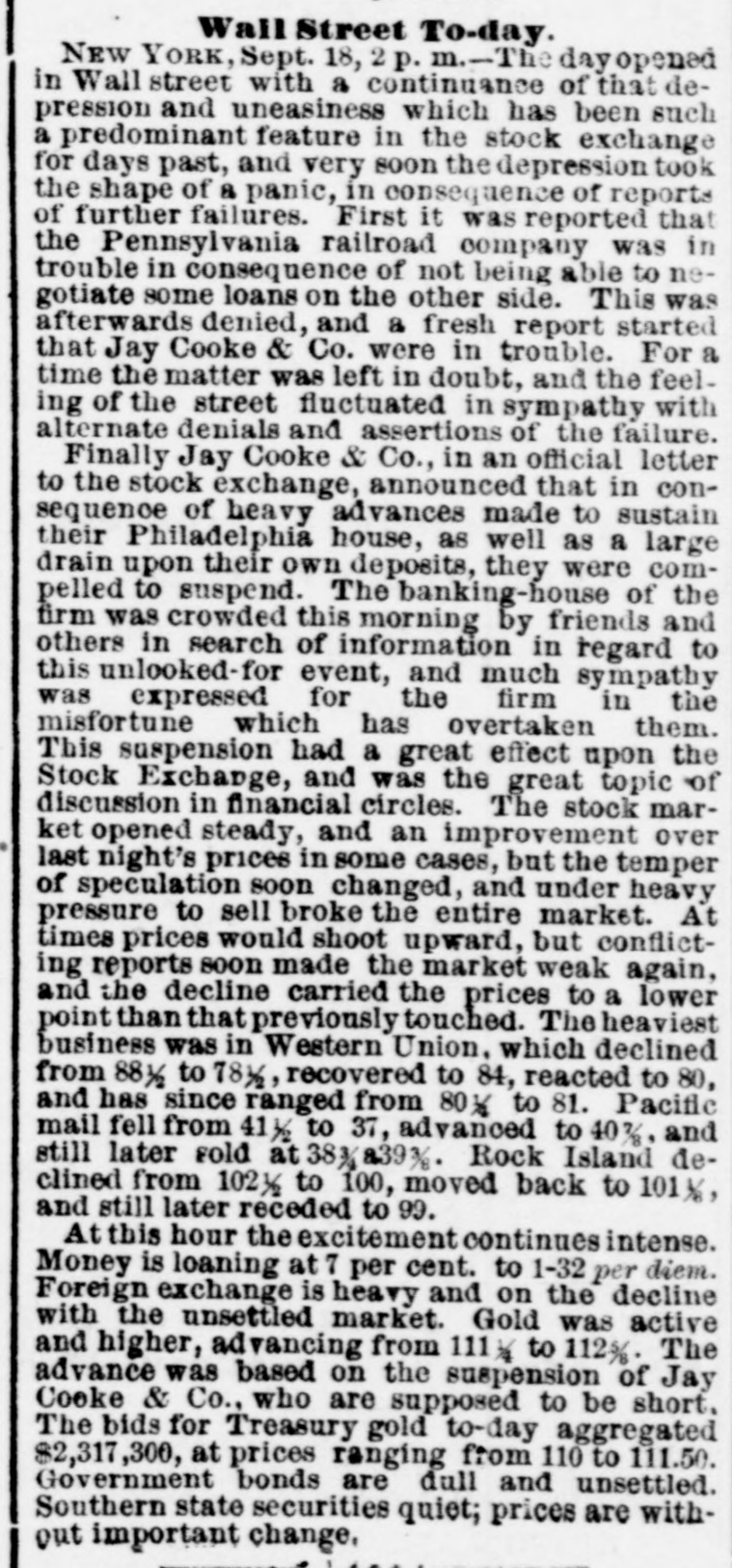
JAY COOKE. Particulars of the Failure of the Great Banking House. The Effect on the Gold and Stock Market. The Effect on the North Pacific-Newspaper Comments. New YORK, Sept. 18.-Wall Street has scon few more eventful days than the one just closed. The Sailure of the Warehouse security Company first gave rise to symptoms of financial uneasiness. Then came the failure of the Southern Canada, which was quickly followed by that of the Midland & Oswego. This morning brought rumors from Philadelphia that the Pennsylvania Railroad was in trouble. Financial timidity soon turned to deadly fear and then Wall Street lost her reason entirely, and without a moments warning, creditors and depositors rushed in droves for every banking house which was known to be In any way connected with railroad enterprises THE RUSH ON JAY COOKE The house of Jay Cooke & Co. was the principal object of their attack. Mr. Moorhead, who had gone "down town in the morning supposing his firm as easy and sound as ever, at once saw the danger and called in the Presidents of six leading banks with which his house had dealings and asked their advice. They replied that they would stand by and help him fight the battle if desired. Jay Cooke telegraphed from Philadelphia that he a million, but in the meantime the streets wild and frantic, at one grew would more send and half past Moorhead decided to close the doors and 80 telegraphed to Philadelphia. The effect of this suspension drove Wall Street mad with excitement, and to-morrow's review of the field will disclose the number of the dead and wounded. Many have failed to day of which no announce ment has been made. THE NORTHERN PACIFIC. The effect of the Jay Cooke failure upon the Northern Pacfic cannot yet be ascertained, but not one dollar of the securities or paper of the Railroad Company has been used by Jay Cooke & Co. The of the Railroad floating debt Company believed Is less that its than half a million, and it is confidently credit will be maintained and every obligation be promptly met. THE ANNOENCEMENT PHILADELPHIA, Pa., Sept. 18.-The following card has been posted on the office door of Jay Cooke & Co., in this city: "We regret to be obliged to announce that, owing to unexpected demands upon us, our office has been obliged to suspend for a few days. We will soon be able to present a statement of our affairs to our cred-


Article from Wilmington Daily Gazette, September 25, 1873

Click image to open full size in new tab

Article Text

DAILY GAZETTE. Valine Another important Failure in New York, on Wednesday created almost as much excitement as that of Henry Clews & Co. It was that of the firm of Howes & Maey. The Herald says, there was no foundation whatever for the mischievous rumors that the firms of Duncan, Sherman & Co., August Belmont and George Opdyke, had suspended. Altogether about seventy firms in New York, have failed since that of Jay Cooke & Co., was announced, while only three or four in Puiladelphia have gone under. There have been many failures in the various towns and cities, but beyond the closing of four houses in Pertersburg, Va., we have heard ofsitone south of Washington It is not a little remarkable that nearly all the failures are of brokers and bankers. Some people say the turn of the merchants in the great cities will come next. It is reported that Jay Cooke & Co., will not pay over 40 cents on the dollar.


Article from The Stark County Democrat, September 25, 1873

Click image to open full size in new tab

Article Text

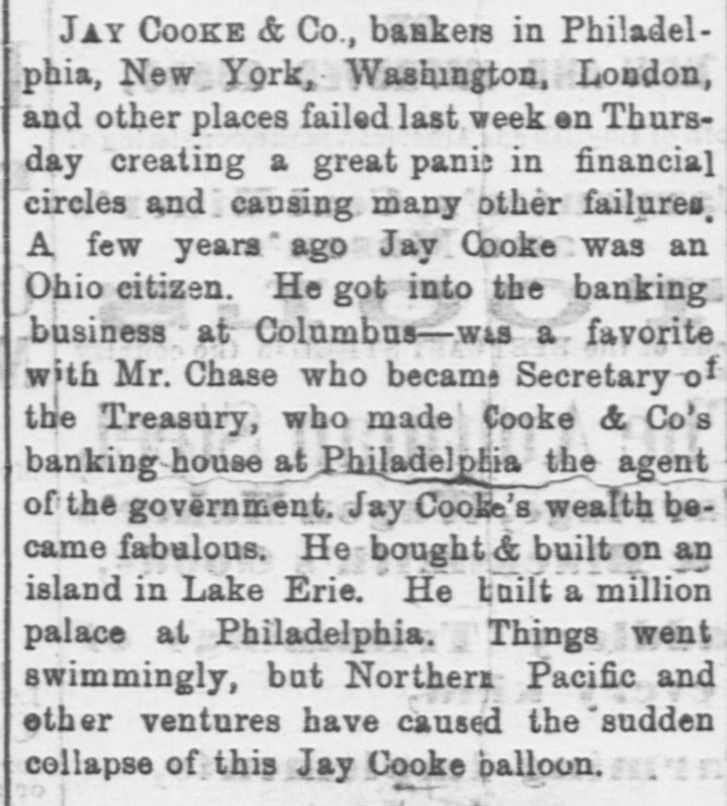
JAY COOKE & Co., bankers in Philadelphia, New York, Washington, London, and other places failed last week on Thursday creating a great panie in financial circles and causing many other failures A few years ago Jay Choke was an Ohio citizen. He got into the banking business at Columbus was a favorite with Mr. Chase who became Secretary of the Treasury, who made Cooke & Co's banking house at Philadelphia the agent of the government. Jay Cooke's wealth became fabulous. He-bought & built on an island in Lake Erie. He built a million palace at Philadelphia. Things went swimmingly, but Northern Pacific and other ventures have caused the sudden collapse of this Jay Cooke balloon.


Article from The Toledo Chronicle, September 25, 1873

Click image to open full size in new tab

Article Text

Panic in Wall Street. The financial world was shocked last Thursday by the announcement that the heavy firm of Jay Cook & Co,, of New York, had suspended payment This firm, as is well known was one of the heaviest banking houses in the world, having advanced immense sums of money w the gov erument during the war when the national credit was gone, and being now one of the leading members o! the syndicate, besides having advance ed millions of dollars to Railroad companies. Th bank suffere a run on Thursday morning. an was com pelled quate early 1a the day to clust The phuosophy of this future, which led to many other suspensions, must be sought in the fact that, instead of attending to a. legitim t banking bu-mess, speculative enterprises were entered into. Immense loads of railroad bonds, in which capitalists are now slow to invest, were taken and the result we see in a financial crisis, whose extent will never 1, known, because of the heavy loss on tailed upon holders of railroad stock responded of at a she " after 1. panic occurred. Among the new vailures we notice the following: Fish & Hatch, N " Y ik; the Fax National Bank of Washington, the New Your Unen Trust Company; he National Bank of in Common wealth, N.W York the National Trust Company. New York; the Bank of America, Non York; the Union Banking Company. 01 Philadelphia. These froms," of them at least. were intimatey associated with Couke & Co 111 their business trans actions, and the financial distress will be more of less wile-spread in proportion to the permanency of the failures. If the alone soff l' ed from the panic, the financial dis turbance would excite little sympto thy, but as it entailed losses upon many who had their all invested in radroal securities, which they sold at he ay loss, the panic is J. plorable. The effect produced upon the floor 01 the Stock Exchange may be intere red from the fact that last Saturday the extreme factuations on some clocks were as follows: Harlem 30 per cam; Panama, 18; Rook Island 91; Western Union. 9; Hammbal & St. Joseph, 9, with other stocks flue tuating from 2 to 8 points. The government came to the relief of the money market by purchasing U. Bonds. By this meaus, togeth. er with the action of Bank Presi dems, through the Clearing House loan certificates, many millions of greerbacks were released, with III touching any portion of the $44,000. 000 reserve now In the National Treasury.


Article from New-York Tribune, September 30, 1873

Click image to open full size in new tab

Article Text

HOWES & MACY. It is not the intention of this firm to make any public detailed statement of their affairs. They consider it unnecessary in view of the fact that they are adjusting matters as rapidly as possible, with the purpose of continuing business at as early a date as practicable. They are in daily receipt of letters from their customers, acceding to the proposition contained in their circular, and with the many satisfactory assu* rances thus received they are determined to resume operations on the plan proposed, in the hope that the experiment will eventually prove successful. Mr. Macy says the whole financial difficulty assumes a very peculiar phase. If a person has "money any where else than town in his own control he cannot get it. People out of who make collections for his house write that such and such an amount is deposited to their credit in such and such a bank. But that does not do them any good; that is not what they need; all the exchanges are so bad that certified checks are next to useless if one cannot get the money on them. Mr. Macy had been visited by a country correspondent who had come to New-York to draw a large amount of money which had been deposited in his bank in small amounts, and which the country banker had sent to the city for investment. But be could not procure the funds in) available shape, and remarked that unless he could get his deposits in bills of staall denominations, they were of no more use to him than 80 much brown paper. Mr Macy would have been glad if the Government relief had been proffered through another channel, whereby it would have brought money into the country and distributed it among the people. He thought $10,000,000 in the hands of the merchants at this time would do more good than if distributed among the banks. The present outlook was not very clear, yet they were cheerful and hopeful. Biugham Bros. & Brace of Mount Morris, N. Y., and E. B. Hale & Co. of Cleveland, Ohio, deny that they are correspondents of Howes & Macy. HENRY CLEWS & CO. This firm is still engaged in the preparation of its statement, but the time of completion is uncertain. It will be exclusively for the information of the creditors of the house, publicity probably being given to nothing beyond a report of assets and liabilities. Mr. Clews believes the effect of the panic will be felt for years. He says everybody in the street has virtually suspended that is,they cannot pay their loans or meet their obligations, and if they were applied to for the money they would be obliged to suspend, the same as the rest of us." He thought the outlook was horrible-frightful. With 6 per cent for greenbacks as against certified checks, who could stand I" JAY COOKE & CO. These gentlemen believe the prospect is brighter and that the good or iil of the future is dependent largely on the exercise or lack of caution and a spirit of accommo dation on the part of creditors as against their debtors. They are rather afraid, however, of the effect of the reopening of the Stock Exchange this morning. The fact is, they say, our banks are poor. They hold large quantities of stocks as security for loans. If they press their claims for the money upon which these collaterals are held the result will be disastrous, and will be felt all over the country. But if the banks are inclined to be lenient toward their customers the trouble will be tided over, and we may before long discern the tokens of better times. Messrs. Jay Cooke & Co. have presented, in their report of assets and liabilities, all they intend to make public. They will, however, issue a statement of their condition and accounts for the information of their customers, together with a circular containing plan of resumption, which will be submitted to their patrons, and to the propositions in which the latter will be asked to accede or dissent therefrom. FISK & HATCH. The members of this firm, while not shrinking from reasonable publicity, feel that a detailed statement of their accounts is a matter strictly between themselves and their creditors. The public is entitled to understand their general condition and prospects, and to cover this obligation it is stated that Fisk & Hatch have an abundance of assets and a surplus sufficient to pay everybody and resume business with a large margin. They are now working with a definite object in view, of which, if accomplished, the public will DO fully informed.; THE UNION TRUST COMPANY. Mr. Wesley, the receiver of the Union Trust Company, yesterday morning denied the report that Commodore Vanderbilt had returned to the Company their loan to the Lake Shore Railroad. FAILURE OF THE GLENHAM MANUFACTURING COMPANY The Glenham Manufacturing Company, a corporation in existence for more than fifty years, having extensive woolen mills at Glenham, N.Y., and its office at No. 293 Broadway, suspended yesterday morning. The President, Russel Dart, said that to give in detail the causes of the suspension would involve a long statement, which he was not disposed and had not the time to make. In general terms, it was due to the depression of business, and resulted directly from the financial panic, which had prevented merchants from going on as they otherwise would. Previous to the disturbance in Wall-st., the outlook for business was good. He was not prepared to make even an approximate estimate of the assets liabilities, and could not tell whetner the suspension would be final or only temporary before learning the disposition of the creditors. He was also unable to say whether the creditors where chiefly individuals or corporations. as it is impossible at present to tell where the paper of the Company 18 placed. The Company was organized in 1820 by Peter H. Schenck, the grandfather of President Dart. James Dart, a brother of the latter, is Treasurer, and the organization is wholly a family affair. The original capital was $140,000, and it has always been maintained at that figure, but Mr. Dart said that at least $1,000,000 had been expended on the Company's property, which could not be replaced for that sum. The Company owns 200 acres of land at Glenham. with large factories for the manufacture of woolen goods, and dwelling-houses for all of the 500 operatives. Mr. Dart was unable to say whether the suspension would result in throwing all these operatives out of work, as this would largely depend upon the action of the creditors. Up to the present time the Company had never been involved in any difficulty. A dispatch from Philadelphia announces the suspension of Benjamin Bullock's Sons. extensive wool dealers, in consequence of the suspension of the Glenham Company, which Company owes the firm about $600,000. FINANCIAL PECULIARTIES.


Article from The Pulaski Citizen, October 9, 1873

Click image to open full size in new tab

Article Text

After all it turns out that ExPresident Johnson had $73,000 on . deposit in Jay Cook's bank at Washington when It suspended. He thinks its recovery doubtful.


Article from The Ottawa Free Trader, November 8, 1873

Click image to open full size in new tab

Article Text

THE PANIC. While the west seems to bear up manfully against the panic, and the Chicago and St. Louis banks have not only fully resumed, but the former, at least, are able to extend pretty liberal accommodations to their customers and assist in moving our enormous crops, the outlook at the east continues gloomy and discouraging. In New York the shrinkage of values continues, and on Thursday gold went down to 614, the lowest point it has reached since 1862. The slight buoyancy that had shown itself at the close of last week was rudely dashed by the announcement that the great manufacturing firm of A. & W. Sprague, of Rhode Island, had suspended. The firm has for three generations occupied a leading position among the manufacturers of the east, and of late years the business has been extended vastly, SO that at the present time the Sprague influence permeates almost every branch of trade and finance in Rhode Island, as well as extending into Maine and other contiguous states. They control not only all the cotton manufacturies of the state, the national and savings banks, run several immense dry goods and general supply stores, but may, in fact, be said to run the entire state of Rhode Island, commercially, socially and politically. The assets of the firm are estimated at from sixteen to twenty-five millions, and their debts at $8,000,000. Their complete suspension would involve the discharge of 10,000 factory operatives. Negotiations are on foot to put their affairs in such a shape as not to close the factories, On the heels of the Sprague suspension followed on Tuesday another disaster-no less than the suspension of Tom Scott, the great Pennsylvania railroad king. His case is very much like that of Jay Cooke. He was carrying the Texas Pacific as Cooke was the North ern Pacific railroad. Scott had gone to Europe and negotiated a loan of $10,000,000 to continue work on his road, meantime endorsing vast amounts of the road's paper in anticipation of receiving the $10,000,000 loan. But just as the loan was being consummated, the news of the Jay Cooke explosion reached Europe, and the Scott loan collapsed. As a consequence, his Texas Pacific paper has gone to protest, and Tom Scott is floored The greatest fear is, that the Pennsylvania Central will, in consequence, fail to pay its usual semi-annual dividend of five per cent., which would greatly add to the embarrass. ment of things. To add still further to the gloom, a rumor was current on the 4th that the great mercantile house of H. Claflin & Co. was about to suspend, but this proved groundless. The firm not only show that they are abundantly solvent, but even refused to accept assistance tendered them by the New York banks. As a bit of sunshine amid the gloom, the announcement is made of the speedy resumption of the Philadelphia house of Jay Cooke & Co. A member of the firm is reported as saying, on Tuesday: "The agreements are rapidly being signed by our creditors, and are coming in with gratifying promptitude. We have every reason to be encouraged. We have merely asked forbearance of our creditors and we shall avoid bankruptcy with perfect certainty. The house will be able to resume within a few weeks, at any rate just as soon as the confidence of a great majority of our creditors is assured to us."


Article from Chicago Daily Tribune, November 27, 1873

Click image to open full size in new tab

Article Text

The United Statos Court, sitting at Philadelphia, has adjudged Jay Cook & Co. to be bankrupts, and made an order for the appointment of a Receiver, etc.


Article from New-York Tribune, November 28, 1873

Click image to open full size in new tab

Article Text

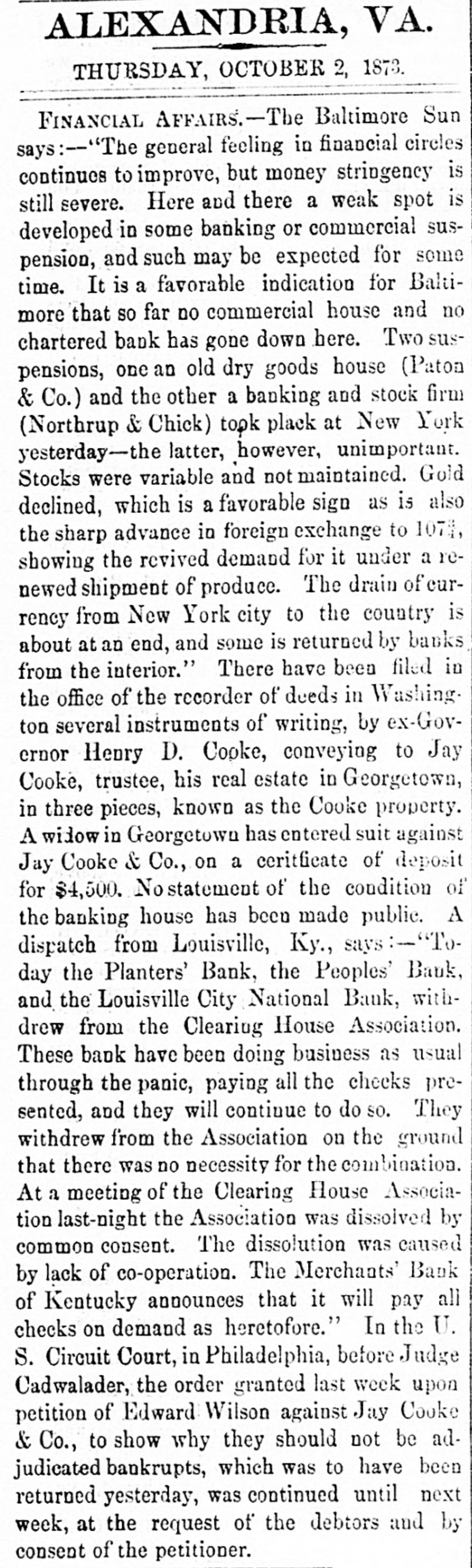
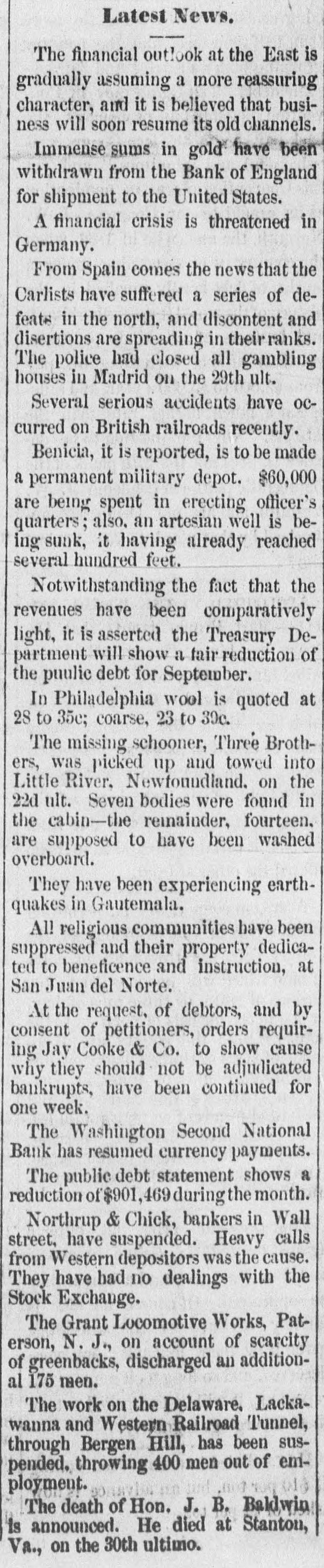
A RECEIVER APPOINTED IN THE JAY COOKE & CO. BANKRUPTCY CASE. PHILADELPHIA, Nov. 27.-Edwin D. Lewis, the President of the Farmers' and Mechanics' Bank, has accepted the position of receiver in Jay Cooke & Co.'s bankruptcy case, offered by the Court. He will act until the creditors appoint an assignee.


Article from Evening Star, January 14, 1874

Click image to open full size in new tab

Article Text

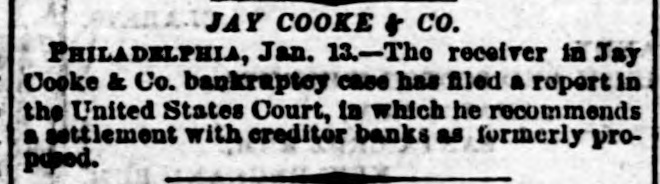
JAY Cooks & Co.-The receiver in Jay Cooke & Co. bankruptcy case has filed n report in the United States court at Philadelphia, in which be recommends a settlement with credwith itor banks as formerly promised.


Article from National Republican, January 14, 1874

Click image to open full size in new tab

Article Text

jay COOKE t CO. Philadelphia, Jan. 13.-The receiver in Jay Cooke & Co. bankraptcy case has filed a report in the United States Court, in which he recommends a settlement with creditor banks as formerly proposed.


Article from Warren Sheaf, February 16, 1882

Click image to open full size in new tab

Article Text

JOHN SHERMAN is not an alarmist, but in view of the great Paris panic, and general extravagance, and over-sanguine investinents in all sorts of wild-cat enterprises. it will do nobody any harm to read and ponder this passage from Senator Sherman's late speech. He said: I have seen so many rapid changes in the condition of financial affairs in the treasury that I never count my chickens until they are hatched. Two years before 1873, no man would have dared to say that within two years all those visionary schemes would disappear; that Jay Cook & Co., would break, and bank after bank, and corporation after corporation fail, until there was a culmination of labor riots in 1877; and yet things looked as brighl in 1871 as they do now."


Article from The Midland Journal, December 18, 1896

Click image to open full size in new tab

Article Text

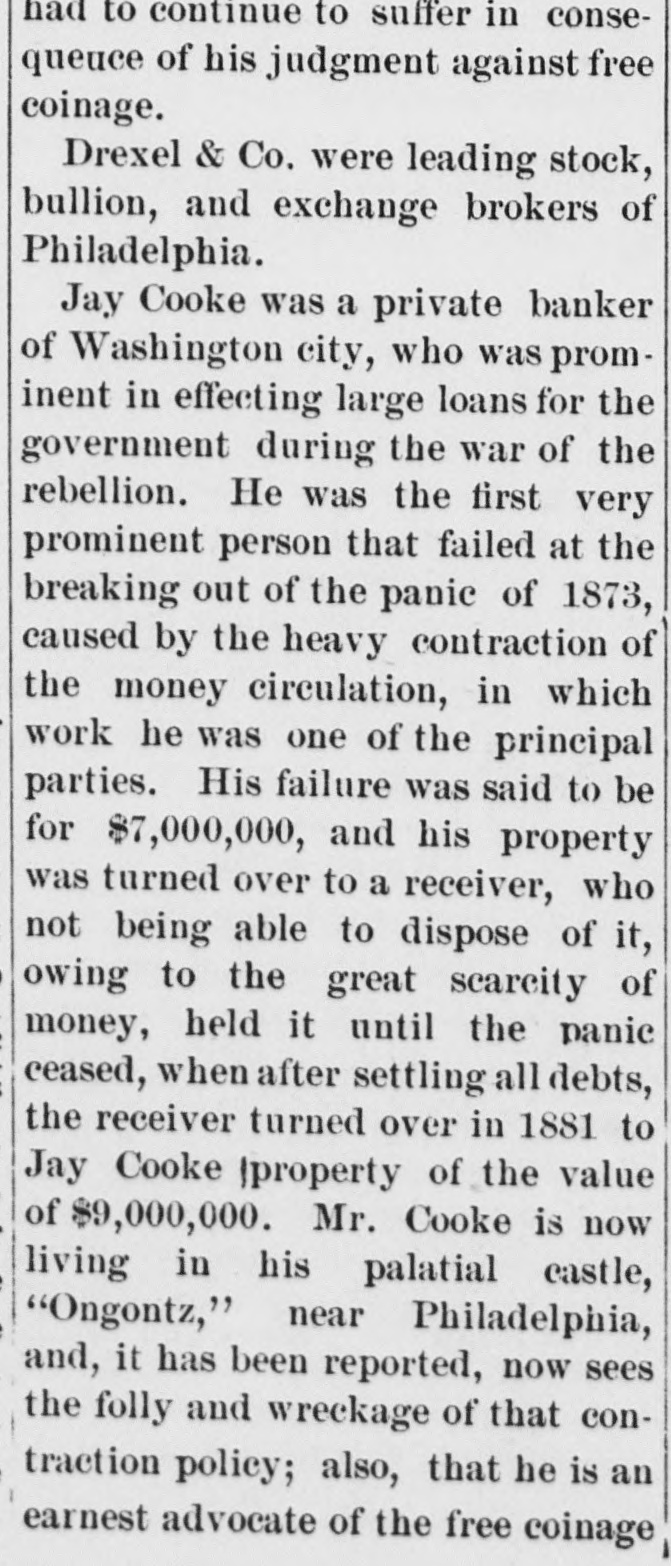
had to continue to suffer in consequeuce of his judgment against free coinage. Drexel & Co. were leading stock, bullion, and exchange brokers of Philadelphia. Jay Cooke was a private banker of Washington city, who was prominent in effecting large loans for the government during the war of the rebellion. He was the first very prominent person that failed at the breaking out of the panic of 1873, caused by the heavy contraction of the money circulation, in which work he was one of the principal parties. His failure was said to be for $7,000,000, and his property was turned over to a receiver, who not being able to dispose of it, owing to the great scarcity of money, held it until the panic ceased, when after settling all debts, the receiver turned over in 1881 to Jay Cooke property of the value of $9,000,000. Mr. Cooke is now living in his palatial castle, "Ongontz," near Philadelphia, and, it has been reported, now sees the folly and wreckage of that contraction policy; also, that he is an earnest advocate of the free coinage


Article from The Pacific Commercial Advertiser, February 17, 1905

Click image to open full size in new tab

Article Text

DEATH OF JAY COOKE ONCE FAMOUS FINANCIER PHILADELPHIA, Feb. 17.-Jay Cooke is dead. Jay Cooke, the famous banker, was born in Sandusky, O., Aug. 10, 1821, being the son of Hon. Eleutheros Cooke. He went to work at 15 and became a clerk in 1838. Later he became a partner in E. W. Clarke & Co., Philadelphia bankers. He founded in 1860 the house of Jay Cooke & Co. which handled the larger part of the $200,000,000 bond issue by the United States during the Civil War. Afterward Mr. Cooke handled large enterprises, including the building of the Northern Pacific R. R. but in the depression of i873 the firm failed and a panic resulted. Later Cooke made a new fortune and became a large owner of Western land. For years he had been a patron of the Ogontz Girls' School, at Ogontz, Pa. The school is situated on the property where Cooke lived before he lost it in the panic of 1873.


Article from The Hawaiian Star, February 17, 1905

Click image to open full size in new tab

Article Text

Jay Cooke, the famous banker, was born in Sandusky, O., August 10. 1821, being the son of Hon. Eleutheros Cooke He went to work at 15 and became a clerk in 1838. Later he became a partner in E. W. Clarke & Co., Philadelphia bankers. He founded in 1860 the house of Jay Cooke & Co., which handled the larger part of the $200,000,000 bond issue of the United States during the Civil War. Afterward Mr. Cooke handled large enterprises, including the building of the Northern Pacific R. R. but in the depression of 1873 the firm failed and a panic resulted. Later Cooke made a new fortune and became a large owner of western land. For years he had been a patron of the Ogontz Girls' School at Ogontz, Pa. The school is situated on the property where Cooke lived before he lost it in the panic of 1873.


Article from The Washington Times, September 19, 1927

Click image to open full size in new tab

Article Text

This Day in Our History N September 19, 1873, the banking firm of Jay Cook & Co., of ON Philadelphia, agents of the, United States Government and leading bankers of the country, failed. This failure precipitated a financial panic.


Article from The Key West Citizen, September 18, 1934

Click image to open full size in new tab

Article Text

1873-Suspension of the great Philadelphia bankers, Jay Cooke & Company, which inaugurated a country-wide panic.


Article from The Key West Citizen, September 18, 1937

Click image to open full size in new tab

Article Text

1873-Suspension of the great Philadelphia banking firm of Jay Cooke & Sons starts a countrywide panic.