Abilene State Bank (Abilene, KS)

Episode Information

Episode UID
9062809491329
Episode Type
Suspension β†’ Closure
Bank Type
state
Bank ID
906280949 hash
Start Date
September 10, 1910
Location
Abilene, Kansas (38.917, -97.214)

Metadata

Model
gemini-3-flash-preview (chosen from majority vote of a three-model LLM ensemble)
Short Digest
bdffdfa77a3eb627

Response Measures

None

Description

The bank initially remained open for a short period after the defalcation was discovered to pay off some depositors before being formally closed by the state and placed in receivership.

Events (3)

1. September 10, 1910 Suspension
Cause
Bank Specific Adverse Info
Cause Details
Discovery of a large shortage/defalcation by the cashier, John A. Flack.
Newspaper Excerpt
The bank was open all last week, but Saturday ceased receiving deposits.
Source
newspapers
2. September 11, 1910 Other
Newspaper Excerpt
I. S. Hallam, 67 years old, president of the Abilene State bank, died Sunday evening at 6 o'clock. He had passed sleepless nights since the discovery of the defalcation
Source
newspapers
3. November 22, 1910 Receivership
Newspaper Excerpt
The Abilene State Bank was closed November 22, 1910, following this disappearance of John Flack, the cashier... E. S. Makins was appointed receiver
Source
newspapers

Newspaper Articles (22)

Article from The Topeka State Journal, September 12, 1910

Click image to open full size in new tab

Article Text

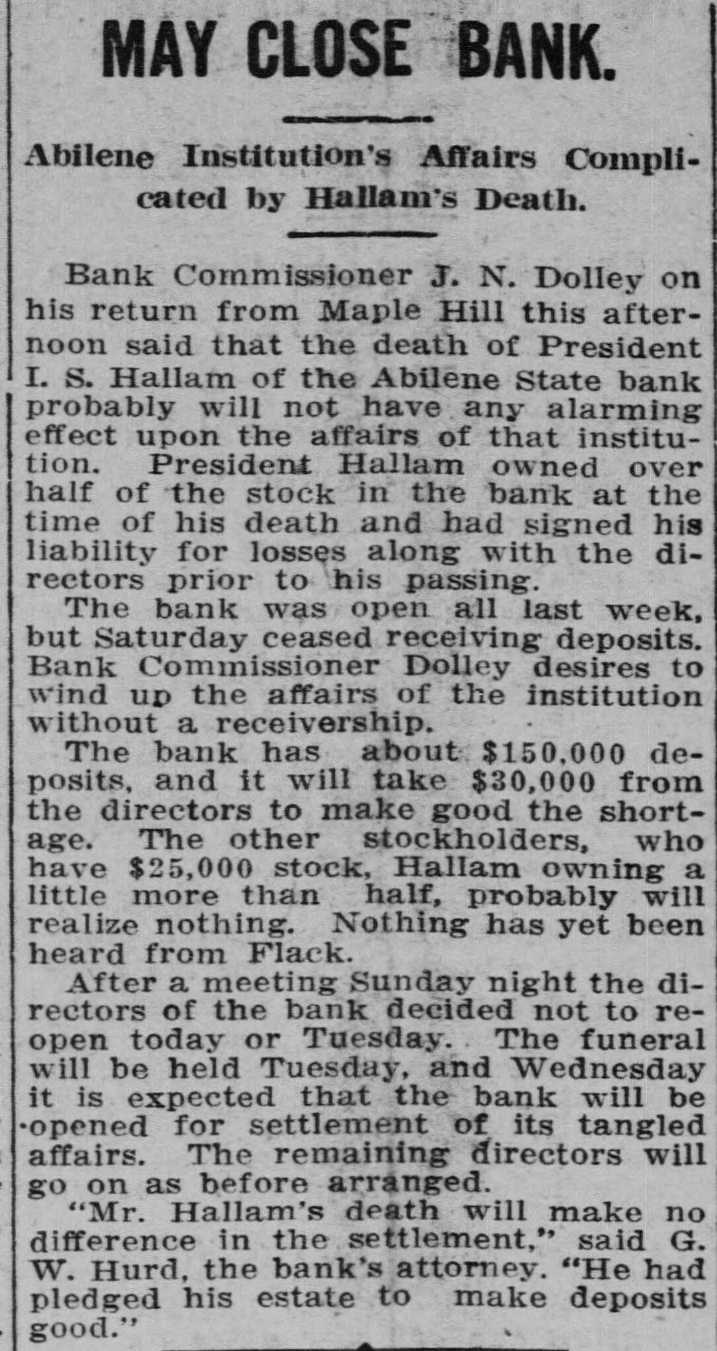
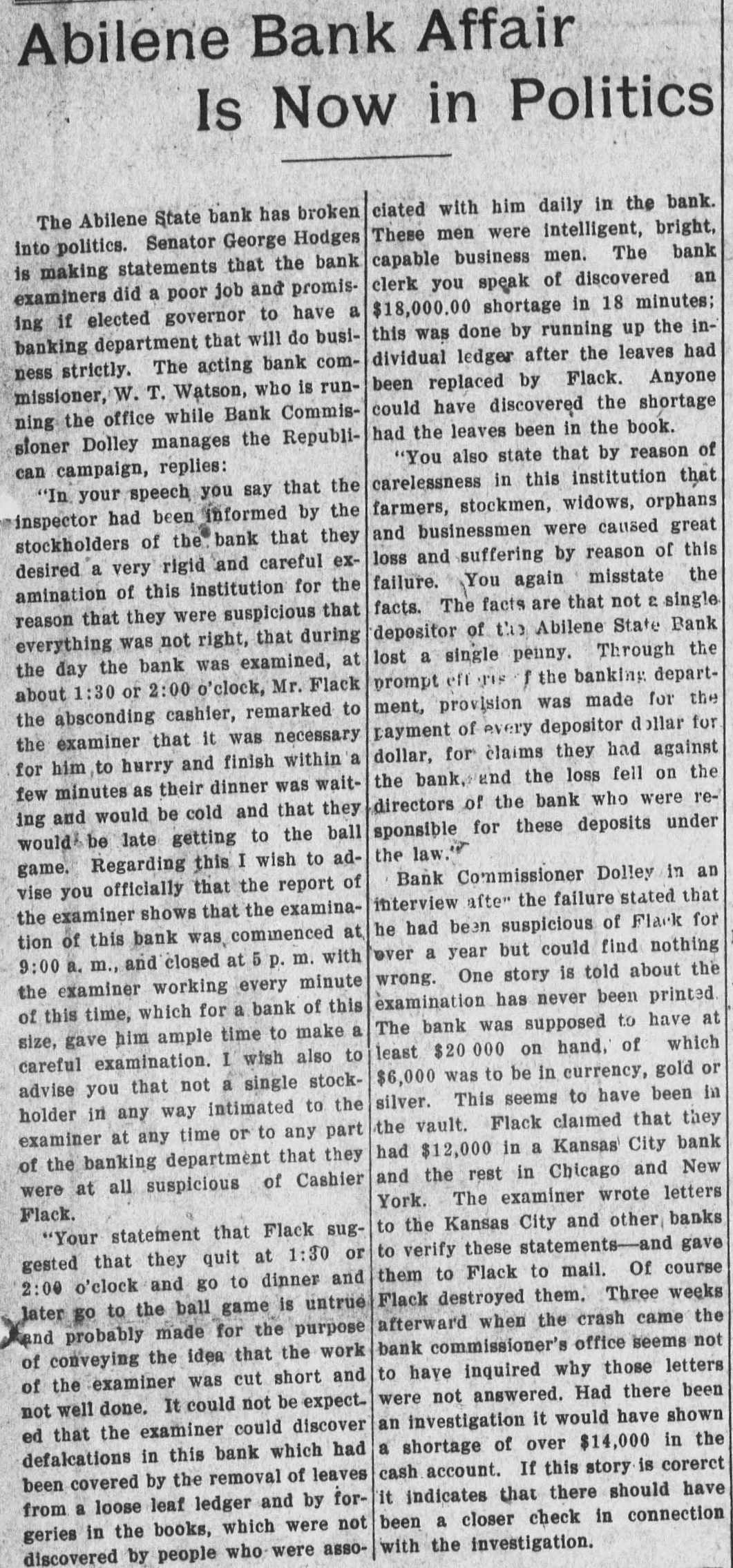
MAY CLOSE BANK. Abilene Institution's Affairs Complicated by Hallam's Death. Bank Commissioner J. N. Dolley on his return from Maple Hill this afternoon said that the death of President I. S. Hallam of the Abilene State bank probably will not have any alarming effect upon the affairs of that institution. President Hallam owned over half of the stock in the bank at the time of his death and had signed his liability for losses along with the directors prior to his passing. The bank was open all last week, but Saturday ceased receiving deposits. Bank Commissioner Dolley desires to wind up the affairs of the institution without a receivership. The bank has about $150,000 deposits, and it will take $30,000 from the directors to make good the shortage. The other stockholders, who have $25,000 stock, Hallam owning a little more than half, probably will realize nothing. Nothing has yet been heard from Flack. After a meeting Sunday night the directors of the bank decided not to reopen today or Tuesday. The funeral will be held Tuesday, and Wednesday it is expected that the bank will be opened for settlement of its tangled affairs. The remaining directors will go on as before arranged. "Mr. Hallam's death will make no difference in the settlement," said G. W. Hurd, the bank's attorney. "He had pledged his estate to make deposits good."


Article from The Vinita Daily Chieftain, September 12, 1910

Click image to open full size in new tab

Article Text

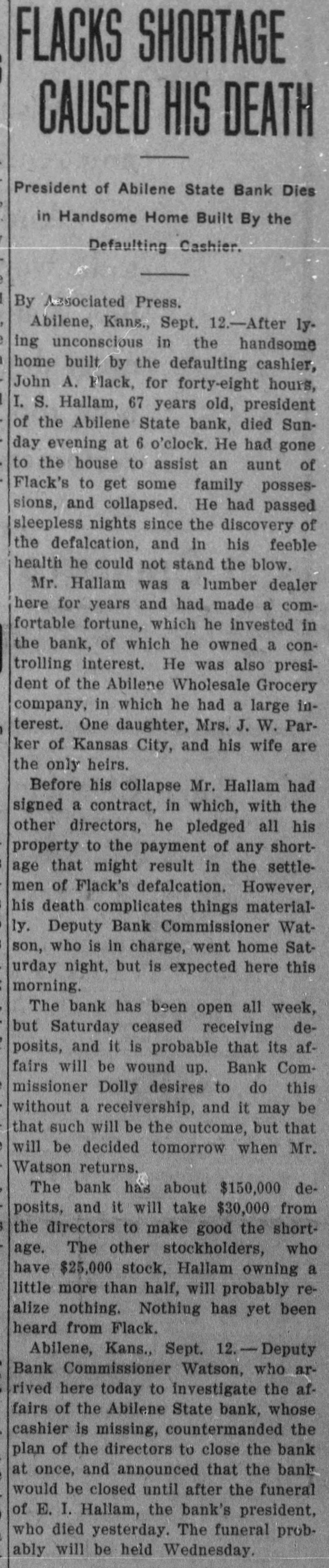
FLACKS SHORTAGE CAUSED HIS DEATH President of Abilene State Bank Dies in Handsome Home Built By the Defaulting Cashier. e I By Associated Press. , Abilene, Kans., Sept. 12.-After ly) ing unconscious in the handsome I home built by the defaulting cashier, John A. Flack, for forty-eight hours, I. S. Hallam, 67 years old, president of the Abilene State bank, died Sunday evening at 6 o'clock. He had gone to the house to assist an aunt of Flack's to get some family possessions, and collapsed. He had passed sleepless nights since the discovery of the defalcation, and in his feeble health he could not stand the blow. Mr. Hallam was a lumber dealer here for years and had made a comfortable fortune, which he invested in the bank, of which he owned a controlling interest. He was also president of the Abilene Wholesale Grocery company, in which he had a large interest. One daughter, Mrs. J. W. Parker of Kansas City, and his wife are the only heirs. Before his collapse Mr. Hallam had signed a contract, in which, with the other directors, he pledged all his property to the payment of any shortage that might result in the settlemen of Flack's defalcation. However, his death complicates things materially. Deputy Bank Commissioner Watson, who is in charge, went home Saturday night, but is expected here this morning. The bank has been open all week, but Saturday ceased receiving deposits, and it is probable that its affairs will be wound up. Bank Commissioner Dolly desires to do this without a receivership, and it may be that such will be the outcome, but that will be decided tomorrow when Mr. Watson returns. The bank has about $150,000 deposits, and it will take $30,000 from I the directors to make good the shortage. The other stockholders, who have $25,000 stock, Hallam owning a little more than half, will probably realize nothing. Nothing has yet been heard from Flack. Abilene, Kans., Sept. 12. - Deputy Bank Commissioner Watson, who arrived here today to investigate the affairs of the Abilene State bank, whose cashier is missing, countermanded the plan of the directors to close the bank at once, and announced that the bank would be closed until after the funeral of E. I. Hallam, the bank's president, who died yesterday. The funeral probably will be held Wednesday.


Article from The Topeka State Journal, September 13, 1910

Click image to open full size in new tab

Article Text

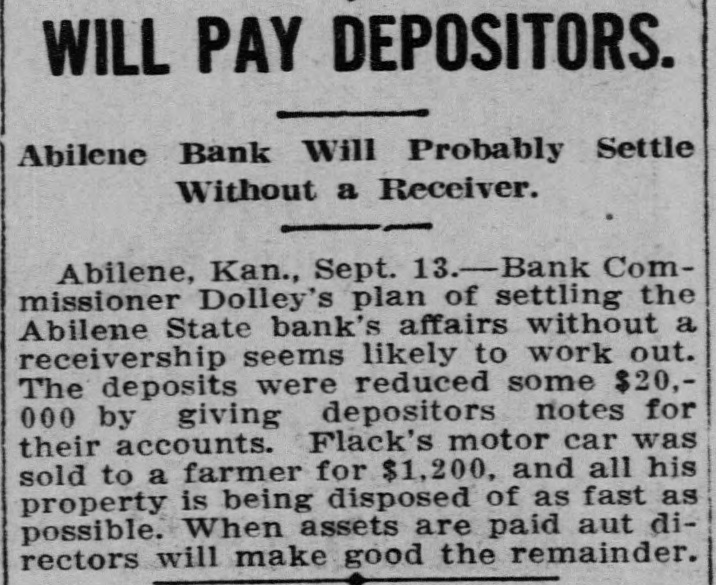
WILL PAY DEPOSITORS. Abilene Bank Will Probably Settle Without a Receiver. Abilene, Kan., Sept. 13.- Bank Commissioner Dolley's plan of settling the Abilene State bank's affairs without a receivership seems likely to work out. The deposits were reduced some $20,000 by giving depositors notes for their accounts. Flack's motor car was sold to a farmer for $1,200, and all his property is being disposed of as fast as possible. When assets are paid aut directors will make good the remainder.


Article from The Weekly Chieftain, September 16, 1910

Click image to open full size in new tab

Article Text

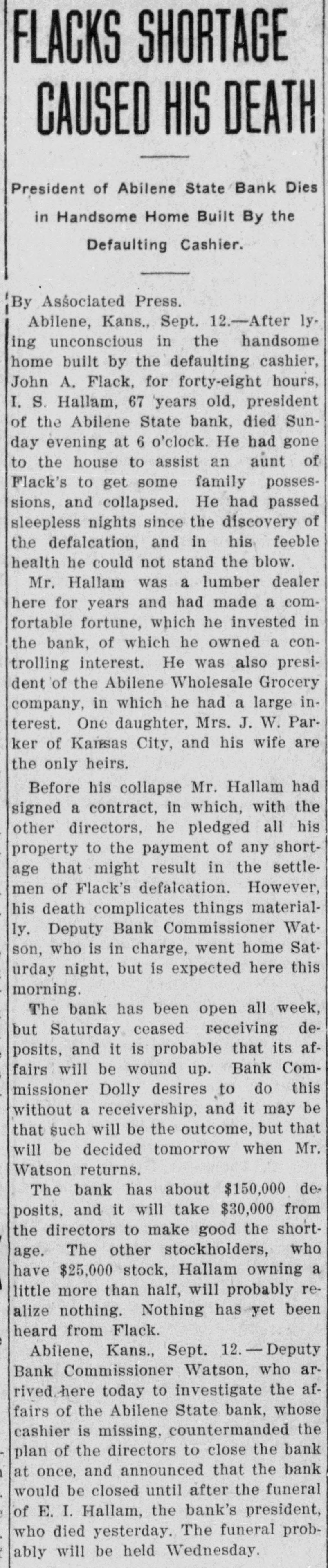
FLACKS SHORTAGE CAUSED HIS DEATH President of Abilene State Bank Dies in Handsome Home Built By the Defaulting Cashier. By Associated Press. Abilene, Kans., Sept. 12.-After lying unconscious in the handsome home built by the defaulting cashier, John A. Flack, for forty-eight hours, I. S. Hallam, 67 years old, president of the Abilene State bank, died Sunday evening at 6 o'clock. He had gone to the house to assist an aunt of Flack's to get some family possessions, and collapsed. He had passed sleepless nights since the discovery of the defalcation, and in his feeble health he could not stand the blow. Mr. Hallam was a lumber dealer here for years and had made a comfortable fortune, which he invested in the bank, of which he owned a controlling interest. He was also president of the Abilene Wholesale Grocery company, in which he had a large interest. One daughter, Mrs. J. W. Parker of Kansas City, and his wife are the only heirs. Before his collapse Mr. Hallam had signed a contract, in which, with the other directors, he pledged all his property to the payment of any shortage that might result in the settlemen of Flack's defalcation. However, his death complicates things materially. Deputy Bank Commissioner Watson, who is in charge, went home Saturday night, but is expected here this morning. The bank has been open all week, but Saturday ceased receiving deposits, and it is probable that its affairs will be wound up. Bank Commissioner Dolly desires to do this without a receivership, and it may be that such will be the outcome, but that will be decided tomorrow when Mr. Watson returns. The bank has about $150,000 deposits, and it will take $30,000 from the directors to make good the shortage. The other stockholders, who have $25,000 stock, Hallam owning a little more than half, will probably realize nothing. Nothing has yet been heard from Flack. Abilene, Kans., Sept. 12. - Deputy Bank Commissioner Watson, who arrived here today to investigate the affairs of the Abilene State bank, whose cashier is missing, countermanded the plan of the directors to close the bank at once, and announced that the bank would be closed until after the funeral of E. I. Hallam, the bank's president, who died yesterday. The funeral probably will be held Wednesday.


Article from The Topeka State Journal, October 25, 1910

Click image to open full size in new tab

Article Text

Hundreds in Kansas Hold Responsible Positions. Wrecking of Abilene Institution Has Brought Attention. # MISS SPECK HAS SAY. Declares Defalcations of Her Sex Are Unknown. Avers They Not Only Are Careful, But Conservative. Since the wrecking of the Abilene State bank by Cashier Flack, attention has been called to the fact that if women had had anything to do with its accounting and management it would have been impossible for any man to cloud and cover up the records and "get away" with it. That is the opinion of Miss Anna Speck of the state bank commissioner's office, whose work is to inspect the reports of the bank examiners and tell the bankers what ails their institutions. Miss Speck probably knows more about the condition of the banks of Kansas than any other person in the state, and she does not hesitate to say that where women are employed in banks there is little danger of a bank wrecking by a designing cashier. The truth is that no woman connected with a bank or an office where public money is handled has ever been known to go wrong. That is the record in this state, and Miss Speck says it speaks volumes for the honesty and integrity of women. "The advance made by women in the banking business, especially in the last five years, is remarkable," she said. "They are now filling positions of responsibility and their keen insight into things, their ability to read people and their absolute honesty have made them invaluable in banking circles. Reports which reach my desk show that any bank whose affairs are managed by a woman is in splendid condition. The banking room, the desk and the entire surroundings of one of these institutions where a woman works always present a neat appearance. The books are in balance, the legal reserve is intact, overdrafts are few, the paper is clean and well secured and the general affairs of the bank are in every way above criticism. Careful and Conservative. "The women connected with Kansas banks are careful and conservative and possess rare judgment, especially as to loans. They bring good returns to their stockholders. Never in the state's history has a woman banker betrayed her trust, nor has a depositor ever lost a penny through any dishonesty or mismanagement on her part. I think this is the greatest tribute I can pay to the women connected with the financial institutions of Kansas." One of the strongest banks in Kansas is conducted by a woman. Five years ago Mrs. S. Alice Halderman inherited a private bank at Girard on the death of her husband. She immediately incorporated it and became its president. She has managed it ever since, and it is making a handsome return for its stockholders Mrs. Margaret Kane of Bucklin, as cashier and active manager of her bank, was able last year to pay her stockholders a dividend of 90 per cent. Mrs. Kane is one of the active business women of southwestern Kansas. At the little town of Pretty Prairie, in Reno county, Mrs. Ella Demoret ran a bank for many years and paid big dividends. She now draws a good salary simply for passing on farm loans. Mrs. Demoret is employed by her brothers, who own the bank in which she works. If you step into the State bank of Langford, in Geary county, you wiil find Miss Isabella Marty in charge. Some years ago her father, who owned the bank, died. Miss Marty, who had been connected with the institution as a helper, took up the thread of the work and is regarded as one of the most efficient bankers of that section of the state. She knows all about loans and discounts, and is watchful as to the interest account. Mrs. Mary E. Cotton is president of a bank at Sabetha, and while she permits subordinates to run it, she keeps in close touch and scrutinizes the loans frequently. Miss Clara M. Hullett is the active manager of a bank at Rusin Center. Scores of women in Kansas are members of bank directories, and the reports filed with Miss Speck in the department here show that they are always present at the meetings of the directors. Hundreds of Women Employed. The list of women who are employed in Kansas banks is large, probably reaching into the hundreds. These young women are trained in this finan-c'al school for the practical business affairs of life, and as wives they find the knowledge gained very useful. Among the active women bankers, including cashiers, assistants, accountants and clerks, are the following: Miss Emma Courtney, assistant cashier Grinnell State bank: Mrs. J. W. Chenoweth. assistant cashier Bank of McCracken; Miss Nannie Goyette, cashier Bank of Elsmore; Miss Myrle Eastwood, assistant cashier Gas City State pank; Miss Lois Wilson, assistant cash-tar LaHarpe State bank: Miss Grace McKitrick, cashier Colony State bank; Mrs. Esther Huffman, cashier Hepler State bank; Miss Anna L. Baty, assistant cashier Condon bank, Oswego; Miss Nan Trinder, cashier Peoples' bank. Cherryvale; Miss Mary E. Cotton, president Citizens' bank. Sabetha; Miss Nora Kreamer, assistant cashier Colony State bank: Mrs. Esther M. Chatterton, assistant cashier State Bank of Admire; Pearl Mathews, assistant cashier First National bank. Logan; Irene Walker, assistant cashier First National bank. Moline: Myrtle Chaffins, assistant cashier Moline bank; Cora Gardner, assistant cashier Citizens' National bank, Ness City; Bessie V. Webb, assistant cashier, First National bank. Nortonville Mrs. F. P. Acten, assistant cashier First National bank. Wetmore; Miss Edna Withrow, assistant cashier First National bank, Conway Springs; Mrs. Mary Sample, cashier Savings bank of Wichita; Miss Jessie Hinds, cashier Turon bank: Miss Anna G. Goodrich. assistant cashier Valley Falls bank; Mrs. A. M. Tomlinson president Brookville State bank; Miss Talmadge; Mrs. C. E. Rhodes, assist-Halmadge; Mrs. C. E. Rhodes, assistant cashier Elmo State bank; Mrs. Grace Taft, cashier Taft State bank. Hanover; Nellie Reimers, cashier Thomas County bank, Colby: Margaret


Article from Meade County News, November 24, 1910

Click image to open full size in new tab

Article Text

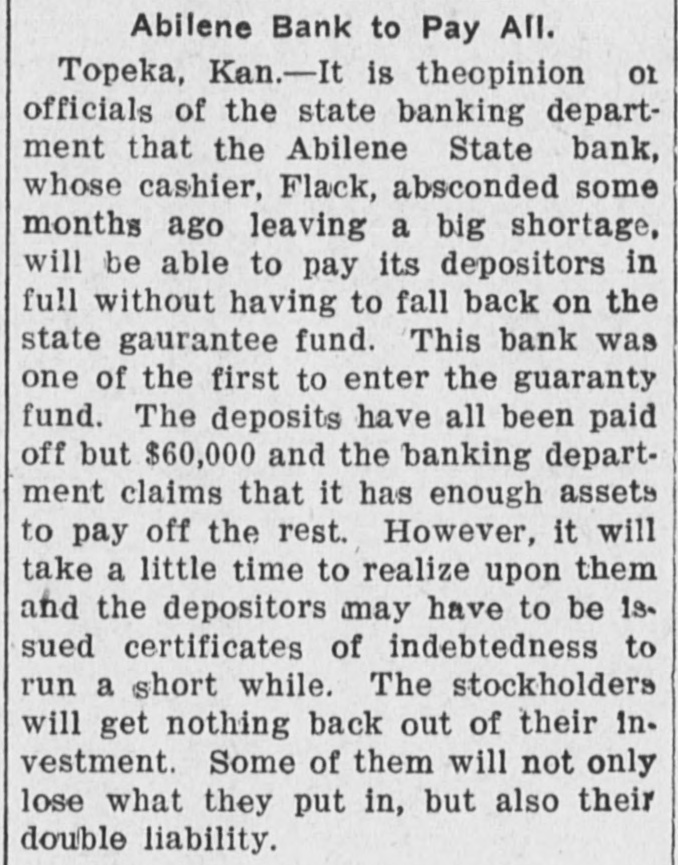
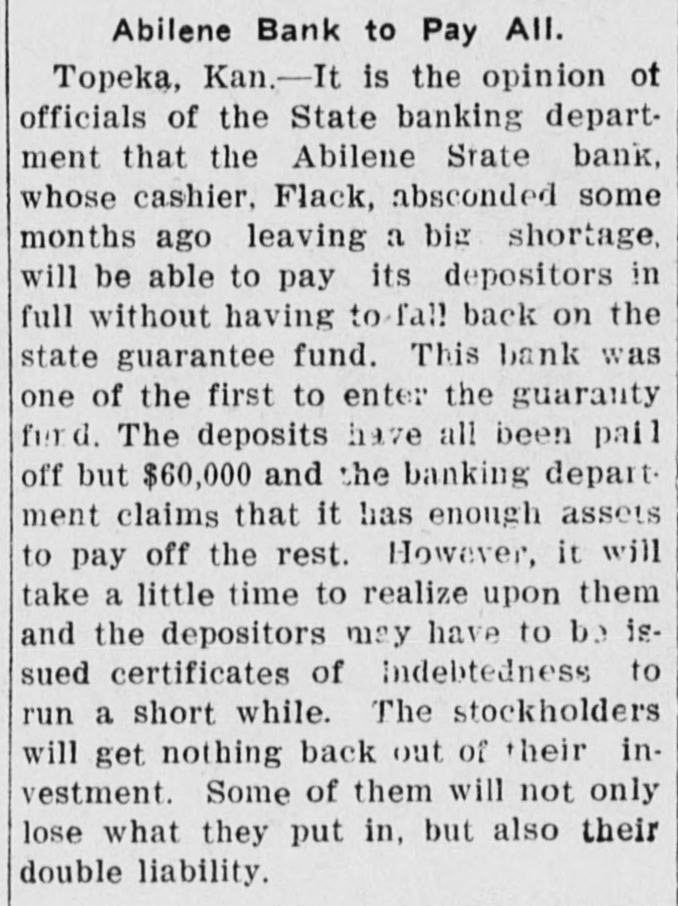
Abilene Bank to Pay All. Topeka, Kan.-It is theopinion 01 officials of the state banking department that the Abilene State bank, whose cashier, Flack, absconded some months ago leaving a big shortage, will be able to pay its depositors in full without having to fall back on the state gaurantee fund. This bank was one of the first to enter the guaranty fund. The deposits have all been paid off but $60,000 and the banking department claims that it has enough assets to pay off the rest. However, it will take a little time to realize upon them and the depositors may have to be 1s. sued certificates of indebtedness to run a short while. The stockholders will get nothing back out of their investment. Some of them will not only lose what they put in, but also their double liability.


Article from The Irish Standard, November 26, 1910

Click image to open full size in new tab

Article Text

Receiver for Looted Bank. Abilene, Kan., Nov. 23.-E. S. Ma. kins was appointed receiver of the Abilene State bank, from which John M. Flack, an absconding cashier, is charged with defaulting approximately $75,000


Article from Iron County Register, December 1, 1910

Click image to open full size in new tab

Article Text

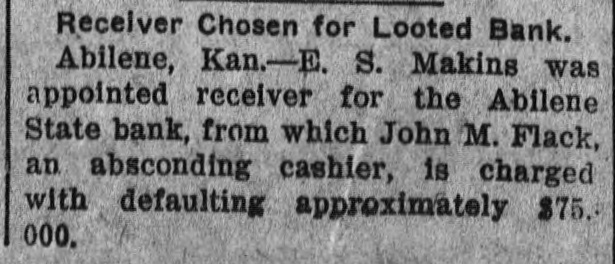
Receiver Chosen for Looted Bank. Abilene, Kan.-E. S. Makins was appointed receiver for the Abilene State bank, from which John M. Flack, an absconding cashier, is charged with defaulting approximately $75. 000.


Article from Abilene Weekly Reflector, December 1, 1910

Click image to open full size in new tab

Article Text

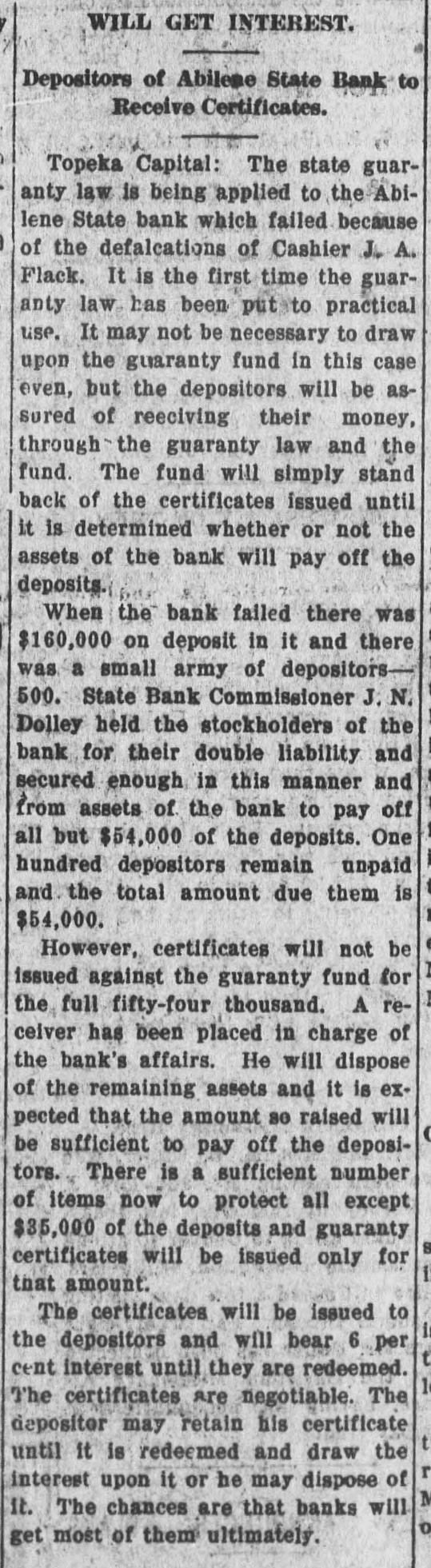
WILL GET INTEREST. Depositors of Abilene State Bank to Receive Certificates. Topeka Capital: The state guaranty law is being applied to the Abilene State bank which failed because of the defalcations of Cashier J. A. Flack. It is the first time the guaranty law has been put to practical use. It may not be necessary to draw upon the guaranty fund in this case even, but the depositors will be assured of reeciving their money, through the guaranty law and the fund. The fund will simply stand back of the certificates issued until it is determined whether or not the assets of the bank will pay off the deposits. When the bank failed there was $160,000 on deposit in it and there was a small army of depositorsβ€” 500. State Bank Commissioner J. N. Dolley held the stockholders of the bank for their double liability and secured enough in this manner and from assets of the bank to pay off all but $54,000 of the deposits. One hundred depositors remain unpaid and the total amount due them is $54,000. However, certificates will not be issued against the guaranty fund for the full fifty-four thousand. A receiver has been placed in charge of the bank's affairs. He will dispose of the remaining assets and it is expected that the amount so raised will be sufficient to pay off the depositors. There is a sufficient number of items now to protect all except $35,000 of the deposits and guaranty certificates will be issued only for that amount. The certificates will be issued to the depositors and will bear 6 per cent interest until they are redeemed. 1 The certificates are negotiable. The depositor may retain his certificate until it is redeemed and draw the interest upon it or he may dispose of M it. The chances are that banks will get most of them ultimately.


Article from The Chanute Times, December 2, 1910

Click image to open full size in new tab

Article Text

Abilene Bank to Pay All. Topeka, Kan.-It is the opinion of officials of the State banking department that the Abilene State bank, whose cashier, Flack, absconded some months ago leaving a big shortage, will be able to pay its depositors in full without having to-fall back on the state guarantee fund. This bank was one of the first to enter the guaranty fund. The deposits have all been pail off but $60,000 and the banking department claims that it has enough assets to pay off the rest. However, it will take a little time to realize upon them and the depositors may have to be issued certificates of indebtedness to run a short while. The stockholders will get nothing back out of their investment. Some of them will not only lose what they put in, but also their double liability.


Article from Twice-A-Week Plain Dealer, December 2, 1910

Click image to open full size in new tab

Article Text

Receiver for Looted Bank. Abilene, Kan., Nov. 23.-E. S. Ma kins was appointed receiver of the Abilene State bank, from which John M. Flack, an absconding cashier, is charged with defaulting approximately $75,000.


Article from Lower Coast Gazette, December 3, 1910

Click image to open full size in new tab

Article Text

Receiver Chosen for Looted Bank. Abilene, Kan.-E. S. Makins was appointed receiver for the Abilene State bank, from which John M. Flack, an absconding cashier, is charged with defaulting approximately $75.4


Article from Abilene Weekly Reflector, December 8, 1910

Click image to open full size in new tab

Article Text

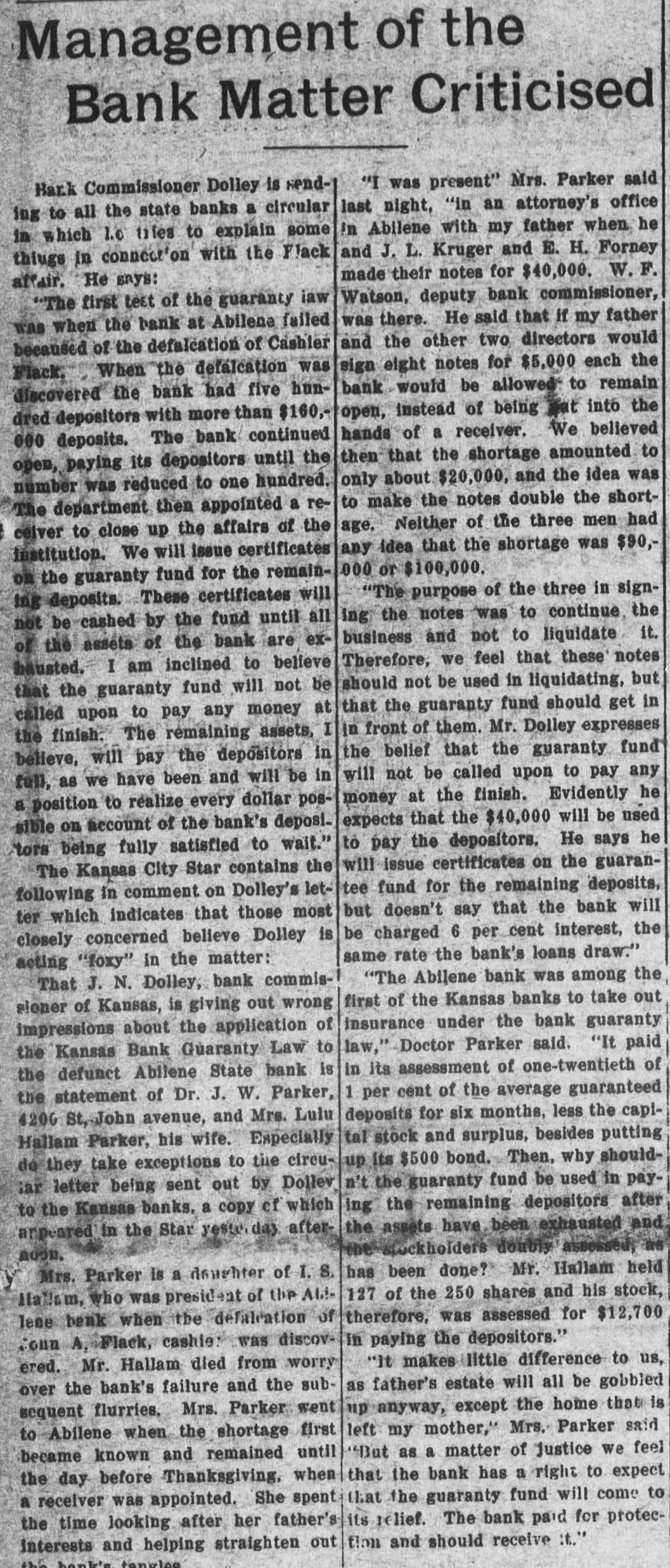
Management of the Bank Matter Criticised "I was present" Mrs. Parker said Bark Commissioner Dolley is sendlast night, "in an attorney's office ing to all the state banks a circular in Abilene with my father when he in which 1.0 tiles to explain some and J. L. Kruger and E. H. Forney things in connect on with the Flack made their notes for $40,000. W. affair. He says: Watson, deputy bank commissioner, "The first teet of the guaranty law was there. He said that if my father WAS when the bank at Abilene failed and the other two directors would becaused of the defalcation of Cashier sign eight notes for $5,000 each the Flack. When the defalcation was bank would be allowed to remain discovered the bank had five hunopen, instead of being But into the dred depositors with more than $160,hands of a receiver. We believed 000 deposits. The bank continued then that the shortage amounted to open, paying its depositors until the only about $20,000, and the idea was number was reduced to one hundred. to make the notes double the shortThe department then appointed a reage, Neither of the three men had ceiver to close up the affairs of the any idea that the shortage was $90,Institution. We will issue certificates 000 or $100,000. on the guaranty fund for the remain"The purpose of the three in signing deposits. These certificates will ing the notes was to continue the not be cashed by the fund until all business and not to liquidate it. of the assets of the bank are exTherefore, we feel that these notes bausted. I am inclined to believe should not be used in liquidating, but that the guaranty fund will not be that the guaranty fund should get in called upon to pay any money at in front of them. Mr. Dolley expresses the finish. The remaining assets, I the belief that the guaranty fund believe, will pay the depositors in will not be called upon to pay any full, as we have been and will be in money at the finish. Evidently he a position to realize every dollar posexpects that the $40,000 will be used sible on account of the bank's deposito pay the depositors. He says he tors being fully satisfied to wait." will issue certificates on the guaranThe Kansas City Star contains the tee fund for the remaining deposits, following in comment on Dolley's letbut doesn't say that the bank will ter which indicates that those most be charged 6 per cent interest, the closely concerned believe Dolley is same rate the bank's loans draw." acting "foxy" in the matter: "The Abilene bank was among the That J. N. Dolley, bank commisfirst of the Kansas banks to take out sioner of Kansas, is giving out wrong insurance under the bank guaranty impressions about the application of law," Doctor Parker said. "It paid the Kansas Bank Guaranty Law to in its assessment of one-twentieth of the defunct Abilene State bank is 1 per cent of the average guaranteed the statement of Dr. J. W. Parker, deposits for six months, less the capi4206 St, John avenue, and Mrs. Lulu tal stock and surplus, besides putting Hallam Parker, his wife. Expecially up its $500 bond. Then, why shouldde they take exceptions to the circun't the guaranty fund be used in payiar letter being sent out by Dollev ing the remaining depositors after to the Kansas banks, a copy of which the assets have been exhausted and appeared in the Star yeste day afterthe stockholders doubly assessed as noon. has been done? Mr. Hallam held Mrs. Parker is a daughter of I. S. 127 of the 250 shares and his stock, Hallam, who was president of the ALLtherefore, was assessed for $12,700 lene bank when the defalcation of in paying the depositors." .can A, Flack, cashie: was discov"It makes little difference to us, ered. Mr. Hallam died from worry as father's estate will all be gobbled over the bank's failure and the subup anyway, except the home that is sequent flurries. Mrs. Parker went left my mother," Mrs. Parker said to Abilene when the shortage first "But as a matter of justice we feel became known and remained until that the bank has a right to expect the day before Thanksgiving, when that the guaranty fund will come to a receiver was appointed. She spent its relief. The bank paid for protecthe time looking after her father's tion and should receive it." interests and helping straighten out


Article from Abilene Weekly Reflector, December 8, 1910

Click image to open full size in new tab

Article Text

Back Commissioner Dolley is sending to all the state banks a circular in which 1.0 tiles to explain some things in connection with the Flack affair. He says: "The first test of the guaranty law WAS when the bank at Abilene failed becaused of the defalcation of Cashier Flack, When the defalcation was discovered the bank had five hundred depositors with more than $160,000 deposits. The bank continued open, paying its depositors until the number was reduced to one hundred. The department then appointed a receiver to close up the affairs of the Institution. We will issue certificates on the guaranty fund for the remaining deposits. These certificates will not be cashed by the fund until all of the assets of the bank are exhausted. I am inclined to believe that the guaranty fund will not be called upon to pay any money at the finish. The remaining assets, I believe, will pay the depositors in full, as we have been and will be in a position to realize every dollar possible on account of the bank's depositors being fully satisfied to wait." The Kansas City Star contains the following in comment on Dolley's letter which indicates that those most closely concerned believe Dolley is acting "foxy" in the matter: That J. N. Dolley, bank commissioner of Kansas, is giving out wrong impressions about the application of the Kansas Bank Guaranty Law to the defunct Abilene State bank is the statement of Dr. J. W. Parker, 4206 St, John avenue, and Mrs. Lulu Hallam Parker, his wife. Expecially de they take exceptions to the circuiar letter being sent out by Dollev to the Kansas banks. a copy of which appeared in the Star yeste. day afternoon. M Mrs. Parker is a daughter of I. Hallam, who was president of the ALLlene bank when the defalcation of .con A, Flack, cashie: was discovered. Mr. Hallam died from worry over the bank's failure and the subsequent flurries. Mrs. Parker went to Abilene when the shortage first became known and remained until the day before Thanksgiving, when a receiver was appointed. She spent the time looking after her father's interests and helping straighten out the bank's tangles.


Article from The Mena Weekly Star, January 12, 1911

Click image to open full size in new tab

Article Text

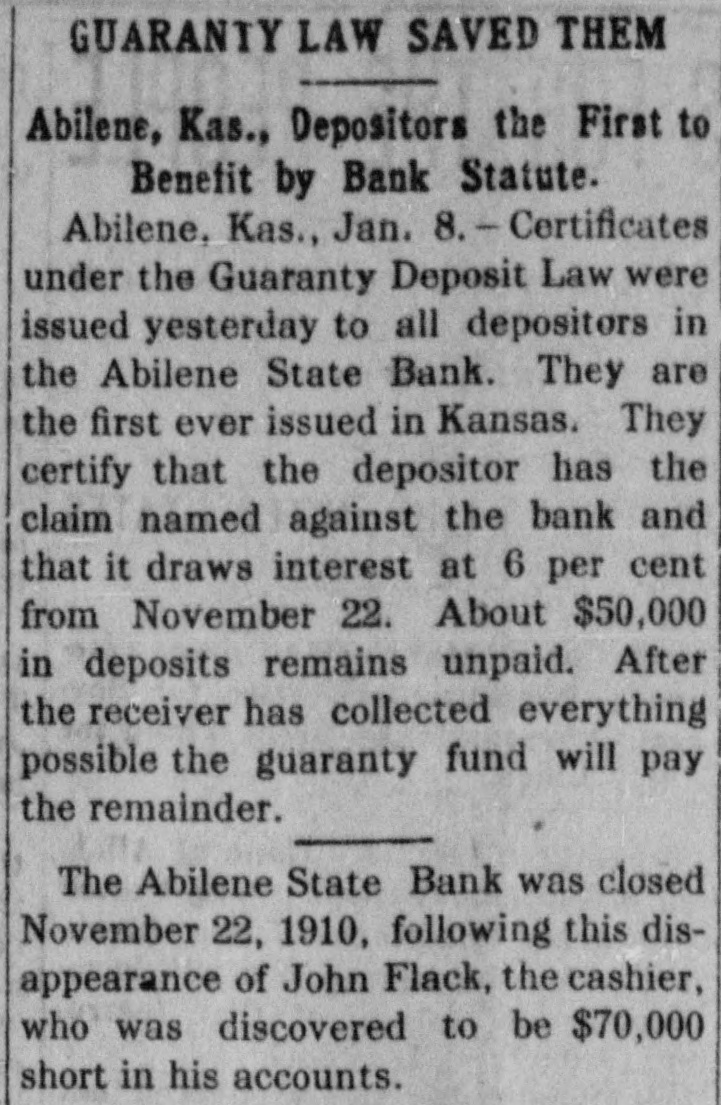
GUARANTY LAW SAVED THEM Abilene, Kas., Depositors the First to Benefit by Bank Statute. Abilene, Kas., Jan. 8. - Certificates under the Guaranty Deposit Law were issued yesterday to all depositors in the Abilene State Bank. They are the first ever issued in Kansas. They certify that the depositor has the claim named against the bank and that it draws interest at 6 per cent from November 22. About $50,000 in deposits remains unpaid. After the receiver has collected everything possible the guaranty fund will pay the remainder. The Abilene State Bank was closed November 22, 1910, following this disappearance of John Flack, the cashier, who was discovered to be $70,000 short in his accounts.


Article from Abilene Weekly Reflector, July 6, 1911

Click image to open full size in new tab

Article Text

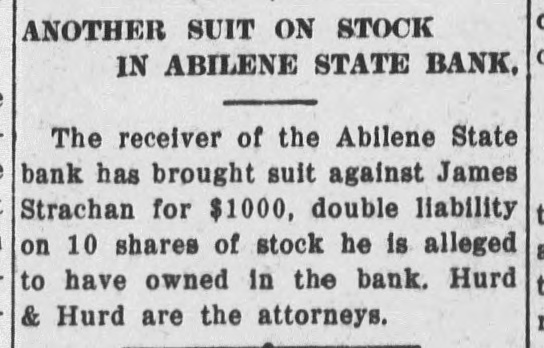
ANOTHER SUIT ON STOCK IN ABILENE STATE BANK, The receiver of the Abilene State bank has brought suit against James Strachan for $1000, double liability on 10 shares of stock he is alleged to have owned in the bank. Hurd & Hurd are the attorneys.


Article from The Chanute Times, November 10, 1911

Click image to open full size in new tab

Article Text

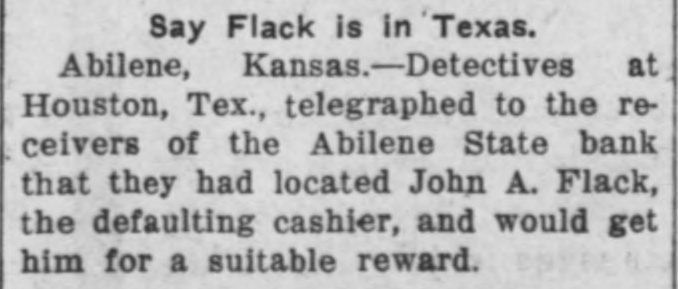
Say Flack is in Texas. Abilene, Kansas.-Detectives at Houston, Tex., telegraphed to the receivers of the Abilene State bank that they had located John A. Flack, the defaulting cashier, and would get him for a suitable reward.


Article from Abilene Weekly Reflector, January 18, 1912

Click image to open full size in new tab

Article Text

Settle Abilene Bank Cases. Abilene, Kan., Jan. 13.-Two cases involved in the failure of the Abilene State bank were settled by the district.court. Judgment was given the Dank against vavid Matteson for $3,000 on stock he claimed to have sold long ago to John Flack, the absconding cashier. James Strachan has proof of his selling his stock and was released from the receivers' claims.


Article from The Chanute Times, January 10, 1913

Click image to open full size in new tab

Article Text

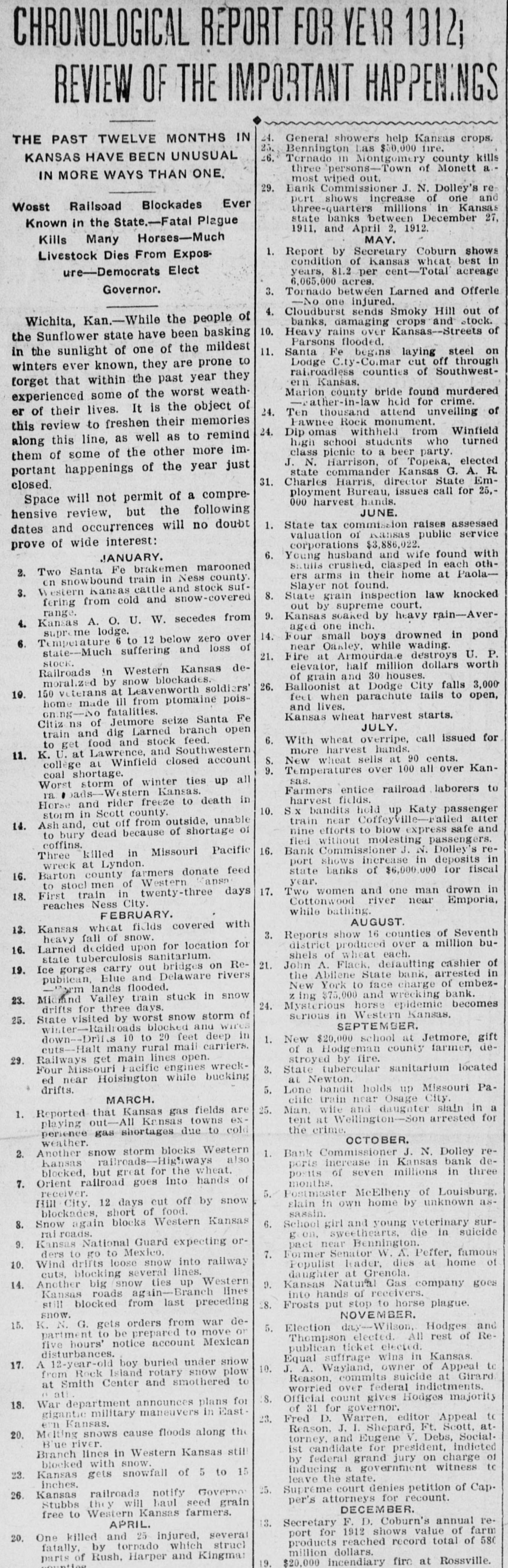
CHRONOLOGICAL REPORT FOR YEAR 1912; REVIEW OF THE IMPORTANT HAPPENINGS 24. General showers help Kansas crops. THE PAST TWELVE MONTHS IN 25. Bennington Las $50,000 fire. KANSAS HAVE BECN UNUSUAL 26. Ternado in Montgomery county kills three persons-Town of Monett a IN MORE WAYS THAN ONE. most wiped out. 29. Bank Commissioner J. N. Dolley's re: port shows increase of one and Wosst Railsoad Blockades Ever three-quarters millions in Kansas state banks between December 27, Known in the State.-Fatal Plague 1911, and April 2, 1912. MAY. Kills Many Horses-Much 1. Report by Secretary Coburn shows Livestock Dies From Exposcondition of Kansas wheat best in years, 81.2 per cent-Total acreage ure-Democrats Elect 6,065,000 acres. Governor. 3. Tornado between Larned and Offerle -No one injured. 4. Cloudburst sends Smoky Hill out of banks, damaging crops and stock. Wichita, Kan.-While the people of 10. Heavy rains over Kansas--Streets of the Sunflower state have been basking Parsons flooded. in the sunlight of one of the mildest 11. Santa Fe begins laying steel on Dodge City-Co.mar cut off through winters ever known, they are prone to rairoadless counties of Southwestern Kansas. forget that within the past year they Marion county bride found murdered experienced some of the worst weath-rather-in-law held for crime. er of their lives. It is the object of 24. Ten thousand attend unveiling of Pawnee Rock monument. this review to freshen their memories 24. Dip omas withheld from Winfield along this line, as well as to remind high school students who turned class pienic to a beer party. them of some of the other more imJ. N. Harrison, of Topeka, elected state commander Kansas G. A. R. portant happenings of the year just 31. Charles Harris, director State Emclosed. ployment Bureau, issues call for 25,Space will not permit of a compre000 harvest hands. JUNE. hensive review, but the following 1. State tax commission raises assessed dates and occurrences will no doubt valuation of Kansas public service corporations $3,886,022. prove of wide interest: 6. Young husband and wife found with JANUARY. shulls crushed, clasped in each oth2. Two Santa Fe brakemen marooned ers arms in their home at Paolaon snowbound train in Ness county. Slayer not found. 3. Western Kansas cattle and stock suf8. State grain inspection law knocked fering from cold and snow-covered out by supreme court. 9. Kansas soaked by heavy rain-Aver4. Kansas range. A. O. U. W. secedes from inch. one aged supreme lodge. 14. Four small boys drowned in pond 6. Temperature 6 to 12 below zero over near Oakley, while wading. state-Much suffering and loss of Fire at Armourda.e destroys U. P. 21. elevator, half million dollars worth Railroads stock. in Western Kansas deof grain and 30 houses. moralized by snow blockades. 26. Balloonist at Dodge City falls 3,000 19. 150 veterans at Leavenworth soldiers' feet when parachute tails to open, home made ill from ptomaine poisand lives. oning-No fatalities. Kansas wheat harvest starts. Citiz ns of Jetmore seize Santa Fe JULY. train and dig Larned branch open 6. With wheat overripe, call issued for to get food and stock feed. more harvest hands. 11. K. U. at Lawrence, and Southwestern S. New wheat sells at 90 cents. collège at Winfield closed account 9. Temperatures over 100 all over Kancoal shortage. sas. Worst storm of winter ties up all Farmers entice railroad laborers to ra # ads-Western Kansas. harvest fields. Horse and rider freeze to death in 10. S.x bandits hold up Katy passenger storm in Scott county. train near Coffeyville-railed after 14. Ash and, cut off from outside, unable nine efforts to blow express safe and to bury dead because of shortage of fled without molesting passengers. 16. Bank Commissioner J. N. Dolley's reThree coffins. killed in Missouri Pacific port shows increase in deposits in wreck at Lyndon. state banks of $6,000.000 for fiscal 16. Barton county farmers donate feed year. to stocl men of Western Kansa 17. Two women and one man drown in 18. First train in twenty-three days Cottonwood river near Emporia, reaches Ness City. while bathing. FEBRUARY. AUGUST 13. Kansas wheat fields covered with 3. Reports show 16 counties of Seventh heavy fall of snow. district produced over a million bu16. Larned decided upon for location for shels of wheat each. state tuberculosis sanitarium. 21. John A. Flack, defaulting cashier of 19. Ice gorges carry out bridges on Rethe Abilene State bank, arrested in publican, Blue and Delaware rivers New York to face charge of embez-Parm lands flooded. Z ing $75,000 and wrecking bank. 23. Midmind Valley train stuck in snow 24. Mysterious horse epidemic becomes drifts for three days. serious in Western Kansas. 25. State visited by worst snow storm of SEPTEMBER. winter-Railroads blocked and wires down--Drife 10 to 20 feet deep in 1. New $20,000 school at Jetmore, gift of a Hodgeman county farmer, deeuts-Halt many rural mail carriers. stroyed by fire. 29. Railways get main lines open. 3. State tubercular sanitarium located Four Missouri Facific engines wreckat Newton. ed near Hoisington while bucking drifts. 5. Lone bandit holds up Missouri Pacitic train near Osage City. MARCH. 25. Man. wife and daughter slain in a 1. Reported that Kansas gas fields are tent at Wellington-Son arrested for playing out-All Kansas towns exthe crime. perience gas shortages due to cold OCTOBER. weather. 1. Bank Commissioner J. N. Dolley re2. Another snow storm blocks Western kansas railroads-Hignways also ports increase in Kansas bank deblocked, but great for the wheat. posits of seven millions in three months. 7. Orient railroad goes into hands of 5. Postmaster McElheny of Louisburg, receiver. slain in own home by unknown asHill City, 12 days cut off by snow sassin. blockades, short of food. 6. School girl and young veterinary sur8. Snow again blocks Western Kansas rai roads. g on. sweethearts, die in suicide 9. Kansas National Guard expecting orpact near Bennington. Former Senator W. A. Peffer, famous ders to go to Mexico. 7. 10. Wind drifts loose snow into railway Populist leader, dies at home of cuts, blocking several lines. daughter at Grenola. 9. Kansas Natural Gas company goes 14. Another big snow ties up Western Kansas roads again-Branch lines into hands of receivers. still blocked from last preceding .8. Frosts put stop to horse plague. NOVEMBER. 15. K. snow. N. G. gets orders from war de5. Election day-Wilson, Hodges and partment to be prepared to move or Thompson elected. All rest of Refive hours' notice account Mexican publican ticket elected. disturbances. Equal suffrage wins in Kansas. 17. A 12-year-old boy buried under snow 10. J. A. Wayland, owner of Appeal to from Rock Island rotary snow plow Reason, commits suicide at Girard at Smith Center and smothered to worried over federal indictments. at Official count gives Hodges majority 8. 18. War department announces plans for of 31 for governor. gigantic military maneuvers in East23. Fred D. Warren, editor Appeal to ern Kansas. Reason, J. 1. Shepard, Ft. Scott, at20. Melting snows cause floods along the torney. and Eugene V. Debs, SocialBlue river. ist candidate for president, indicted Branch lines in Western Kansas still by federal grand jury on charge of blocked with snow. inducing a government witness tc 23. Kansas gets snowfall of 5 to 15 leave the state. inches. 25. Supreme court denies petition of Cap26. Kansas railroads notify Governor per's attorneys for recount. Stubbs the will haul seed grain DECEMBER. free to Western Kansas farmers. 13. Secretary F. D. Coburn's annual reAPRIL. port for 1912 shows value of farm 20. One killed and 25 injured, several products reached record total of 580 fatally, by tornado which struct million dollars. parts of Rush, Harper and Kingmai 19. $20,000 incendiary fire at Rossville.


Article from Abilene Weekly Reflector, November 6, 1913

Click image to open full size in new tab

Article Text

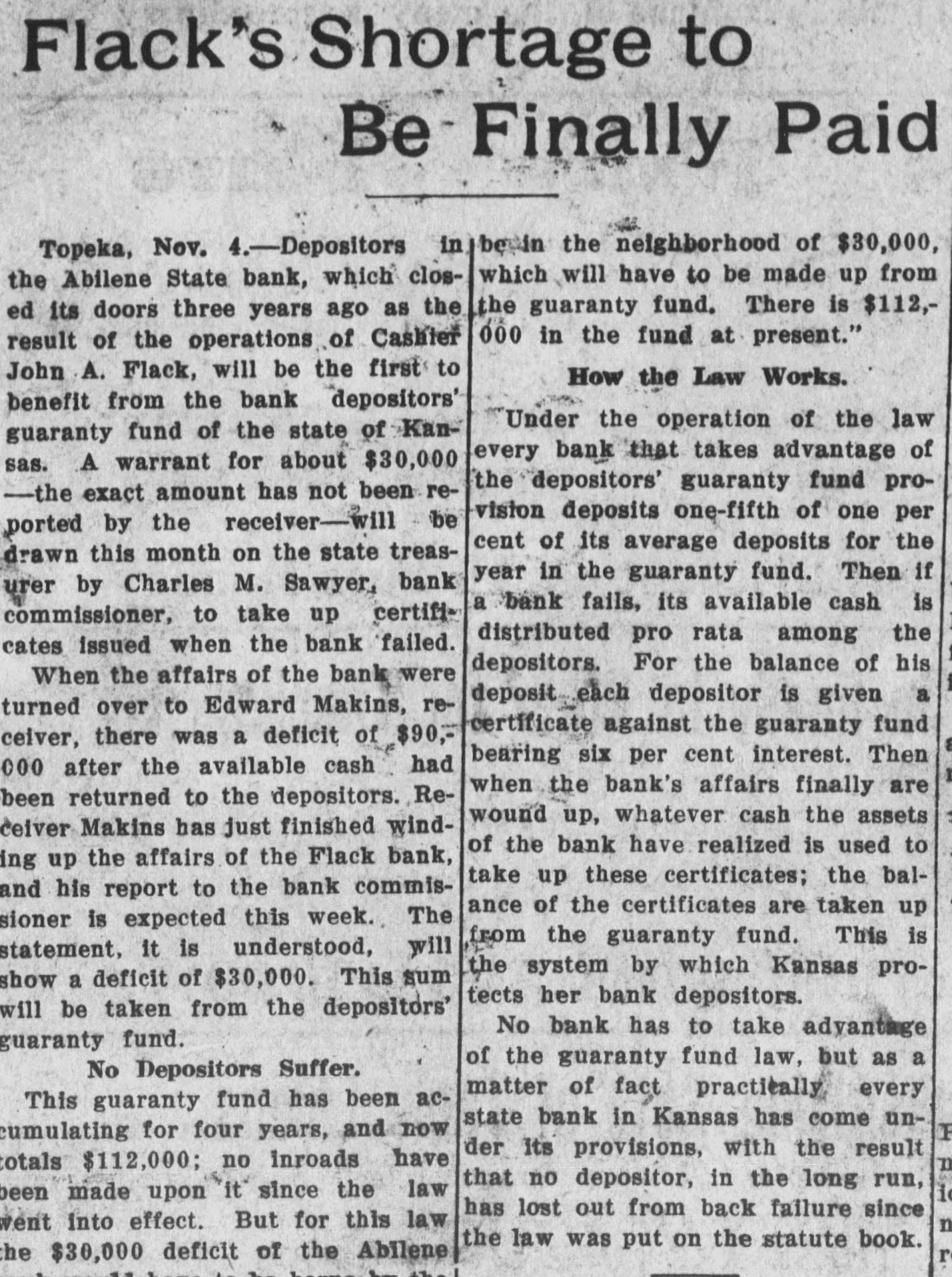
Flack's Shortage to Be - Finally Paid Topeka, Nov. 4.-Depositors in be in the neighborhood of $30,000, which will have to be made up from the Abilene State bank, which closthe guaranty fund. There is $112,ed its doors three years ago as the 000 in the fund at present." result of the operations of Cashier John A. Flack, will be the first to How the Law Works. benefit from the bank depositors' Under the operation of the law guaranty fund of the state of Kanevery bank that takes advantage of sas. A warrant for about $30,000 the depositors' guaranty fund prothe exact amount has not been revision deposits one-fifth of one per ported by the receiver-will be cent of its average deposits for the drawn this month on the state treasyear in the guaranty fund. Then if urer by Charles M. Sawyer, bank a bank fails, its available cash is commissioner, to take up certifidistributed pro rata among the cates issued when the bank failed. depositors. For the balance of his When the affairs of the bank were deposit each depositor is given a turned over to Edward Makins, recertificate against the guaranty fund ceiver, there was a deficit of $90,bearing six per cent interest. Then 000 after the available cash had when the bank's affairs finally are been returned to the depositors. Rewound up, whatever cash the assets ceiver Makins has just finished windof the bank have realized is used to ing up the affairs of the Flack bank, take up these certificates; the baland his report to the bank commisance of the certificates are taken up sioner is expected this week. The from the guaranty fund. This is statement, it is understood, will the system by which Kansas proshow a deficit of $30,000. This sum tects her bank depositors. will be taken from the depositors' No bank has to take advantage guaranty fund. of the guaranty fund law, but as a No Depositors Suffer. matter of fact practically every This guaranty fund has been acstate bank in Kansas has come uncumulating for four years, and now der its provisions, with the result totals $112,000; no inroads have that no depositor, in the long run, been made upon it since the law has lost out from back failure since went into effect. But for this law the law was put on the statute book. the $30,000 deficit of the Abilene


Article from Abilene Weekly Reflector, November 27, 1913

Click image to open full size in new tab

Article Text

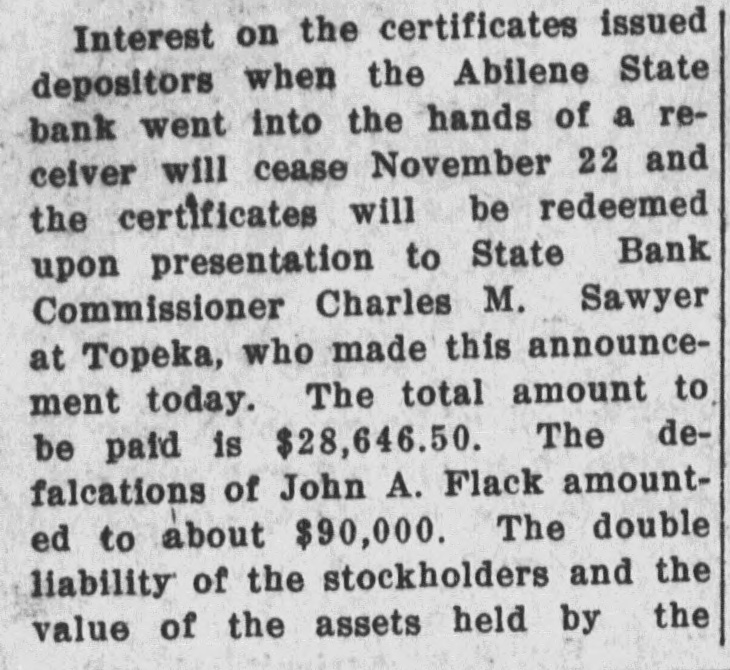
PAYMENT OF GUARANTY CERTIFICATES NOW MADE Closing Up of Abilene State Bank's Affairs Ended. payment of the certificates the of indebtedness The that will complete dedue depositors of the amounts Abilene State bank commenc- comfunct Saturday. The state bank ed has drawn from the guar- state missioner fund held by the 487 State anty of which the Abilene cancel banks, was one, $28,640.50 to is bank claims. Of this $6,184.52 all on the certificates which since interest been drawing interest cent. November have 1, 1910, at 6 per loss entailed by the failure part was The $90,000 but the larger While about on the stockholders. came deposits were in excess of $140,the some of this was county money protected 000, by bond and not participating in the guaranty fund. When the certificates were origissued they amounted to $46,- the inally but assets from the sale of 809, bank's property, the real estate the turned over to the directors by and defaulting cashier, J. A. Flack, double liability of the stock- the h holders the paid 52 per cent of time 0 amount, credited from time to d the ctrtificates, leaving certi- $22,455.98 on as the balance. The the t ficates were used by many of at g depositors as collateral for loans banks S local banks or sold to the cent E outright the and probably 75 per W of the amount is so held. tl A long list of lawsuits grew out a the failure, owing to the careless h of bookkeeping that did not indicate cl who were the real stockholders. Men who had disposed of their beC stock years before were sued had the transfer of the stock by cause been entered on the books never the cashier and manager. They ri compelled to pay their share n of were the liability. The heaviest loser iz J. L. Kruger, one of the directi was who had $700 in stock. He was for m tors, of the signers of eight notes 1 one $5000 each given the day after was ga Flack's disappearance when it thought that this would rehabilitate P the bank, it being considered that pr with the property turned over by tr the cashier after his defalcation was discovered would make up the difwa ference. Instead, it was found that ne there was a shortage of nearly $90,L. 000 and the doors were closed. Three W of the notes Kruger paid. The Ξ“a other five remained among the Af bank's assets. In closing the afrie fairs all the assets remaining were ho sold to Mr. Kruger for $7500. He sei received the five notes, all the small sp assets, including some stock in a in Texas land company, some building Mr and loan association stock, the house E. owned by Flack, known as the Tayor residence on Fifth street. His FR oss was $23,900 less the value of hese assets. The receiver, Edward Makins, been paid $125/ a month for wil hree as years and two months, a tosul al of $4750. Many long contested son awsuits over the tangled affairs tra ave dragged out the proceedings to f receivership. The county deposits bric ere protected by bonding compancon es and Flack's property was all sold an good figures except the Taylor the Dav ouse mentioned. The estate of reco resident, I. S. Hallam, who died the the shock of the failure and in vise lack's house where he had gone see inspect the property, was wiped pro ut by the disaster. inst While many theories have been fair dvanced to account for the actual han sappearance of some $90,000 in twe period of three or four years, none pan is been verified. There is no incation that Flack had any propermore than he returned to the T nk, selling for about $25,000. The now mainder is unaccounted for in any figh finite way. It is doubtful if Flack could give any accounting, provide


Article from Abilene Weekly Reflector, January 8, 1914

Click image to open full size in new tab

Article Text

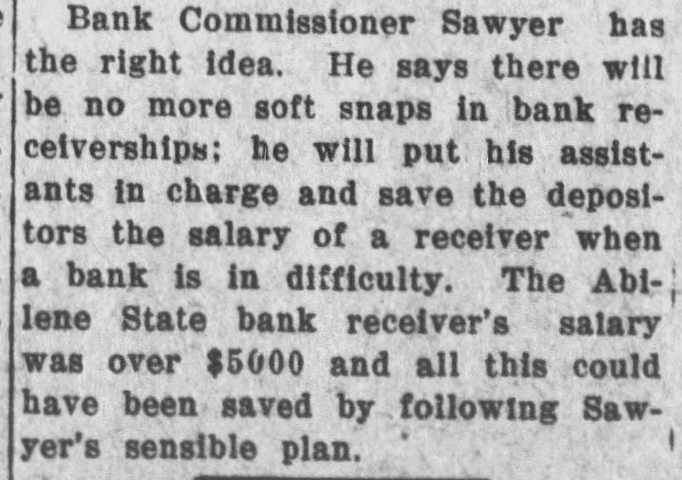
Bank Commissioner Sawyer has the right idea. He says there will be no more soft snaps in bank receiverships; he will put his assistants in charge and save the depositors the salary of a receiver when a bank is in difficulty. The Abilene State bank receiver's salary was over $5000 and all this could have been saved by following Sawyer's sensible plan.